
Life, 1922-08-31 · page 21 of 36
Life — August 31, 1922 — page 21: what you’re looking at
What you’re looking at
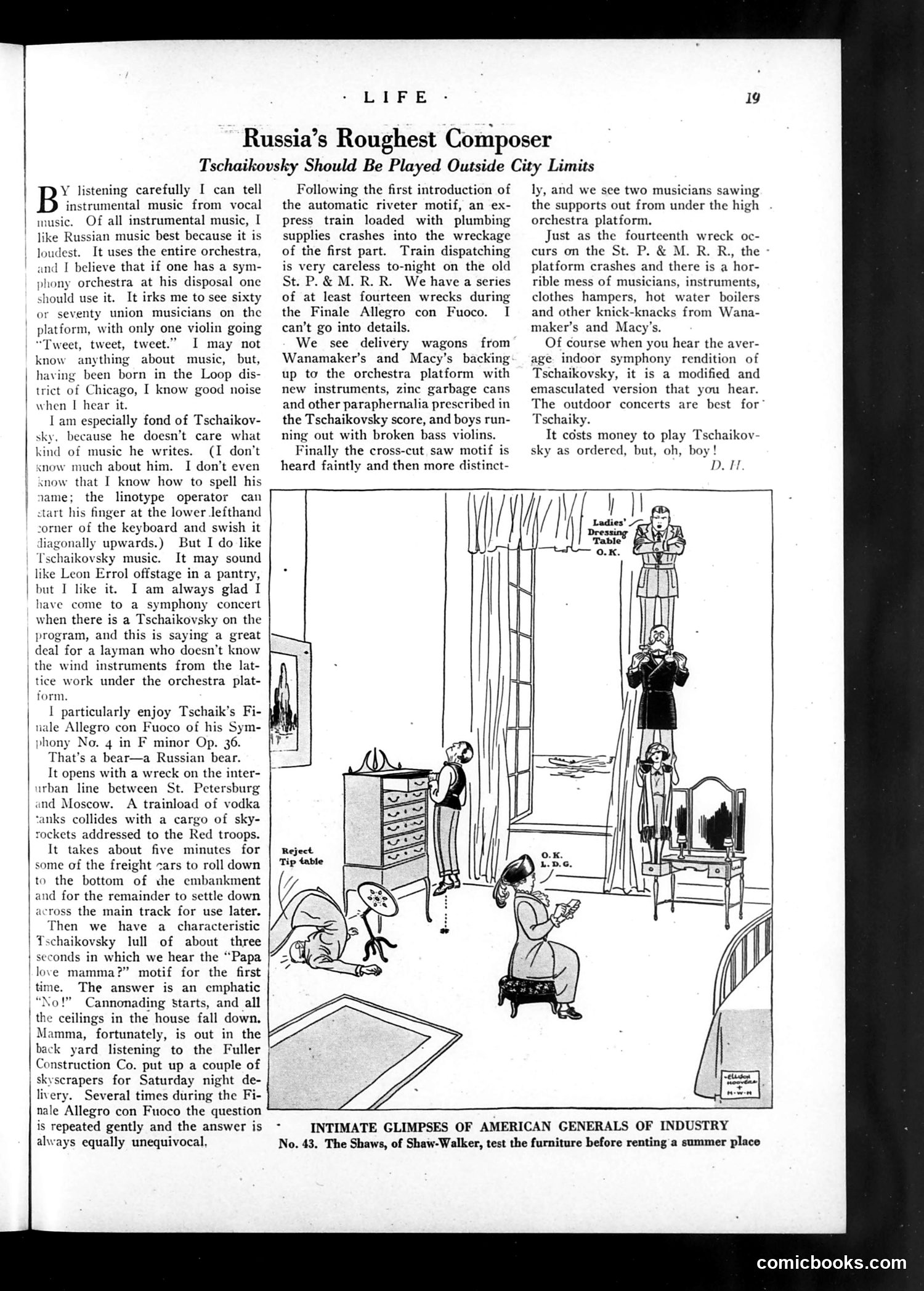
This is a humorous essay mocking Tchaikovsky's music as absurdly loud and chaotic. The author (writing from a Chicagoan's perspective valuing noise over refinement) humorously "describes" the composer's Fourth Symphony as literally depicting industrial catastrophes—trainloads of vodka colliding with skyrockets, multiple wrecks, falling ceilings, delivery trucks, and ultimately the orchestra platform itself collapsing. The satire works on multiple levels: it skewers both highbrow concert culture (treating classical music as pretentious) and Tchaikovsky's actual dramatic, bombastic orchestration. The joke is that his music sounds so violent and chaotic that the author imagines actual physical destruction occurring, making the point that performing it "properly" (as Tchaikovsky intended) would require literal destruction of the concert hall. The accompanying cartoon shows a chaotic domestic interior, likely illustrating the "destruction" theme. The piece gently mocks both Russophilia in American culture and those who claim to understand sophisticated music they actually don't.
📄 Transcribed text from this page (OCR, searchable)
Machine-transcribed from the original scan — historical spelling and the odd misread are preserved.
| | Russia’s Roughest Composer LIFE Tschaikovsky Should Be Played Outside City Limits Y listening carefully I can tell instrumental music from vocal music. Of all instrumental music, I like Russian music best because it is loudest. It uses the entire orchestra, and I believe that if one has a sym- phony orchestra at his disposal one should use it. It irks me to see sixty or seventy union musicians on the | platform, with only one violin going “Tweet, tweet, tweet.” I may not know anything about music, but, having been born in the Loop dis- trict of Chicago, I know good noise when I hear it. l am especially fond of Tschaikov- sky, because he doesn’t care what kind of music he writes. (I don’t know much about him. I don’t even xnow that I know how to spell his name; the linotype operator can start his finger at the lower lefthand corner of the keyboard and swish it liagonally upwards.) But I do like 'schaikovsky music. It may sound like Leon Errol offstage in a pantry, but I like it. I am always glad I have come to a symphony concert when there is a Tschaikovsky on the program, and this is saying a great deal for a layman who doesn’t know the wind instruments from the lat- tice work under the orchestra plat- form. I particularly enjoy Tschaik’s Fi- | phony No. 4 in F minor Op. 36. That's a bear—a Russian bear. It opens with a wreck on the inter- irban line between St. Petersburg and Moscow. A trainload of vodka canks collides with a cargo of sky- rockets addressed to the Red troops. It takes about five minutes for some of the freight cars to roll down to the bottom of che embankment and for the remainder to settle down s the main track for use later. Then we have a characteristic Yschaikovsky lull of about three seconds in which we hear the “Papa love mamma?” motif for the first time. The answer is an emphatic “N Cannonading Starts, and all the ceilings in the house fall down, Mamma, fortunately, is out in the back yard listening to the Fuller Construction Co. put up a couple of skyscrapers for Saturday night de- livery. Several times during the Fi- nale Allegro con Fuoco the question is repeated gently and the answer is always equally unequivocal, nale Allegro con Fuoco of his Sym- FE Following the first introduction of the automatic riveter motif, an ex- press train loaded with plumbing supplies crashes into the wreckage of the first part. Train dispatching is very careless to-night on the old St. P.& M. R. R. We have a series of at least fourteen wrecks during the Finale Allegro con Fuoco. I can’t go into details. We see delivery wagons from Wanamaker’s and Macy’s backing up to the orchestra platform with new instruments, zinc garbage cans and other paraphernalia prescribed in the Tschaikovsky score, and boys run- ning out with broken bass violins. Finally the cross-cut saw motif is heard faintly and then more distinct- ly, and we see two musicians sawing the supports out from under the high orchestra platform. Just as the fourteenth wreck oc- curs on the St. P. & M. R. R., the - platform crashes and there is a hor- rible mess of musicians, instruments, clothes hampers, hot water boilers and other knick-knacks from Wana- maker’s and Macy's. Of course when you hear the aver- age indoor symphony rendition of Tschaikovsky, it is a modified and emasculated version that you hear. The outdoor concerts are best for Tschaiky. It costs money to play Tschaikov- sky as ordered, but, oh, boy! DH . INTIMATE GLIMPSES OF AMERICAN GENERALS OF INDUSTRY No. 43. The Shaws, of Shaw-Walker, test the furniture before renting a summer place comicbooks.com