
A complete issue · 36 pages · 1922
Life — August 10, 1922
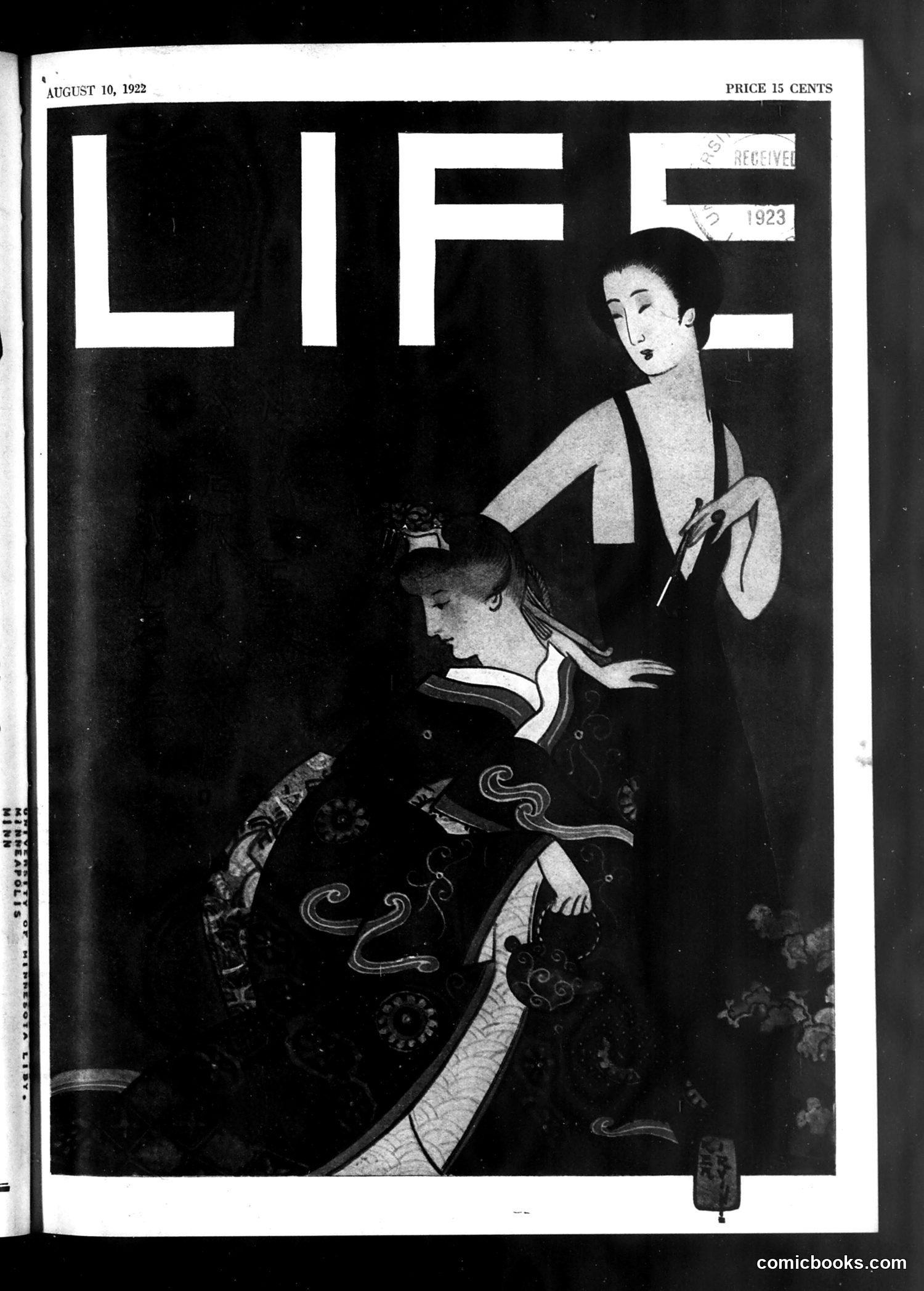
I can see this is a Life magazine cover from August 10, 1922 (price 15 cents). The image shows two figures in an Art Deco style illustration: a woman in Western dress in the background and a figure in the foreground wearing elaborate Asian-inspired clothing with decorative patterns and a traditional hairstyle. However, without clearer text visible on this page, I cannot definitively identify the specific figures or explain the satirical point with certainty. The composition suggests commentary on either cultural attitudes, fashion, or possibly a theatrical/entertainment topic from that era, but I cannot assert specific identities or political references without supporting text evidence. The artistic style is characteristic of 1920s magazine illustration.
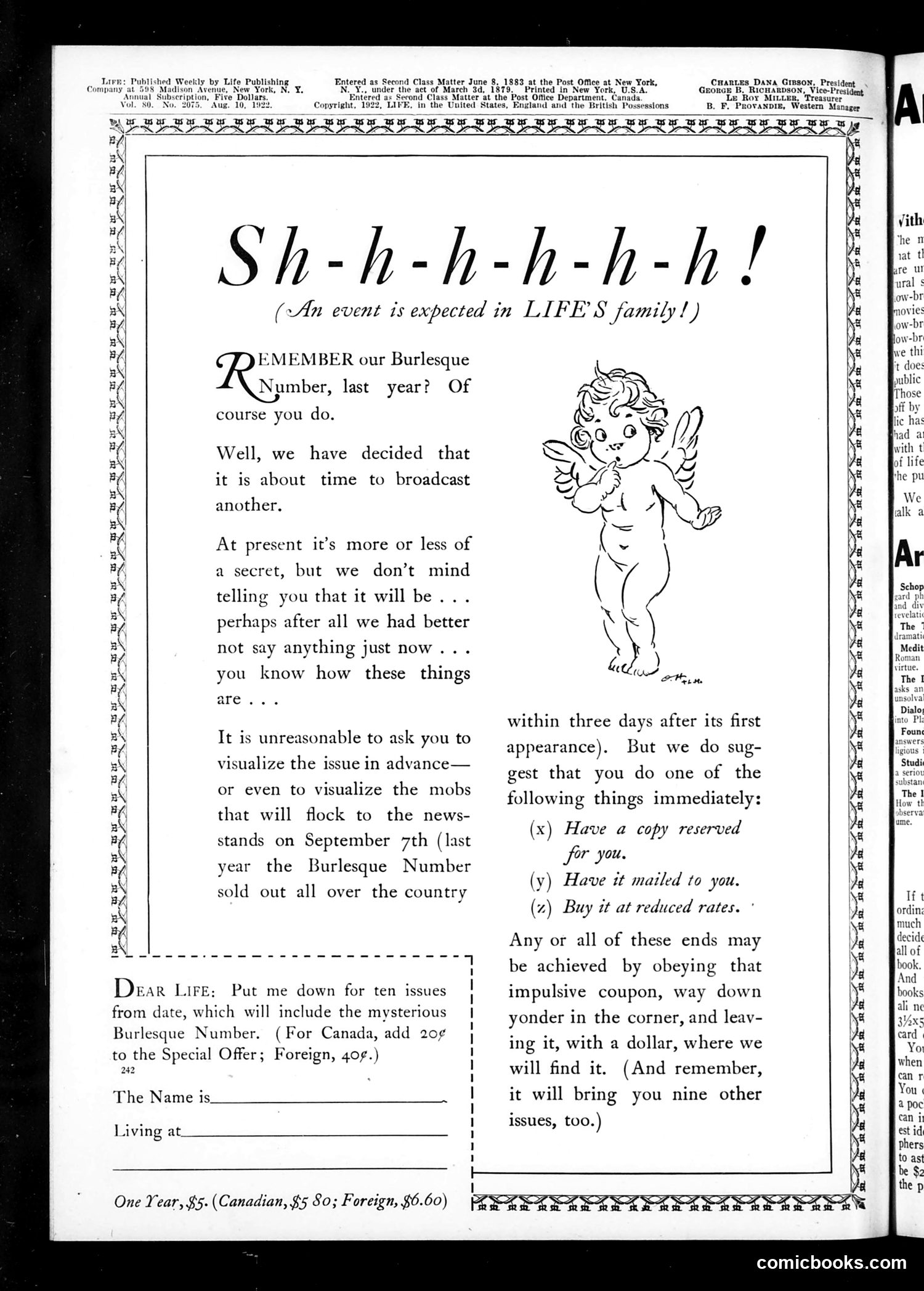
This is a house advertisement promoting an upcoming special "Burlesque Number" issue of Life magazine, set to appear September 7th. The chubby cherub illustration represents the playful, irreverent tone. The ad uses mock-secretive language ("Sh-h-h-h-h!") to build anticipation for this mystery issue, referencing a successful burlesque-themed number from the previous year that "sold out all over the country." The coupon invites readers to subscribe to ten issues including this special edition. The tone is deliberately coy and humorous—Life presents itself as slightly scandalous yet respectable, teasing readers with promises of something racy while maintaining satirical propriety. This reflects Life's role as sophisticated humor magazine for educated audiences in the early-to-mid 20th century.
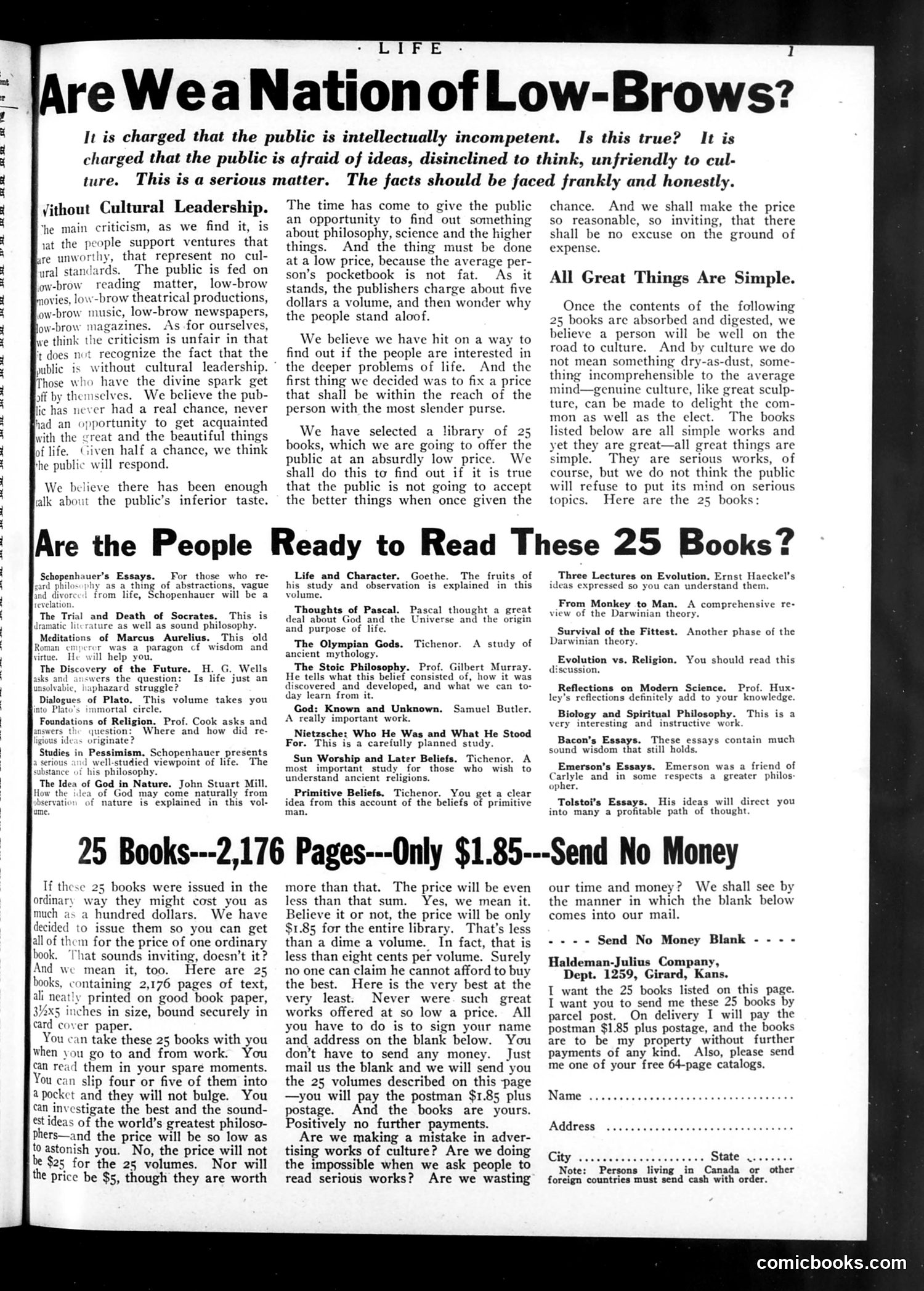
This is not a satirical cartoon page but rather an earnest advertorial article from *Life* magazine promoting an ambitious book distribution scheme. The page argues Americans are intellectually "low-brow" and lack cultural leadership. It proposes selling 25 classic books—including works by Schopenhauer, Pascal, Nietzsche, and Emerson—for $1.85 total (roughly $35 today), positioning this as democratizing high culture. The appeal reflects early 20th-century Progressive-era anxieties about public taste and education. Rather than mockery, *Life* here adopts a paternalistic, reformist stance: the masses need uplifting through access to serious philosophy and essays. The Haldeman-Julius Company's mail-order model represented a genuine attempt at making canonical literature affordable to working-class readers. This reflects genuine cultural anxiety, not satire.
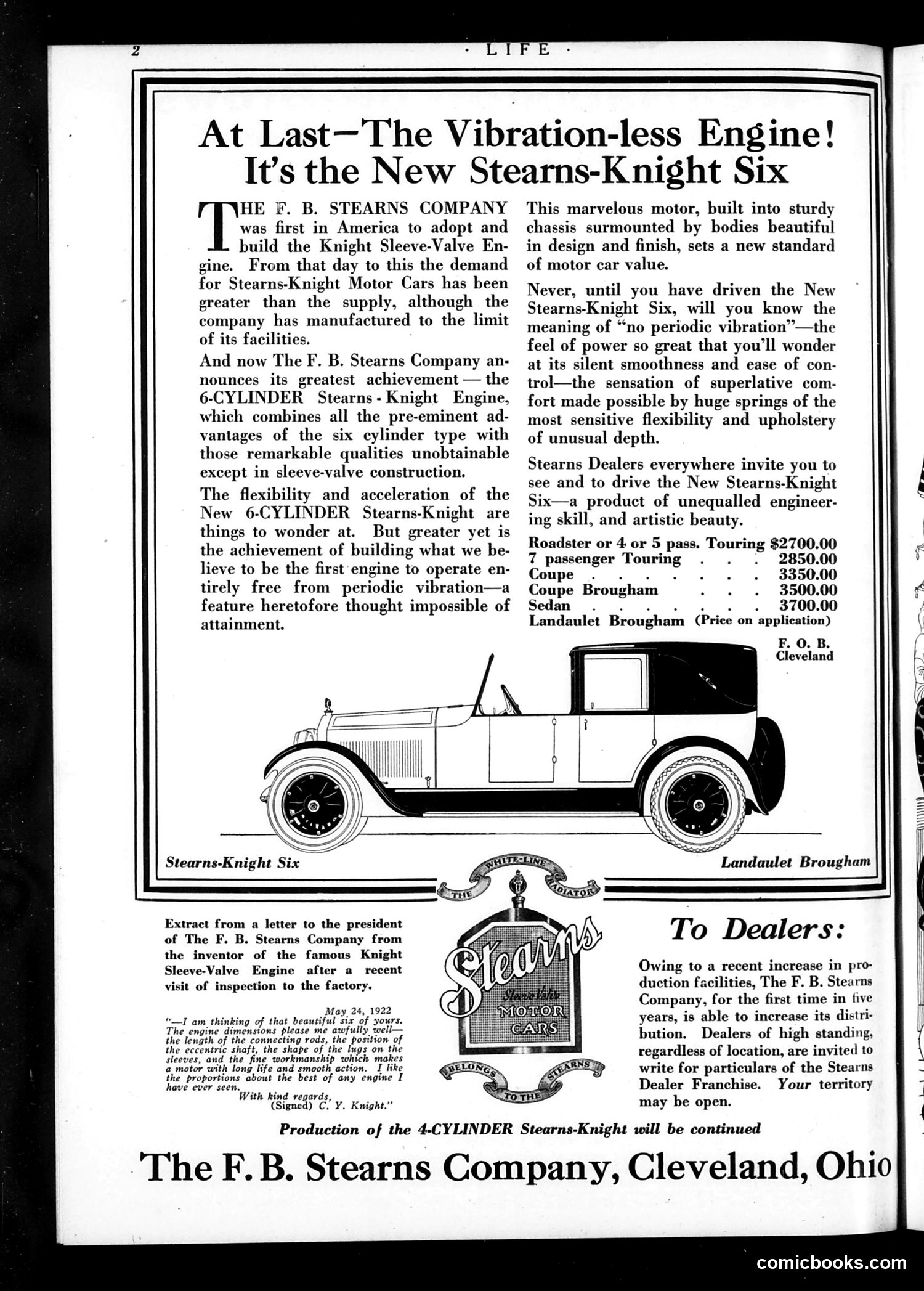
This page is **primarily advertising, not satire or political commentary**. It's a full-page advertisement for the F.B. Stearns Company's new Stearns-Knight Six automobile, published in *Life* magazine (circa 1923, based on the date visible in the letter extract). The ad emphasizes the car's "vibration-less" 6-cylinder engine as a major innovation. The only non-advertising content is a brief extracted letter praising the engine's smoothness. The illustration shows a side-view of the Landaulet Brougham model. Pricing ranges from $2,700 to $3,700 depending on body style. There is no political cartoon or satire present—this is straightforward commercial promotion typical of *Life* magazine's content during the 1920s automotive boom.
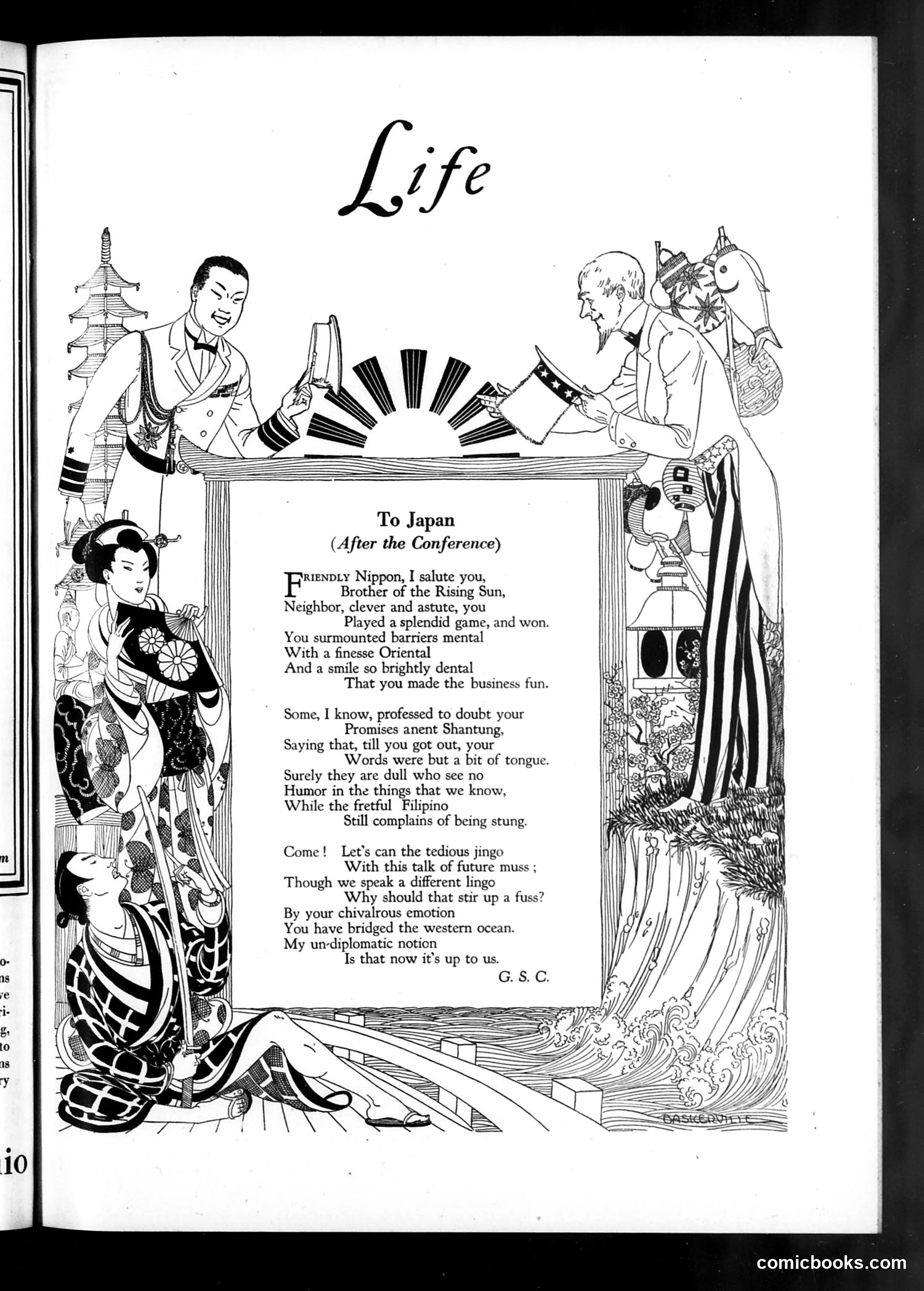
This page satirizes post-conference diplomatic relations with Japan, likely following a major early 20th-century peace negotiation. The poem, signed "G.S.C.," addresses Japan as "Friendly Nippon" and "Brother of the Rising Sun," congratulating them on winning negotiations through Oriental finesse and diplomacy. The satire cuts deeper in later stanzas, mocking Western negotiators for being gullible—their promises were "but a bit of tongue." The poem suggests Japan successfully played diplomatic games while Westerners remain oblivious to the humor. The elaborate Japanese-inspired artwork (geishas, pagodas, rising sun) frames this commentary on perceived Japanese cunning versus Western naïveté in international dealings. The overall tone is one of bemused respect mixed with self-deprecating American humor about being outmaneuvered.
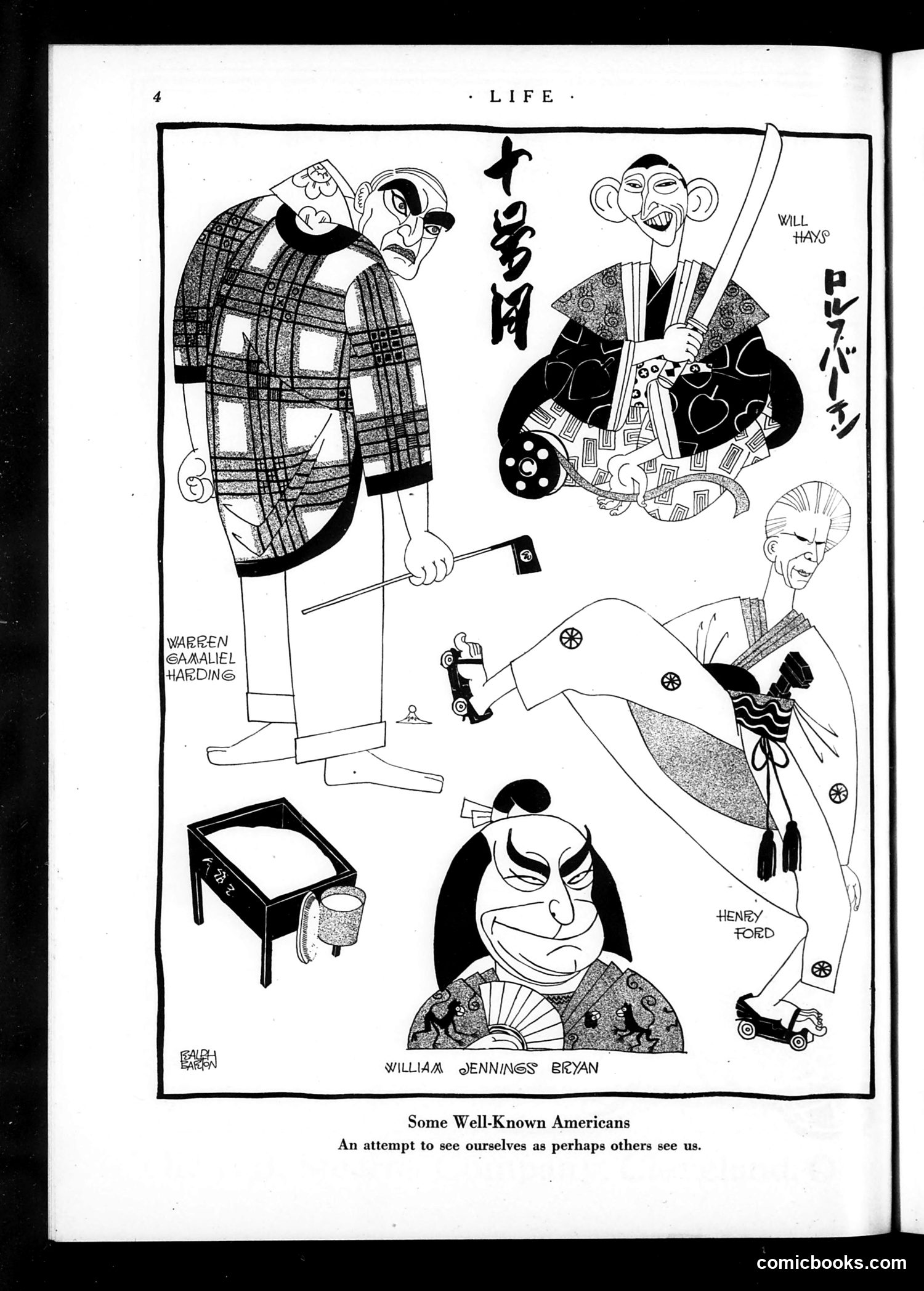
This page satirizes prominent American figures through exaggerated caricature, with the subtitle "An attempt to see ourselves as perhaps others see us." The identified figures are: - **Warren G. Harding** (left, with axe) — likely satirizing his presidency or policies - **Will Hays** (upper right, with sword) — film industry censor - **William Jennings Bryan** (center, with fan) — three-time presidential candidate - **Henry Ford** (right, on roller skates) — industrialist/automobile magnate The cartoon employs grotesque facial features and symbolic props (weapons, entertainment objects) to mock these public figures. The artist is Ralph Barton. The satire appears to critique American leadership and industry through unflattering physical distortion—a common technique in early 20th-century satirical magazines.
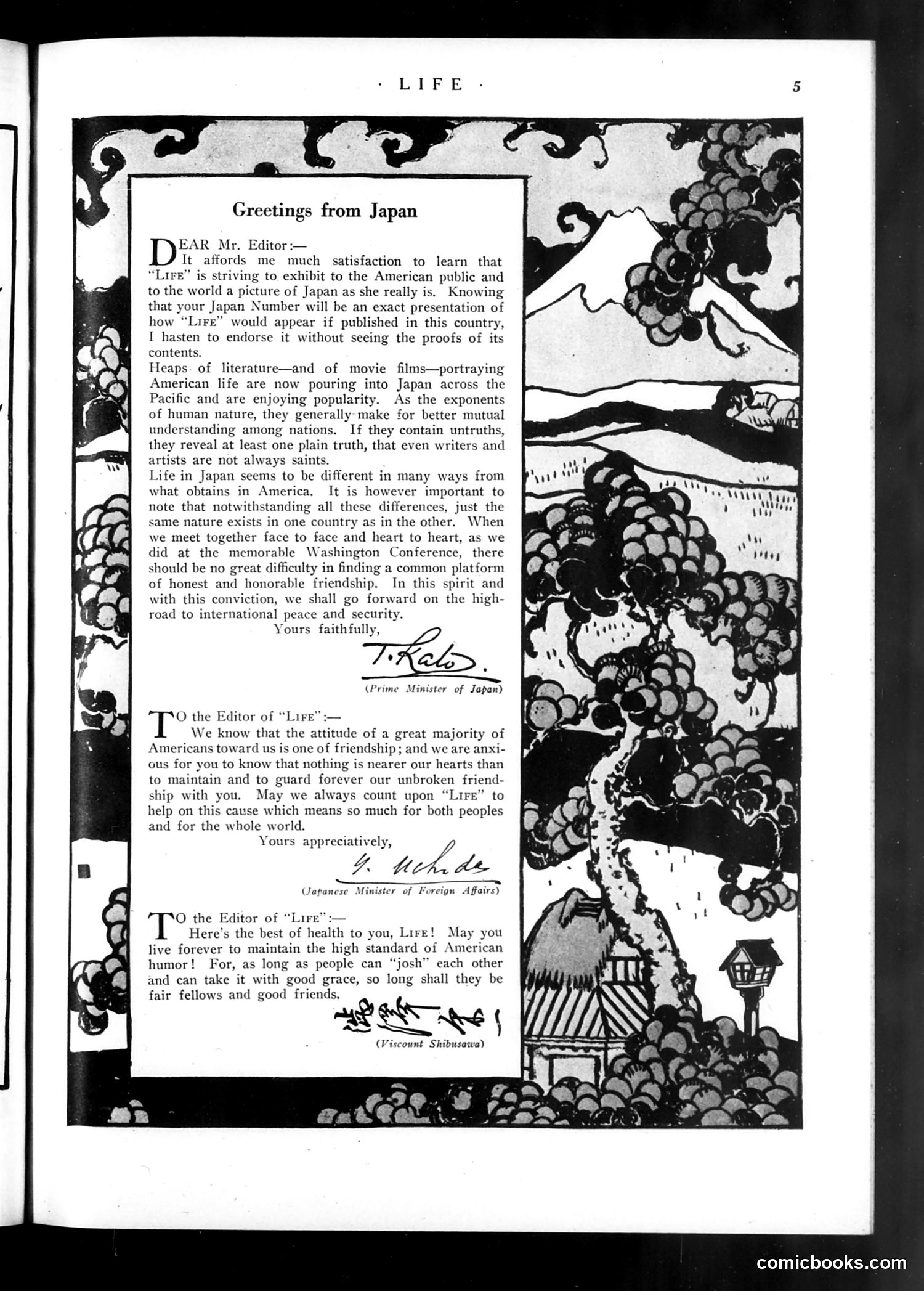
This page features three letters of greeting to *Life* magazine's editor from Japanese officials, framed by decorative Japanese-inspired artwork (mountains, pagodas, flora). The letters are from: 1. **Prime Minister** (signed T. Kato) 2. **Japanese Minister of Foreign Affairs** (signed M. Debuchi) 3. **Viscount Shibuawa** The context appears to be *Life* magazine's special Japan issue, celebrating Japanese culture and promoting U.S.-Japan friendship. The officials praise *Life*'s efforts to present accurate portrayals of Japan to Americans, emphasizing mutual understanding and peaceful relations—likely referencing the Washington Conference era of international diplomacy. The decorative border and artistic styling reflect contemporary American interest in Japanese aesthetics and culture.
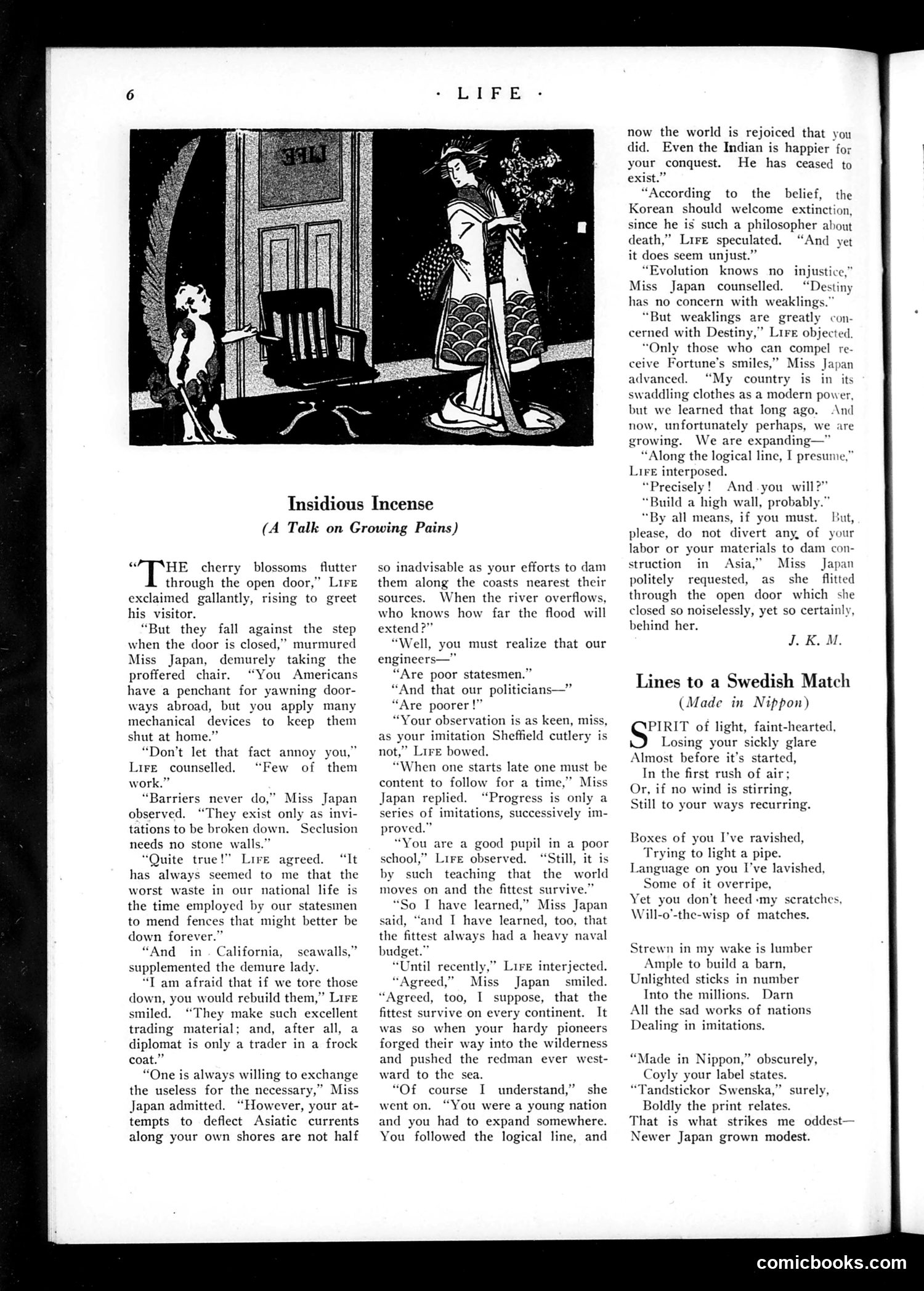
The cartoon depicts a conversation between an American woman (labeled "Miss Japan") and a Japanese figure in traditional dress, with a small dog present. The satire addresses American expansion into Asia during the early 20th century. Miss Japan expresses concerns about American imperialism—specifically damaging Asian rivers and coasts through industrial expansion. The American character dismisses these worries, arguing that "progress" justifies such efforts. The piece satirizes American justifications for colonial expansion by portraying them as self-serving rhetoric masking exploitation. The dialogue suggests America views Asian "growing pains" as inevitable and necessary, while Miss Japan represents Asian perspectives being ignored by Western powers. The "insidious incense" title implies the sweetly-scented but ultimately deceptive nature of imperialist arguments.
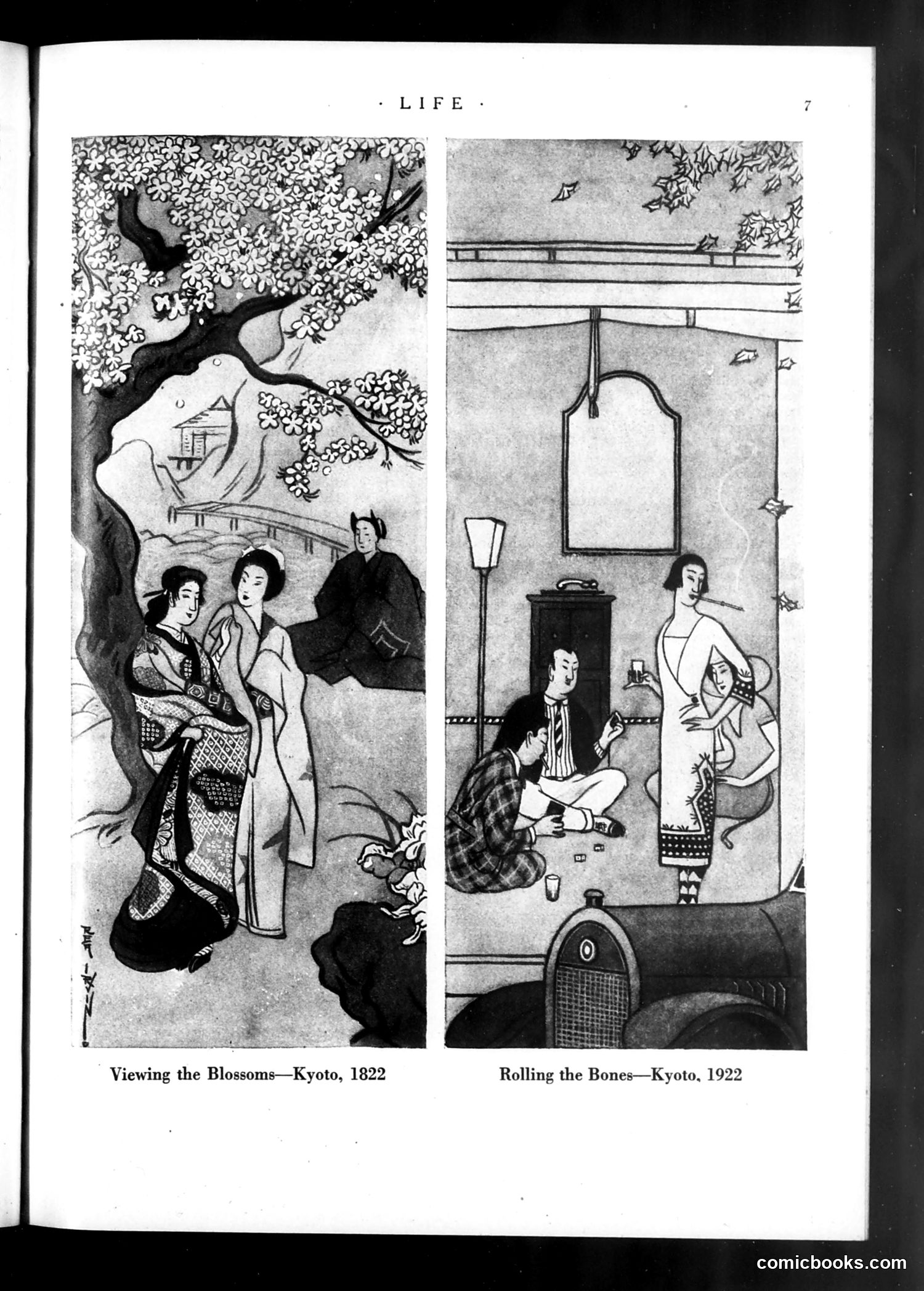
This page presents two contrasting illustrations of life in Kyoto, Japan in 1922, likely commentary on modernization and cultural change. The left panel, "Viewing the Blossoms—Kyoto, 1822," depicts a traditional Japanese scene: people in period dress gathered beneath a flowering cherry tree, engaged in the classic cultural practice of *hanami* (blossom viewing). The right panel, "Rolling the Bones—Kyoto, 1922," shows the same location a century later, now modernized with Western furnishings, electric lighting, and industrial elements. The figures appear to be gambling or engaging in Western leisure activities in an urban interior. The satire critiques Japan's rapid Westernization over a hundred years—suggesting that traditional aesthetic and cultural practices have been replaced by Western commercialism and vice.
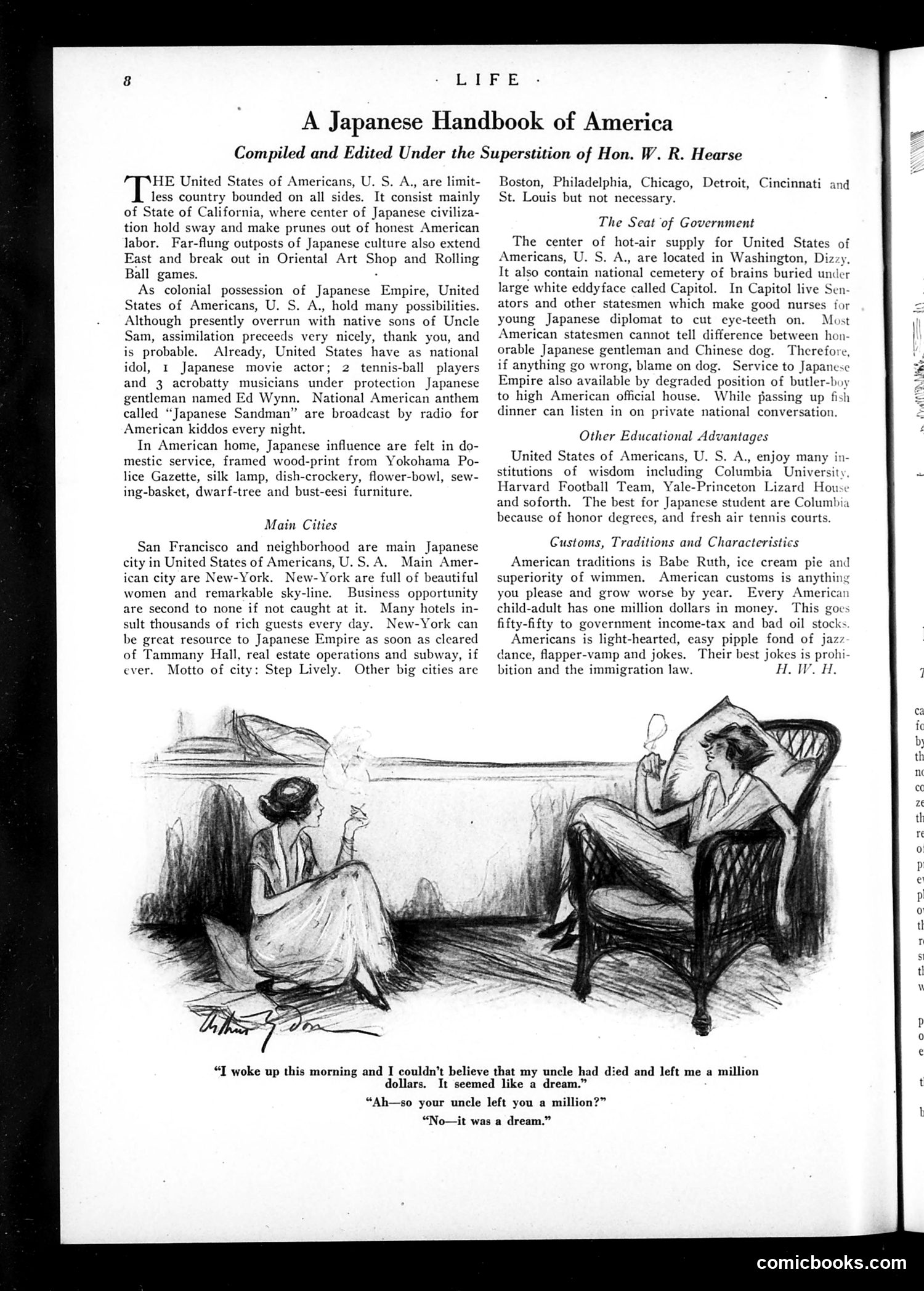
This satirical piece mocks both Japanese perceptions of America and American stereotypes about Japan. The mock "handbook" claims to describe America for Japanese readers, listing absurdities: Japanese actors and musicians as American celebrities, American wealth measured in millions, and crude generalizations about customs (Babe Ruth, ice cream pie, light-heartedness). The accompanying cartoon depicts a woman telling a man about inheriting a million dollars from an uncle, only to reveal it was a dream—satirizing the American "get rich quick" fantasy that appears to fascinate Japanese observers. The satire targets mutual misunderstandings between cultures, suggesting that Japanese guidebooks about America were as comically inaccurate as Western stereotypes about Japan. It's gentle ridicule of cross-cultural confusion during the early 20th century.
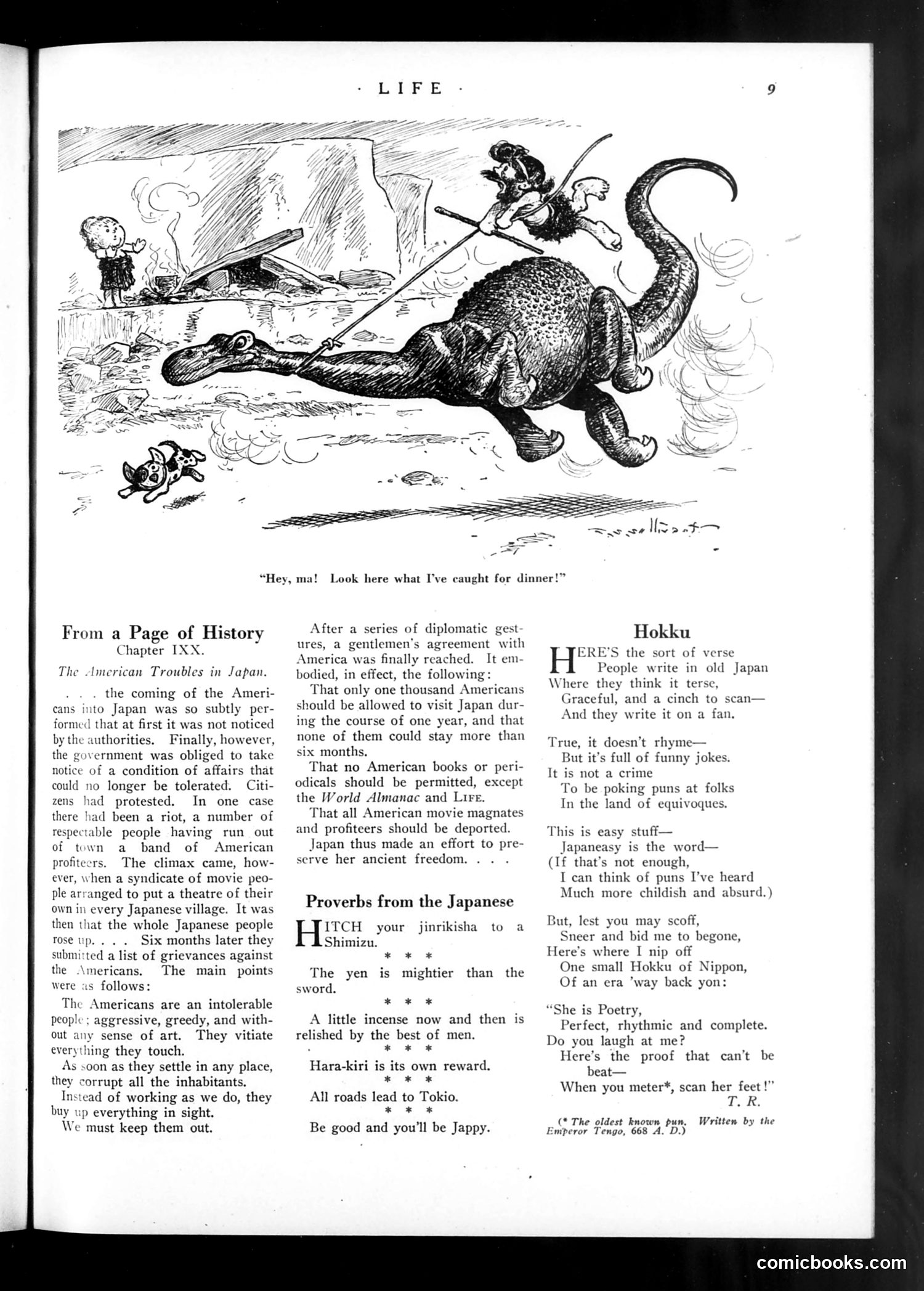
The top cartoon satirizes American imperialism in Japan. A figure rides an enormous alligator (labeled as catch "for dinner"), while a Japanese person watches from a destroyed building. This illustrates how American commercial and military presence was consuming Japanese sovereignty and resources. The accompanying text details American grievances against Japan, listing complaints about restrictions on American access. The satire suggests that despite diplomatic agreements limiting American involvement to one thousand visitors annually, Americans were aggressively pursuing economic and cultural dominance—depicted as the voracious alligator—regardless of Japan's desire to preserve its independence. This appears to reference early 20th-century U.S.-Japan tensions over trade, military presence, and cultural influence.
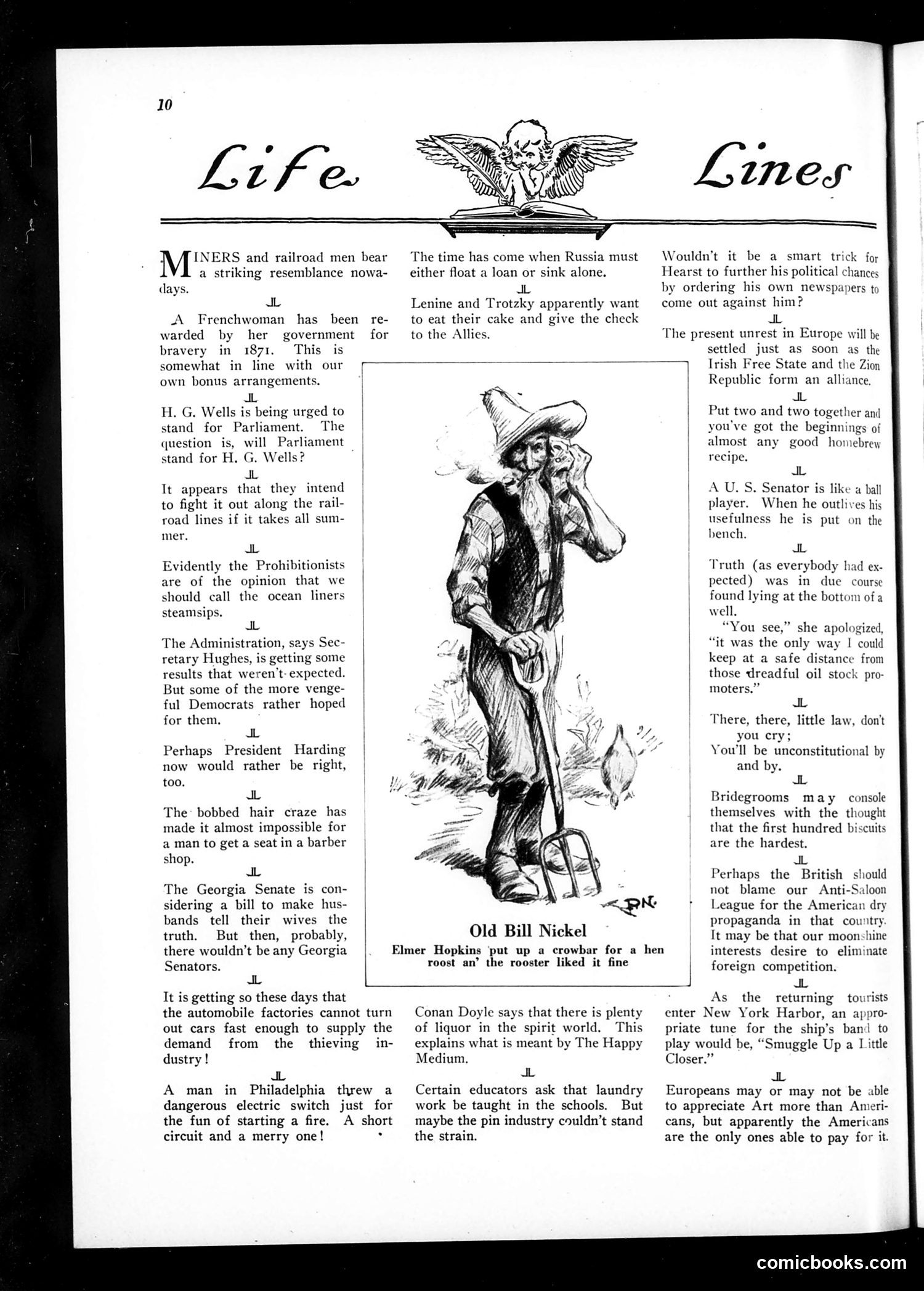
The central cartoon depicts "Old Bill Nickel," a raggedy, wizened character carrying a suitcase. The caption credits "Elmer Hopkins put up a crowbar for a hen roost an' the rooster liked it fine"—a rural American tall tale suggesting deception or fraud. The surrounding text contains typical Life magazine satirical commentary on contemporary issues: Russian politics (Lenin and Trotsky), Prohibition enforcement, Senate politics, and American business practices. The cartoon likely satirizes either a specific political figure or represents the archetypal "con man" or charlatan—someone selling false promises to the gullible. Without additional context identifying "Old Bill Nickel" specifically, the precise target remains unclear, though the shabby appearance and deceptive framing suggest mockery of fraudulent schemes common in 1920s America.
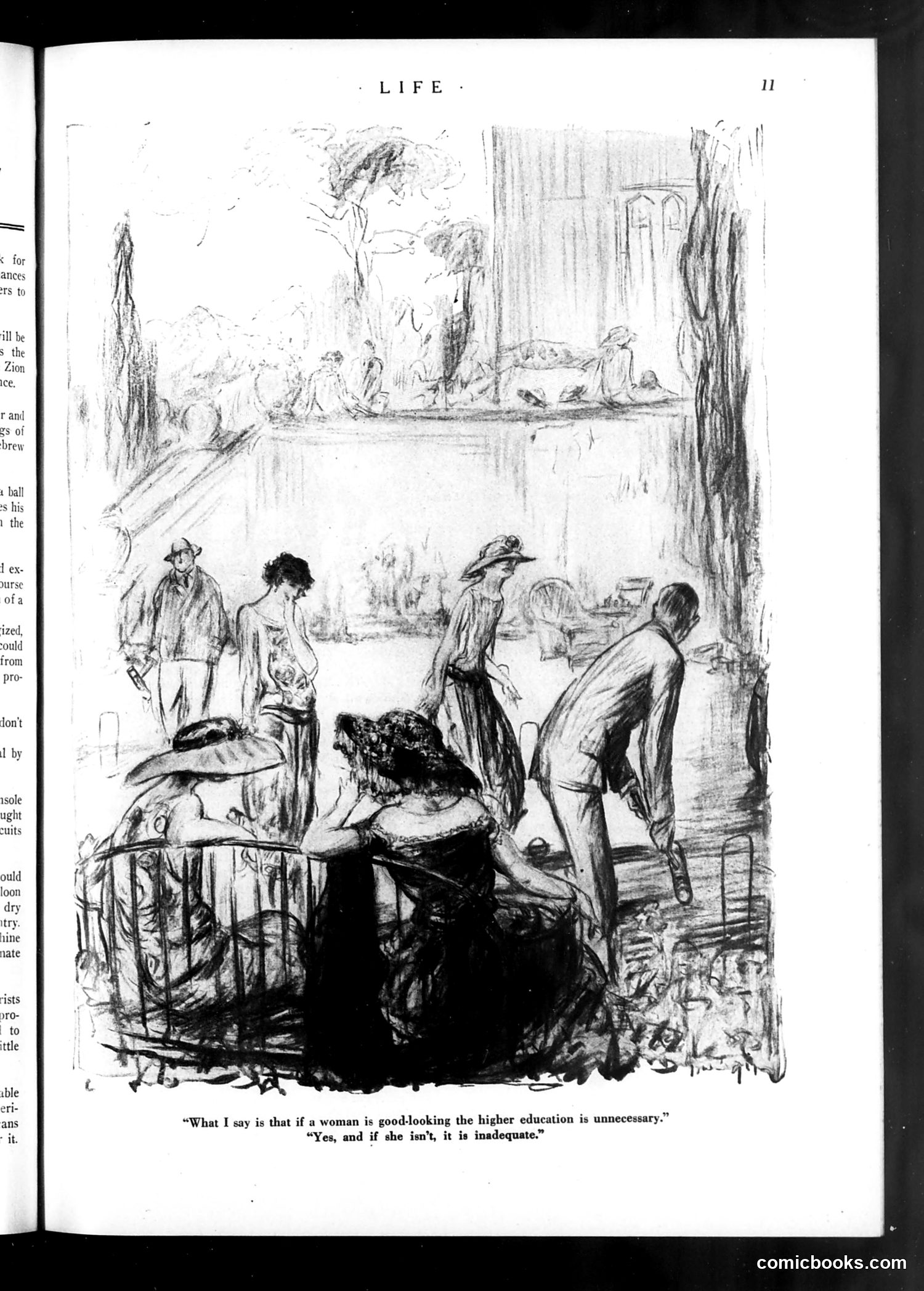
This is a satirical cartoon about women's education. The scene depicts a riverside or waterside social gathering with multiple figures in period dress (appears to be early 20th century). The dialogue caption reads: "What I say is that if a woman is good-looking the higher education is unnecessary." "Yes, and if she isn't, it is inadequate." The satire targets contemporary debates about women's higher education. One figure argues that attractive women don't need education, while the response sarcastically suggests that unattractive women's education won't help them anyway—mocking the dismissive attitude toward women's intellectual development. The cartoon ridicules the notion that women's worth depends on appearance rather than education and capability.
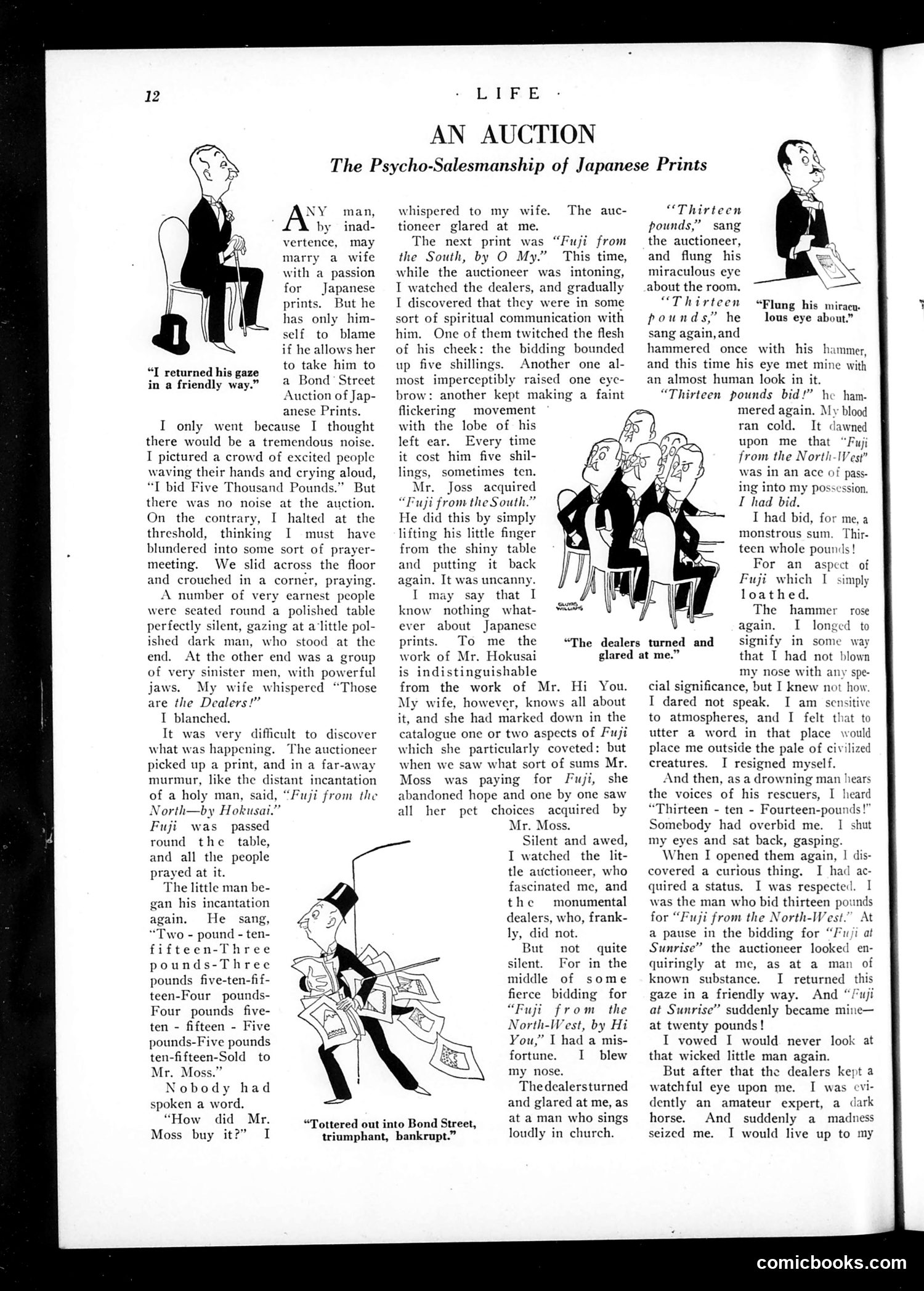
This satirical article describes an auction of Japanese prints where an unnamed auctioneer uses psychological manipulation on wealthy bidders. The humor centers on how dealers exploit collectors' status anxiety and competitive instincts—bidders get caught up in rivalry rather than genuine appreciation of the art. Key satirical elements include: - The auctioneer's theatrical performance ("spiritual communication" with a print titled "Fuji from the South") - Dealers deliberately raising bids to manipulate prices upward - Wealthy collectors being portrayed as easily duped, emotionally reactive individuals competing for prestige - The final detail: Mr. Moss, seemingly the richest bidder, actually ends up bankrupt after the auction The satire mocks both the pretension of fine-art collecting and the psychological tactics salesmen use to extract money from the wealthy.
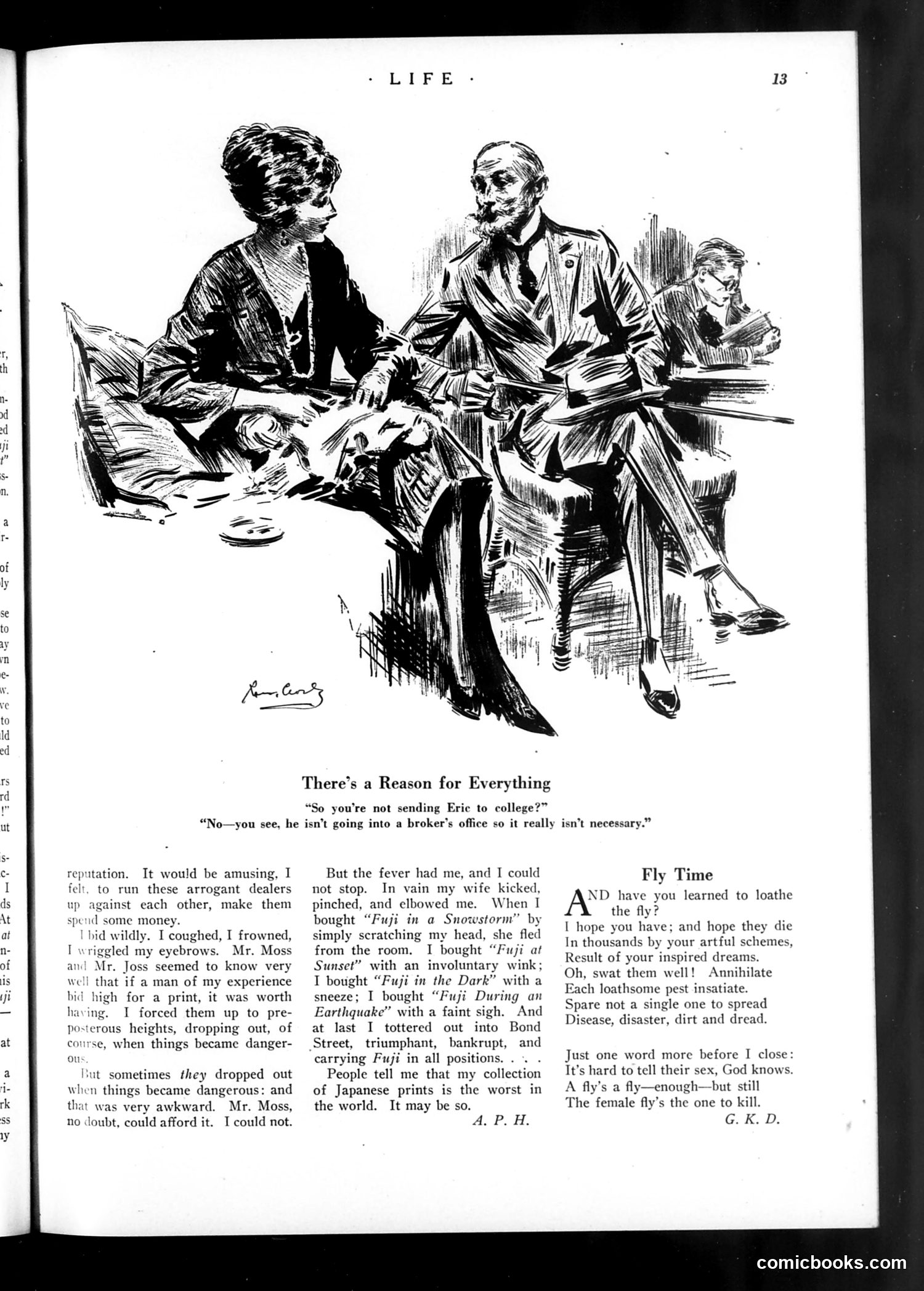
The main cartoon, titled "There's a Reason for Everything," depicts three figures in what appears to be a financial or business setting. A woman on the left holds papers while a man in the center (appearing older, possibly a broker or financial advisor) gestures dismissively. The caption explains she's not sending her stocks to a broker's office because "it really isn't necessary." The satire likely mocks either financial advice, stock market dealings, or investment practices of the era—suggesting the woman has found an alternative (or inferior) solution to professional financial management. The page also contains two short humorous pieces about collecting Japanese prints and observations about flies, signed by different authors (A.P.H. and G.K.D.), suggesting this is a typical page mixing cartoons with brief comedic essays.
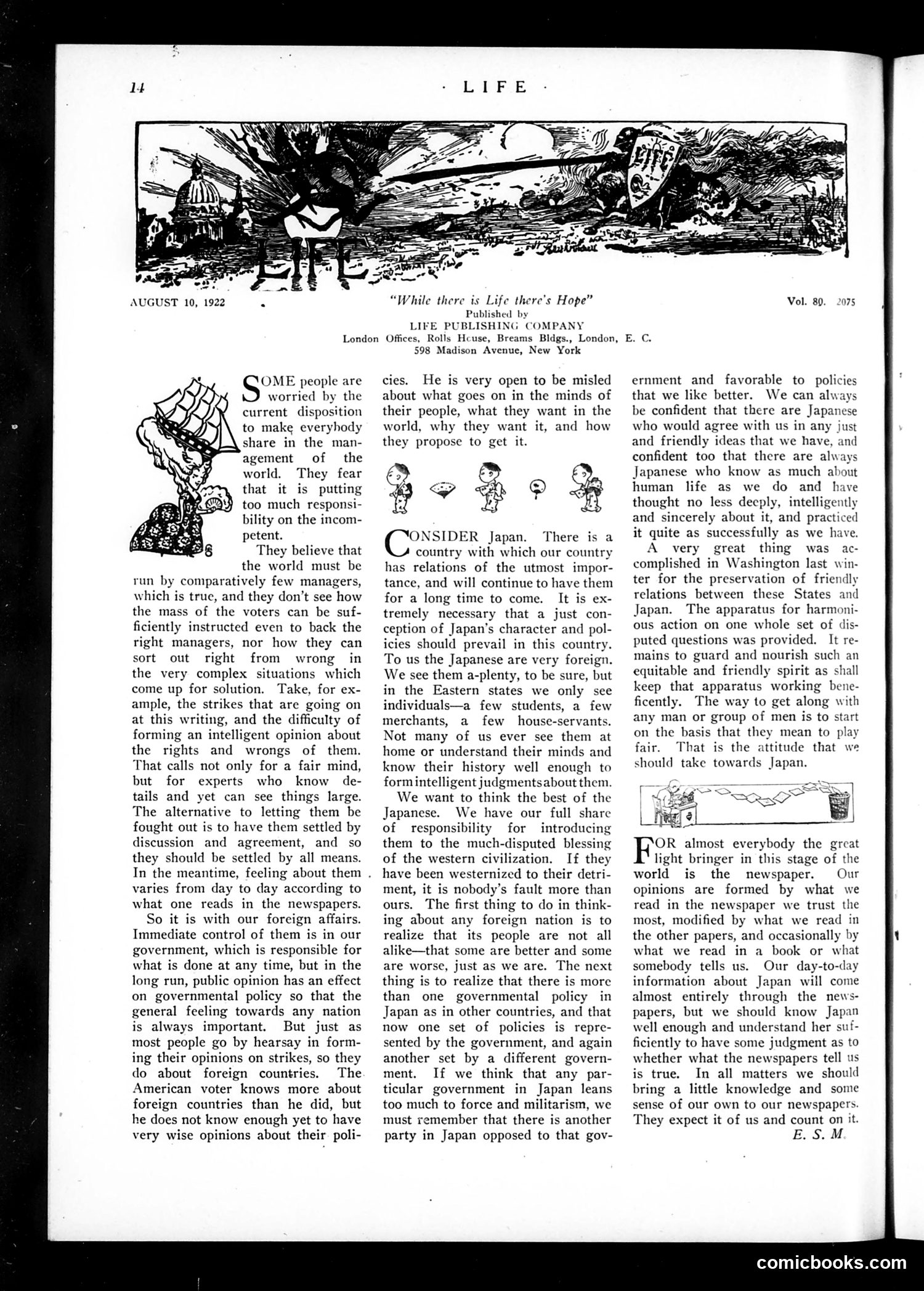
The page features an editorial essay titled "While there is Life there's Hope" discussing American-Japanese relations. The accompanying political cartoon (upper left) appears to show a figure wielding a club or weapon amid chaotic imagery including a burning building and military elements, likely satirizing concerns about Japanese militarism or foreign policy aggression. The essay argues for informed American public opinion about Japan, asserting that Americans know too little about foreign nations to form wise judgments. It advocates understanding Japan's perspective while maintaining skepticism about its government's militaristic policies, which the author suggests contradict peaceful elements within Japanese society. The cartoon reinforces anxieties about Japan's imperial ambitions prevalent in 1920s American discourse.
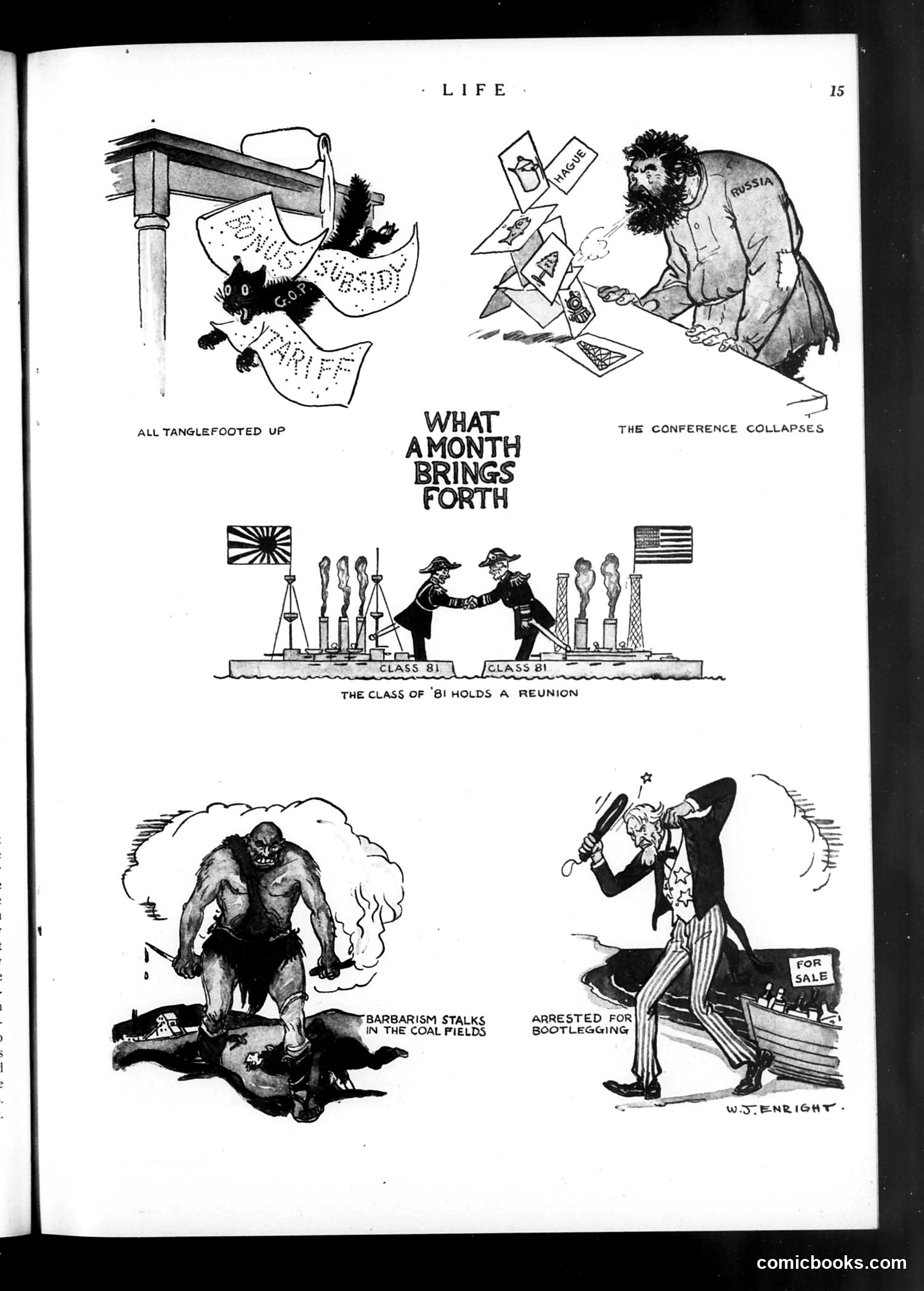
This page presents five satirical cartoons titled "What a Month Brings Forth." The top left shows tangled diplomatic documents, suggesting international confusion. The top right depicts "Russia" at a collapsed conference table with scattered papers—likely referencing failed peace negotiations or diplomatic breakdowns. The center cartoon shows the "Class of '81" (a military reunion) with Japanese and American flags, suggesting tensions between these nations. The bottom left illustrates "Barbarism Stalks in the Coal Fields"—depicting violence or brutal conditions in coal mining regions, a reference to labor unrest and strike violence common in early 20th-century American mining. The bottom right shows someone "Arrested for Bootlegging," referencing Prohibition-era illegal alcohol smuggling. Without a visible date, the exact historical moment is unclear, but these cartoons address contemporary diplomatic failures, military tensions, labor violence, and crime.
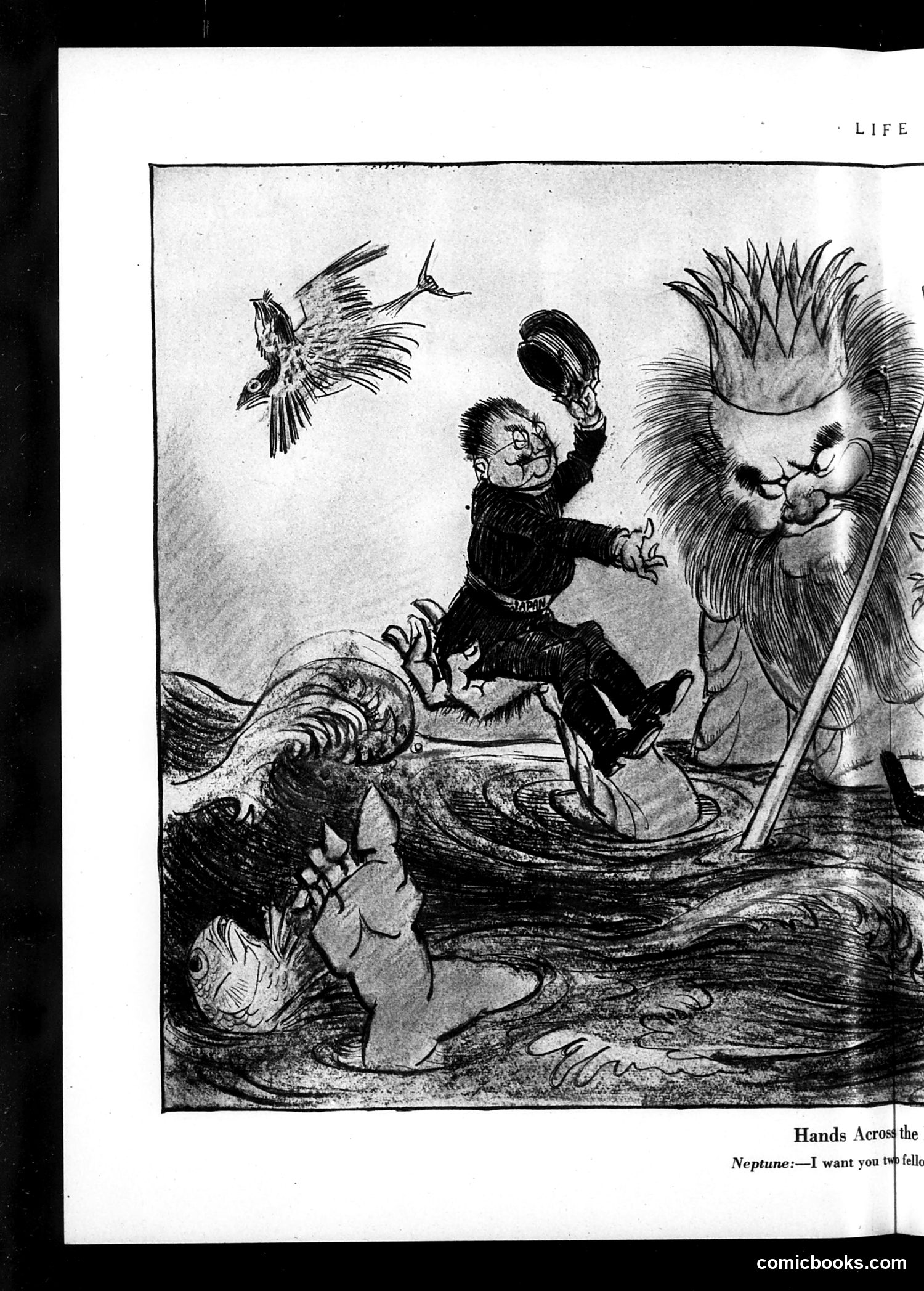
This appears to be a satirical cartoon from *Life* magazine depicting Neptune (the Roman god of the sea, recognizable by his trident and crown) interacting with underwater or mythological creatures and a human figure in formal dress. The incomplete caption "Hands Across the / Neptune:—I want you two fell[ows]" suggests a theme of international cooperation or diplomacy ("hands across"). The formal-dressed human appears to be a political figure, possibly representing a nation or leader, engaged in negotiation or agreement with Neptune and other figures. Without the complete caption or date, the specific political reference remains unclear, though the "hands across" phrasing suggests this addresses international relations or cooperation during an era when such metaphors were common in American political commentary.
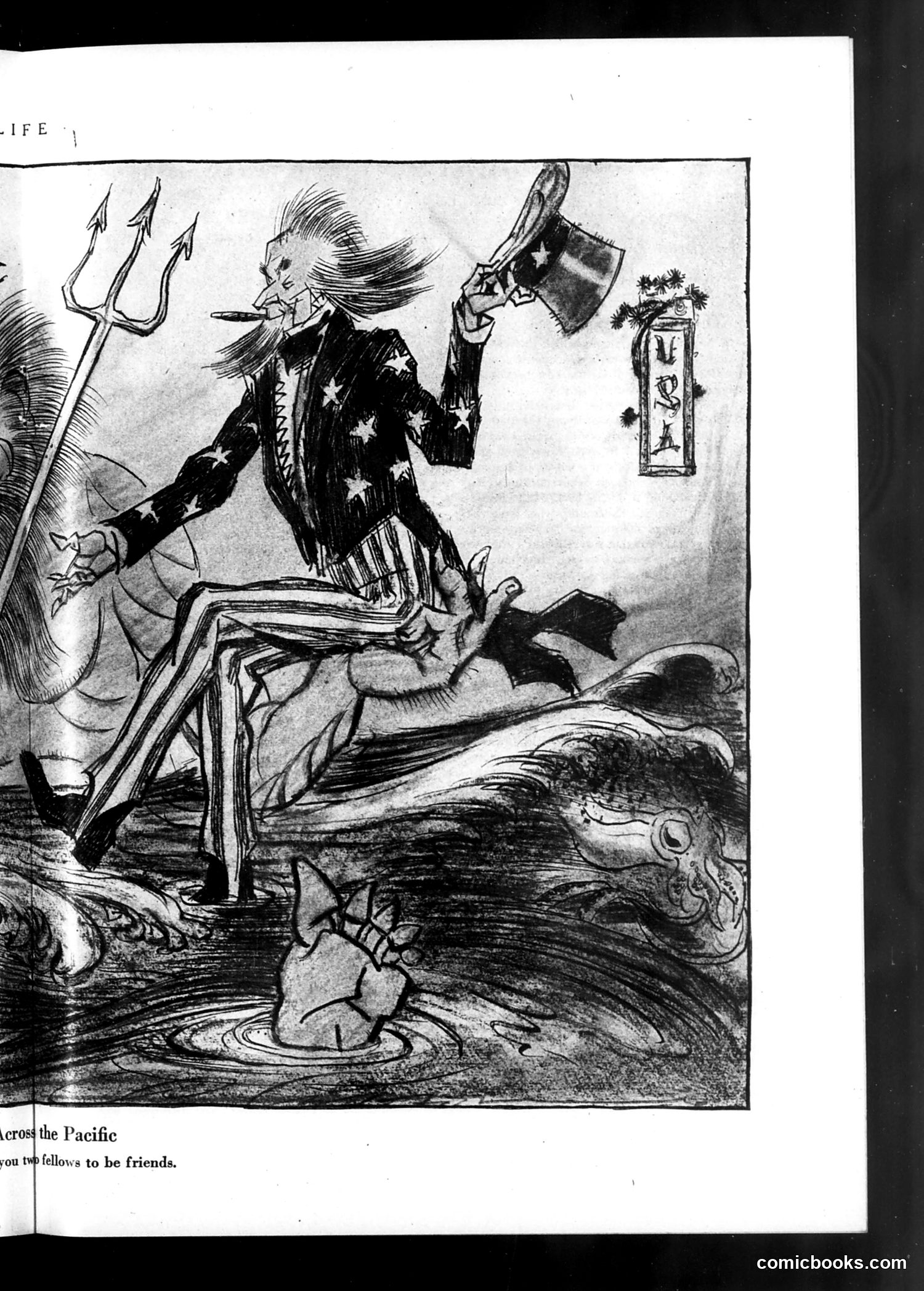
This appears to be an early 20th-century American political cartoon satirizing U.S.-Asian relations. A figure representing Uncle Sam (identifiable by the star-spangled outfit) stands wielding an axe and trident, towering over what appear to be Asian figures or nations in the water below. The caption references the Pacific and "fellows to be friends," suggesting the cartoon critiques American imperial ambitions or military intervention across the Pacific. The weapons and aggressive posture, combined with the ironic caption about friendship, mock American foreign policy—likely depicting how the U.S. imposed relationships through military force rather than genuine diplomacy. The exact historical moment is unclear without a visible date, but this reflects broader turn-of-the-century American expansionism into Pacific territories.
This is a theater review essay, not a political cartoon. The critic praises "The Plantation Revue" for authenticity, arguing it succeeds because it showcases genuine African American talent—singing, dancing, and stage presence—rather than imitating white Broadway conventions. The piece contains period racial attitudes typical of 1920s white liberalism: it celebrates Black performers' "distinctive talents" and "elemental quality," while patronizingly suggesting their comedy lacks sophistication (comparing jokes to "Piltdown circuit" primitiveness). The reviewer, Robert C. Benchley, notes "Strut Miss Lizzie" features songwriters Creamer and Layton, praised as "exceedingly likeable people." The review reflects the Jazz Age moment when African American entertainment was gaining mainstream attention following "Shuffle Along's" success, yet remains filtered through condescending racial frameworks typical of the era.
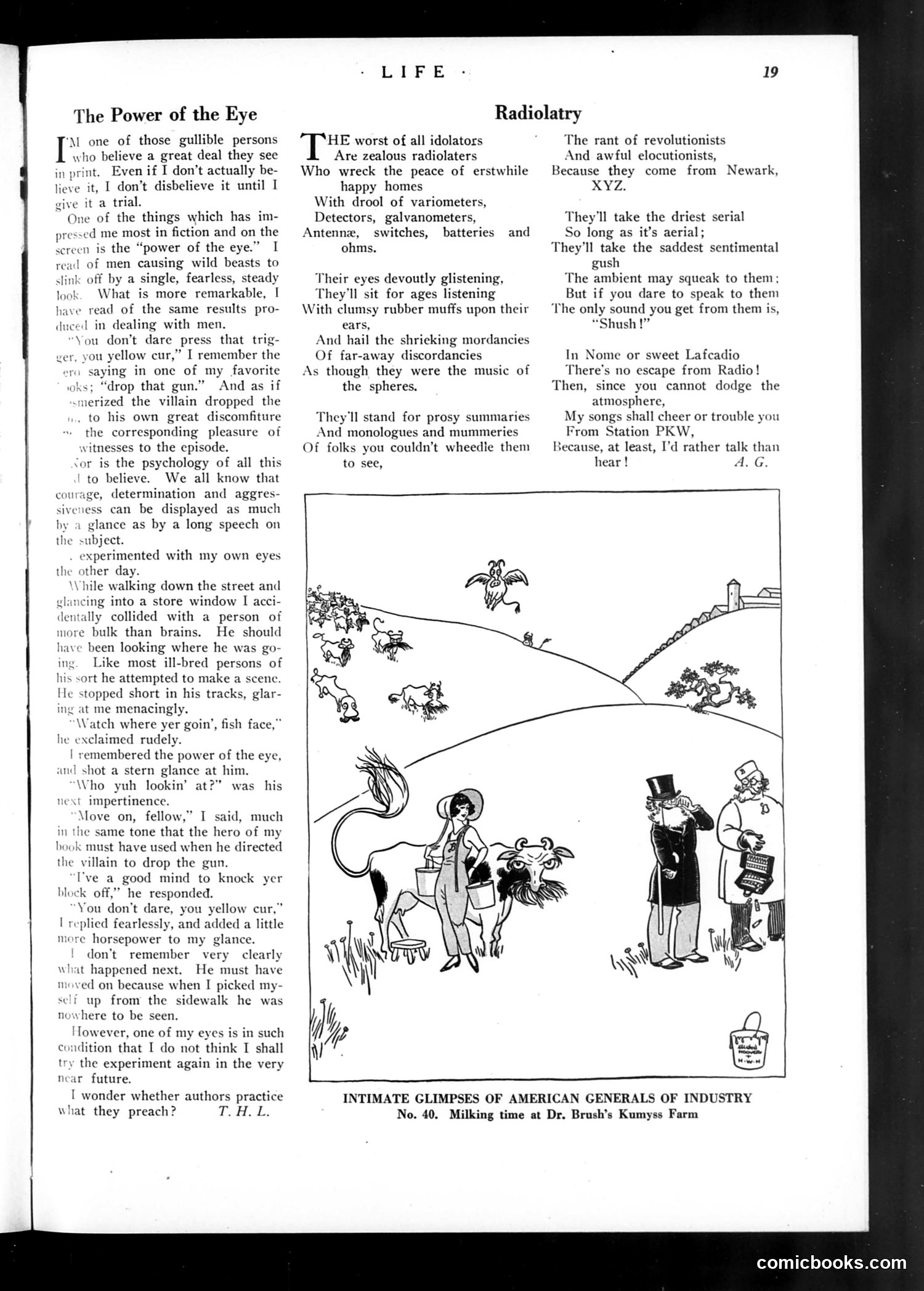
This *Life* magazine page (page 19) contains two satirical pieces and an illustration. **"The Power of the Eye"** is a humorous essay mocking the literary trope of piercing stares that intimidate villains. The author describes attempting this technique on a rude stranger after a street collision, only to get beaten up—satirizing the gap between fiction and reality. **"Radiolatry"** is a poem satirizing the obsessive early radio enthusiasts of the 1920s-30s. It mocks people ("radiolaters") who ignore their families to listen to radio broadcasts for hours, treating mediocre content as sacred. The poem ridicules their fascination with distant stations and their demand for silence during broadcasts—capturing the cultural moment when radio was a novelty that captivated audiences. **The cartoon** below, titled "Intimate Glimpses of American Generals of Industry," depicts a wealthy industrialist (likely Dr. Brush) milking cows at his farm, contrasting his public image of business success with pastoral leisure activities—likely mocking the pretensions of wealthy industrialists.
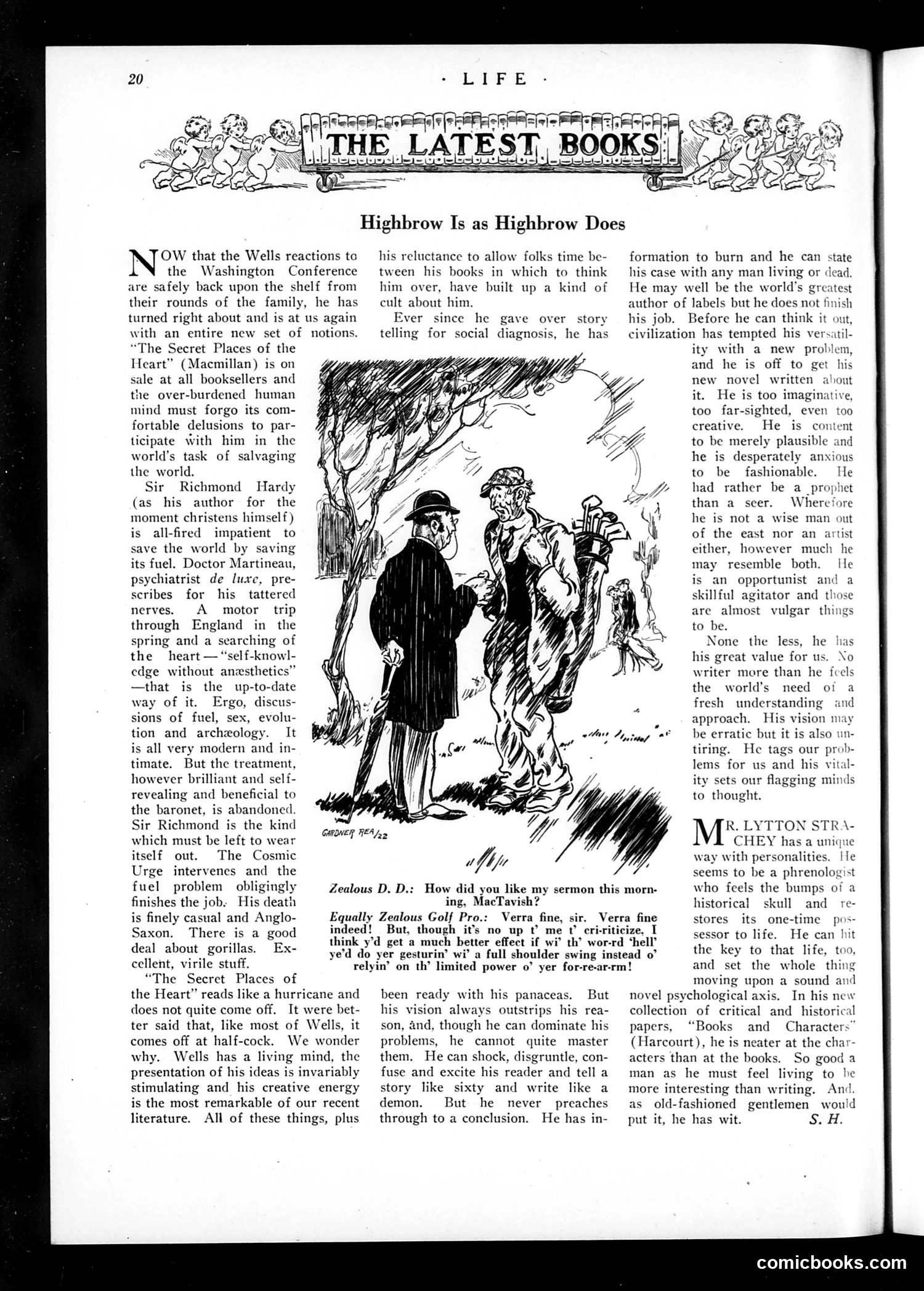
This page reviews H.G. Wells' novel *The Secret Places of the Heart* and critiques Wells himself as a public intellectual. The cartoon depicts a clergyman (labeled "Zealous D.D.") and a golf pro—both self-appointed experts offering unsolicited advice on matters outside their expertise. The satire targets Wells specifically: the review praises his brilliance and vital energy but criticizes him for abandoning ideas before fully developing them, jumping between causes (fuel conservation, social diagnosis), and prioritizing being fashionable over being profound. He's compared unfavorably to prophets and seers—more "opportunist and skillful agitator" than artist or wise man. The cartoon's parallel structure suggests Wells resembles these bumbling "highbrows"—earnest but overconfident figures dispensing half-baked opinions beyond their depth. The title "Highbrow Is as Highbrow Does" implies intellectual pretension without substance.
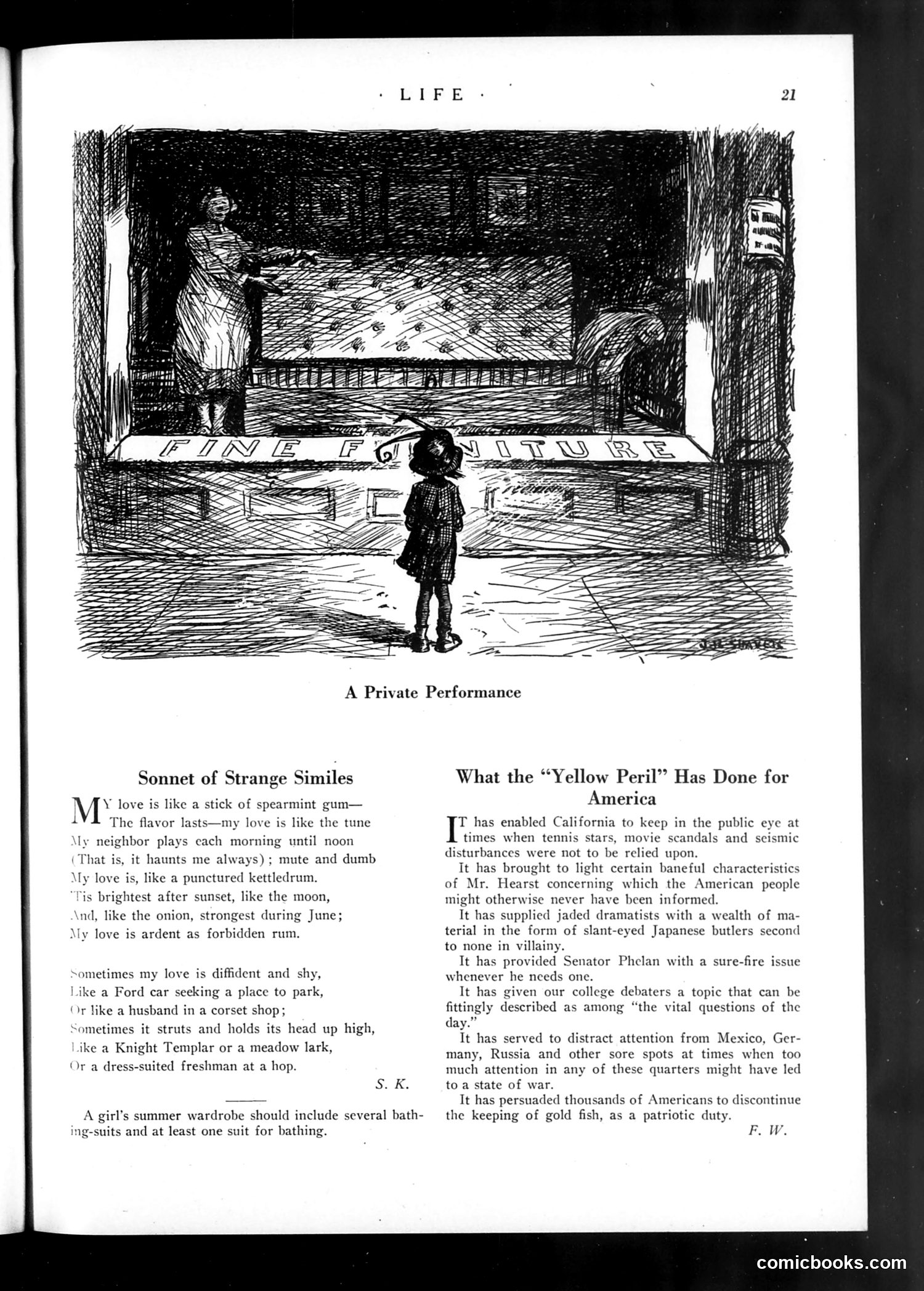
The top illustration shows a child viewing a stage with "FINE FOR FUTURE" written across it—a satirical commentary on theatrical performances or entertainment aimed at younger audiences, likely critiquing overly moralistic or simplistic shows. Below, the "Sonnet of Strange Similes" is light verse comparing love to everyday objects (spearmint gum, Ford cars, kettledrums), typical of Life's humorous poetry. The substantial article "What the 'Yellow Peril' Has Done for America" satirizes contemporary anti-Japanese sentiment and xenophobia. It mockingly credits the "Yellow Peril" panic (American fears of Japanese expansion) with providing: California publicity; ammunition against publisher William Randolph Hearst; dramatic material (the "Japanese butler" villain trope); political capital for Senator Phelan; college debate topics; and distraction from genuine geopolitical threats. The final jab—that fear prompted Americans to stop keeping goldfish as unpatriotic—reveals the absurdity of the hysteria. The piece critiques both the manufactured nature of this panic and media/political exploitation of xenophobia.
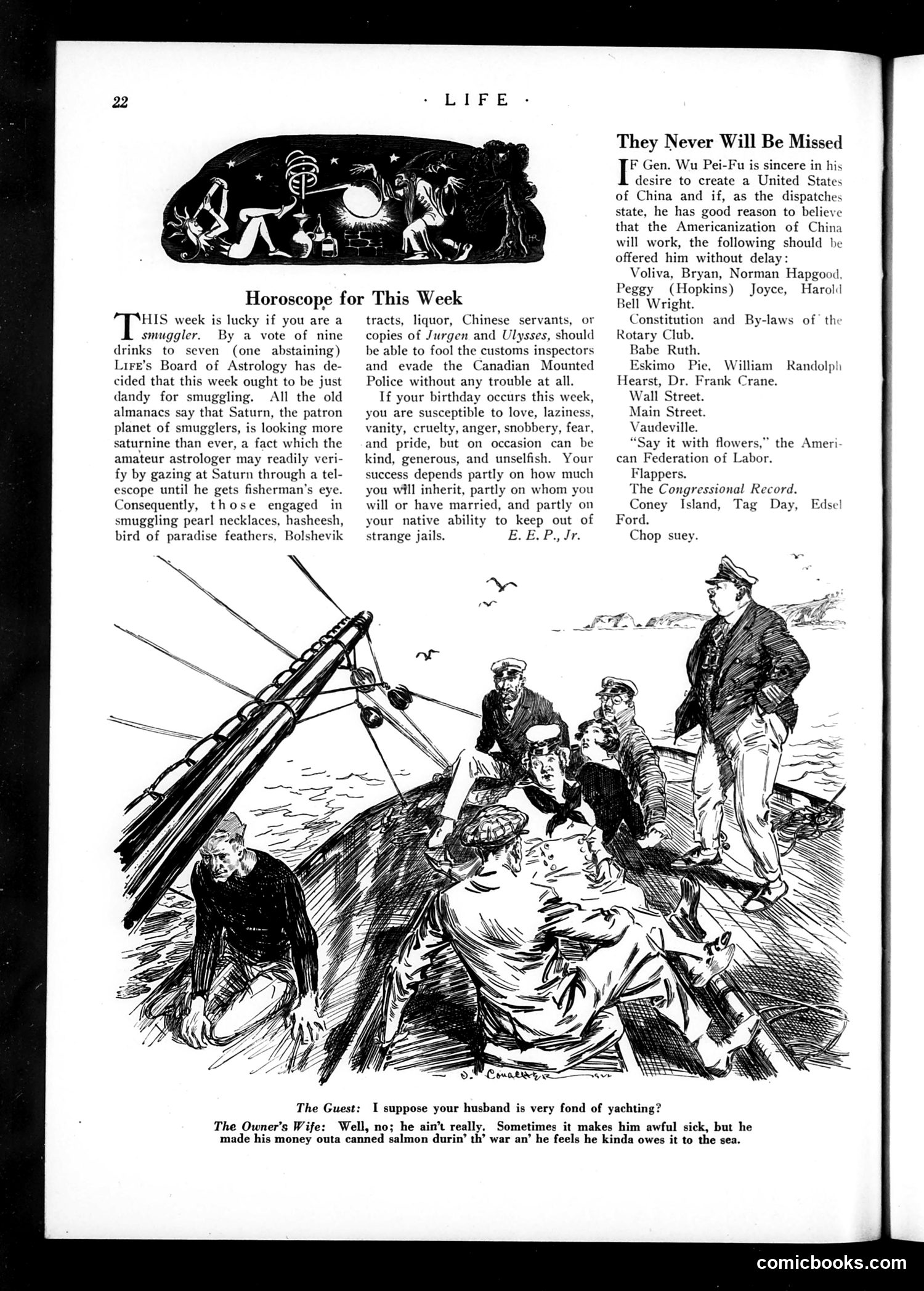
This page contains two satirical pieces from Life magazine: **"Horoscope for This Week"** is a humorous mock-horoscope declaring the week "lucky for smugglers." It's satirizing Prohibition-era smuggling (note references to liquor, banned books like *Ulysses* and *Jurgen*), listing absurd contraband alongside actual illegal goods. The joke targets both smugglers' confidence and the era's widespread flouting of alcohol laws. **"They Never Will Be Missed"** is darker political satire. General Wu Pei-Fu (a Chinese warlord attempting modernization) is sarcastically offered a list of Americans to "export" to China—implying these figures represent America's worst cultural exports. The list mixes celebrities (Babe Ruth, Peggy Hopkins Joyce), politicians (Bryan), and institutions (Rotary Club, Wall Street, Congressional Record), suggesting American materialism, conformity, and commercialism are undesirable influences. The bottom cartoon depicts a woman explaining her husband profited from wartime canned salmon sales and now feels obligated to enjoy yachting—satirizing nouveau-riche war profiteers awkwardly adopting upper-class leisure activities.
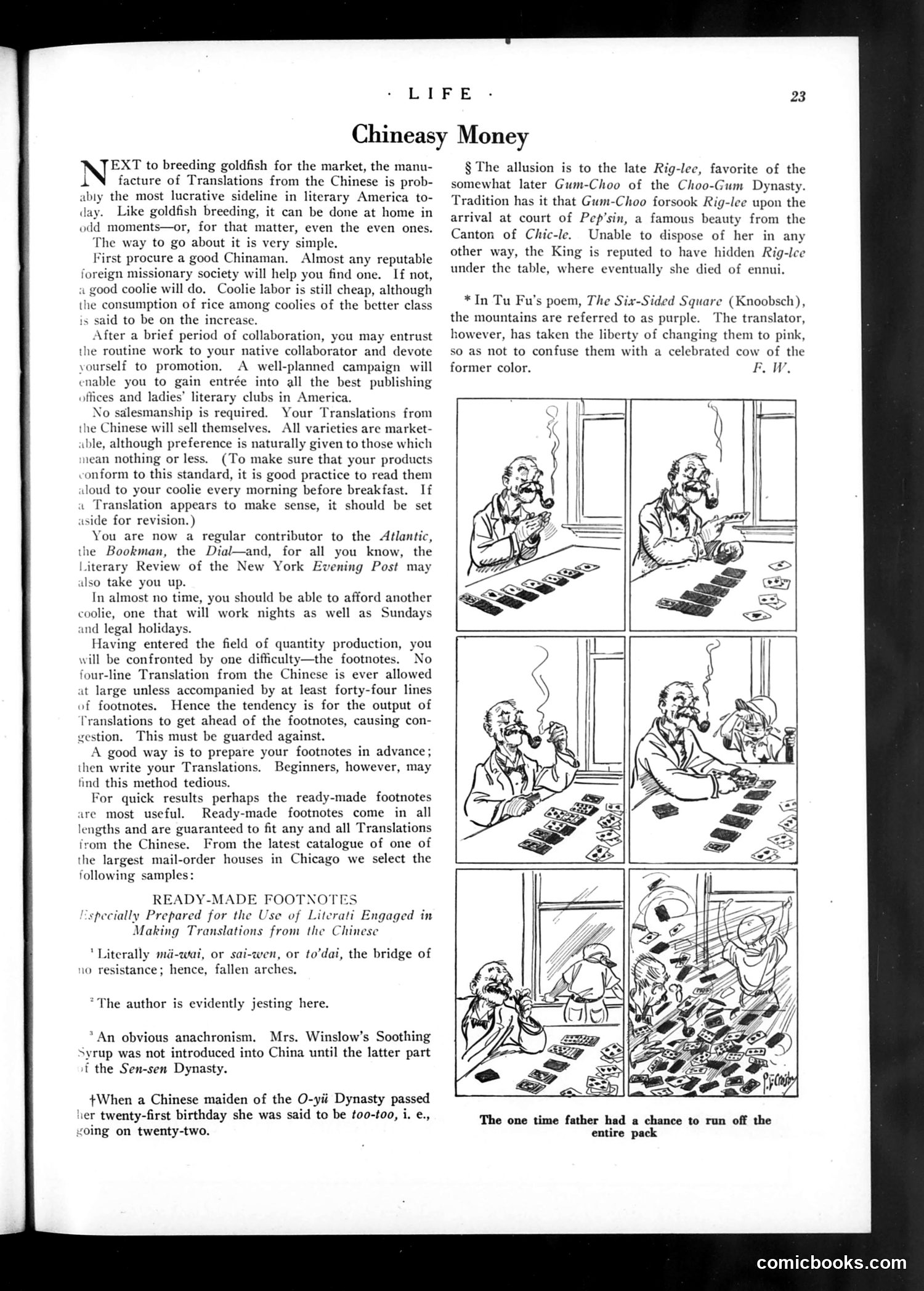
This article satirizes the early 20th-century literary craze for translations of Chinese poetry and philosophy. The text mocks how American publishers and literati eagerly published Chinese translations with minimal effort or understanding. The joke: anyone could manufacture these translations profitably by hiring cheap Chinese labor (a "coolie"), then padding the work with lengthy, often nonsensical footnotes—a requirement Life claims was forty-four lines of footnotes per four lines of translation. The satirical "ready-made footnotes" specimen demonstrate the absurdity: fabricated etymologies, fake dynasties ("Choo-Gum Dynasty"), and ridiculous explanations pretending scholarly gravitas while discussing commercial products like Mrs. Winslow's Syrup and Pep'sin as if they were ancient Chinese references. The accompanying comic strip (right) illustrates a man arranging dominoes—a visual metaphor for how these translations were mechanically assembled without genuine insight. The satire targets both the commercialization of "exotic" literature and American intellectual pretension.
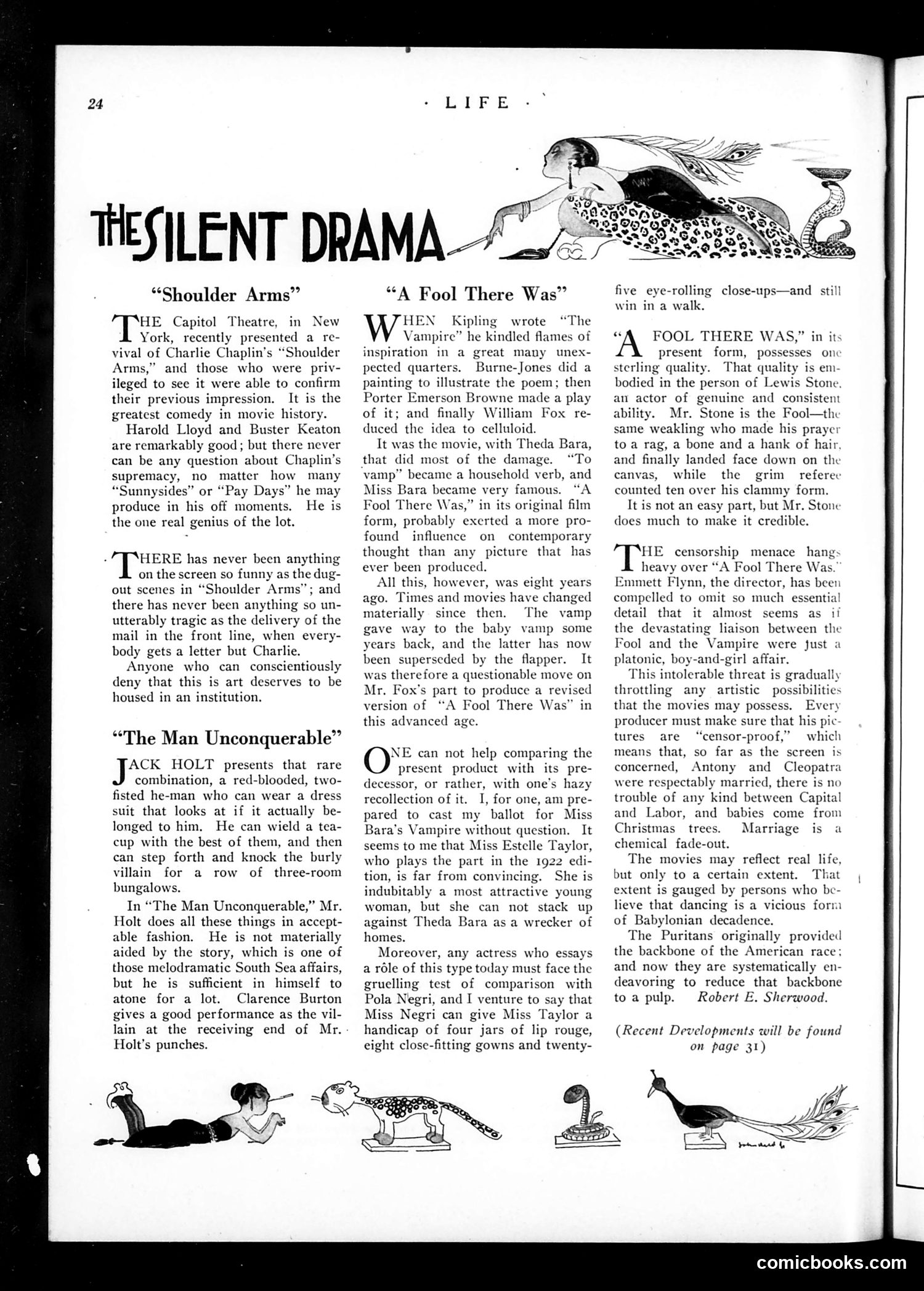
This page contains three film reviews from the early 1920s. The critic praises Charlie Chaplin's *Shoulder Arms* as cinema's greatest comedy, particularly its tragic mail-delivery scene. *The Man Unconquerable* features actor Jack Holt as a masculine lead who can both wear formal dress and fight villains—a common "he-man" character type of silent film era. The most substantial review addresses *A Fool There Was*, a 1922 remake of an earlier 1915 film starring Theda Bara. The critic argues that while the original popularized the "vamp" archetype (making it a household verb), the remake with Estelle Taylor pales in comparison. He suggests that contemporary audiences now have better options, particularly citing Pola Negri as a superior performer of such roles. The review reflects how rapidly silent film conventions and star power shifted in the early 1920s.
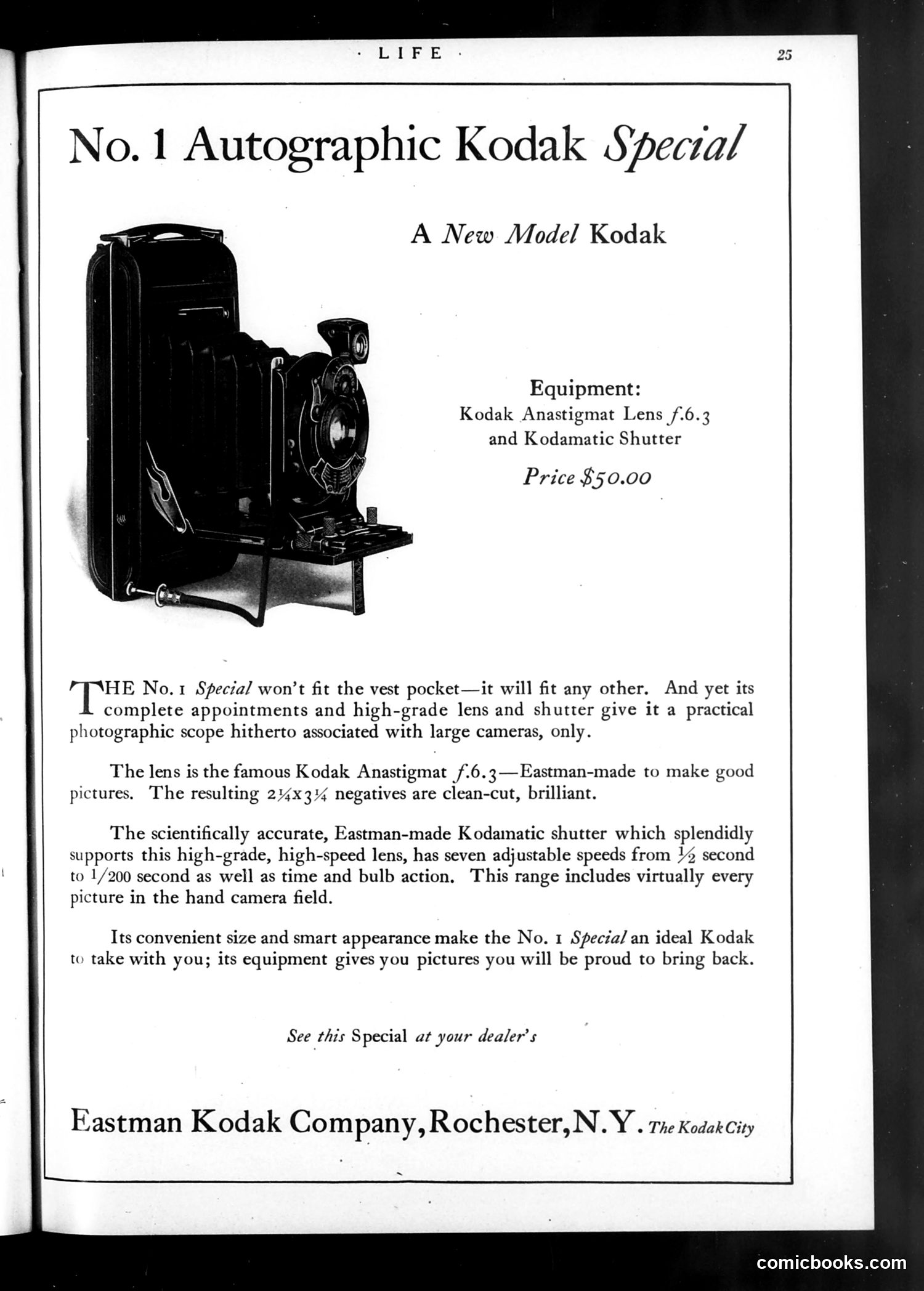
This is **not a cartoon or satire**—it's a straightforward product advertisement for Eastman Kodak Company. The page promotes the No. 1 Autographic Kodak Special camera, priced at $50.00. The ad emphasizes the camera's appeal to amateur photographers: despite not fitting in a vest pocket, it offers professional-grade features (Anastigmat lens, Kodamatic shutter with speeds from 1/2 to 1/200 second) in a compact, portable design suitable for travel photography. The text stresses convenience and quality results—"pictures you will be proud to bring back." This represents early 20th-century consumer marketing targeting middle-class hobbyists seeking accessible yet capable cameras. The emphasis on portability and ease reflects the growing amateur photography market of the era.
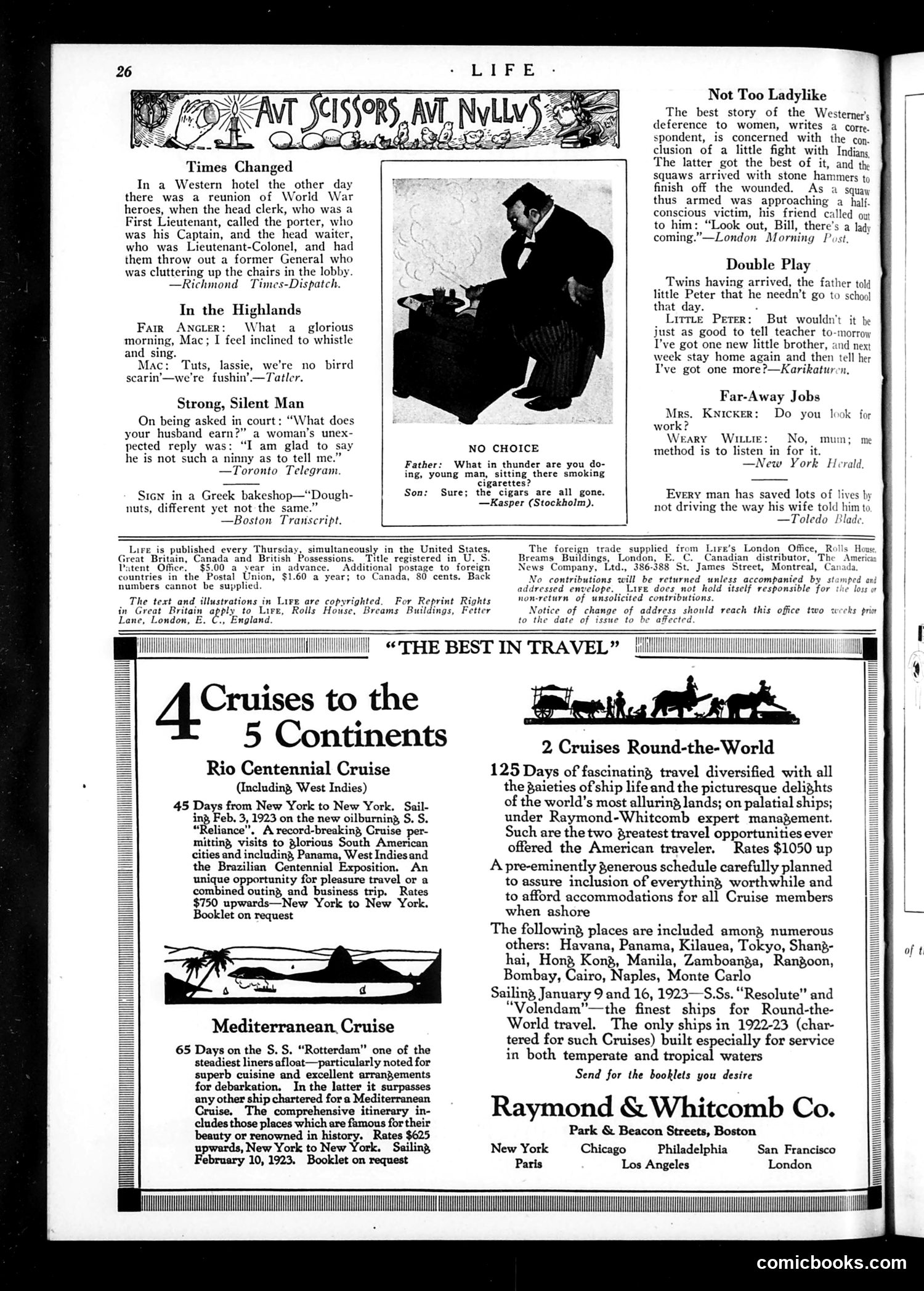
This page contains humor pieces typical of 1920s Life magazine. The central cartoon "NO CHOICE" depicts a father confronting his son smoking cigarettes, explaining he's resorted to them because "the cigars are all gone"—a joke about post-WWI tobacco scarcity or rationing effects lingering into the early 1920s. The surrounding text features short satirical anecdotes commenting on social changes: "Times Changed" mocks post-WWI role reversals where enlisted men now outrank their former officers in civilian jobs; "Not Too Ladylike" plays on frontier stereotypes; "Double Play" jokes about twin births and school attendance; "Far-Away Jobs" relies on period slang ("listen in" likely refers to radio). Most content reflects 1920s concerns: class mobility, gender roles, and the jarring social disruptions following World War I's end. The extensive travel advertisements below promote luxury cruises—indicating the magazine's affluent readership.
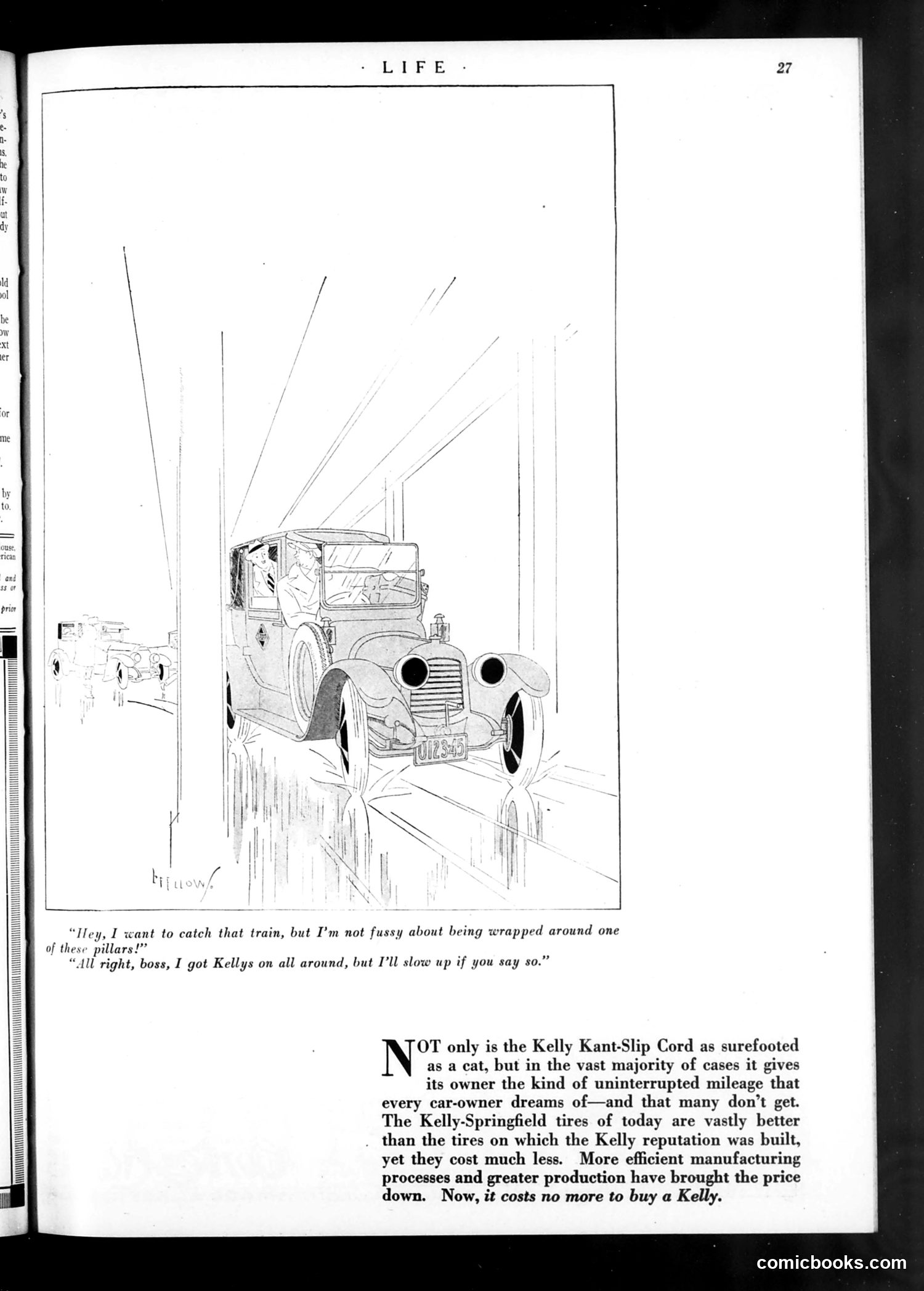
This is primarily an **advertisement for Kelly-Springfield tires**, not political satire. The cartoon illustrates a humorous scenario where a car driver urgently wants to catch a train but fears collision with a pillar. His chauffeur reassures him that the car has Kelly tires "all around" and will slow down if needed—suggesting the tires provide superior safety and control. The ad's pitch emphasizes that Kelly-Springfield tires now offer better quality at lower cost than earlier versions, due to improved manufacturing. The joke relies on the contrast between the driver's anxious urgency and the chauffeur's calm confidence in the vehicle's tire quality—implying that good tires enable both speed and safety. This appears to be 1920s-era advertising using humor to promote consumer confidence in an automotive product.
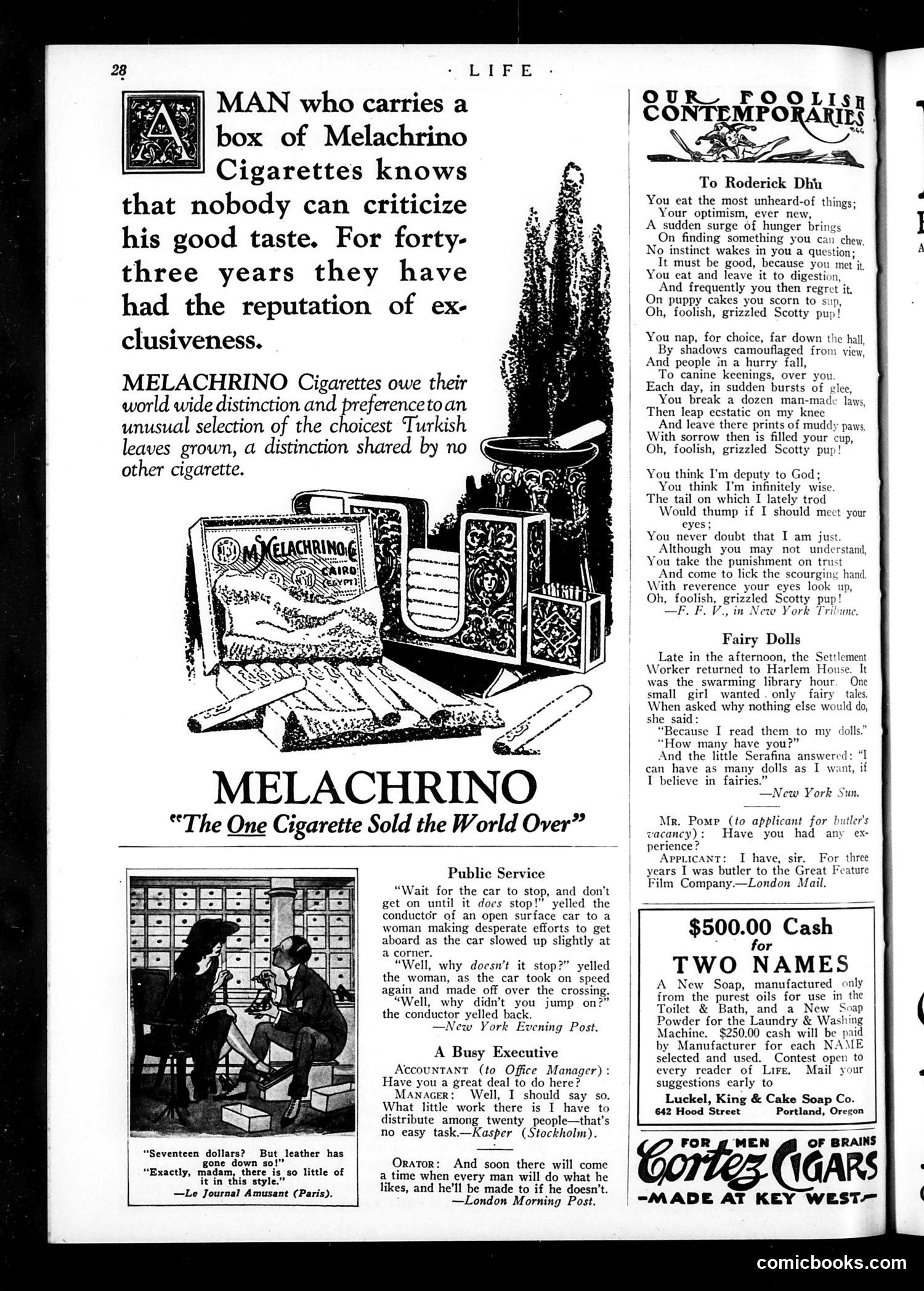
This page is primarily **advertising and humor content** rather than political satire. The dominant feature is a Melachrino Cigarettes advertisement emphasizing exclusivity and Turkish tobacco quality—a luxury brand pitch typical of 1920s marketing. The page also contains several brief **humorous anecdotes** mocking everyday situations: a woman's logic about streetcar stops, an office manager's absurdly inefficient delegation of minimal work, and an orator's paradoxical statement about freedom. These represent Life's typical satirical commentary on modern life's small absurdities. A sentimental poem addresses "Roderick Dhu," apparently a Scottish terrier, celebrating canine loyalty and foolish trust. The "Fairy Dolls" item notes a Harlem girl's belief in fairies as justification for collecting dolls—likely reflecting patronizing contemporary attitudes toward poor children's imaginative play. **Context for modern readers:** This represents Life's mix of luxury advertising and genteel satire targeting educated, affluent readers—humor about servants, bureaucratic inefficiency, and sentimental pet ownership.
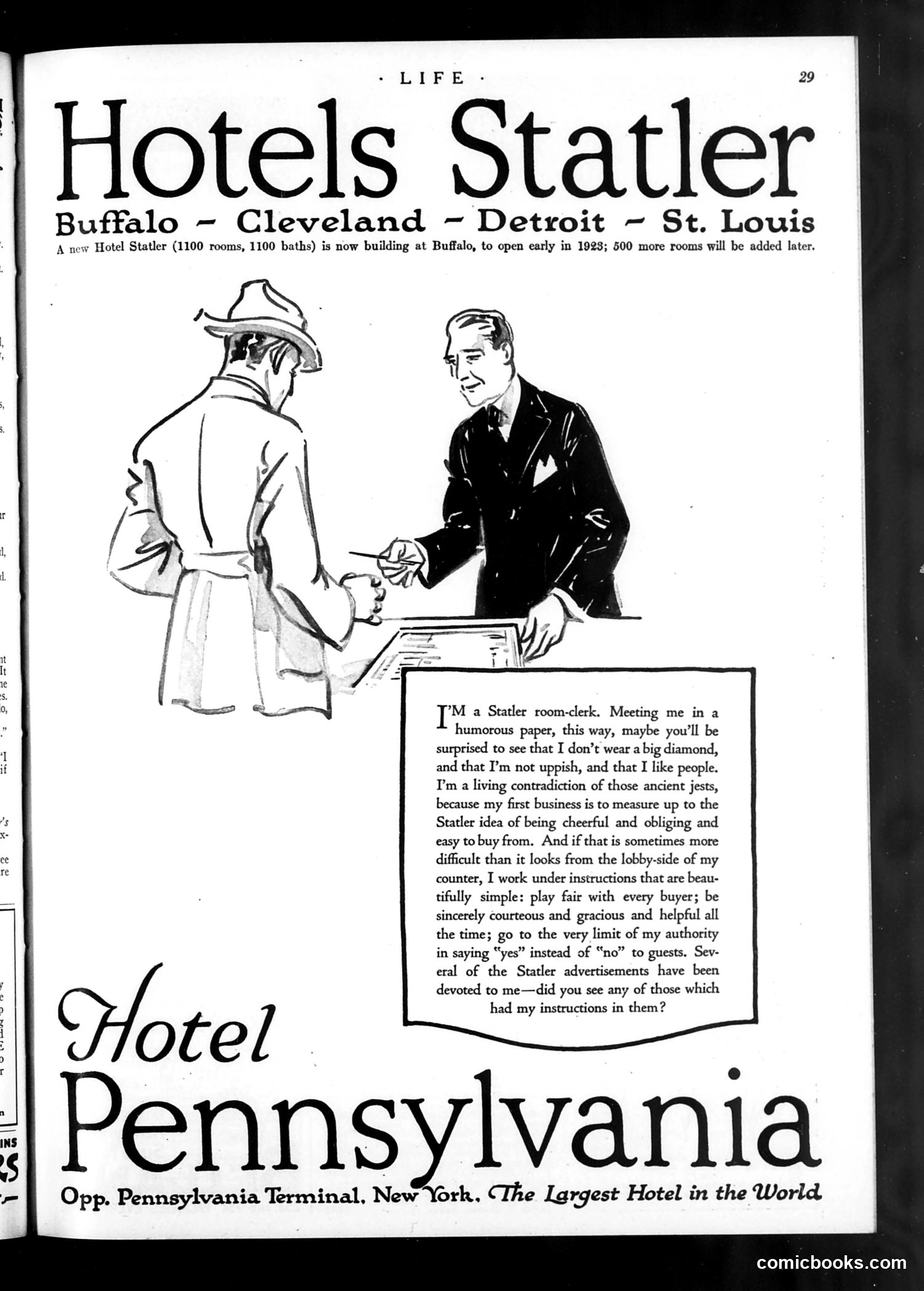
This is a **Statler Hotels advertisement** from Life magazine (page 29), not political satire. It promotes the hotel chain's expansion and brand philosophy. The illustration shows a hotel room clerk (right, in formal attire) greeting a guest (left, in coat and hat). The accompanying text is the clerk's first-person statement defending his profession against stereotype—specifically, the "ancient jests" that hotel clerks were snobbish, money-grubbing, or unfriendly. The advertisement's point: Statler Hotels differentiate themselves through genuinely courteous, helpful service. The clerk emphasizes he follows simple instructions: fairness, courtesy, and saying "yes" to guests whenever possible. This challenges outdated caricatures of hotel staff as elitist or difficult. The ad references Statler's expansion (new Buffalo location opening 1923) and positions their Pennsylvania Terminal location as "The Largest Hotel in the World"—a competitive claim. The satire is gentle corporate branding: using the humor magazine *Life* to position Statler's customer service as refreshingly unpretentious.
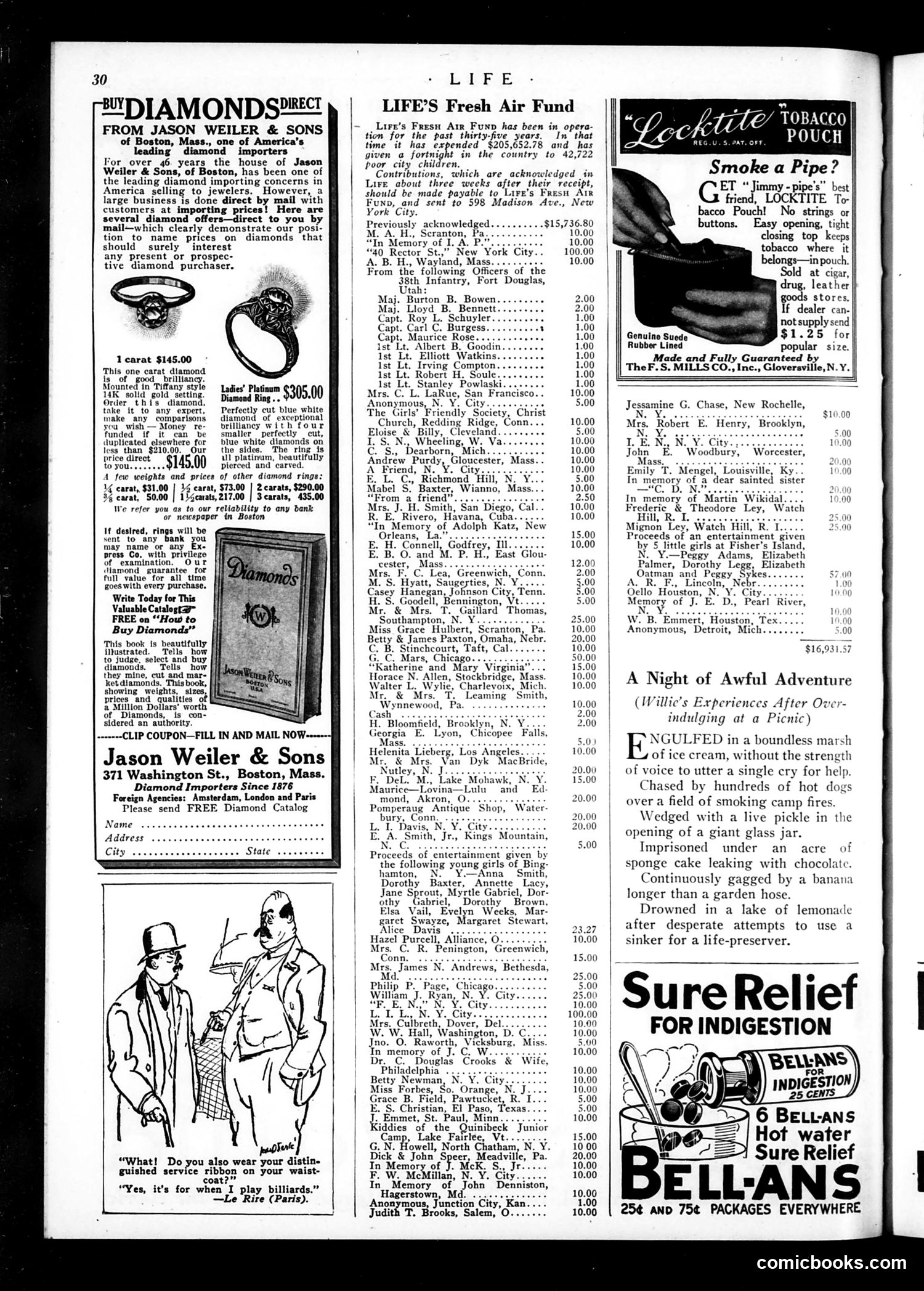
This page consists primarily of **commercial advertising** rather than editorial cartoons or satire. The main content includes: 1. **Diamond Import Advertisement** (Jason Weiler & Sons): A straightforward mail-order diamond business promoting direct sales to consumers at "importing prices," emphasizing their 46-year reputation and offering guarantees. 2. **Small Cartoon Caption** (bottom left): A brief French joke ("Le Rire," a Parisian publication) about a man wearing his military service ribbon inappropriately—on his waistcoat while playing billiards rather than on his uniform. This gentle satire mocks casual misuse of military honors. 3. **Life's Fresh Air Fund**: A charitable listing acknowledging donations to a children's welfare program, showing contributor names and amounts. 4. **Tobacco Pouch Advertisement** (Locktite brand) and **Indigestion Remedy Advertisement** (Bell-ans): Standard period product promotions. The page contains **no significant political satire or social commentary**—it's largely a commercial and philanthropic document typical of early 20th-century magazine publishing.
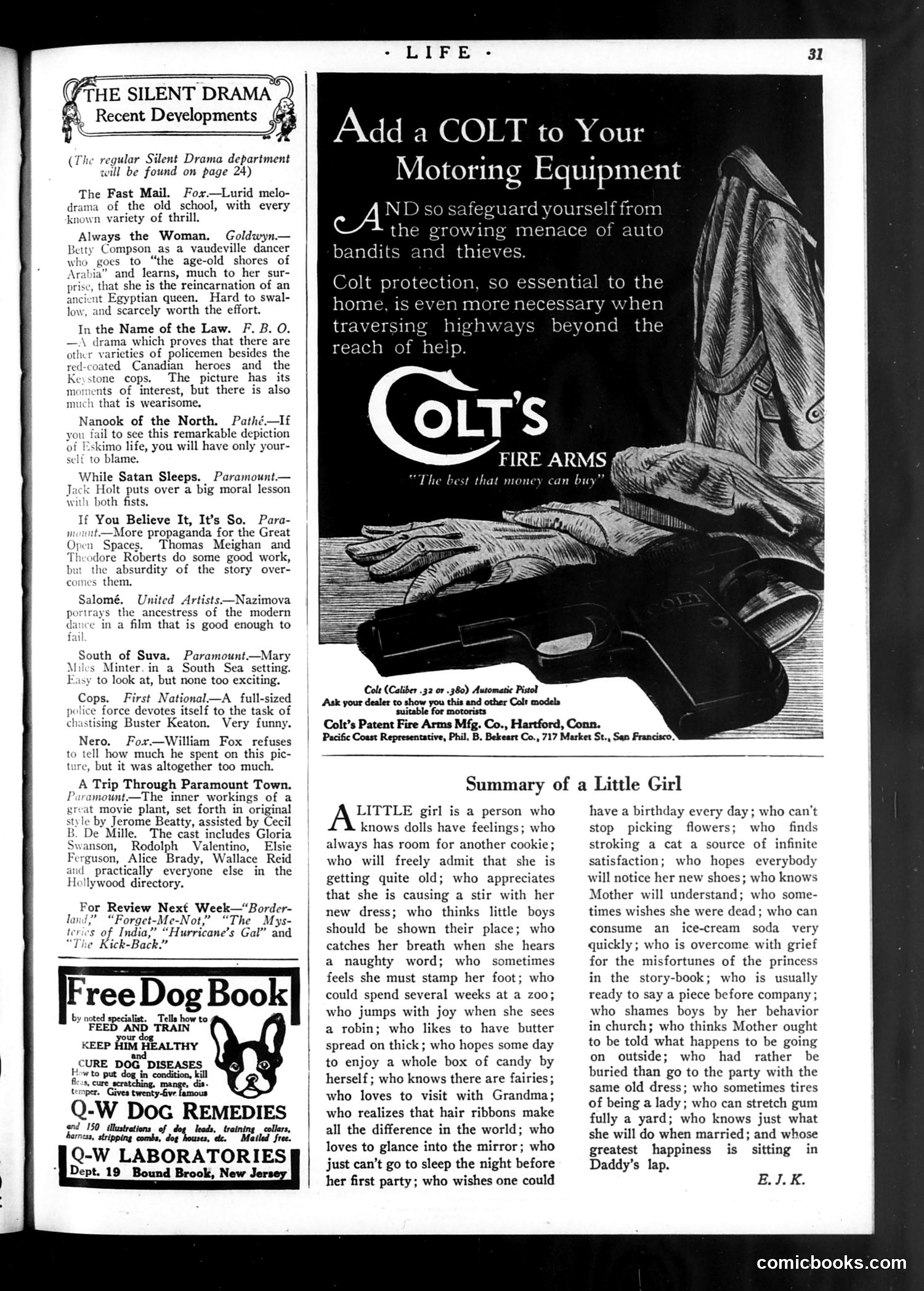
This page mixes **film reviews** with **period advertising**, lacking political cartoons. The "Silent Drama" section reviews current movies (1920s silent films), offering sarcastic criticism—praising *Nanook of the North* while dismissing *Always the Woman* as implausible (an Egyptian queen reincarnation) and *Nero* as wastefully expensive. The **Colt firearms advertisement** exploits contemporary anxiety about "auto bandits and thieves"—referring to real 1920s highway robbery and car theft epidemics—to market pistols as essential "motoring equipment" for protection. The charming **"Summary of a Little Girl"** piece humorously catalogs stereotypical childhood behaviors (loving dolls, cookies, ribbons, grandmothers, zoos) and innocent wishes, presenting idealized femininity for period readers. It's nostalgic rather than satirical. The page reflects 1920s concerns: silent cinema's artistic merit, crime waves threatening motorists, and sentimental constructions of childhood—all presented without overt political content.
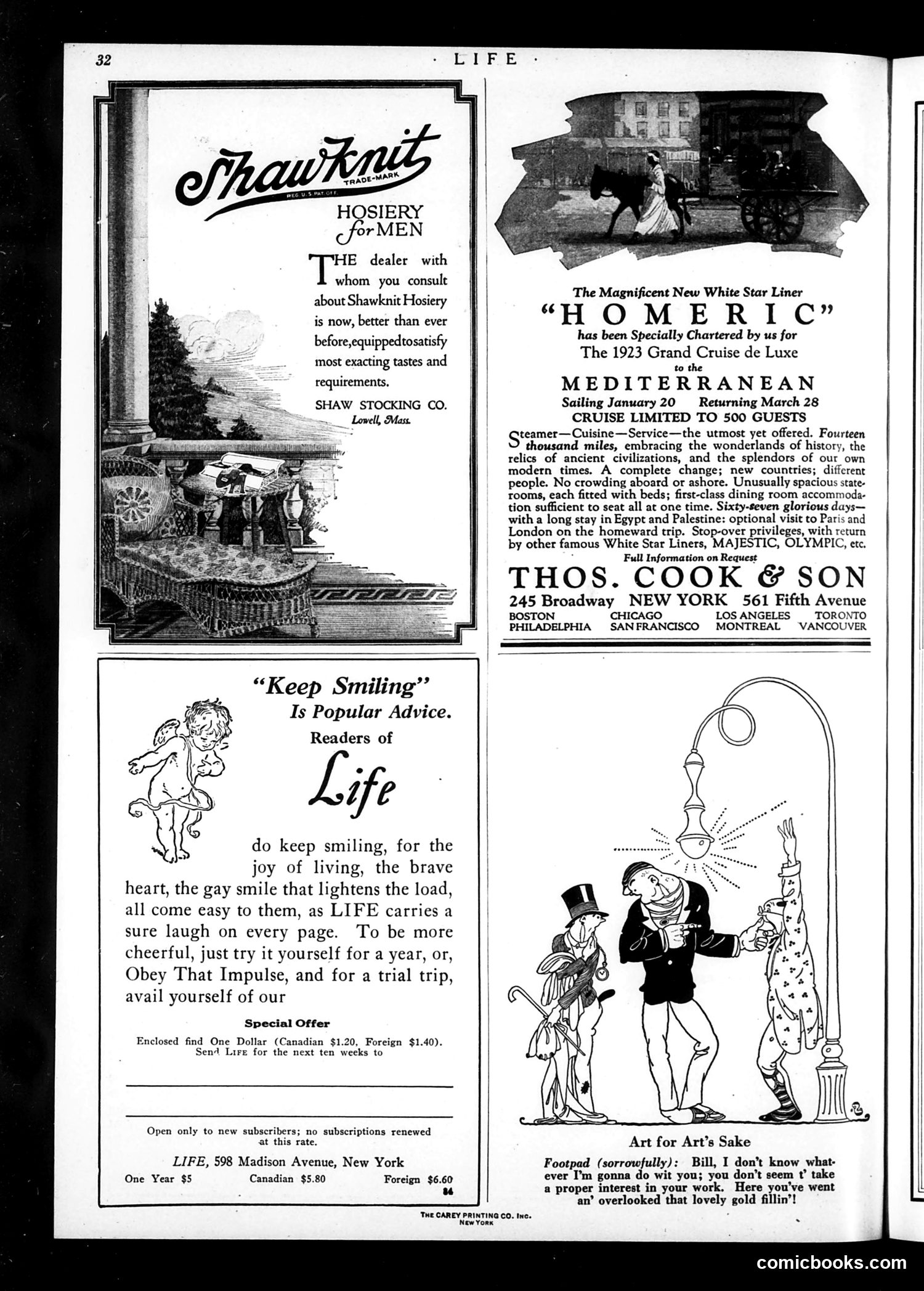
This page is primarily **advertising and subscription promotion** rather than political satire. The main content includes: **Advertisements:** Shawknit hosiery for men, a 1923 Mediterranean luxury cruise on the White Star Liner "Homeric" (67 days, limited to 500 guests), and travel services through Thomas Cook & Son. **Magazine Promotion:** Life magazine advertises itself as a source of humor and cheerfulness, encouraging subscriptions with a special offer ($1 for ten weeks). **Single Cartoon:** "Art for Art's Sake" depicts a footpad (mugger/robber) sorrowfully scolding an accomplice named Bill for overlooking a victim's gold filling during a robbery. The joke plays on criminals having professional standards—the robber is frustrated at incompetent theft technique rather than moral concerns. The page reflects 1920s American consumer culture and Life's positioning as sophisticated humor for affluent readers who could afford luxury travel and quality hosiery.
This is not a cartoon but an **advertisement for advertising itself**—a meta-promotional piece. It invokes the famous quote attributed to Davy Crockett ("Be sure you're right, then go ahead") to encourage readers to trust Life magazine's advertisements as reliable shopping guides. The piece argues that advertisements serve the public good by: - Stabilizing prices across sellers - Standardizing quality (implying only reputable products advertise) - Providing transparent cost and product information - Helping consumers make informed purchases For modern readers, this reveals early 20th-century assumptions about advertising's trustworthiness that seem naive today. The text presents advertising as essentially *consumer protection*—assuming advertisers maintain reputations through honest claims. There's no acknowledgment of persuasive manipulation or exaggeration, now standard concerns about advertising. The contact information at bottom identifies this as house advertising by Life's own advertising department, essentially promoting their own ad pages to readers.
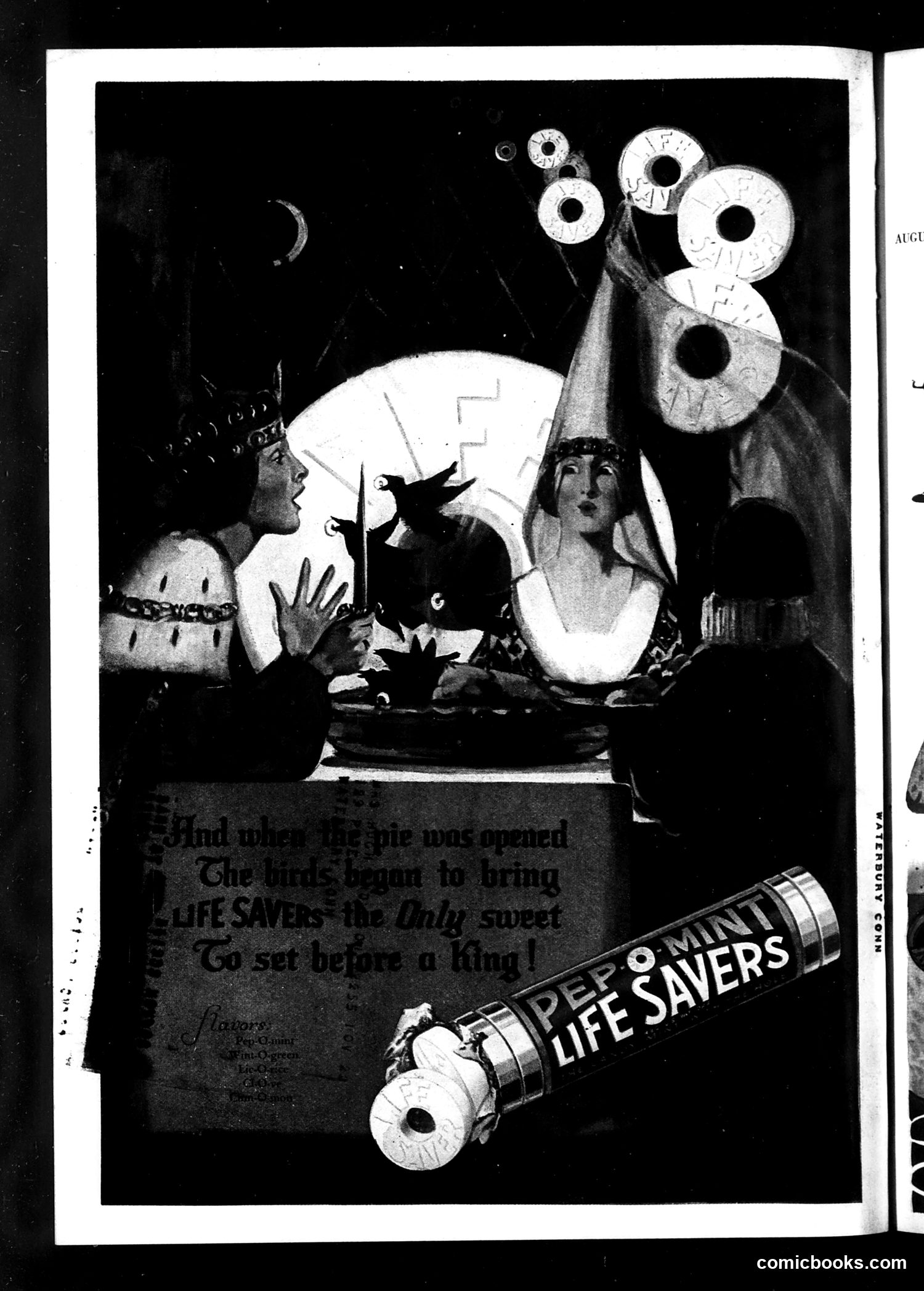
This is a **Pep-O-Mint Life Savers candy advertisement** from an early 20th-century issue of Life magazine. The surreal theatrical scene depicts two figures in elaborate costume presenting large Life Savers candies like magical treasures before a stylized king or ruler (right side). The accompanying text plays on the candy's name: "And when the pie was opened / The birds begun to bring / LIFE SAVERS in / Duly / sweet / Go set before a King!" This references the nursery rhyme "Sing a Song of Sixpence," adapting it to advertise Life Savers as a premium, regal product worthy of royalty. The elaborate fantasy staging and theatrical presentation were typical advertising techniques of the era, emphasizing the candy's desirability through imaginative, whimsical scenarios rather than straightforward product claims.