
Life, 1922-08-10 · page 8 of 36
Life — August 10, 1922 — page 8: what you’re looking at
What you’re looking at
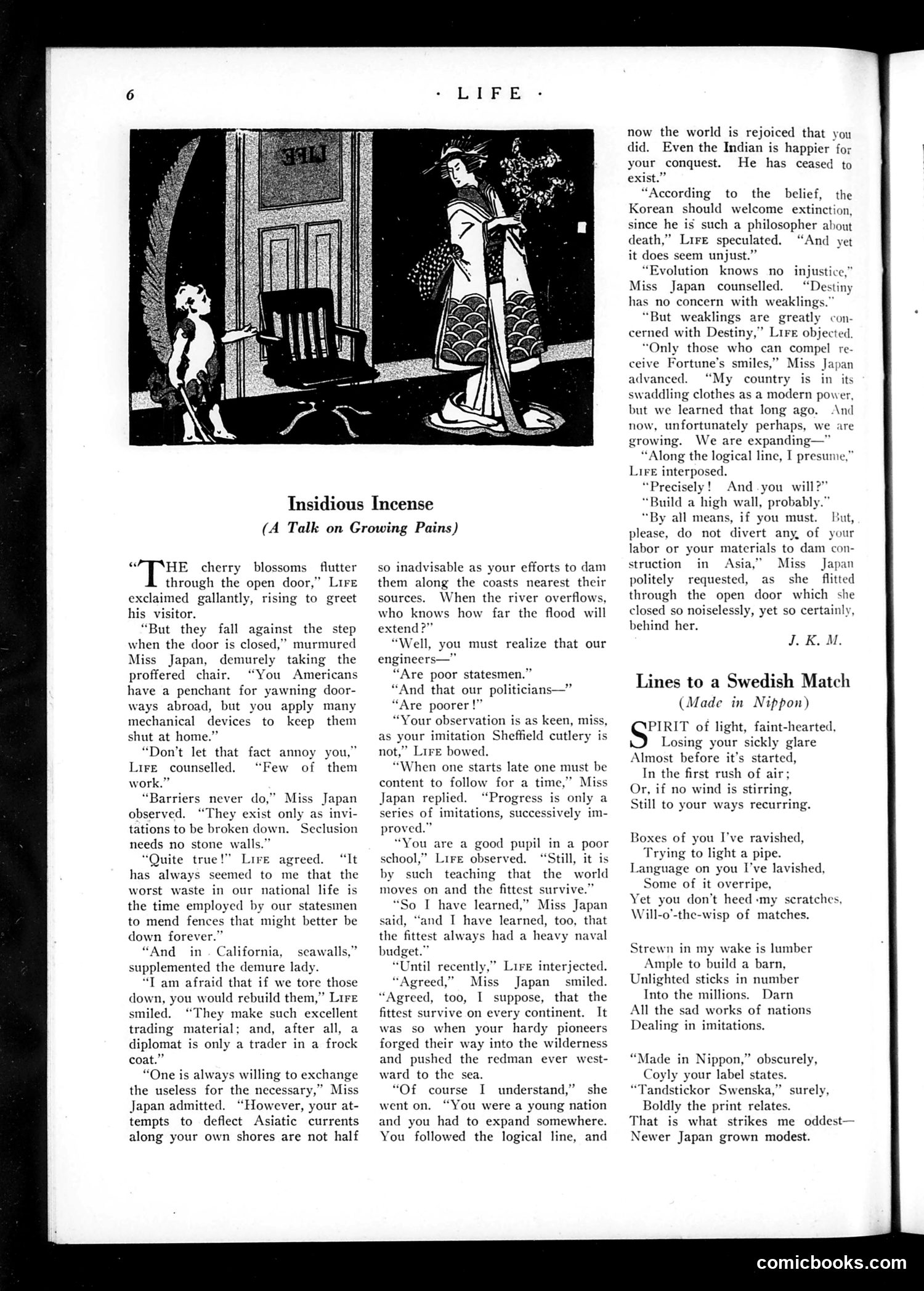
The cartoon depicts a conversation between an American woman (labeled "Miss Japan") and a Japanese figure in traditional dress, with a small dog present. The satire addresses American expansion into Asia during the early 20th century. Miss Japan expresses concerns about American imperialism—specifically damaging Asian rivers and coasts through industrial expansion. The American character dismisses these worries, arguing that "progress" justifies such efforts. The piece satirizes American justifications for colonial expansion by portraying them as self-serving rhetoric masking exploitation. The dialogue suggests America views Asian "growing pains" as inevitable and necessary, while Miss Japan represents Asian perspectives being ignored by Western powers. The "insidious incense" title implies the sweetly-scented but ultimately deceptive nature of imperialist arguments.
📄 Transcribed text from this page (OCR, searchable)
Machine-transcribed from the original scan — historical spelling and the odd misread are preserved.
Insidious Incense (A Talk on Growing Pains) “ HE cherry blossoms flutter through the open door,” Lire exclaimed gallantly, rising to greet his visitor. “But they fall against the step when the door is closed,” murmured Miss Japan, demurely taking the proffered chair. “You Americans have a penchant for yawning door- ways abroad, but you apply many mechanical devices to keep them shut at home.” Don’t let that fact annoy you,” Lire counselled. “Few of them work.” “Barriers never do,” Miss Japan observed. hey exist only as invi- tations to be broken down. Seclusion needs no stone walls.’ “Quite true!” Lire agreed. “It has always seemed to me that the worst waste in our national life is the time employed by our statesmen to mend fences that might better be down forever.” “And in. California, seawa supplemented the demure lady. “IT am afraid that if we tore those down, you would rebuild them,” Lire smiled. “They make such excellent trading material; and, after all, a diplomat is only a trader in a frock coat.” “One is always willing to exchange the useless for the necessary,” Miss Japan admitted. “However, your at- tempts to deflect Asiatic currents along your own shores are not half so inadvisable as your efforts to dam them along the coasts nearest their sources. When the river overflows, who knows how far the flood will extend?” “Well, you must realize that our engineers—" ‘Are poor statesmen.” “And that our politicians—” “Are poorer !” Your observation is as keen, miss as your imitation Sheffield cutlery is not,” Lire bowed. “When one starts late one must be content to follow for a time,” Miss Japan replied. “Progress is only a series of imitations, successively im- proved.” “You are a good pupil in a poor school,” Lire observed. “Still, it is by such teaching that the world moves on and the fittest survive.” “So I have learned,” Miss Japan said, “and I have learned, too, that the fittest always had a heavy naval budget.” “Until recently,” Lire interjected. “Agreed,” Miss Japan smiled. “Agreed, too, I suppose, that the fittest survive on every continent. It was so when your hardy pioneers forged their way into the wilderness and pushed the redman ever west- ward to the sea. “Of course I understand,” she went on. “You were a young nation and you had to expand somewhere. You followed the logical line, and now the world is rejoiced that you did. Even the Indian is happier for your conquest. He has ceased to exist.” According to the belief, the Korean should welcome extinction, since he is such a philosopher about death,” Lire speculated. “And yet it does seem unjust.” ° volution knows no_ injustice,” Miss Japan counselled. “Destiny has no concern with weaklings.” ~ “But weaklings are greatly con- cerned with Destiny,” Lire objected. Only those who can compel re- ceive Fortune's smiles,” Miss Japan advanced. “My country is in its swaddling clothes as a modern power, but we learned that long ago. And now, unfortunately perhaps, we are growing. We are expanding—” “Along the logical line, I presume,” Lire interposed. “Precisel And .you will?” “Build a high wall, probably.” “By all means, if you must. Lut, please, do not divert any, of your labor or your materials to dam con- struction in sia,” _M Japan politely requested, as she flitted through the open door which she closed so noiselessly, yet so certainly, behind her. J. K.M. Lines to a Swedish Match (Made in Nippon) eer of light, faint-hearted, Losing your sickly glare Almost before it’s started, In the first rush of air; Or, if no wind is stirring, Still to your ways recurring. 3oxes of you I've ravished, Trying to light a pipe. Language on you I've lavished, Some of it overripe, Yet you don’t heed my scratches, Will-o’-the-wisp of matches. Strewn in my wake is lumber Ample to build a barn, Unlighted sticks in number Into the millions. Darn All the sad works of nations Dealing in imitations. “Made in Nippon,” obscurely, Coyly your label states. “Tandstickor Swenska,” surely, Boldly the print relates. That is what strikes me oddest- Newer Japan grown modest. comicbooks.com