
Life, 1922-08-10 · page 22 of 36
Life — August 10, 1922 — page 22: what you’re looking at
What you’re looking at
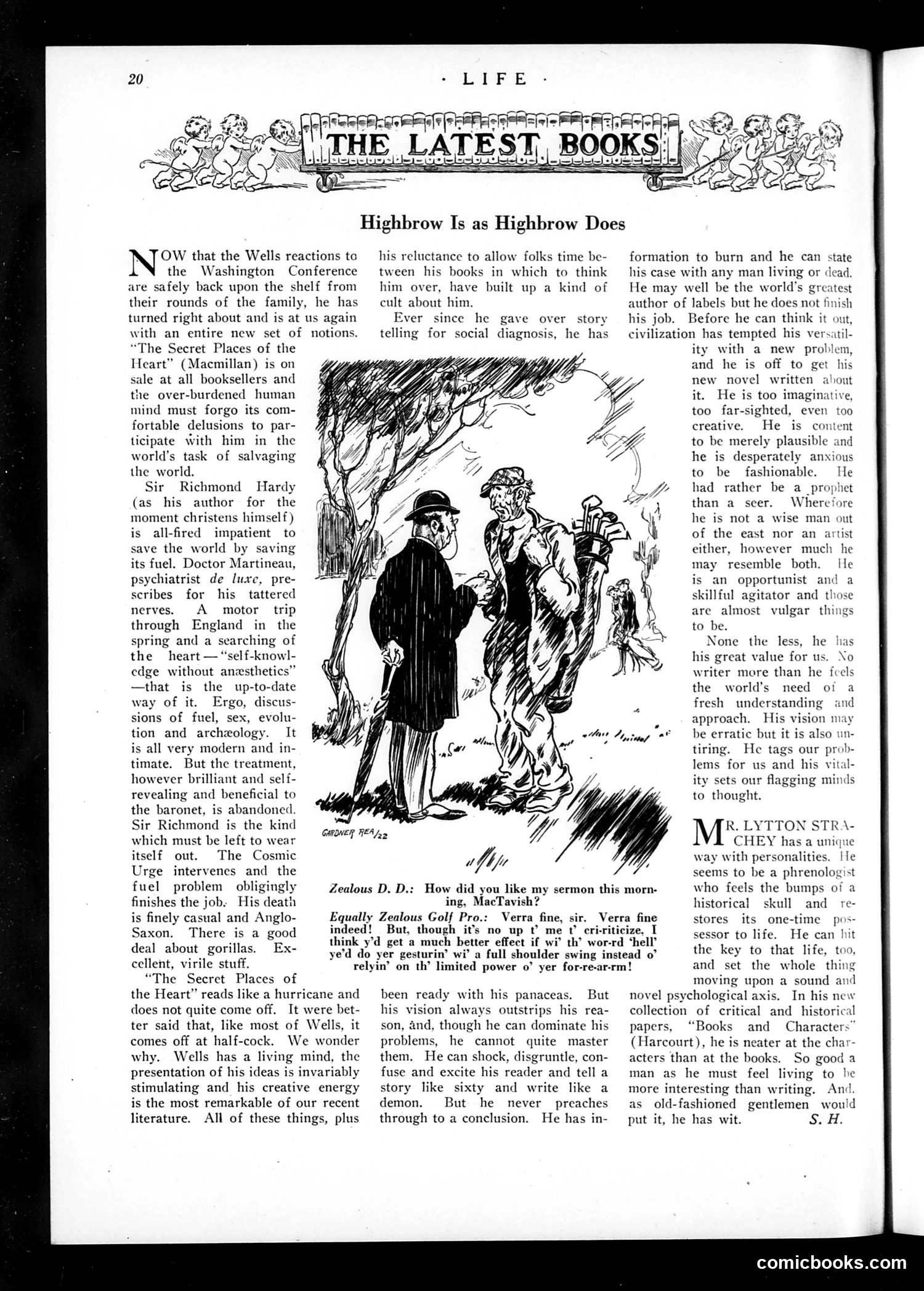
This page reviews H.G. Wells' novel *The Secret Places of the Heart* and critiques Wells himself as a public intellectual. The cartoon depicts a clergyman (labeled "Zealous D.D.") and a golf pro—both self-appointed experts offering unsolicited advice on matters outside their expertise. The satire targets Wells specifically: the review praises his brilliance and vital energy but criticizes him for abandoning ideas before fully developing them, jumping between causes (fuel conservation, social diagnosis), and prioritizing being fashionable over being profound. He's compared unfavorably to prophets and seers—more "opportunist and skillful agitator" than artist or wise man. The cartoon's parallel structure suggests Wells resembles these bumbling "highbrows"—earnest but overconfident figures dispensing half-baked opinions beyond their depth. The title "Highbrow Is as Highbrow Does" implies intellectual pretension without substance.
📄 Transcribed text from this page (OCR, searchable)
Machine-transcribed from the original scan — historical spelling and the odd misread are preserved.
OE PFE THE LA BO OW that the Wells reactions to the Washington Conference are safely back upon the shelf from their rounds of the family, he has turned right about and is at us again with an entire new set of notions. “The Secret Places of the Heart” (Macmillan) is on sale at all booksellers and the over-burdened human mind must forgo its com- fortable delusions to par- ticipate with him in the world’s task of salvaging the world. Sir Richmond Hardy (as his author for the moment christens himself) is all-fired impatient to save the world by saving its fuel. Doctor Martineau, psychiatrist de luxe, pre- scribes for his tattered nerves. A motor trip through England in the spring and a searching of the heart — “self-knowl- edge without anesthetics” —that is the up-to-date way of it. Ergo, discus- sions of fuel, sex, evolu- tion and archeology. It is all very modern and in- timate. But the treatment, however brilliant and self- revealing and beneficial to the baronet, is abandoned. Sir Richmond is the kind which must be left to wear itself out. The Cosmic Urge intervenes and the fuel problem obligingly finishes the job. His death is finely casual and Anglo- Saxon. There is a good deal about gorillas. Ex- cellent, virile stuff. “The Secret Places of the Heart” reads like a hurricane and does not quite come off. It were bet- ter said that, like most of Wells, it comes off at half-cock. We wonder why. Wells has a living mind, the presentation of his ideas is invariably stimulating and his creative energy is the most remarkable of our recent literature. All of these things, plus Equally Zealous Golf Pro.: indeed! think y’d get a much better effect if wi’ th’ wor-r ye’d do yer gesturin’ wi’ a full shoulder swing instead 0” relyin’ on th’ limited power o” yer for-re-ar-rm! TEST, his reluctance to allow folks time be- tween his books in which to think him over, have built up a kind of cult about him. Ever since he gave over story telling for social diagnosis, he has GerovER FEA xe a Vr Zealous D. D.: How did you like my sermon this morn- ing, MacTavish? Verra fine, But, though it’s no up t’ me t’ been ready with his panaceas. But his vision always outstrips his rea- son, and, though he can dominate his problems, he cannot quite master them. He can shock, disgruntle, con- fuse and excite his reader and tell a story like sixty and write like a demon. But he never preaches through to a conclusion. He has in- Verra fine ize. Highbrow Is as Highbrow Does formation to burn and he can state his case with any man living or dead, He may well be the world’s greatest author of labels but he does not finish his job. Before he can think it out, civilization has tempted his versatil- ity with a new problem, and he is off to get his new novel written out it. He is too imaginative, too far-sighted, even too creative. He is content to be merely plausible and he is desperately anxious to be fashionable. He had rather be a_ prophet than a seer. Wherefore he is not a wise man out of the east nor an artist either, however much he may resemble both. [He is an opportunist and a skillful agitator and those are almost vulgar things to be. None the less, he has his great value for us. No writer more than he fcels the world’s need of a fresh understanding and approach. His vision may be erratic but it is also un- tiring. He tags our prob- lems for us and his vital- ity sets our flagging minds to thought. R. LYTTON STRA- CHEY has a unique way with personalities. He seems to be a phrenologist who feels the bumps of a historical skull and re- stores its one-time pos- sessor to life. He can hit the key to that life, too, and set the whole thing moving upon a sound and novel psychological axis. In his new collection of critical and historical papers, “Books and Characters” (Harcourt), he is neater at the char- acters than at the books. So good a man as he must feel living to he more interesting than writing. And. as old-fashioned gentlemen would put it, he has wit. S.H. ‘shell’ comicbooks.com