
Life, 1922-08-10 · page 26 of 36
Life — August 10, 1922 — page 26: what you’re looking at
What you’re looking at
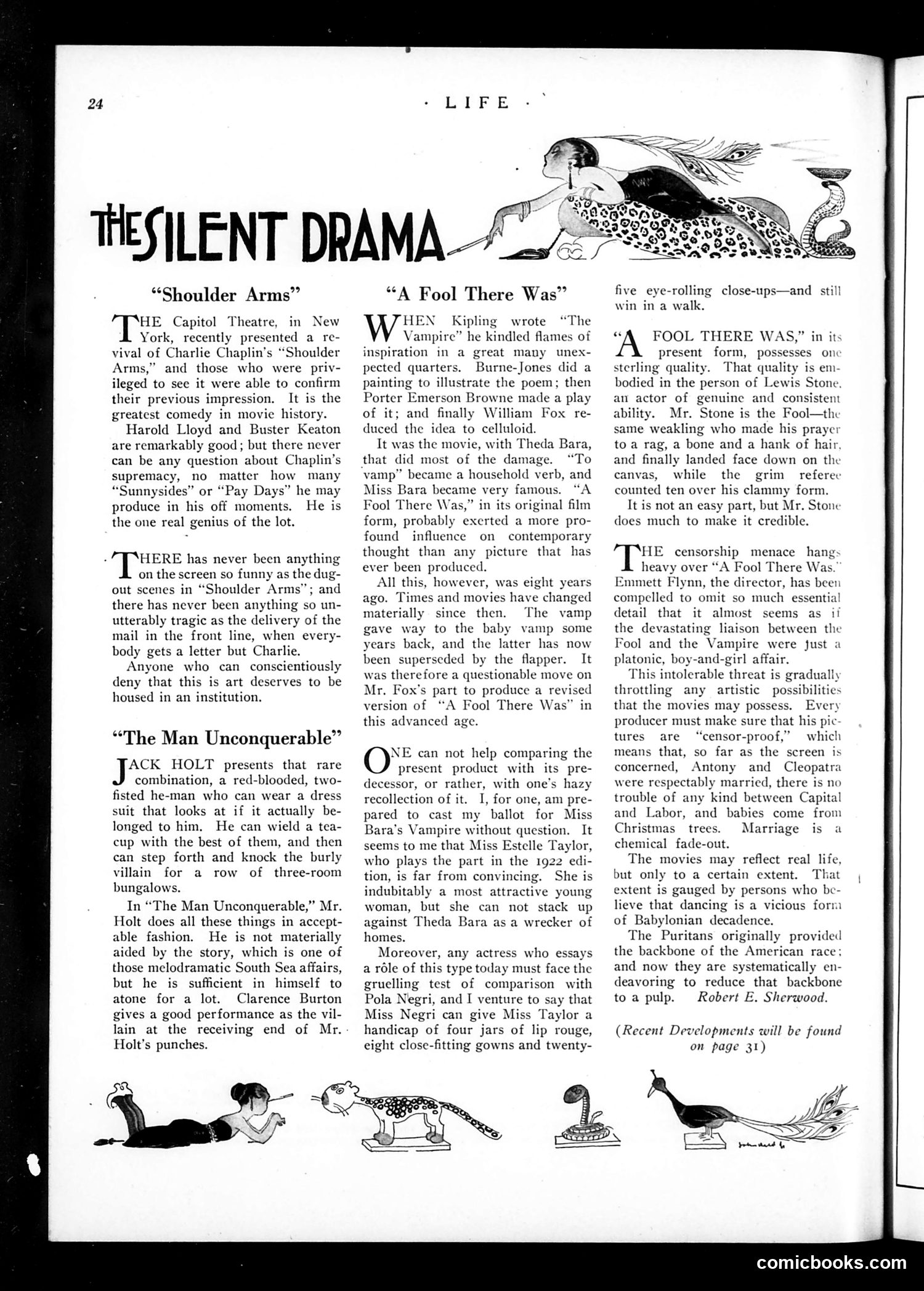
This page contains three film reviews from the early 1920s. The critic praises Charlie Chaplin's *Shoulder Arms* as cinema's greatest comedy, particularly its tragic mail-delivery scene. *The Man Unconquerable* features actor Jack Holt as a masculine lead who can both wear formal dress and fight villains—a common "he-man" character type of silent film era. The most substantial review addresses *A Fool There Was*, a 1922 remake of an earlier 1915 film starring Theda Bara. The critic argues that while the original popularized the "vamp" archetype (making it a household verb), the remake with Estelle Taylor pales in comparison. He suggests that contemporary audiences now have better options, particularly citing Pola Negri as a superior performer of such roles. The review reflects how rapidly silent film conventions and star power shifted in the early 1920s.
📄 Transcribed text from this page (OCR, searchable)
Machine-transcribed from the original scan — historical spelling and the odd misread are preserved.
TESILENT DRAMA“ “Shoulder Arms” HE Capitol Theatre, in New York, recently presented a re- vival of Charlie Chaplin’s “Shoulder Arms,” and those who were priv- ileged to see it were able to confirm their previous impression. It is the greatest comedy in movie history. Harold Lloyd and Buster Keaton are remarkably good; but there never can be any question about Chaplin’s supremacy, no matter how many “Sunnysides” or “Pay Days” he may produce in his off moments. He is the one real genius of the lot. HERE has never been anything on the screen so funny as the dug- out scenes in “Shoulder Arms”; and there has never been anything so un- utterably tragic as the delivery of the mail in the front line, when every- body gets a letter but Charlie. Anyone who can conscientiously deny that this is art deserves to be housed in an institution. “The Man Unconquerable” ACK HOLT presents that rare combination, a red-blooded, two- fisted he-man who can wear a dress suit that looks at if it actually be- longed to him, He can wield a tea- cup with the best of them, and then can step forth and knock the burly villain for a row of three-room bungalows. In “The Man Unconquerable,” Mr. Holt does all these things in accept- able fashion. He is not materially aided by the story, which is one of those melodramatic South Sea affairs, but he is sufficient in himself to atone for a lot. Clarence Burton gives a good performance as the vil- lain at the receiving end of Mr. Holt’s punches. “A Fool There Was” HEN Kipling wrote “The Vampire” he kindled flames of inspiration in a great many unex- pected quarters. Burne-Jones did a painting to illustrate the poem; then Porter Emerson Browne made a play of it; and finally William Fox re- duced the idea to celluloid. It was the movie, with Theda Bara, that did most of the damage. “To vamp” became a household verb, and Miss Bara became very famous. “A Fool There Was,” in its original film form, probably exerted a more pro- found influence on contemporary thought than any picture that has ever been produced. All this, however, was eight years ago. Times and movies have changed materially since then. The vamp gave way to the baby vamp some years back, and the latter has now been superseded by the flapper. It was therefore a questionable move on Mr. Fox's part to produce a revised ion of “A Fool There Was” in advanced age. NE can not help comparing the present product with its pre- decessor, or rather, with one’s hazy recollection of it. I, for one, am pre- pared to ¢ my ballot for Miss Bara’s Vampire without question. It seems to me that Miss Estelle Taylor, who plays the part in the 1922 edi- tion, is far from convincing. She is indubitably a most attractive young woman, but she can not stack up against Theda Bara as a wrecker of homes. Moreover, any actress who essays a role of this type today must face the gruelling test of comparison with Pola Negri, and I venture to say that Miss Negri can give Miss Taylor a handicap of four jars of lip rouge, eight close-fitting gowns and twenty- five eye-rolling close-ups—and still win in a walk. FOOL THERE WAS,” in its present form, po sterling quality. That quality is em- bodied in the person of Lewis Stone. an actor of genuine and consistent ability. Mr. Stone is the Fool—th: same weakling who made his prayer to a rag, a bone and a hank of hair and finally landed face down on the canvas, while the grim referee counted ten over his clammy form. It is not an easy part, but Mr. Stone does much to make it credible. ses Onl HE censorship menace hangs heavy over “A Fool There Was. Emmett Flynn, the director, has been compelled to omit so much essential detail that it almost seems as ii the devastating liaison between the Fool and the Vampire were just a platonic, boy-and-girl affair. This intolerable threat is gradually throttling any artistic possibilities that the movies may possess. Every producer must make sure that his pic tures are “censor-proof,” which means that, so far as the screen is concerned, Antony and Cleopatra were respectably married, there is no trouble of any kind between Capital and Labor, and babies come from Christmas trees. Marriage is a chemical fade-out. The movies may reflect real life, but only to a certain extent. That extent is gauged by persons who be- lieve that dancing is a vicious form of Babylonian decadence. The Puritans originally provided the backbone of the American race; and now they are systematically en- deavoring to reduce that backbone toa pulp. Robert E. Sherwood. (Recent Developments will be found on page 31) comicbooks.com