
Life, 1922-08-10 · page 25 of 36
Life — August 10, 1922 — page 25: what you’re looking at
What you’re looking at
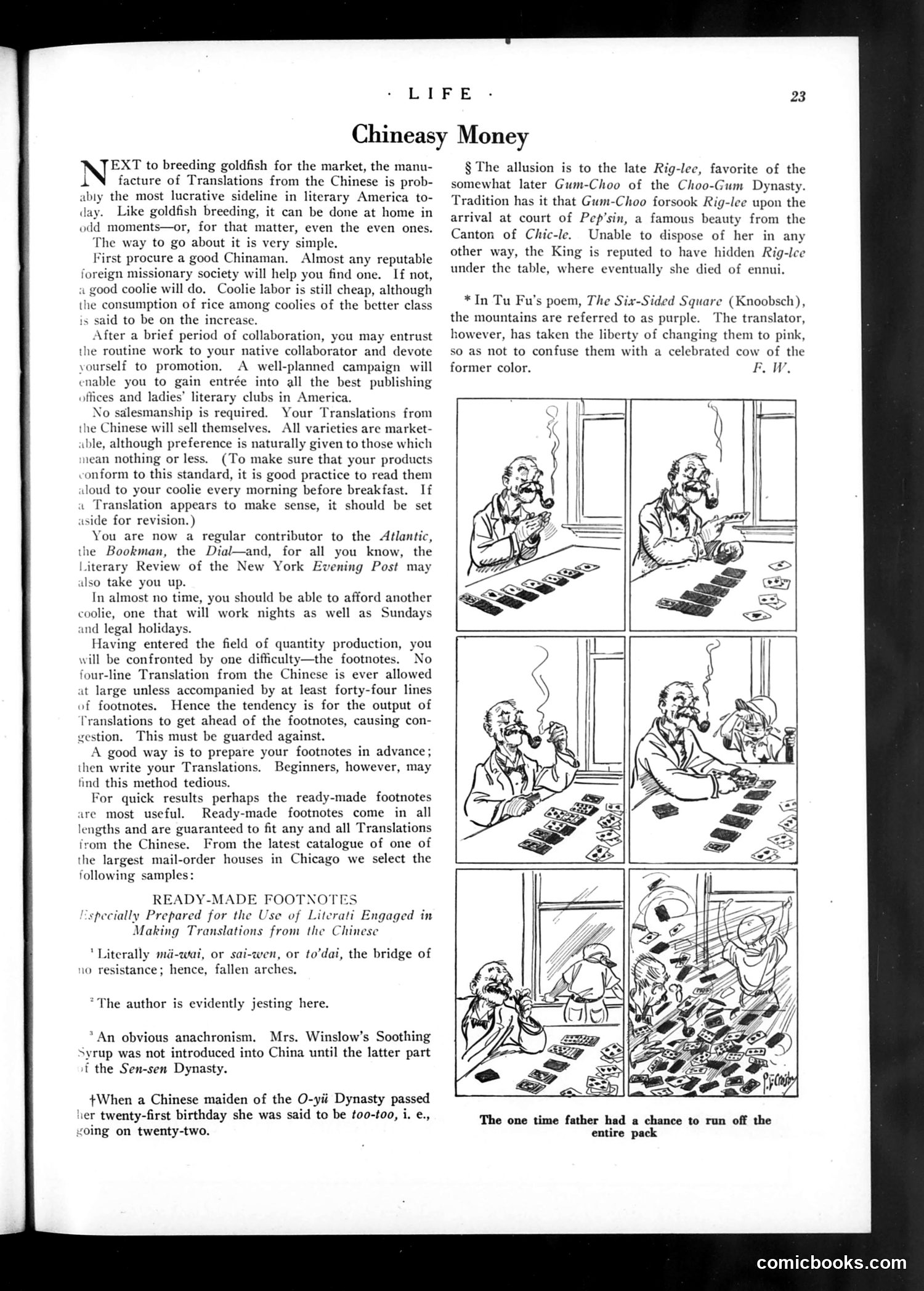
This article satirizes the early 20th-century literary craze for translations of Chinese poetry and philosophy. The text mocks how American publishers and literati eagerly published Chinese translations with minimal effort or understanding. The joke: anyone could manufacture these translations profitably by hiring cheap Chinese labor (a "coolie"), then padding the work with lengthy, often nonsensical footnotes—a requirement Life claims was forty-four lines of footnotes per four lines of translation. The satirical "ready-made footnotes" specimen demonstrate the absurdity: fabricated etymologies, fake dynasties ("Choo-Gum Dynasty"), and ridiculous explanations pretending scholarly gravitas while discussing commercial products like Mrs. Winslow's Syrup and Pep'sin as if they were ancient Chinese references. The accompanying comic strip (right) illustrates a man arranging dominoes—a visual metaphor for how these translations were mechanically assembled without genuine insight. The satire targets both the commercialization of "exotic" literature and American intellectual pretension.
📄 Transcribed text from this page (OCR, searchable)
Machine-transcribed from the original scan — historical spelling and the odd misread are preserved.
- LIFE Chineasy Money EXT to breeding goldfish for the market, the manu- facture of Translations from the Chinese is prob- ably the most lucrative sideline in literary America to- day. Like goldfish breeding, it can be done at home in odd moments—or, for that matter, even the even ones. The way to go about it is very simple. First procure a good Chinaman. Almost any reputable foreign missionary society will help you find one. If not, x good coolie will do, Coolie labor is still cheap, although the consumption of rice among coolies of the better class is said to be on the increase. After a brief period of collaboration, you may entrust the routine work to your native collaborator and devote yourself to promotion. A well-planned campaign will enable you to gain entrée into all the best publishing fh literary clubs in America. p is required. Your Translations from the Chinese will sell themselves. All varieties are market- ible, although preference is naturally given to those which 1ean nothing or less. (To make sure that your products onform to this standard, it is good practice to read them loud to your coolie every morning before breakfast. If . Translation appears to make sense, it should be set aside for revision.) You are now a regular contributor to the Atlantic, the Bookman, the Dial—and, for all you know, the Literary Review of the New York Evening Post may ilso take you up. In almost no time, you should be able to afford another coolie, one that will work nights as well as Sundays ind legal holidays. Having entered the field of quantity production, you will be confronted by one difficulty—the footnotes. No four-line Translation from the Chinese is ever allowed at large unless accompanied by at least forty-four lines of footnotes. Hence the tendency is for the output of lranslations to get ahead of the footnotes, causing con- gestion. This must be guarded against. A good way is to prepare your footnotes in advance; then write your Translations. Beginners, however, may find this method tedious. For quick results perhaps the ready-made footnotes are most useful. Ready-made footnotes come in all lengths and are guaranteed to fit any and all Translations from the Chinese. From the latest catalogue of one of the largest mail-order houses in Chicago we select the following samples: READY-MADE FOOTNOT specially Prepared for the Use of Literati Engaged in Making Translations from the Chinese ‘Literally mié-wai, or sai-wen, or to’dai, the bridge of no resistance; hence, fallen arches. *The author is evidently jesting here. ‘An obvious anachronism, Mrs. Winslow’s Soothing Syrup was not introduced into China until the latter part ft the Sen-sen Dynasty. +When a Chinese maiden of the O-yii Dynasty passed .er twenty-first birthday she was said to be too-too, i. e., xoing on twenty-two. § The allusion is to the late Rig-lee, favorite of the somewhat later Gum-Choo of the Choo-Gum Dynasty. Tradition has it that Gum-Choo forsook Rig-lee upon the arrival at court of Pep’sin, a famous beauty from the Canton of Chic-le. Unable to dispose of her in any other way, the King is reputed to have hidden Rig-lce under the table, where eventually she died of ennui. *In Tu Fu’s poem, The Six-Sided Square (Knoobsch), the mountains are referred to as purple. The translator, however, has taken the liberty of changing them to pink, so as not to confuse them with a celebrated cow of the former color. FLW. The one time father had a chance to run off the entire pack comicbooks.com