
Life, 1922-08-10 · page 16 of 36
Life — August 10, 1922 — page 16: what you’re looking at
What you’re looking at
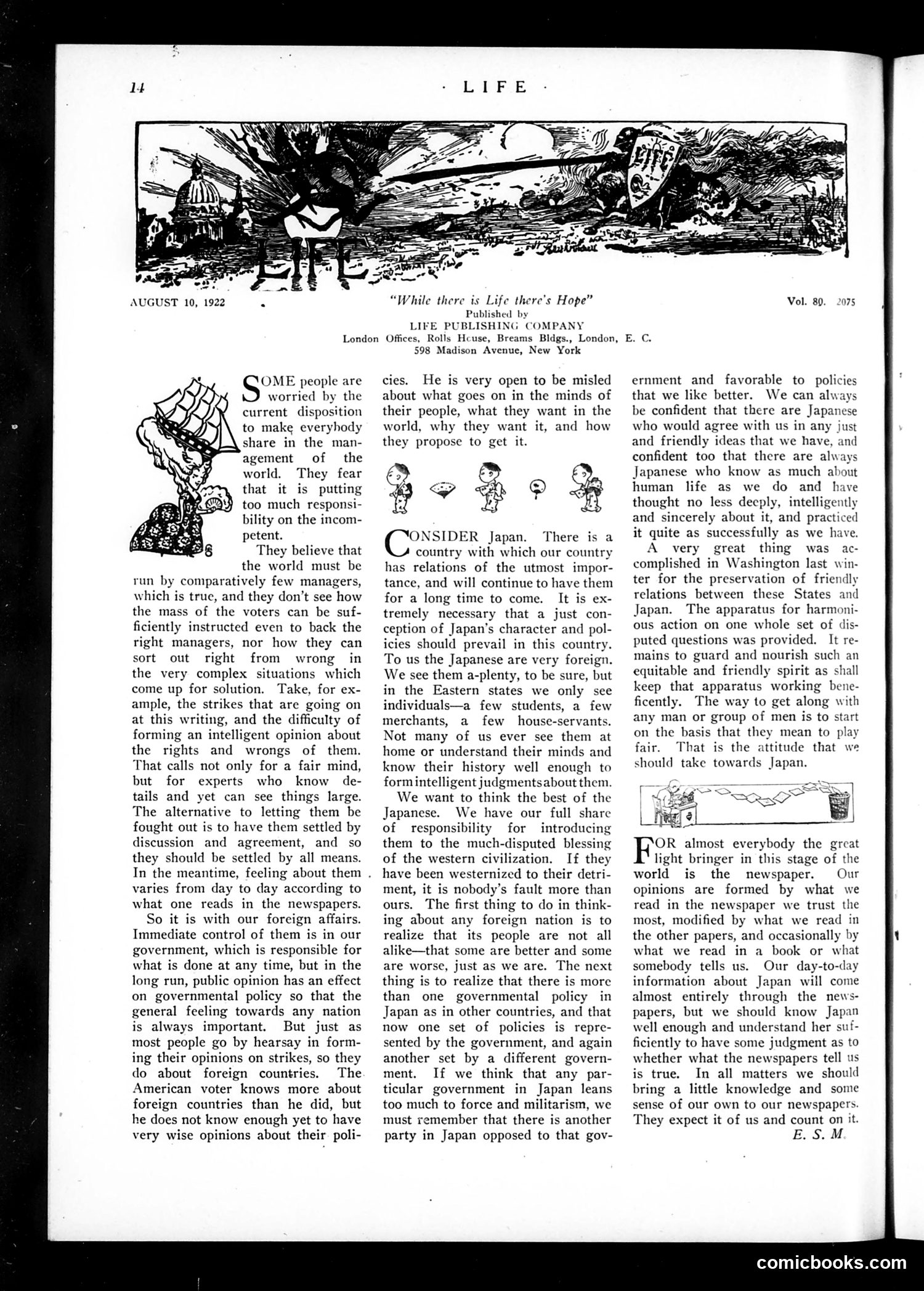
The page features an editorial essay titled "While there is Life there's Hope" discussing American-Japanese relations. The accompanying political cartoon (upper left) appears to show a figure wielding a club or weapon amid chaotic imagery including a burning building and military elements, likely satirizing concerns about Japanese militarism or foreign policy aggression. The essay argues for informed American public opinion about Japan, asserting that Americans know too little about foreign nations to form wise judgments. It advocates understanding Japan's perspective while maintaining skepticism about its government's militaristic policies, which the author suggests contradict peaceful elements within Japanese society. The cartoon reinforces anxieties about Japan's imperial ambitions prevalent in 1920s American discourse.
📄 Transcribed text from this page (OCR, searchable)
Machine-transcribed from the original scan — historical spelling and the odd misread are preserved.
AUGUST 10, 1922 “While there is Life there's Hope” Published by LIFE PUBLISHING COMPANY Vol. 89. 2075 London Offices, Rolls Hcuse, Breams Bldgs., London, E. C. S' )ME people are worried by the current disposition to make everyhody share in the man- agement of the world. They fear that it is putting too much responsi- bility on the incom- petent. They believe that the world must be run by comparatively few managers, which is true, and they don’t see how the mass of the voters can be suf- ficiently instructed even to back the right managers, nor how they can sort out right from wrong in the very complex situations which come up for solution. Take, for ex- ample, the strikes that are going on at this writing, and the difficulty of forming an intelligent opinion about the rights and wrongs of them. That calls not only for a fair mind, but for experts who know de- tails and yet can see things large. The alternative to letting them be fought out is to have them settled by discussion and agreement, and so they should be settled by all means. In the meantime, feeling about them . varies from day to day according to what one reads in the newspapers. So it is with our foreign affairs. Immediate control of them is in our government, which is responsible for what is done at any time, but in the long run, public opinion has an effect on governmental policy so that the general feeling towards any nation is always important. But just as most people go by hearsay in form- ing their opinions on strikes, so they do about foreign countries. The American voter knows more about foreign countries than he did, but he does not know enough yet to have very wise opinions about their poli- 598 Madison Avenue, New York cies. He is very open to be misled about what goes on in the minds of their people, what they want in the world, why they want it, and how they propose to get it. IONSIDER Japan. There is a country with which our country has relations of the utmost impor- tance, and will continue to have them for a long time to come. It is ex- tremely necessary that a just con- ception of Japan’s character and pol- icies should prevail in this country To us the Japanese are very foreign. We see them a-plenty, to be sure, but in the Eastern states we only see individuals—a few students, a few merchants, a few house-servants. Not many of us ever see them at home or understand their minds and know their history well enough to form intelligent judgmentsabout them. We want to think the best of the Japanese. We have our full share of responsibility for introducing them to the much-disputed blessing of the western civilization. If they have been westernized to their detri- ment, it is nobody’s fault more than ours. The first thing to do in think- ing about any foreign nation is to realize that its people are not all alike—that some are better and some are worse, just as we are. The next thing is to realize that there is more than one governmental policy in Japan as in other countries, and that now one set of policies is repre- sented by the government, and again another set by a different govern- ment. If we think that any par- ticular government in Japan leans too much to force and militarism, we must remember that there is another party in Japan opposed to that gov- ernment and favorable to policies that we like better. We can alw be confident that there are Japanese who would agree with us in any just and friendly ideas that we have, and confident too that there are alway Japanese who know as much about human life as we do and have thought no less deeply, intelligently and sincerely about it, and practiced it quite as successfully as we have. A very great thing was ac- complished in Washington last win- ter for the preservation of friendly relations between these States and Japan. The apparatus for harmoni- ous action on one whole set of di puted questions was provided. It re- mains to guard and nourish such an equitable and friendly spirit as shall keep that apparatus working bene- ficently. The way to get along with any man or group of men is to start on the basis that they mean to play fair. That is the attitude that we should take towards Japan. OR almost everybody the great light bringer in this stage of the world is the newspaper. Our opinions are formed by what we read in the newspaper we trust the most, modified by what we read in the other papers, and occasionally by what we read in a book or what somebody tells us. Our day-to-day information about Japan will come almost entirely through the news- papers, but we should know Japan well enough and understand her suf- ficiently to have some judgment as to whether what the newspapers tell us is true. In all matters we should bring a little knowledge and some sense of our own to our newspapers. They expect it of us and count on it. E. S.M comicbooks.com