
Life, 1922-08-10 · page 11 of 36
Life — August 10, 1922 — page 11: what you’re looking at
What you’re looking at
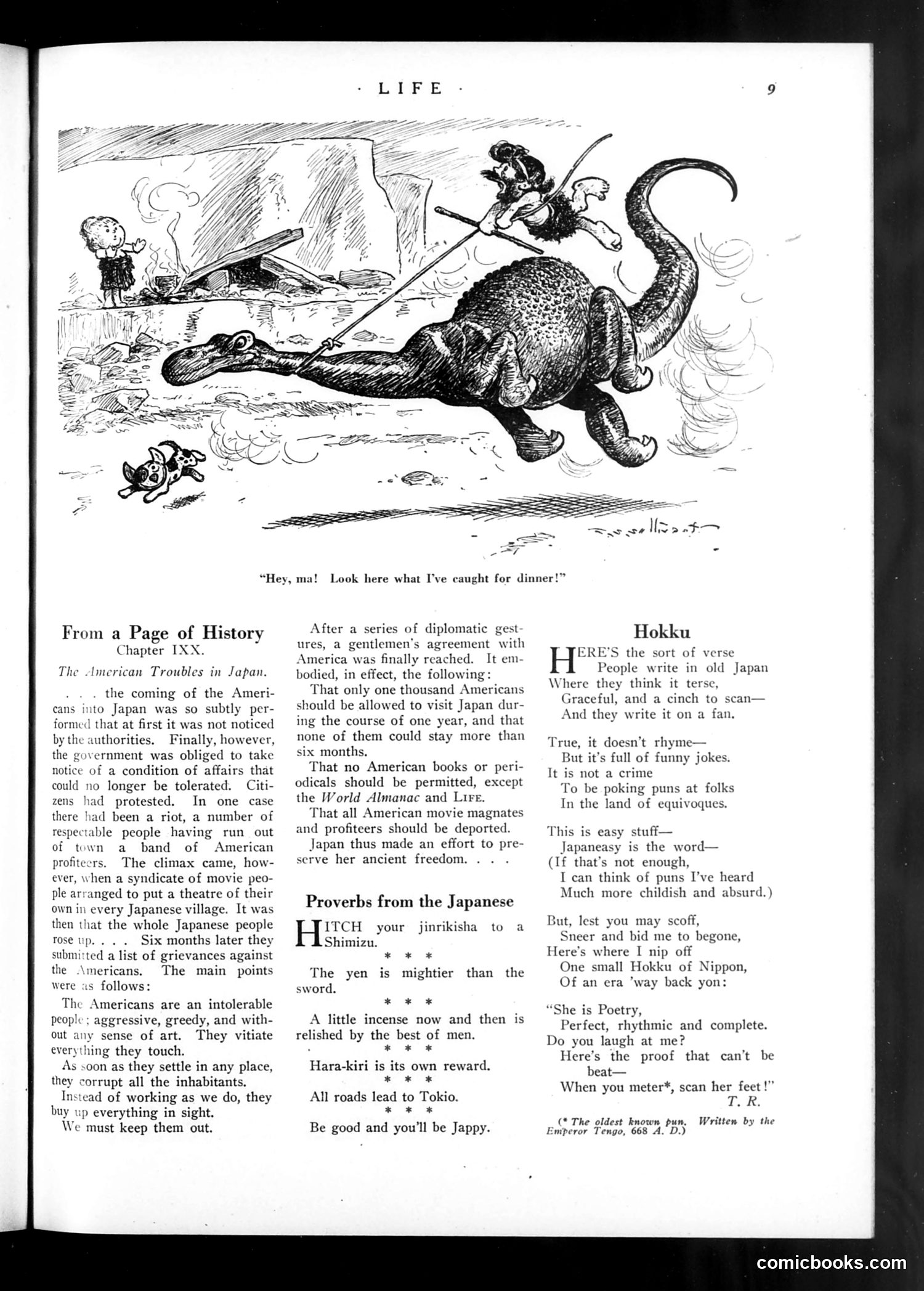
The top cartoon satirizes American imperialism in Japan. A figure rides an enormous alligator (labeled as catch "for dinner"), while a Japanese person watches from a destroyed building. This illustrates how American commercial and military presence was consuming Japanese sovereignty and resources. The accompanying text details American grievances against Japan, listing complaints about restrictions on American access. The satire suggests that despite diplomatic agreements limiting American involvement to one thousand visitors annually, Americans were aggressively pursuing economic and cultural dominance—depicted as the voracious alligator—regardless of Japan's desire to preserve its independence. This appears to reference early 20th-century U.S.-Japan tensions over trade, military presence, and cultural influence.
📄 Transcribed text from this page (OCR, searchable)
Machine-transcribed from the original scan — historical spelling and the odd misread are preserved.
From a Page of History Chapter IXX. The -Imerican Troubles in Japan. the coming of the Ameri- cans into Japan was so subtly per- formed that at first it was not noticed by the authorities. Finally, however, the government was obliged to take notice of a condition of affairs that could no longer be tolerated. Citi- zens had protested. In one case there had been a riot, a number of respectable people having run out of town a band of American profiteers. The climax came, how- ever, when a syndicate of movie peo- ple arranged to put a theatre of their own in every Japanese village. It was then that the whole Japanese people rose up... .. Six months later they submitted a list of grievances against the \mericans. The main points were as follows: The Americans are an intolerable people ; aggressive, greedy, and with- out any sense of art. They vitiate everything they touch. As soon as they settle in any place, they corrupt all the inhabitants. Instead of working as we do, they buy up everything in sight. We must keep them out. After a series of diplomatic gest- ures, a gentlemen's agreement with America was finally reached. It em- bodied, in effect, the following: That only one thousand Americans should be allowed to visit Japan dur- ing the course of one year, and that none of them could stay more than six months, That no American books or peri- odicals should be permitted, except the World Almanac and Lire. That all American movie magnates and profiteers should be deported. Japan thus made an effort to pre- serve her ancient freedom. . Proverbs from the Japanese ITCH your Shimizu. jinrikisha to a + * * The yen is mightier than the sword. * * * A little incense now and then is relished by the best of men. ‘ * * * is its own reward. * * * All roads lead to Tokio. * * * Be good and you'll be Jappy. Hara-ki ao alles Hokku ERE’S the sort of verse People write in old Japan Where they think it terse, Graceful, and a cinch to scan— And they write it on a fan. True, it doesn’t rhyme— But it’s full of funny jokes. It is not a crime To be poking puns at folks In the land of equivoques. Japaneasy is the word— (If that’s not enough, I can think of puns I’ve heard Much more childish and absurd.) But, lest you may scoff, Sneer and bid me to begone, Here's where I nip off One small Hokku of Nippon, Of an era ’way back yon: “She is Poetry, Perfect, rhythmic and complete. Do you laugh at me? Here’s the proof that can’t be beat— When you meter*, scan her feet!” He (* The oldest known oun Written by the Emperor Tengo, 668 A. D. comicbooks.com