
Life, 1922-08-10 · page 14 of 36
Life — August 10, 1922 — page 14: what you’re looking at
What you’re looking at
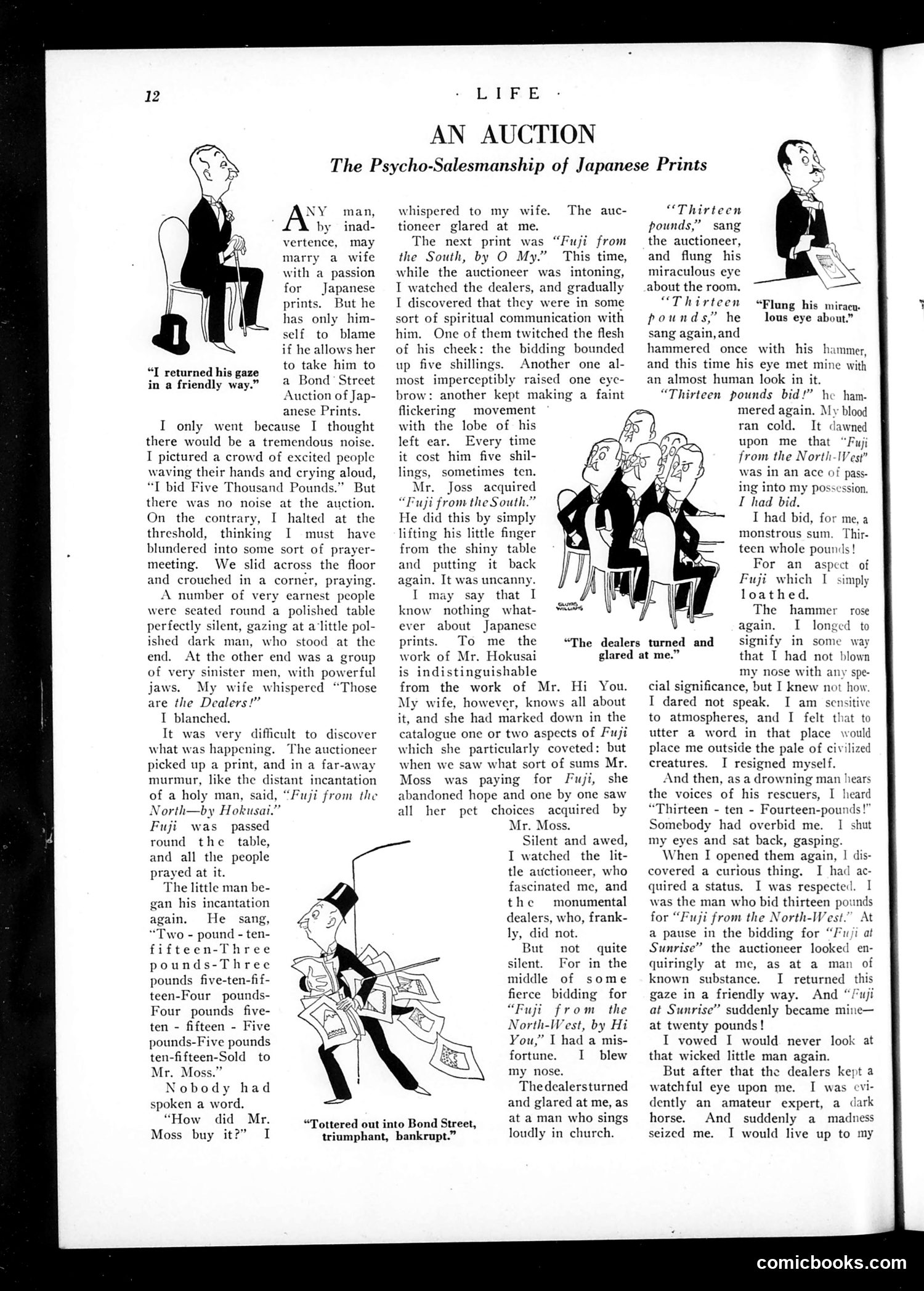
This satirical article describes an auction of Japanese prints where an unnamed auctioneer uses psychological manipulation on wealthy bidders. The humor centers on how dealers exploit collectors' status anxiety and competitive instincts—bidders get caught up in rivalry rather than genuine appreciation of the art. Key satirical elements include: - The auctioneer's theatrical performance ("spiritual communication" with a print titled "Fuji from the South") - Dealers deliberately raising bids to manipulate prices upward - Wealthy collectors being portrayed as easily duped, emotionally reactive individuals competing for prestige - The final detail: Mr. Moss, seemingly the richest bidder, actually ends up bankrupt after the auction The satire mocks both the pretension of fine-art collecting and the psychological tactics salesmen use to extract money from the wealthy.
📄 Transcribed text from this page (OCR, searchable)
Machine-transcribed from the original scan — historical spelling and the odd misread are preserved.
A Y man, by inad- vertence, may marry a wife with a passion for Japanese prints. But he has only him- self to blame if he allows her to take him to a Bond Street Auction of Jap- anese Prints. I only went because I thought there would be a tremendous noise. I pictured a crowd of excited people waving their hands and crying aloud, “I bid Five Thousand Pounds.” But there was no noise at the auction. On the contrary, I halted at the threshold, thinking I must have blundered into some sort of prayer- meeting. We slid across the floor and crouched in a corner, praying. A number of very earnest people were seated round a polished table perfectly silent, gazing at a‘little pol- ished dark man, who stood at the end. At the other end was a group of very sinister men, with powerful jaws. My wife whispered “Those are the Dealers!” I blanched. It was very difficult to discover what was happening. The auctioneer picked up a print, and in a far-away murmur, like the distant incantation of a holy man, said, “Fuji from the North—by Hokusai. Fuji was passed round the table, and all the people prayed at it. The little man be- gan his incantation again. He sang, “Two - pound - ten- fifteen-Three pounds-Three pounds five-ten-fif- teen-Four pounds- Four pounds five- ten - fifteen - Five pounds-Five pounds ten-fifteen-Sold to Mr. Moss.” Nobody had spoken a word. “How did Mr. Moss buy it?” I “I returned his gaze in a friendly way.” “Tottered out into Bond Street, triumphant, bankrupt.” LIFE AN AUCTION The Psycho-Salesmanship of Japanese Prints whispered to my wife. The auc- tioneer glared at me. The next print was “Fuji from the South, by O My.” This time, while the auctioneer was intoning, I watched the dealers, and gradually I discovered that they were in some sort of spiritual communication with him. One of them twitched the flesh of his cheek: the bidding bounded up five shillings. Another one al- most imperceptibly raised one eyc- brow: another kept making a faint flickering movement with the lobe of his left ear. Every time it cost him five shil- lings, sometimes ten. Mr. Joss acquired “Fuji from theSouth.” He did this by simply lifting his little finger from the shiny table and putting it back again. It was uncanny. I may say that I know nothing what- ever about Japanese prints. To me the work of Mr. Hokusai is indistinguishable from the work of Mr. Hi You. My wife, however, knows all about it, and she had marked down in the catalogue one or two aspects of Fuji which she particularly coveted: but when we saw what sort of sums Mr. Moss was paying for Fuji, she abandoned hope and one by one saw all her pet choices acquired by Mr. Moss. Silent and awed, I watched the lit- tle auctioneer, who fascinated me, and the monumental dealers, who, frank- ly, did not. But not quite silent. For in the middle of some fierce bidding for ji from the North-West, by Hi You,” I had a mis- fortune. I blew my nose. Thedealersturned and glared at me, as at a man who sings loudly in church. “The dealers turned and glared at me.” “Thirteen pounds,” sang the auctioneer, and flung his miraculous eye about the room. “Thirteen pounds,” he sang again, and hammered once with his hammer, and this time his eye met mine with an almost human look in it. “Thirteen pounds bid!” he ham- mered again. My blood ran cold. It da upon me that “F from the North-IVest” was in an ace of pass ing into my possession, I had bid. I had bid, for me, a monstrous sum. Thir- teen whole pounds! For an aspect of Fuji which I simply loathed. The hammer rose again. I longed to signify in some way that I had not blown my nose with any spe- cial significance, but I knew not how. I dared not speak. I am sensitive to atmospheres, and I felt that to utter a word in that place would place me outside the pale of civilized creatures. I resigned myself. And then, as a drowning man hears the voices of his rescuers, I heard “Thirteen - ten - Fourteen-pounds Somebody had overbid me. 1 shut my eyes and sat back, gasping. When I opened them again, | dis- covered a curious thing. I had ac- quired a status. I was respected. I was the man who bid thirteen pounds for “Fuji from the North-West.” At a pause in the bidding for “Fuji at Sunrise” the auctioneer looked en- quiringly at me, as at a man of known substance. I returned this gaze in a friendly way. And “fuji at Sunrise” suddenly became mine— at twenty pounds! I vowed I would never look at that wicked little man again. But after that the dealers kept a watchful eye upon me. I was evi- dently an amateur expert, a dark horse. And suddenly a madness seized me. I would live up to my “Flung his miracu. lous eye about.” comicbooks.com