
Life, 1922-08-10 · page 20 of 36
Life — August 10, 1922 — page 20: what you’re looking at
What you’re looking at
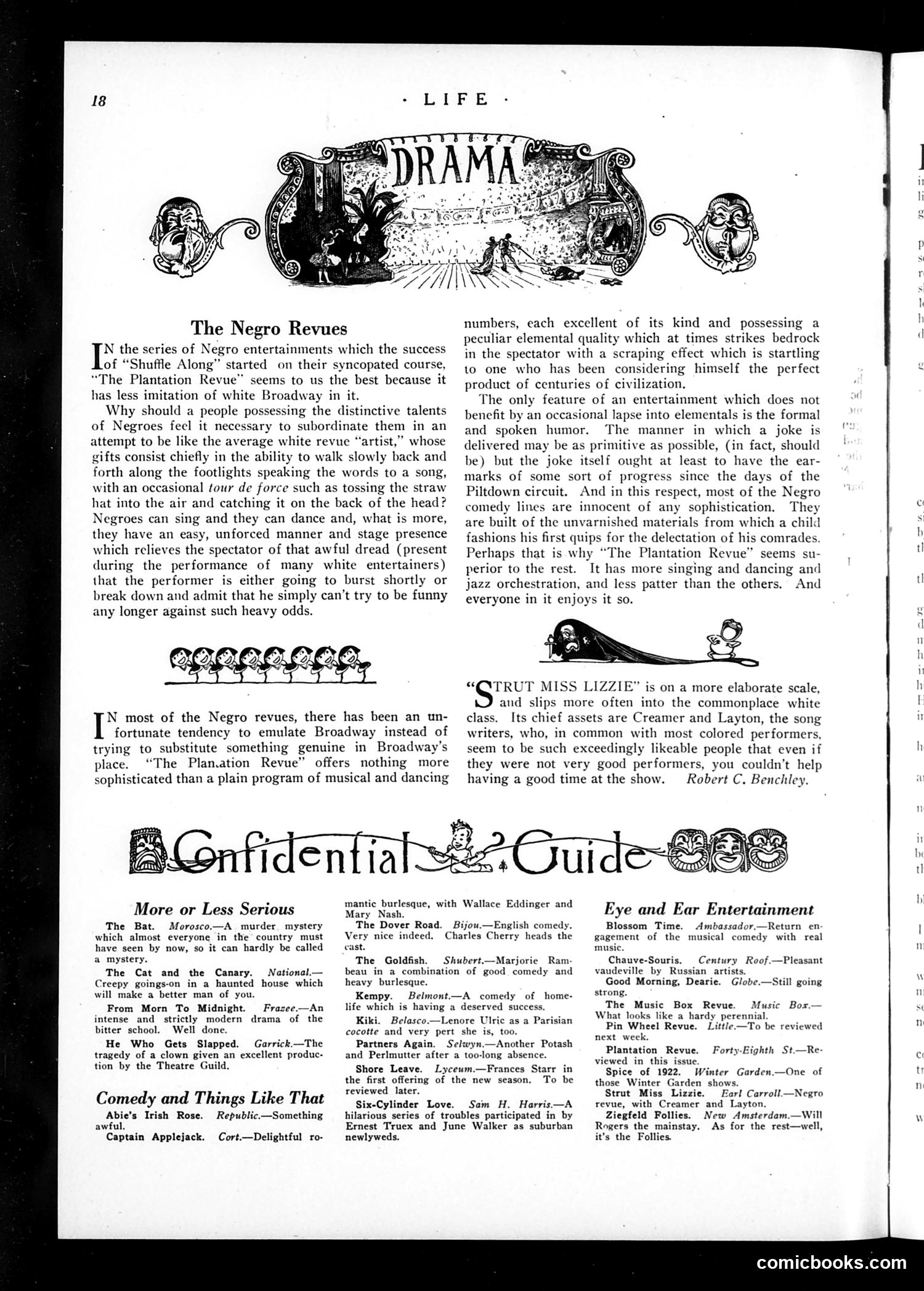
This is a theater review essay, not a political cartoon. The critic praises "The Plantation Revue" for authenticity, arguing it succeeds because it showcases genuine African American talent—singing, dancing, and stage presence—rather than imitating white Broadway conventions. The piece contains period racial attitudes typical of 1920s white liberalism: it celebrates Black performers' "distinctive talents" and "elemental quality," while patronizingly suggesting their comedy lacks sophistication (comparing jokes to "Piltdown circuit" primitiveness). The reviewer, Robert C. Benchley, notes "Strut Miss Lizzie" features songwriters Creamer and Layton, praised as "exceedingly likeable people." The review reflects the Jazz Age moment when African American entertainment was gaining mainstream attention following "Shuffle Along's" success, yet remains filtered through condescending racial frameworks typical of the era.
📄 Transcribed text from this page (OCR, searchable)
Machine-transcribed from the original scan — historical spelling and the odd misread are preserved.
The Negro Revues N the series of Negro entertainments which the success of “Shuffle Along” started on their syncopated course, The Plantation Revue” seems to us the best because it has less imitation of white Broadway in it. Why should a people possessing the distinctive talents of Negroes feel it necessary to subordinate them in an attempt to be like the average white revue “artist,” whose gifts consist chiefly in the ability to walk slowly back and forth along the footlights speaking the words to a song, with an occasional tour de force such as tossing the straw hat into the air and catching it on the back of the head? Negroes can sing and they can dance and, what is more, they have an easy, unforced manner and stage presence which relieves the spectator of that awful dread (present during the performance of many white entertainers) that the performer is either going to burst shortly or break down and admit that he simply can’t try to be funny any longer against such heavy odds. N most of the Negro revues, there has been an un- fortunate tendency to emulate Broadway instead of trying to substitute something genuine in Broadway's “The Plan.ation Revue” offers nothing more cated than a plain program of musical and dancing mantic burlesque, with Wallace Eddinger and More or Less Serious hey Nash. The Bat. Morosco.—A murder mystery The Dover Road. Bijou.—English comedy. numbers, each excellent of its kind and possessing a peculiar elemental quality which at times strikes bedrock in the spectator with a scraping effect which is startling to one who has been considering himself the perfect product of centuries of civilization. The only feature of an entertainment which does not benefit by an occasional lapse into elementals is the formal and spoken humor. The manner in which a joke is delivered may be as primitive as possible, (in fact, should be) but the joke itself ought at least to have the ear- marks of some sort of progress since the days of the Piltdown circuit. And in this respect, most of the Negro comedy lines are innocent of any sophistication. They are built of the unvarnished materials from which a child fashions his first quips for the delectation of his comrades. Perhaps that is why “The Plantation Revue” seems su- perior to the rest. It has more singing and dancing and jazz orchestration, and less patter than the others. And everyone in it enjoys it so. “QTRUT MISS LIZZIE” is on a more elaborate scale, and slips more often into the commonplace white class. Its chief assets are Creamer and Layton, the song writers, who, in common with most colored performers, seem to be such exceedingly likeable people that even if they were not very good performers, you couldn't help having a good time at the show. Robert C. Benchley. Eye and Ear Entertainment Blossom Time. Ambassador.—Return en. h almost everyone in the country must Very nice indeed. Charles Cherry heads the gagement of the musical comedy with real have seen by now, so it can hardly be called cast. a mystery. The Goldfish. Shubert—Marjorie Ram- music. Chauve-Souris. Cent Roof.—Pleasant The Cat and the Canary. National.— beau in a combination of good comedy and vaudeville by Russian artists. Creepy goings-on in a haunted house which heavy burlesque. Good Morning, Dearie. Globe.—Still going will make a better man of you. Kempy. Belmont.—A comedy of home- Strong. From Morn To Midnight. Frasee—An life which is having a deserved succes Belasco.—Lenore Ulric as a Parisian cocotte and very pert she is, too. Partners Again. Selwyn.—Another Potash tragedy of a clown given an excellent produc- and Perlmutter after a too-long absence. Shore Leave. Lyceum.—Frances Starr in the first offering of the new season. To be intense and strictly modern drama of the bitter school. Well done. He Who Gets Slapped. Garrick.—The tion by the Theatre Guild. Comedy and Things Like That “¥o"2 2°" Six-Cylinder Love. Abie’s Irish Rose. Republic—Something hilarious series of troubles participated in by The Music Box Revue. Music Box.— What looks like a hardy perennial. Pin Wheel Revue. Little—To be reviewed next week. Plantation Revue. Forty-Eighth St—Re- viewed in this issue. Spice of 1922. Winter Garden.—One of those Winter Garden shows. Strut Miss Lizzie. Earl Carroll—Negro Sam H. Harris—A revue, with Creamer and Layton, Ziegfeld Follies. New Amsterdam.—Will awful. Ernest Truex and June Walker as suburban Rogers the mainstay. As for the rest—well, Captain Applejack. Cort.—Delightful ro- newlyweds. it’s the Follies. comicbooks.com