
A complete issue · 36 pages · 1922
Life — June 15, 1922
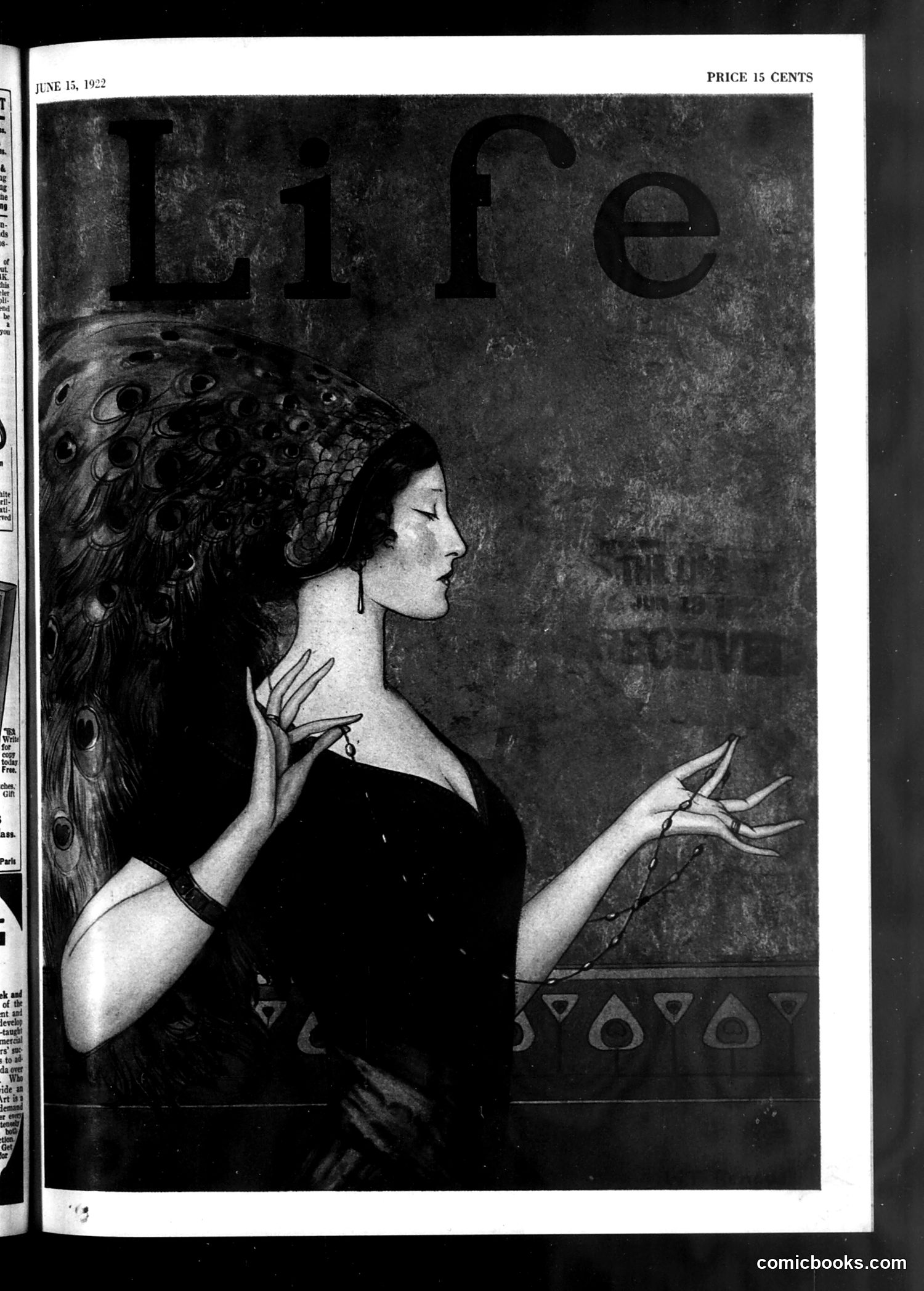
This appears to be a Life magazine cover featuring an Art Deco-style illustration of a woman in profile wearing an elaborate feathered headdress and an off-the-shoulder black dress. The artistic style and fashion suggest this represents the aesthetics of the early 1920s Jazz Age. The woman's pose—with elongated fingers and stylized gestures—emphasizes the period's characteristic affectation and sophistication. The decorative border at the bottom contains geometric patterns typical of contemporary design. Without accompanying OCR text visible on this cover, the specific satirical message remains unclear, though the image likely comments on 1920s fashion trends, female sophistication, or social attitudes of that era. The "Life" masthead suggests humor or social commentary was intended.
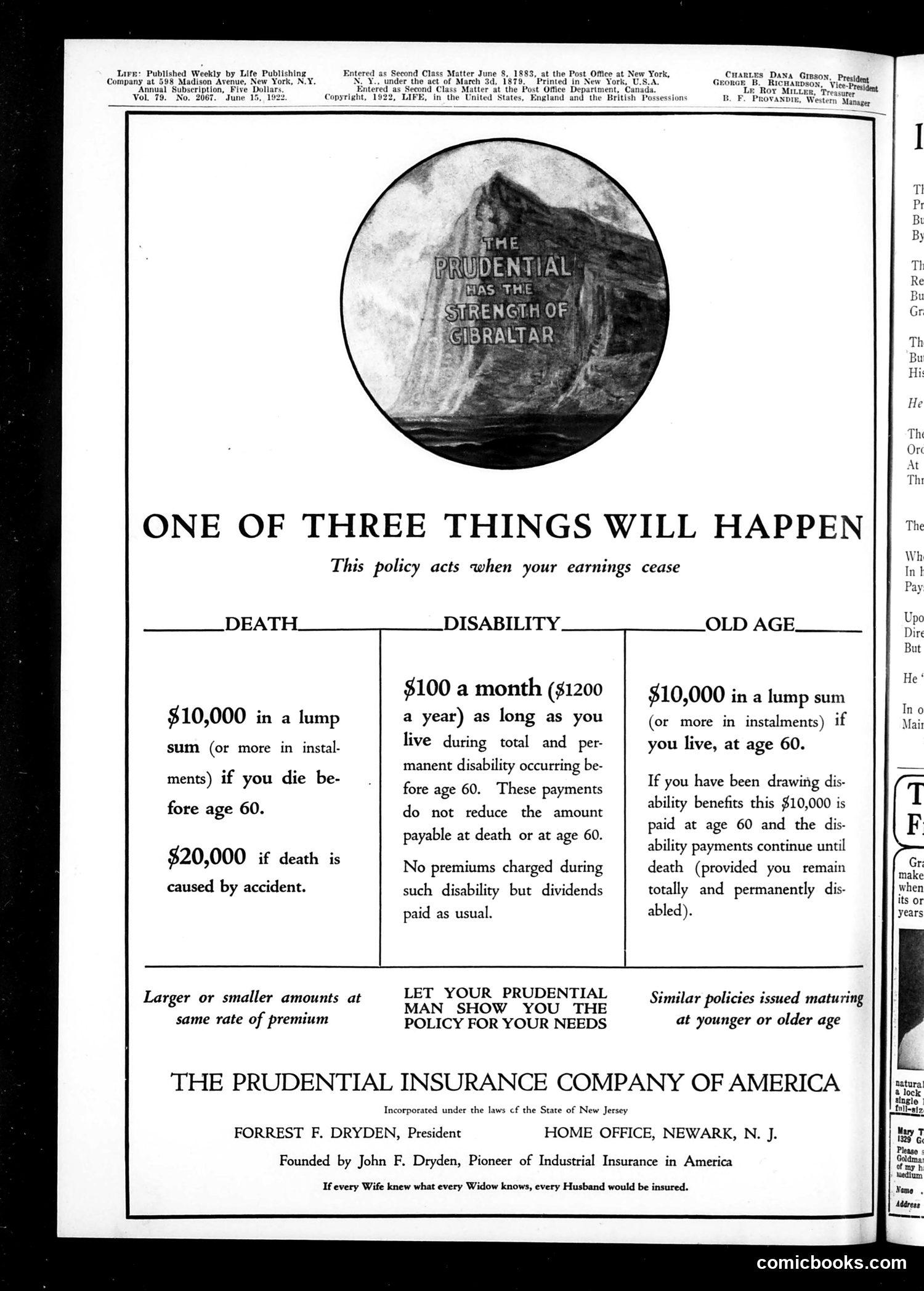
This page is primarily a **life insurance advertisement**, not satire or political commentary. It's from *Life* magazine (June 15, 1922) and promotes The Prudential Insurance Company of America. The circular image shows the Rock of Gibraltar with text "THE PRUDENTIAL HAS THE STRENGTH OF GIBRALTAR"—a metaphorical claim about the company's stability and reliability. The advertisement presents three insurance policy outcomes: death (lump sum payment), disability (monthly payments), or old age (lump sum at age 60). The tagline "One of Three Things Will Happen" emphasizes life's inevitable outcomes and positions insurance as financial protection. The closing slogan, "If every Wife knew what every Widow knows, every Husband would be insured," appeals to domestic security concerns typical of early 20th-century insurance marketing.
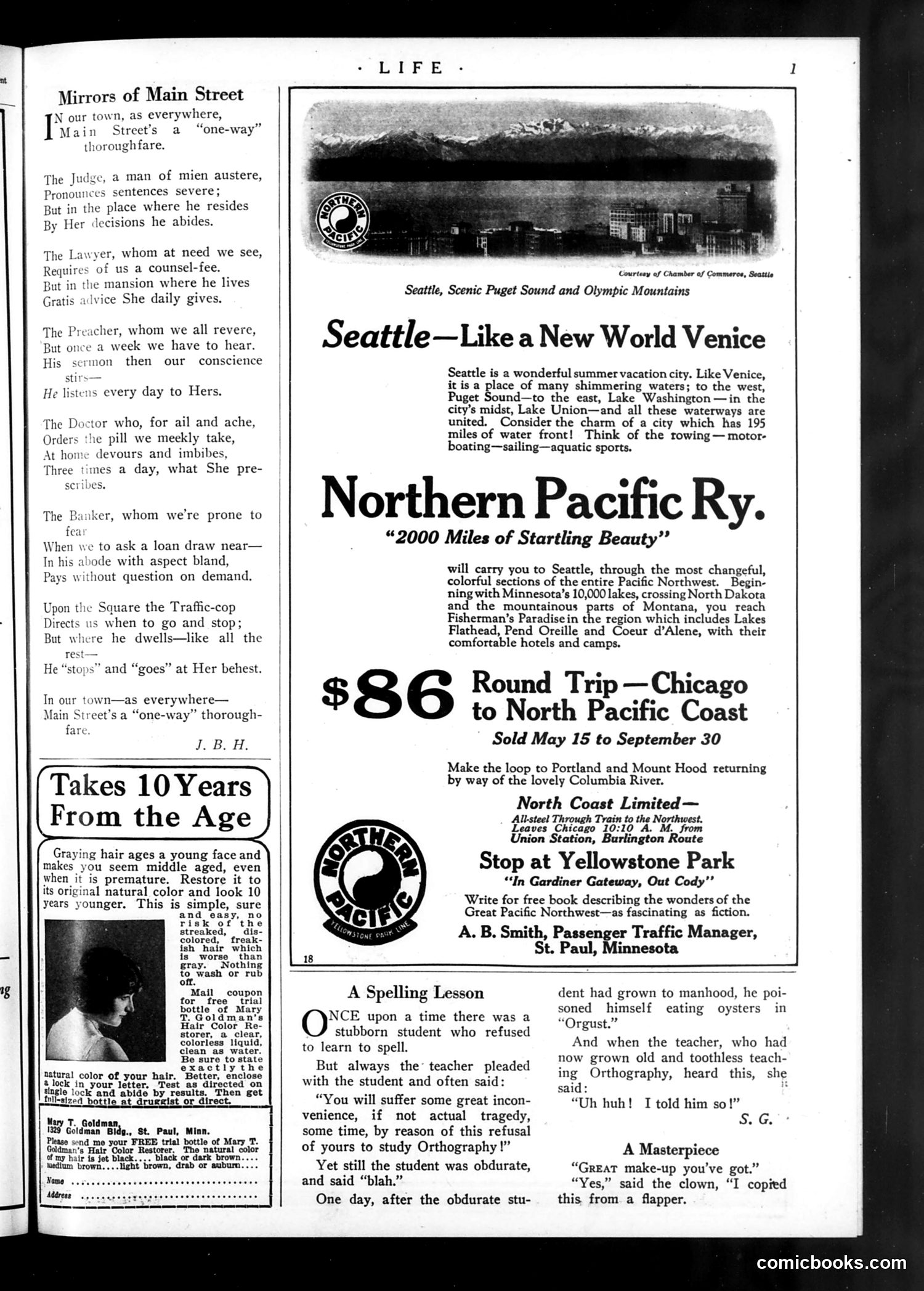
This page is primarily **advertising and light humor content**, not political satire. The left column contains "Mirrors of Main Street," satirical verses about small-town figures (judge, lawyer, preacher, doctor, banker, traffic cop) and their social roles—gentle social commentary rather than sharp satire. Below is an advertisement for hair coloring, showing a woman's profile. The right side features travel advertisements: Northern Pacific Railway promoting Seattle and Pacific Northwest trips ($86 round trip from Chicago), and Great Northern Railway advertising Yellowstone Park. Two short humorous pieces follow: "A Spelling Lesson" (about a stubborn student refusing to learn orthography) and "A Masterpiece" (a brief joke about a clown's makeup). The page reflects early 20th-century small-town American culture and leisure travel marketing.
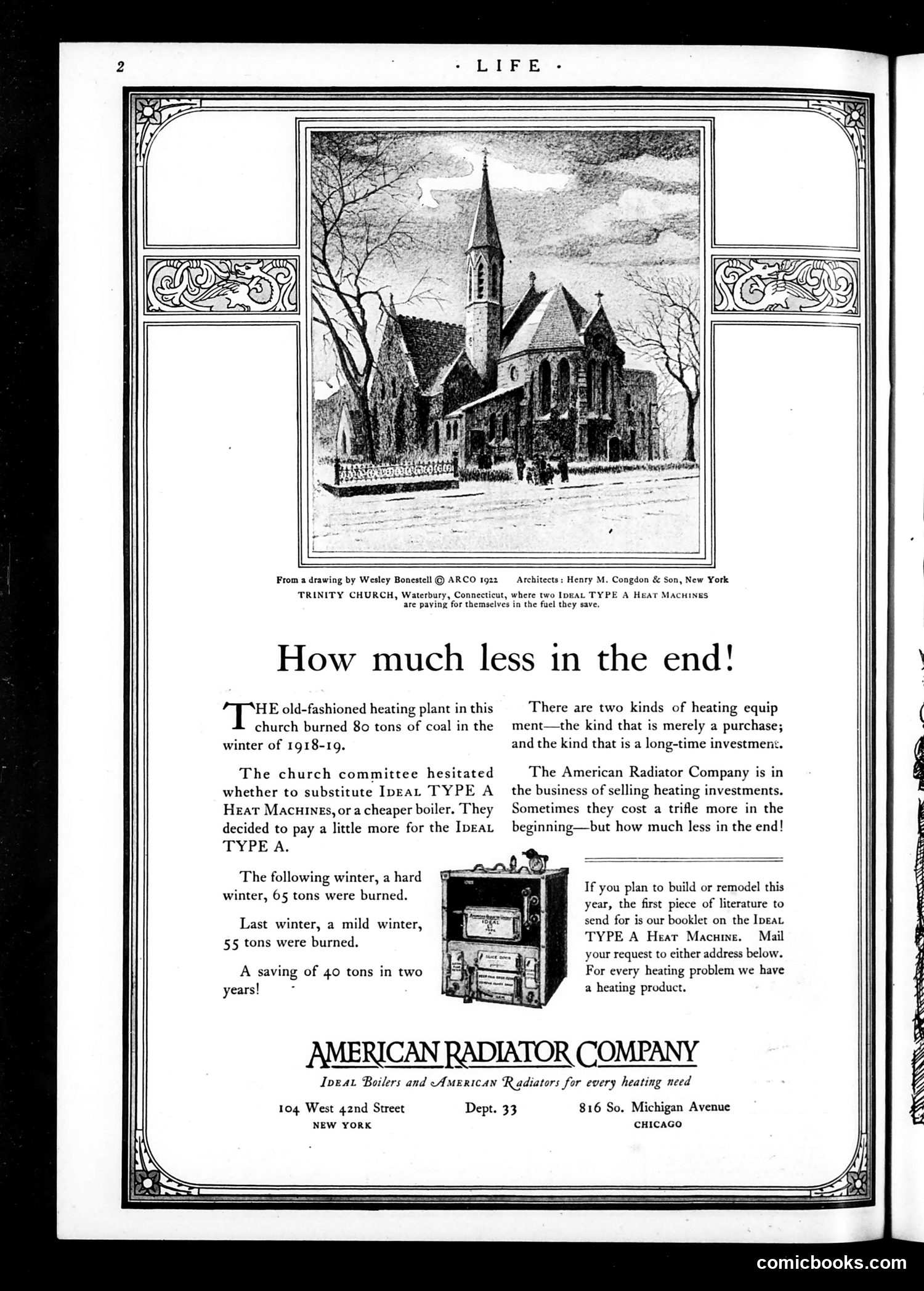
This page is primarily **advertising, not satire or political commentary**. It promotes the American Radiator Company's Ideal TYPE A Heat Machines to churches and institutions. The advertisement uses Trinity Church in Waterbury, Connecticut as a case study. The pitch emphasizes fuel cost savings: the church previously burned 80 tons of coal annually, but after installing Ideal TYPE A heat machines, consumption dropped to 65 tons in a hard winter and 55 tons in a mild winter—totaling 40 tons saved over two years. The headline "How much less in the end!" appeals to institutional budgets. The company positions itself as offering long-term investment value rather than cheap initial cost. This is straightforward commercial messaging rather than satirical commentary.
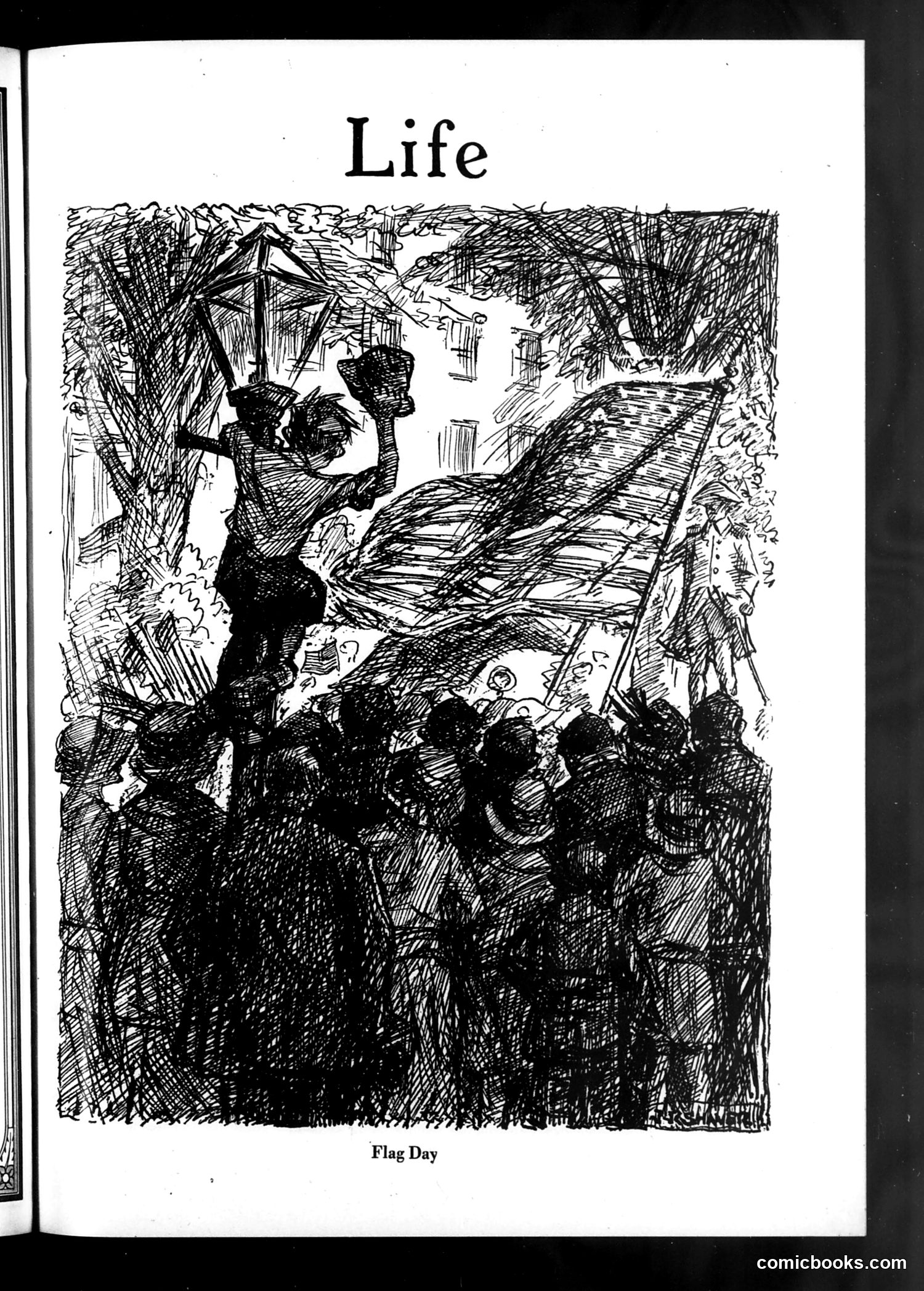
This page titled "Life" depicts a section labeled "Flag Day" with a sketch showing a crowd of silhouetted figures gazing upward at what appears to be a flag or banner being raised or displayed above them. The artistic style uses heavy cross-hatching and bold lines typical of early-to-mid 20th century editorial illustration. Without additional context or visible text identifying specific figures, the cartoon appears to be commentary on American patriotism or civic observance. The crowd's upward gaze suggests reverence or aspiration. The composition emphasizes collective emotion around a national symbol, likely satirizing either genuine patriotic fervor or performative nationalism depending on Life magazine's editorial stance at the time of publication.
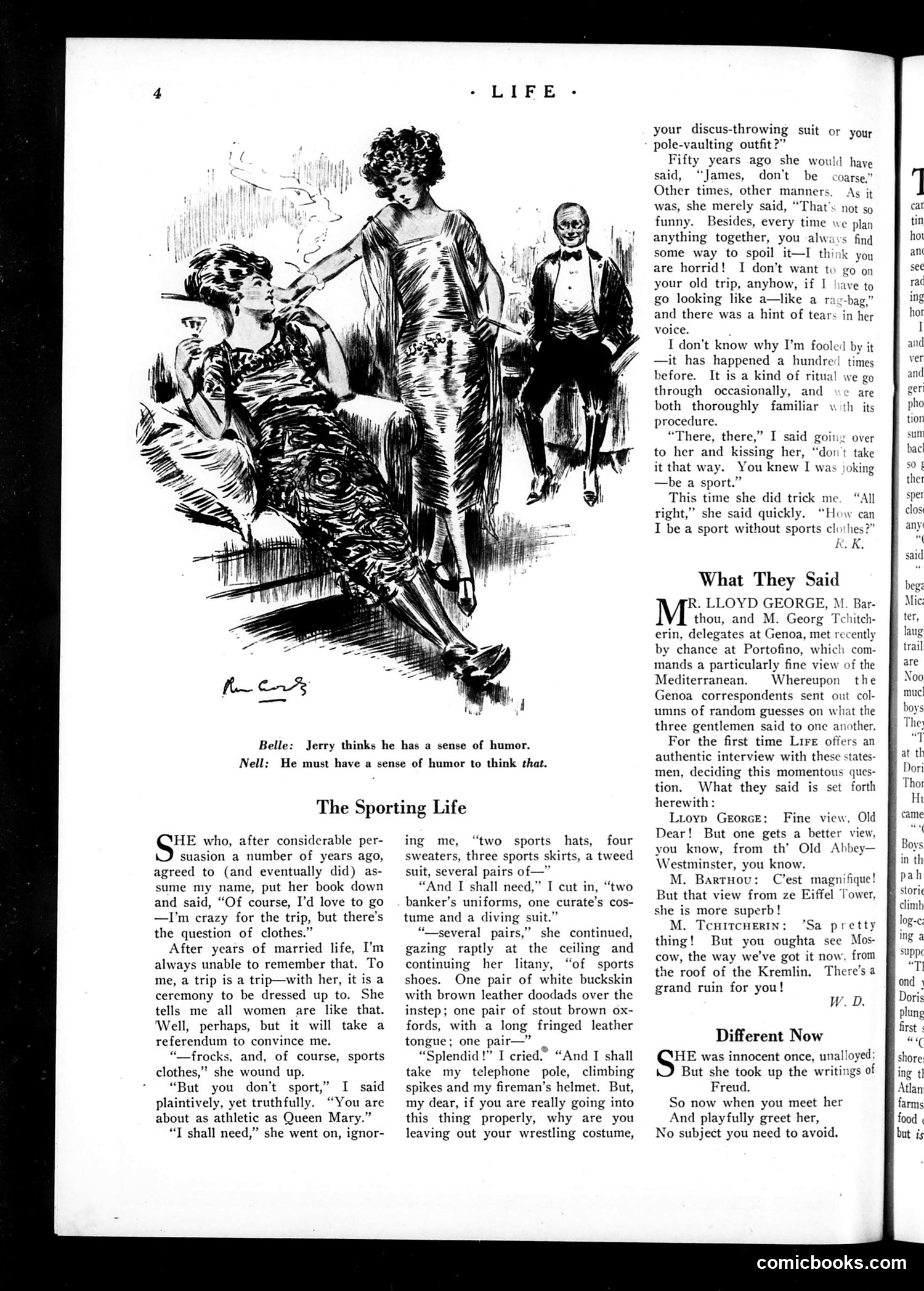
This page satirizes a married couple's dispute over athletic clothing for a vacation trip. The husband wants to pack sports attire (athletic wear, multiple sports outfits), while his wife objects, calling such clothes unfashionable and coarse. The cartoon illustration shows the wife (center, in an elegant dress) gesturing dismissively at the husband's proposed wardrobe, while a third male figure observes. The satire mocks early 20th-century gender expectations: the husband assumes sports clothes are practical and appropriate, while the wife prioritizes fashion and social appearance even on vacation. The accompanying section "What They Said" features diplomatic quotes, suggesting this domestic dispute mirrors broader social tensions about changing gender roles and the proper presentation of oneself in public life.
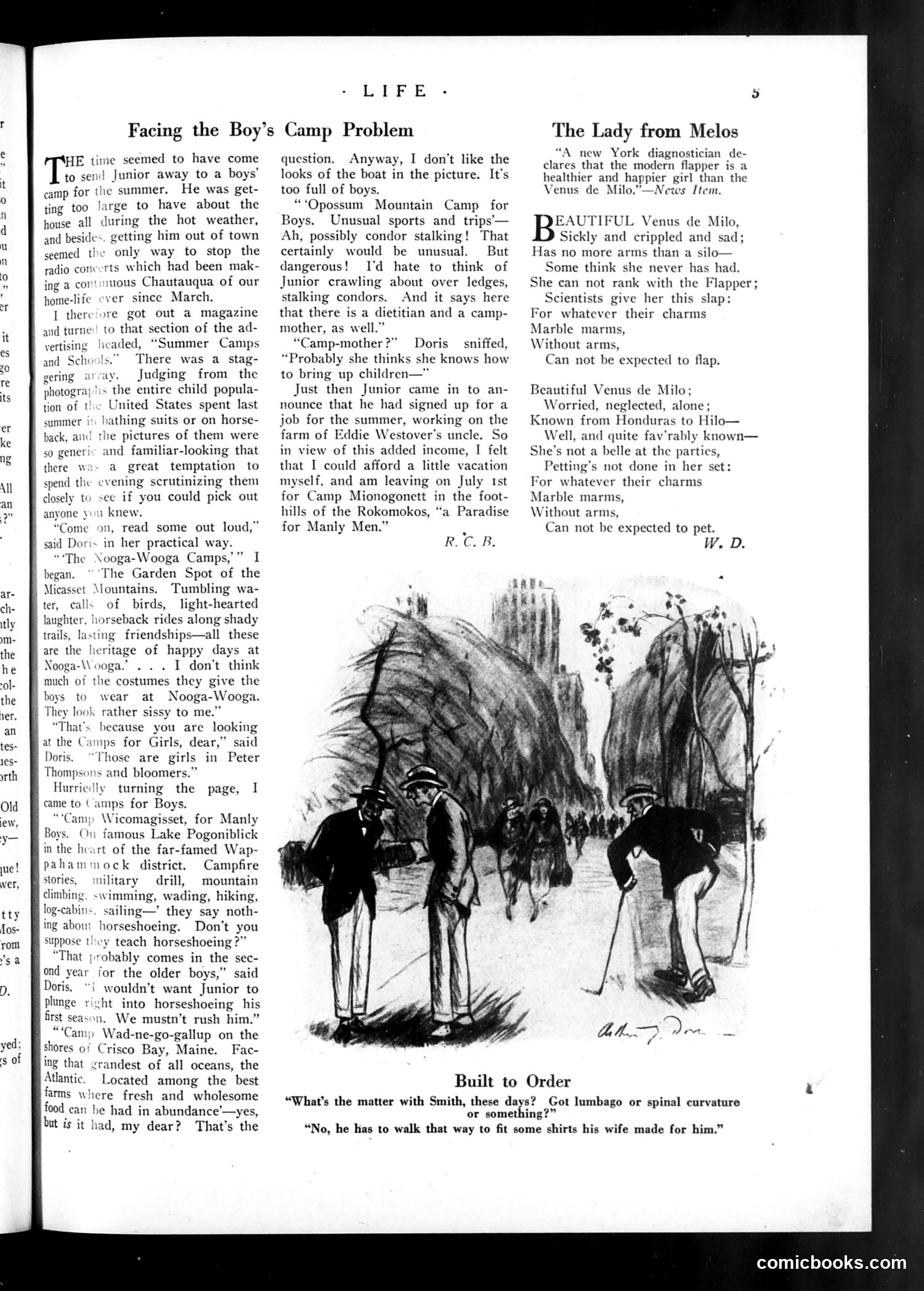
This page contains two distinct pieces: **Left column ("Facing the Boy's Camp Problem"):** A humorous article debating whether to send a son to boys' camp versus girls' camp. The author examines various camps, noting that boys' camps feature activities like horseback riding and drilling, while girls' camps focus on "bloomers" and Peter Thompson costumes. The satire gently mocks both gender-specific camp experiences and parental anxiety about summer childcare. **Right side ("The Lady from Melos"):** A poem praising the Venus de Milo sculpture, emphasizing her armless classical beauty as superior to modern women with arms who "flap." **Bottom cartoon ("Built to Order"):** A visual gag showing a man walking in an exaggerated bent posture, with the caption revealing his wife made him custom-fitted shirts causing this awkward gait—satirizing both marital dynamics and poorly tailored clothing.
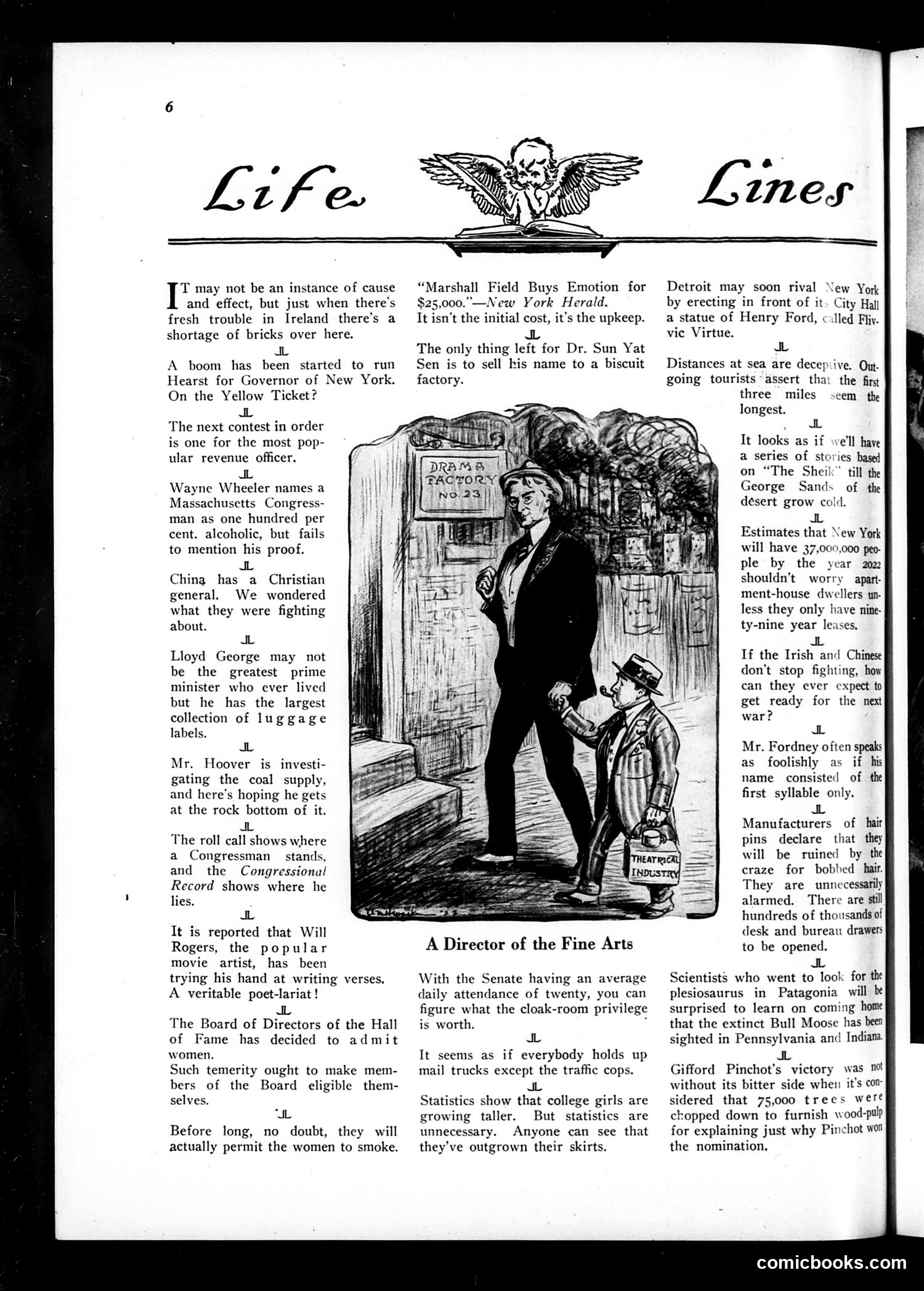
This cartoon satirizes someone (identity unclear from image alone) who appears to be directing or managing "fine arts" activities—likely a government or institutional position. The visual shows a tall, well-dressed man in formal attire instructing a smaller figure, with a "Drama Factory" sign visible in the background. The accompanying text notes that the Senate has average daily attendance of twenty, making the "cloak-room privilege" valuable—suggesting the cartoon critiques how little actual legislative work occurs while certain positions of authority flourish. The satire appears to target bureaucratic inefficiency and the contradiction of serious "fine arts" direction existing amid institutional dysfunction. Without the publication date, specific identity remains unclear, though it comments on government waste and mismanagement.
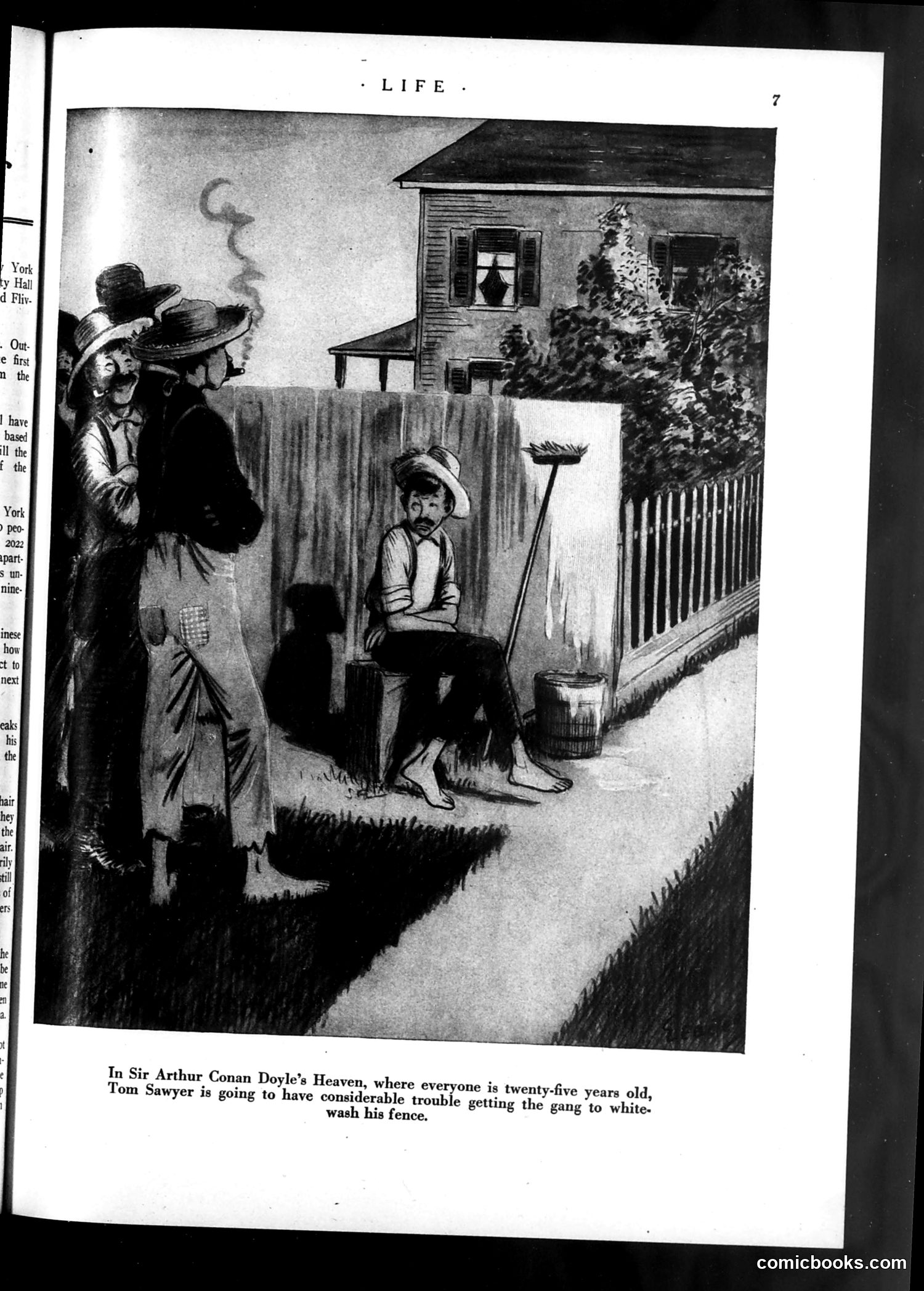
This is a satirical cartoon referencing Sir Arthur Conan Doyle's concept of "Heaven." The joke presents a afterlife scenario where Tom Sawyer (Mark Twain's fictional character) faces a humorous problem: convincing a gang of people to whitewash a fence—a famous scene from Twain's novel where Tom cleverly manipulates others into doing his chores. The satire appears to mock Doyle's idealized vision of heaven by suggesting that even in paradise, the mundane frustrations of life persist. The cartoon humorously suggests that Tom Sawyer's characteristic cunning and manipulation would be necessary even in the afterlife, implying heaven might not be as perfectly blissful as Doyle imagined. The joke relies on readers' familiarity with both Twain's novel and Doyle's spiritualist beliefs.
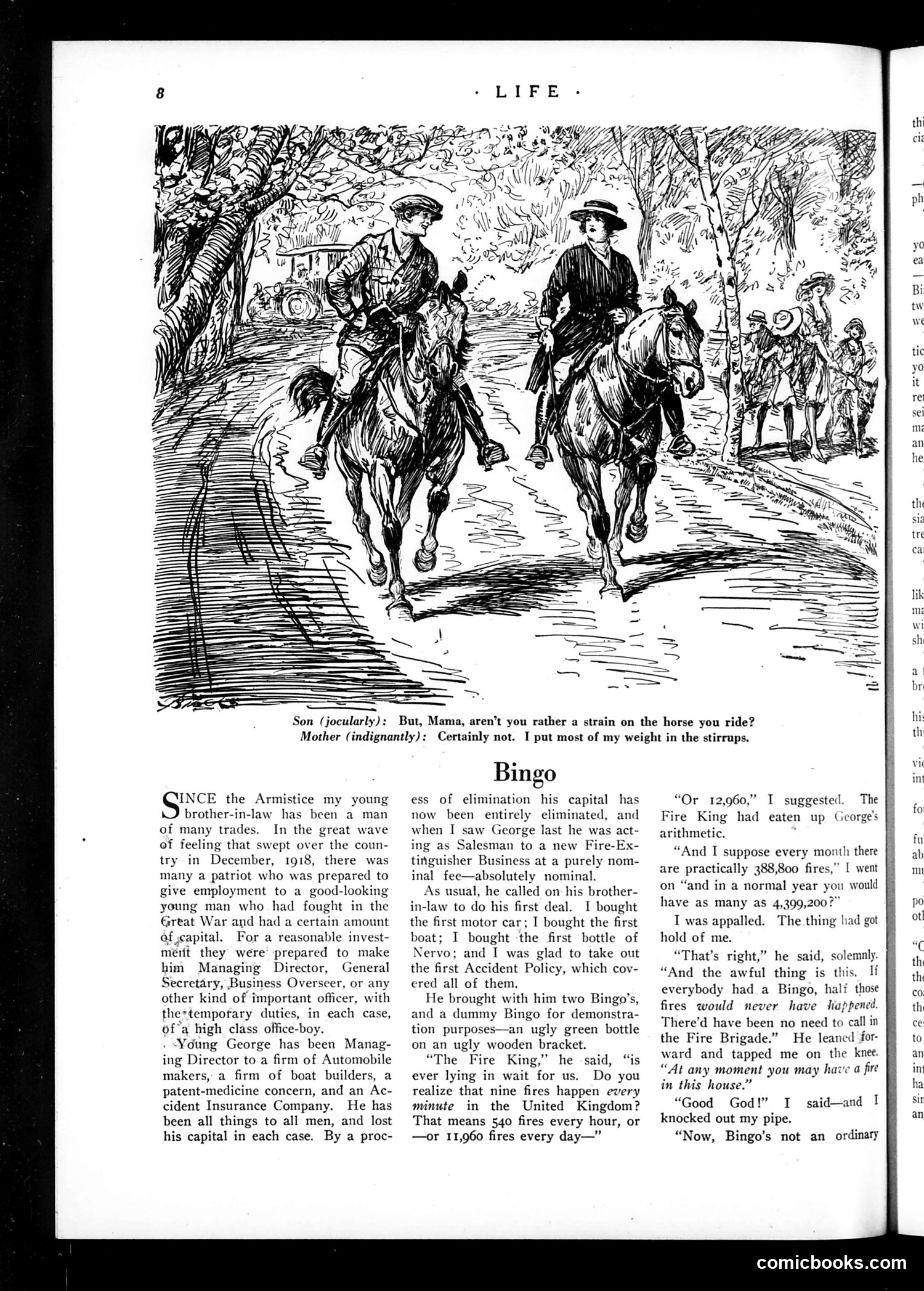
The cartoon and accompanying story satirize post-WWI profiteering and business incompetence. A young man (the "brother-in-law") has repeatedly failed at various ventures—automobile manufacturing, boat building, patent medicines, and insurance—losing capital each time. Despite these disasters, he's now launching yet another business scheme. The humor targets how some individuals, particularly those with family connections or capital, could repeatedly fail upward during the economically chaotic 1920s. The title "Bingo" suggests luck rather than skill drives his ventures. The satirical point: incompetent businessmen kept finding new schemes and investors willing to fund them, regardless of track records—a commentary on post-war economic recklessness and poor business judgment among the privileged classes.
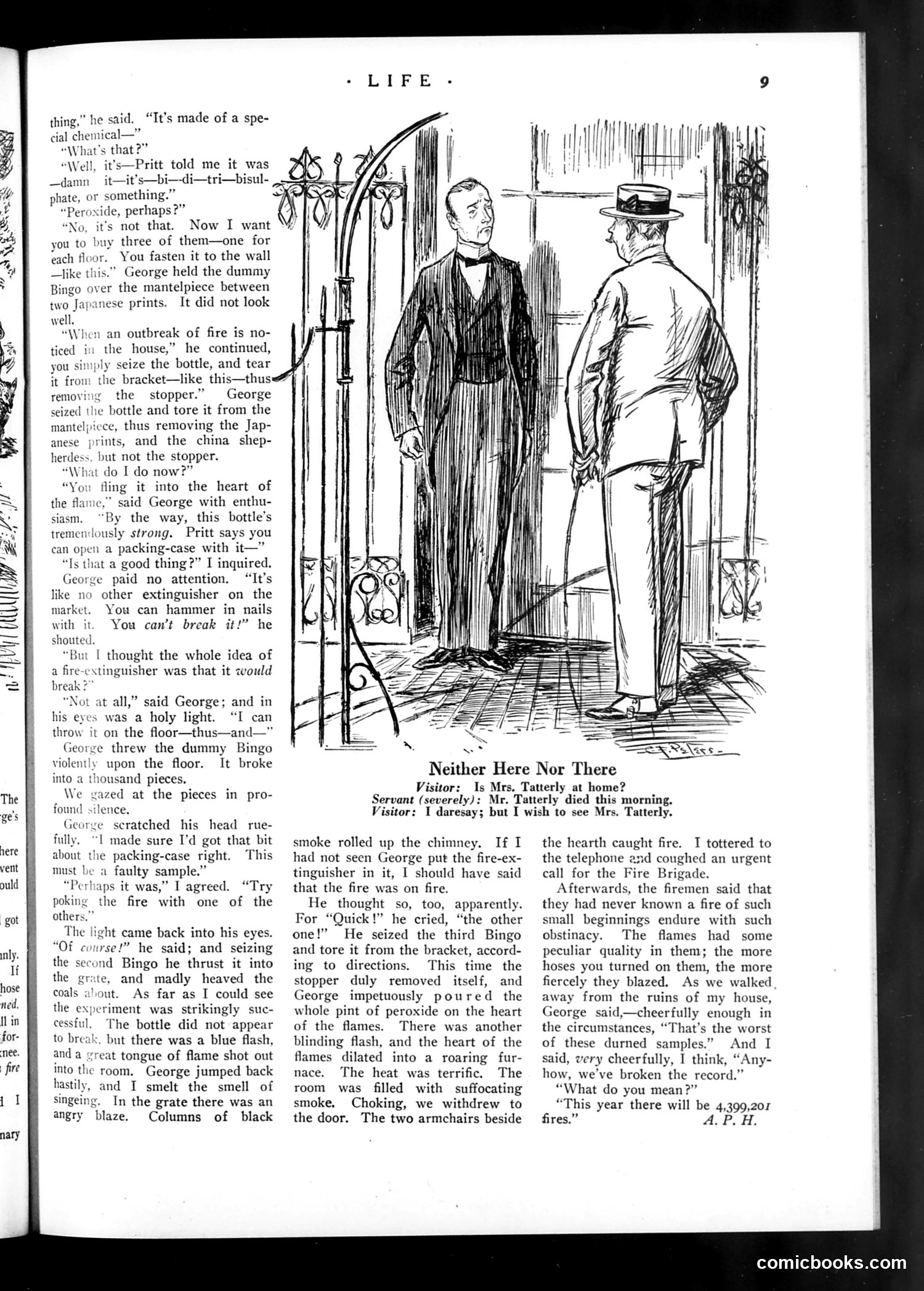
This is a humorous domestic sketch rather than political satire. The illustration shows two men in conversation at a doorway, with the caption indicating a visitor has called to see Mrs. Tatterly, who died that morning. The joke's premise is absurd bureaucratic literalism: the visitor insists on seeing Mrs. Tatterly anyway, creating an awkward social situation. The humor derives from the visitor's apparent inability or unwillingness to accept that the woman has died—he persists in his stated intention despite this obvious obstacle. The accompanying text describes George demonstrating a new fire extinguisher device (a "Bingo" bottle), with the main satire targeting the product's dubious effectiveness and George's overly enthusiastic sales pitch.
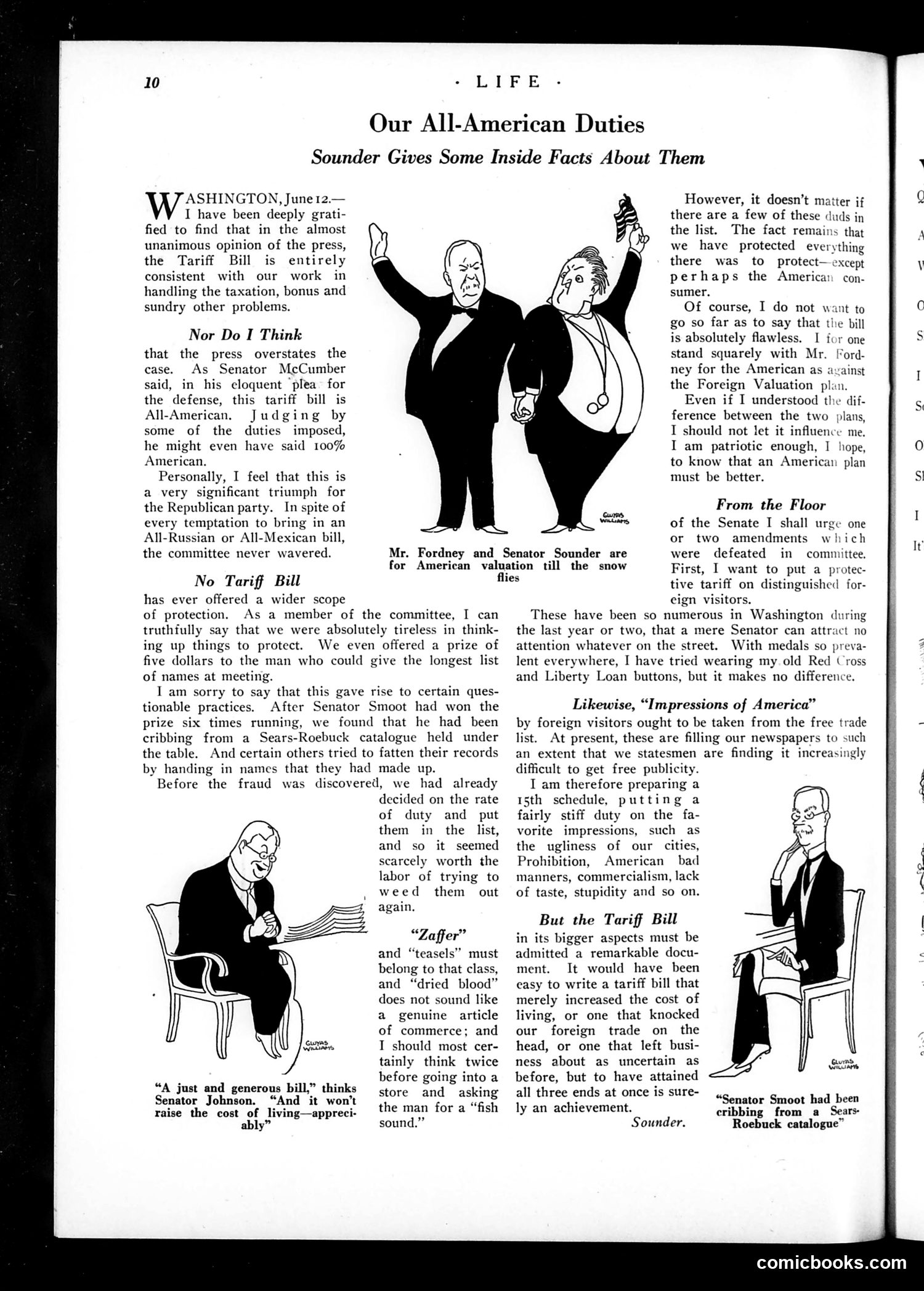
This page satirizes the **Tariff Bill** debate in the U.S. Senate. The main cartoon depicts **Mr. Fordney and Senator Sounder** (identifiable by the caption) celebrating the bill's passage, with "snow flies"—suggesting the debate occurs during winter legislative sessions. The text presents opposing viewpoints: Senator Sounder defends the tariff as protective ("All-American"), while critics argue it's overly broad and protectionist. A secondary cartoon mocks **Senator Smoot**, who apparently tried to hide fraudulent practices—the caption references him "cribbing from a Sears-Roebuck catalog," suggesting he plagiarized tariff language. The satire targets Republican protectionist trade policies and senatorial dishonesty during debates over economic taxation and American commerce.
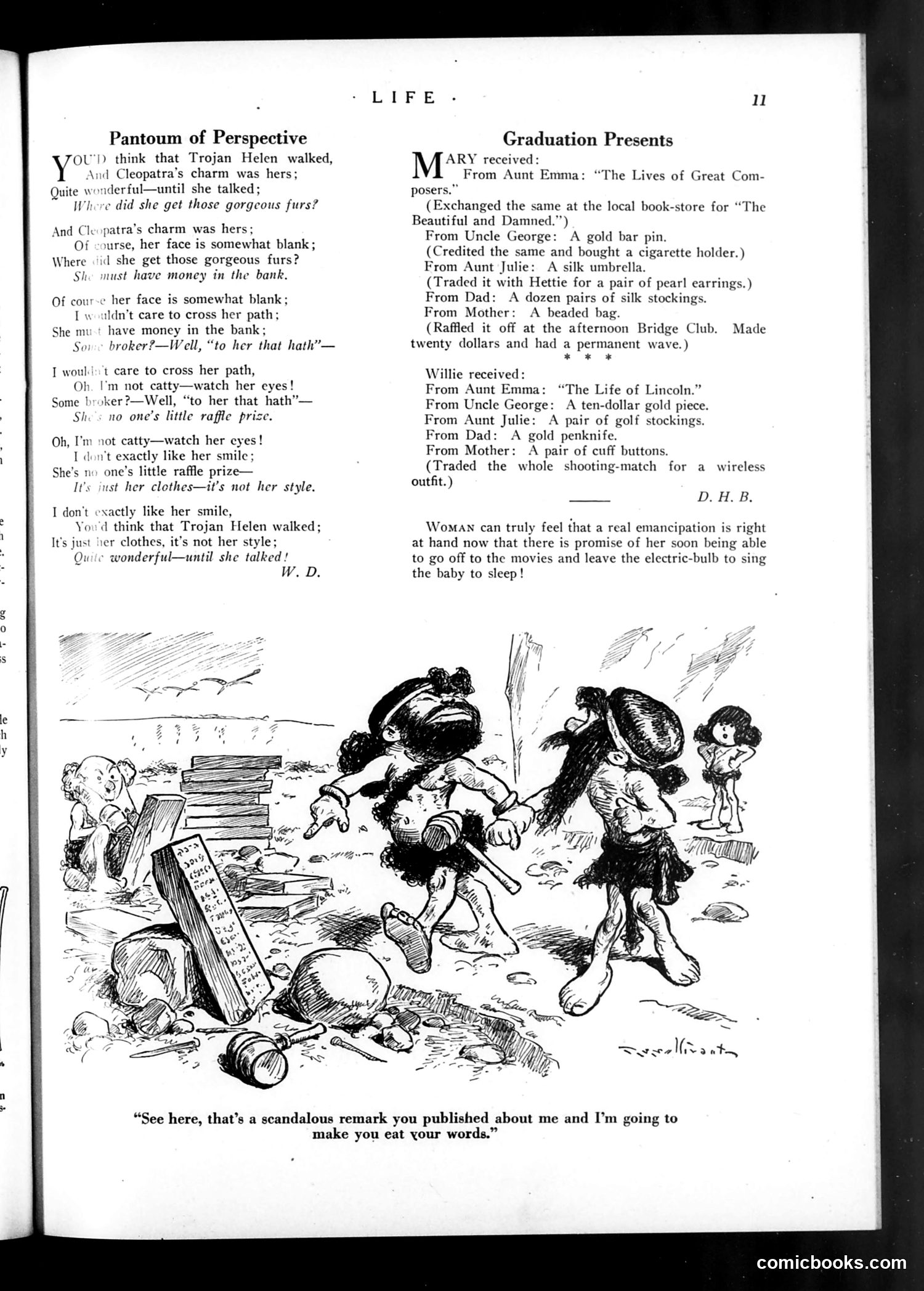
This page contains two distinct pieces of satire: **"Pantomum of Perspective"** (left): A poem mocking a young woman's materialism. The speaker questions where "Trojan Helen" got her "gorgeous furs," revealing they're not from genuine wealth or charm but from financial transactions—"Some broker? Well, 'to her that hath.'" The satire targets women who trade romantic/social appeal for luxury goods from wealthy men, critiquing both the women's vanity and the transactional nature of courtship. **"Graduation Presents"** (right): Lists modest, practical gifts a graduate received, humorously contrasting what young women actually get versus aspirational luxury. The final illustration shows a primitive/caveman figure threatening violence over published criticism—a visual gag about overreaction to criticism, suggesting "eating your words" literally. Both pieces satirize 1920s gender dynamics and consumer culture among the wealthy class.
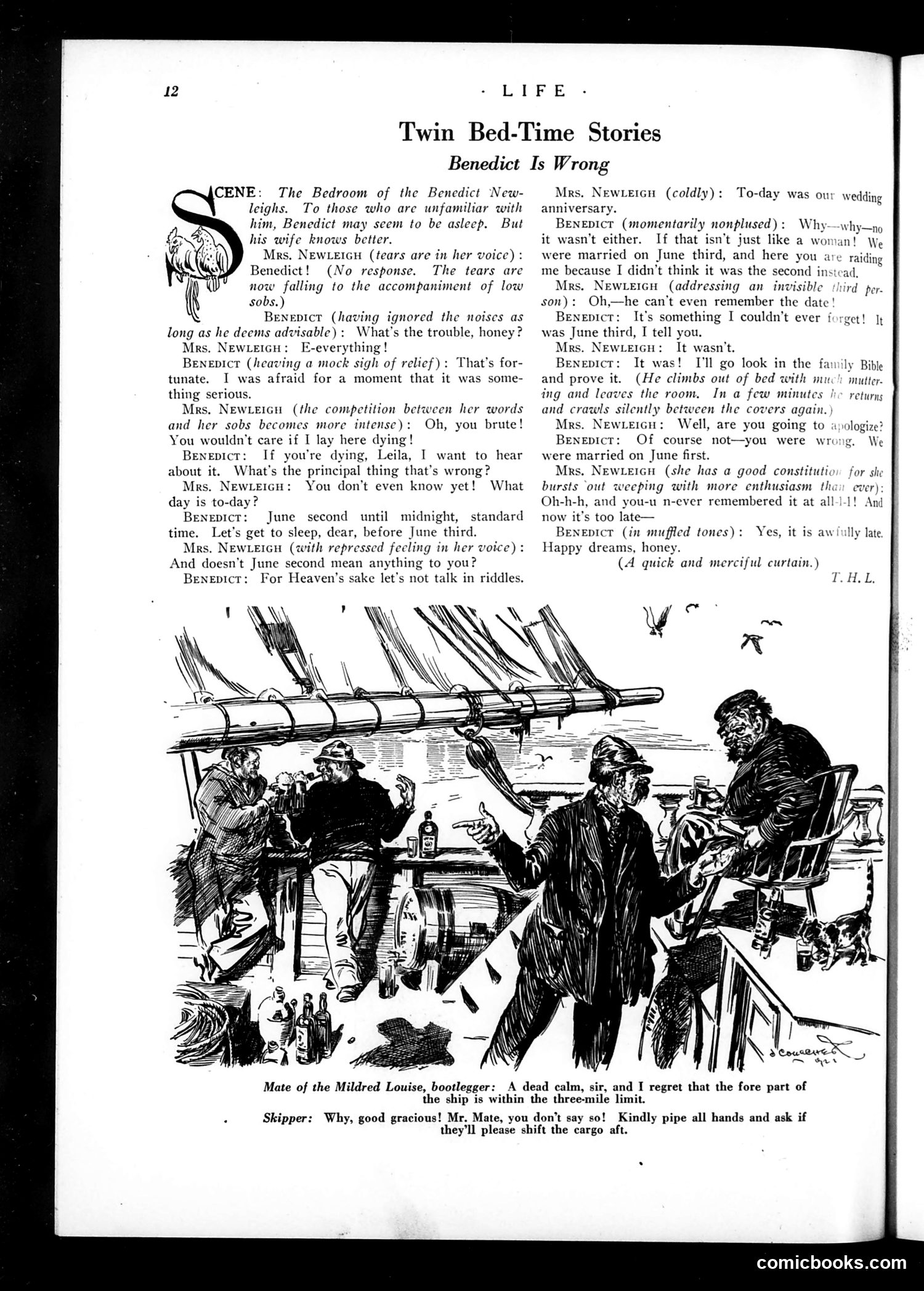
This page contains two satirical pieces. The top section is a bedroom dialogue between newlyweds Benedict and Mrs. Newleigh, where they argue about their wedding anniversary date—she claims June second, he insists June third. The humor derives from marital miscommunication and the husband's dismissive attitude toward what should be a meaningful date. The lower illustration depicts sailors aboard a ship, with a captain instructing crew to shift cargo aft to avoid violating a three-mile territorial limit—likely referencing smuggling or illegal cargo transport during Prohibition era. The satire mocks attempts to circumvent federal law through technical loopholes. Both pieces mock human folly: domestic forgetfulness and legal circumvention schemes.
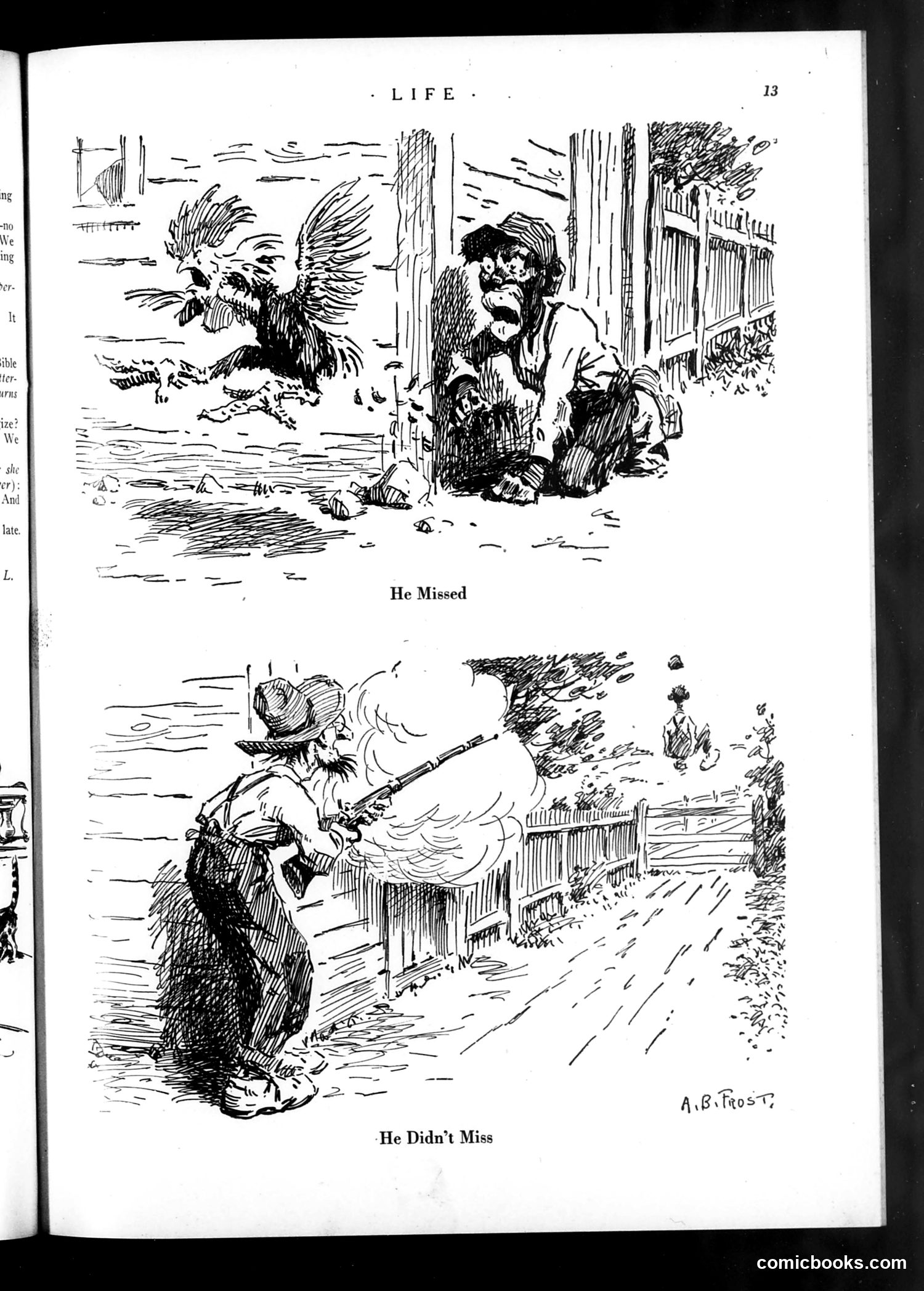
This page presents two contrasting cartoon panels by A.B. Frost about hunting or shooting. The top panel ("He Missed") shows a man aiming a rifle at what appears to be a bird or fowl, with an angry, bearded figure in the background—possibly representing failure or frustration. The bottom panel ("He Didn't Miss") depicts a hunter successfully shooting, with smoke and activity visible in the distance near a fence. The cartoons appear to be a straightforward visual joke contrasting successful versus unsuccessful hunting attempts. Without additional historical context visible on this page, the specific political or social satire—if any—remains unclear. The humor seems to rest primarily on the contrast between missing and hitting a target.
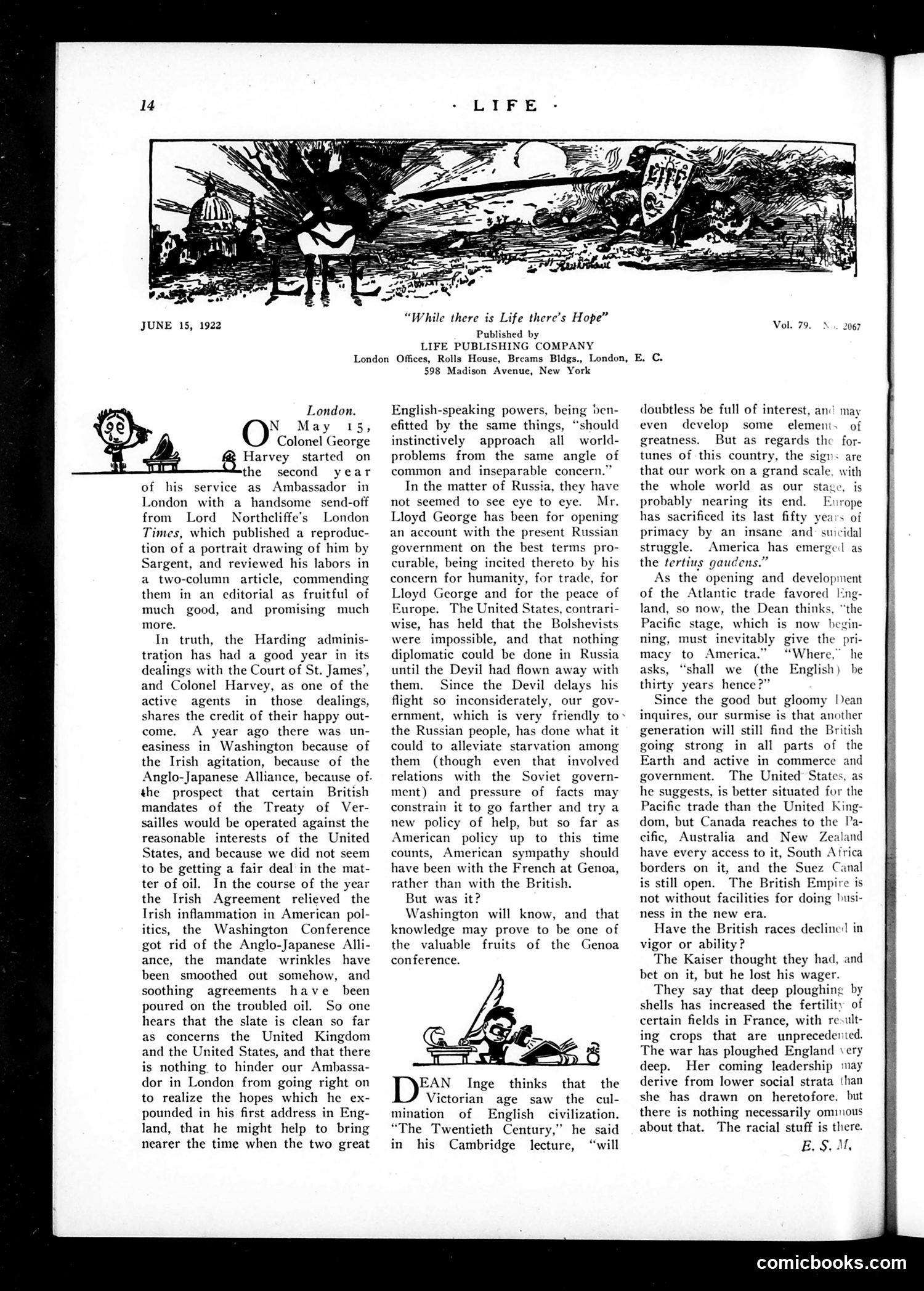
This page contains editorial commentary rather than cartoons. The header illustration shows a stylized "LIFE" masthead with classical and modern imagery. The main article discusses Colonel Harvey's appointment as Ambassador to London, praising the Harding administration's diplomatic work. It addresses Anglo-American relations and criticizes Bolshevik Russia, asserting that Britain and America should pursue cooperative policies rather than competitive ones. A secondary piece by "Dean Inge" (likely Dean William Ralph Inge of St. Paul's Cathedral) discusses whether English civilization peaked in the Victorian era, arguing that the "Twentieth Century" will demonstrate continued British vigor. The content reflects 1920s concerns about post-WWI international relations, the Russian Revolution's threat, and Britain's economic future—issues central to American political debate during the early Harding presidency.
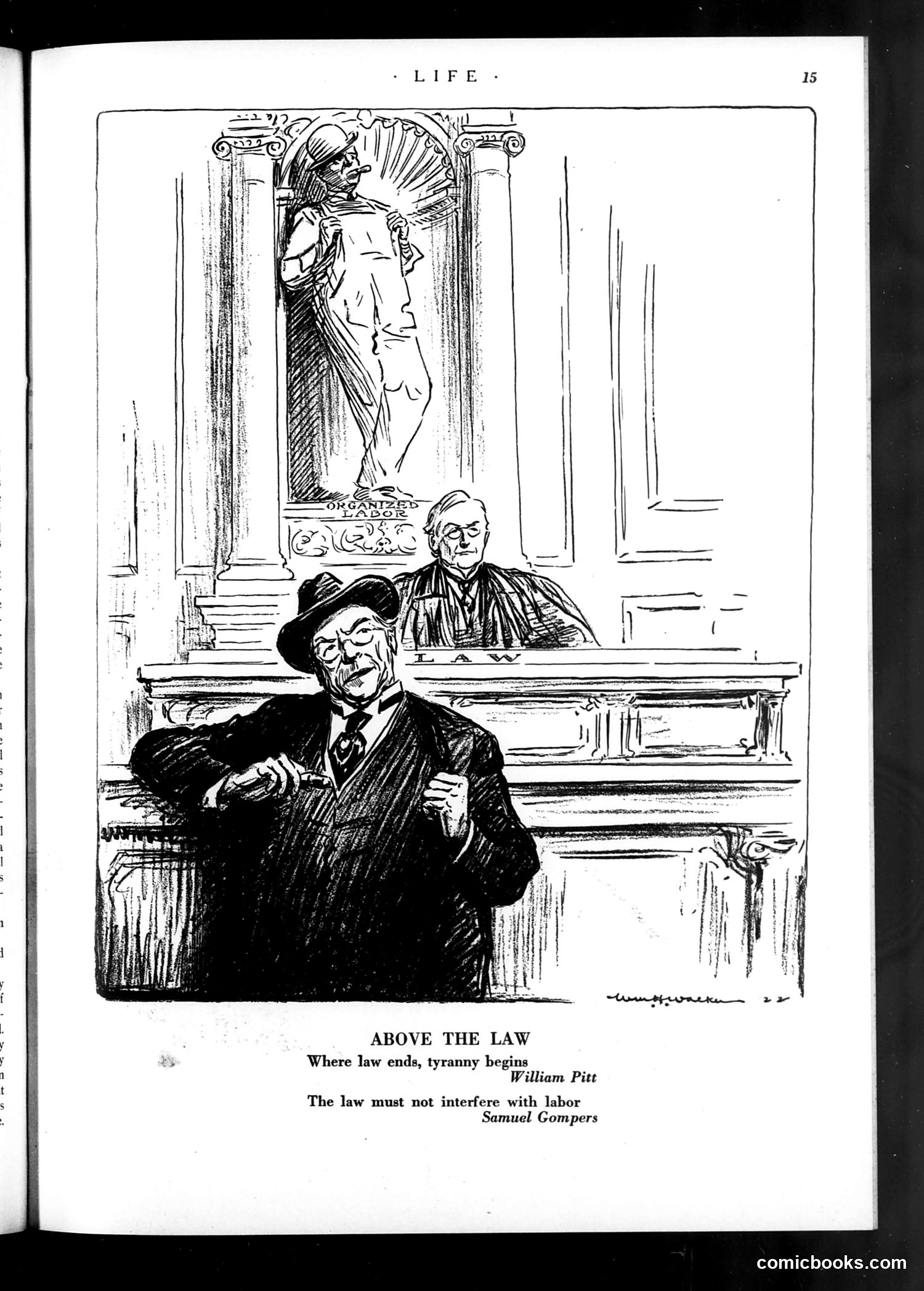
This cartoon depicts a courtroom scene criticizing judicial overreach in labor matters. A judge presides while a working-class man (likely representing organized labor or a union member) stands before the bench. The figure appears menacing or predatory, suggesting the cartoon critiques how courts wielded power against laborers. The quotes frame the satire: William Pitt's warning about tyranny without law contrasts with Samuel Gompers' (real AFL leader) principle that law shouldn't restrict labor rights. The cartoon suggests courts were operating "above the law"—using judicial authority to suppress labor organizing rather than protecting workers' legal rights. This reflects early 20th-century tensions when American courts frequently issued injunctions against strikes and union activities, effectively blocking workers' organizing efforts through legal mechanisms.
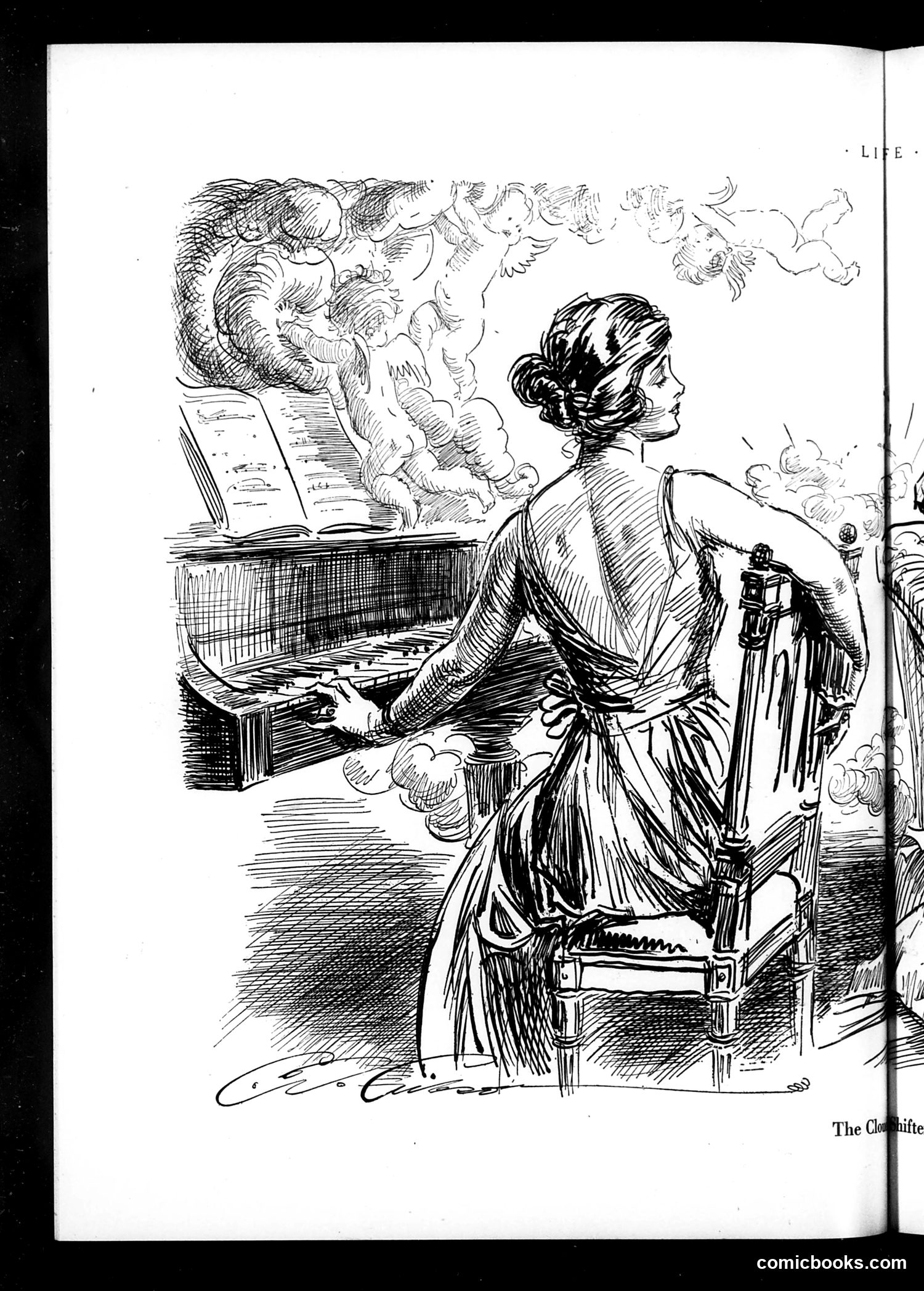
This Life magazine cartoon depicts a woman at a piano, viewed from behind, with cherubs or putti emerging from the sheet music above. The caption reads "The Clue Shifter," though the full meaning is unclear from the image alone. The drawing style suggests early-to-mid 20th century. The woman appears to be a pianist, and the whimsical cherubs emerging from the music suggest either a commentary on musical inspiration or possibly a satirical reference to someone's artistic pretensions. Without additional context about the specific date or historical references, the exact subject of satire—whether critiquing a particular performer, musical trend, or social type—remains uncertain.
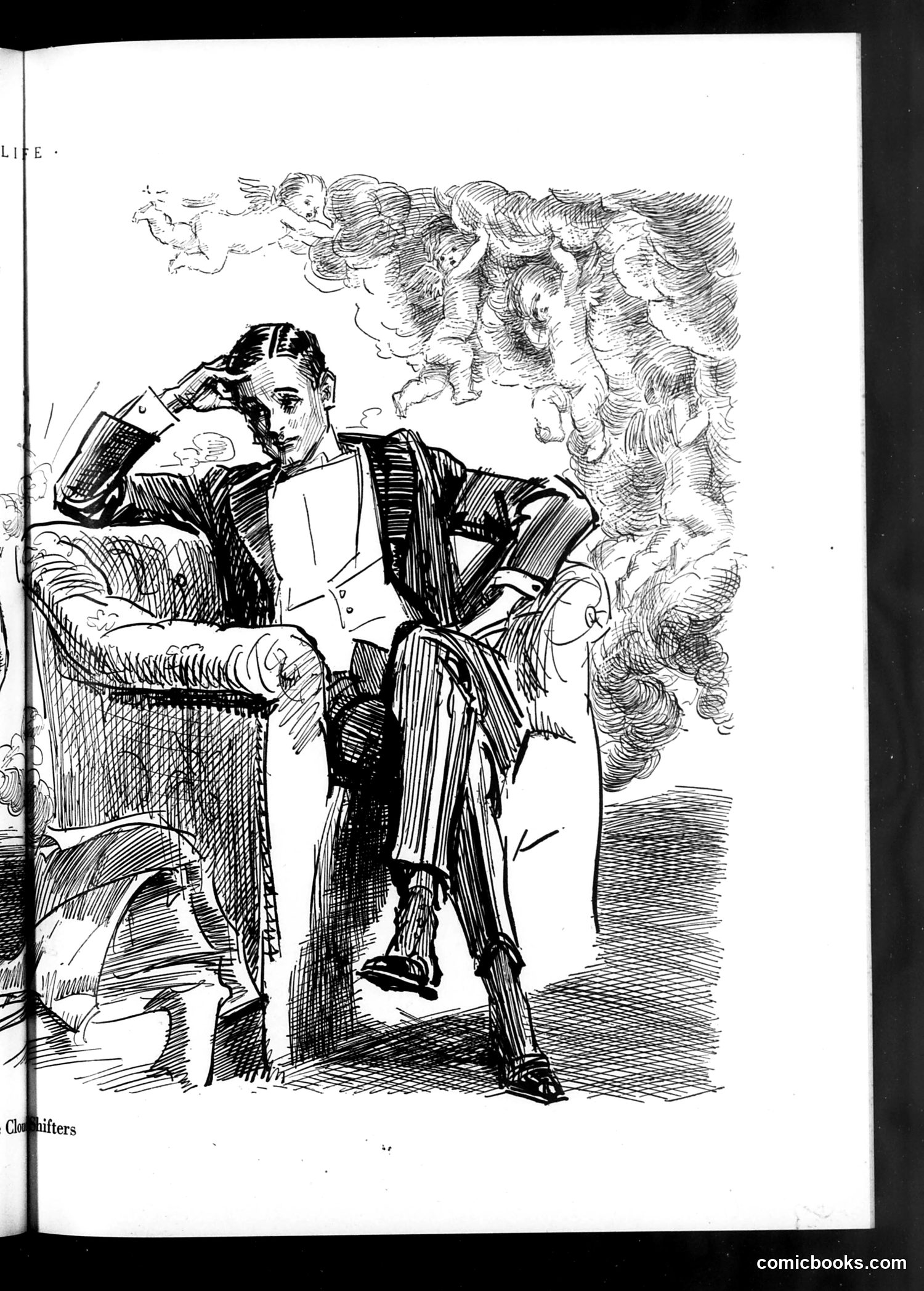
This page shows a single ink illustration signed "Cesare Shifters" (or similar). It depicts a well-dressed man in formal evening wear seated in an armchair, holding papers and appearing contemplative or troubled, with his hand to his head in a gesture suggesting worry or stress. Above him floats a cloud of cherubs or putti—classical artistic figures often associated with love, innocence, or idealized concepts. The OCR text appears corrupted and yields no readable content, making it impossible to identify the specific political or social reference, the figure depicted, or the cartoon's satirical point. Without legible caption or context, the meaning remains unclear to a modern reader.
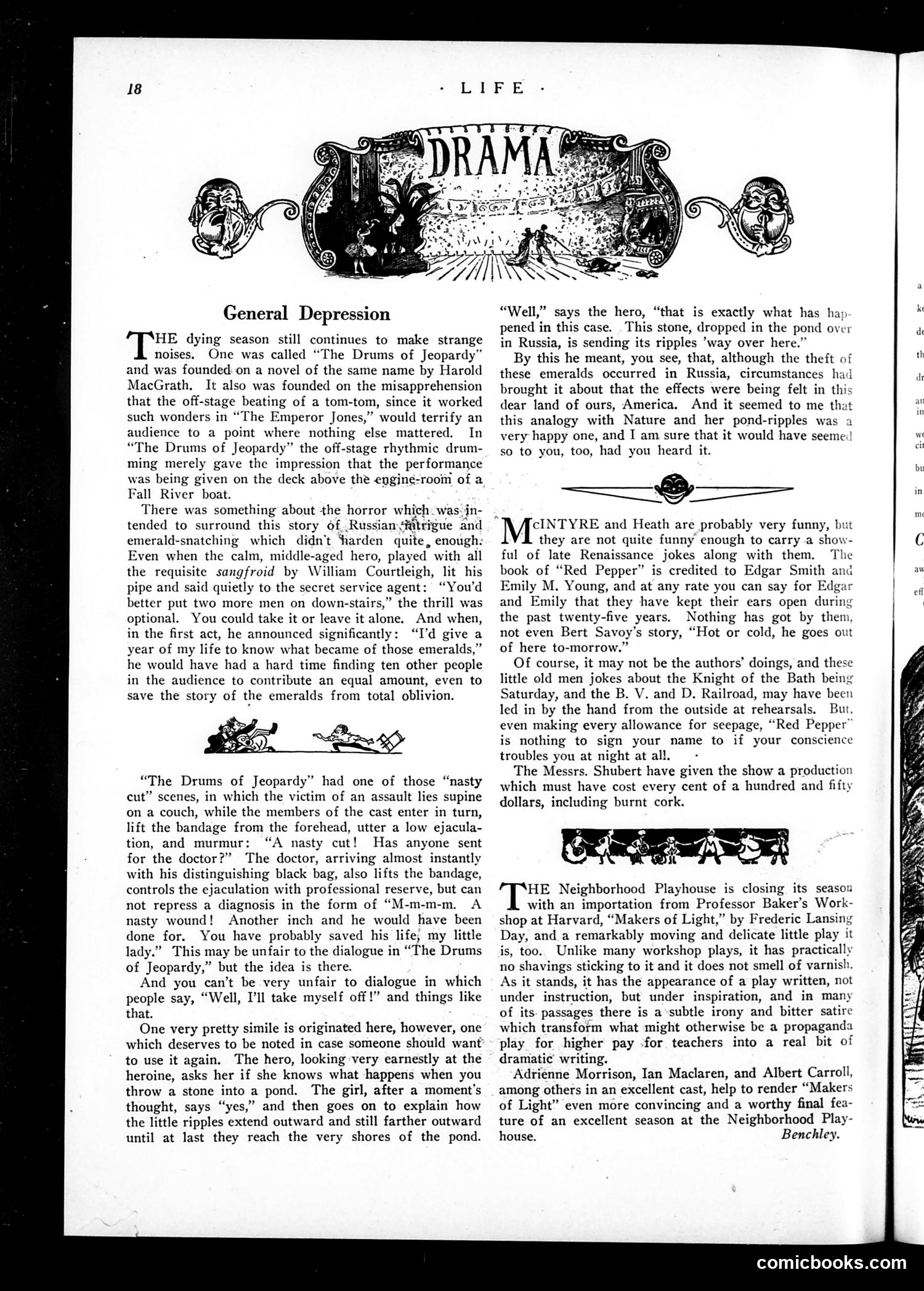
This theater review satirizes a play called *"The Drums of Jeopardy,"* based on a Harold MacGrath novel. The critic mocks its heavy-handed attempt to create suspense through offstage tom-tom drumming—a technique that worked in *"The Emperor Jones"* but here merely sounds like the play occurs on a steamship's upper deck. The review ridicules the melodramatic dialogue and contrived plot (Russian jewel theft affecting America). It highlights absurd scenes: a "nasty cut" diagnosis repeated by every character, and a particularly clumsy metaphor comparing emerald-theft consequences to ripples spreading across a pond. The critic also briefly reviews *"Red Pepper,"* noting its dated Renaissance-era humor, though crediting writers Edgar Smith and Emily M. Young for staying current with popular jokes. The overall tone is witty dismissal of theatrical mediocrity during Broadway's struggling "dying season."
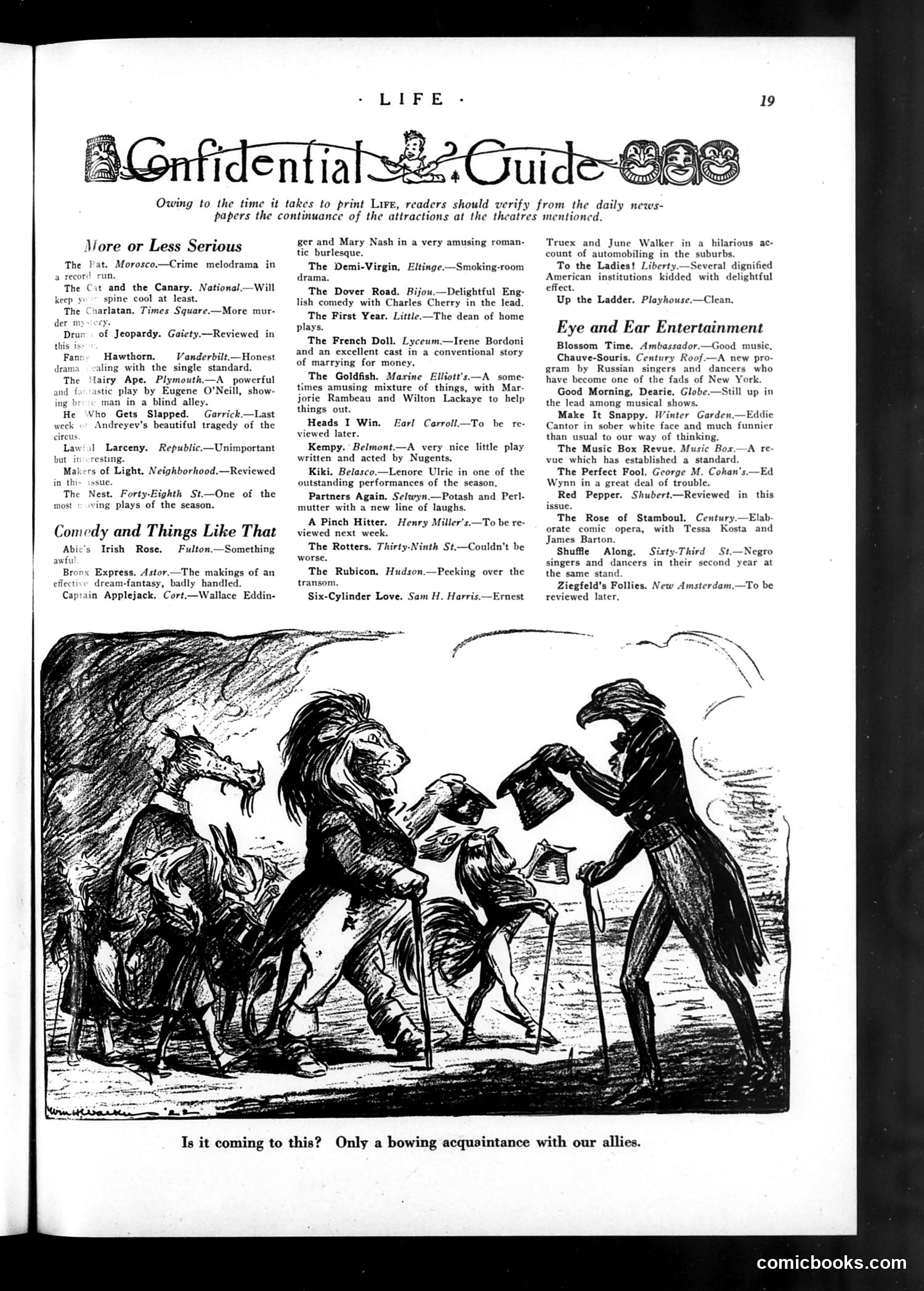
This page is a theatre guide from *Life* magazine listing current Broadway shows with brief reviews. The single cartoon at bottom depicts anthropomorphized animals—a lion, what appears to be a bird or rooster, and other creatures—bowing to each other formally. The caption reads: "Is it coming to this? Only a bowing acquaintance with our allies." **The satire:** This likely references post-World War I diplomatic relations. The animal caricatures probably represent Allied nations (possibly Britain as the lion, France as the rooster—traditional national symbols). The joke expresses concern that former wartime allies are becoming distant, maintaining only superficial courtesy rather than genuine alliance. The cartoon suggests diplomatic relationships were cooling or becoming merely formal rather than substantive, a common post-1918 anxiety about fractured international partnerships. The specific date and context remain unclear without additional publication information.
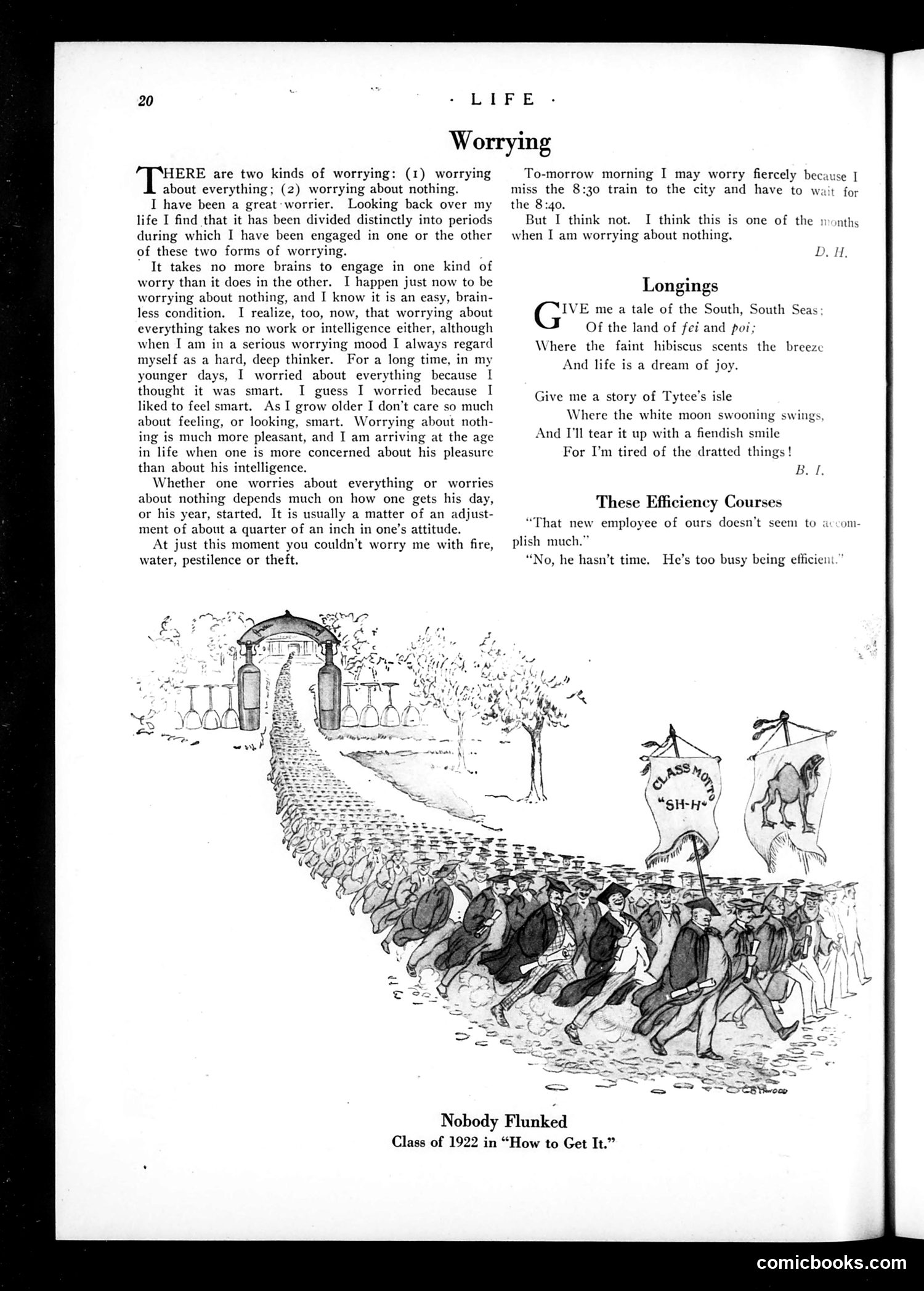
This page contains satirical commentary on 1920s American life rather than a single unified cartoon. The main illustration depicts the "Class of 1922 in 'How to Get It'"—a crowd of graduates streaming toward a building labeled "Class No. SH-H" (suggesting secrecy), carrying banners with a camel and text about "getting it." This satirizes Prohibition-era bootlegging and the widespread illegal pursuit of alcohol following the 1920 Volstead Act. The joke: despite official education in proper behavior, graduates are stampeding toward illicit alcohol instead. The text essays discuss worrying and longing, while the "Efficiency Courses" joke mocks the contemporary corporate efficiency movement—suggesting the new employee is too busy performing efficiency procedures to actually accomplish work. Overall, the page humorously critiques modern anxieties, corporate culture, and the gap between societal rules and actual behavior during the Jazz Age.
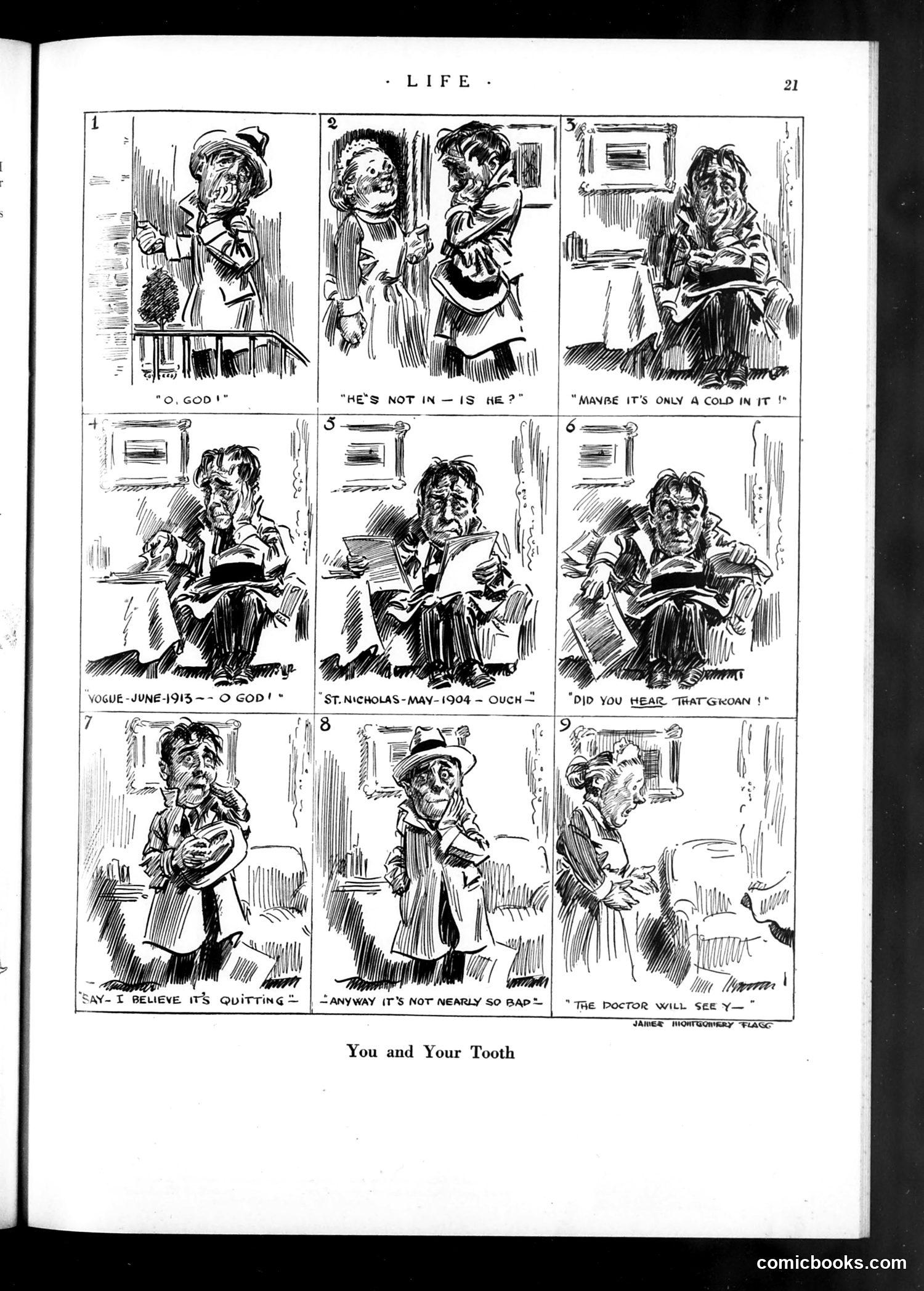
This nine-panel comic strip satirizes the anxiety and ordeal of visiting a dentist. Each panel depicts a man's escalating distress about a toothache—from initial denial ("O God!"), through searching for the dentist, to waiting in the office with mounting dread. The captions track his rationalizations ("Maybe it's only a cold in it," "Say, I believe it's quitting") and desperate hope ("The Doctor will see you"). The humor derives from the universal experience of dental fear: the man's exaggerated facial expressions and body language convey panic despite his attempts to minimize the problem. The references to specific magazine issues (Vogue June 1915, St. Nicholas May 1904) suggest this strip ran in *Life* magazine, which frequently published Flagg's humorous illustrated commentary on everyday American anxieties and social situations.
This page contains film criticism from *Life* magazine's "Silent Drama" section, reviewing three movies produced by William Fox. **Main targets of satire:** 1. **William Fox himself** — The critic mocks Fox's grandiose promotional letters that use exaggerated adjectives and announce only two formulaic plot types: sentimental mother-love stories or elaborate historical epics. 2. **"Silver Wings"** — A tearjerker starring Mary Carr, criticized as a transparent attempt to replicate the success of "Over the Hill," but hampered by uninteresting characters. 3. **"Nero"** — A historical epic set in Rome with ridiculous plotting (a volcano and revolution conveniently save the heroine) and implausible logistics (Roman general using non-existent airplanes). The critic finds the film's absurdities unintentionally comedic. 4. **By contrast, Jackie Coogan** — The child actor is praised as genuinely talented, requiring no artificial tricks—implicit praise that Fox's expensive spectacles lack authentic artistry. The satire targets Fox's reliance on formula, bombast, and manufactured emotion over genuine talent.
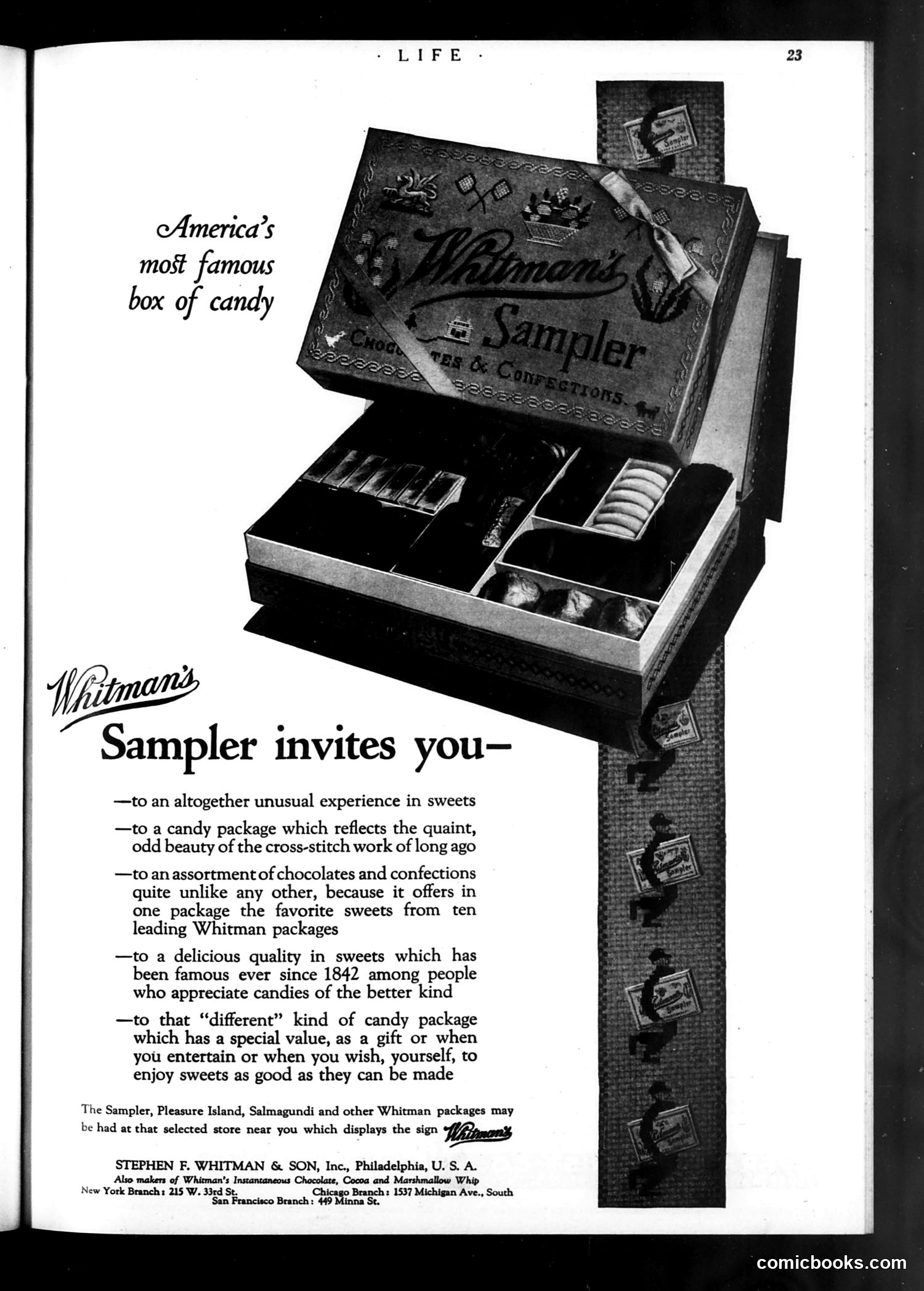
This is **not a cartoon or satire**—it's a straightforward advertisement for Whitman's candy, specifically their "Sampler" box. The page showcases an ornate chocolate assortment box with decorative cross-stitch patterning on the lid. The ad emphasizes luxury and heritage, highlighting that Whitman's has been making quality candies since 1842. The appeal is to consumers who view candy as a refined gift or treat rather than mere confection. The marketing language targets "people who appreciate candies of the better kind," positioning the product as upscale. The Sampler's value proposition is offering "favorite sweets from ten leading Whitman packages" in one box—essentially a curated collection. There is no political commentary, caricature, or satirical point. This is a period advertisement demonstrating how candy was marketed to middle and upper-class consumers in early-to-mid 20th century America, emphasizing tradition, quality, and aesthetic presentation.
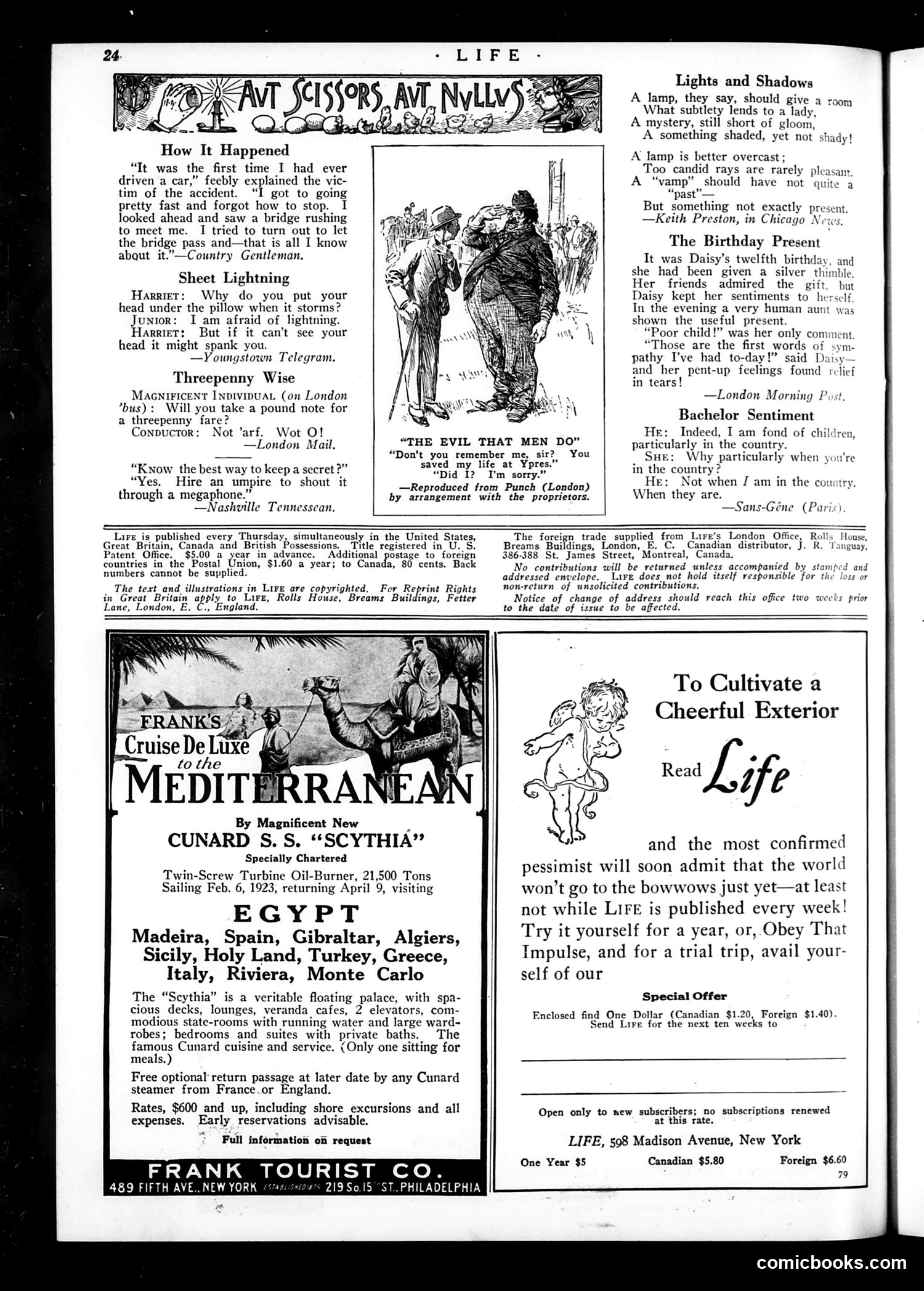
This page contains mostly **humorous anecdotes and advertisements** rather than political cartoons. The humor is domestic and social rather than satirical: **Key Content:** The cartoons/jokes depict everyday situations: a novice driver's accident, a child's disappointment with a practical birthday gift, and bachelor sentiments about children. There's one sketch titled "The Evil That Men Do" showing what appears to be a WWI veteran ("You saved my life at Ypres") meeting someone who doesn't remember him—likely satirizing how quickly post-war society forgot soldiers' sacrifices. **Social Context:** The references to Ypres (major WWI battle) and casual treatment of a soldier's unacknowledged service suggest post-WWI disillusionment—a common theme in 1920s satire. The humor is light and personal rather than attacking institutions or political figures. **Mostly Advertising:** The page is dominated by cruise ship ads (Cunard's "Scythia") and subscription promotions for *Life* magazine itself.
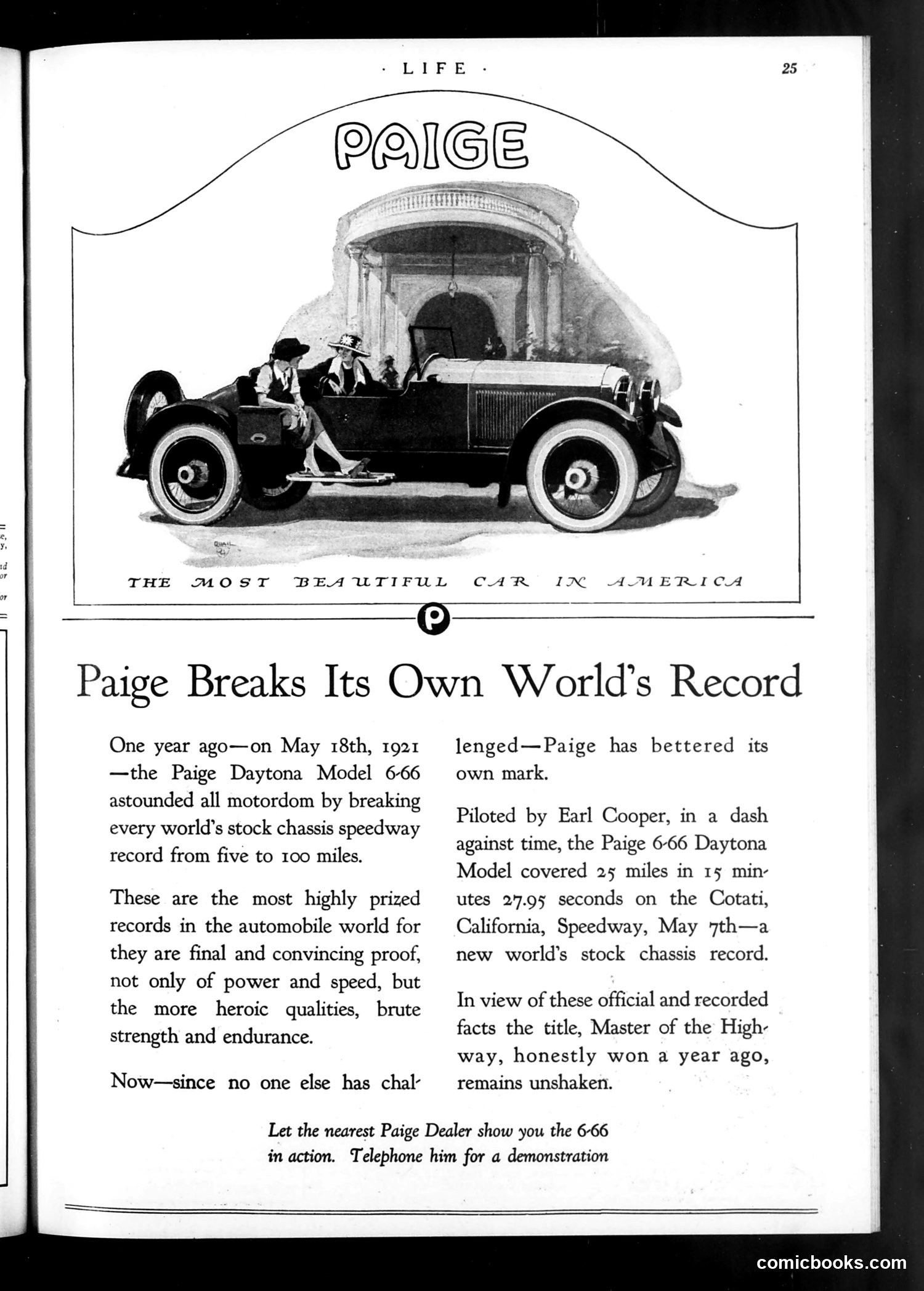
This is a **straight advertisement**, not satire or editorial content. It promotes the Paige automobile's speed records. The page features an illustration of a 1920s touring car with two well-dressed passengers driving past a classical building, labeled "The Most Beautiful Car in America." The text celebrates the Paige Daytona Model 6-66, which set stock-chassis speedway records. One year prior (May 1921), it broke multiple speed records from 5-100 miles. Now (May 1922), driver Earl Cooper has bettered the 25-mile record, covering the distance in 15 minutes 27.95 seconds at California's Cotati Speedway. The advertisement argues these official records prove not just speed and power, but "heroic qualities, brute strength and endurance"—selling the car's superiority since "no one else has challenged" its title of "Master of the Highway." This reflects the 1920s marketing obsession with speed records as proof of automotive excellence and status.
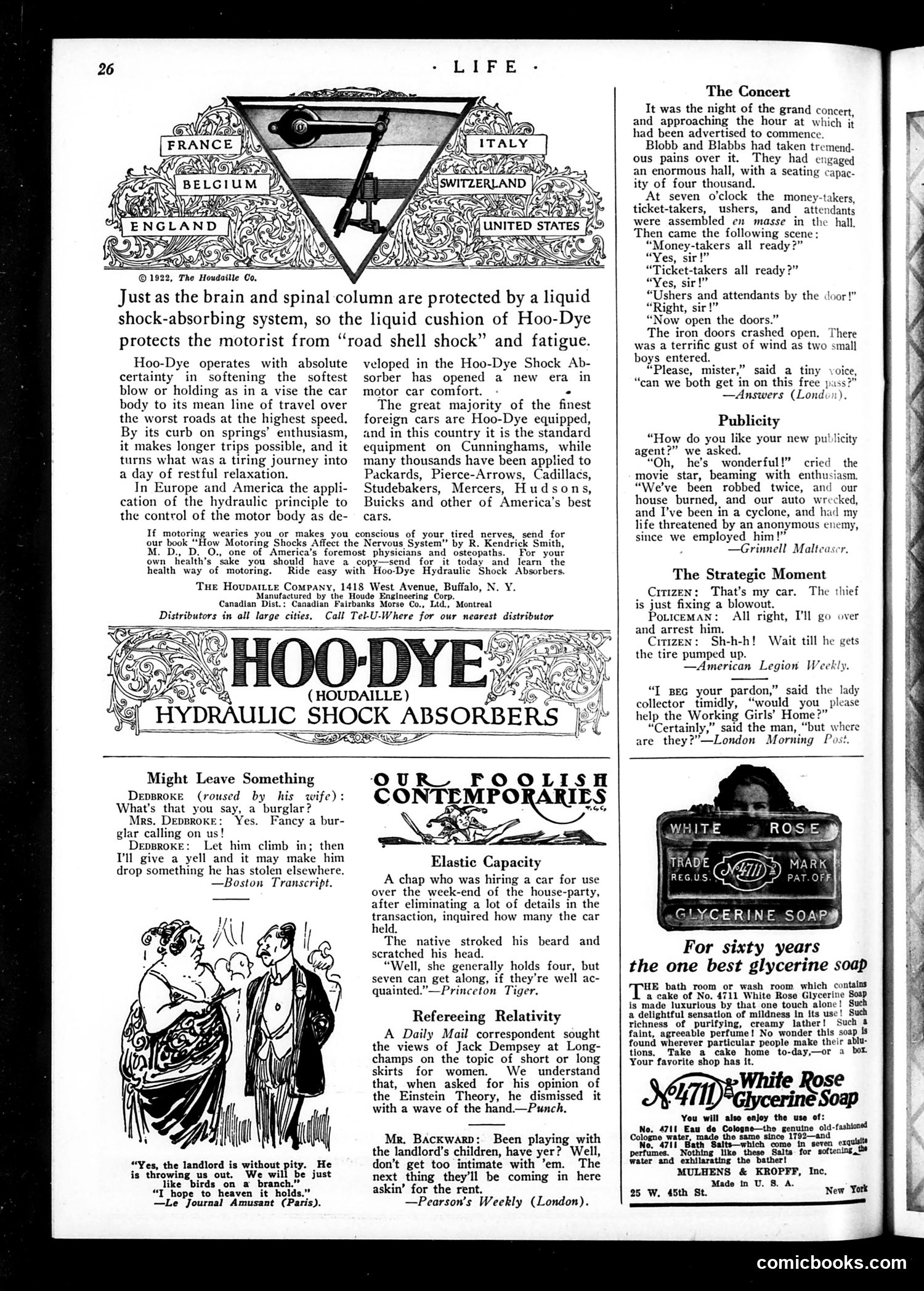
This page from *Life* magazine (a satirical publication) contains multiple short humorous pieces typical of early 20th-century American humor: **"The Concert"** satirizes poor event planning: organizers meticulously prepare staff for a grand concert, but when doors open, only two small boys attend—a joke about massive over-preparation meeting complete failure. **"Publicity"** mocks movie star publicity agents: a star praises her agent despite experiencing robberies, fires, wrecks, cyclones, and death threats—the joke being that any publicity, even catastrophic, is considered successful marketing. **"The Strategic Moment"** plays on police procedure: a citizen tells a cop to wait before arresting a car thief because the thief is currently pumping up a tire—implying the citizen wants the thief to finish the job first. The page also contains a large **Hoo-Dye shock absorber advertisement** comparing hydraulic car suspension to the brain's shock-absorbing system—typical automotive advertising of the era emphasizing modern comfort and safety technology.
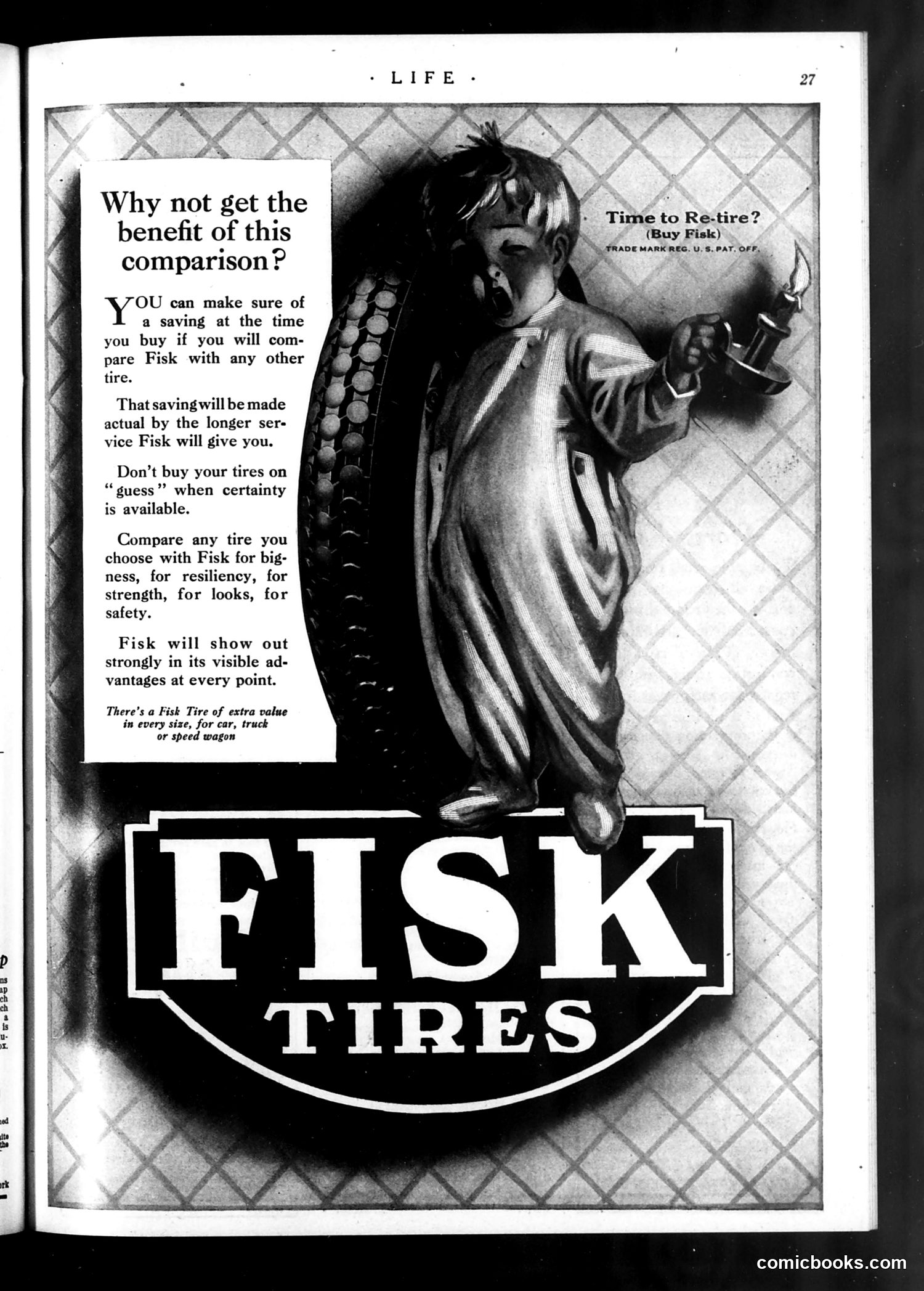
This is a full-page advertisement for Fisk Tires, not political satire. The image features a character (appears to be the "Fisk Boy," a mascot associated with the brand) holding a tire, with text encouraging consumers to compare Fisk tires against competitors. The ad's pitch emphasizes value: buyers should compare Fisk tires on objective qualities—bigness, resilience, strength, appearance, and safety—rather than guessing. The tagline "Time to Re-tire? (Buy Fisk)" is a pun playing on "retire" and "re-tire." The layout and messaging reflect early 20th-century advertising strategy: building consumer confidence through comparative claims and brand mascots. There is no satirical or political content here; it's straightforward commercial messaging aimed at automotive owners.
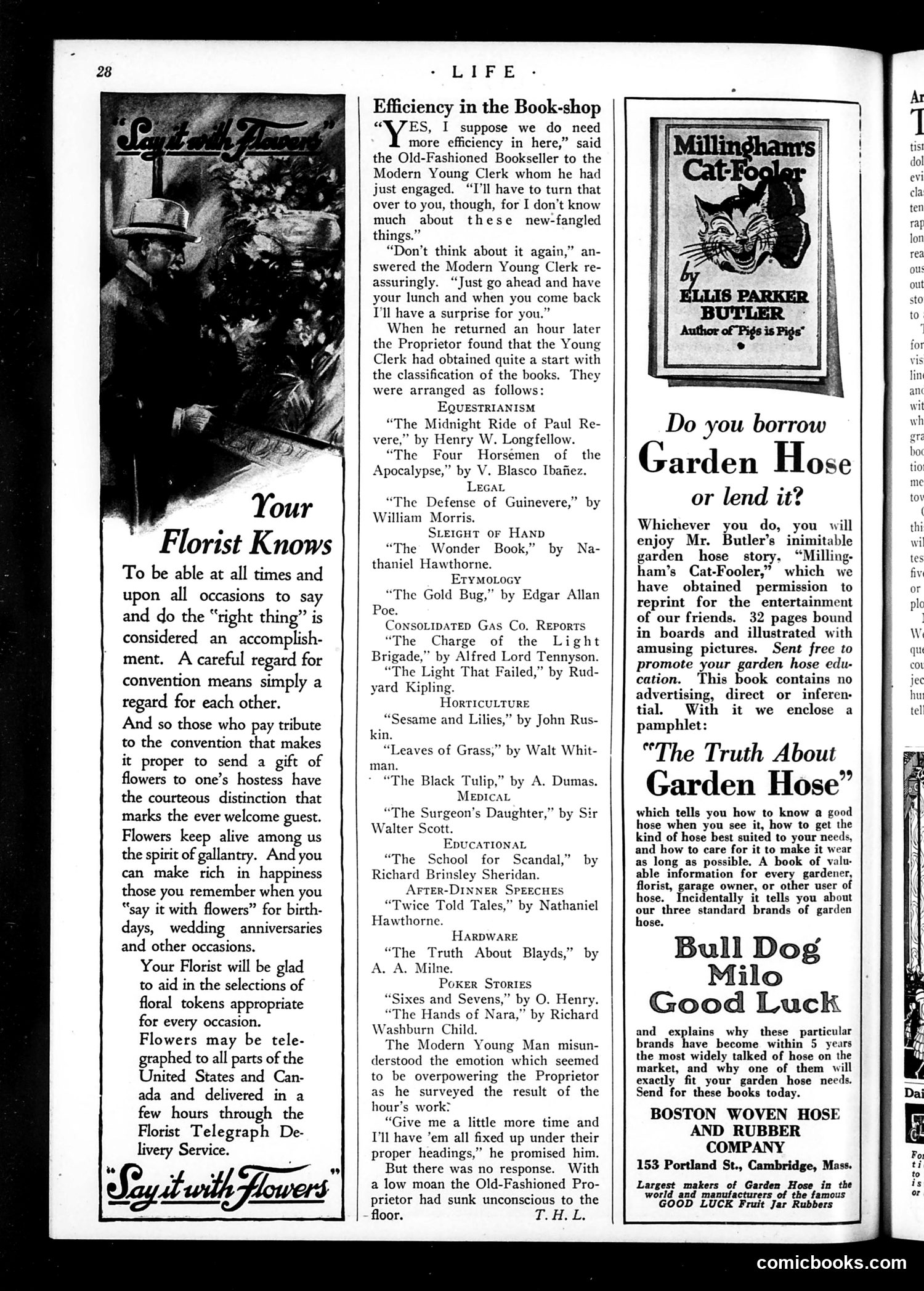
This page contains two distinct sections: **Left side: "Your Florist Knows"** — An advertisement promoting flower-giving as a mark of good manners and social convention. **Center: "Efficiency in the Book-shop"** — A satirical story mocking the "Modern Young Clerk's" absurd literal-mindedness. The joke: he reorganizes books by pun-based categories rather than conventional library systems. For example, he files *The Four Horsemen of the Apocalypse* under "Equestrianism" (horses), *The Gold Bug* under "Etymology" (sounds like "etymology"), and *Sesame and Lilies* under "Horticulture" (plants). The old-fashioned proprietor faints in despair. This reflects 1920s anxieties about replacing traditional wisdom with "efficiency" and modern methods that miss the point entirely—a common Life magazine theme satirizing overzealous modernization. **Right side:** Advertisements for garden hose and a book about cat-fooling.
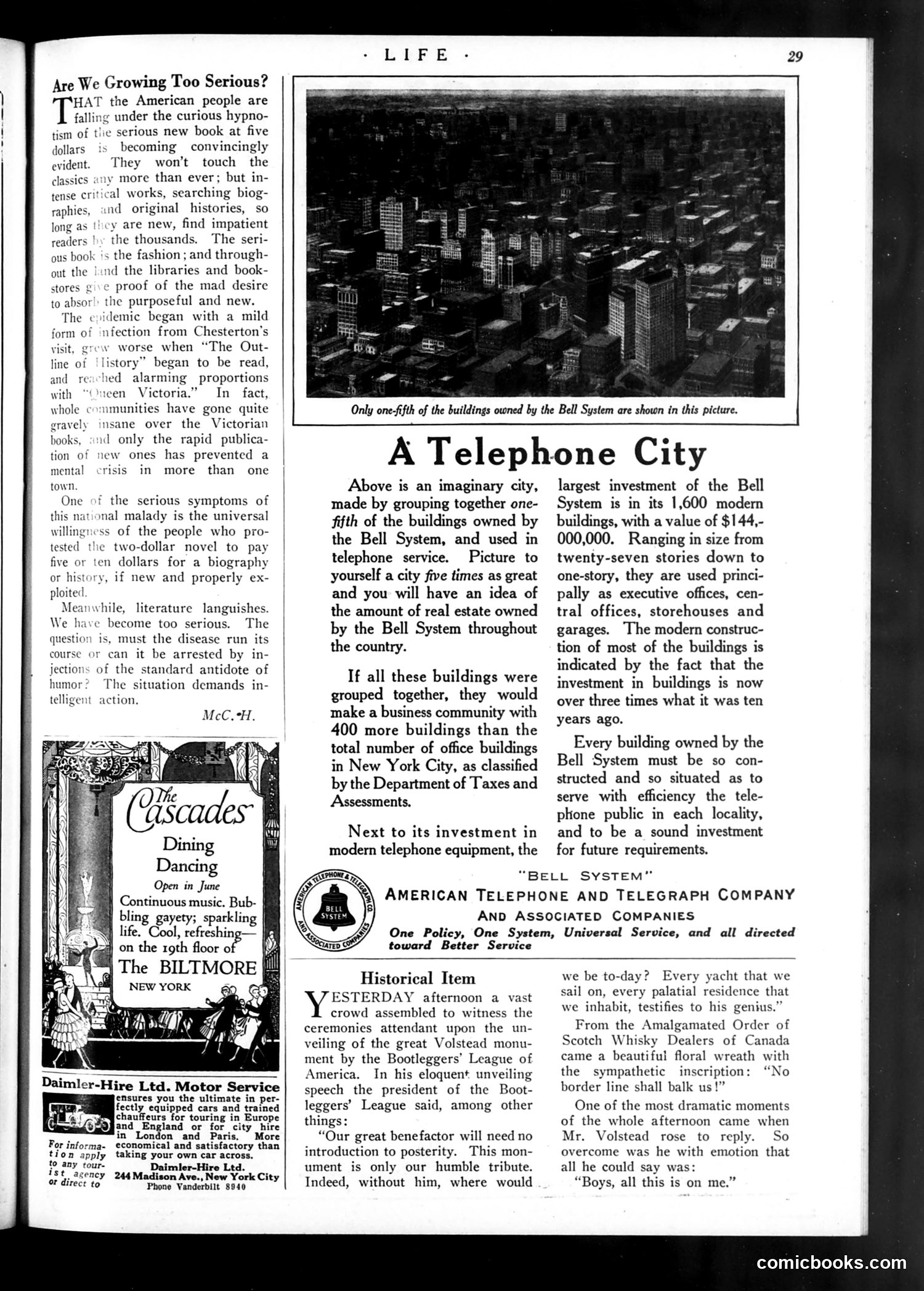
This page contains two distinct pieces: **"Are We Growing Too Serious?"** — A satirical editorial lamenting that Americans have become obsessed with buying serious, expensive new books (biographies, histories) while neglecting fiction and literature. The author blames this trend on visits from G.K. Chesterton and popularity of works like "The Outline of History," suggesting Americans need humor to counteract this "disease." **"A Telephone City"** — A Bell System corporate advertisement disguised as editorial content. It visualizes the company's vast real-estate holdings by imagining a city composed of one-fifth of Bell's 1,600 buildings. The piece touts the system's $144 million investment and modern infrastructure, implicitly promoting the company's dominance and stability. **"Historical Item"** — A satirical piece about Prohibition-era bootleggers erecting a monument to Andrew Volstead (who sponsored Prohibition legislation). The joke: organized criminals are publicly celebrating the law that made their business profitable, with absurdist details like sympathetic wreaths from whisky dealers. All three pieces reflect 1920s concerns: reading habits, corporate power, and Prohibition's perverse effects.
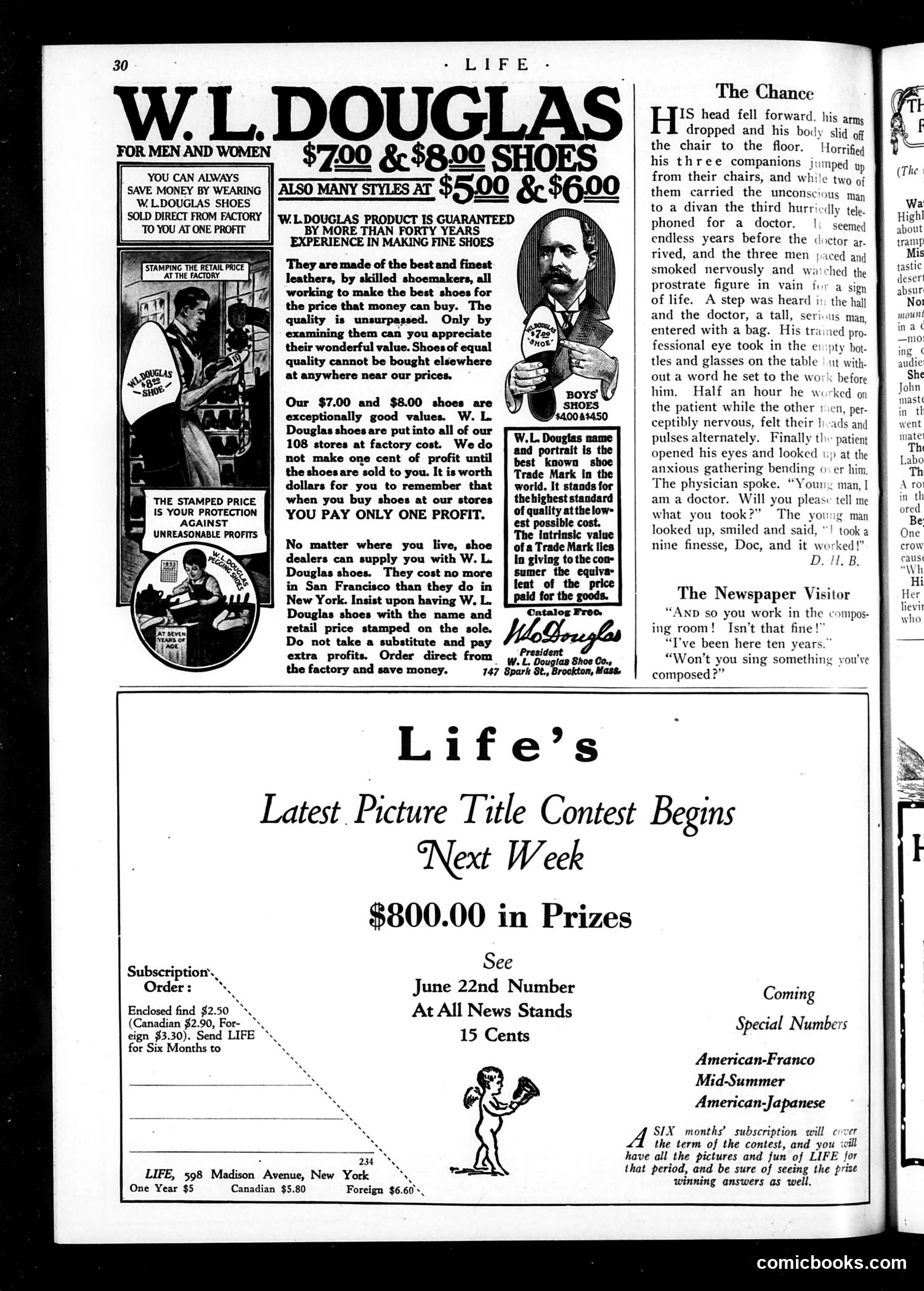
This page is primarily **advertising** for W.L. Douglas Shoes, a mail-order footwear company emphasizing factory-direct sales and low profit margins. The dominant visual shows the company's trademark—a man's portrait—and illustrations of factory workers, reinforcing claims of quality and cost control. The page includes two brief **humorous stories**: 1. **"The Chance"**: A comedic sketch about a man who collapses after consuming mystery substances (suggested by empty bottles). When a doctor asks what he took, the patient replies he consumed "a nine finesse" and it "worked"—apparently a reference to a card game term, suggesting the man was intoxicated but somehow lucky. 2. **"The Newspaper Visitor"**: A brief joke about a visitor to a newspaper composing room asking a worker to sing something he's composed—playing on the double meaning of "composition" (typesetting versus musical creation). Both are light, pun-based humor typical of Life's satirical style. The page also advertises an upcoming picture-title contest with $800 in prizes.
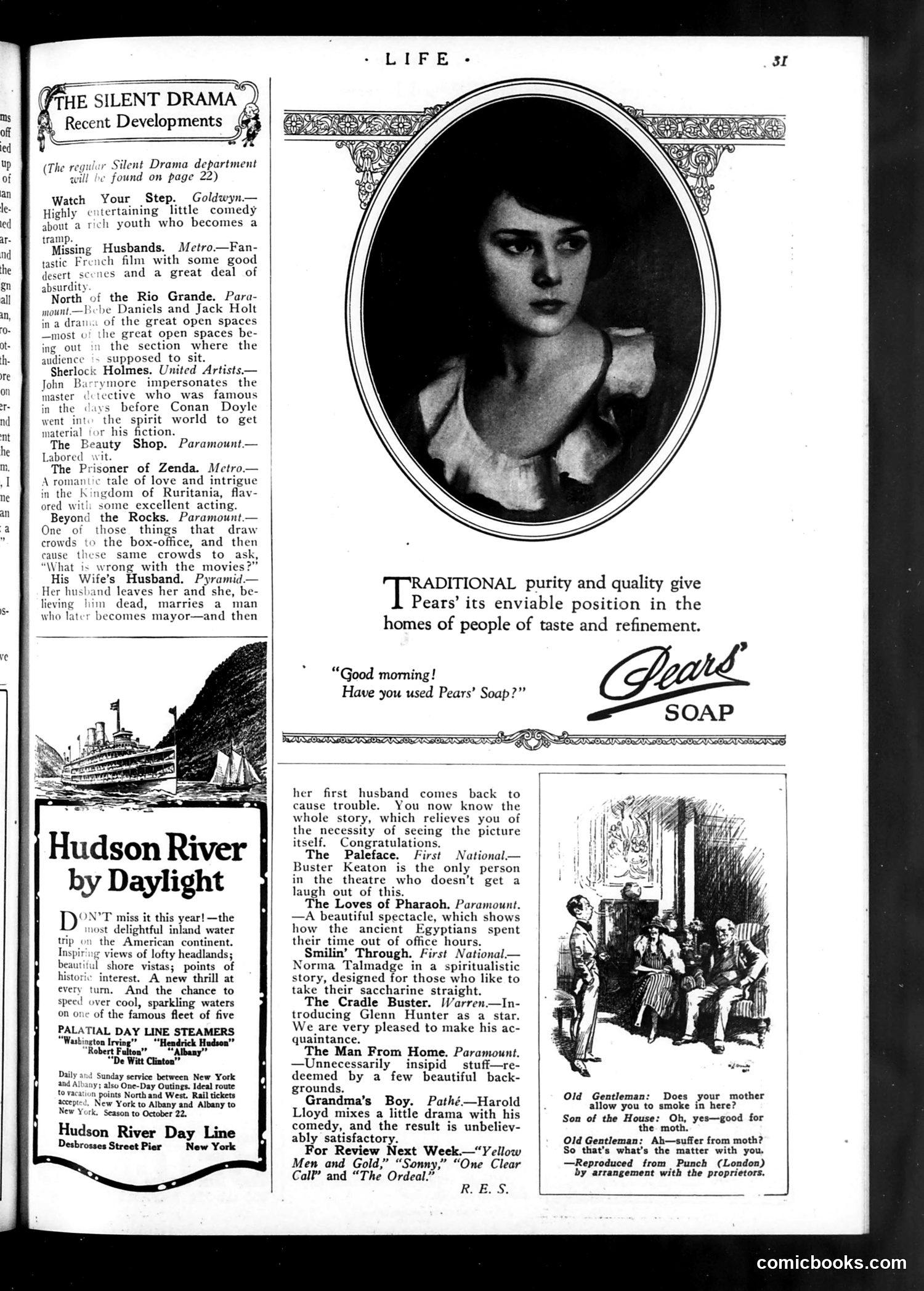
This page features **film reviews** of silent movies from major studios (Goldwyn, Metro, Paramount, etc.), written with satirical commentary typical of Life magazine's humorous style. The reviews mock both good and bad films with witty one-liners—for example, criticizing "North of the Rio Grande" because "most of the great open spaces [are] out in the section where the audience is supposed to sit." The page includes **period advertisements**: the Hudson River Day Line steamship service and Pears' Soap, featuring a formal portrait of a gentleman to suggest refinement and tradition. A small **cartoon** at bottom-right shows an "Old Gentleman" and "Son of the House" discussing moth smoke—a mild joke about the boy's smoking habit, reprinted from London's *Punch* magazine. The content reflects 1920s entertainment culture and advertising aesthetics, when silent films dominated cinema and luxury travel/soap were marketed to affluent readers.
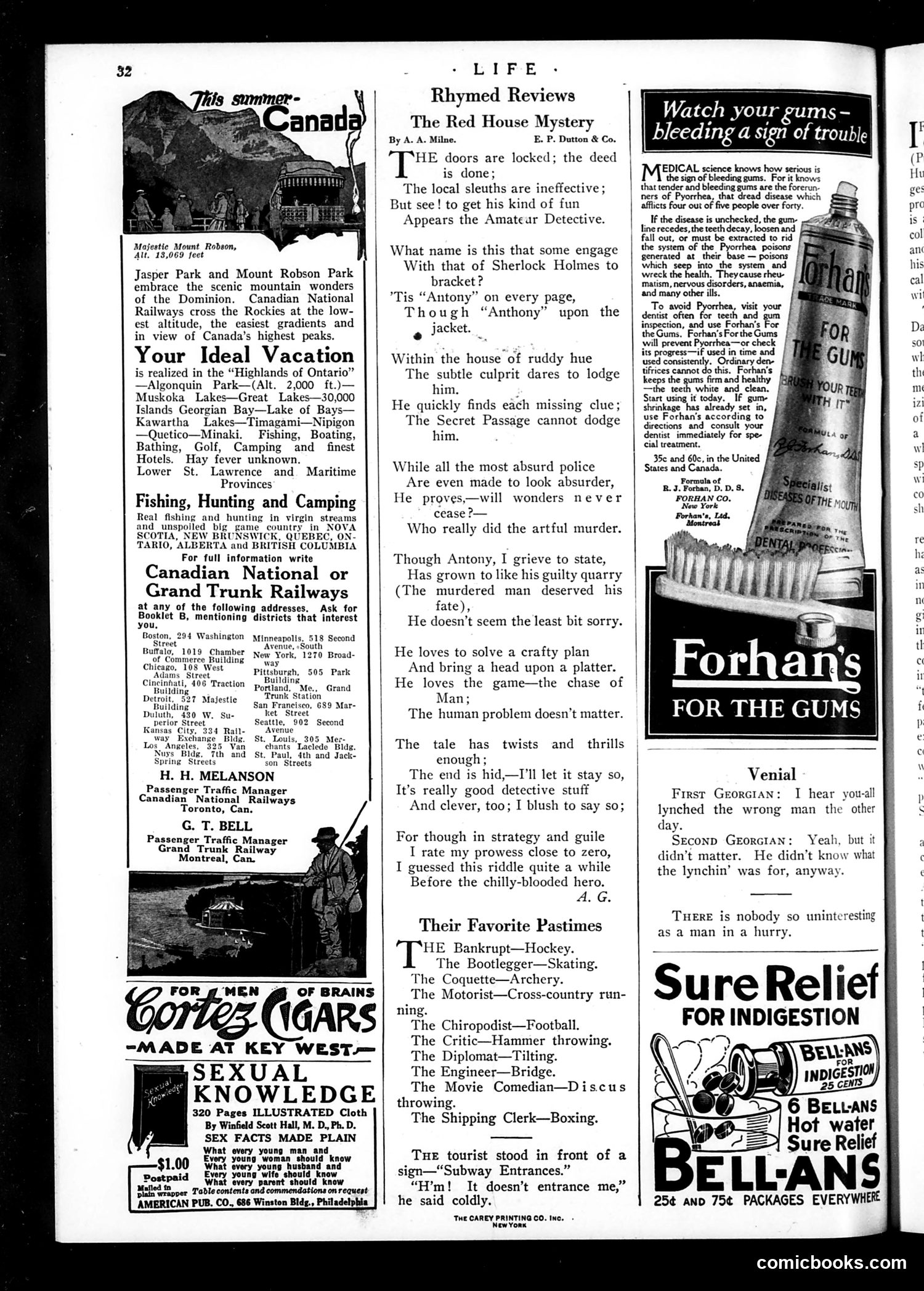
This page from *Life* magazine contains travel advertising, a book review, and humor pieces typical of early 20th-century American magazines. **Main Content:** The dominant elements are **Canadian tourism advertisements** for railways and vacation destinations (Jasper Park, Mount Robson, Ontario lakes), reflecting period interest in travel promotion. **"Rhymed Reviews"** critiques A.A. Milne's detective novel *The Red House Mystery*, written in clever verse. The reviewer praises the amateur detective "Antony" (Anthony on jacket) for solving mysteries that professional police bungle, though notes the protagonist is emotionally detached from his crimes. **"Their Favorite Pastimes"** is a humorous list matching professions to activities through wordplay—"The Bankrupt—Hockey" (going broke), "The Bootlegger—Skating" (illegal), "The Engineer—Bridge," etc. This reflects Prohibition-era America (bootleggers referenced) and uses puns on job titles. The page also includes period product advertisements (Forhan's dental products, Cortez cigars, Bell-ans antacid) and a sexual education manual—all typical *Life* magazine content from this era.
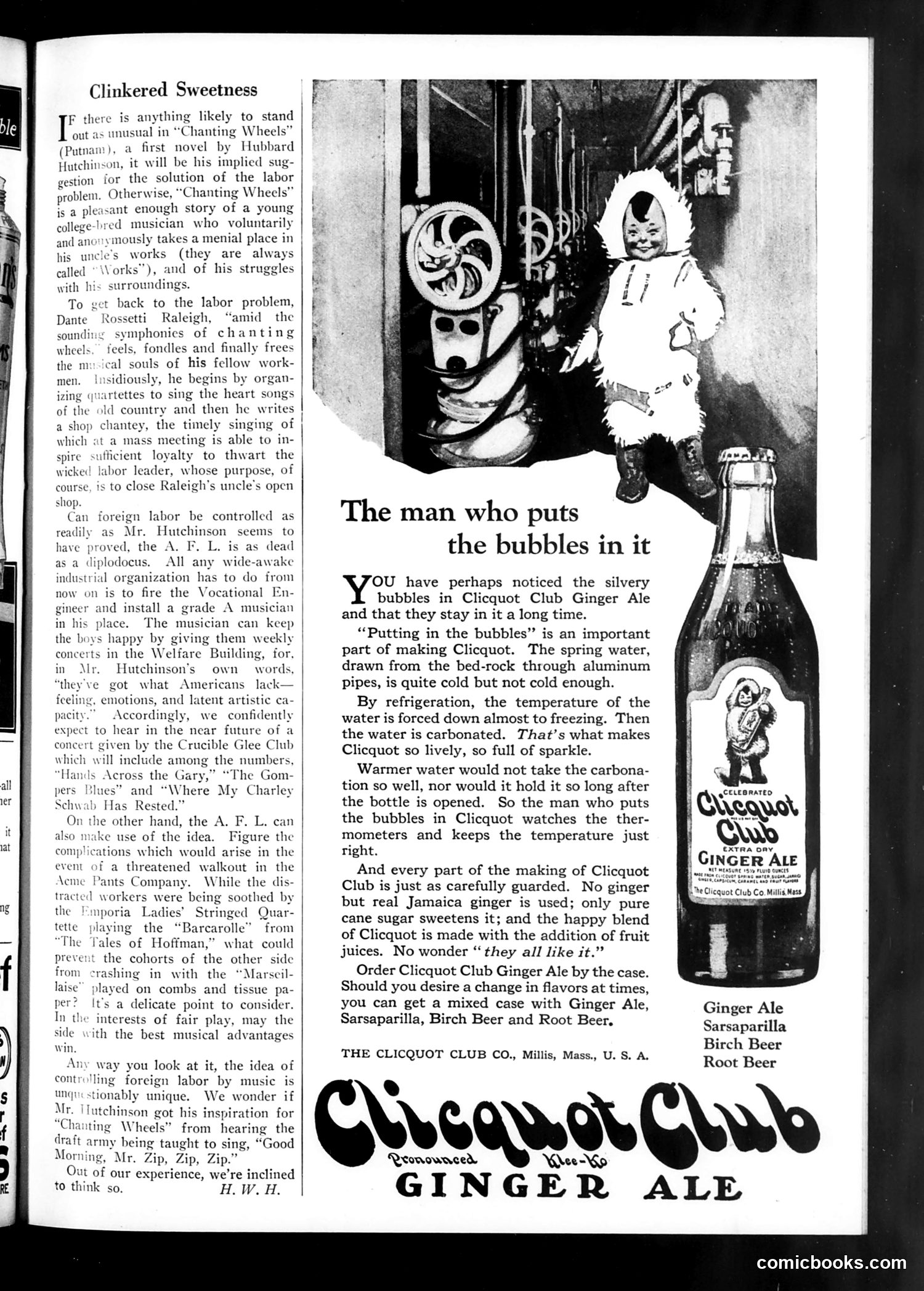
This page contains two distinct elements: **Left side - Book review ("Clinkered Sweetness"):** A satirical critique of Hubbard Hutchinson's novel *Chanting Wheels*, which proposes solving labor unrest through music. The reviewer mocks this naive solution, suggesting that having a musician sing patriotic songs to workers would prevent unionization better than the American Federation of Labor (A.F.L.). The satire highlights the absurdity of this anti-labor approach—implying management would prefer musical distraction to genuine worker organization. The reference to "Mr. Zip, Zip, Zip" suggests WWI-era propaganda songs used to control public sentiment. **Right side - Advertisement:** A Clicquot Club Ginger Ale ad explaining the carbonation process. This is straightforward product marketing with no satirical content. The juxtaposition is ironic: the book review criticizes using entertainment to manipulate workers, while an advertisement simultaneously uses detailed explanation as persuasive marketing—illustrating how advertising itself functions as a form of influence.
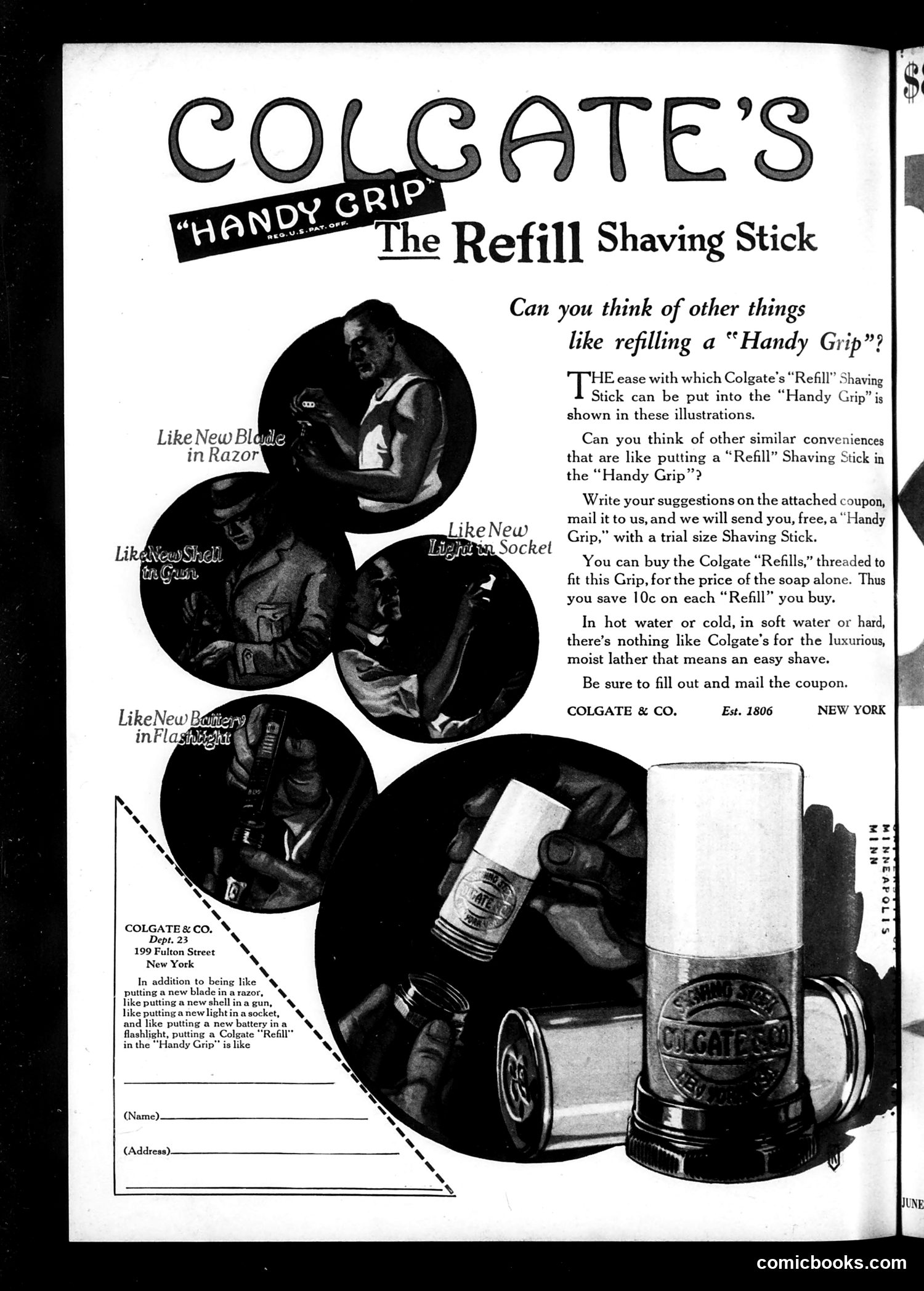
This is a **product advertisement**, not political satire. Colgate & Co. promotes their refillable "Handy Grip" shaving stick holder through a creative marketing campaign. The page shows circular photographs demonstrating various everyday refilling scenarios—inserting new blades in razors, shells in guns, light bulbs in sockets, batteries in flashlights. These analogies reinforce how convenient the refillable shaving stick system is. The marketing strategy is clear: readers submit suggestions for "other things like refilling a Handy Grip," and Colgate rewards them with a free sample. This encourages consumer participation and brand engagement. The key selling point: refills cost only the soap price, saving 10¢ per replacement—emphasizing economy and practicality to Depression-era consumers concerned about value. This represents early 20th-century consumer advertising targeting male grooming habits through relatable, familiar comparisons.