
Life, 1922-06-15 · page 24 of 36
Life — June 15, 1922 — page 24: what you’re looking at
What you’re looking at
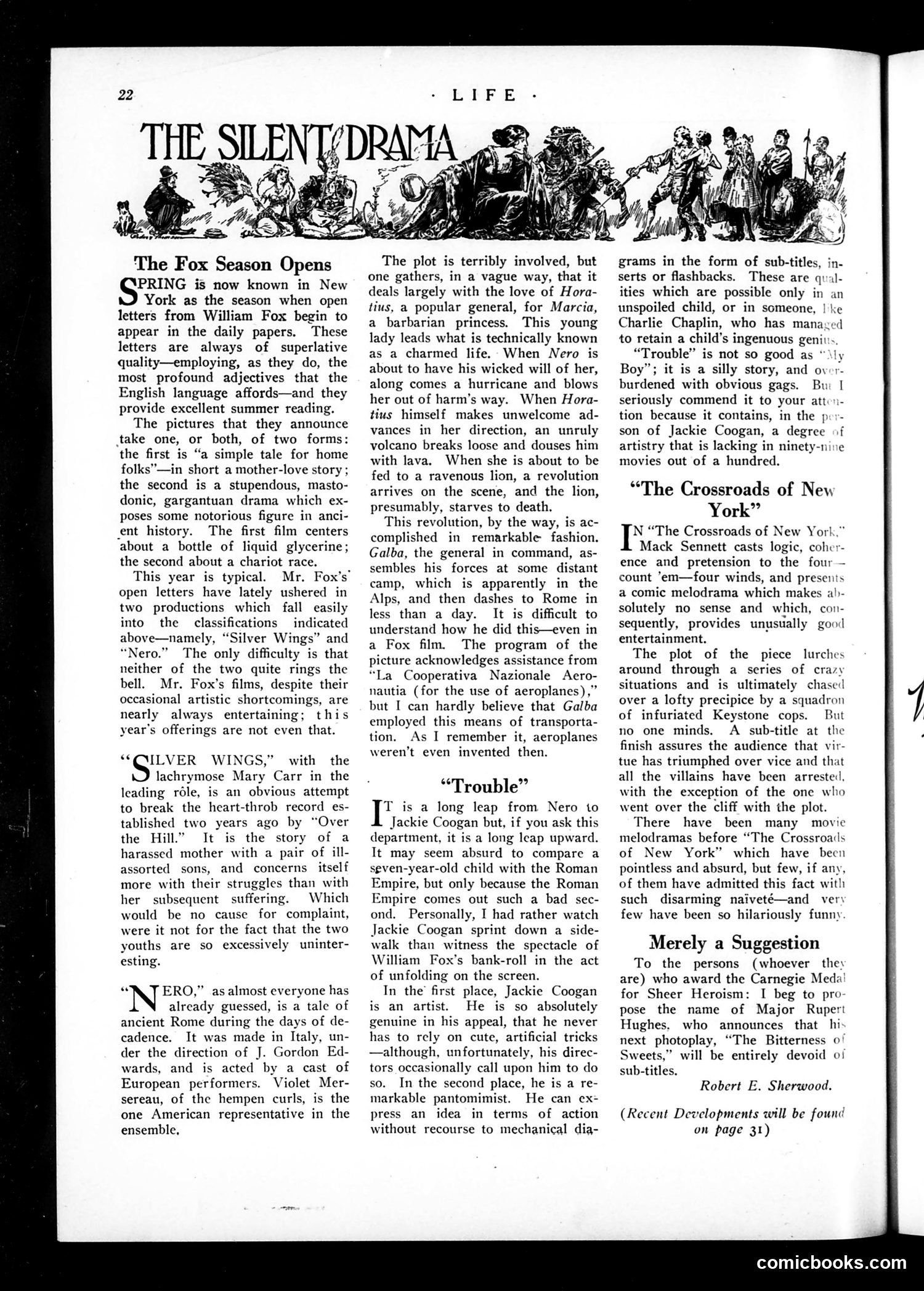
This page contains film criticism from *Life* magazine's "Silent Drama" section, reviewing three movies produced by William Fox. **Main targets of satire:** 1. **William Fox himself** — The critic mocks Fox's grandiose promotional letters that use exaggerated adjectives and announce only two formulaic plot types: sentimental mother-love stories or elaborate historical epics. 2. **"Silver Wings"** — A tearjerker starring Mary Carr, criticized as a transparent attempt to replicate the success of "Over the Hill," but hampered by uninteresting characters. 3. **"Nero"** — A historical epic set in Rome with ridiculous plotting (a volcano and revolution conveniently save the heroine) and implausible logistics (Roman general using non-existent airplanes). The critic finds the film's absurdities unintentionally comedic. 4. **By contrast, Jackie Coogan** — The child actor is praised as genuinely talented, requiring no artificial tricks—implicit praise that Fox's expensive spectacles lack authentic artistry. The satire targets Fox's reliance on formula, bombast, and manufactured emotion over genuine talent.
📄 Transcribed text from this page (OCR, searchable)
Machine-transcribed from the original scan — historical spelling and the odd misread are preserved.
22 The Fox Season Opens PRING is now known in New York as the season when open letters from William Fox begin to appear in the daily papers. These letters are always of superlative quality—employing, as they do, the most profound adjectives that the English language affords—and they provide excellent summer reading. The pictures that they announce take one, or both, of two forms: the first is “a simple tale for home folks"—in short a mother-love story ; the second is a stupendous, masto- donic, gargantuan drama which ex- poses some notorious figure in anci- ent history. The first film centers about a bottle of liquid glycerine; the second about a chariot race. This year is typical. open letters have lately ushered in two productions which fall easily into the classifications indicated above—namely, “Silver Wings” and “Nero.” The only difficulty is that neither of the two quite rings the bell. Mr. Fox’s films, despite their occasional artistic shortcomings, are nearly always entertaining; this year's offerings are not even that. ““GILVER WINGS,” with the lachrymose Mary Carr in the leading réle, is an obvious attempt to break the heart-throb record es- tablished two years ago by “Over the Hill.” It the story of a harassed mother with a pair of ill- assorted sons, and concerns itself more with their struggles than with her subsequent suffering. Which would be no cause for complaint, were it not for the fact that the two youths are so excessively uninter- esting. s ERO,” as almost everyone has already guessed, is a tale of ancient Rome during the days of de- cadence. It was made in Italy, un- der the direction of J. Gordon Ed- wards, and is acted by a cast of European performers. Violet Mer- sereau, of the hempen curls, is the one American representative in the ensemble, Mr. Fox's” LIFE The plot is terribly involved, but one gathers, in a vague way, that it deals largely with the love of Hora- tius, a popular general, for Marcia, a barbarian princess. This young lady leads what is technically known as a charmed life. When Nero is about to have his wicked will of her, along comes a hurricane and blows her out of harm's way. When Hora- tius himself makes unwelcome ad- vances in her direction, an unruly volcano breaks loose and douses him with lava. When she is about to be fed to a ravenous lion, a revolution arrives on the scene, and the lion, presumably, starves to death. This revolution, by the way, is ac- complished in remarkable fashion. Galba, the general in command, as- sembles his forces at some distant camp, which is apparently in the Alps, and then dashes to Rome in less than a day. It is difficult to understand how he did this—even in a Fox film. The program of the picture acknowledges assistance from “La Cooperativa Nazionale Aero- nautia (for the use of aeroplanes),” but I can hardly believe that Galba employed this means of transporta- tion. As I remember it, aeroplanes weren't even invented then. “Trouble” T is a long leap from Nero to Jackie Coogan but, if you ask this department, it is a long leap upward. It may seem absurd to compare a seven-year-old child with the Roman Empire, but only because the Roman Empire comes out such a bad sec- ond. Personally, I had rather watch Jackie Coogan sprint down a side- walk than witness the spectacle of William Fox’s bank-roll in the act of unfolding on the screen. In the’ first place, Jackie Coogan is an artist. He is so absolutely genuine in his appeal, that he never has to rely on cute, artificial tricks —although, unfortunately, his direc- tors occasionally call upon him to do so. In the second place, he is a re- markable pantomimist. He can ex- press an idea in terms of action without recourse to mechanical dia- grams in the form of sub-titles, in- serts or flashbacks. These are qual- ities which are possible only in an unspoiled child, or in someone, | k Charlie Chaplin, who has manayed to retain a child’s ingenuous geniu:. “Trouble” is not so good as * Boy”; it is a silly story, and oy burdened with obvious gags. Bu seriously commend it to your att tion because it contains, in the p son of Jackie Coogan, a degree artistry that is lacking in ninety-n movies out of a hundred. “The Crossroads of New York” N “The Crossroads of New York.” Mack Sennett casts logic, coher- ence and pretension to the four — count ’em—four winds, and preseuits a comic melodrama which makes al)- solutely no sense and which, con- sequently, provides unusually good entertainment. The plot of the piece lurches around through a series of crazy situations and is ultimately chased over a lofty precipice by a squadron of infuriated Keystone cops. But no one minds. A sub-title at the finish assures the audience that vir- tue has triumphed over vice and that all the villains have been arrested, with the exception of the one who went over the cliff with the plot. There have been many movie melodramas before “The Crossroads of New York” which have been pointless and absurd, but few, if any, of them have admitted this fact with such disarming naiveté—and very few have been so hilariously funny Merely a Suggestion To the persons (whoever they are) who award the Carnegie Meda for Sheer Heroism: I beg to pro pose the name of Major Rupert Hughes. who announces that hi next photoplay, “The Bitterness 0 Sweets,” will be entirely devoid o/ sub-titles. Robert E. Sherwood. (Recent Developments will be found on page 31) comicbooks.com