
Life, 1922-06-15 · page 20 of 36
Life — June 15, 1922 — page 20: what you’re looking at
What you’re looking at
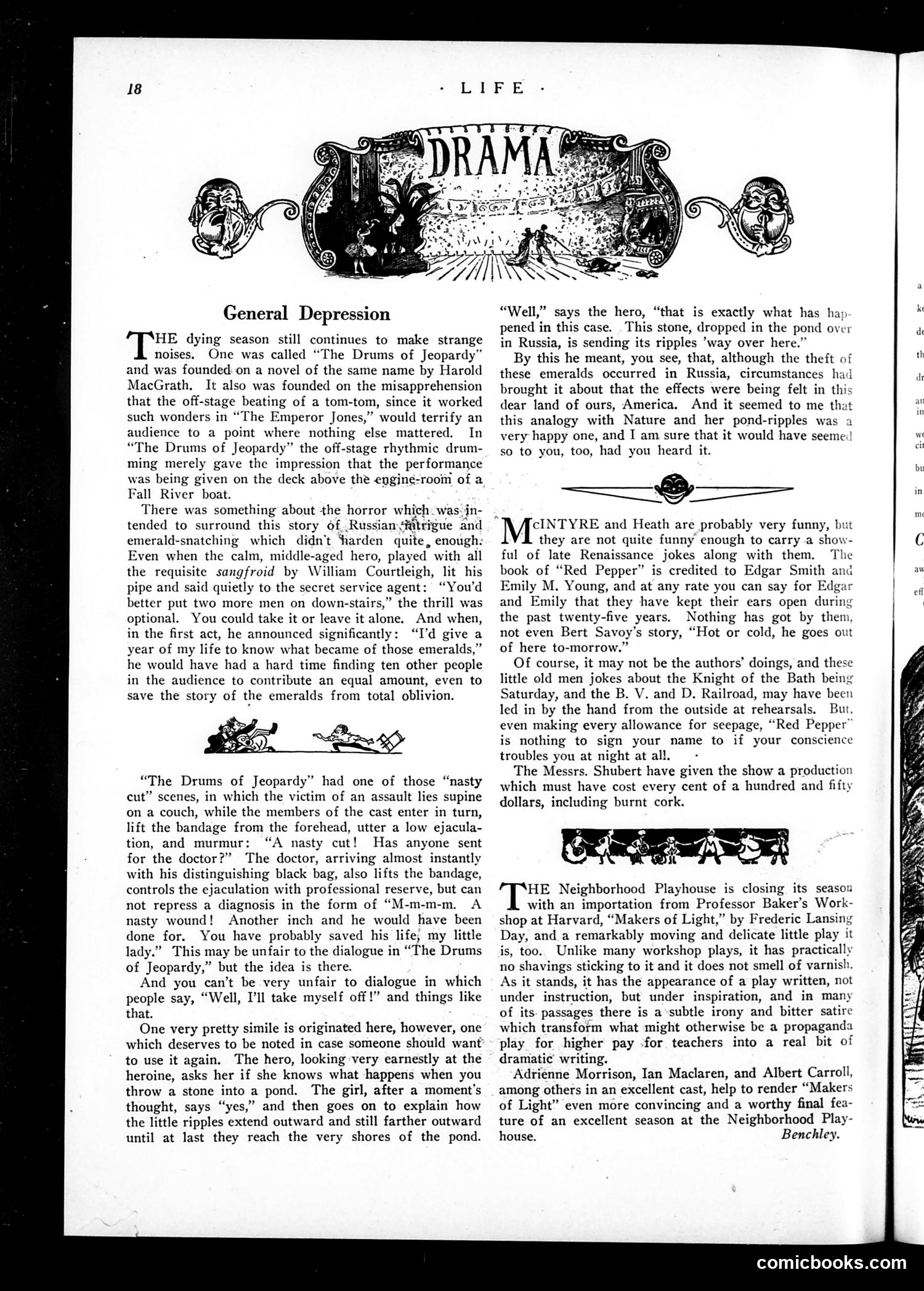
This theater review satirizes a play called *"The Drums of Jeopardy,"* based on a Harold MacGrath novel. The critic mocks its heavy-handed attempt to create suspense through offstage tom-tom drumming—a technique that worked in *"The Emperor Jones"* but here merely sounds like the play occurs on a steamship's upper deck. The review ridicules the melodramatic dialogue and contrived plot (Russian jewel theft affecting America). It highlights absurd scenes: a "nasty cut" diagnosis repeated by every character, and a particularly clumsy metaphor comparing emerald-theft consequences to ripples spreading across a pond. The critic also briefly reviews *"Red Pepper,"* noting its dated Renaissance-era humor, though crediting writers Edgar Smith and Emily M. Young for staying current with popular jokes. The overall tone is witty dismissal of theatrical mediocrity during Broadway's struggling "dying season."
📄 Transcribed text from this page (OCR, searchable)
Machine-transcribed from the original scan — historical spelling and the odd misread are preserved.
General Depression HE dying season still continues to make strange noises. One was called “The Drums of Jeopardy” and was founded. on a novel of the same name by Harold MacGrath. It also was founded on the misapprehension that the off-stage beating of a tom-tom, since it worked such wonders in “The Emperor Jones,” would terrify an audience to a point where nothing else mattered. In “The Drums of Jeopardy” the off-stage rhythmic drum- ming merely gave the impression that the performance was being given on the deck above the enginé-room of a Fall River boat. There was something about the horror which was. jn- tended to surround this story of,.Russians#itrigue and emerald-snatching which didn't ‘harden quite, enough: Even when the calm, middle-aged hero, played with all the requisite sangfroid by William Courtleigh, lit his pipe and said quietly to the secret service agent: “You'd better put two more men on down-stairs,” the thrill was optional. You could take it or leave it alone. And when, in the first act, he announced significantly: “I’d give a year of my life to know what became of those emeralds,” he would have had a hard time finding ten other people in the audience to contribute an equal amount, even to save the story of the emeralds from total oblivion. “The Drums of Jeopardy” had one of those “nasty cut” scenes, in which the victim of an assault lies supine on a couch, while the members of the cast enter in turn, lift the bandage from the forehead, utter a low ejacula- tion, and murmur: “A nasty cut! Has anyone sent for the doctor?” The doctor, arriving almost instantly with his distinguishing black bag, also lifts the bandage, controls the ejaculation with professional reserve, but can not repress a diagnosis in the form of “M-m-m-m. A nasty wound! Another inch and he would have been done for. You have probably saved his life, my little lady.” This may be unfair to the dialogue in “The Drums of Jeopardy,” but the idea is there. And you can’t be very unfair to dialogue in which people say, “Well, I’ll take myself off!” and things like that. One very pretty simile is originated here, however, one which deserves to be noted in case someone should want to use it again, The hero, looking very earnestly at the heroine, asks her if she knows what happens when you throw a stone into a pond. The girl, after a moment's thought, says “yes,” and then goes on to explain how the little ripples extend outward and still farther outward until at last they reach the very shores of the pond. “Well,” says the hero, “that is exactly what has hap pened in this case. This stone, dropped in the pond over in Russia, is sending its ripples ’way over here.” By this he meant, you see, that, although the theft of these emeralds occurred in Russia, circumstances had brought it about that the effects were being felt in this dear land of ours, America. And it seemed to me that this analogy with Nature and her pond-ripples was a very happy one, and I am sure that it would have seeme:! so to you, too, had you heard it. . NJENTYRE and Heath are probably very funny, but they are not quite funny enough to carry a show- ful of late Renaissance jokes along with them. The book of “Red Pepper” is credited to Edgar Smith and Emily M. Young, and at any rate you can say for Edgar and Emily that they have kept their ears open during the past twenty-five years. Nothing has got by them, not even Bert Savoy’s story, “Hot or cold, he goes out of here to-morrow.” Of course, it may not be the authors’ doings, and these little old men jokes about the Knight of the Bath being Saturday, and the B. V. and D, Railroad, may have been led in by the hand from the outside at rehearsals. But, even making every allowance for seepage, “Red Pepper’ is nothing to sign your name to if your conscience troubles you at night at all. The Messrs. Shubert have given the show a production which must have cost every cent of a hundred and fifty dollars, including burnt cork. HE Neighborhood Playhouse is closing its season with an importation from Professor Baker’s Work- shop at Harvard, “Makers of Light,” by Frederic Lansing Day, and a remarkably moving and delicate little play it is, too. Unlike many workshop plays, it has practically no shavings sticking to it and it does not smell of varnish. As it stands, it has the appearance of a play written, not under instruction, but under inspiration, and in many of its. passages there is a subtle irony and bitter satire which transform what might otherwise be a propaganda play for higher pay for teachers into a real bit of dramatic writing. Adrienne Morrison, Ian Maclaren, and Albert Carroll, among others in an excellent cast, help to render “Makers of Light” even more convincing and a worthy final fea- ture of an excellent season at the Neighborhood Play- house. Benchley. comicbooks.com