
Life, 1922-06-15 · page 16 of 36
Life — June 15, 1922 — page 16: what you’re looking at
What you’re looking at
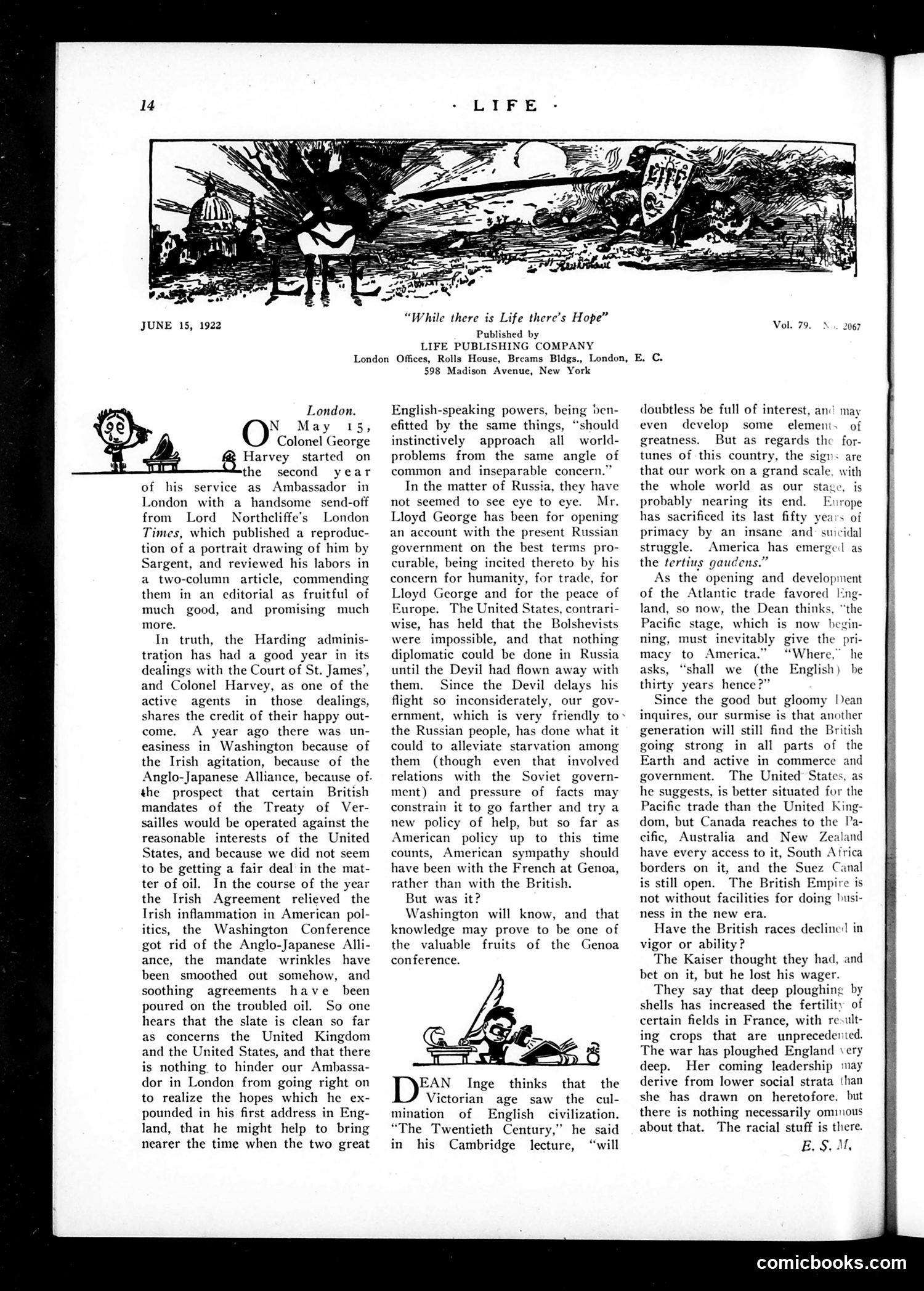
This page contains editorial commentary rather than cartoons. The header illustration shows a stylized "LIFE" masthead with classical and modern imagery. The main article discusses Colonel Harvey's appointment as Ambassador to London, praising the Harding administration's diplomatic work. It addresses Anglo-American relations and criticizes Bolshevik Russia, asserting that Britain and America should pursue cooperative policies rather than competitive ones. A secondary piece by "Dean Inge" (likely Dean William Ralph Inge of St. Paul's Cathedral) discusses whether English civilization peaked in the Victorian era, arguing that the "Twentieth Century" will demonstrate continued British vigor. The content reflects 1920s concerns about post-WWI international relations, the Russian Revolution's threat, and Britain's economic future—issues central to American political debate during the early Harding presidency.
📄 Transcribed text from this page (OCR, searchable)
Machine-transcribed from the original scan — historical spelling and the odd misread are preserved.
ay ge ee JUNE 15, 1922 Be er oe “While there is Life there’s Hope” Published by LIFE PUBLISHING COMPANY London Offices, Rolls House, Breams Bldgs., London, E. C. London. N May 15, Colonel George Harvey started on the second year of his service as Ambassador in London with a handsome send-off from Lord Northcliffe’s London Times, which published a reproduc- tion of a portrait drawing of him by Sargent, and reviewed his labors in a two-column article, commending them in an editorial as fruitful of much good, and promising much more. In truth, the Harding adminis- tration has had a good year in its dealings with the Court of St. James’, and Colonel Harvey, as one of the active agents in those dealings, shares the credit of their happy out- come. A year ago there was un- easiness in Washington because of the Irish agitation, because of the Anglo-Japanese Alliance, because of. the prospect that certain British mandates of the Treaty of Ver- sailles would be operated against the reasonable interests of the United States, and because we did not seem to be getting a fair deal in the mat- ter of oil. In the course of the year the Irish Agreement relieved the Irish inflammation in American pol- itics, the Washington Conference got rid of the Anglo-Japanese Alli- ance, the mandate wrinkles have been smoothed out somehow, and soothing agreements have _ been poured on the troubled oil. So one hears that the slate is clean so far as concerns the United Kingdom and the United States, and that there is nothing to hinder our Ambassa- dor in London from going right on to realize the hopes which he ex- pounded in his first address in Eng- land, that he might help to bring nearer the time when the two great 598 Madison Avenue, New York English-speaking powers, being ben- efitted by the same things, “should instinctively approach all world- problems from the same angle of common and inseparable concern.” In the matter of Russia, they have not seemed to see eye to eye. Mr. Lloyd George has been for opening an account with the present Russian government on the best terms pro- curable, being incited thereto by his concern for humanity, for trade, for Lloyd George and for the peace of Europe. The United States, contrari- wise, has held that the Bolshevists were impossible, and that nothing diplomatic could be done in Russi until the Devil had flown away with them. Since the Devil delays his flight so inconsiderately, our gov- ernment, which is very friendly to~ the Russian people, has done what it could to alleviate starvation among them (though even that involved relations with the Soviet govern- ment) and pressure of facts may constrain it to go farther and try a new policy of help, but so far as American policy up to this time counts, American sympathy should have been with the French at Genoa, rather than with the British. But was it? Washington will know, and that knowledge may prove to be one of the valuable fruits of the Genoa conference. K EAN Inge thinks that the Victorian age saw the cul- mination of English civilization. “The Twentieth Century,” he said in his Cambridge lecture, “will doubtless be full of interest, an’ may even develop some element. of greatnes But as regards the for- tunes of this country, the sign. are that our work on a grand scale, with the whole world as our stage, is probably nearing its end. Europe has sacrificed its last fifty years of primacy by an insane and suicidal struggle. America has emerge! as the tertius gaudens.” As the opening and development of the Atlantic trade favored |ing- land, so now, the Dean thinks, “the Pacific stage, which is now begin- ning, must inevitably give the pri- macy to America.” “Where,” he “shall we (the English) be thirty years hence?” Since the good but gloomy |ean inquires, our surmise is that another generation will still find the British going strong in all parts of the Earth and active in commerce and government. The United’ States, as he suggests, is better situated for the Pacific trade than the United King- dom, but Canada reaches to the Pa- cific, Australia and New Zealand have every access to it, South Africa borders on it, and the Suez Canal is still open. The British Empire is not without facilities for doing usi- ness in the new era. Have the British races decline: in vigor or ability? The Kaiser thought they had, and bet on it, but he lost his wager. They say that deep ploughing by shells has increased the fertility of certain fields in France, with re-ult- ing crops that are unprecedented. The war has ploughed England very deep. Her coming leadership ‘ay derive from lower social strata (han she has drawn on heretofore, but there is nothing necessarily ommious about that. The racial stuff is there. E, S$, M, comicbooks.com