
Life, 1922-06-15 · page 35 of 36
Life — June 15, 1922 — page 35: what you’re looking at
What you’re looking at
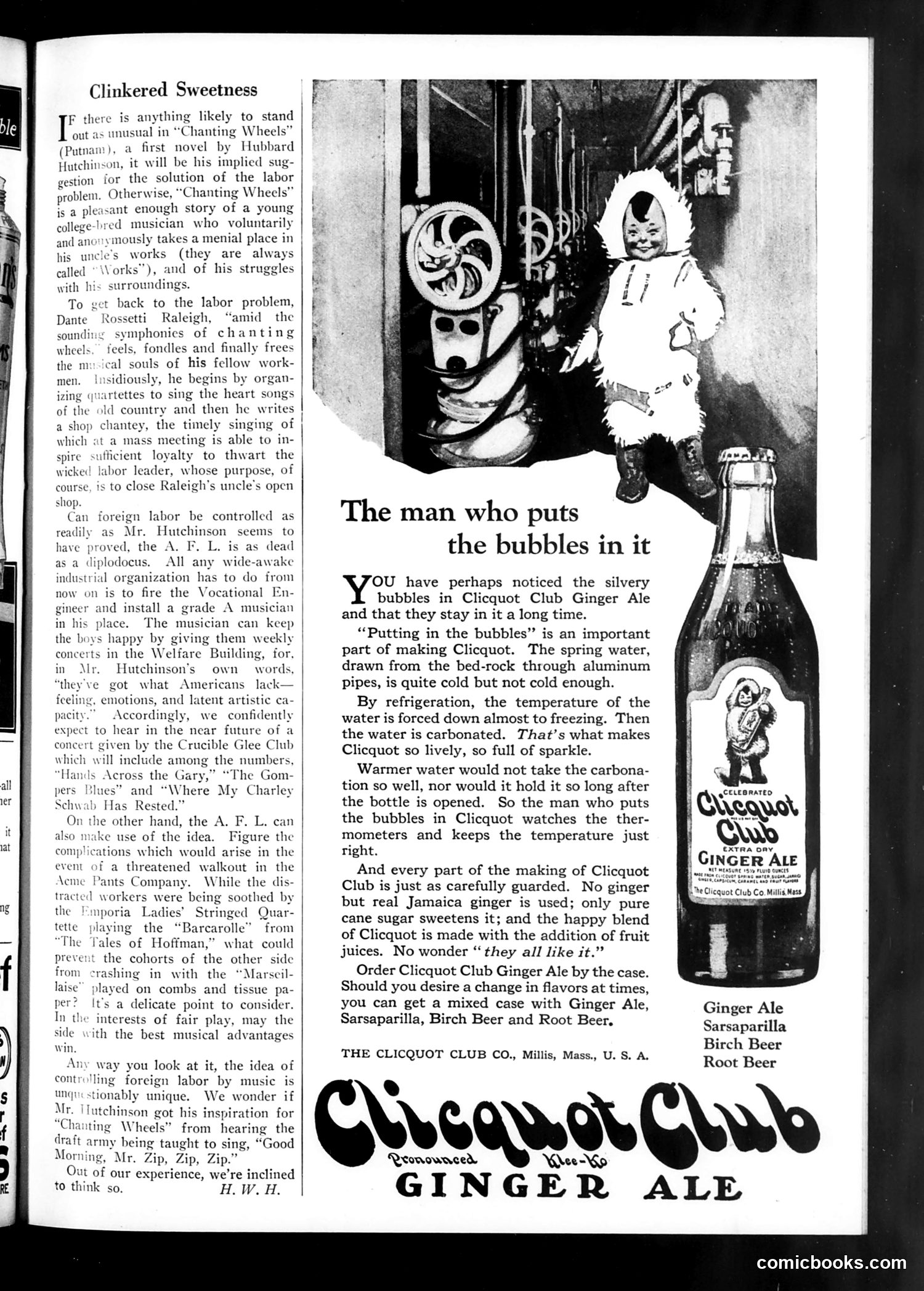
This page contains two distinct elements: **Left side - Book review ("Clinkered Sweetness"):** A satirical critique of Hubbard Hutchinson's novel *Chanting Wheels*, which proposes solving labor unrest through music. The reviewer mocks this naive solution, suggesting that having a musician sing patriotic songs to workers would prevent unionization better than the American Federation of Labor (A.F.L.). The satire highlights the absurdity of this anti-labor approach—implying management would prefer musical distraction to genuine worker organization. The reference to "Mr. Zip, Zip, Zip" suggests WWI-era propaganda songs used to control public sentiment. **Right side - Advertisement:** A Clicquot Club Ginger Ale ad explaining the carbonation process. This is straightforward product marketing with no satirical content. The juxtaposition is ironic: the book review criticizes using entertainment to manipulate workers, while an advertisement simultaneously uses detailed explanation as persuasive marketing—illustrating how advertising itself functions as a form of influence.
📄 Transcribed text from this page (OCR, searchable)
Machine-transcribed from the original scan — historical spelling and the odd misread are preserved.
—— ~~ =F Awan oe Clinkered Sweetness there is anything likely to stand s unusual in “Chanting Wheels” (Putnam), a first novel by Hubbard Hutchinson, it will be his implied sug- gestion for the solution of the labor problem. Otherwise, “Chanting Wheels’ ant enough story of a young »red musician who voluntarily and his uncle's worl (they are always called “\Vorks”), and of his struggles with his surroundings. To get back to the labor problem, Dante Rossetti Raleigh, “amid the sounding symphonies of chanting wheels, feels, fondles and finally frees the m:-ical souls of his fellow work- men. lusidiously, he begins by organ- izing quartettes to sing the heart songs of the old country and then he writes a shop chantey, the timely singing of which at a mass meeting is able to in- spire sufficient loyalty to thwart the wicked labor leader, whose purpose, of course, is to close Raleigh’s uncle's open ign labor be controlled as Mr. Hutchinson seems to oved, the A. F. L. is as dead as a diplodocus. All any wide-awake industrial organization has to do from now on is to fire the Vocational E gineer and install a grade A mus‘ in his place. The musician can keep the boys happy by giving them weekly concerts in the Welfare Building, for, in Mr. Hutchinson’s own words, ‘ve got what Americans lack emotions, and latent artistic pacit Accordingly, we confidently expect to hear in the near future of a concert given by the Crucible Glee Club whic! ill include among the numbers, “Hands Across the Ga The Gom- pers Ilues” and “Where My Charley Schwab Has Rested.” e other hand, the A. F. L. can tke use of the idea. Figure the complications which would arise in the | event of a threatened walkout in the \eme Pants Company. While the dis- tracte orkers were being soothed by the Fmporia Ladies’ Stringed Quar- tette playing the “Barcarolle” from “The Tales of Hoffman,” what could prevent the cohorts of the other side from ing in with the “Marseil- lai played on combs and tissue pa- per? It's a delicate point to consider. In the interests of fair play, may the side \with the best musical advantages win, Any way you look at it, the idea of controlling foreign labor by music is onably unique. We wonder if tchinson got his inspiration for iting Wheels” from hearing the army being taught to sing, “Good ng, Mr. Zip, Zip, Zi of our experience, we're inclined to think so. H.W. H. ymously takes a menial place in | The man who puts the bubbles in it OU have perhaps noticed the silvery bubbles in Clicquot Club Ginger Ale and that they stay in it a long time. “Putting in the bubbles” is an important part of making Clicquot. The spring water, drawn from the bed-rock through aluminum pipes, is quite cold but not cold enough. By refrigeration, the temperature of the water is forced down almost to freezing. Then the water is carbonated. That’s what makes Clicquot so lively, so full of sparkle. Warmer water would not take the carbona- tion so well, nor would it hold it so long after the bottle is opened. So the man who puts the bubbles in Clicquot watches the ther- mometers and keeps the temperature just right. And every part of the making of Clicquot Club is just as carefully guarded. No ginger but real Jamaica ginger is used; only pure cane sugar sweetens it; and the happy blend of Clicquot is made with the addition of fruit juices. No wonder “ they all like it.” Order Clicquot Club Ginger Ale by the case. Should you desire a change in flavors at times, you can get a mixed case with Ginger Ale, Sarsaparilla, Birch Beer and Root Beer. THE CLICQUOT CLUB CO,, Millis, Mass., U. S. A. Wree-Ko Ginger Ale Sarsaparilla Birch Beer Root Beer Gdocanae Goro GINGER ALE comicbooks.com