
Life, 1922-06-15 · page 10 of 36
Life — June 15, 1922 — page 10: what you’re looking at
What you’re looking at
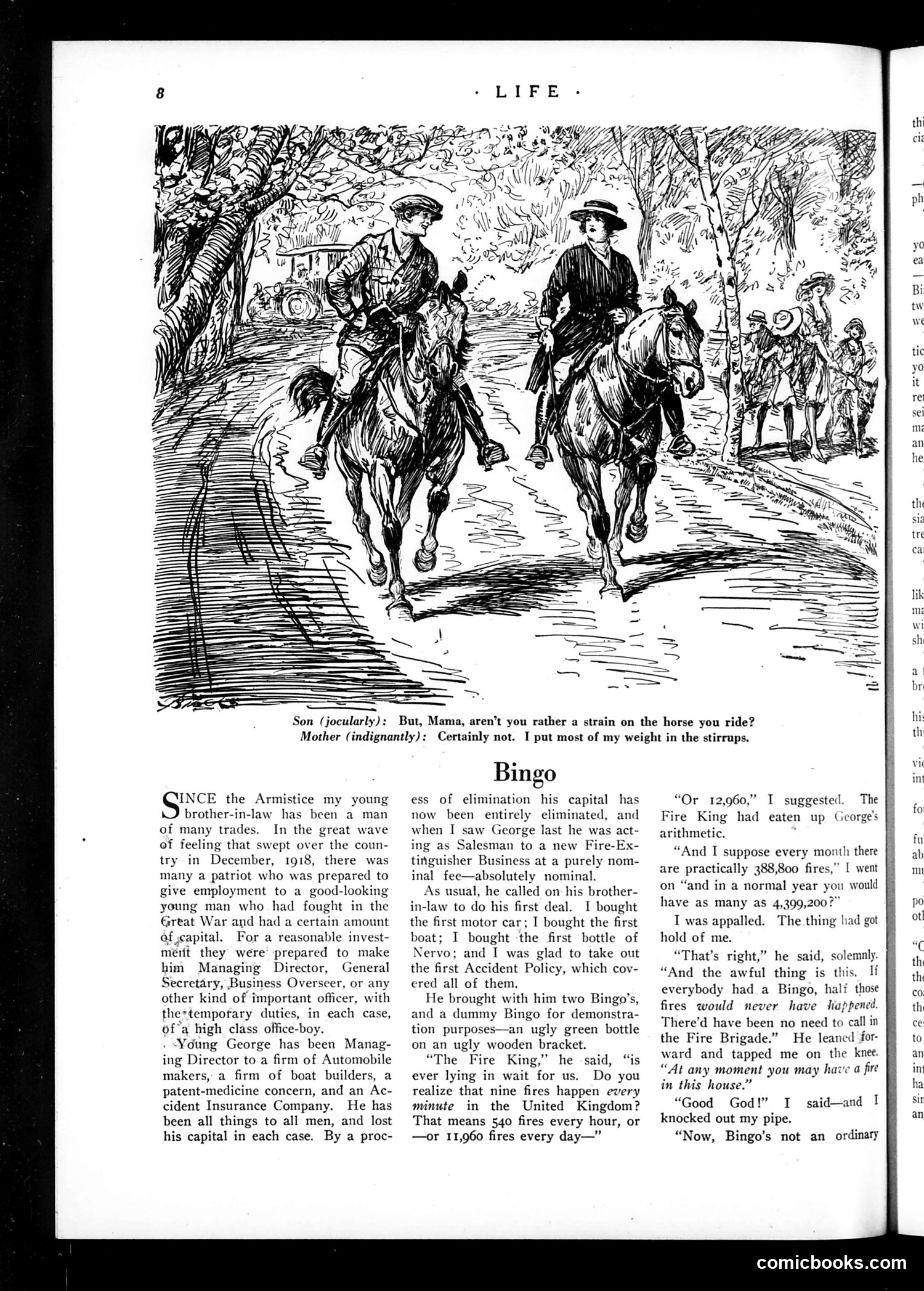
The cartoon and accompanying story satirize post-WWI profiteering and business incompetence. A young man (the "brother-in-law") has repeatedly failed at various ventures—automobile manufacturing, boat building, patent medicines, and insurance—losing capital each time. Despite these disasters, he's now launching yet another business scheme. The humor targets how some individuals, particularly those with family connections or capital, could repeatedly fail upward during the economically chaotic 1920s. The title "Bingo" suggests luck rather than skill drives his ventures. The satirical point: incompetent businessmen kept finding new schemes and investors willing to fund them, regardless of track records—a commentary on post-war economic recklessness and poor business judgment among the privileged classes.
📄 Transcribed text from this page (OCR, searchable)
Machine-transcribed from the original scan — historical spelling and the odd misread are preserved.
Son (jocularly): INCE the Armistice my young brother-in-law has been a man of many trades. In the great wave of feeling that swept over the coun- try in December, 1918, there was many a patriot who was prepared to give employment to a good-looking young man who had fought in the Great War and had a certain amount of capital. For a reasonable invest- merit they were’ prepared to make him Managing Director, General Secretary, Business Overseer, or any other kind of important officer, with thestempotary duties, in each case, of’a high class office-boy. . “¥Ydung George has been Manag- ing Director to a firm of Automobile makers, a firm of boat builders, a patent-medicine concern, and an Ac- cident Insurance Company. He has been all things to all men, and lost his capital in each case. By a proc- Yy Lp ~ oy ) K ia = But, Mama, aren’t you rather a strain on the horse you ride? Mother (indignantly): Certainly not. I put most of my weight in the stirrups. Bingo ess of elimination his capital has now been entirely eliminated, and when I saw George last he was act- ing as Salesman to a new Fire-Ex- titguisher Business at a purely nom- inal fee—absolutely nominal. As usual, he called on his brother- in-law to do his first deal. I bought the first motor car; I bought the first boat; I bought the first bottle of Nervo; and I was glad to take out the first Accident Policy, which cov- ered all of them. He brought with him two Bingo’s, and a dummy Bingo for demonstra- tion purposes—an ugly green bottle on an ugly wooden bracket. “The Fire King,” he said, “is ever lying in wait for us. Do you realize that nine fires happen every minute in the United Kingdom? That means 540 fires every hour, or —or 11,960 fires every day—” “Or 12,960,” I suggested. The Fire King had eaten up George's arithmetic. : “And I suppose every month there are practically 388,800 fires,” I went on “and in a normal year you would | have as many as 4,399,200?” I was appalled. The thing had got fF hold of me. “That's right,” he said, solemnly. [ “And the awful thing is this. If everybody had a Bingo, half those f fires would never have tiappened. There’d have been no need to call in the Fire Brigade.” He leaned for- ward and tapped me on the knee. “At any moment you may have a fire in this house.” “Good God!” I knocked out my pipe. “Now, Bingo’s not an ordinary said—and I comicbooks.com we mé an th vic in in