
A complete issue · 34 pages · 1922
Life — May 25, 1922
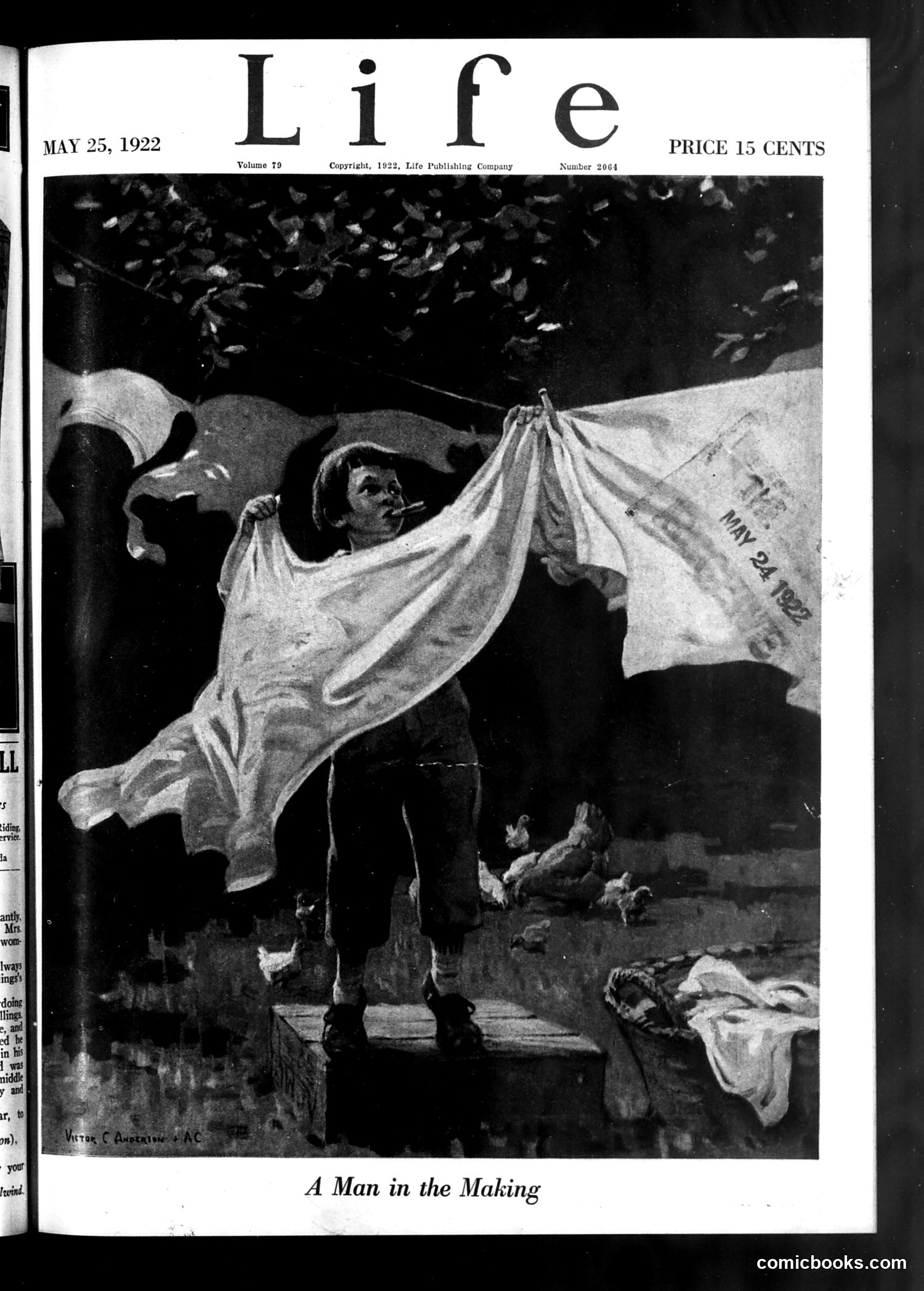
This Life magazine cover from May 25, 1922 presents a photograph rather than a cartoon. The image shows a child hanging laundry or fabric outdoors, with the caption "A Man in the Making" suggesting commentary on childhood development and labor. The photograph appears to document domestic work—likely laundry—being performed by a young person. Given Life's satirical nature, the title likely offers ironic social commentary, possibly critiquing child labor practices or suggesting that such domestic responsibilities were considered character-building in early 20th-century American culture. Without additional context from the article text, the specific target of satire remains unclear, though the juxtaposition of childhood innocence with adult work responsibilities seems intentional.
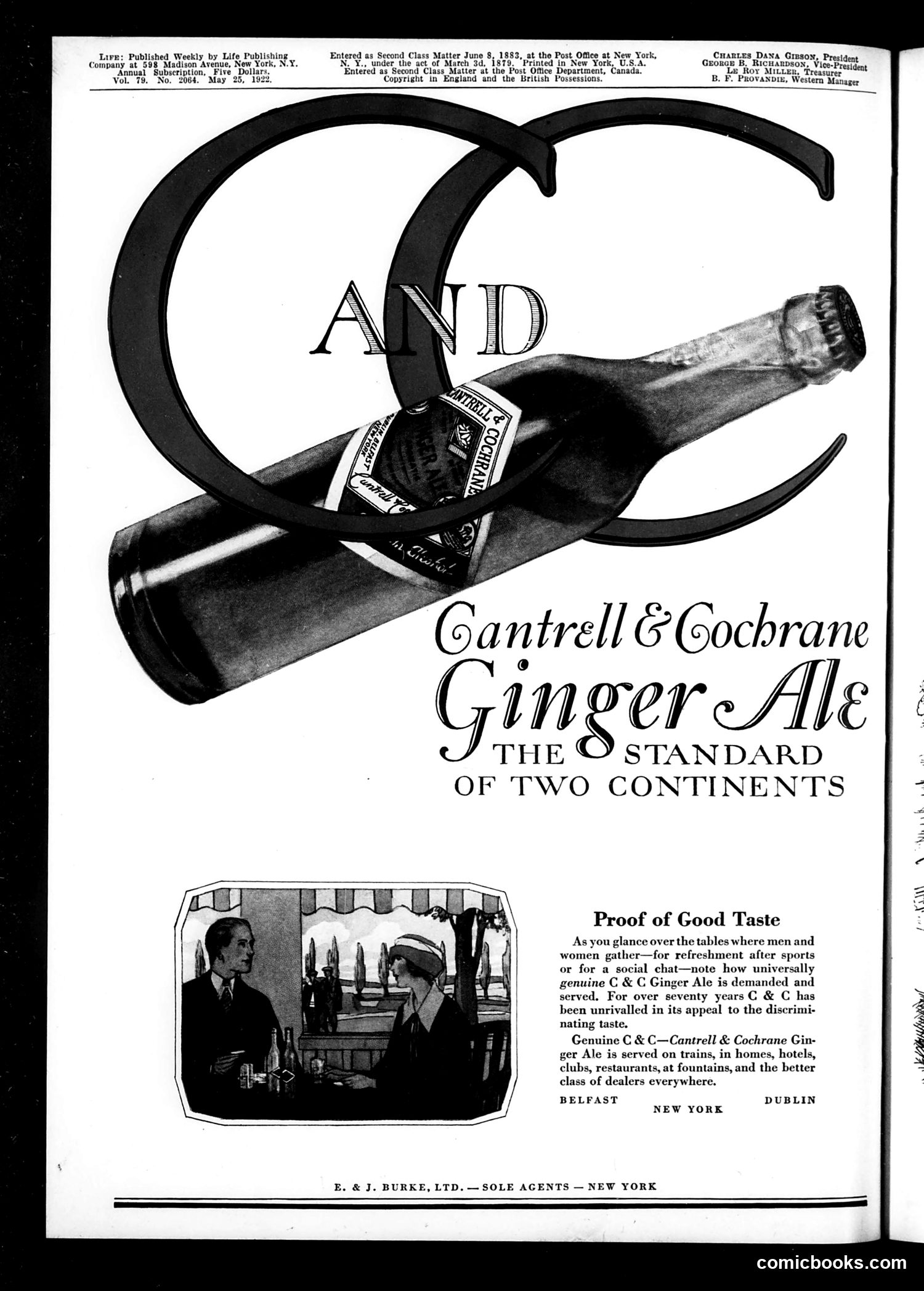
This is primarily a **commercial advertisement**, not political satire. The page promotes Cantrell & Cochrane Ginger Ale, a beverage brand with operations in Belfast, Dublin, and New York. The visual design uses decorative typography and a stylized bottle illustration with ornamental curved elements. The "C & C" lettering dominates the upper portion. Below is a photograph showing two people (a man and woman) in what appears to be a social setting—consistent with the ad's messaging about the drink being served "where men and women gather—for refreshment after sports or for a social chat." The advertisement emphasizes the product's seventy-year heritage and availability at quality establishments. There is no political commentary or satire present on this page—it is straightforward commercial marketing from the early 20th century.
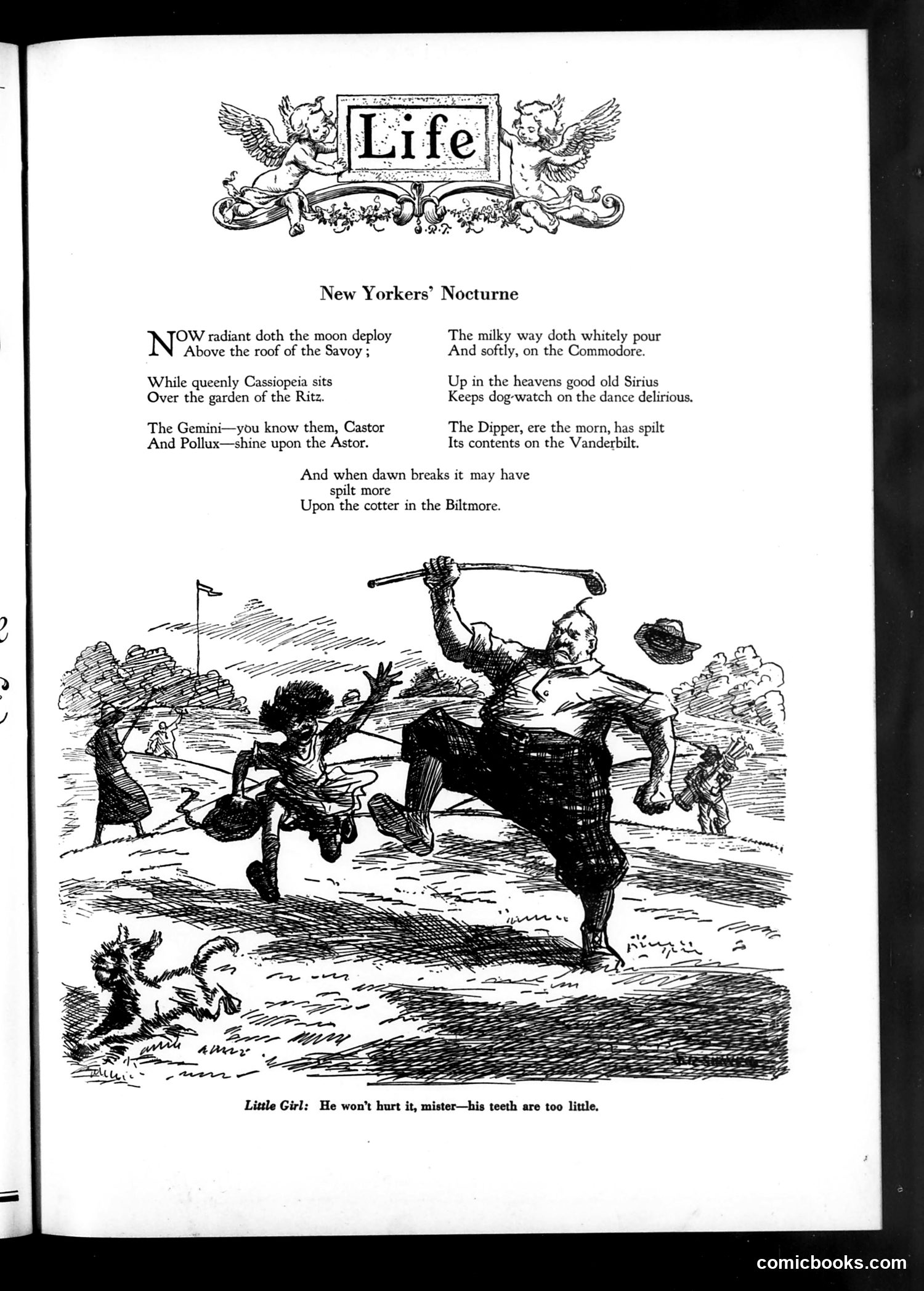
This is a humorous poem about New York nightlife, accompanied by a satirical illustration. The poem references specific Manhattan locations—the Savoy (hotel), the Ritz (hotel), and the Commodore—and mentions astronomical bodies (Sirius, the Dipper, Cassiopeia, Gemini, Pollux, Castor) in a playful conceit about nighttime revelry. The illustration shows a well-dressed man dancing wildly with small figures (possibly demons or imps), suggesting raucous, uninhibited behavior. The caption—"Little Girl: He won't hurt it, mister—his teeth are too little"—implies the man is dangerously drunk or manic, though harmless due to his inebriation. The satire mocks wealthy New Yorkers' excessive nightclub culture and the chaos of late-night Manhattan entertainment.
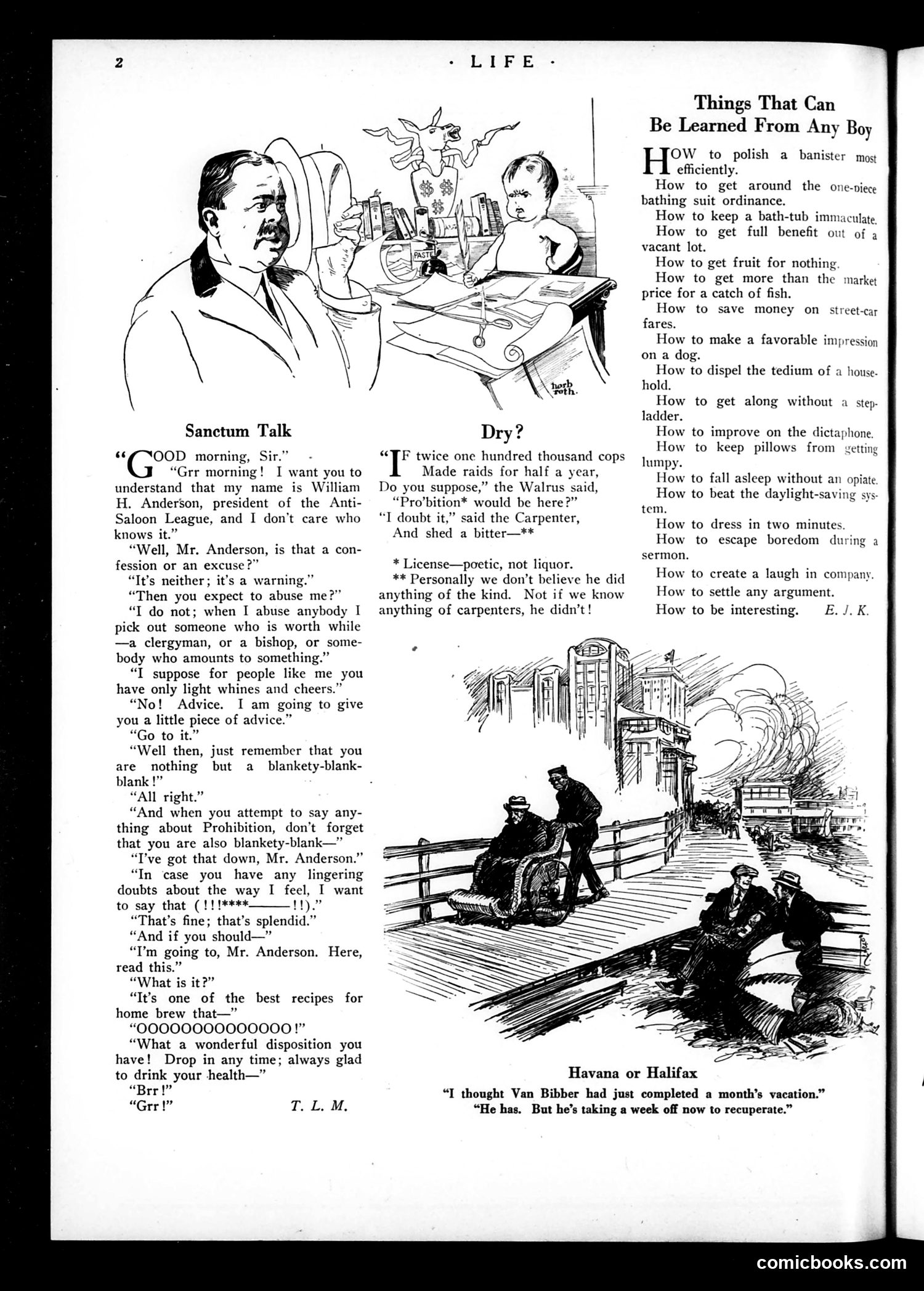
**"Sanctum Talk"** satirizes William H. Anderson, president of the Anti-Saloon League (visible in the illustration). Anderson is depicted lecturing someone about Prohibition enforcement with sanctimonious certainty. The satire mocks his self-righteous condemnation of those who question or circumvent Prohibition laws, treating all dissenters as moral failures. Anderson dismisses legitimate concerns by calling critics "blankety-blanks" and threatens them with condescension rather than engaging substantively. **"Dry?"** is a Lewis Carroll-style absurdist poem mocking Prohibition's failures, particularly that despite "two hundred thousand cops" patrolling for half a year, illegal alcohol (the "Walrus" character) persists—suggesting Prohibition was unenforceable and ultimately futile. Both pieces satirize Prohibition-era hypocrisy and the movement's aggressive moralizing.
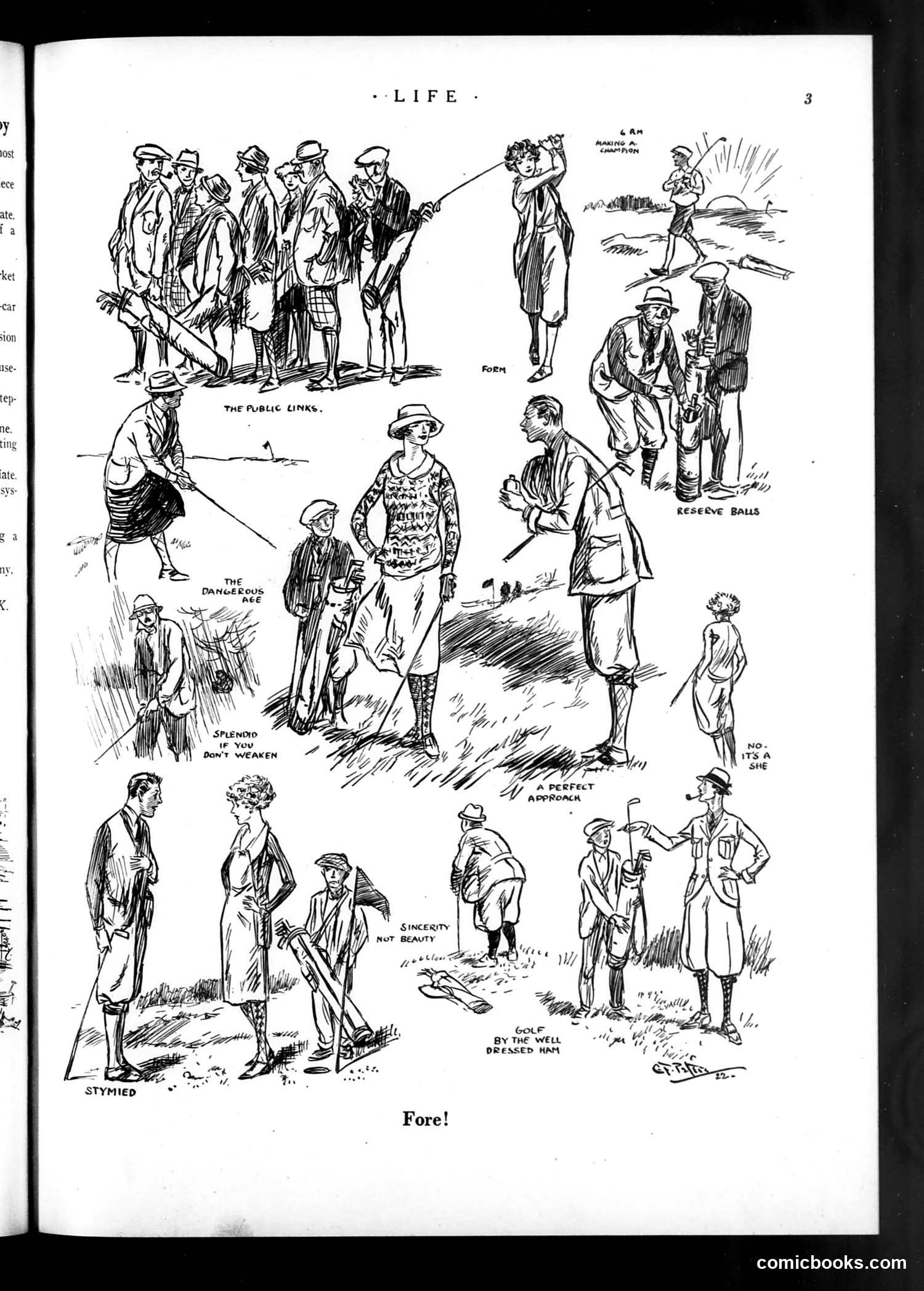
This page satirizes early 20th-century golf culture through various social scenes labeled with golfing terminology. The central figure wears "A PERFECT APPROACH" while others exemplify golf fashion and etiquette. The jokes contrast proper golfing behavior with social pretension: "THE PUBLIC LINKS" shows working-class golfers; "RESERVE BALLS" depicts caddy management; "SPLENDID IF YOU DON'T WEAKEN" suggests nervous players; "SINCERE, NOT BEAUTY" mocks artificial style; "STYMIED" shows romantic complications; and "GOLF BY THE WELL DRESSED MAN" emphasizes fashionable appearance. The repeated word "Fore!" (golf's warning cry) frames how golf terminology infiltrated broader social discourse. The satire targets golf's rapid popularization among the American middle class and the pretension surrounding the sport's adoption as a status marker.
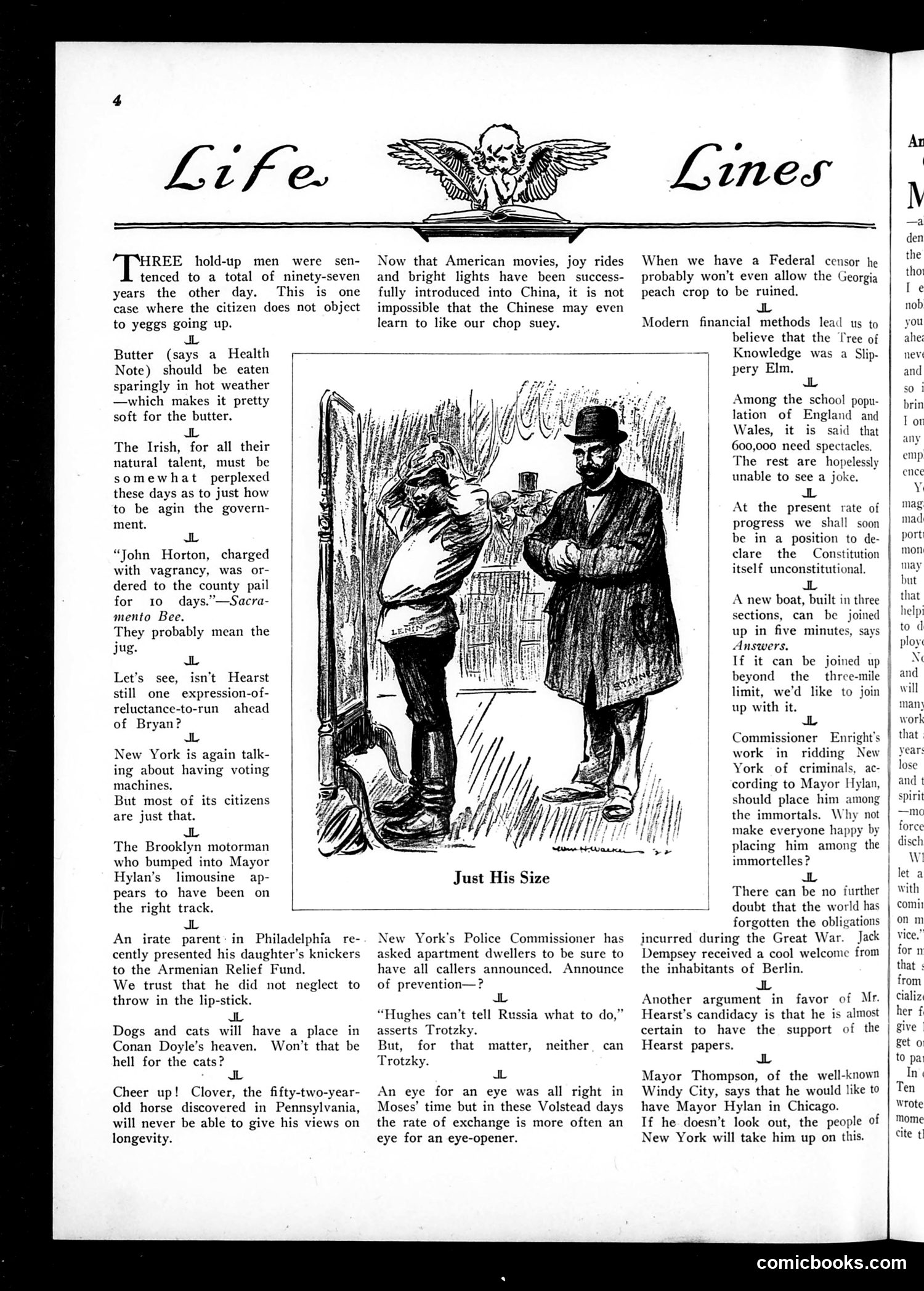
This cartoon depicts two men in what appears to be a street encounter. Based on the surrounding text references to "New York's Police Commissioner" and mentions of Mayor Hylan, the figures likely represent political figures from early 1920s New York City politics. The caption "Just His Size" suggests a confrontation between equals or appropriately matched opponents. The cartoon appears to satirize a dispute between city officials—possibly concerning police matters, given the commissioner reference. The cartoon mocks the relative power or competence of these political figures, implying one is now facing an opponent of "his size" (equal standing), rather than wielding unchecked authority. The text discusses voting machines and municipal reform, suggesting this comments on New York's political corruption or administrative conflicts.
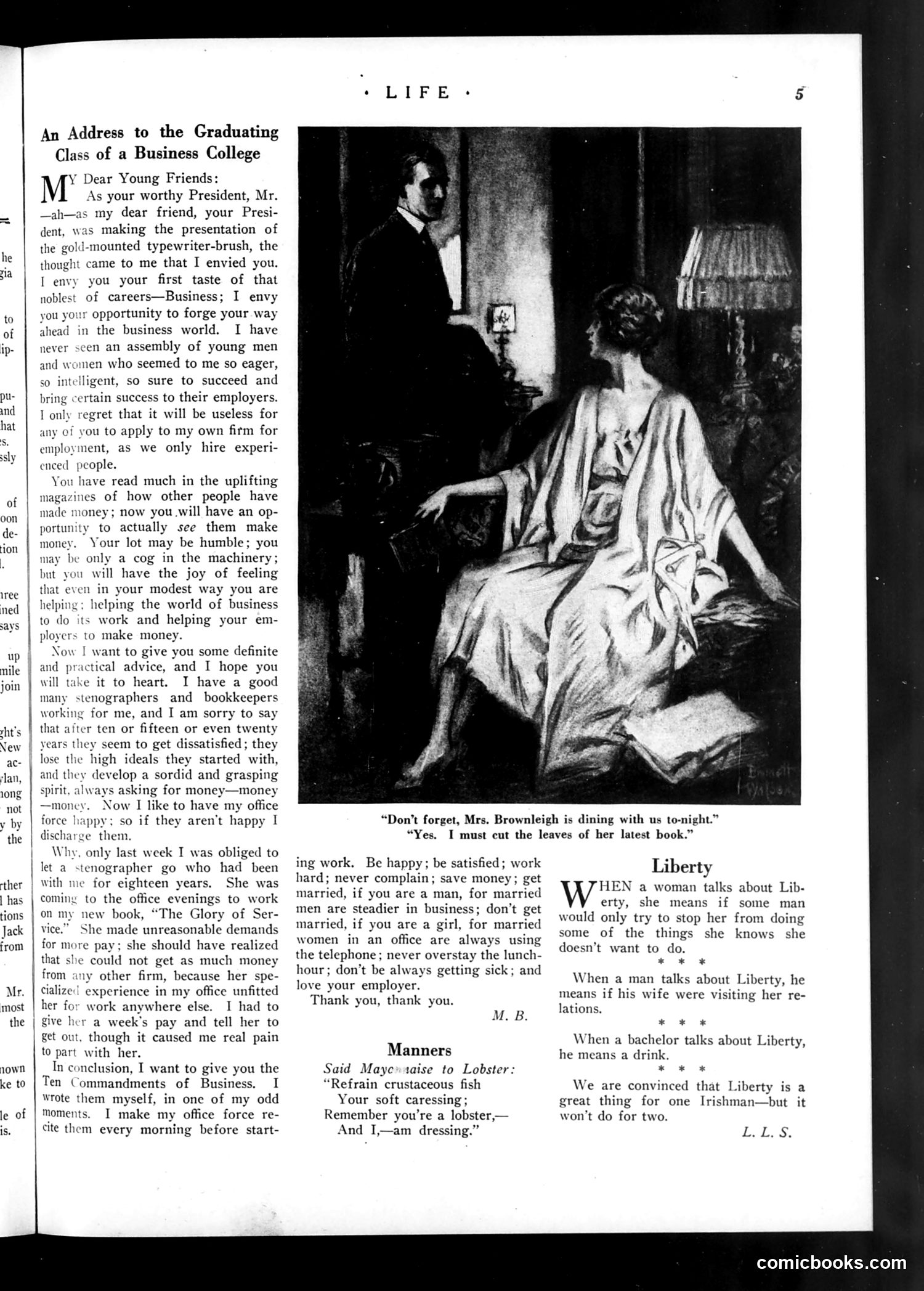
This page contains a commencement address to business college graduates by "M.B." (likely a prominent businessman of the era). The address offers practical career advice: work hard, save money, remain happy and satisfied, avoid complaining, and don't expect excessive pay immediately. The photograph shows a domestic scene with caption "Don't forget, Mrs. Browneigh is dining with us to-night," suggesting middle-class social obligations. Below are brief satirical sections on "Liberty" and "Manners." The Liberty section uses humor to distinguish how different social groups define the term—a woman's liberty means freedom from domestic work, a bachelor's means drinking. The Manners section jokes about proper etiquette toward lobster at dinner. The satire gently mocks emerging business culture, class consciousness, and social pretension of early-20th-century America.
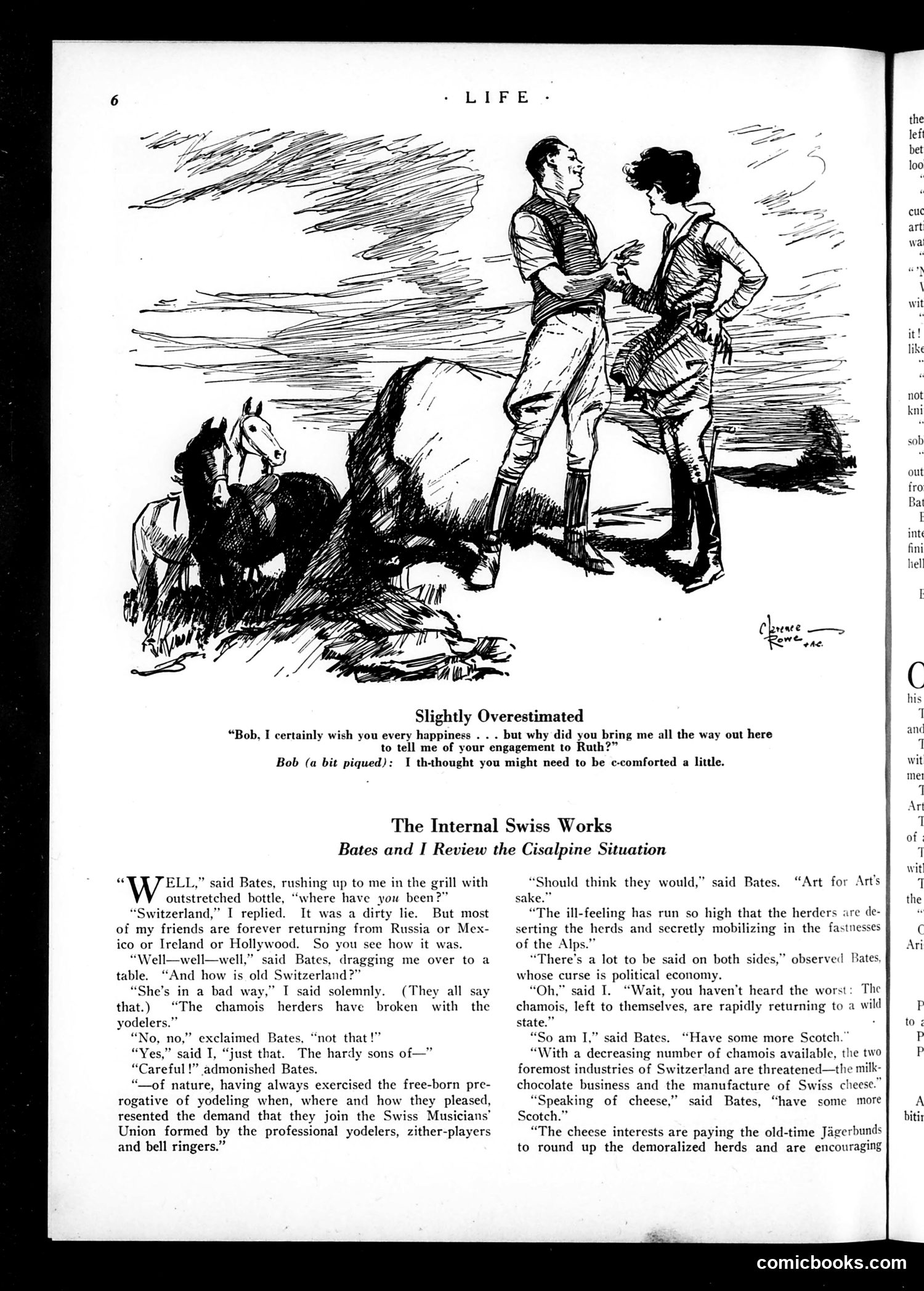
This cartoon satirizes romantic courtship customs. A man (Bob) has brought his fiancée Ruth to a remote rural location, ostensibly to "comfort" her. The woman appears skeptical of his explanation, implying Bob's motivation is less noble than stated. The title "Slightly Overestimated" suggests Bob has misjudged the situation or overestimated Ruth's need for solitude and comfort. The humor lies in the social understanding that a man bringing a woman to an isolated spot had romantic rather than consoling intentions—a pointed jab at courtship pretense and male duplicity. The accompanying story about Swiss herds and industrial disputes appears unrelated to this cartoon.
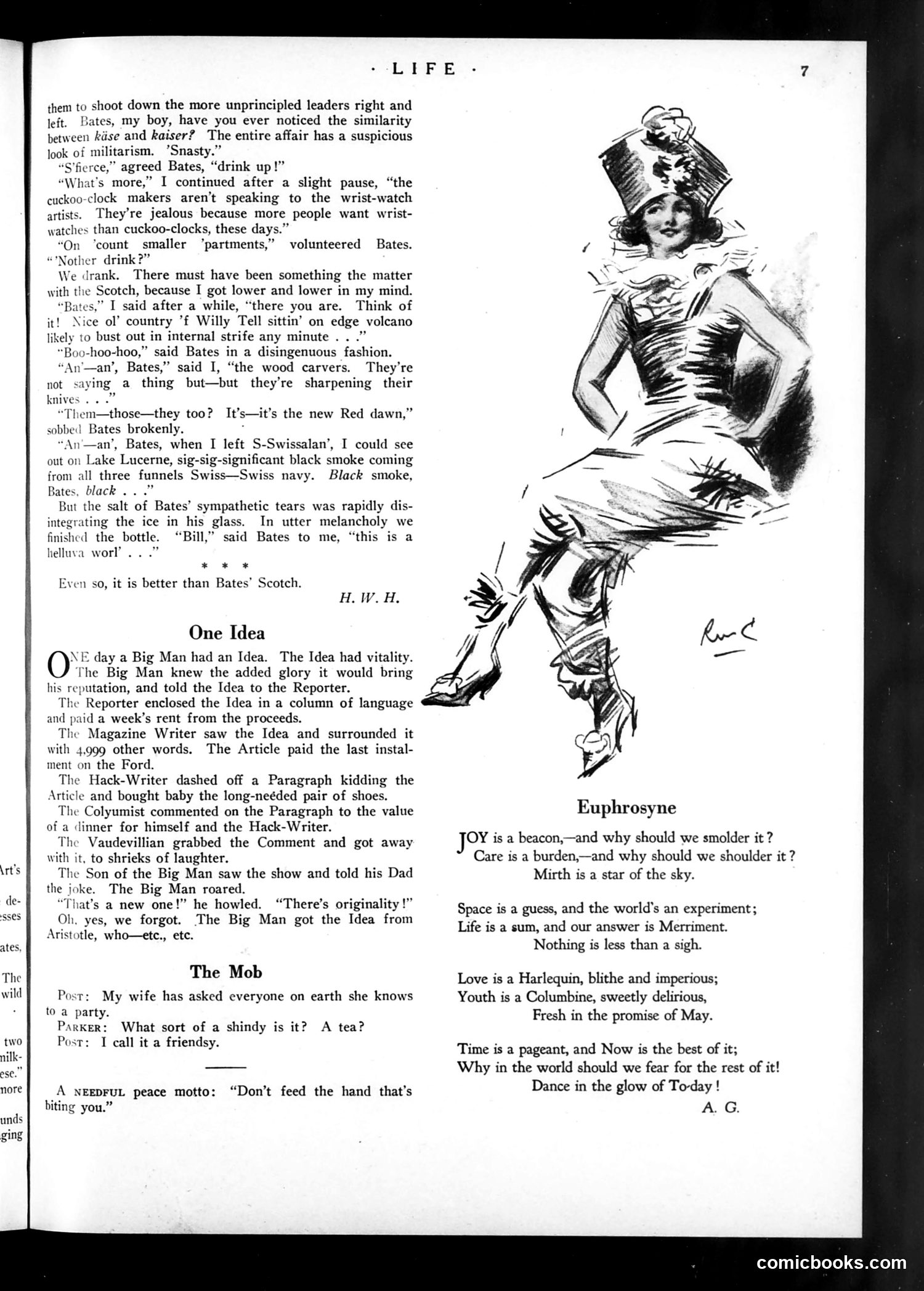
This page contains three satirical pieces: 1. **Top section (H.W.H.)**: A dialogue mocking Swiss neutrality during WWI, comparing "kase" (cheese) and "kaiser" (German emperor). The joke centers on Switzerland's contradictory position—profiting from war while claiming neutrality. References to "S-Swissalan'" and black smoke from "three tunnels" allude to Switzerland's geographic vulnerability and economic entanglement with warring powers. 2. **"One Idea"**: A satirical progression showing how a single idea passes through various media figures (Reporter, Magazine Writer, Hack-Writer, Columnist, Vaudevillian, Big Man's son)—each layer diluting the original concept. This critiques sensationalism and idea degradation in popular media. 3. **"The Mob"**: A brief joke about a wife's party being called a "friendsy"—likely mocking new social terminology or pretentious naming conventions of the era. The illustrated figure appears decorative rather than tied to specific content.
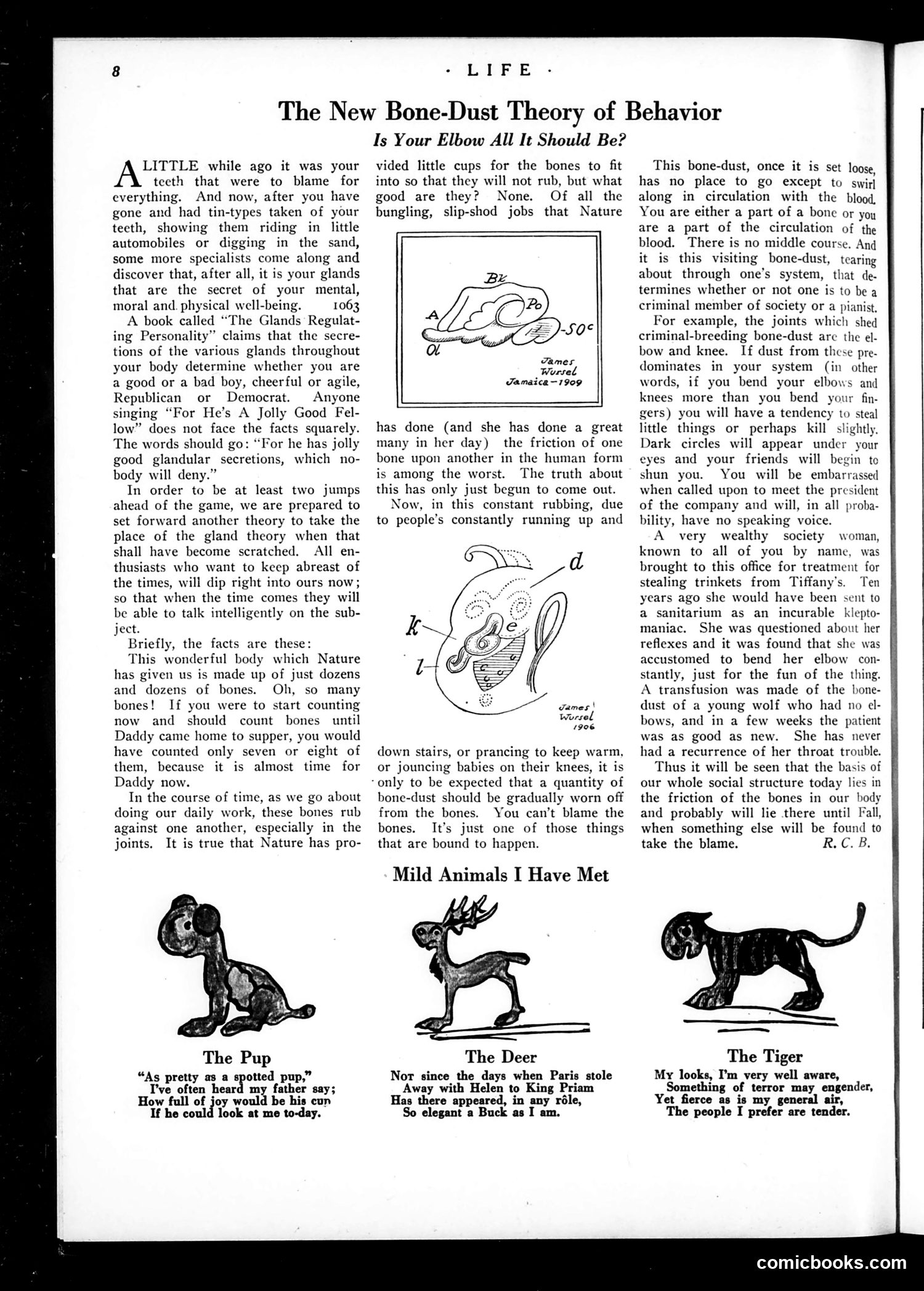
This page contains satirical commentary on pseudo-scientific personality theory. The main article, "The New Bone-Dust Theory of Behavior," mocks the popular early-20th-century belief that facial features and physical characteristics determined personality and morality. The diagrams show bones and anatomical details supposedly revealing character traits. The article ridicules this determinism by noting absurd conclusions—that bent elbows mean criminality, for instance. The lower section, "Mild Animals I Have Met," presents humorous animal caricatures with personality quotes (a pup, deer, and tiger), seemingly extending the bone-dust theory to animals. The satire targets pseudoscientific racism and phrenology-adjacent theories that were then used to justify social hierarchies and prejudice by claiming physical features scientifically proved moral or intellectual differences.
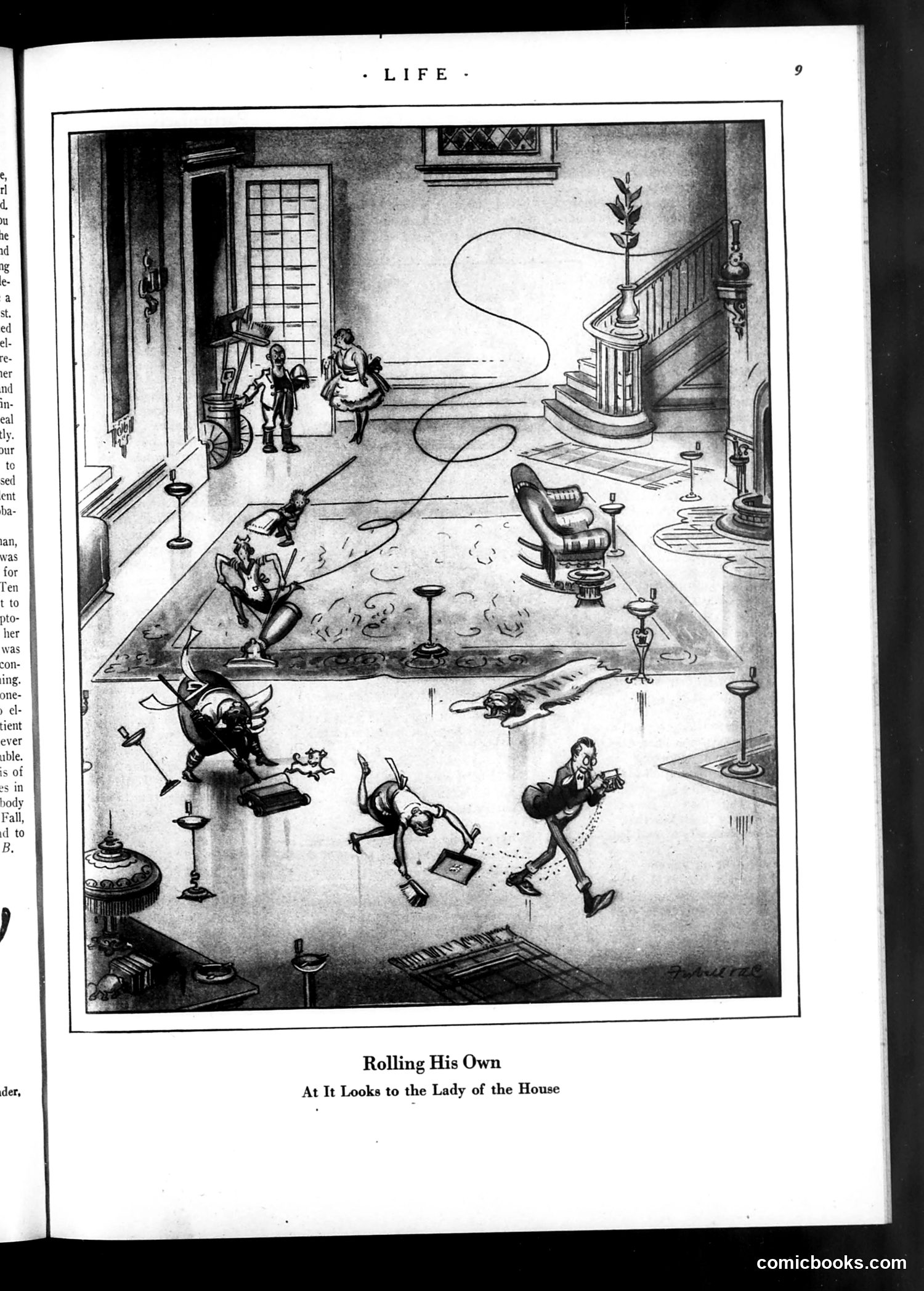
This cartoon satirizes a husband's domestic incompetence. The title "At It Looks to the Lady of the House" suggests the wife's perspective as she observes chaos. The scene depicts a man attempting to manage household tasks—visible are children, scattered furniture, and domestic disorder. Various objects are overturned or displaced, suggesting he's making a mess of things. The man appears to be "rolling his own" (handling matters himself, possibly doing laundry or other housework), but comically failing. The satire targets traditional gender roles: the implication is that a man thrust into domestic duties—typically women's work—becomes hilariously inept. This reflects early-20th-century humor mocking men who couldn't manage "simple" household management, reinforcing contemporary assumptions about gender and domestic competence.
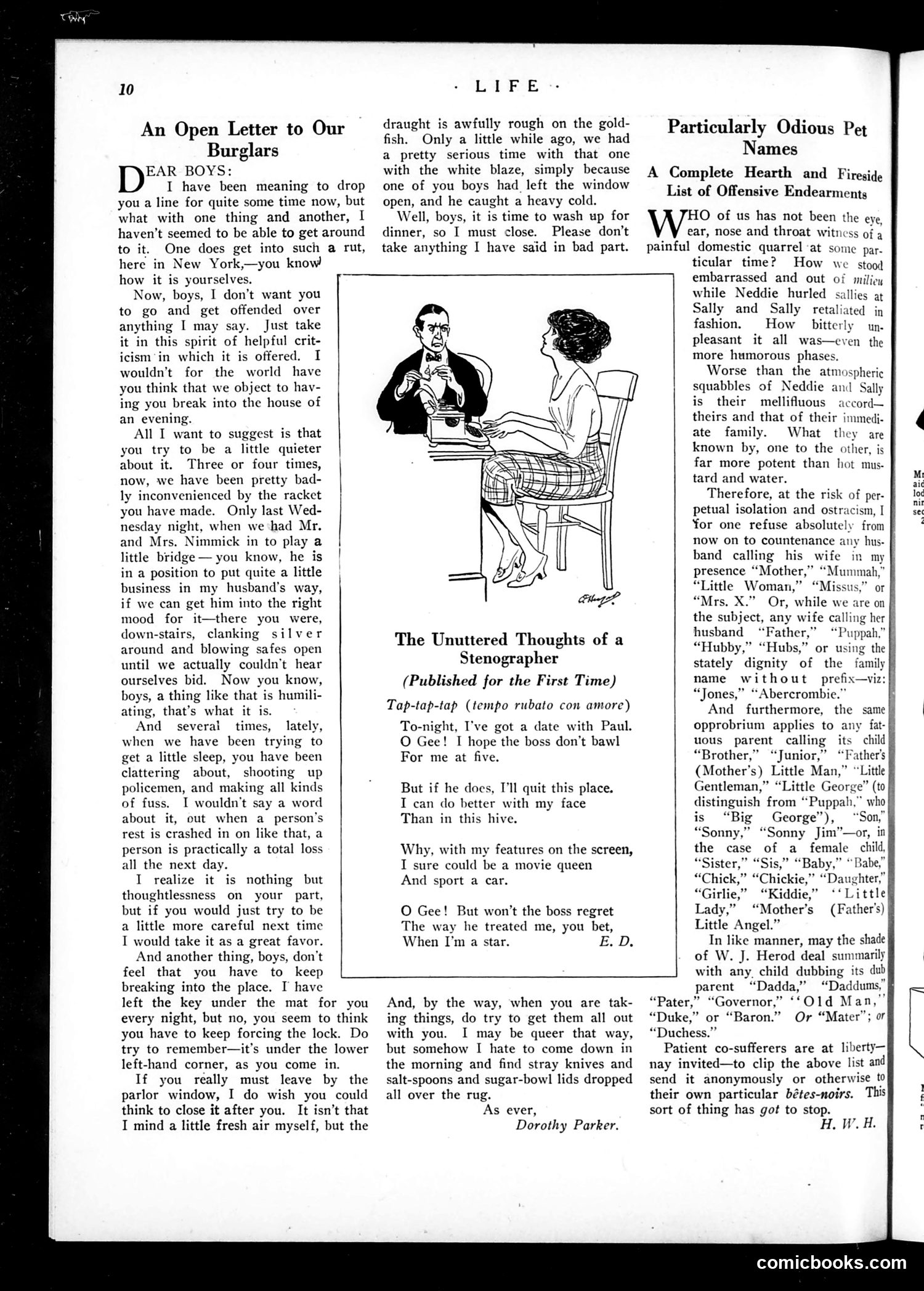
This cartoon depicts a female stenographer (secretary) taking dictation from a male businessman. The satirical poem reveals her inner frustration: while outwardly professional, she's actually resentful of her boss's demanding behavior and romantic rejection. The humor relies on the period's gender dynamics—women stenographers were expected to be dutiful and silent, yet this piece exposes their genuine feelings of underappreciation and humiliation. References to her boss potentially becoming a "movie queen" and complaints about his treatment mock his inflated self-importance. The accompanying article about "Particularly Odious Pet Names" similarly satirizes domestic and professional relationships, highlighting the condescension women faced through infantilizing nicknames like "Little Woman" or "Baby." Together, these pieces critique the era's casual disrespect toward women in workplace and home settings.
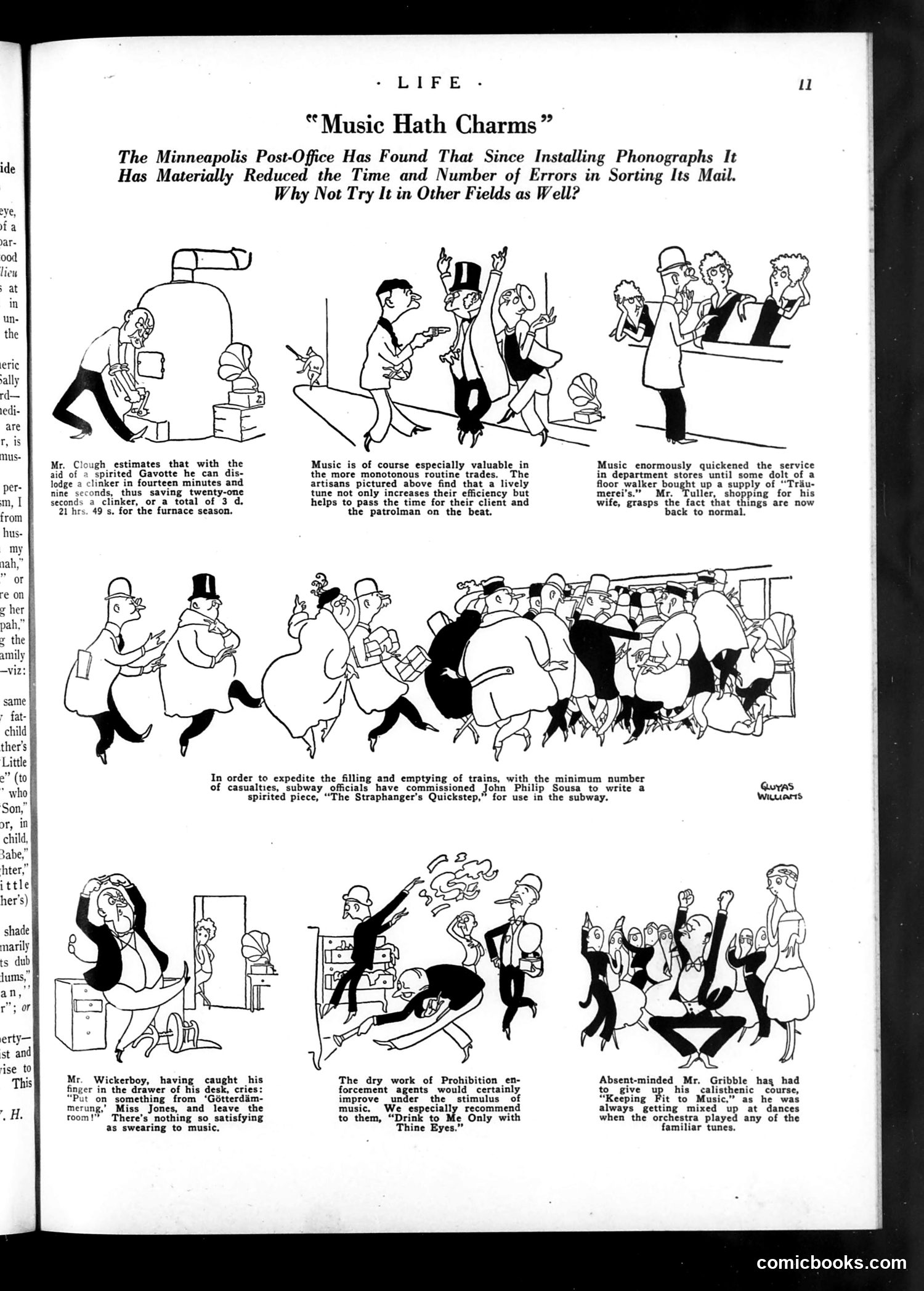
This satirical piece argues that playing phonograph music improves workplace efficiency and morale. The page shows various humorous scenarios where music supposedly benefits different professions: - A postal worker sorting mail faster with phonographs playing - Office workers and artisans becoming more productive and cheerful - Subway officials commissioning a spirited piece for train operations - Workers in various trades (prohibition enforcement, office work) performing better under musical stimulation The satire mocks the era's optimistic belief that modern technology (phonographs) could solve workplace problems through entertainment. Each cartoon exaggerates the claimed benefits—showing workers dancing, energized, or dramatically more efficient—to ridicule this notion. The piece likely references actual Minneapolis Post-Office experiments mentioned in the subtitle, making fun of applying technological solutions to human labor and morale issues.
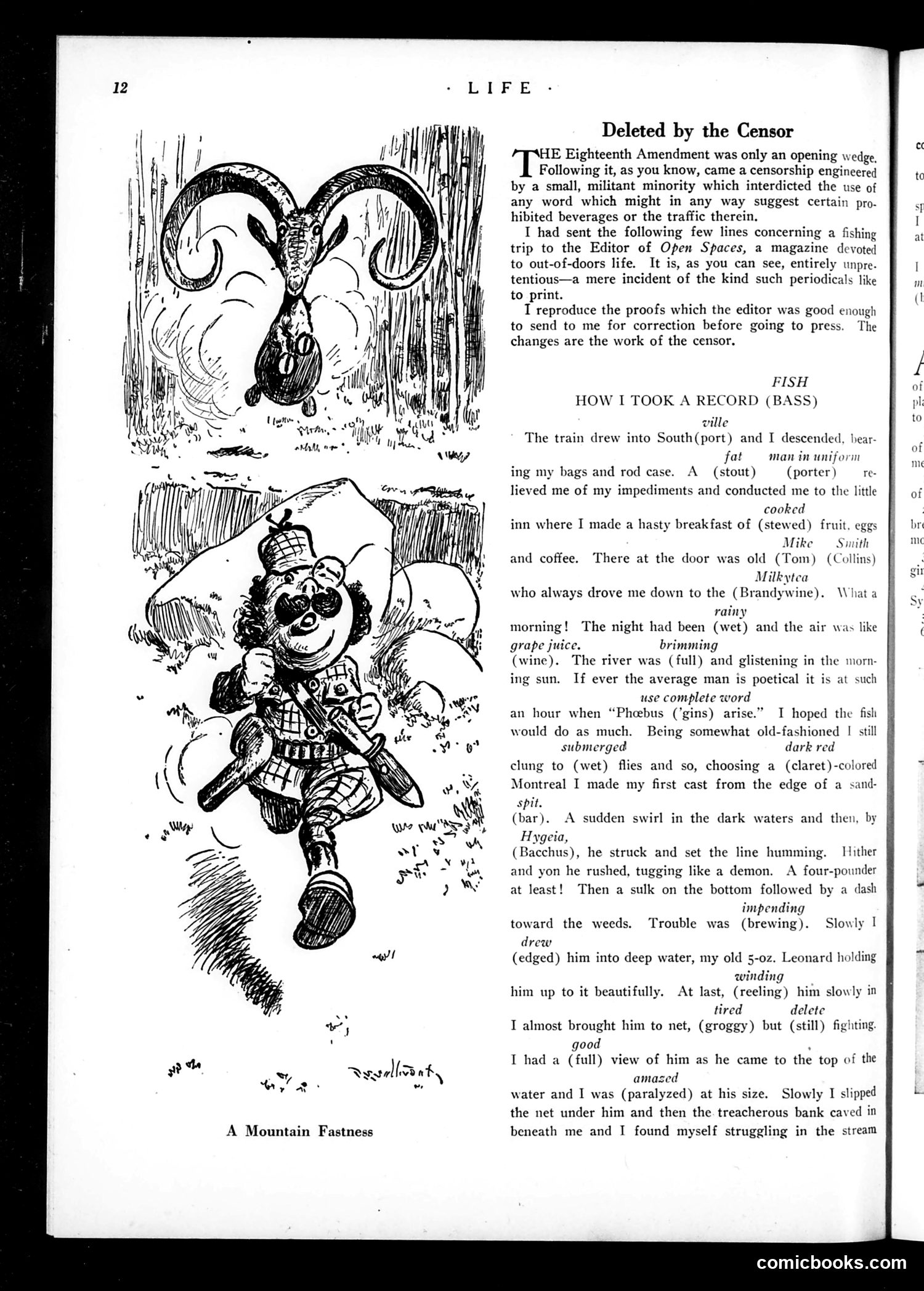
This page from *Life* magazine discusses **Prohibition-era censorship**. The header "Deleted by the Censor" explains that the Eighteenth Amendment (Prohibition) enabled censorship of any content mentioning banned beverages or "traffic therein." The editor shows censored proofs of a fishing story, with words struck out and replaced with italicized alternatives—for example, "cooked" instead of a beverage reference, "Mike Smith" replacing a name, "rainy" substituting for "wet," and "complete word" censoring "Phebus (gins)." The accompanying illustrations appear to be satirical cartoons of fantastical creatures, likely mocking the absurdity of such heavy-handed editorial control. The satire's point: **Prohibition censorship was so excessive it required ridiculous editorial gymnastics**, making ordinary writing incomprehensible while supposedly protecting public morals.
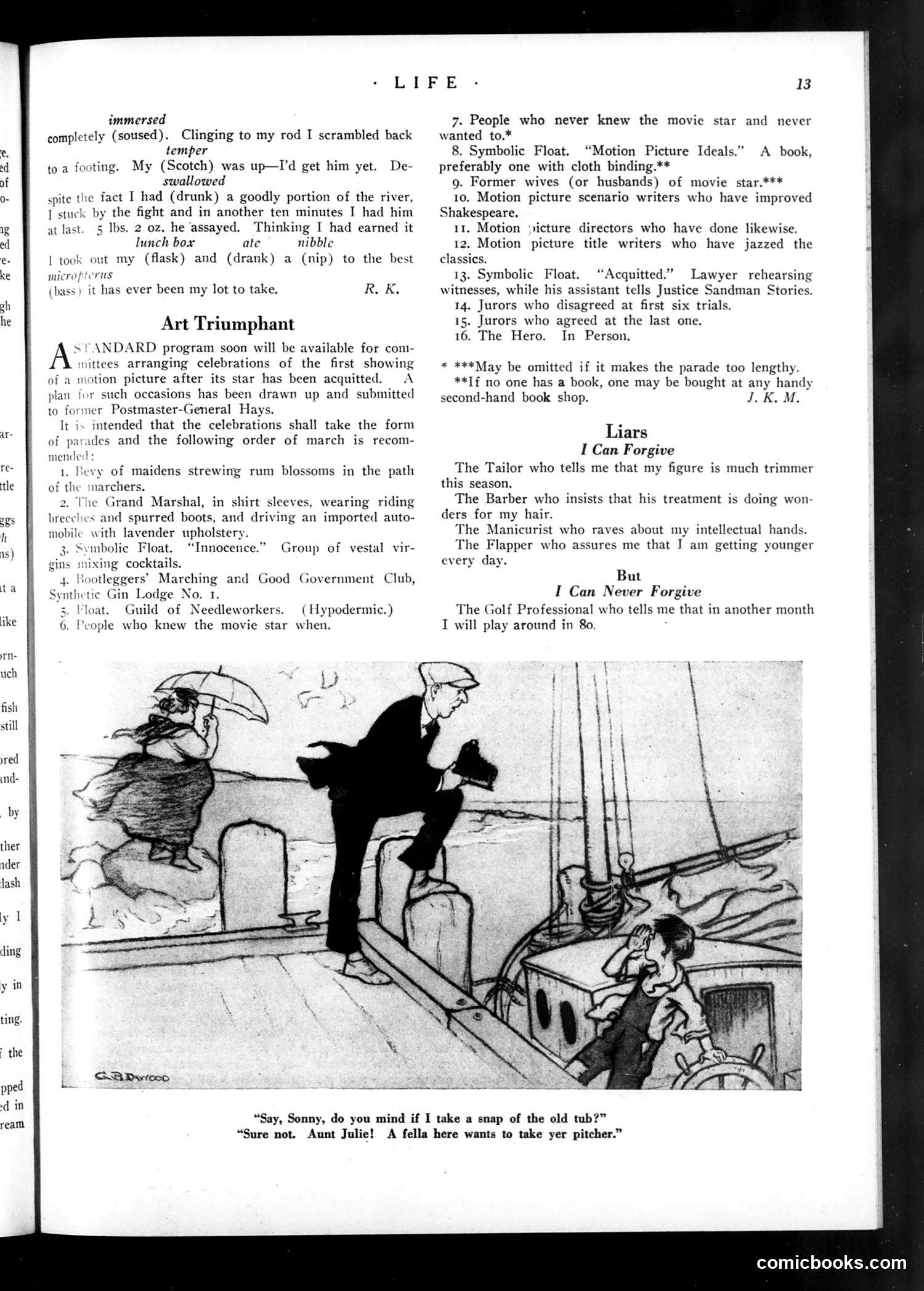
This cartoon depicts a seaside/boat scene with what appears to be a gentleman attempting to take a nap in a bathtub on deck, while a young boy (labeled "Sonny") and an older woman (labeled "Aunt Julie") discuss whether the boy can take the man's place as "pitcher." The humor relies on a double meaning of "pitcher" — the man likely misunderstands it as a baseball position, when the conversation is actually about a water pitcher (jug) needed nearby. The joke satirizes the obliviousness of someone trying to rest on a crowded boat, where domestic activities and demands persist regardless. The cartoon gently mocks vacation disruptions and the impossibility of peace even in leisure settings, a relatable social observation for Life magazine's readers.
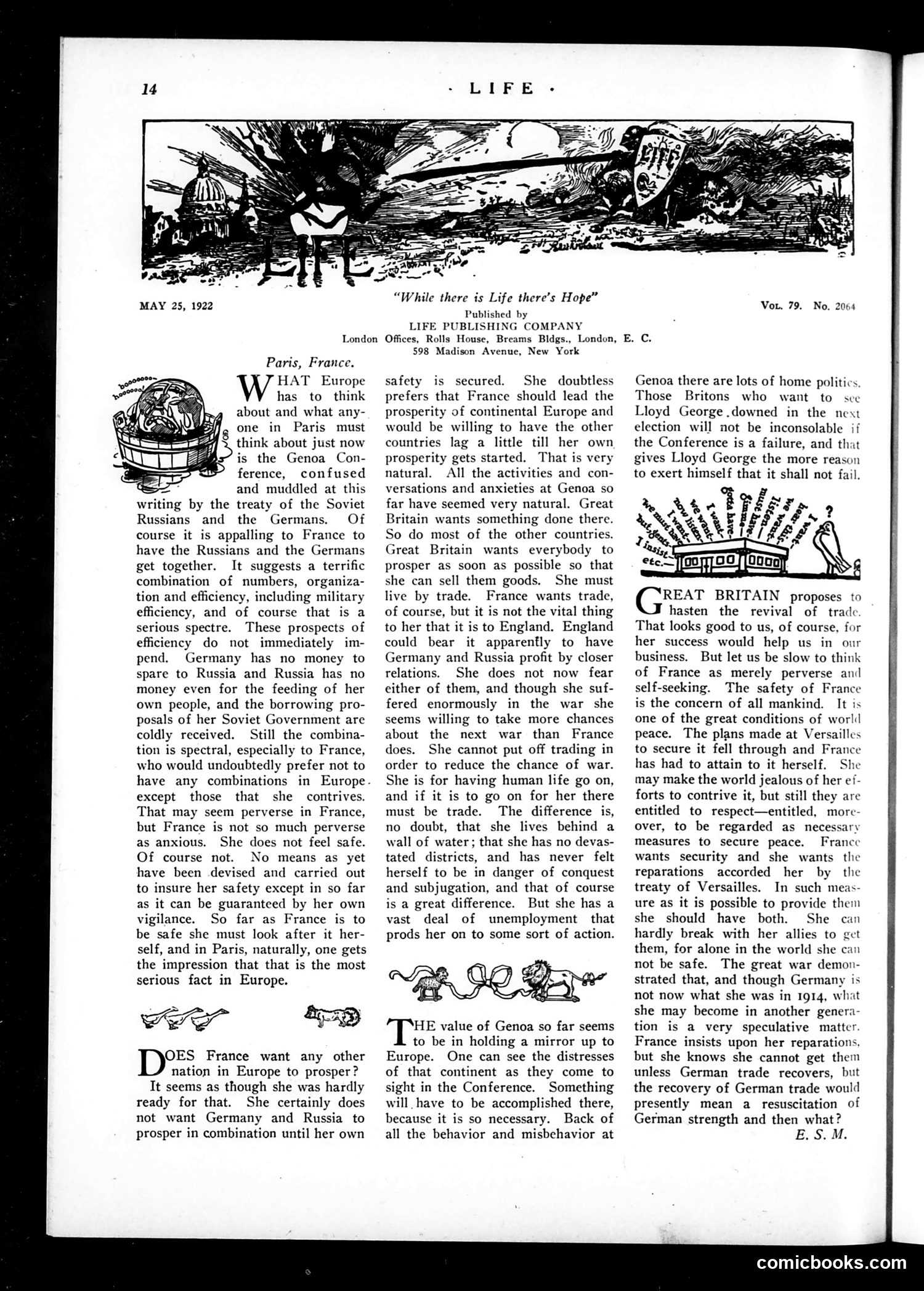
This page discusses the Genoa Conference, a post-WWI economic summit. The article expresses concern that France fears losing continental economic dominance if Germany and Russia recover through trade partnerships. The cartoon at top (left) appears to show a globe or world being held, likely representing Europe's fragile geopolitical situation—referenced as "a mirror up to Europe" showing distress. The second illustration depicts Great Britain, presented as skeptical of trade revival. The text argues Britain should lead economic recovery to help France feel secure, warning that without prosperity and security measures, France risks becoming isolated and vulnerable to future conflicts. The author (E.S.M.) emphasizes that post-war peace depends on managing Germany's resurgence carefully through negotiated trade rather than confrontation.
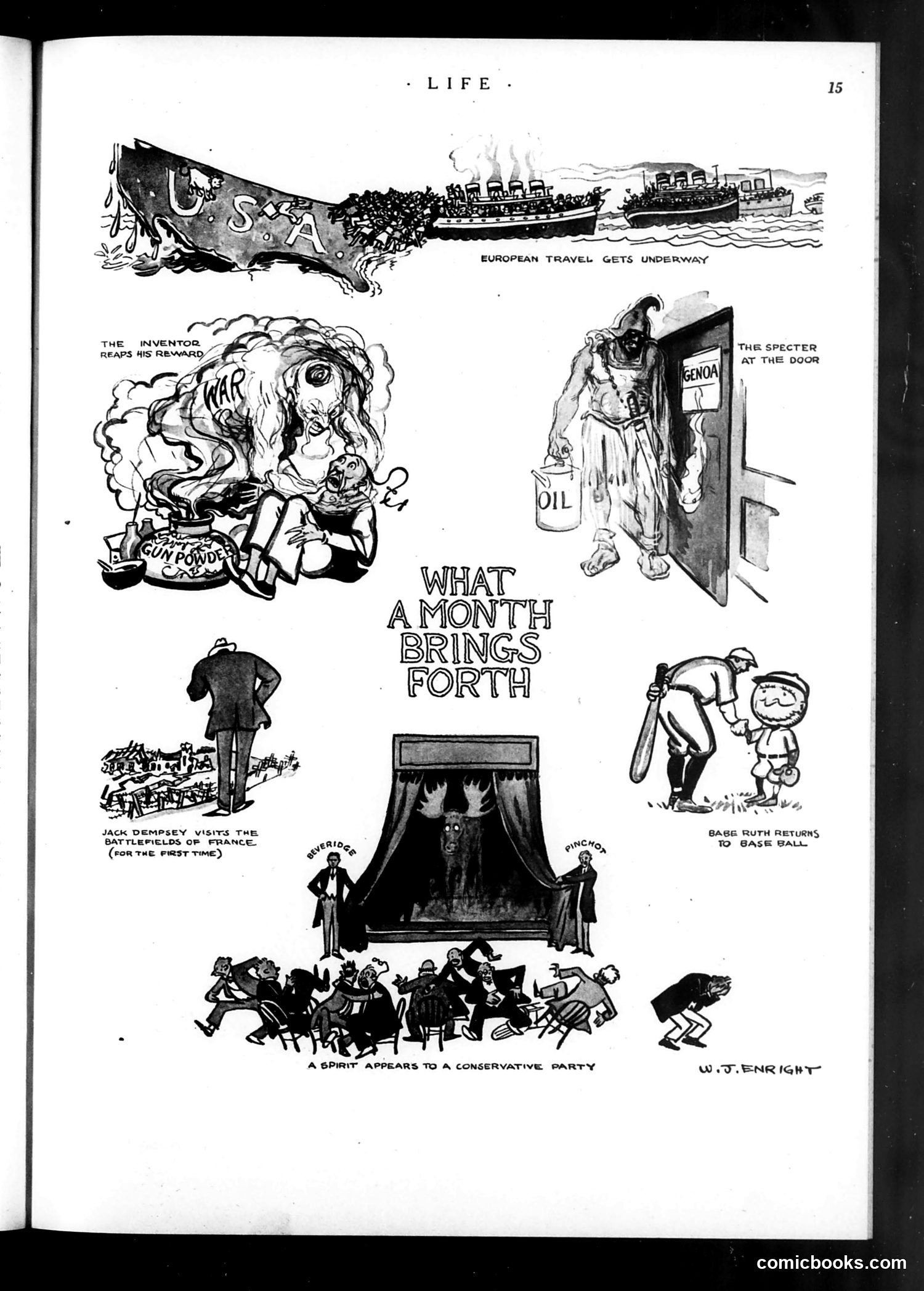
This Life magazine page satirizes major events from a single month (date unclear from image). The cartoons mock: **Top section:** European travel resuming post-WWI, with ships departing. **"The Inventor Reaps His Reward":** Likely references a recent patent or invention with humorous consequences. **"The Specter at the Door":** A ghostly figure with an oil can—possibly referencing Prohibition's enforcement or economic anxieties. **Jack Dempsey/Babe Ruth:** These famous athletes' activities (Dempsey visiting French battlefields for the first time; Ruth returning to baseball) were major celebrity news. **Bottom cartoon:** "A Spirit Appears to a Conservative Party"—a supernatural figure frightens conservative politicians, likely satirizing a political development that alarmed the right-leaning establishment. The overall theme celebrates unexpected or dramatic monthly occurrences in 1920s American life and politics.
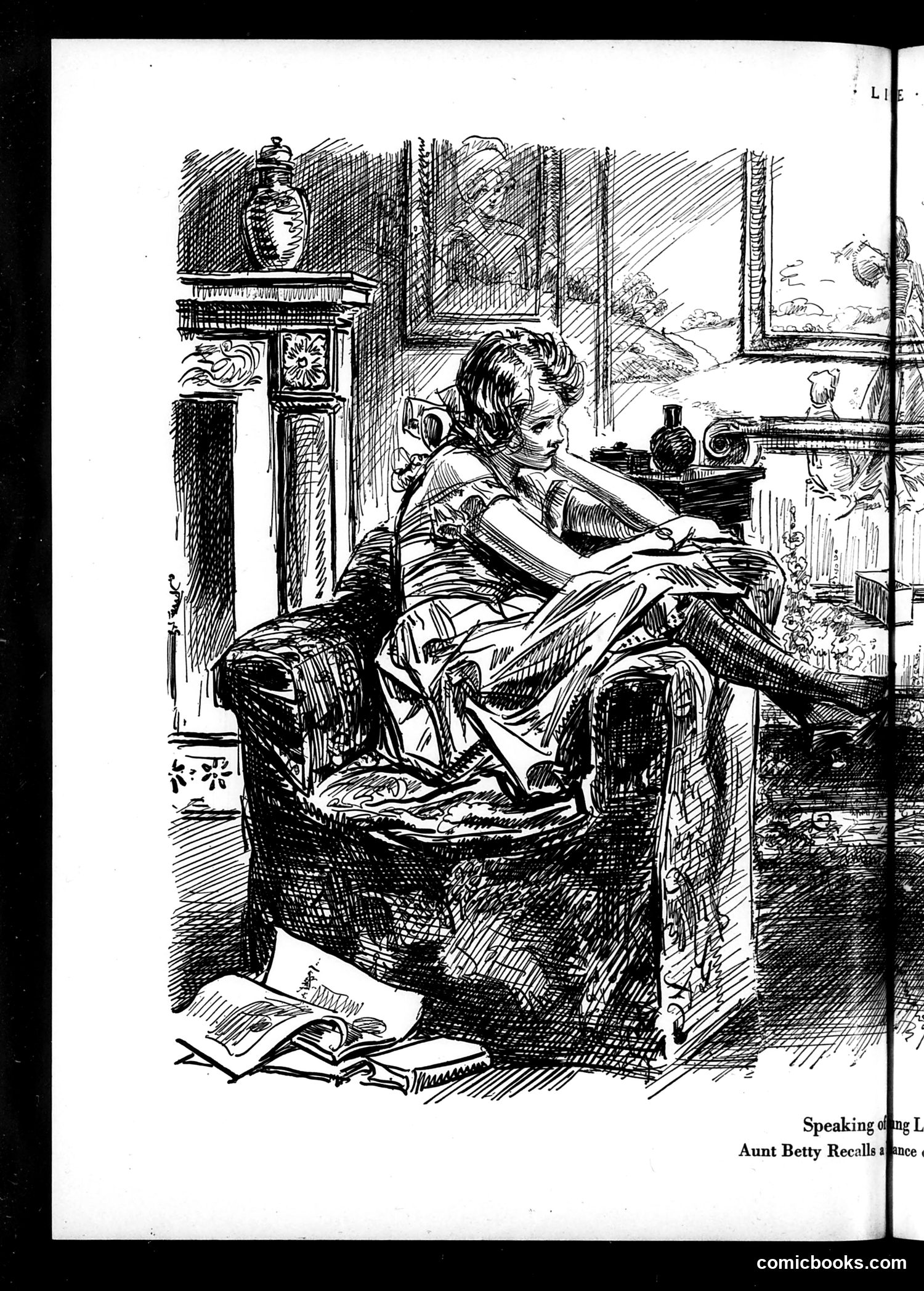
This is a pen-and-ink illustration showing a woman reclining in an ornate chair, reading. The scene depicts an upper-class interior with decorative elements—a pedestal with an urn, framed pictures, windows with draped curtains, and scattered items on a side table. The visible text references "Aunt Betty Recalls a fiance" (though OCR is unclear). This appears to be a humorous domestic illustration, likely accompanying a story or column in *Life* magazine about romantic reminiscence or courtship memories. Without clearer text or additional context, the specific satirical point is unclear. The image may be satirizing upper-class leisure, nostalgia, or courtship customs of the era, but the exact target of humor cannot be determined from the visible evidence alone.
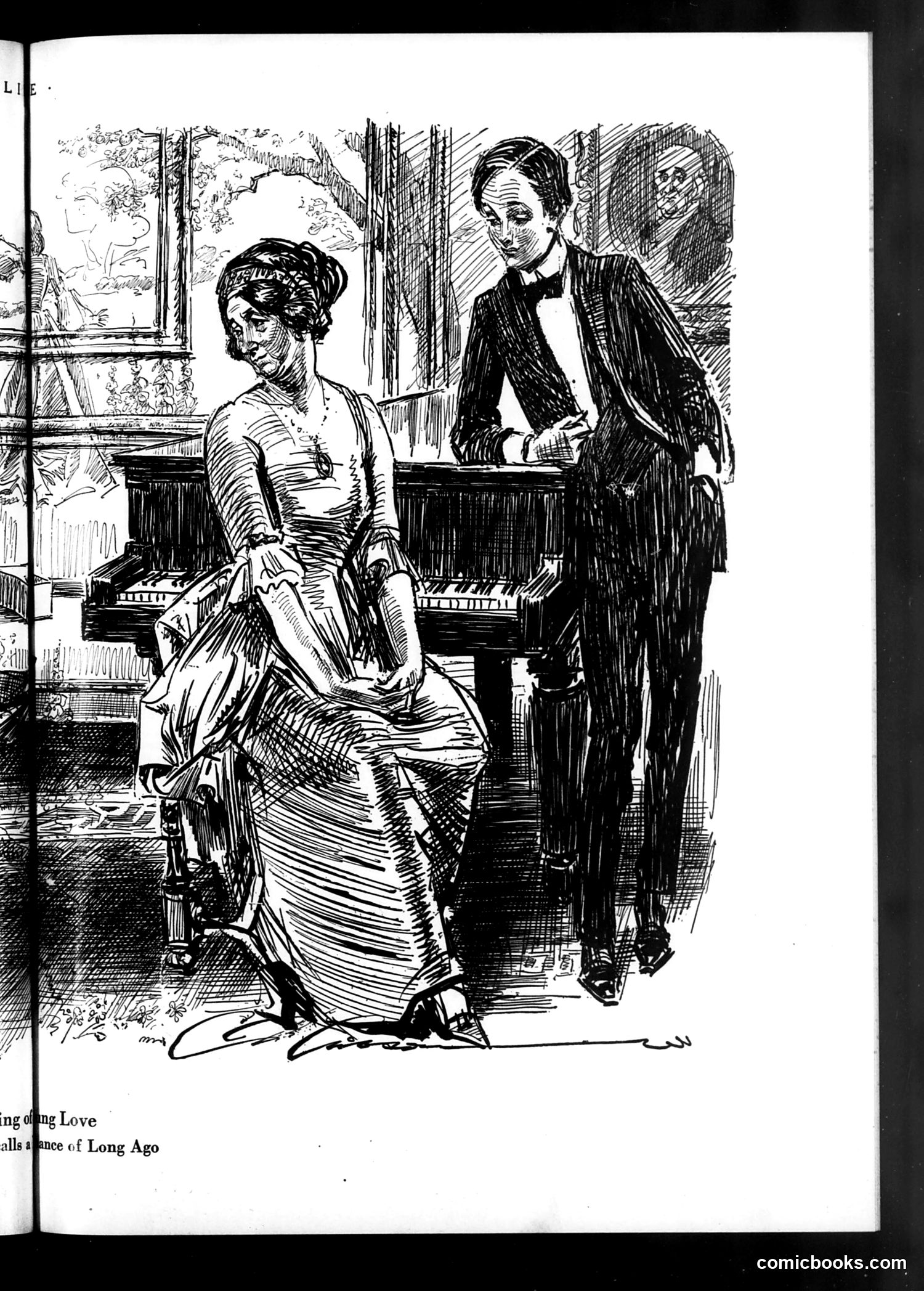
This appears to be an illustration from *Life* magazine depicting a romantic or social scene. A woman sits at a piano while a man stands beside her in formal attire (suit and bow tie). The setting is an elegant interior with windows and decorative elements visible in the background. The partially legible text references "Love" and mentions "Long Ago," suggesting this illustrates a nostalgic romantic moment or perhaps commentary on courtship customs. The formal dress and piano setting indicate this depicts upper-class or genteel society. Without clearer text or additional context, the specific satirical point remains unclear—it could be mocking Victorian romance conventions, social pretension, or changing attitudes toward courtship. The artistic style is consistent with early 20th-century *Life* magazine's humorous social commentary.
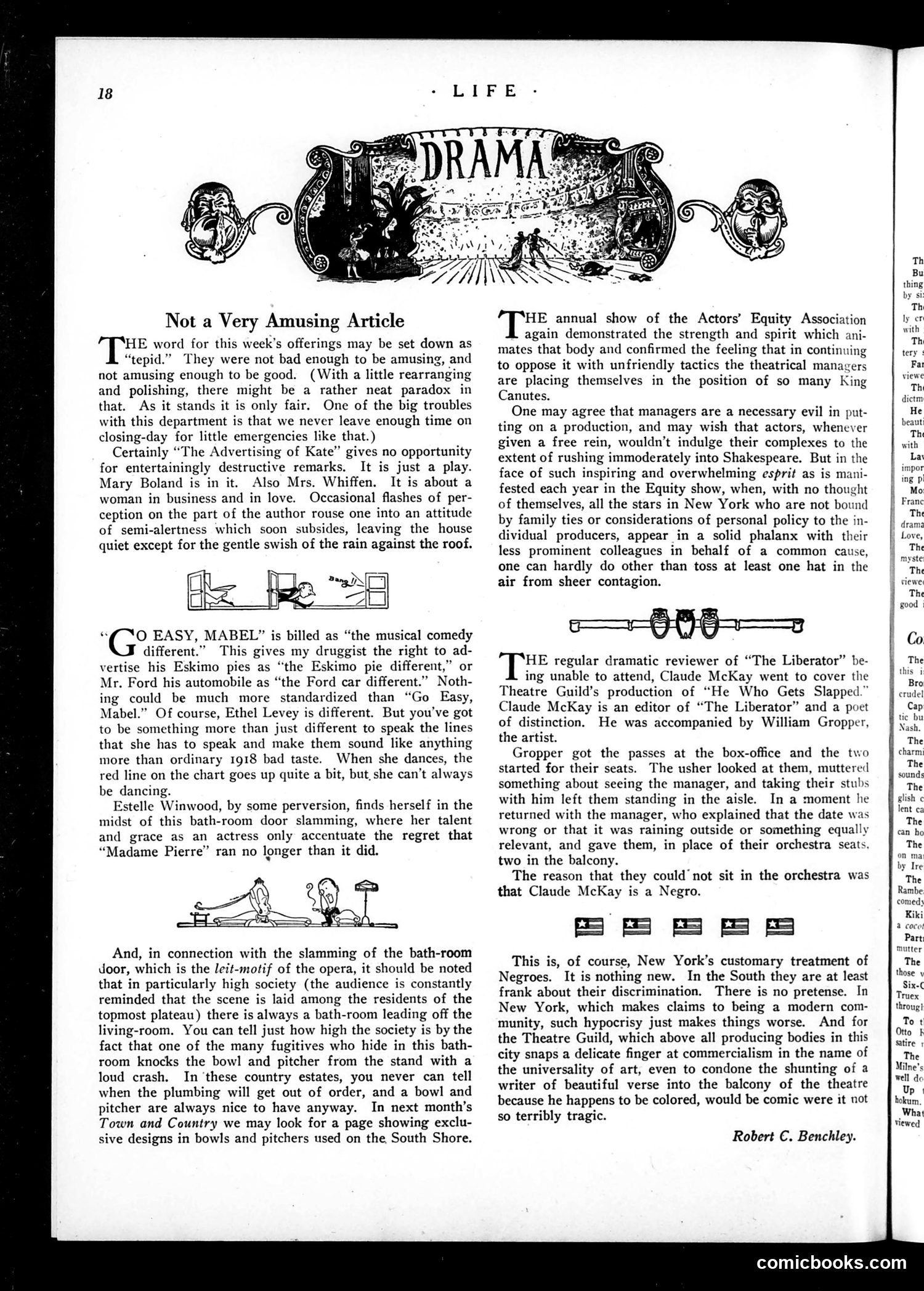
This page contains theater reviews from Life magazine's drama section. The main content mocks weak theatrical productions: **"Not a Very Amusing Article"** critiques three Broadway plays as mediocre—neither bad enough to be entertaining nor good enough to merit praise. The reviewer dismisses "The Advertising of Kate" and "Go Easy, Mabel" as standardized, tepid offerings. He sarcastically suggests that calling something "different" (like Ford's "different" automobile) is meaningless standardization. He praises actress Estelle Winwood despite the play's bathroom-door-slamming farce humor. **The bath-room humor section** jokes about how these society comedies rely on slamming doors and breaking chamber pots as their primary comedic device. **The Actors' Equity section** praises the theater union's annual show, comparing managers opposing them to King Canute (the legendary king who commanded the tide—a futile gesture). It celebrates actors' solidarity. **The final section** addresses racial discrimination: Claude McKay (a Black poet and editor) was assigned to cover a Theatre Guild show because the regular reviewer couldn't attend—apparently because McKay is Black and couldn't sit in orchestra seats due to segregation policies.
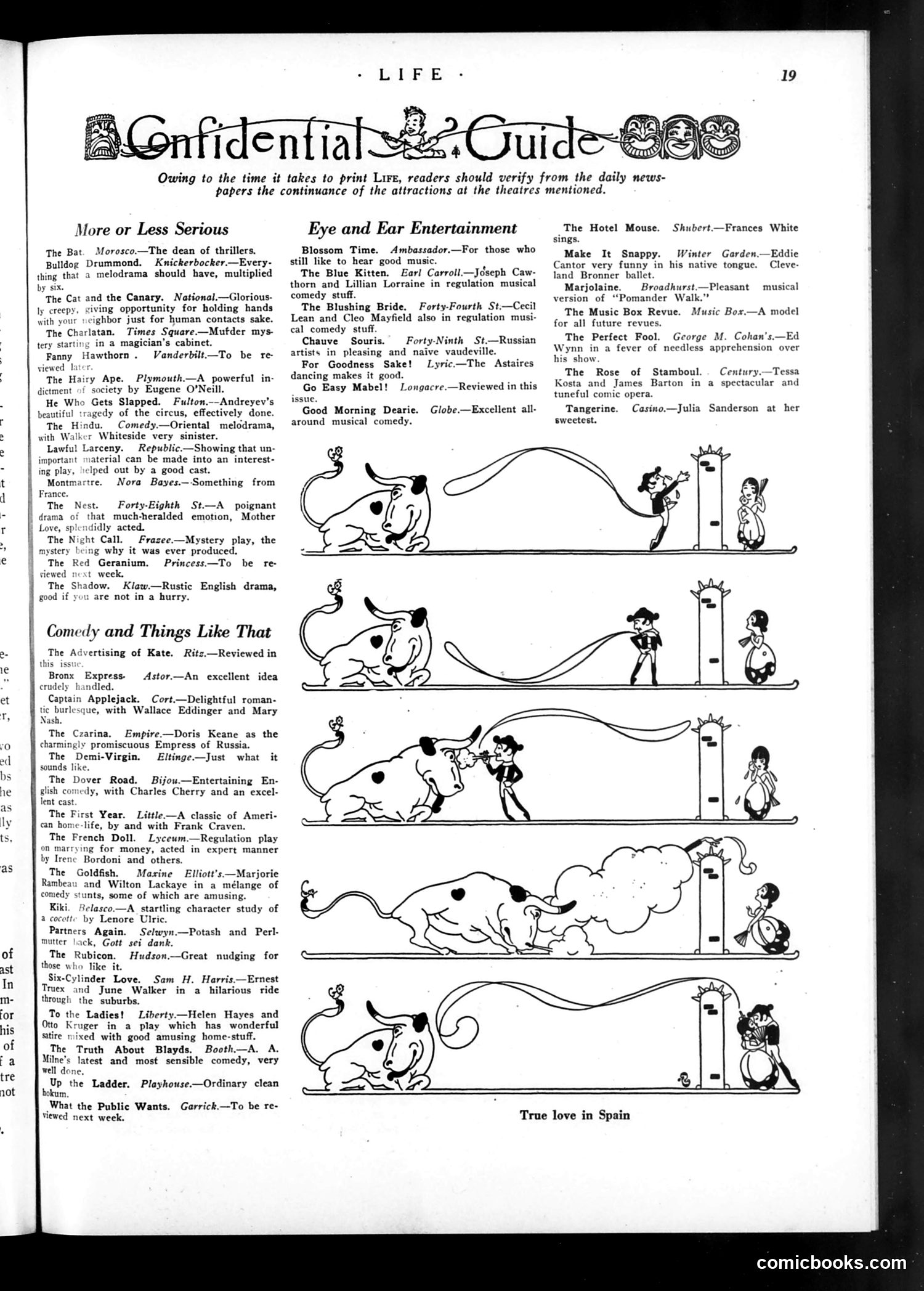
This page is a **theater review guide** from Life magazine's "Confidential Guide" section, listing Broadway shows with brief critical assessments. It's organized by category: "More or Less Serious," "Comedy and Things Like That," and "Eye and Ear Entertainment." The reviews use witty, dismissive humor typical of 1920s theater criticism. For example, *Bulldog Drummond* has "everything a melodrama should have, multiplied by six" (excess as criticism), while *The Night Call* is a "mystery play, the mystery being why it was ever produced" (it shouldn't exist). The right side features a **sequential comic strip** labeled "True Love in Spain," showing a dog attempting increasingly absurd rescue methods to reach a woman in a tower—a visual gag on romantic melodrama clichés. The page reflects Jazz Age Broadway culture, listing contemporary actors (Frances White, Doris Keane, Frank Craven) and venues. Most reviews assume audience familiarity with theatrical conventions, making gentle fun of predictable plots and "regulation musical comedy stuff."
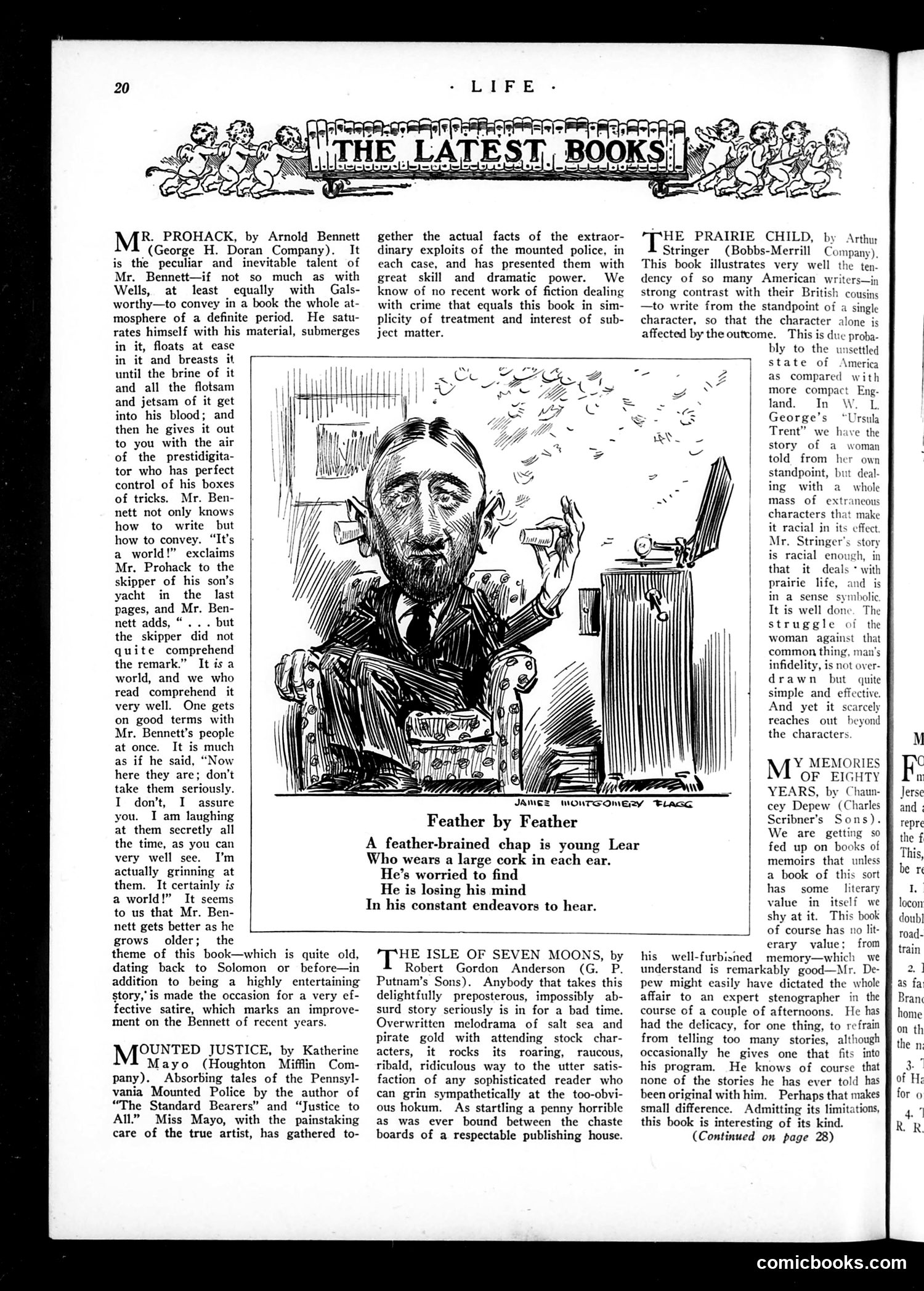
This page is primarily a book review section from *Life* magazine. The only cartoon is the small, untitled piece titled **"Feather by Feather,"** which presents a humorous limerick about a character named Lear. The joke is straightforward physical comedy: a young man wears large corks in both ears (presumably to muffle sound or for some foolish reason), yet paradoxically worries he's losing his mind *because* he cannot hear properly. The irony is that his own deliberate action—inserting the corks—is causing the very hearing loss he laments. This appears to be simple satirical humor mocking human foolishness and self-inflicted problems, rather than commentary on specific political or social figures. The cartoon works as a gentle jab at illogical behavior without requiring knowledge of particular contemporary events or people.
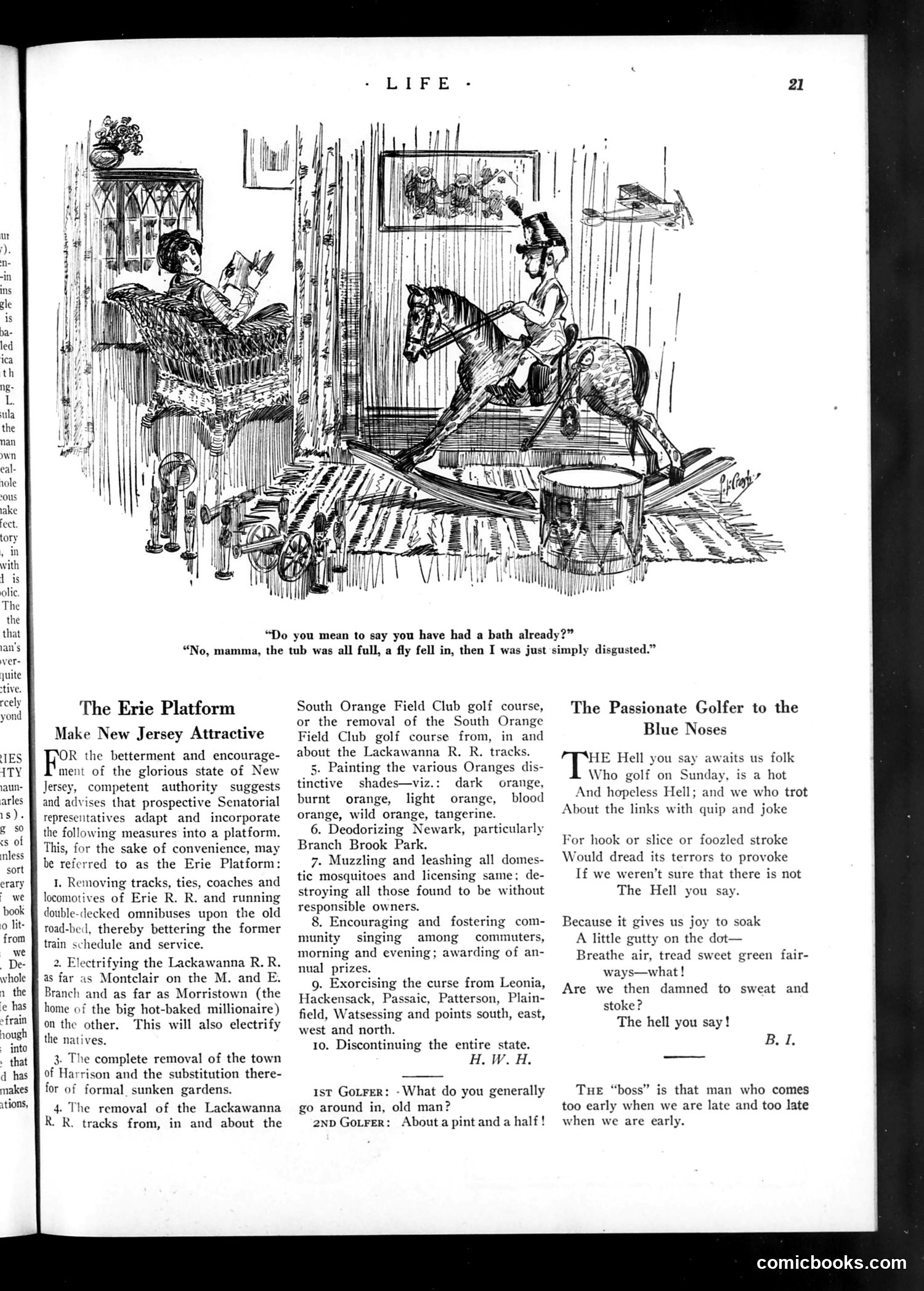
**The Main Cartoon** depicts a child in a bathtub on a rocking horse, explaining to his mother that he abandoned his bath because "a fly fell in." This is simple domestic humor—the child uses an absurd excuse (being "disgusted" by a single fly) to justify avoiding bathing, a common parental battle with children. **"The Erie Platform"** is satirical political commentary. It mockingly proposes ten ridiculous "reforms" for New Jersey, ostensibly to make it attractive to senatorial candidates. The items absurdly suggest removing railroad infrastructure, obliterating the town of Harrison entirely, painting cities different shades of orange, and "discontinuing the entire state." This satirizes the dysfunction and poor conditions in New Jersey (industrial pollution, mosquitoes, undesirable towns) by proposing literally impossible "solutions"—the joke being that New Jersey is so problematic that normal fixes won't work. **The Golf Jokes** mock both Sunday golf (condemned by religious "blue noses"—puritans) and golfers who drink heavily during rounds ("about a pint and a half").
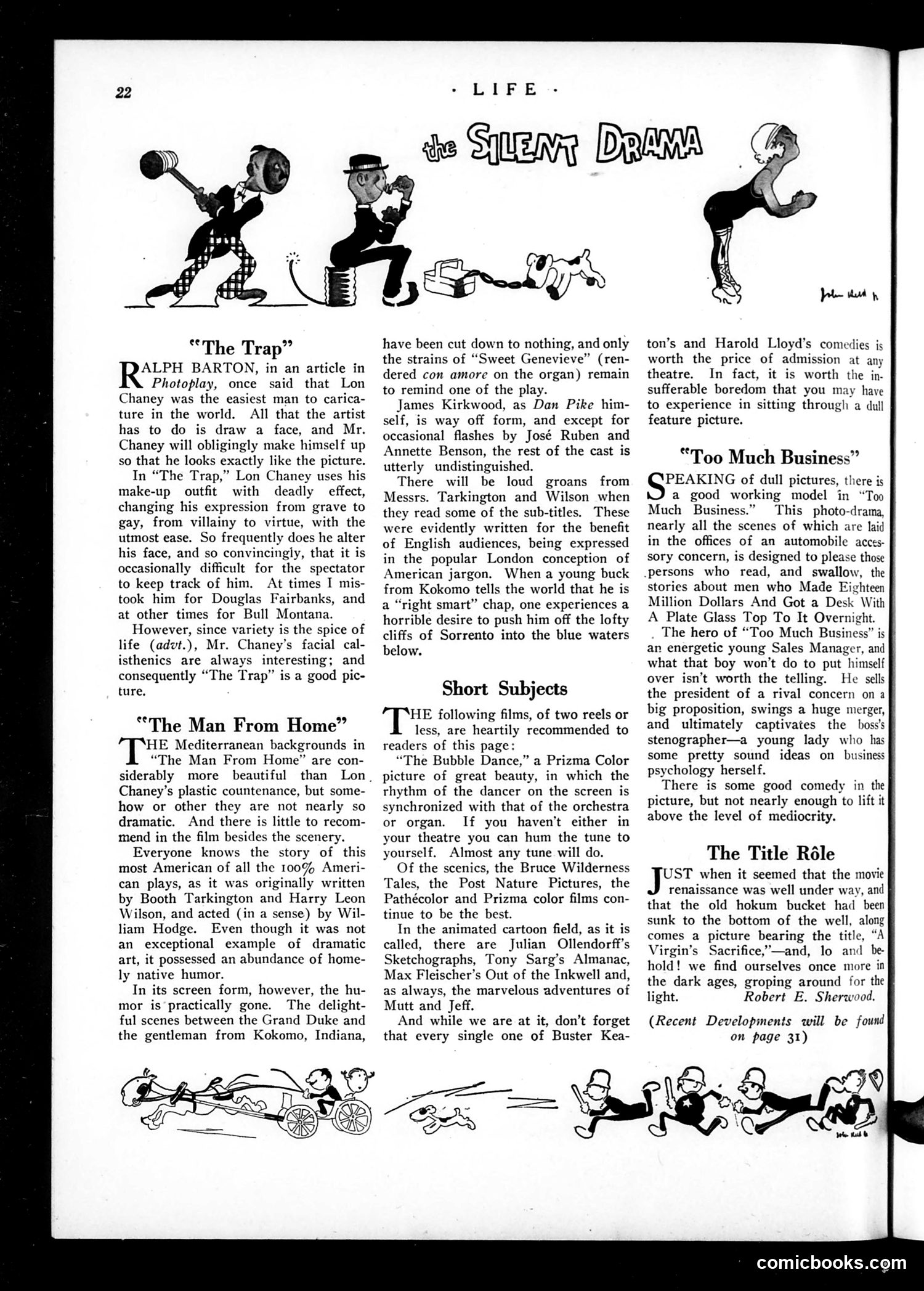
This page reviews three 1920s silent films. "The Trap" praises Lon Chaney's extraordinary facial expressiveness—his makeup artistry is so convincing the reviewer momentarily confused him with other actors (Douglas Fairbanks, Bull Montana). The review jokes that Chaney is easier to caricature than photograph because he'll simply transform his face to match any drawing. "The Man From Home" adapts a popular Booth Tarkington play but loses its humor in translation. The critic particularly mocks the subtitles, which render American Midwestern dialect ("right smart chap") in exaggerated "London conception of American jargon," creating unintentionally comic effects. The "Short Subjects" section recommends animated cartoons (Mutt and Jeff, Felix the Cat-era work) and live-action comedies by Buster Keaton and Harold Lloyd—suggesting these shorts were often more entertaining than feature films of the era.

This is a **tire company advertisement**, not political satire. The page features a Fisk Tires ad showing a child peeking around a large tire. The child appears to represent innocence or curiosity, with the visual suggesting the tire's impressive size and quality. The ad's messaging emphasizes four tire qualities—size, strength, resiliency, and price—claiming Fisk Tires surpass competition. A tagline reads "Time to Re-tire? (Buy Fisk)," a pun on "retire." The copy stresses that Fisk Tires offer reliable value and durability ("low cost mileage and unbroken service") for cars, trucks, and wagons. This appears to be early-to-mid 20th century advertising, when such direct product endorsements regularly appeared in magazines. There is no political commentary or satirical intent—it's straightforward commercial promotion.
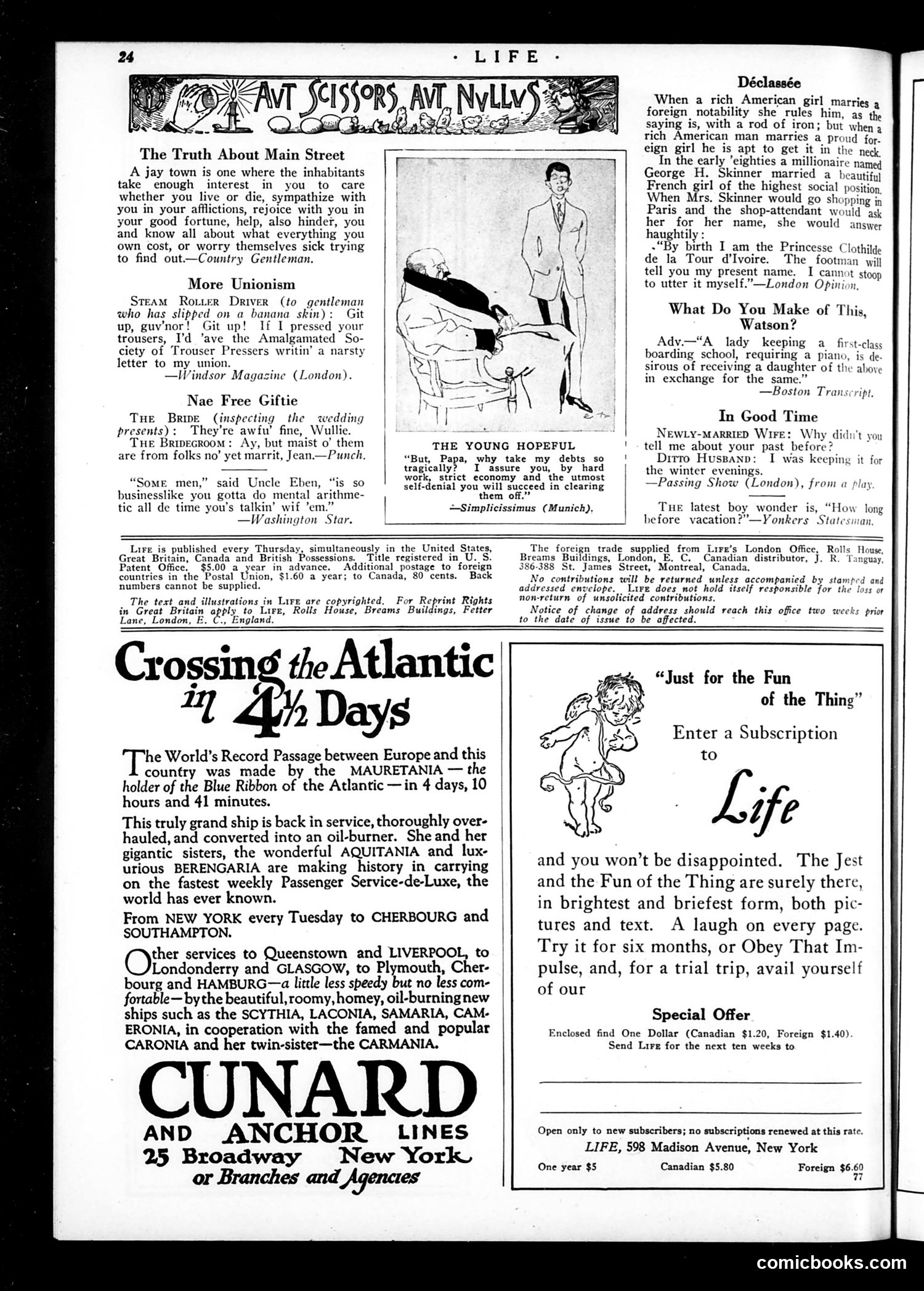
This page contains several satirical short pieces and advertisements typical of Life magazine's format. The main cartoon and accompanying text "The Young Hopeful" depicts a father lecturing his son about clearing debts through hard work and self-denial—the satire being the son's apparent indifference to this moral lecture, suggesting generational attitudes toward responsibility. The opening piece "Déclassée" satirizes wealthy American women who marry foreign nobility: when such women go abroad, they ostentatiously use their titles while concealing their husbands' names, implying social pretension and snobbery. The anecdote about "Mrs. Skinner" exemplifies this behavior. Other brief jokes mock small-town nosiness ("The Truth About Main Street"), British labor unions' pickiness ("More Unionism"), Scottish stinginess regarding wedding gifts, and marital communication gaps. The page is primarily advertising space, notably featuring Cunard shipping lines' advertisement for transatlantic service on the Mauretania and other vessels.
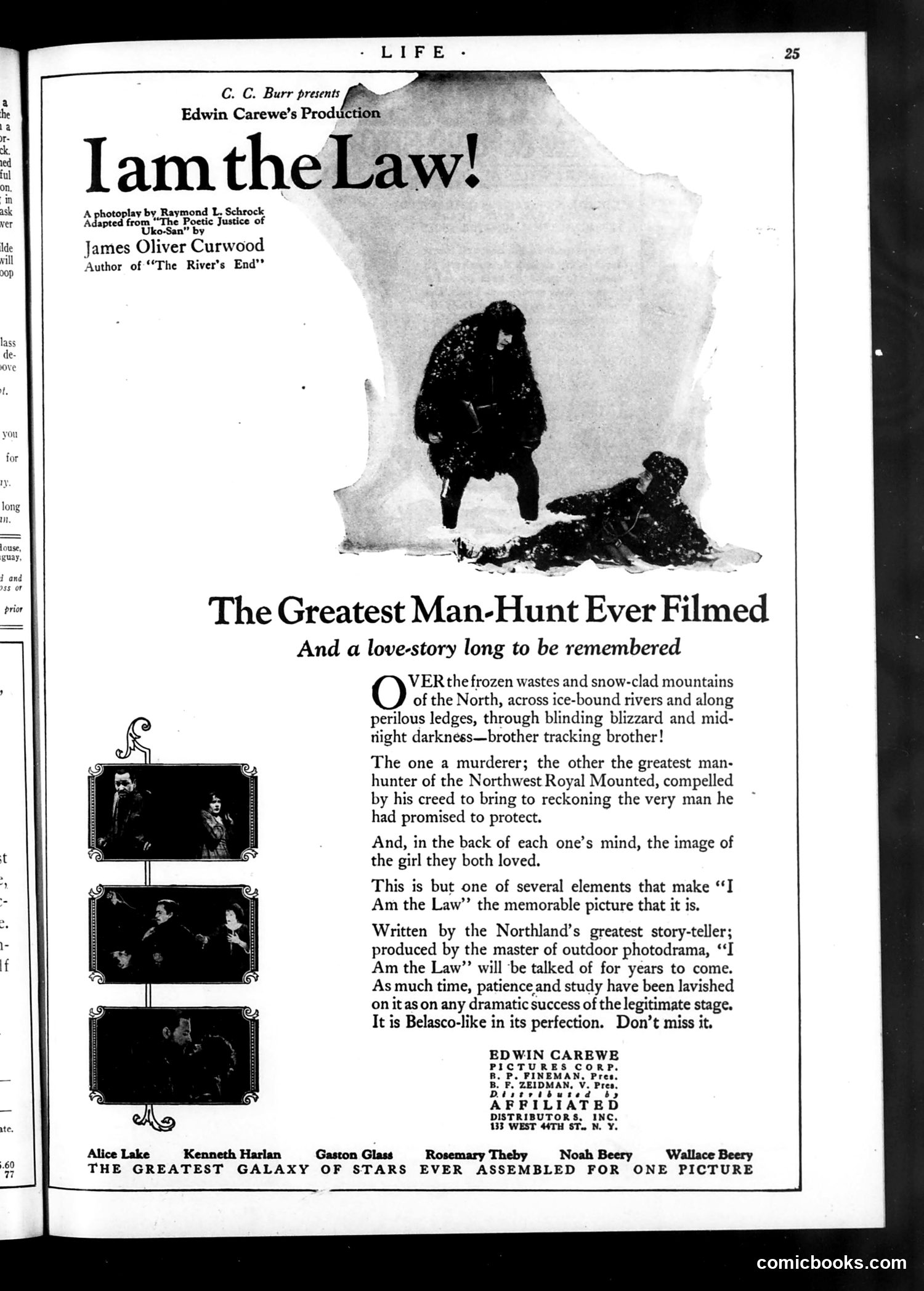
This is a **film advertisement**, not political satire. It promotes a silent movie produced by Edwin Carewe, adapted from James Oliver Curwood's Northland adventure story "Uko-San." The plot involves two brothers in Canada's frozen North: one a murderer, the other a Royal Mounted Police officer duty-bound to capture him. A woman both love complicates matters—a melodramatic conflict typical of 1920s adventure cinema. The page emphasizes production prestige, comparing it to David Belasco's theatrical productions and noting meticulous craftsmanship. It features an ensemble cast including Wallace Beery and Kenneth Harlan (recognizable silent-film stars), presented as "the greatest galaxy of stars ever assembled." The three small framed images on the left appear to be stills from the film, though specific scenes are unclear in this reproduction. This represents mainstream entertainment advertising from the silent film era, not editorial commentary or political content.
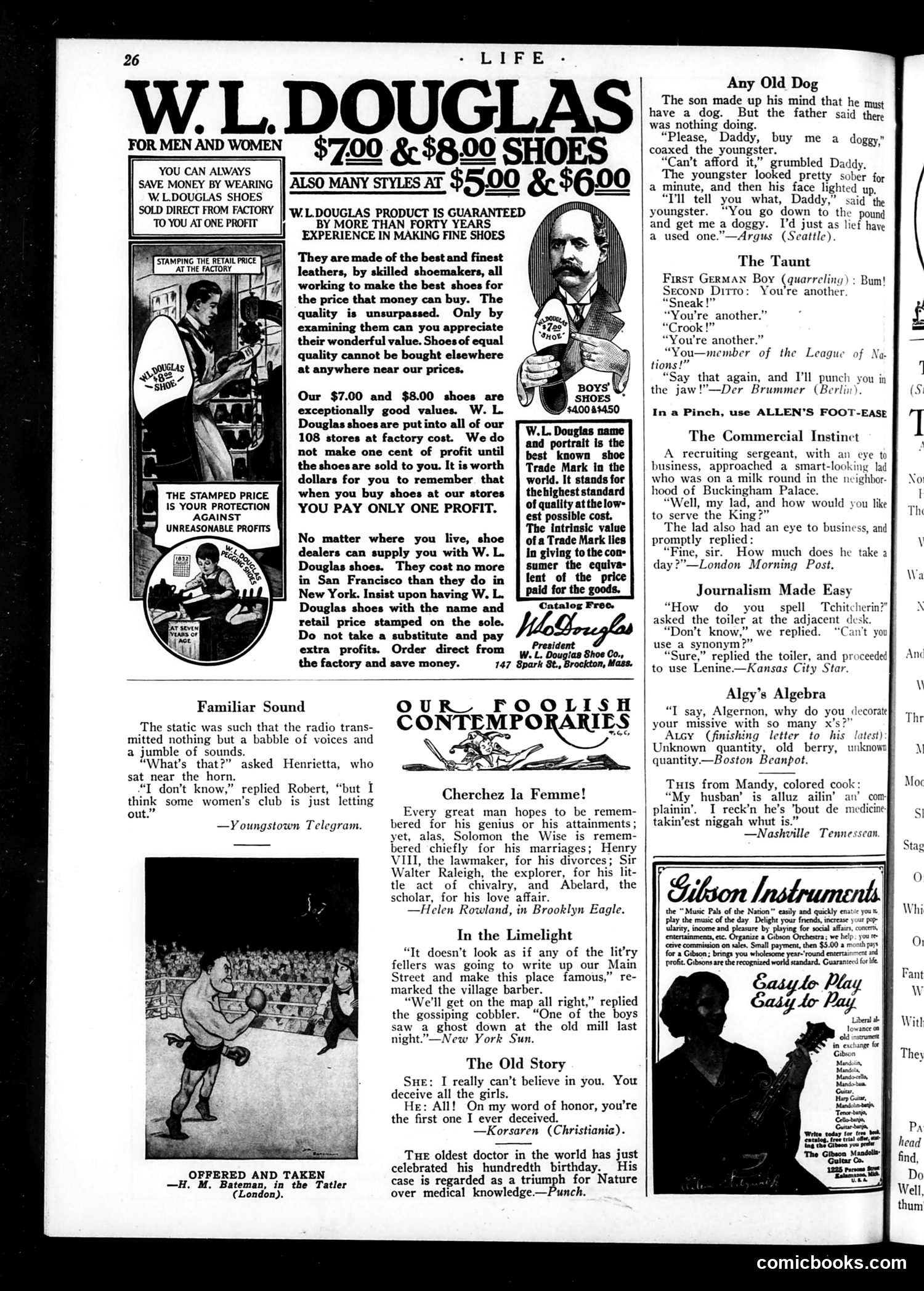
This page is primarily **advertising-driven**, dominated by a large W.L. Douglas shoe company advertisement claiming direct-factory pricing and quality guarantees. The editorial content consists of brief satirical humor pieces: **"Familiar Sound"** jokes that radio static sounds like "women's club" chatter—a gendered stereotype about women's supposed chattiness. **"Cherchez la Femme"** observes that great historical figures (Solomon, Henry VIII, Raleigh, Abelard) are remembered for romantic/marital exploits rather than achievements—a commentary on how society reduces men's legacies. **"In the Limelight"** depicts small-town gossip culture, where a ghost sighting becomes local fame. **"The Old Story"** presents a man's transparent seduction line claiming a woman is his "first" conquest—mocking male duplicity. Other pieces mock children's logic, martial quarreling, and medical establishments. These are gentle, character-based humor typical of 1920s Life magazine's satirical voice—observing everyday social absurdities rather than making sharp political points.
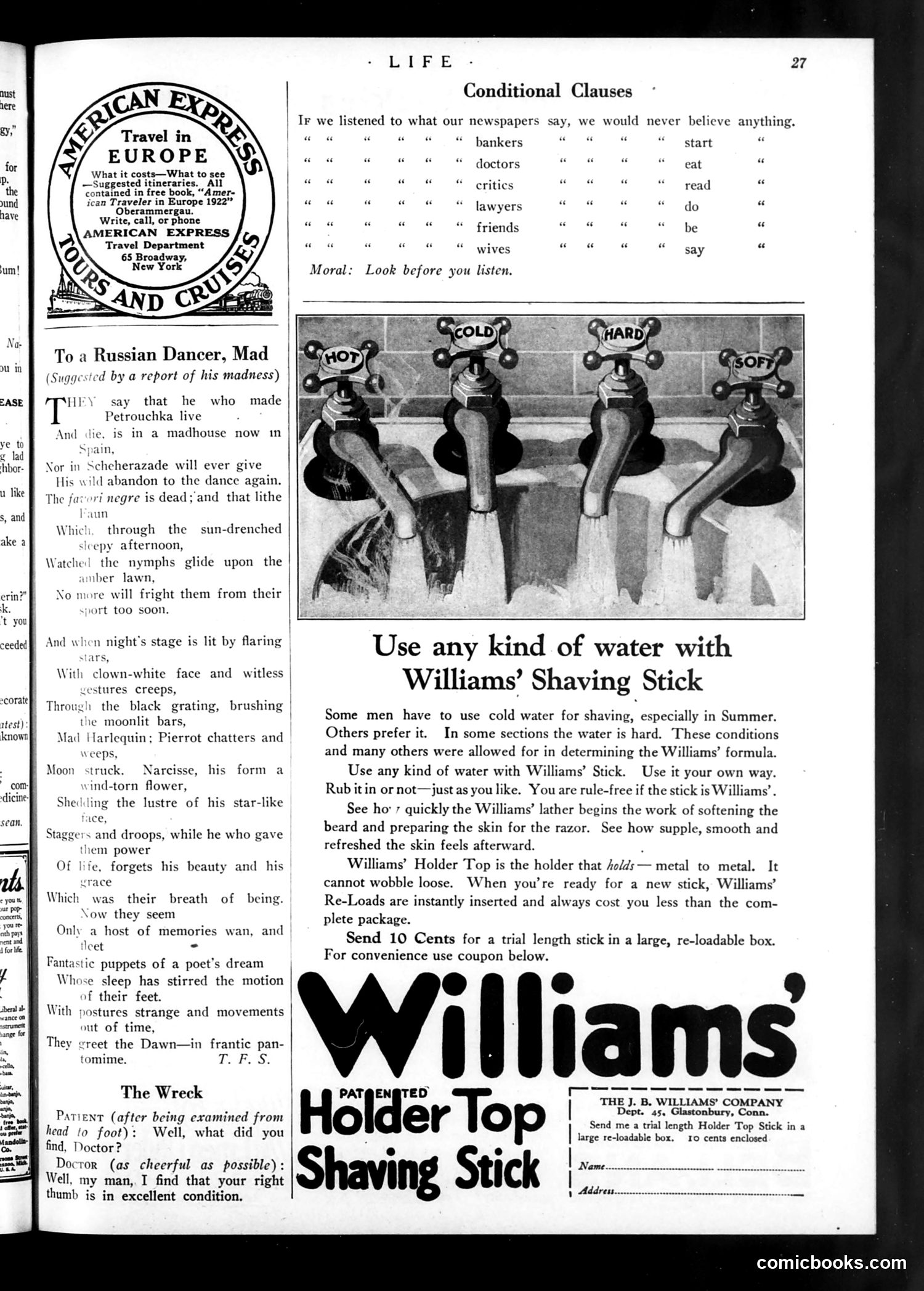
This page mixes editorial content with advertising. The main satirical piece is "Conditional Clauses"—a commentary on media distrust. It humorously suggests that if we believed everything newspapers claimed about various professions (bankers, doctors, critics, lawyers, friends, wives), we'd be credulous fools. The moral warns readers to "look before you listen"—a jab at sensationalist journalism and the unreliability of press accounts about different social groups. The poem "To a Russian Dancer, Mad" appears to reference the real mental health crisis of a celebrated Russian dancer (likely Vaslav Nijinsky, institutionalized in 1912, though the exact figure isn't specified). It mourns the loss of his artistic brilliance through vivid references to his famous roles (Petrouchka, Scheherazade). The remainder is advertising for Williams' Shaving Stick and American Express travel services.
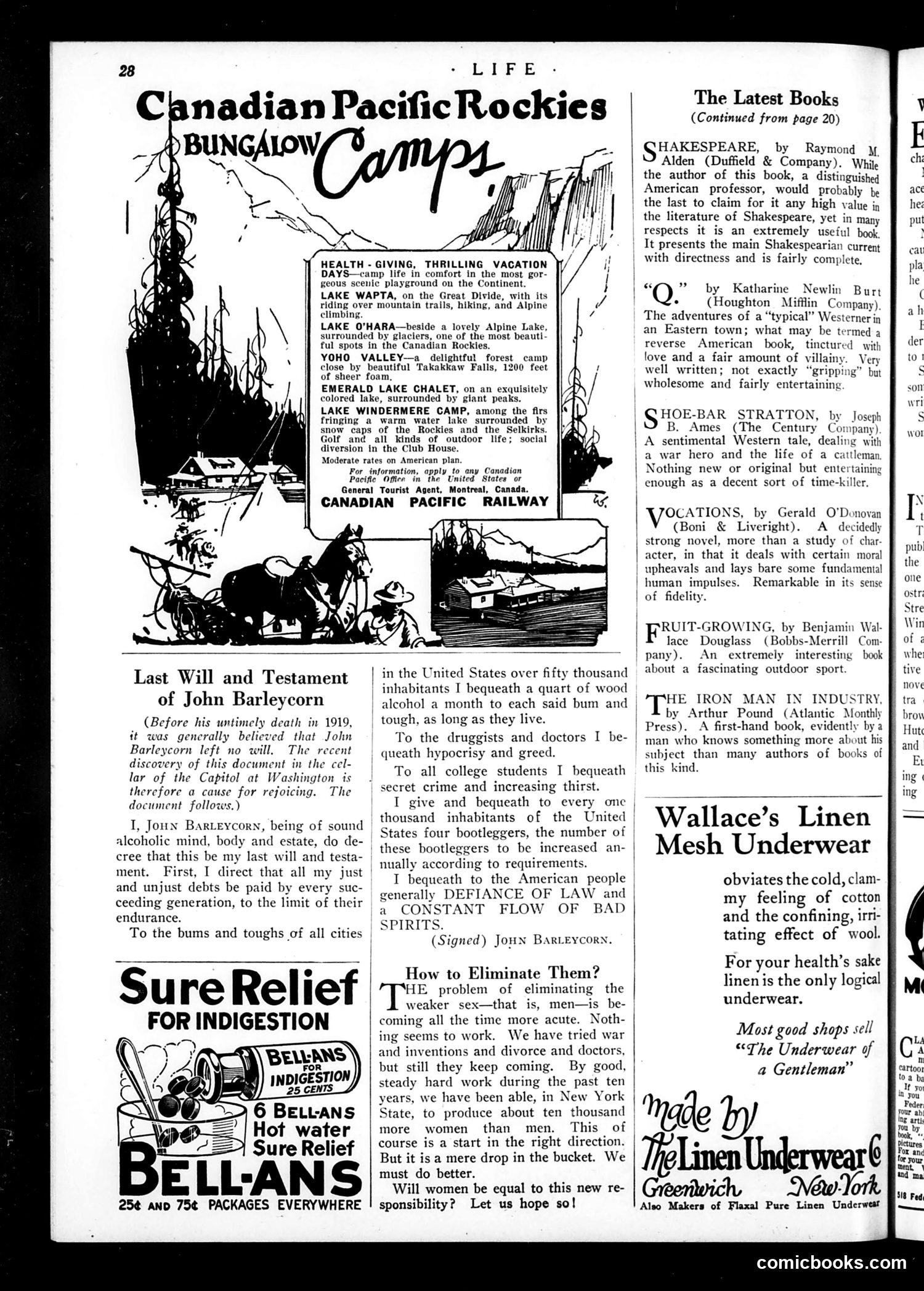
This page from Life magazine (circa 1919-1920) contains satirical commentary on Prohibition's recent passage. The centerpiece is a mock "Last Will and Testament of John Barleycorn"—a personification of alcohol itself—written as if alcohol were dying due to Prohibition legislation. The satire is biting: "John Barleycorn" bequeaths bootleggers, hypocrisy, and "defiance of law" to Americans, mocking predictions that Prohibition would fail and generate criminal enterprise. The will's language mimics legal documents while its content reveals the author's skepticism about the amendment's enforceability. The accompanying article "How to Eliminate Them?" appears to be satirical commentary on gender politics, using dark humor about population imbalances. The page also features Canadian Pacific Railway advertising and book reviews—typical Life magazine content mixing serious editorial with advertising and lighter fare.
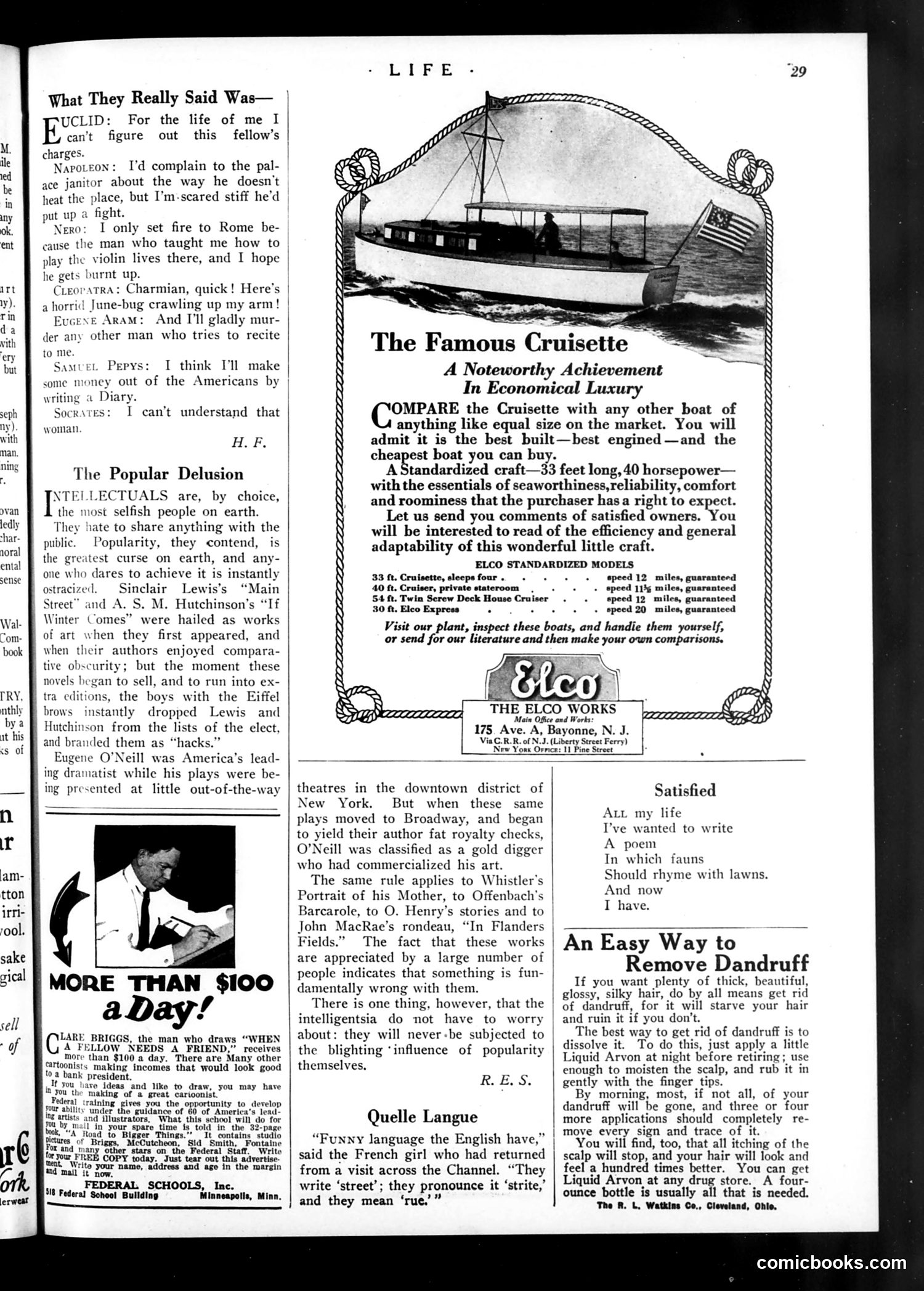
This page satirizes the contrast between artistic integrity and commercial success. The "What They Really Said Was" section features historical figures (Euclid, Napoleon, Nero, Cleopatra, Samuel Pepys, Socrates) offering absurdly trivial complaints instead of their actual legacies—a joke about how people rationalize failure or mediocrity. The main essay, "The Popular Delusion," critiques intellectual hypocrisy: academics celebrate works by Sinclair Lewis and A.S.M. Hutchinson when obscure, then dismiss them as "hacks" once they become commercially successful. The Eugene O'Neill example illustrates this perfectly—his avant-garde plays were praised in small theaters but deemed less worthy once they achieved Broadway success and made him wealthy. The satire targets the literary establishment's false pretense that popularity corrupts art, when the work itself hasn't changed. It's a pointed attack on snobbery masquerading as aesthetic principle. The page also includes period advertising (cartoon correspondence school, boat sales) typical of 1920s Life magazine content.
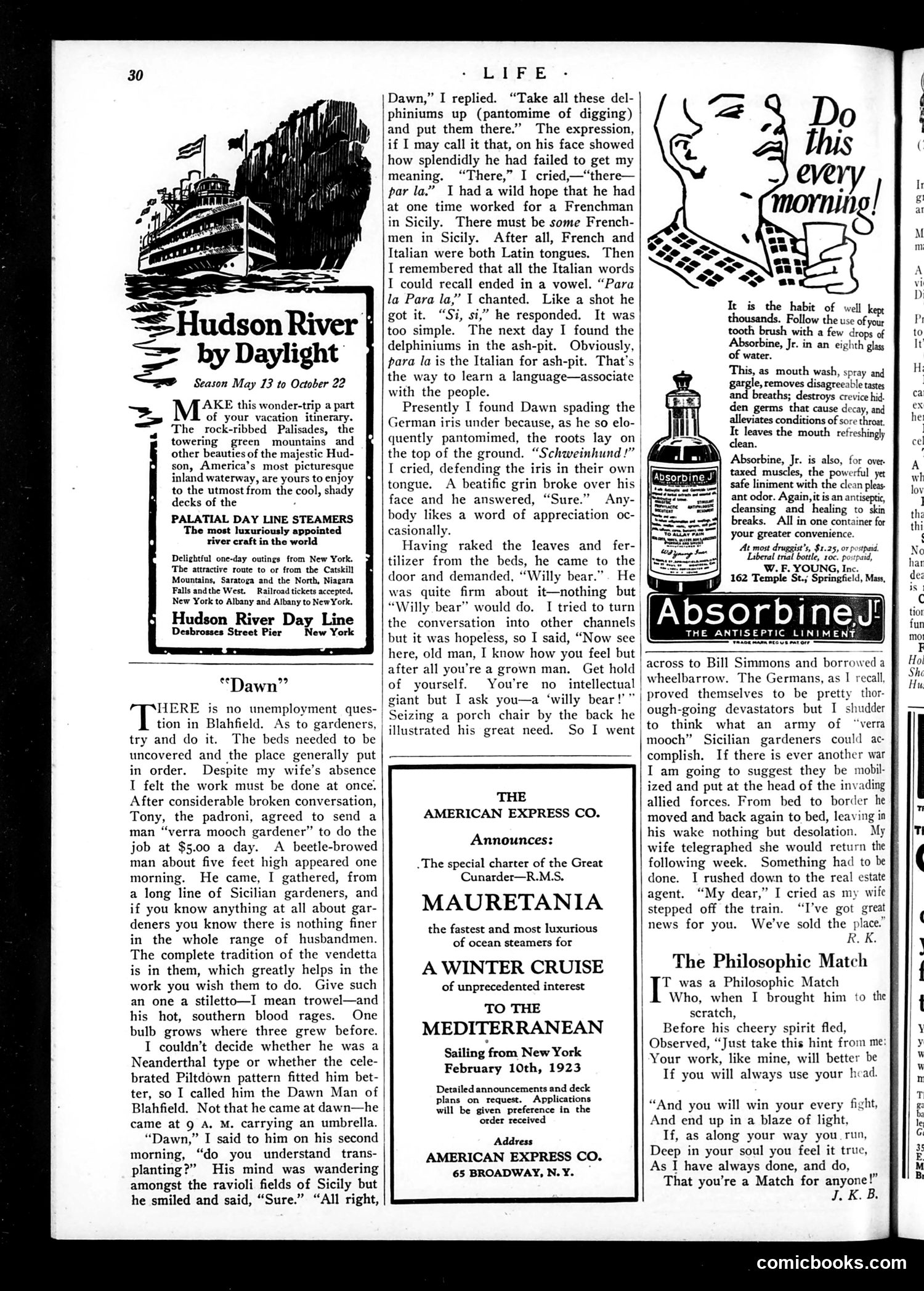
This story satirizes the comic frustrations of employing Italian immigrant workers in early 1920s America. The narrator hires an unnamed Sicilian gardener he nicknames "the Dawn Man," based on his apparent prehistoric appearance. The satire hinges on language barriers: the narrator attempts communication through English, French, and Italian, with absurd results—when he chants "Para la para la" (attempting Italian), the gardener interprets it as "ash-pit" and dumps the delphiniums there. German insults work better ("Schweinhund!"), earning the gardener's approval. The humor derives from the narrator's condescension toward the worker's intelligence and the failed assumption that Latin-based languages would somehow bridge understanding. The gardener's repeated demand for "Willy bear" (unclear reference, possibly liquor or a tool) adds final comic futility—pure gesture replaces words entirely. This reflects 1920s American anxiety about unassimilated immigrants and communication across class/ethnic divides.
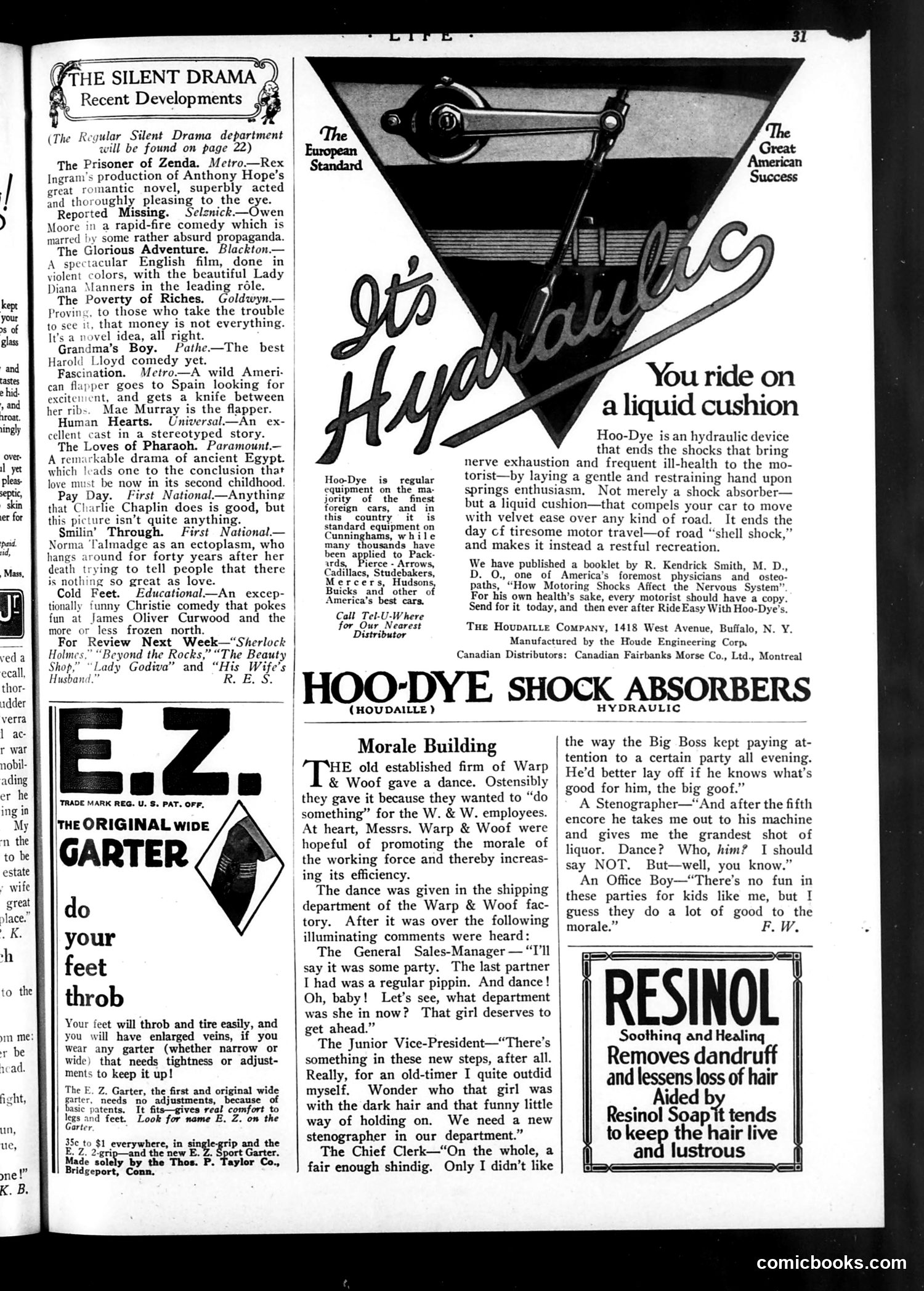
This page is primarily **advertisements and film reviews** with no significant political cartoon content. The **top section** reviews recent silent films—comedies, romances, and dramas typical of early 1920s cinema. Notable: a dismissive review of Charlie Chaplin's *Pay Day* ("isn't quite anything") and praise for Harold Lloyd's *Grandma's Boy*. The **advertising** dominates: the E.Z. Garter (a garter that stays up without adjustment), Hoo-Dye shock absorbers (hydraulic devices marketed to reduce "road shell shock" for motorists), and Resinol soap for dandruff. The only potential satire is subtle: the *Morale Building* article describes a Warp & Woof factory dance where employees get promoted based on appearances and personality rather than merit—mildly poking fun at corporate pretense. This is primarily a **commercial** page typical of Life's hybrid content: entertainment journalism mixed with advertising.
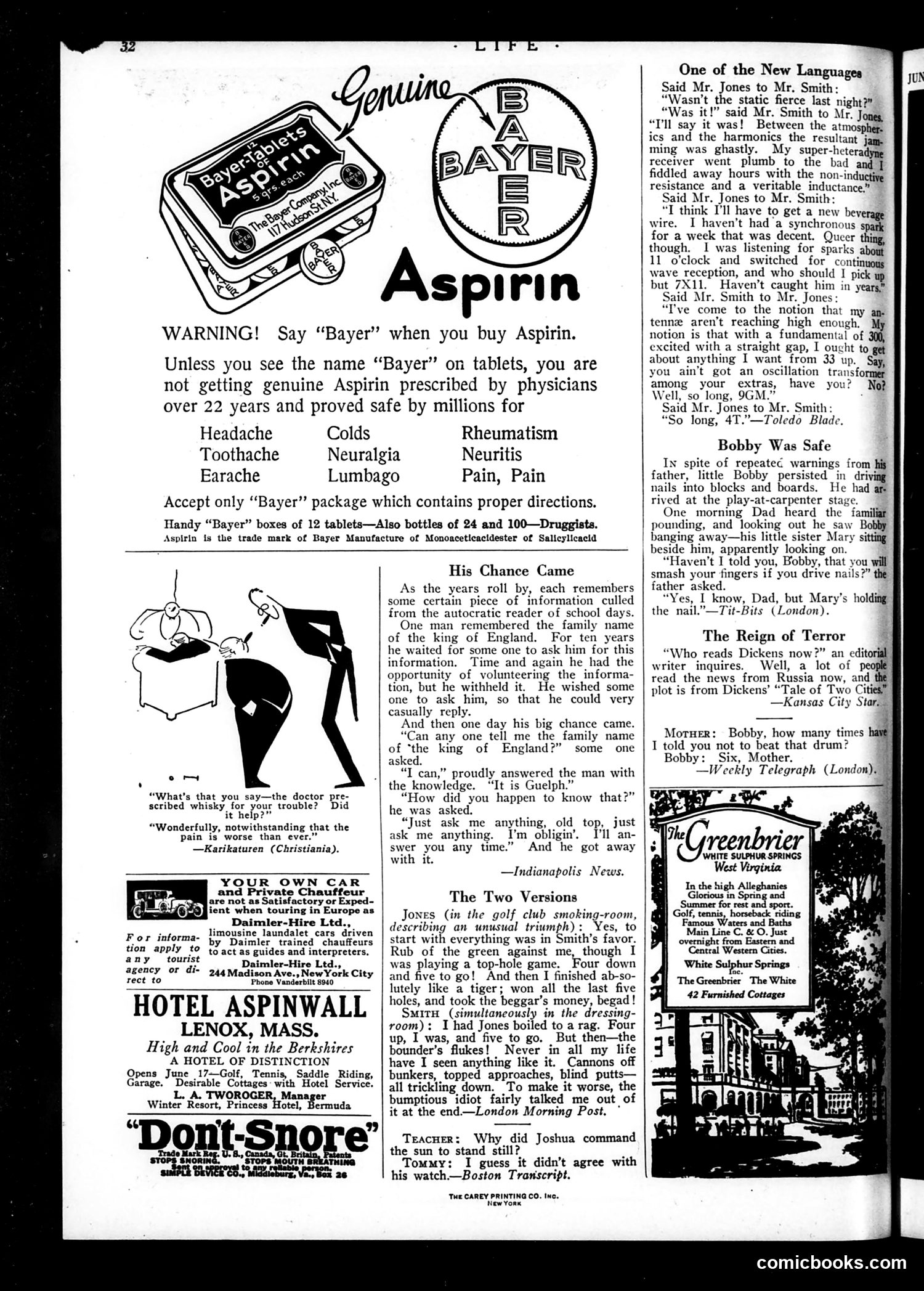
This page is primarily **advertising**, dominated by a large Bayer Aspirin advertisement warning consumers to specify "Bayer" brand to ensure genuine product. The warning reflects early 20th-century concerns about counterfeit medicines and trademark disputes—Bayer had recently lost aspirin trademark rights in the U.S. and was fighting to maintain brand recognition. The remaining content consists of **short humorous anecdotes** typical of Life magazine's satirical humor: - A joke about whisky prescribed as medicine but worsening pain (poking fun at dubious medical practices) - "His Chance Came" satirizes pedantic knowledge-hoarding—a man waits years to share trivia about England's royal family name - "The Two Versions" mocks golfers' contradictory bragging about the same match - "One of the New Languages" jokes about incomprehensible radio/wireless technical jargon confusing ordinary people These pieces target pretension, medical quackery, and the public's bewilderment with emerging technology—common satirical themes of the 1920s era.