
Life, 1922-05-25 · page 13 of 34
Life — May 25, 1922 — page 13: what you’re looking at
What you’re looking at
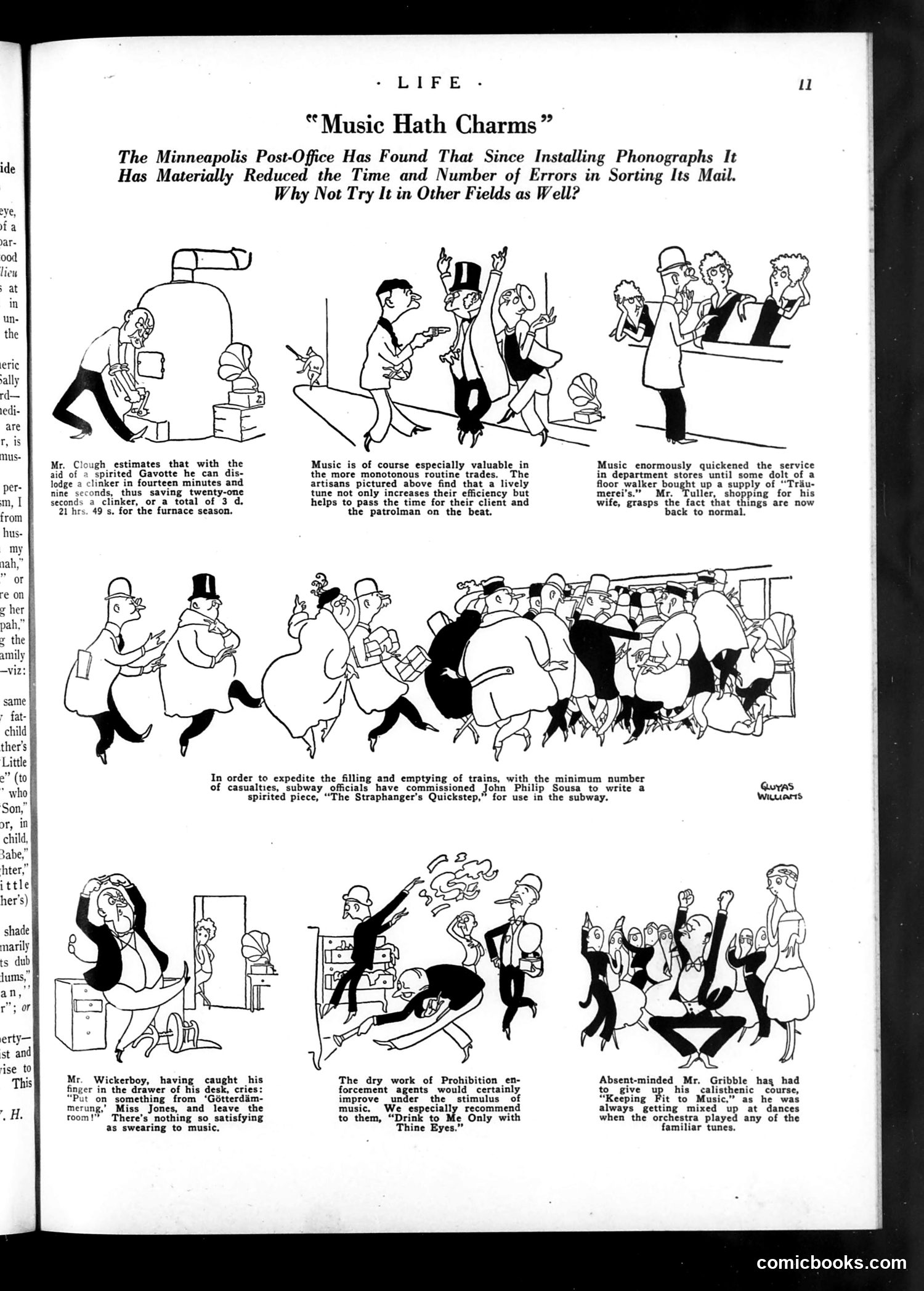
This satirical piece argues that playing phonograph music improves workplace efficiency and morale. The page shows various humorous scenarios where music supposedly benefits different professions: - A postal worker sorting mail faster with phonographs playing - Office workers and artisans becoming more productive and cheerful - Subway officials commissioning a spirited piece for train operations - Workers in various trades (prohibition enforcement, office work) performing better under musical stimulation The satire mocks the era's optimistic belief that modern technology (phonographs) could solve workplace problems through entertainment. Each cartoon exaggerates the claimed benefits—showing workers dancing, energized, or dramatically more efficient—to ridicule this notion. The piece likely references actual Minneapolis Post-Office experiments mentioned in the subtitle, making fun of applying technological solutions to human labor and morale issues.
📄 Transcribed text from this page (OCR, searchable)
Machine-transcribed from the original scan — historical spelling and the odd misread are preserved.
- LIFE “Music Hath Charms” The Minneapolis Post-Office Has Found That Since Installing Phonographs It Has Materially Reduced the Time and Number of Errors in Sorting Its Mail. Why Not Try It in Other Fields as Well? the eric ally rd— edi- are r, is mus- Mr. Clough estimates that with the Music is of course especially valuable in Music enormously quickened the service aid of a spirited Gavotte he can dis- the more monotonous routine trades. The in department stores until some dolt of a es lodge a clinker in fourteen minutes and artisans pictured above find that a lively floor walker bought up a supply of “Triu- Pr nine seconds, thus saving twenty-one tune not only increases their efficiency but merei’s.” Mr. Tuller, shopping for his m, I seconds a clinker, or a total of 3 d. helps to pass the time for their client and wife, grasps the fact that things are now es 21 hrs. 49 s. for the furnace season. the patrolman on the beat. back to normal. hus- my § nah,” f ” or re on fl x her pah,” f x the ff fat- child § ther's Little 2” (to In order to expedite the filling and emptying of trains, with the minimum number * whol of casualties, subway officials have commissioned John Philip Sousa to write a spirited piece, “The Straphanger's Quickstep,” for use in the subway. Son,” § or, in child, abe,” hter,” ittle her's) shade marily ts dub jums,” an,” r”; or erty— st and ‘ise to This Wickerboy, having caught his The dry work of Prohibition en- Absent-minded Mr. Gribble hag had finger in the drawer of his desk, cries: forcement agents would certainly fe give up his calisthenic course, “Put on something from ‘Gétterd: improve under the stimulus of “Keeping Fit to Music.” as he was H merung,’ Miss Jones, and leave the music. We especially recommend always getting mixed up at dances A. room!” There's nothing so satisfying to them, “Drink to Me Only with when the orchestra played any of the as swearing to music. Thine Eyes.” familiar tunes. comicbooks.com