
Life, 1922-05-25 · page 4 of 34
Life — May 25, 1922 — page 4: what you’re looking at
What you’re looking at
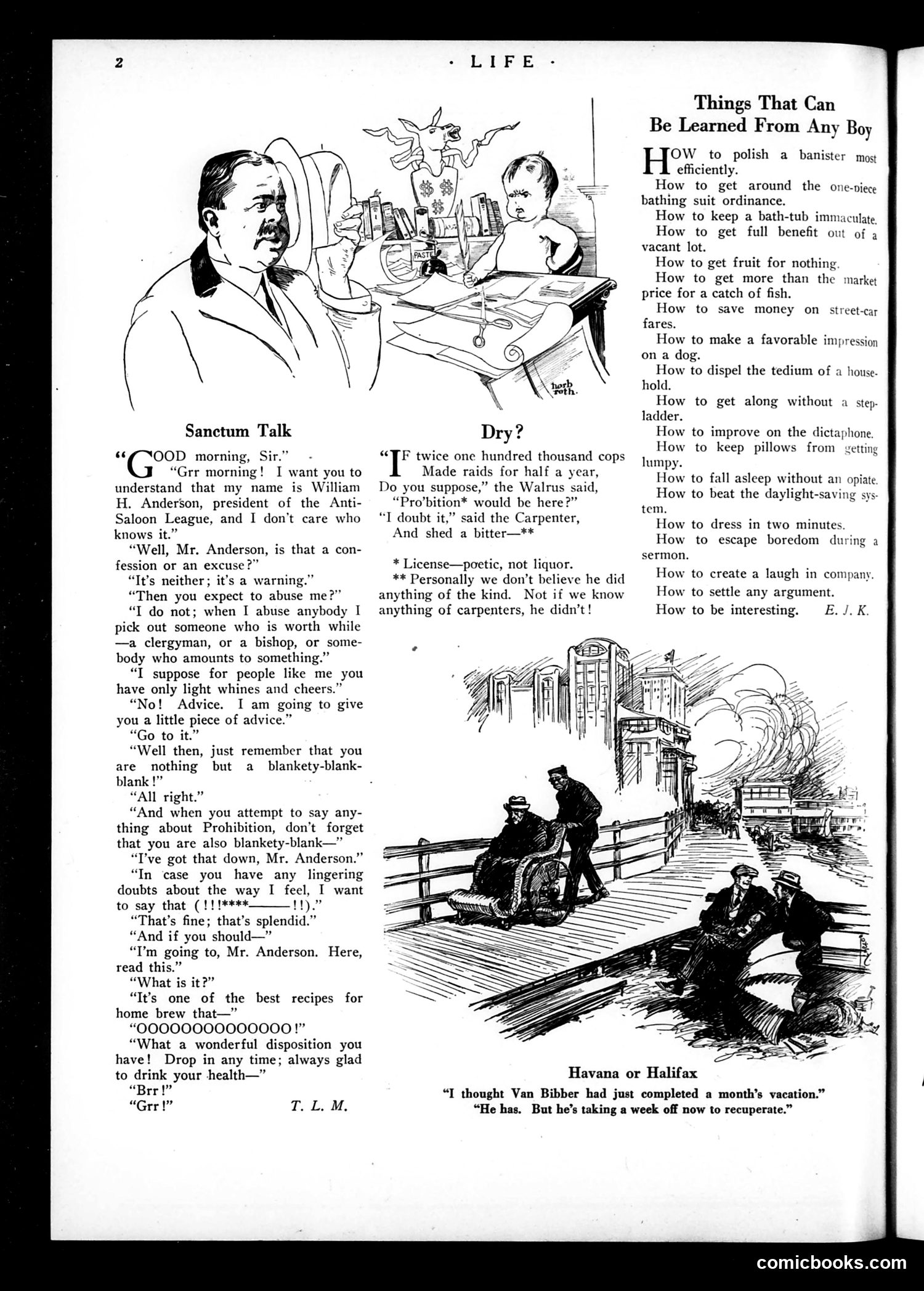
**"Sanctum Talk"** satirizes William H. Anderson, president of the Anti-Saloon League (visible in the illustration). Anderson is depicted lecturing someone about Prohibition enforcement with sanctimonious certainty. The satire mocks his self-righteous condemnation of those who question or circumvent Prohibition laws, treating all dissenters as moral failures. Anderson dismisses legitimate concerns by calling critics "blankety-blanks" and threatens them with condescension rather than engaging substantively. **"Dry?"** is a Lewis Carroll-style absurdist poem mocking Prohibition's failures, particularly that despite "two hundred thousand cops" patrolling for half a year, illegal alcohol (the "Walrus" character) persists—suggesting Prohibition was unenforceable and ultimately futile. Both pieces satirize Prohibition-era hypocrisy and the movement's aggressive moralizing.
📄 Transcribed text from this page (OCR, searchable)
Machine-transcribed from the original scan — historical spelling and the odd misread are preserved.
Sanctum Talk “cs OOD morning, Sir.” “Grr morning! I want you to understand that my name is William H. Anderson, president of the Anti- Saloon League, and I don’t care who knows it.” “Well, Mr. Anderson, is that a con- fession or an excuse?” “It’s neither; it’s a warning.” “Then you expect to abuse me?” “T do not; when I abuse anybody I pick out someone who is worth while —a clergyman, or a bishop, or some- body who amounts to something.” “I suppose for people like me you have only light whines and cheers.” “No! Advice. I am going to give you a little piece of advice.” “Go to it.” “Well then, just remember that you are nothing but blank!” “All right.” “And when you attempt to say any- thing about Prohibition, don’t forget that you are also blankety-blank—” “T’ve got that down, Mr. Anderson.” “In case you have any lingering doubts about the way I feel, I want to say that (!!!****——_!1).” “That’s fine; that’s splendid. “And if you should—” “I’m going to, Mr. Anderson. Here, read this.” “What is it?” “It’s one of the best recipes for home brew that—” “QOOOOO000000000!” “What a wonderful disposition you have! Drop in any time; always glad to drink your health—” “Brr!” “Grr!” T. L. M. a_ blankety-blank- “TF twice one hundred thousand cops Made raids for half a year, Do you suppose,” the Walrus said, “Pro’bition* would be here?” “I doubt it,” said the Carpenter, And shed a bitter—** * License—poetic, not liquor. ** Personally we don’t believe he did anything of the kind. Not if we know anything of carpenters, he didn’t! Things That Can Be Learned From Any Boy OW to polish a banister mog efficiently. How to get around the one-piece bathing suit ordinance. How to keep a bath-tub immaculate, How to get full benefit out of g vacant lot. How to get fruit for nothing. How to get more than the market price for a catch of fish. How to save money on street-car fares. How to make a favorable impression on a dog. How to dispel the tedium of a house- hold. How ladder. How to improve on the dictaphone. How to keep pillows from getting lumpy. How to fall asleep without an opiate How to beat the daylight-saving sys- tem. How to dress in two minutes. How to escape boredom during a sermon. to get along without a step. How to create a laugh in company How to settle any argument. to be interesting. £. J. K. Havana or Halifax “I thought Van Bibber had just completed a month’s vacation.” “He has. But he’s taking a week off now to recuperate.” comicbooks.com