
Life, 1922-05-25 · page 10 of 34
Life — May 25, 1922 — page 10: what you’re looking at
What you’re looking at
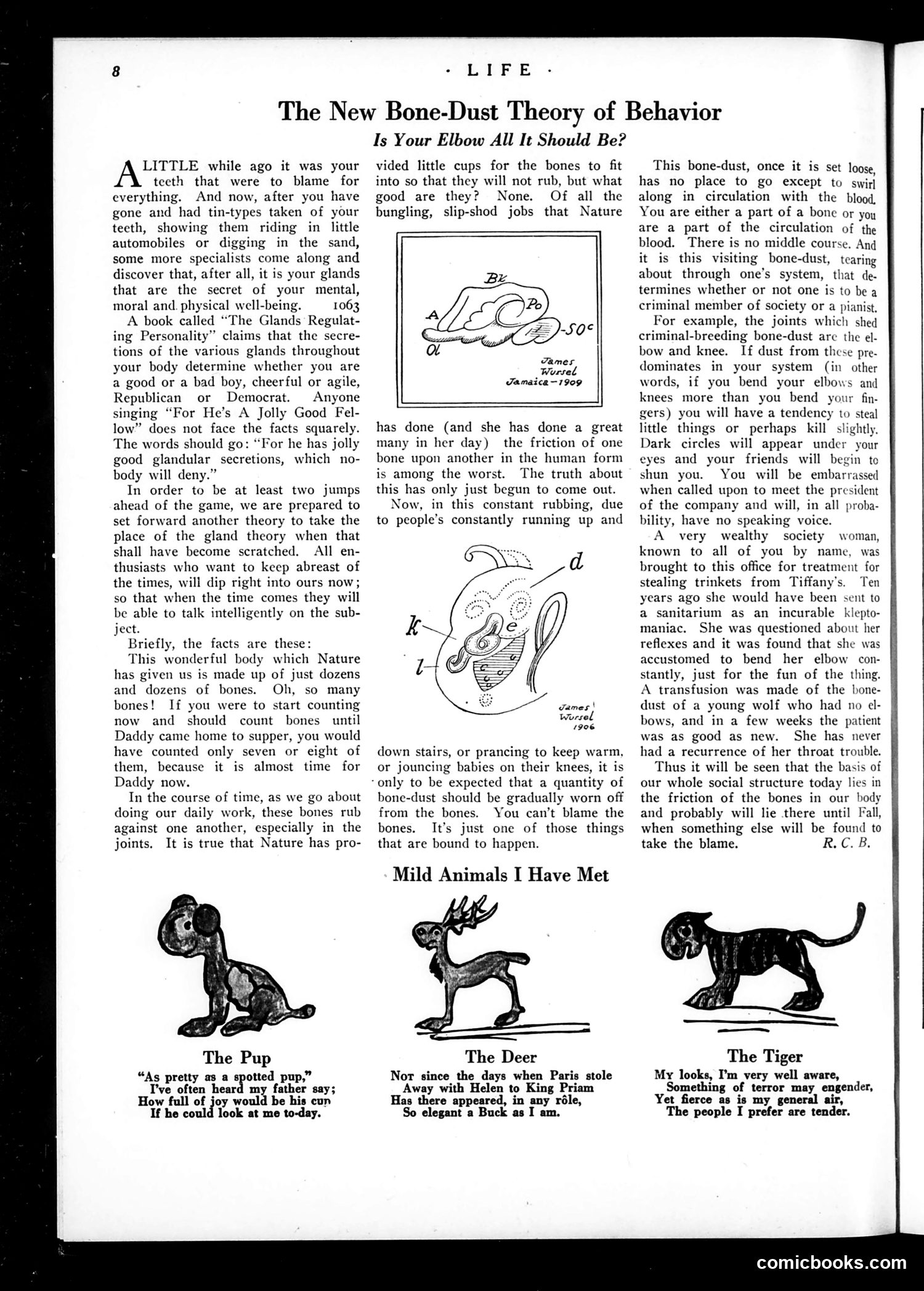
This page contains satirical commentary on pseudo-scientific personality theory. The main article, "The New Bone-Dust Theory of Behavior," mocks the popular early-20th-century belief that facial features and physical characteristics determined personality and morality. The diagrams show bones and anatomical details supposedly revealing character traits. The article ridicules this determinism by noting absurd conclusions—that bent elbows mean criminality, for instance. The lower section, "Mild Animals I Have Met," presents humorous animal caricatures with personality quotes (a pup, deer, and tiger), seemingly extending the bone-dust theory to animals. The satire targets pseudoscientific racism and phrenology-adjacent theories that were then used to justify social hierarchies and prejudice by claiming physical features scientifically proved moral or intellectual differences.
📄 Transcribed text from this page (OCR, searchable)
Machine-transcribed from the original scan — historical spelling and the odd misread are preserved.
- LIFE .- The New Bone-Dust Theory of Behavior LITTLE while ago it was your teeth that were to blame for everything. And now, after you have gone and had tin-types taken of your teeth, showing them riding in little automobiles or digging in the sand, some more specialists come along and discover that, after all, it is your glands that are the secret of your mental, moral and. physical well-being. 1063 A book called “The Glands Regulat- ing Personality” claims that the secre- tions of the various glands throughout your body determine whether you are a good or a bad boy, cheerful or agile, Republican or Democrat. Anyone singing “For He’s A Jolly Good Fel- low” does not face the facts squarely. The words should go: “For he has jolly good glandular secretions, which no- body will deny.” In order to be at least two jumps ahead of the game, we are prepared to set forward another theory to take the place of the gland theory when that shall have become scratched. All en- thusiasts who want to keep abreast of the times, will dip right into ours now; so that when the time comes they will be able to talk intelligently on the sub- ject. Briefly, the facts are these: This wonderful body which Nature has given us is made up of just dozens and dozens of bones. Oh, so many bones! If you were to start counting now and should count bones until Daddy came home to supper, you would have counted only seven or eight of them, because it is almost time for Daddy now. In the course of time, as we go about doing our daily work, these bones rub against one another, especially in the joints. It is true that Nature has pro- “As pretty as a spotted pup,” T’ve often heard my father say; How fall of joy would be his cun If he could Took at me to-day. Is Your Elbow All It Should Be? vided little cups for the bones to fit into so that they will not rub, but what good are they? None. Of all the bungling, slip-shod jobs that Nature Bz James Worsed Jamaica-1909 has done (and she has done a great many in her day) the friction of one bone upon another in the human form is among the worst. The truth about this has only just begun to come out. Now, in this constant rubbing, due to people’s constantly running up and Worse 1906 down stairs, or prancing to keep warm, or jouncing babies on their knees, it is only to be expected that a quantity of bone-dust should be gradually worn off from the bones. You can’t blame the bones. It’s just one of those things that are bound to happen. Mild Animals I Have Met The Deer Nor since the days when Paris stole Away with Helen to King Priam Has there appeared, in any réle, So elegant a Buck as I am. This bone-dust, once it is set loose, has no place to go except to swirl along in circulation with the blood, You are either a part of a bone or you are a part of the circulation of the blood. There is no middle course. And it is this visiting bone-dust, tearing about through one’s system, that de- termines whether or not one is to bea criminal member of society or a pianist, For example, the joints which shed criminal-breeding bone-dust are the el- bow and knee. If dust from these pre- dominates in your system (in other words, if you bend your elbows and knees more than you bend your fin- gers) you will have a tendency to steal little things or perhaps kill slightly. Dark circles will appear under y eyes and your friends will bes shun you. You will be embarr when called upon to meet the president of the company and will, in all proba- bility, have no speaking voice. Avery wealthy society woman, known to all of you by name, was brought to this office for treatment for stealing trinkets from Tiffany's. Ten years ago she would have been sent to a sanitarium as an incurable klepto- maniac. She was questioned about her reflexes and it was found that she was accustomed to bend her elbow con- stantly, just for the fun of the thing. A transfusion was made of the bone- dust of a young wolf who had no el- bows, and in a few weeks the patient was as good as new. She has never had a recurrence of her throat trouble. Thus it will be seen that the basis of our whole social structure today lies in the friction of the bones in our body and probably will lie there until Fall, when something else will be found to take the blame. R.C..B, My looks, I’m very well aware, Something of terror may engender, Yet fierce as is my general air, The people I prefer are tender. comicbooks.com