
Life, 1922-05-25 · page 24 of 34
Life — May 25, 1922 — page 24: what you’re looking at
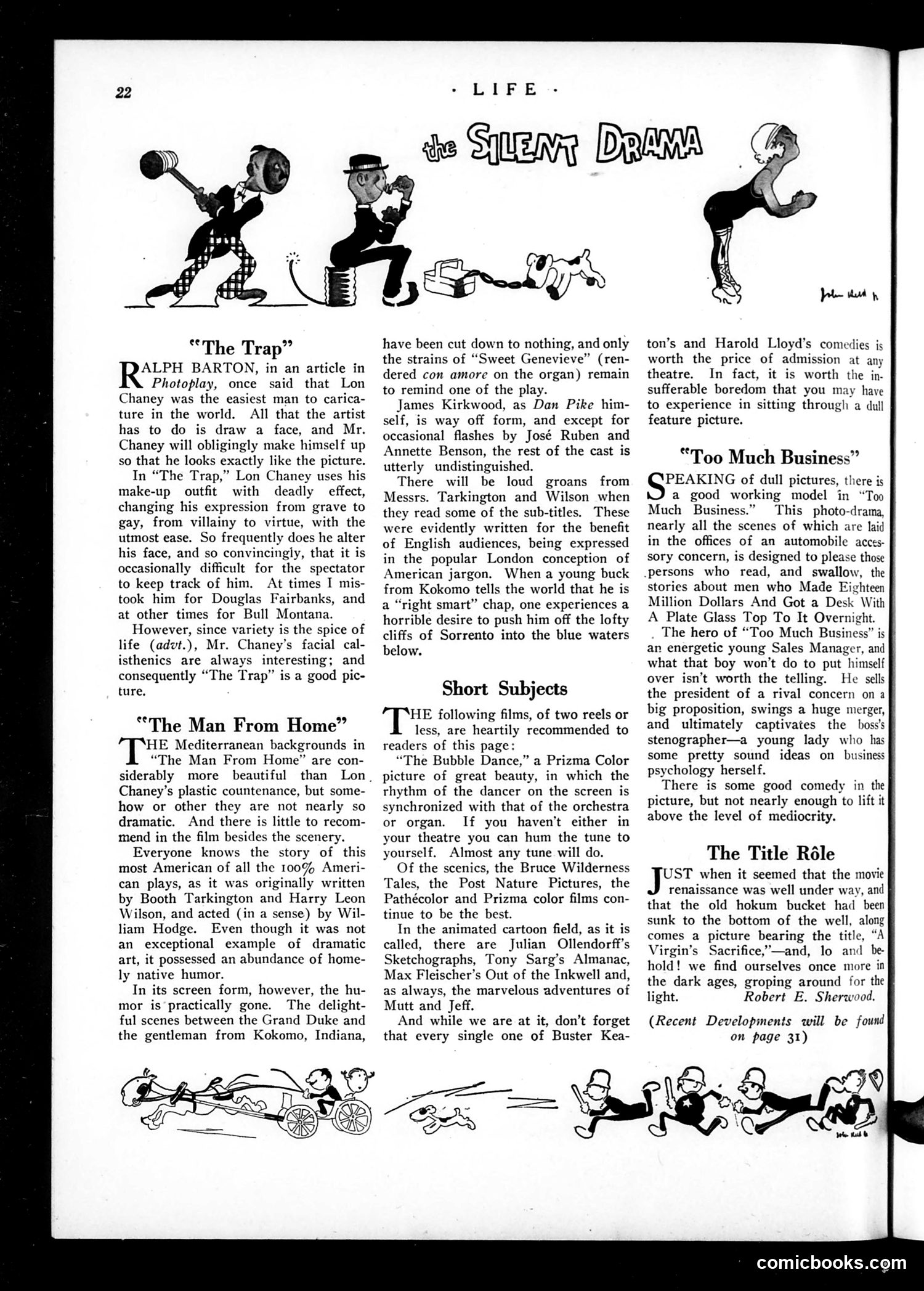
What you’re looking at
This page reviews three 1920s silent films. "The Trap" praises Lon Chaney's extraordinary facial expressiveness—his makeup artistry is so convincing the reviewer momentarily confused him with other actors (Douglas Fairbanks, Bull Montana). The review jokes that Chaney is easier to caricature than photograph because he'll simply transform his face to match any drawing. "The Man From Home" adapts a popular Booth Tarkington play but loses its humor in translation. The critic particularly mocks the subtitles, which render American Midwestern dialect ("right smart chap") in exaggerated "London conception of American jargon," creating unintentionally comic effects. The "Short Subjects" section recommends animated cartoons (Mutt and Jeff, Felix the Cat-era work) and live-action comedies by Buster Keaton and Harold Lloyd—suggesting these shorts were often more entertaining than feature films of the era.
📄 Transcribed text from this page (OCR, searchable)
Machine-transcribed from the original scan — historical spelling and the odd misread are preserved.
“The Trap” ALPH BARTON, in an article in Photoplay, once said that Lon Chaney was the easiest man to carica- ture in the world. All that the artist has to do is draw a face, and Mr. Chaney will obligingly make himself up so that he looks exactly like the picture. In “The Trap,” Lon Chaney uses his make-up outfit with deadly effect, changing his expression from grave to gay, from villainy to virtue, with the utmost ease. So frequently does he alter his face, and so convincingly, that it is occasionally difficult for the spectator to keep track of him. At times I mis- took him for Douglas Fairbanks, and at other times for Bull Montana. However, since variety is the spice of life (advt.), Mr. Chaney’s facial cal- isthenics are always interesting; and consequently “The Trap” is a good pic- ture, “The Man From Home” ‘HE Mediterranean backgrounds in “The Man From Home” are con- siderably more beautiful Chaney’s plastic countenance, but some- how or other they are not nearly so dramatic. And there is little to recom- mend in the film besides the scenery. Everyone knows the story of this most American of all the 100% Ameri- can plays, as it was originally written by Booth Tarkington and Harry Leon Wilson, and acted (in a sense) by Wil- liam Hodge. Even though it was not an exceptional example of dramatic art, it possessed an abundance of home- ly native humor. In its screen form, however, the hu- mor is ‘practically gone. The delight- ful scenes between the Grand Duke and the gentleman from Kokomo, Indiana, than Lon. if have been cut down to nothing, and only the strains of “Sweet Genevieve” (ren- dered con amore on the organ) remain to remind one of the play. James Kirkwood, as Dan Pike him- self, is way off form, and except for occasional flashes by José Ruben and Annette Benson, the rest of the cast is utterly undistinguished. There will be loud groans from Messrs. Tarkington and Wilson when they read some of the sub-titles. These were evidently written for the benefit of English audiences, being expressed in the popular London conception of American jargon. When a young buck from Kokomo tells the world that he is a “right smart” chap, one experiences a horrible desire to push him off the lofty cliffs of Sorrento into the blue waters below. Short Subjects HE following films, of two reels or less, are heartily recommended to readers of this page: “The Bubble Dance,” a Prizma Color picture of great beauty, in which the rhythm of the dancer on the screen is synchronized with that of the orchestra or organ. If you haven't either in your theatre you can hum the tune to yourself. Almost any tune will do. Of the scenics, the Bruce Wilderness Tales, the Post Nature Pictures, the Pathécolor and Prizma color films con- tinue to be the best. In the animated cartoon field, as it is called, there are Julian Ollendorff’s Sketchographs, Tony Sarg’s Almanac, Max Fleischer’s Out of the Inkwell and, as always, the marvelous adventures of Mutt and Jeff. And while we are at it, don’t forget that every single one of Buster Kea- ton’s and Harold Lloyd’s comedies is worth the price of admission at any theatre. In fact, it is worth the in- sufferable boredom that you may have to experience in sitting through a dull feature picture. “Too Much Business” PEAKING of dull pictures, there is a good working model in “Too Much Business.” This photo-drama, nearly all the scenes of which are laid in the offices of an automobile acces- sory concern, is designed to please those persons who read, and swallow, the stories about men who Made Eighteen Million Dollars And Got a Desk With A Plate Glass Top To It Overnight. The hero of “Too Much Business” is F an energetic young Sales Manager, and what that boy won’t do to put himself over isn’t worth the telling. He sells the president of a rival concern ona big proposition, swings a huge merger, and ultimately captivates the boss's stenographer—a young lady who has some pretty sound ideas on business psychology herself. There is some good comedy in the picture, but not nearly enough to lift it above the level of mediocrity. The Title Réle UST when it seemed that the movie renaissance was well under way, and that the old hokum bucket had been sunk to the bottom of the well, along comes a picture bearing the title, “A Virgin’s Sacrifice,”’—and, lo and be hold! we find ourselves once more in the dark ages, groping around for the light. Robert E. Sherwood. (Recent Developments will be found on page 31) comicbooks.com