
Life, 1922-05-25 · page 7 of 34
Life — May 25, 1922 — page 7: what you’re looking at
What you’re looking at
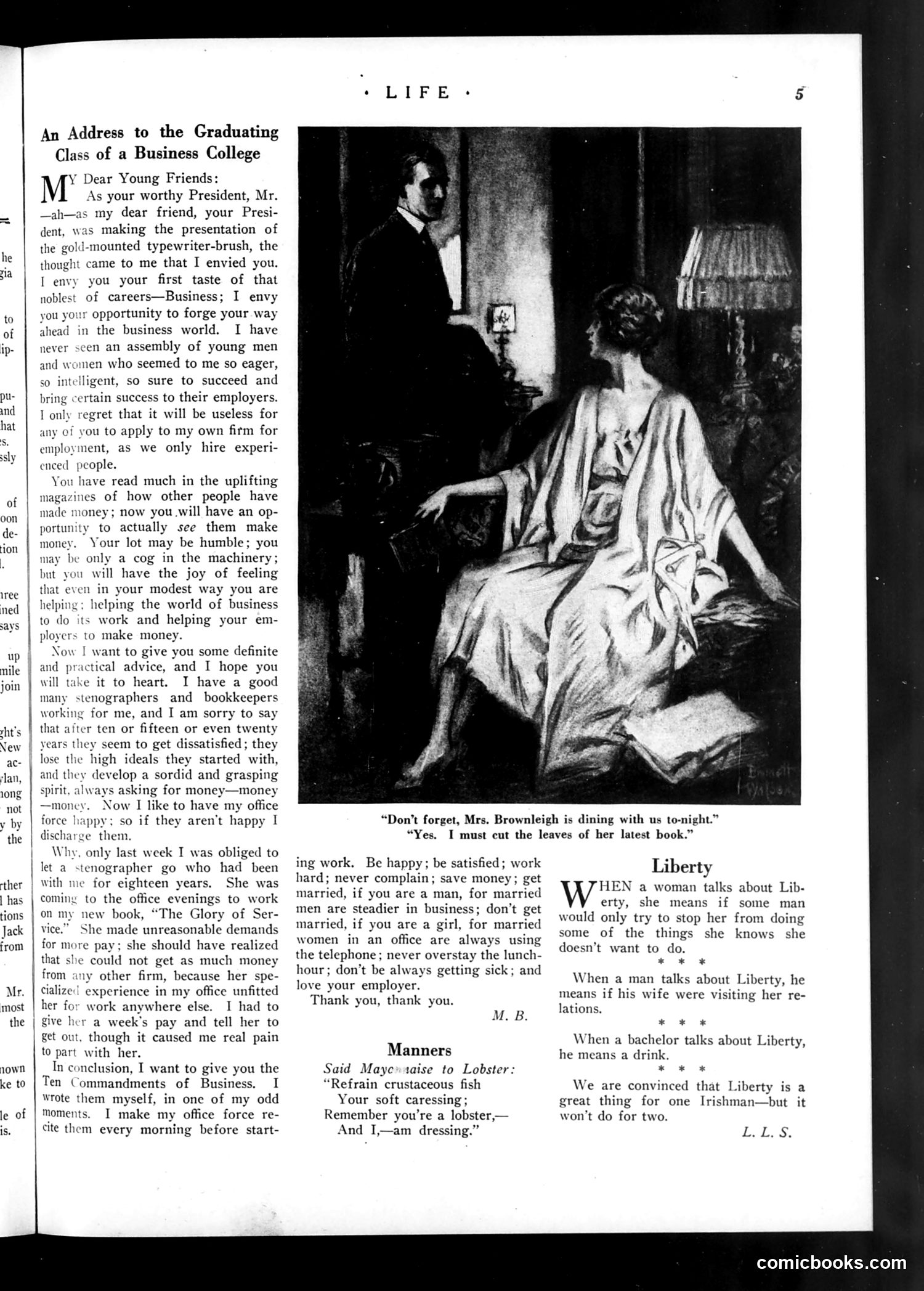
This page contains a commencement address to business college graduates by "M.B." (likely a prominent businessman of the era). The address offers practical career advice: work hard, save money, remain happy and satisfied, avoid complaining, and don't expect excessive pay immediately. The photograph shows a domestic scene with caption "Don't forget, Mrs. Browneigh is dining with us to-night," suggesting middle-class social obligations. Below are brief satirical sections on "Liberty" and "Manners." The Liberty section uses humor to distinguish how different social groups define the term—a woman's liberty means freedom from domestic work, a bachelor's means drinking. The Manners section jokes about proper etiquette toward lobster at dinner. The satire gently mocks emerging business culture, class consciousness, and social pretension of early-20th-century America.
📄 Transcribed text from this page (OCR, searchable)
Machine-transcribed from the original scan — historical spelling and the odd misread are preserved.
of | oon de- ‘ion Iree ned up mile join sht's New ac- ‘lan, long not y by the ther | has tions Jack from Mr. most the nown ke to le of is. An Address to the Graduating Class of a Business College Y Dear Young Friends: As your worthy President, Mr. —alh: my dear friend, your Presi- dent, was making the presentation of the gold-mounted typewriter-brush, the thought came to me that I envied you. I envy you your first taste of that noblest of careers—Business; I envy you your opportunity to forge your way ahead in the business world, I have never seen an assembly of young men and women who seemed to me so eager, so intelligent, so sure to succeed and bring certain success to their employers. l only regret that it will be useless for any of you to apply to my own firm for employment, as we only hire experi- enced people. You have read much in the uplifting magazines of how other people have made money ; now you will have an op- portunity to actually see them make money. Your lot may be humble; you may be only a cog in the machinery; but you will have the joy of feeling that even in your modest way you are helping; helping the world of business to do its work and helping your em- ployers to make money. Now I want to give you some definite and practical advice, and I hope you will t it to heart. I have a good many stenographers and bookkeepers working for me, and I am sorry to say that after ten or fifteen or even twenty years they seem to get dissatisfied; they lose the high ideals they started with, and they develop a sordid and grasping spirit, always asking for money—money —money. Now I like to have my office force happy; so if they aren't happy I discharge the’ Why, only last week I was obliged to let a stenographer go who had been with me for eighteen years. She was coming to the office evenings to work j on my new book, “The Glory of Ser- vice.” She made unreasonable demands for more pay; she should have realized | that she could not get as much money from y other firm, because her spe- cialize experience in my office unfitted her for work anywhere else. I had to give her a week's pay and tell her to get out, though it caused me real pain to part with her. In conclusion, I want to give you the Ten Commandments of Business. I Wrote them myself, in one of my odd moments. I make my office force re- cite them every morning before start- “Don’t forget, Mrs. Brownleigh is dining with us to-night.” “Yes. ing work. Be happy; be satisfied; work hard; never complain; save money; get married, if you are a man, for married men are steadier in business; don’t get married, if you are a girl, for married women in an office are always using the telephone ; never overstay the lunch- hour; don’t be always getting sick; and love your employer. Thank you, thank you. M. B. Manners Said Maye» aise to Lobster: “Refrain crustaceous fish Your soft caressing; Remember you're a lobster,— And I,—am dressing.” I must cut the leaves of her latest book.” Liberty HEN a woman talks about Lib- erty, she means if some man would only try to stop her from doing some of the things she knows she doesn’t want to do. * * * When a man talks about Liberty, he means if his wife were visiting her re- lations. x ok * When a bachelor talks about Liberty, he means a drink. * * * We are convinced that Liberty is a great thing for one Irishman—but it won't do for two. LL. S. comicbooks.com