
Life, 1922-05-25 · page 22 of 34
Life — May 25, 1922 — page 22: what you’re looking at
What you’re looking at
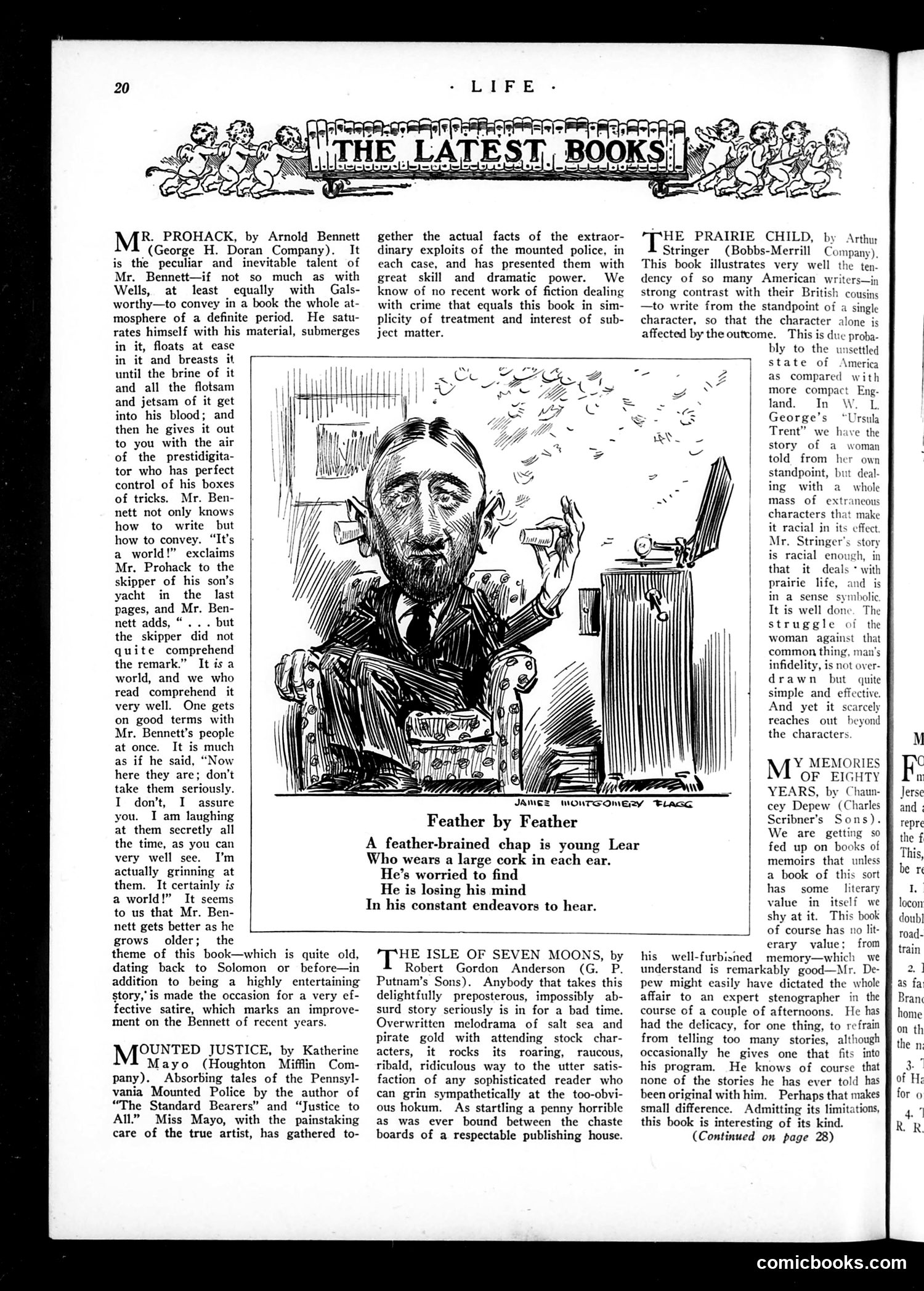
This page is primarily a book review section from *Life* magazine. The only cartoon is the small, untitled piece titled **"Feather by Feather,"** which presents a humorous limerick about a character named Lear. The joke is straightforward physical comedy: a young man wears large corks in both ears (presumably to muffle sound or for some foolish reason), yet paradoxically worries he's losing his mind *because* he cannot hear properly. The irony is that his own deliberate action—inserting the corks—is causing the very hearing loss he laments. This appears to be simple satirical humor mocking human foolishness and self-inflicted problems, rather than commentary on specific political or social figures. The cartoon works as a gentle jab at illogical behavior without requiring knowledge of particular contemporary events or people.
📄 Transcribed text from this page (OCR, searchable)
Machine-transcribed from the original scan — historical spelling and the odd misread are preserved.
Ms PROHACK, by Arnold Bennett (George H. Doran Company). It is the peculiar and inevitable talent of Mr. Bennett—if not so much as with Wells, at least equally with Gals- worthy—to convey in a book the whole at- mosphere of a definite period. He satu- rates himself with his material, submerges in it, floats at ease gether the actual facts of the extraor- dinary exploits of the mounted police, in each case, and has presented them with great skill and dramatic power. We know of no recent work of fiction dealing with crime that equals this book in sim- plicity of treatment and interest of sub- ject matter. THe PRAIRIE CHILD, by Arthur Stringer (Bobbs-Merrill Company), This book illustrates very well the ten- dency of so many American writers—in strong contrast with their British cousins —to write from the standpoint of a single character, so that the character alone is affected by the outcome. This is due proba- bly to the unsettled in it and breasts it until the brine of it and all the flotsam and jetsam of it get into his blood; and then he gives it out to you with the air of the prestidigita- tor who has perfect control of his boxes of tricks. Mr. Ben- nett not only knows how to write but how to convey. “It’s a world!” exclaims Mr. Prohack to the skipper of his son’s yacht in the last pages, and Mr. Ben- nett adds, “ the skipper did not quite comprehend the remark.” It is a world, and we who read comprehend it very well. One gets on good terms with Mr. Bennett’s people at once. It is much as if he said, “Now here they are; don’t take them seriously. I don’t, I assure you. I am laughing at them secretly all the time, as you can very well see. I’m actually grinning at them. It certainly is a world!” It seems to us that Mr. Ben- nett gets better as he Tey | Feather by Feather A feather-brained chap is young Lear Who wears a large cork in each ear. He’s worried to find He is losing his mind In his constant endeavors to hear. state of America as compared more compa land. In 7 L George’s “Ursula Trent” we have the story of woman told from her own standpoint, but deal- ing with a whole mass of extraneous characters that make it racial in it Mr. Stringer is racial eno: that it deals prairie life, and is in a sense symbolic It is well done. The struggle of the woman against that common thing, man’s infidelity, is not over- drawn_ but i simple and effecti And yet it y reaches out beyond the characters Y MEMORIES IVI oF EIGHTY grows older; the theme of this book—which is quite old, dating back to Solomon or before—in addition to being a highly entertaining story,’ is made the occasion for a very ef- fective satire, which marks an improve- ment on the Bennett of recent years. MOUNTED JUSTICE, by Katherine Mayo (Houghton Miffin Com- pany). Absorbing tales of the Pennsyl- vania Mounted Police by the author of “The Standard Bearers” and “Justice to All.” Miss Mayo, with the painstaking care of the true artist, has gathered to- HE ISLE OF SEVEN MOONS, by Robert Gordon Anderson (G. P. Putnam’s Sons). Anybody that takes this delightfully preposterous, impossibly ab- surd story seriously is in for a bad time. Overwritten melodrama of salt sea and pirate gold with attending stock char- acters, it rocks its roaring, raucous, ribald, ridiculous way to the utter satis- faction of any sophisticated reader who can grin sympathetically at the too-obvi- ous hokum. As startling a penny horrible as was ever bound between the chaste boards of a respectable publishing house. M F; YEARS, by Chaun- f Jerse cey Depew (Charles B and ; Scribner's Sons). B repre We are getting 90 Bf the ¢ fed up on books of This memoirs that unless *s a book of this sort [J be has some erary I, value in itself we J locon shy at it. This book § dou of course has no lit’ 9 roaq_ erary value; from Jt train his well-furbisned —memory—which _we understand is remarkably good—Mr. De- 2] pew might easily have dictated the whole ff as fa: affair to an expert stenographer in the § Bran course of a couple of afternoons. He has § home had the delicacy, for one thing, to r< from telling too many stories, alt! occasionally he gives one that fi on th the n his program. He knows of course that 3 none of the stories he has ever told has J) of Hi been original with him. Perhaps that makes ff for o small difference. Admitting its limitations, 4 this book is interesting of its kind. RR (Continued on page 28) comicbooks.com