
Life, 1922-05-25 · page 20 of 34
Life — May 25, 1922 — page 20: what you’re looking at
What you’re looking at
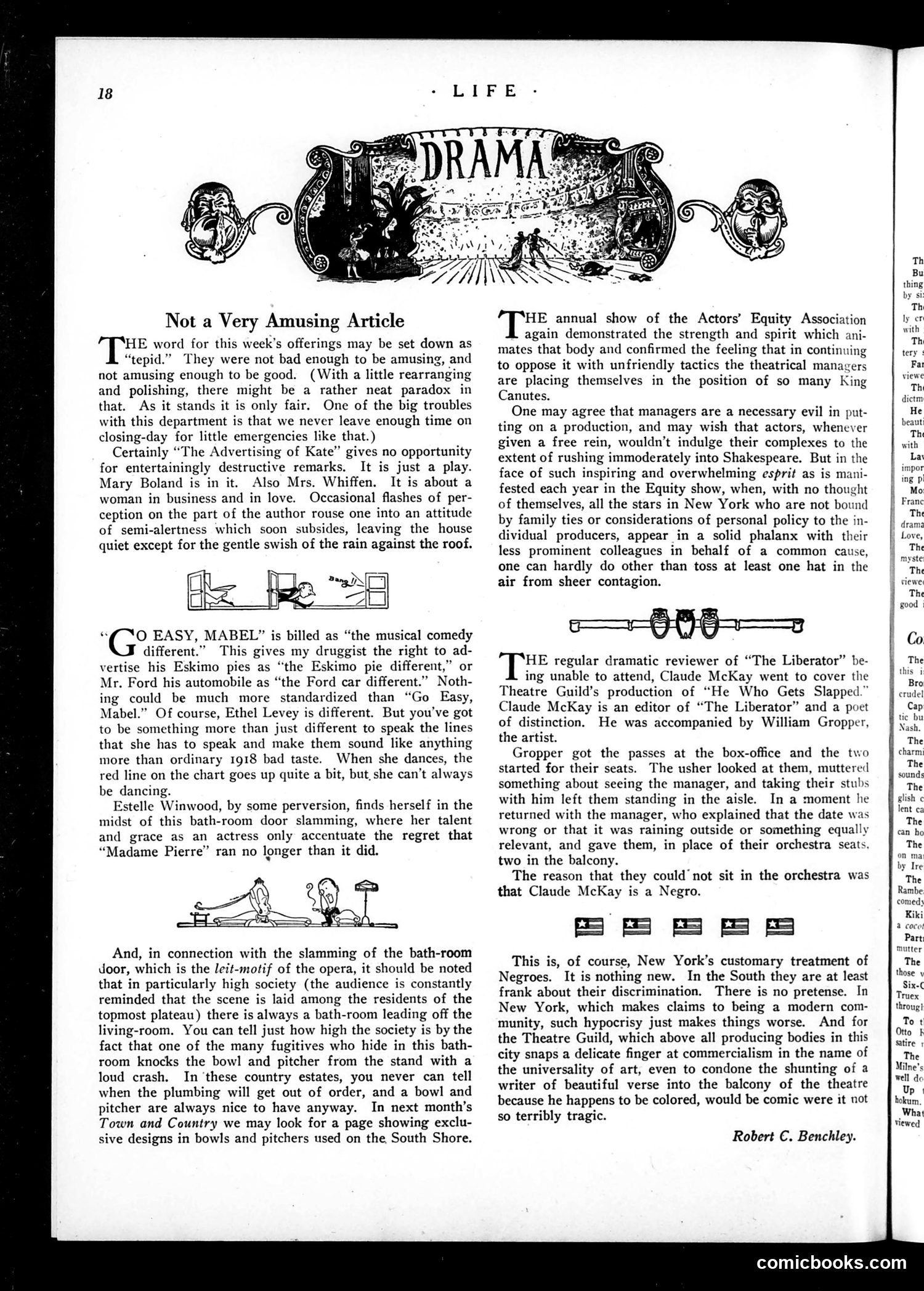
This page contains theater reviews from Life magazine's drama section. The main content mocks weak theatrical productions: **"Not a Very Amusing Article"** critiques three Broadway plays as mediocre—neither bad enough to be entertaining nor good enough to merit praise. The reviewer dismisses "The Advertising of Kate" and "Go Easy, Mabel" as standardized, tepid offerings. He sarcastically suggests that calling something "different" (like Ford's "different" automobile) is meaningless standardization. He praises actress Estelle Winwood despite the play's bathroom-door-slamming farce humor. **The bath-room humor section** jokes about how these society comedies rely on slamming doors and breaking chamber pots as their primary comedic device. **The Actors' Equity section** praises the theater union's annual show, comparing managers opposing them to King Canute (the legendary king who commanded the tide—a futile gesture). It celebrates actors' solidarity. **The final section** addresses racial discrimination: Claude McKay (a Black poet and editor) was assigned to cover a Theatre Guild show because the regular reviewer couldn't attend—apparently because McKay is Black and couldn't sit in orchestra seats due to segregation policies.
📄 Transcribed text from this page (OCR, searchable)
Machine-transcribed from the original scan — historical spelling and the odd misread are preserved.
Not a Very Amusing Article ‘HE word for this week’s offerings may be set down as “tepid.” They were not bad enough to be amusing, and not amusing enough to be good. (With a little rearranging and polishing, there might be a rather neat paradox in that. As it stands it is only fair. One of the big troubles with this department is that we never leave enough time on closing-day for little emergencies like that.) Certainly “The Advertising of Kate” gives no opportunity for entertainingly destructive remarks. It is just a play. Mary Boland is in it. Also Mrs. Whiffen. It is about a woman in business and in love. Occasional flashes of per- ception on the part of the author rouse one into an attitude of semi-alertness which soon subsides, leaving the house quiet except for the gentle swish of the rain against the roof. = meg IN “ O EASY, MABEL” is billed as “the musical comedy different.” This gives my druggist the right to ad- vertise his Eskimo pies as “the Eskimo pie different,” or Mr. Ford his automobile as “the Ford car different.” Noth- ing could be much more standardized than “Go Easy, Mabel.” Of course, Ethel Levey is different. But you’ve got to be something more than just different to speak the lines that she has to speak and make them sound like anything more than ordinary 1918 bad taste. When she dances, the red line on the chart goes up quite a bit, but, she can’t always be dancing. Estelle Winwood, by some perversion, finds herself in the midst of this bath-room door slamming, where her talent and grace as an actress only accentuate the regret that “Madame Pierre” ran no longer than it did. And, in connection with the slamming of the bath-room door, which is the leit-motif of the opera, it should be noted that in particularly high society (the audience is constantly reminded that the scene is laid among the residents of the topmost plateau) there is always a bath-room leading off the living-room. You can tell just how high the society is by the fact that one of the many fugitives who hide in this bath- room knocks the bowl and pitcher from the stand with a loud crash, In ‘these country estates, you never can tell when the plumbing will get out of order, and a bowl and pitcher are always nice to have anyway. In next month’s Town and Country we may look for a page showing exclu- sive designs in bowls and pitchers used on the South Shore. 'HE annual show of the Actors’ Equity Association again demonstrated the strength and spirit which ani- mates that body and confirmed the feeling that in continuing to oppose it with unfriendly tactics the theatrical managers are placing themselves in the position of so many King Canutes. One may agree that managers are a necessary evil in put- ting on a production, and may wish that actors, whenever given a free rein, wouldn’t indulge their complexes to the extent of rushing immoderately into Shakespeare. But in the face of such inspiring and overwhelming esprit as is mani- fested each year in the Equity show, when, with no thought of themselves, all the stars in New York who are not bound by family ties or considerations of personal policy to the in- dividual producers, appear in a solid phalanx with their less prominent colleagues in behalf of a common cause, one can hardly do other than toss at least one hat in the air from sheer contagion. OG HE regular dramatic reviewer of “The Liberator” be- ing unable to attend, Claude McKay went to cover the Theatre Guild’s production of “He Who Gets Slapped.” Claude McKay is an editor of “The Liberator” and a poet of distinction. He was accompanied by William Gropper, the artist. Gropper got the passes at the box-office and the two started for their seats. The usher looked at them, muttered something about seeing the manager, and taking their stubs with him left them standing in the aisle. In a moment he returned with the manager, who explained that the date was wrong or that it was raining outside or something equally relevant, and gave them, in place of their orchestra seats, two in the balcony. The reason that they could’ not sit in the orchestra was that Claude McKay is a Negro. SE This is, of course, New York’s customary treatment of Negroes. It is nothing new. In the South they are at least frank about their discrimination. There is no pretense. In New York, which makes claims to being a modern com- munity, such hypocrisy just makes things worse. And for the Theatre Guild, which above all producing bodies in this city snaps a delicate finger at commercialism in the name of the universality of art, even to condone the shunting of a writer of beautiful verse into the balcony of the theatre because he happens to be colored, would be comic were it not so terribly tragic. Robert €. Benchley. Thi dictm He beaut Th with Lay } impor } ing p |, Mo }) Franc viewes Co The this i Bro crudel Cap tic bu Nash. | The charmi The sounds The B lish lent a The can ho The on ma by Ire The Rambe comed; Kiki a coco Part mutter The those Six-¢ Truex throug! To t Otto stire The Mitne’s well dc Up tokum. What viewed comicbooks.com