
A complete issue · 38 pages · 1922
Life — May 11, 1922
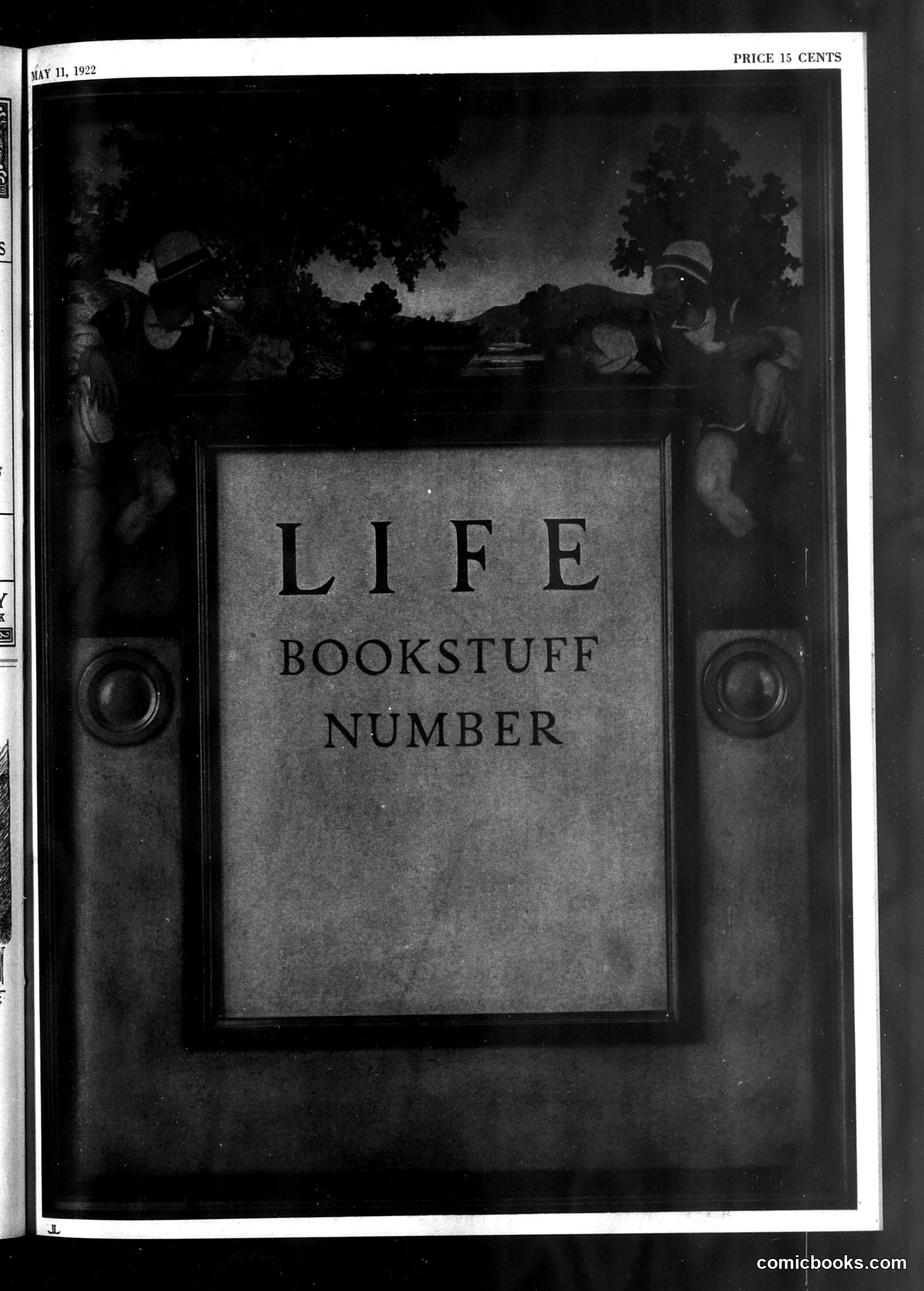
This appears to be a cover page for a "Life Bookstuff Number" special issue from May 11, 1922 (price 15 cents). The page features a framed rectangular panel reading "LIFE BOOKSTUFF NUMBER" centered on the page, flanked by decorative figures on either side—likely cherubs or classical figures representing literature or the arts. The page itself is promotional rather than satirical. It announces a special themed issue dedicated to books and literary content. Without seeing the interior pages, I cannot identify specific cartoons, caricatures, or political references. The decorative border and classical imagery suggest this was positioned as a cultural/intellectual issue focused on book reviews, literary criticism, or publishing industry commentary typical of Life magazine's satirical approach to contemporary affairs.
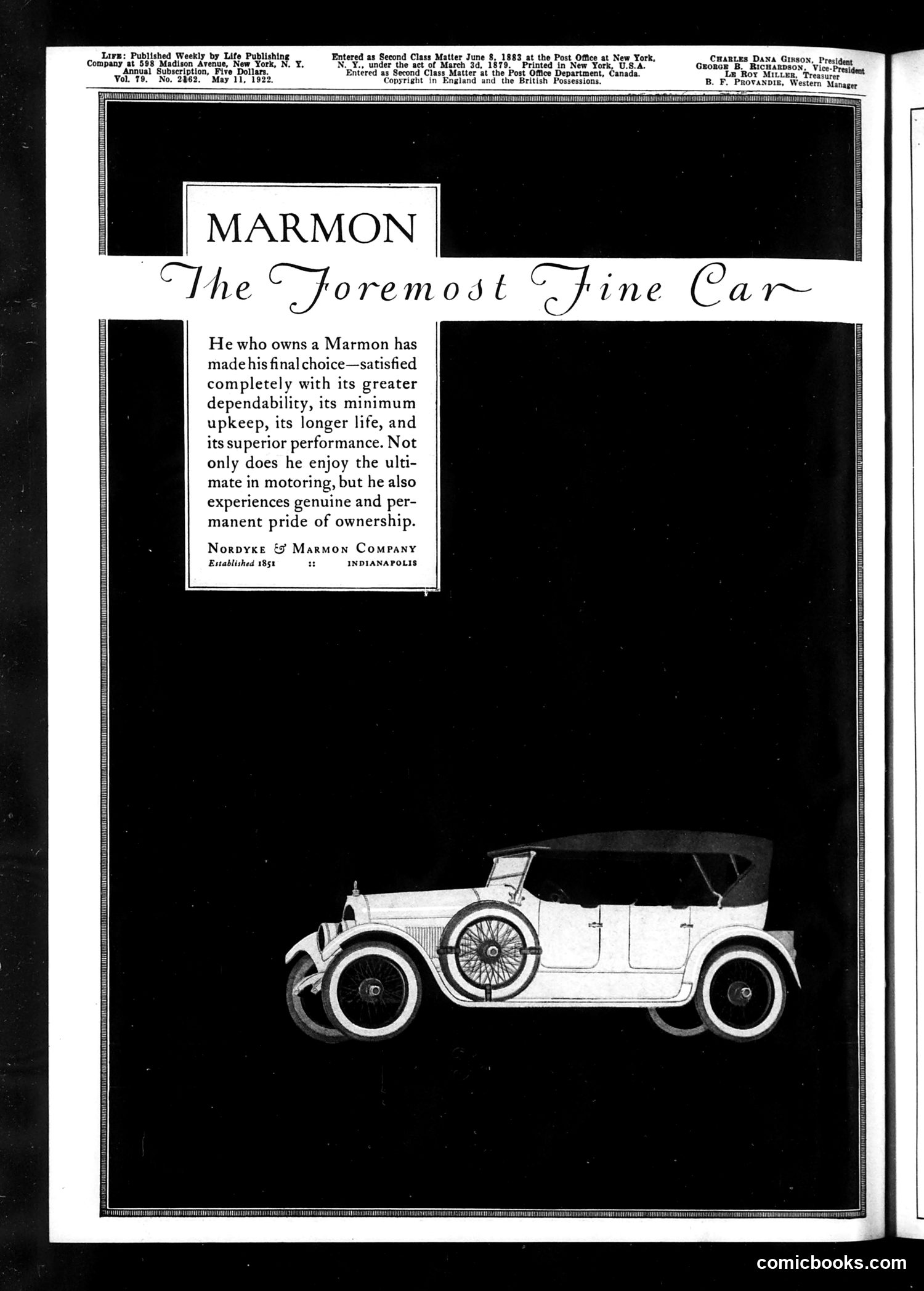
This is **not a cartoon or satire**—it's a straightforward advertisement for Marmon automobiles, produced by Nordyke & Marmon Company of Indianapolis (established 1851). The ad emphasizes the Marmon as "The Foremost Fine Car," appealing to affluent buyers. The sales pitch highlights practical virtues: dependability, low maintenance costs, longevity, and performance. Importantly, it targets **pride of ownership**—suggesting that owning a Marmon confers social status and permanent satisfaction, not mere temporary pleasure. The elegant line-drawing of the open-air touring car exemplifies the luxury automobile market of the 1910s-1920s, when such vehicles were expensive status symbols for the wealthy. The ad's tone and design reflect the refined marketing typical of high-end automotive advertising during this era.
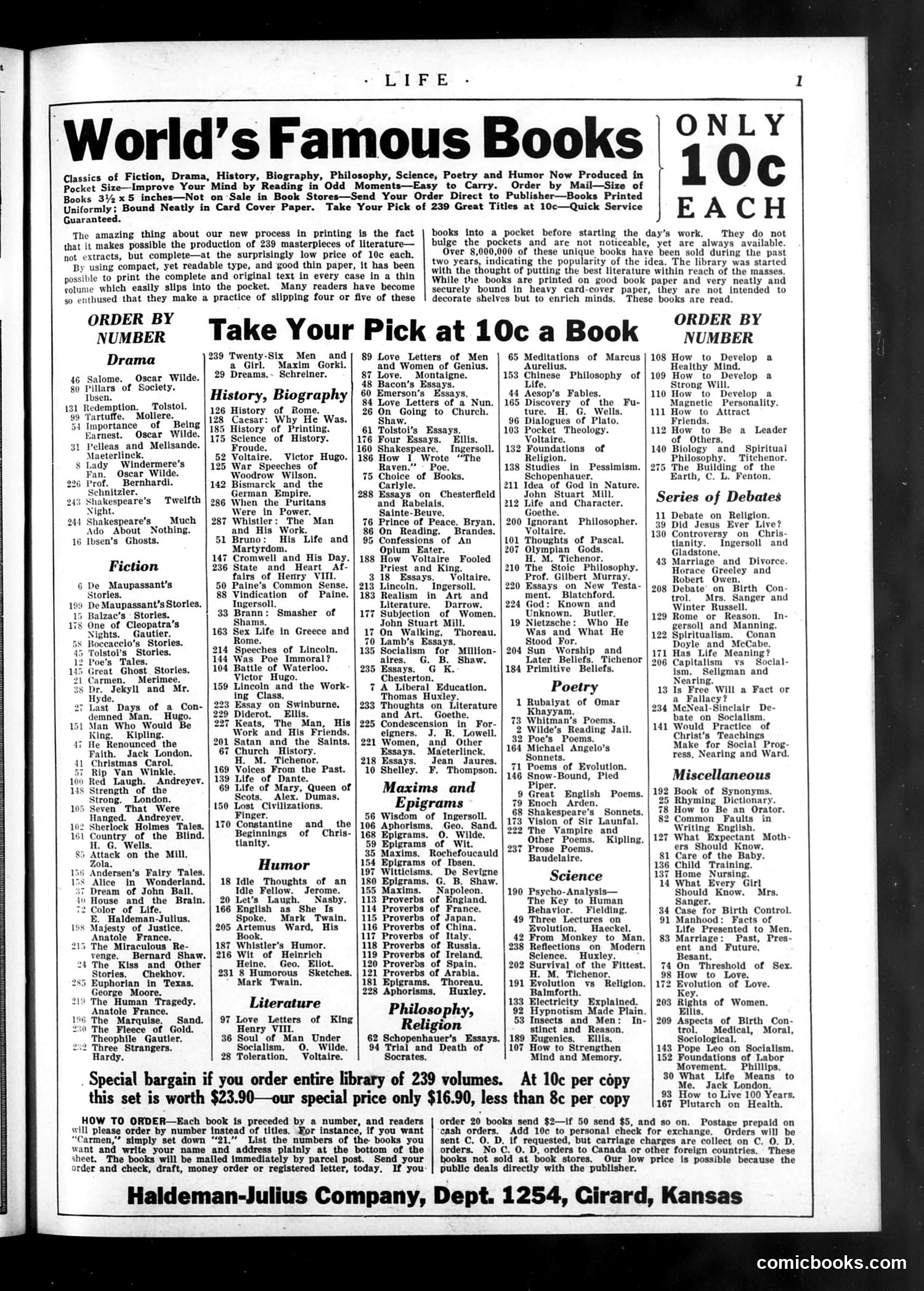
This page is **entirely advertising**, not political satire or editorial cartoon content. It advertises "World's Famous Books" — a mail-order book collection offered by Haldeman-Julius Company at 10 cents per volume. The ad lists 239 classical titles across categories: Fiction, History/Biography, Philosophy, Science, Poetry, and Humor. Notable authors include Oscar Wilde, Tolstoy, Shakespeare, and Voltaire. The marketing pitch emphasizes affordability and convenience — books compressed into pocket-sized formats, orderable by number directly from the publisher rather than bookstores. A special offer promises the entire 239-volume collection for $16.90 (less than 8 cents per copy). This reflects early 20th-century mass-market publishing strategies making "serious" literature accessible to working-class readers.
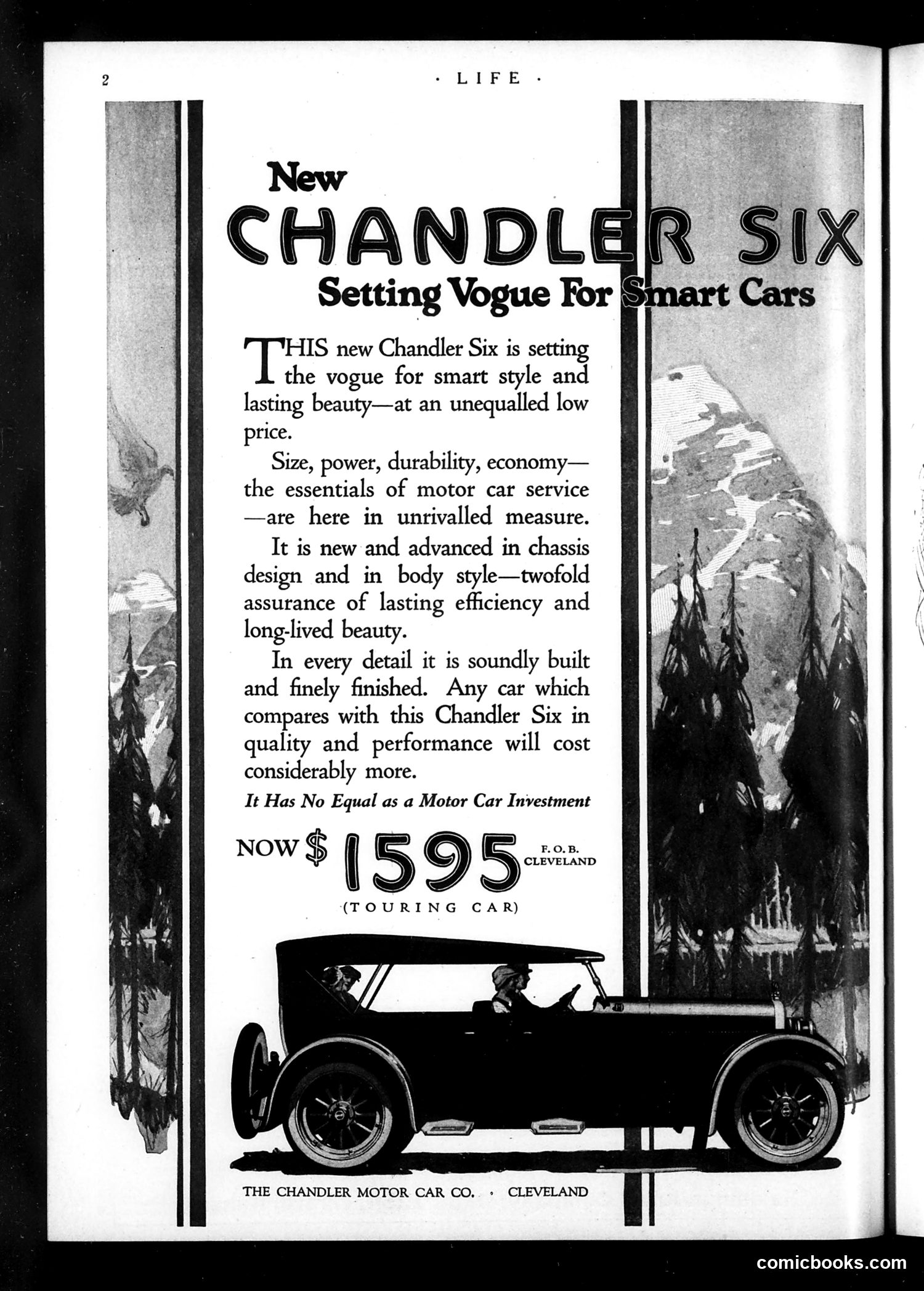
This page is **not a cartoon or satirical content** — it's a straightforward automobile advertisement from Life magazine's early era. The ad promotes the **Chandler Six**, a touring car manufactured in Cleveland, priced at $1,595 F.O.B. (freight on board). The marketing emphasizes qualities modern buyers would recognize: style, durability, economy, and build quality. The tagline "It Has No Equal as a Motor Car Investment" suggests competitive positioning against other vehicles. The decorative Art Deco-style borders featuring stylized trees and landscape are period design elements typical of 1920s advertising aesthetics. There is no satire, political commentary, or caricature present — this is commercial product promotion aimed at affluent readers of Life magazine.
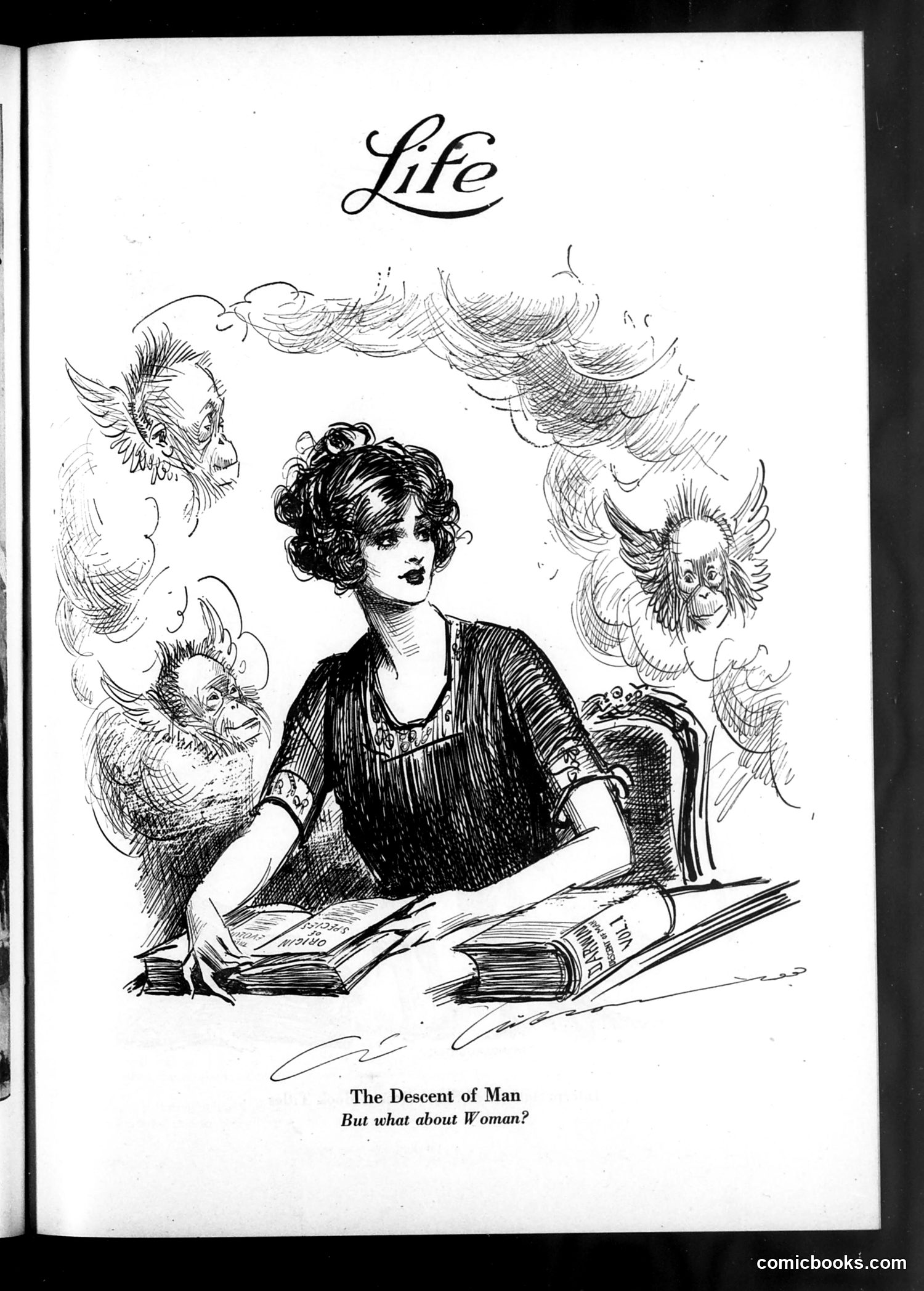
This page from *Life* magazine presents a satirical commentary on gender and literature. The central illustration shows a woman reading, surrounded by winged figures (appearing to be cherubs or allegorical beings) representing different philosophical or literary ideas. The caption reads "The Descent of Man / But what about Woman?" — a direct reference to Darwin's *The Descent of Man* (1871). The satire questions why scientific and philosophical discourse focused on man's evolution while ignoring woman's place in the same narrative. The winged figures surrounding the reading woman suggest she's grappling with complex intellectual ideas, implying that women were capable of engaging with serious literature and philosophy. This appears to advocate for women's intellectual equality and recognition in scientific and literary discourse during an era when such ideas were still controversial.
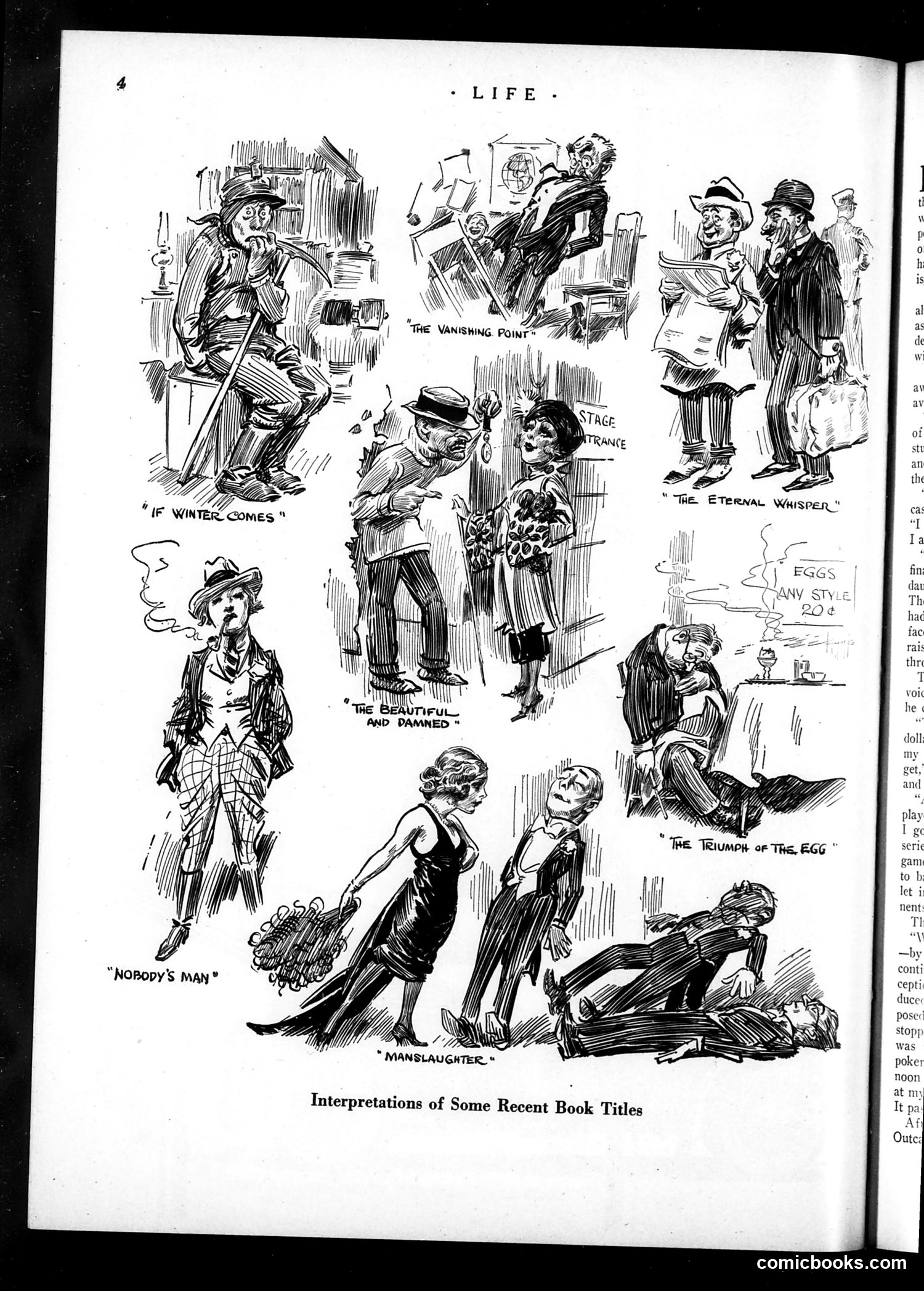
This is a humorous page of satirical sketches reimagining contemporary book titles as comedic scenes. The cartoons include: - **"If Winter Comes"**: A freezing man in tattered clothes - **"The Vanishing Point"**: A magician making papers disappear - **"The Eternal Whisper"**: Men gossiping conspiratorially - **"The Beautiful and Damned"**: A couple at stage entrance - **"Nobody's Man"**: A bewildered figure - **"The Triumph of the Egg"**: A cook preparing eggs - **"Manslaughter"**: Two women brutally attacking a man The satire works by literalizing book titles through exaggerated visual interpretations—transforming serious literary works into absurdist scenes. This reflects Life magazine's typical irreverent approach to contemporary culture, making fun of popular literature by imagining the most ridiculous possible enactments of their titles.
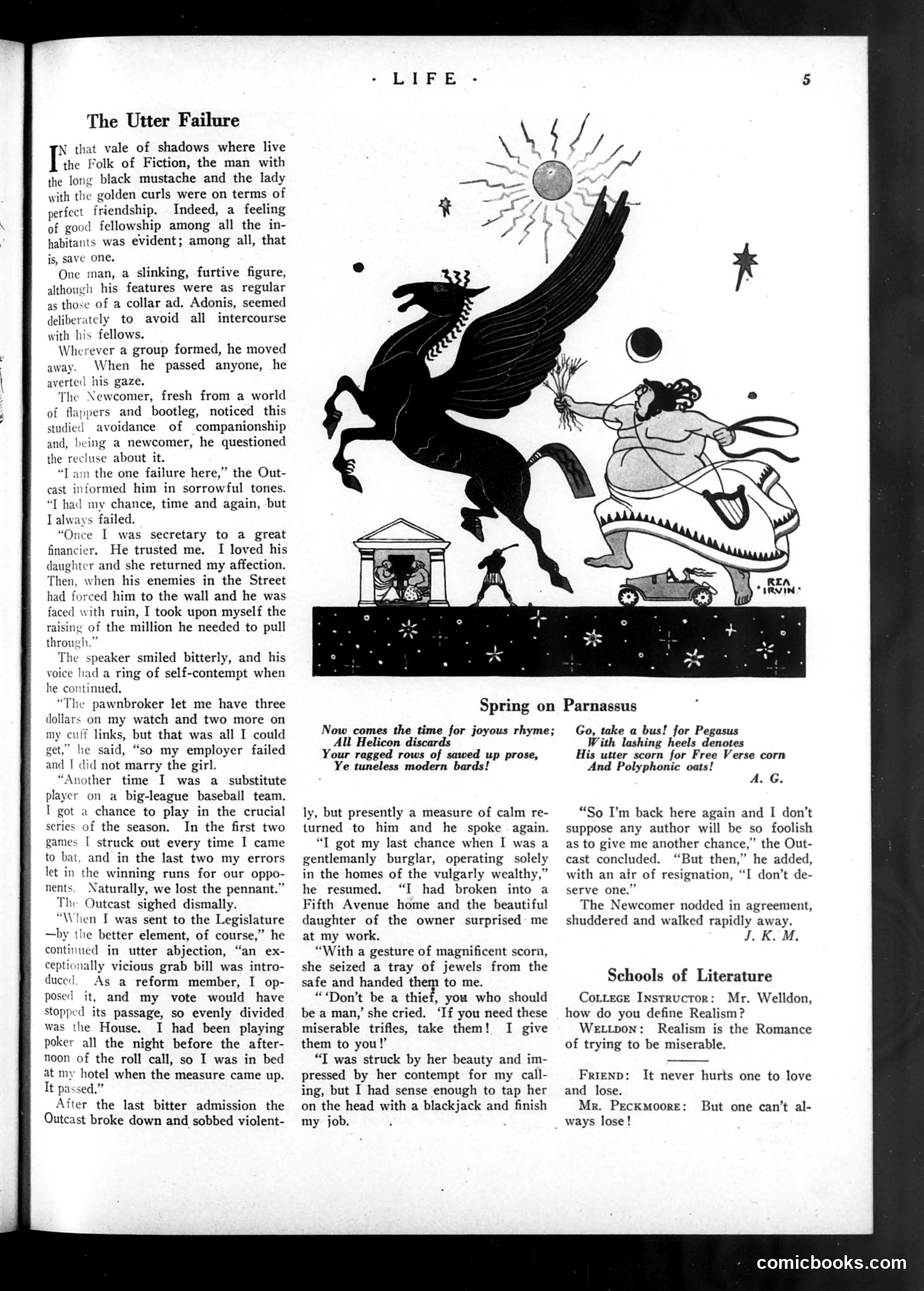
This is a whimsical literary satire rather than political commentary. The illustration depicts chaos on Mount Parnassus (the mythological home of the Muses and poetry), with a rearing horse, a fleeing figure, and various fantastical elements amid stars. The accompanying poem mocks modern poetry's decline, using classical allusions. The text laments that contemporary verse lacks merit compared to classical standards—"Helicon discards / Your ragged routs of sewed up prose, / Ye timeless modern bards!" This reflects early 20th-century literary criticism dismissing modernist poetry as inferior to traditional forms. The satire targets contemporary poets and their experimental work, suggesting they've abandoned true poetic craft for incoherent "prose." The mythological setting emphasizes what's been lost from classical literary traditions.
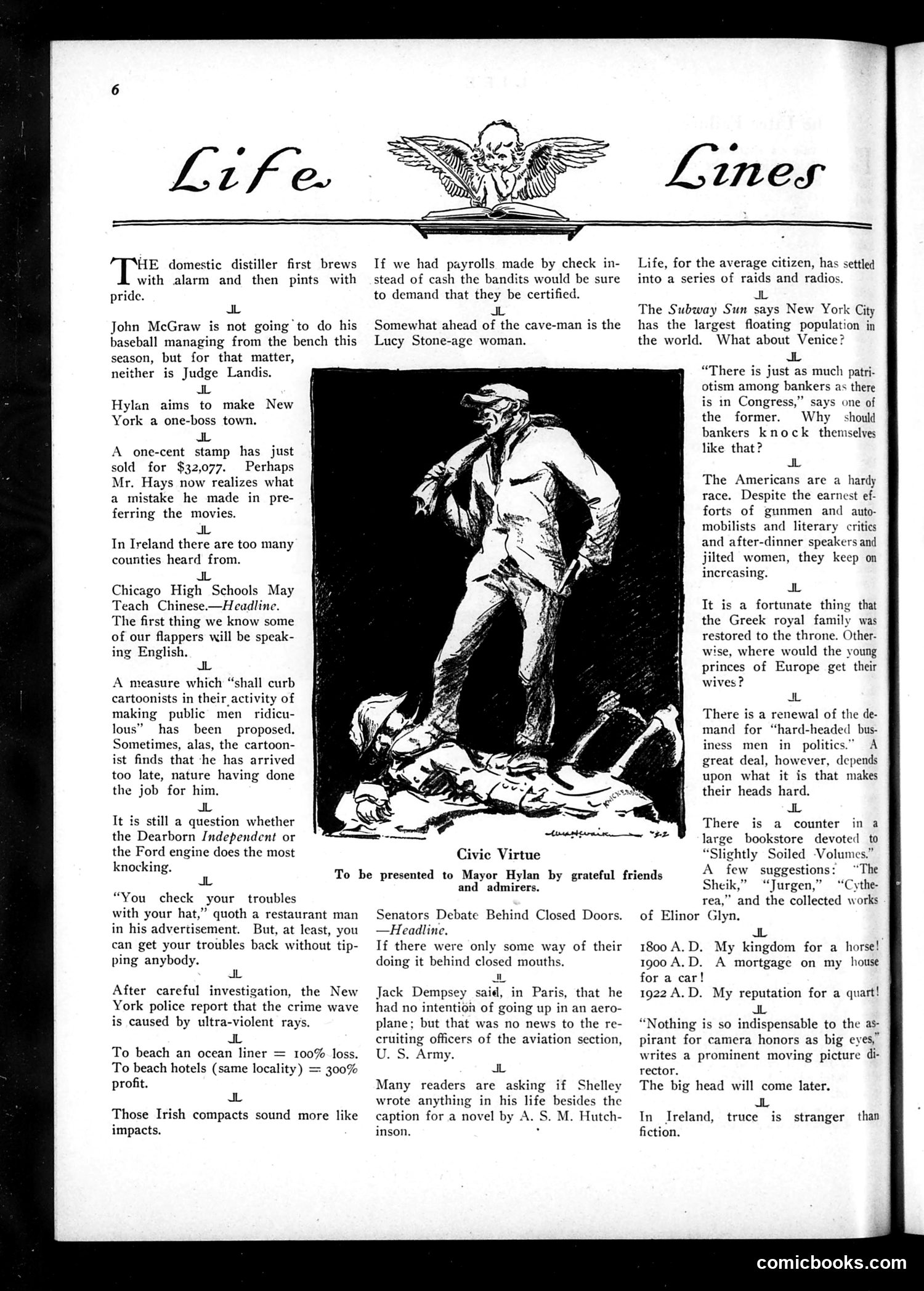
The central image depicts a male figure standing triumphantly over a fallen woman, titled "Civic Virtue" and noted as "To be presented to Mayor Hylan by grateful friends and admirers." This is satirical commentary on a famous sculpture (the actual "Civic Virtue" statue). The cartoon mocks the statue's depiction of a muscular man dominating a prostrate female figure labeled to represent vice or corruption. The satire critiques both the sculpture's questionable artistic merit and its gender politics—presenting "virtue" as male dominance over femininity. The reference to Mayor Hylan suggests this relates to 1920s New York politics and public art controversies of that era. The page's surrounding text items are unrelated brief quips typical of Life's satirical format.
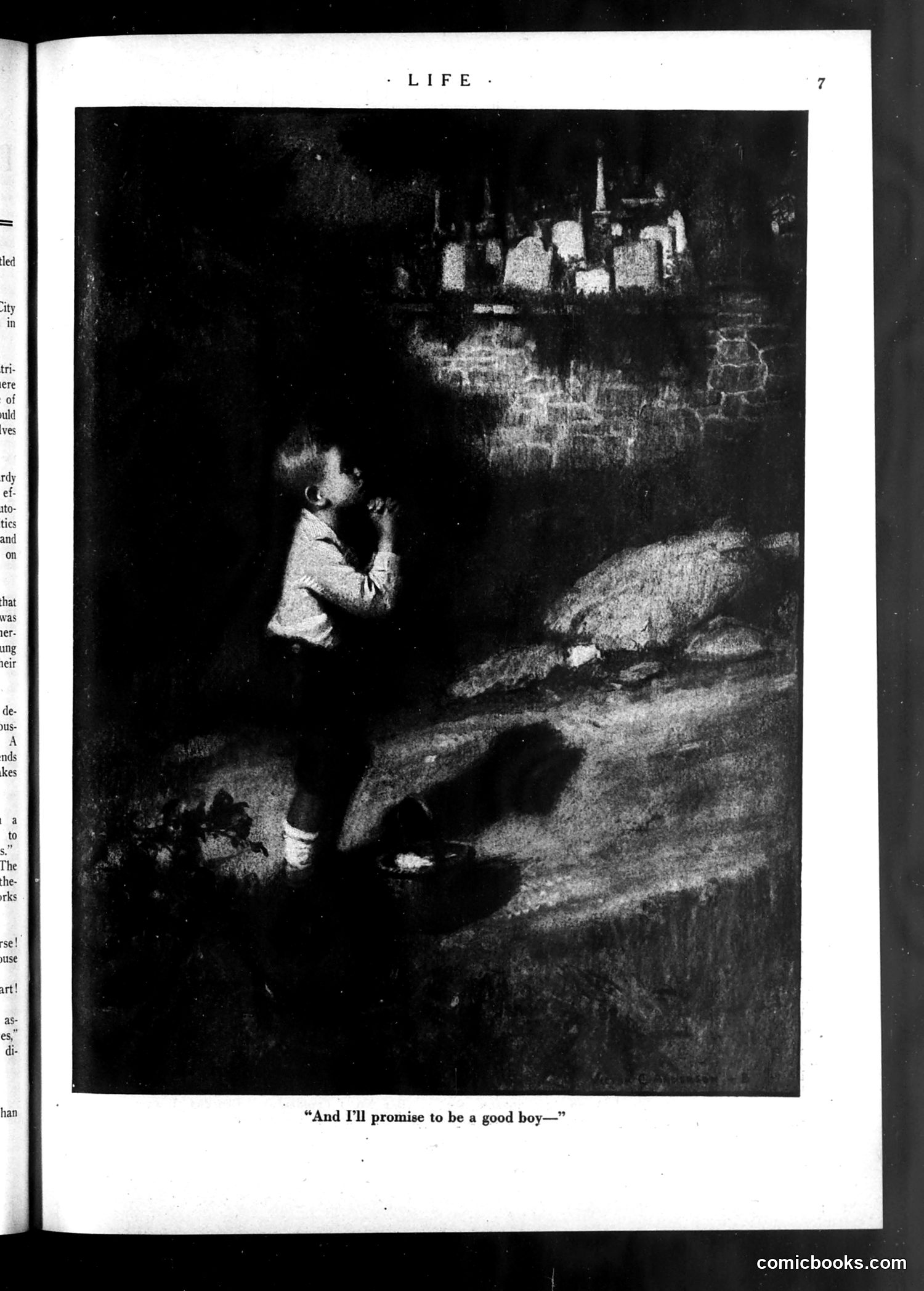
This page from *Life* magazine shows a black and white photograph of a young child kneeling in prayer at night, gazing upward toward a distant cityscape illuminated against the dark sky. The caption reads: "And I'll promise to be a good boy—" The image appears to be sentimental rather than satirical. It depicts a child making a nighttime prayer or promise, possibly during wartime (given the silhouetted urban landscape). The composition suggests earnest faith or childhood innocence—a child appealing to God or a higher power with a simple pledge of good behavior. Without additional context from surrounding text, the exact satirical point remains unclear, though *Life's* typical approach would likely involve commentary on American values, faith, or social conditions.
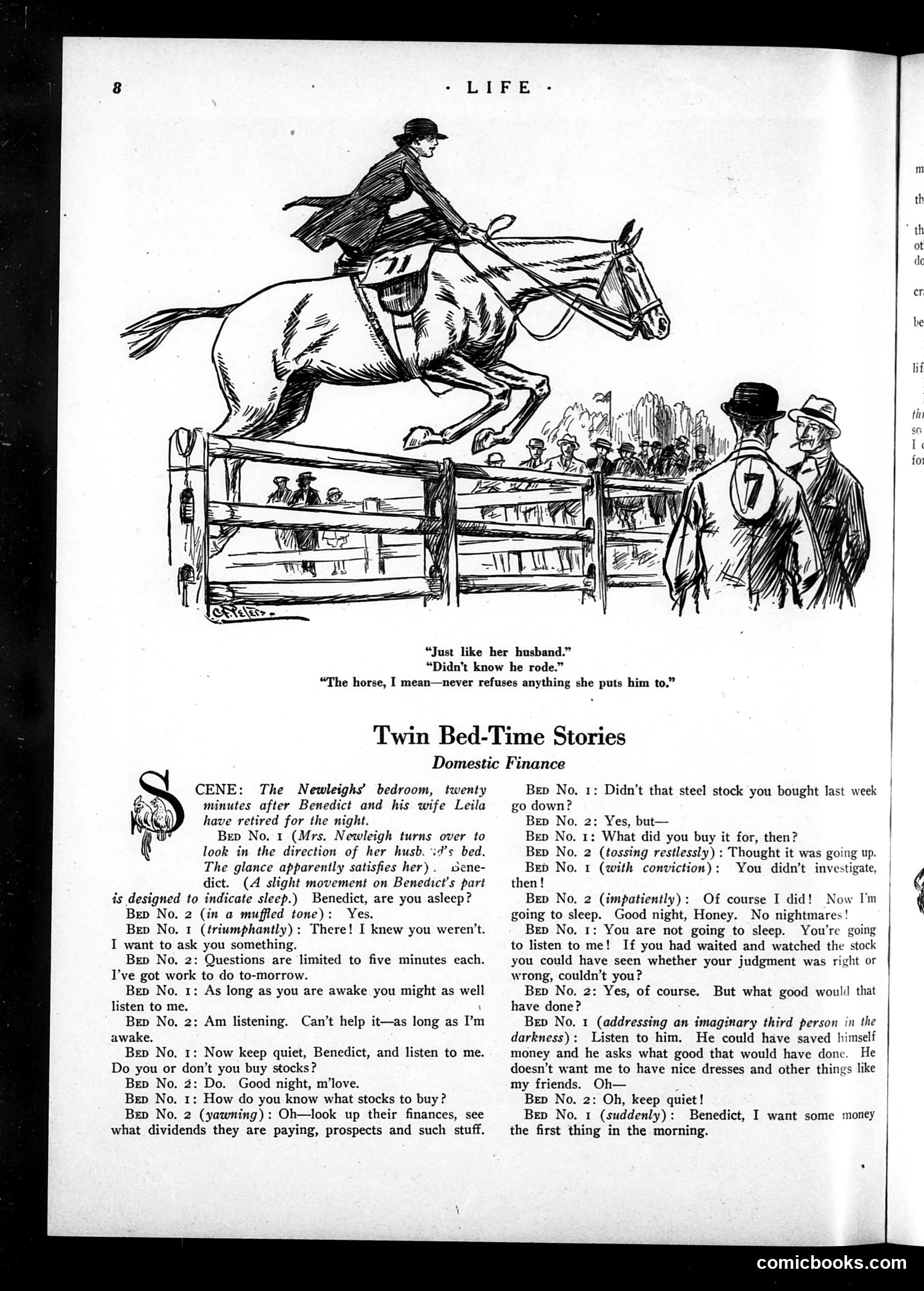
This satirical sketch depicts a married couple (labeled "Bed No. 1" and "Bed No. 2") arguing about household finances before sleep. The humor centers on marital discord over money management: the husband wants to discuss stock investments while the wife interrupts with domestic concerns—she lacks nice dresses and wants money immediately. The illustration above shows a jockey on a horse jumping a fence, captioned with dialogue about a wife who "never refuses anything" her husband asks of her—a sardonic commentary on marital obedience. The satire targets early 20th-century gender dynamics in marriage, where husbands controlled finances while wives had limited access to money for personal needs. The "twin beds" reference suggests separate sleeping arrangements, common in that era, emphasizing emotional and financial distance between spouses.
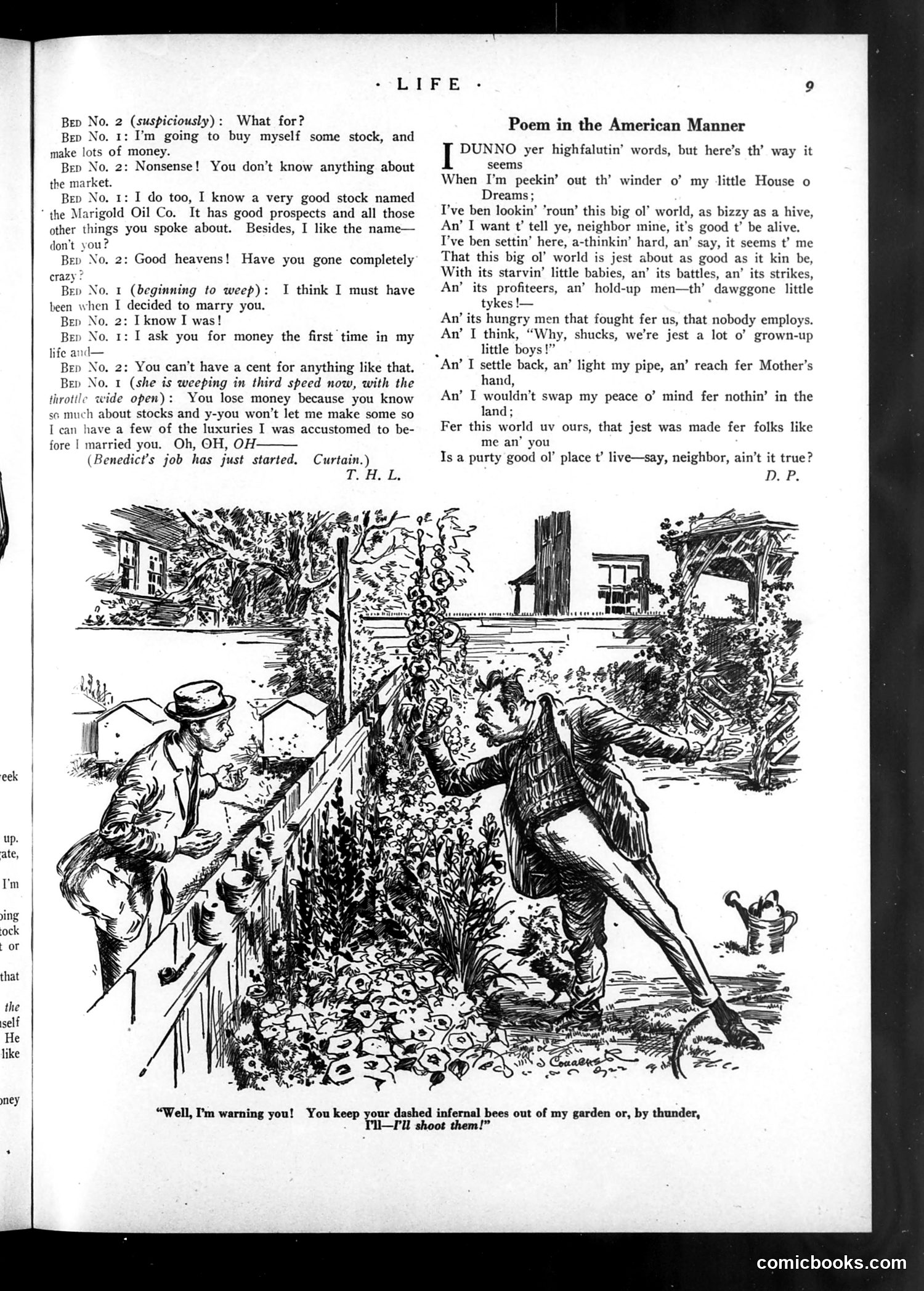
This page contains a satirical dialogue between "Ben No. 1" and "Ben No. 2" (likely representing different social perspectives) arguing about stock market investment and financial prudence. Ben No. 1 defends buying stocks; Ben No. 2 warns against risk. Below is an illustration and accompanying poem titled "Poem in the American Manner" by D.P. The cartoon depicts two men in a garden—one threatening the other over bees. The caption reads: "Well, I'm warning you! You keep your dashed infernal bees out of my garden or, by thunder, I'll—I'll shoot them!" The satire likely mocks neighborly disputes, property disputes, or the American tendency toward aggressive confrontation over minor grievances. The poem romanticizes simple rural American life in colloquial dialect, possibly satirizing sentimental Americana or populist sentiment.
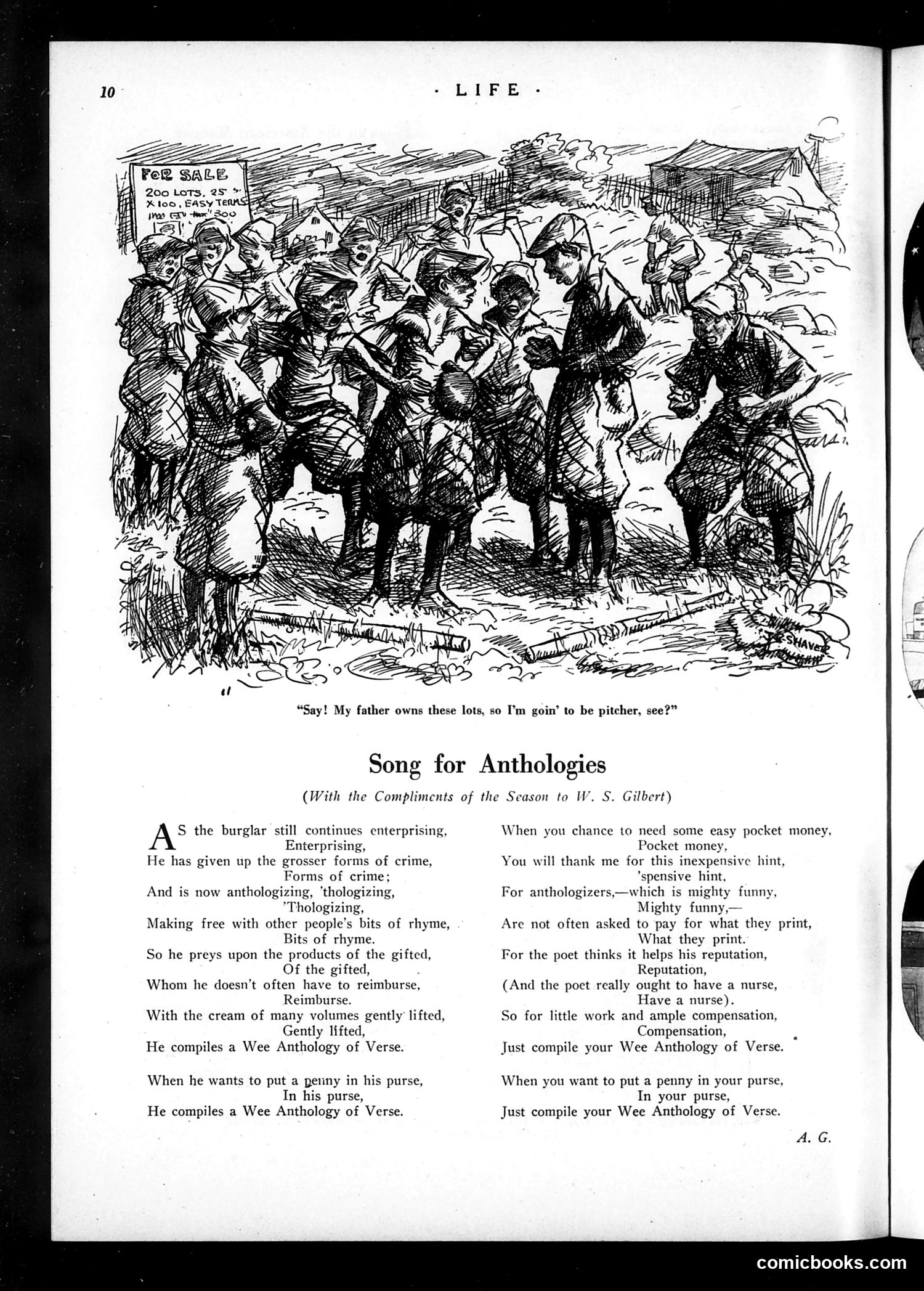
The top cartoon depicts a group of children in a vacant lot with a "For Sale" sign. One child declares, "Say! My father owns these lots, so I'm goin' to be pitcher, see?"—meaning he'll be the pitcher in their baseball game because his father owns the property. The satire mocks childhood privilege and entitlement: the child assumes he deserves a superior position simply due to his father's wealth/ownership, rather than earning it through skill. This reflects early 20th-century social commentary on class privilege determining opportunity. Below is a poem titled "Song for Anthologies" by A.G., satirizing anthology compilers who profit from collecting existing poems without substantial compensation to original poets—a commentary on publishing economics and artistic exploitation of the era.
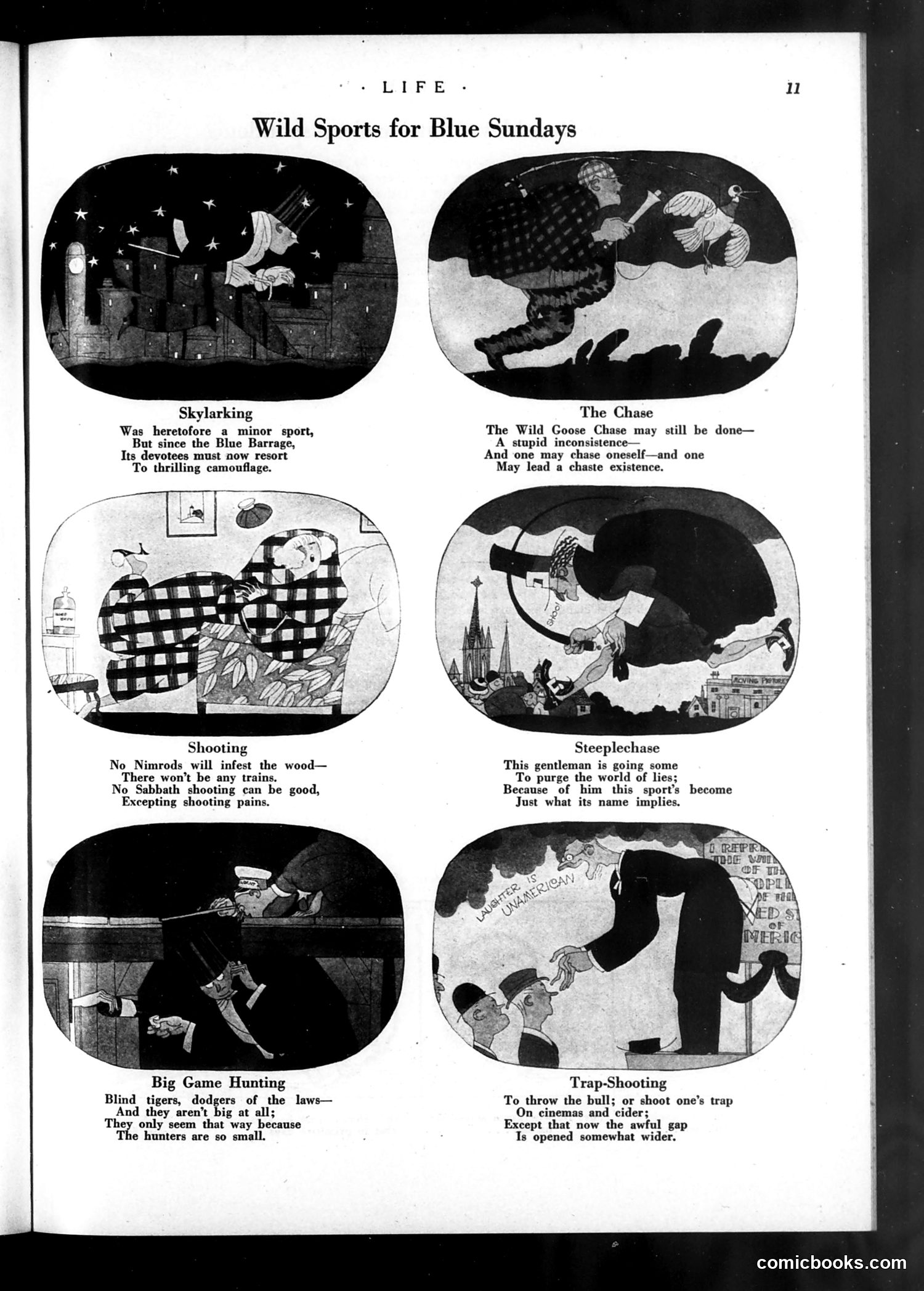
This page satirizes recreational activities people pursued on Sundays, when many businesses and entertainment venues were closed due to "Blue Laws" (religious restrictions). Each illustrated "sport" is a humorous workaround: - **Skylarking**: Rooftop activities replacing banned entertainment - **The Chase**: Pursuing wild geese as outdoor amusement - **Shooting**: Hunting to bypass Sabbath shooting restrictions - **Steeplechase**: Horse racing presented as truth-telling competition - **Big Game Hunting**: Hunting portrayed as absurdly difficult - **Trap-Shooting**: Modified sport due to cinema/alcohol bans The satire mocks how Blue Laws forced creative (often silly or dangerous) Sunday leisure activities. The accompanying verses use ironic tone to critique the absurdity of these legal restrictions on what Americans could do on weekends.
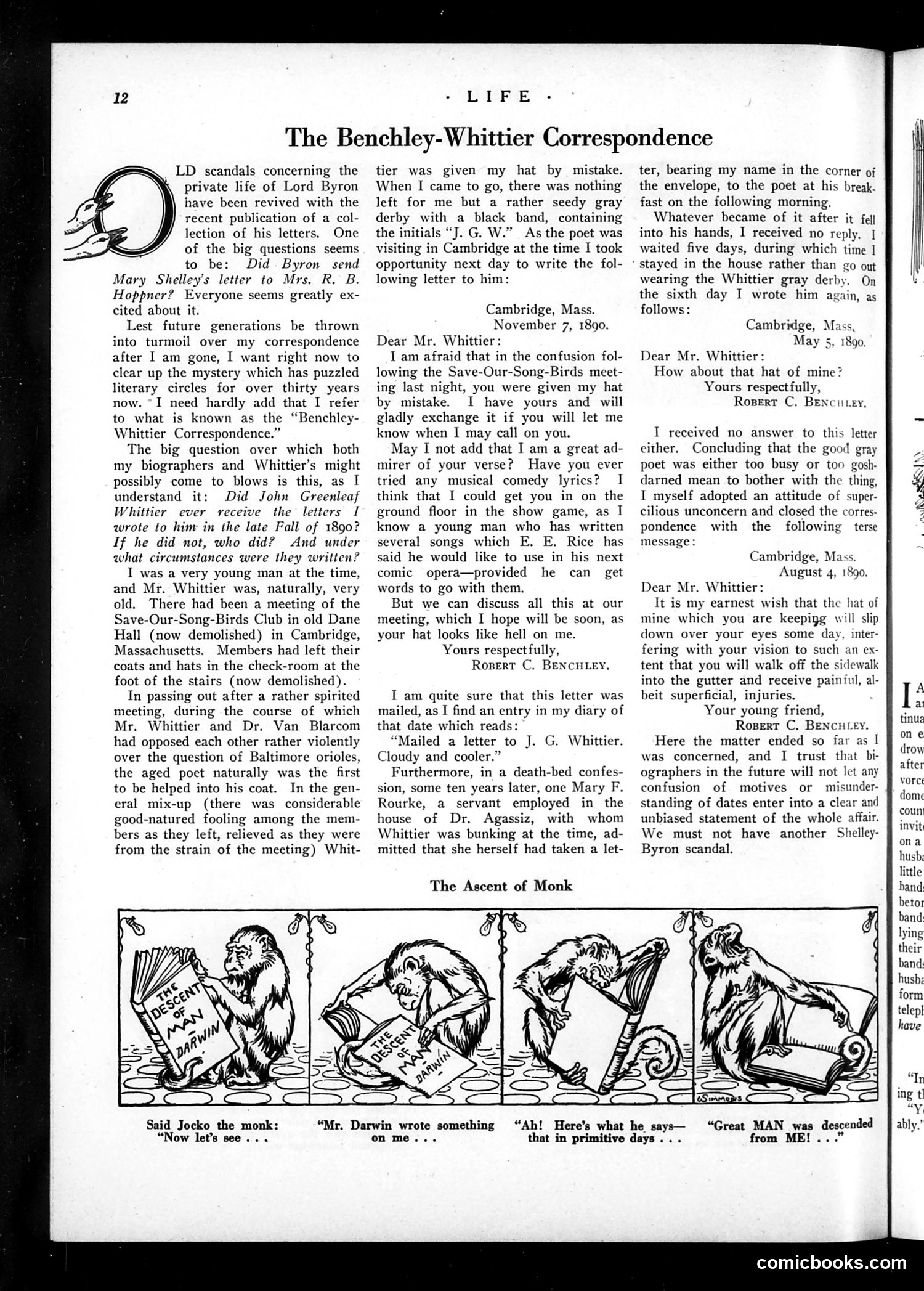
This four-panel comic strip satirizes Charles Darwin's theory of evolution. A monkey (labeled "Jacko the monk") progressively transforms, reading Darwin's writings. The sequence shows: the monkey reading "The Descent of Man," then examining Darwin's work, discovering it describes "primitive days," and finally declaring "Great MAN was descended from ME!" The joke inverts Darwin's actual argument—which proposed humans descended from ape-like ancestors—to suggest the monkey humorously claims *humans* evolved from monkeys. This reflects late-19th-century public confusion and religious resistance to evolutionary theory. The cartoon mocks both Darwin's ideas and popular misunderstandings of them, using slapstick humor typical of Life magazine's satirical approach to scientific controversy.
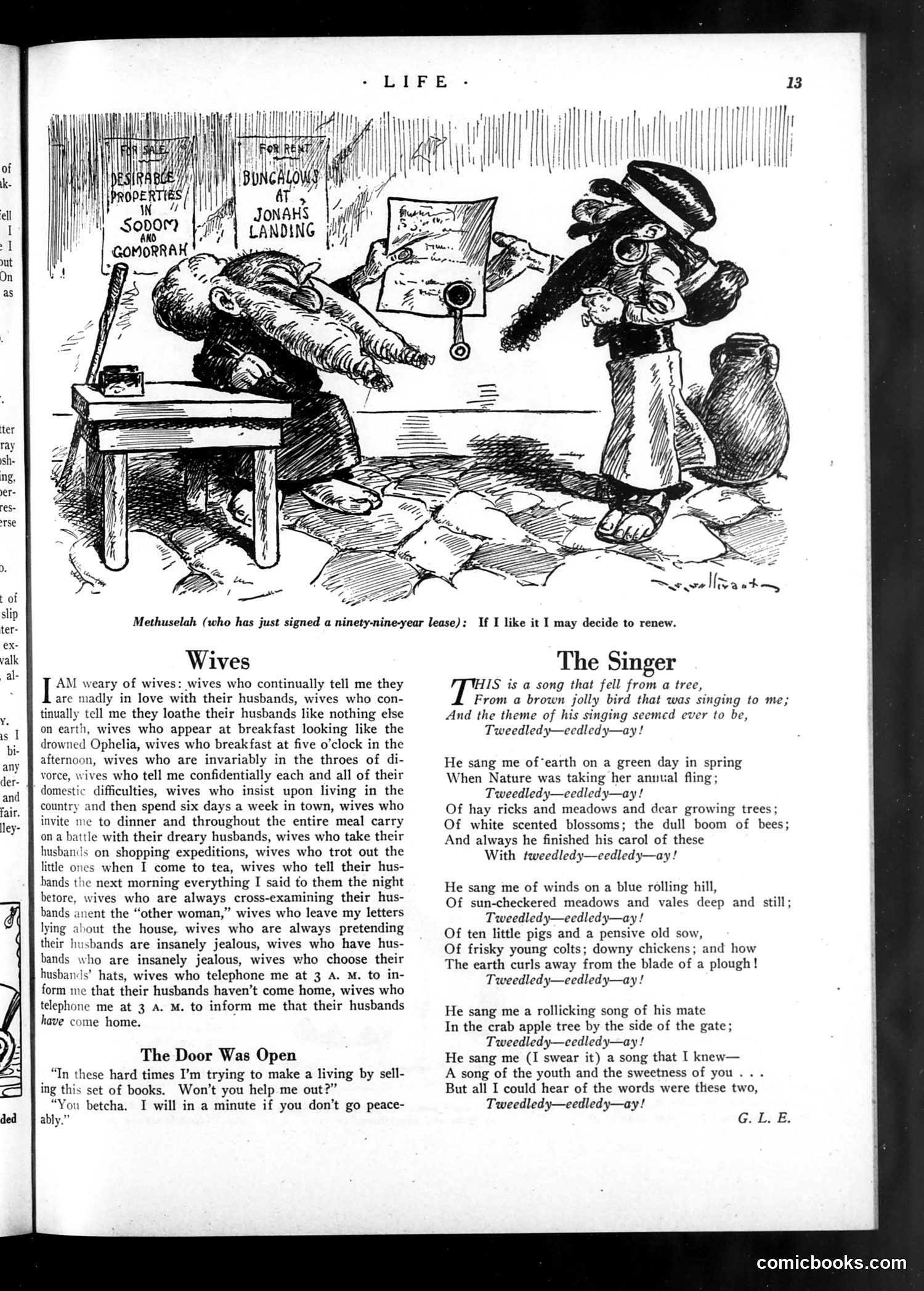
The main cartoon depicts a figure lying on a table, apparently exhausted or incapacitated, while another character stands nearby holding a map labeled "For Rent: Desirable Properties at Sodom & Gomorrah" and a sign reading "Bungalows at Jonah's Landing." The caption identifies the prone figure as "Methuselah (who has just signed a ninety-nine-year lease): If I like it I may decide to renew." This is satirizing **real estate speculation and dubious property dealings**. By placing biblical references (Sodom, Gomorrah, Jonah) on rental properties, the cartoon mocks offering cursed or undesirable locations—a joke about fraudulent or worthless land sales. Methuselah's long lease despite apparent exhaustion suggests the absurdity of committing to obviously bad investments.
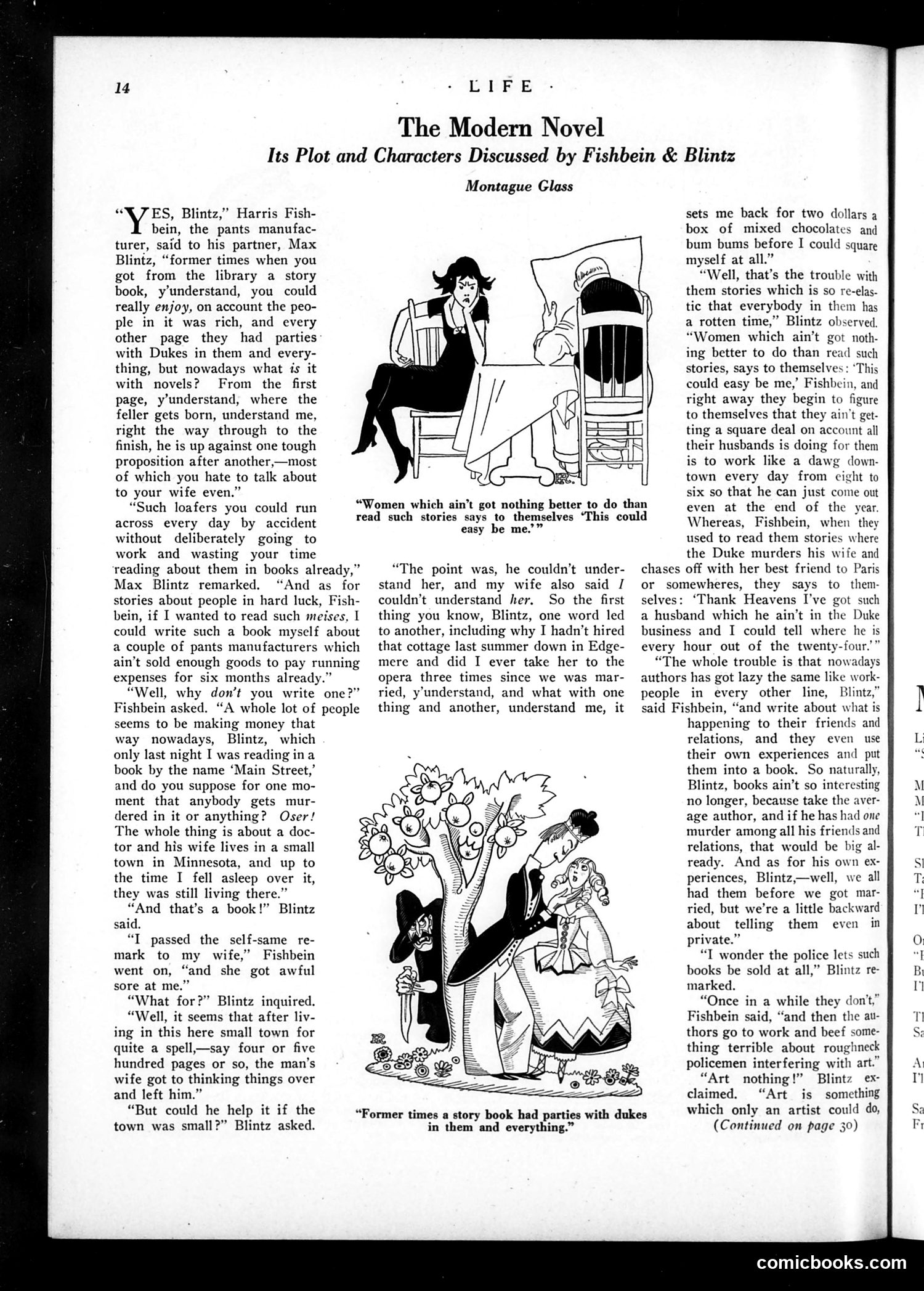
This satirical article discusses how modern novels have become tedious and unrealistic compared to older story books. Harris Fishbein and Max Blintz, identified as pants manufacturers, debate whether contemporary novels are worth reading. The cartoons illustrate their complaint: the first shows a woman finding modern domestic narratives boring (a wife complaining about her husband's mundane work life). The second depicts an exaggerated, chaotic "tree of life" scene—likely mocking modernist literature's experimental complexity and psychological depth. The satire targets the gap between readers' expectations and modernist fiction's actual subject matter: instead of exciting adventures with "dukes" and dramatic parties, readers encounter realistic portrayals of ordinary people's everyday struggles and internal lives—which the characters find insufferably dull.
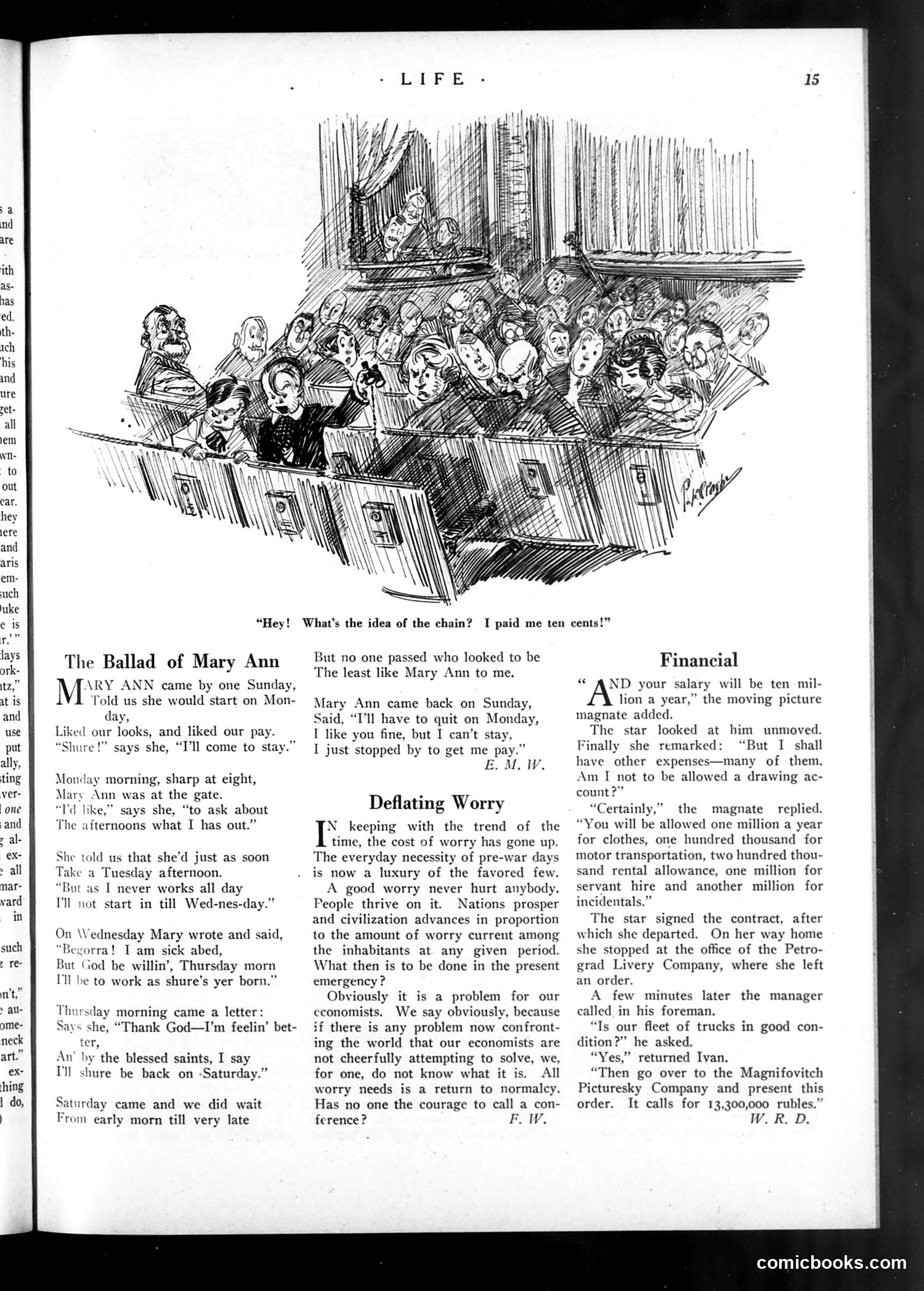
The top cartoon depicts a theater or courtroom scene where someone complains about a "chain" costing ten cents—likely satirizing petty complaints or nickel-and-diming behavior during wartime or economic hardship. The three text pieces mock contemporary absurdities: **"The Ballad of Mary Ann"** ridicules an unreliable domestic servant who constantly makes excuses (illness, saints' blessings) to avoid work while expecting full pay—a common complaint about labor reliability in the 1910s-20s. **"Deflating Worry"** ironically suggests that since economists can't solve real problems, they should tackle "worry" itself through conferences, mocking both economic incompetence and bureaucratic solutions. **"Financial"** satirizes Hollywood excess by showing a movie star negotiate lavish expenses (clothing, cars, servants) so extravagant that she places a 13-million-ruble truck order—absurd given post-WWI economic collapse in Russia. The punchline criticizes both industry waste and the disconnect between American wealth and global hardship.
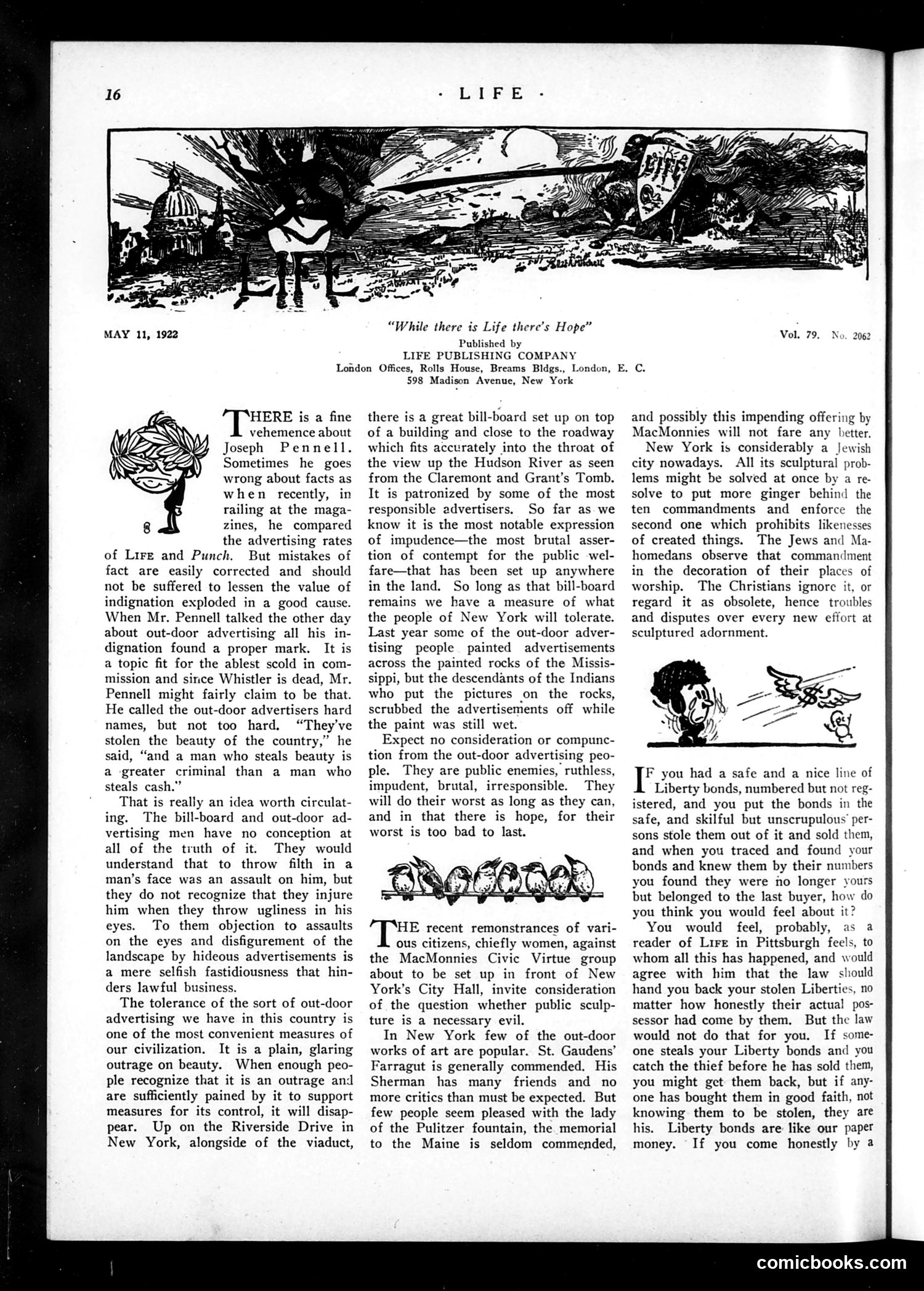
This page contains Joseph Pennell's editorial attack on billboard advertising in America, particularly the eyesore on Riverside Drive overlooking the Hudson River near Grant's Tomb. Pennell argues that outdoor advertisers are "public enemies"—ruthless, brutal, and indifferent to beauty. He compares their assault on the landscape to physical violence, noting that Native Americans once removed advertisements painted on Mississippi rocks, showing more civic respect than modern Americans. The article then pivots to discuss the MacMonnies "Civic Virtue" sculpture soon to be installed at New York City Hall, questioning whether public outdoor art serves the city well. It notes that few New York outdoor artworks are popular, though St. Gaudens' Farragut is generally admired. The piece hints at controversy surrounding the MacMonnies work, possibly referencing its provocative subject matter or reception in the Jewish community (New York being "considerably a Jewish city").
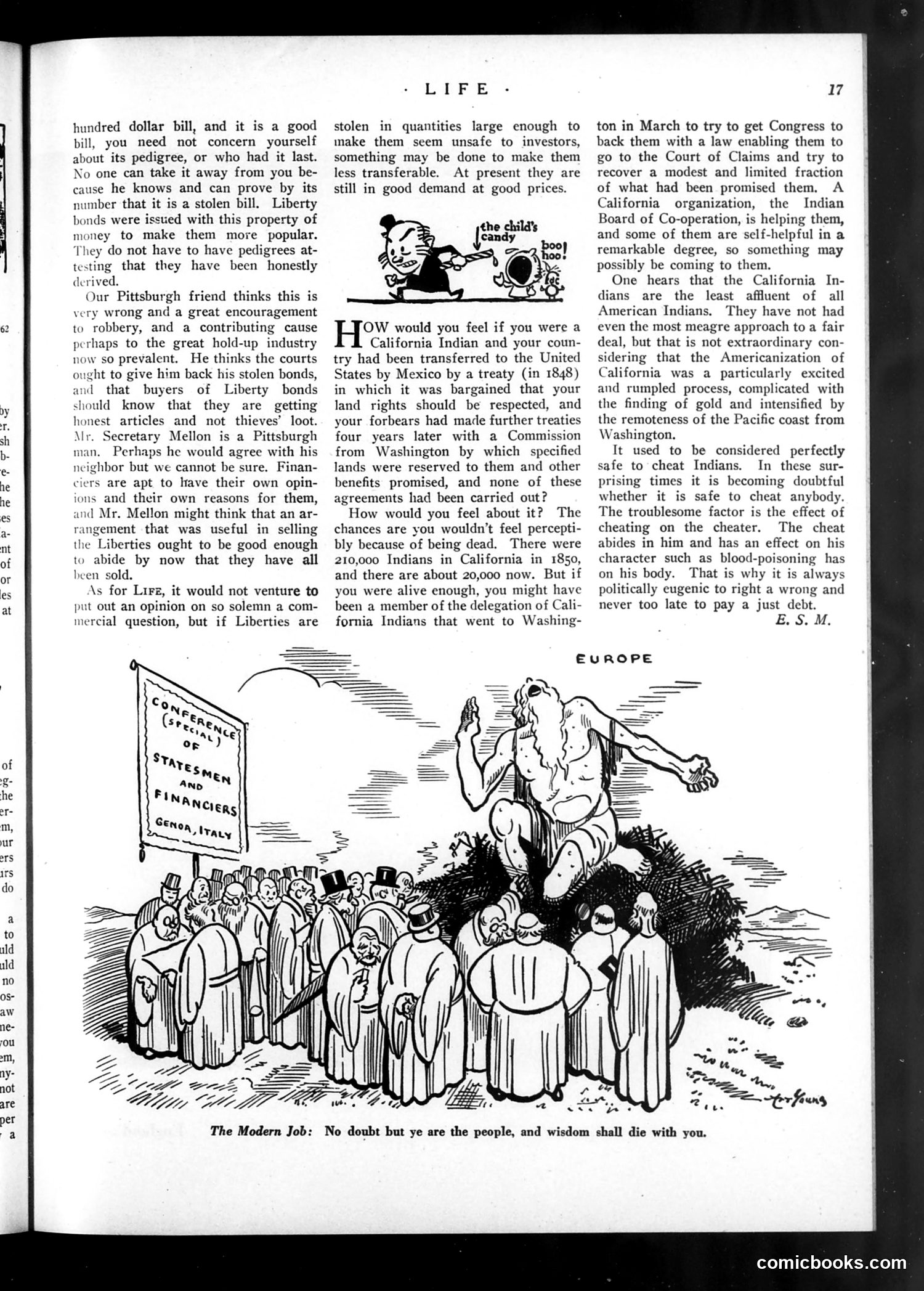
The large political cartoon depicts a bloated, demonic figure looming over a crowd of businessmen and statesmen gathered around a sign reading "Conference of Statesmen and Financiers, Genoa, Italy." **Context:** The Genoa Conference (1922) brought together European and American financial and political leaders to address post-World War I economic reconstruction. The cartoon satirizes their arrogance and ineffectiveness. **The satire:** The monstrous figure represents the accumulated problems—war debt, economic chaos, reparations—that towers over their deliberations. The caption, paraphrasing Job 12:2, mocks their self-importance: these supposedly wise leaders believe only they possess wisdom, yet remain helpless before forces beyond their control. **Point:** Despite their prestigious gathering and confident assertions, these financiers and statesmen are comically impotent against the massive problems confronting them. The satire critiques elite overconfidence during a period of genuine international crisis.
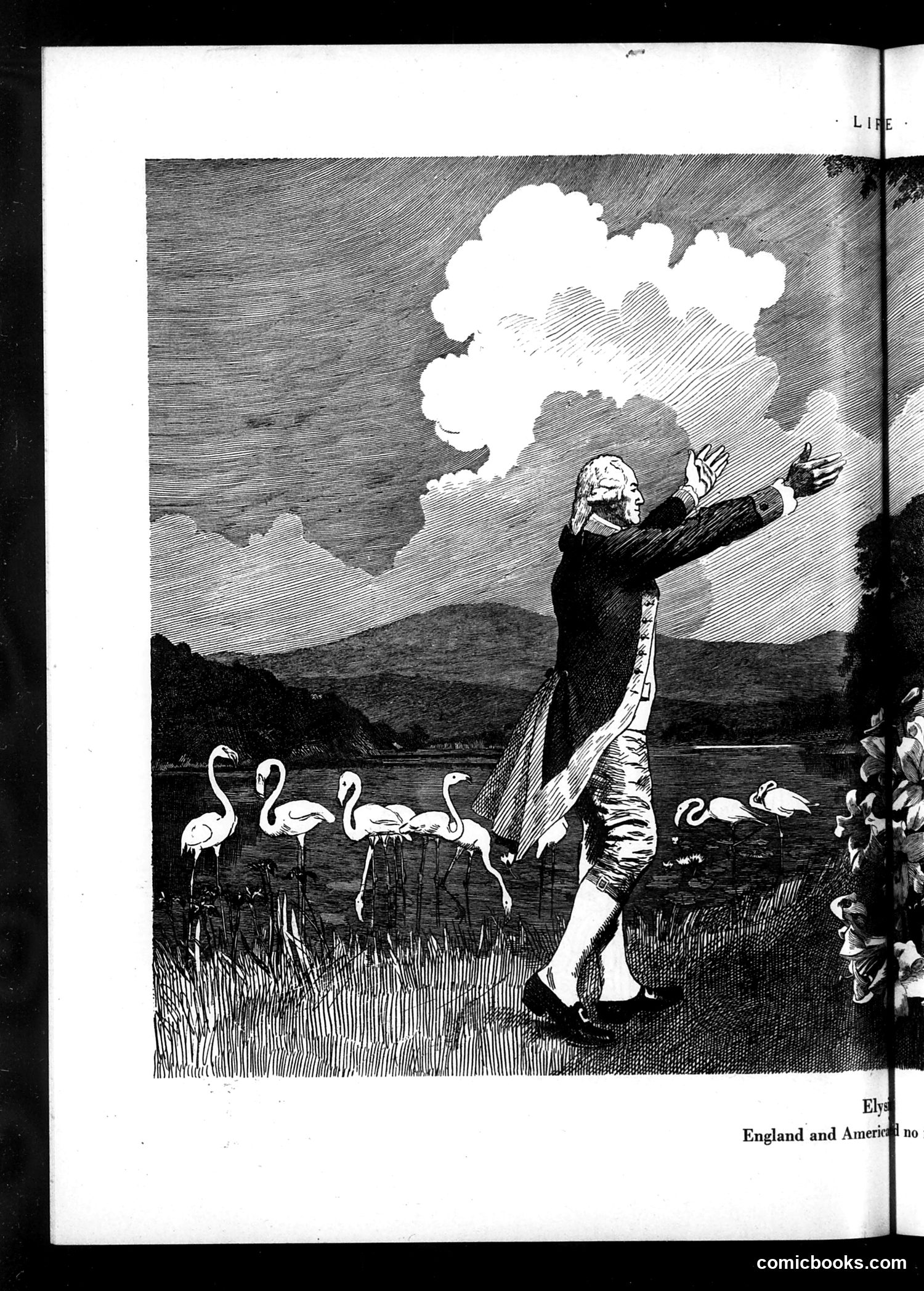
This engraving depicts a woman in 18th-century dress gesturing expansively toward a flock of flamingos by a water's edge, with dramatic clouds above. The visible text references "England and America," suggesting this is political satire comparing the two nations. The woman likely represents either "America" or "Britain" personified. The flamingos—exotic, decorative birds—appear to symbolize colonial possessions or territorial claims. Her theatrical pose and gesture suggest she's proudly displaying or claiming these territories. The satirical point likely critiques imperial ambitions or territorial disputes between England and America, particularly relevant to early American history. The flamingos' artificiality underscores the satirist's view of colonial pursuits as vain or absurd theatrical performance rather than serious governance. The OCR text is too corrupted to provide certain context about publication date or artist attribution.
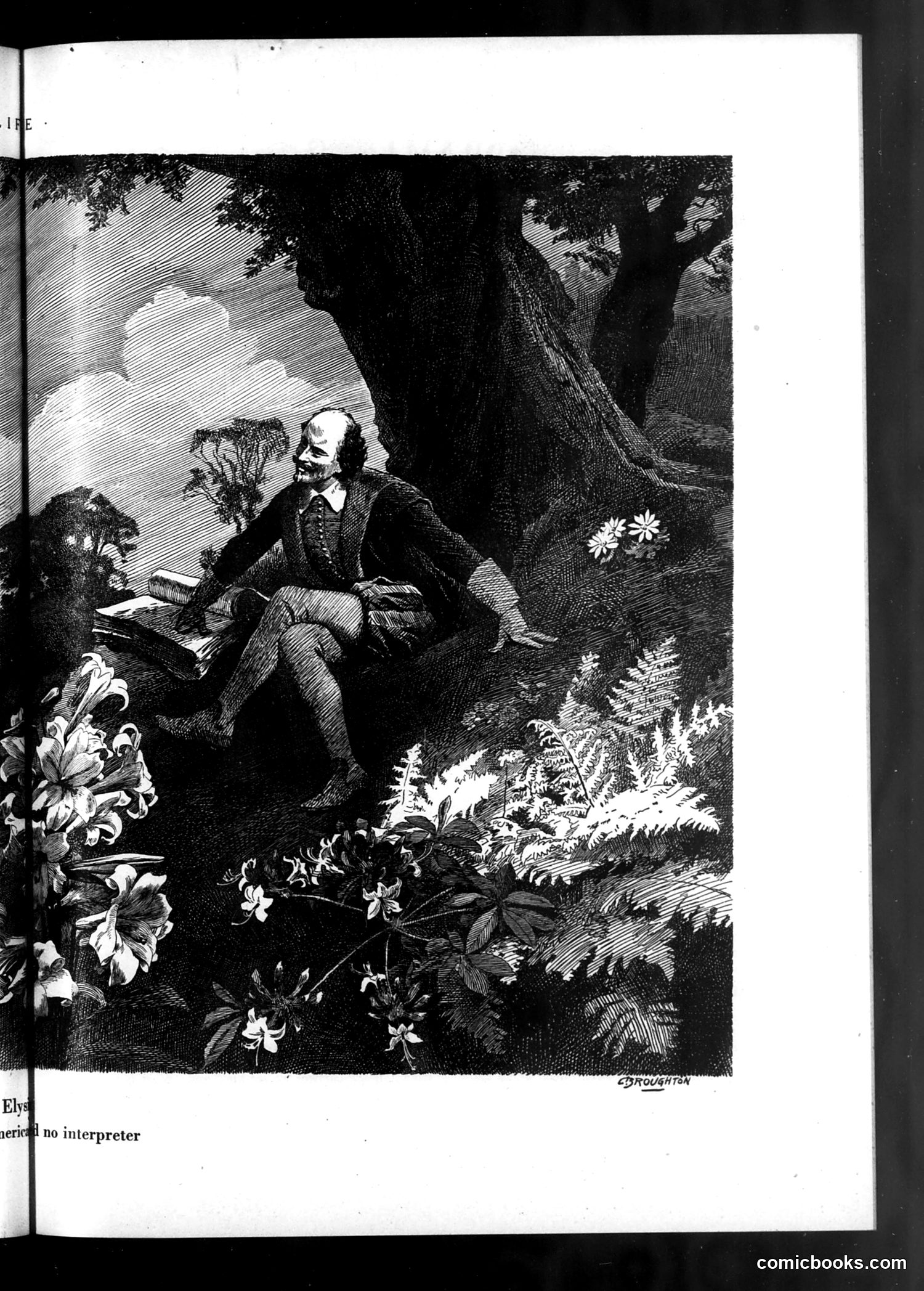
This engraving by Broughton depicts a well-dressed gentleman seated beneath a large tree in a pastoral landscape, surrounded by flowering plants and ferns. He holds what appears to be a book or manuscript and gazes upward contemplatively. The partial OCR text references "no interpreter," suggesting the cartoon comments on someone's self-sufficiency or independence in understanding nature or literature without external guidance. The romantic setting—the natural scenery, solitary scholar, and leisurely pose—evokes 19th-century Transcendentalist or Romantic ideals of communion with nature. Without the complete caption or surrounding context, the specific target of satire remains unclear, though the image likely mocks either an intellectually pretentious figure or critiques Romantic philosophy's emphasis on nature as a teacher requiring "no interpreter."
This page contains theater reviews critiquing several Broadway plays. The main targets are: **"The Shadow"**: A mystery play set in rural England (Dartmoor dialect) about a disappeared gentleman. The reviewer finds it tedious and repetitive—characters endlessly state it's "good" the man disappeared, testing the audience's patience. Yet moments of genuine drama occasionally redeem it. Performances by J.M. Kerrigan and Dallas Welford provide comic relief. **"The Hairy Ape"**: Eugene O'Neill's expressionist play uses raw language (oaths, blasphemy) to depict a stoker's spiritual torment. The reviewer is *furious* that society women and brought children treat serious tragic dialogue as comedy, giggling at profanity. The author fantasizes breaking his chair arm as a club—expressing intellectual frustration at audiences misreading the play's purpose. **Mystery plays generally**: The success of "The Bat" and "The Cat and the Canary" has spawned imitators. The cartoons (decorative theatrical masks) frame these reviews as entertainment criticism, not news.
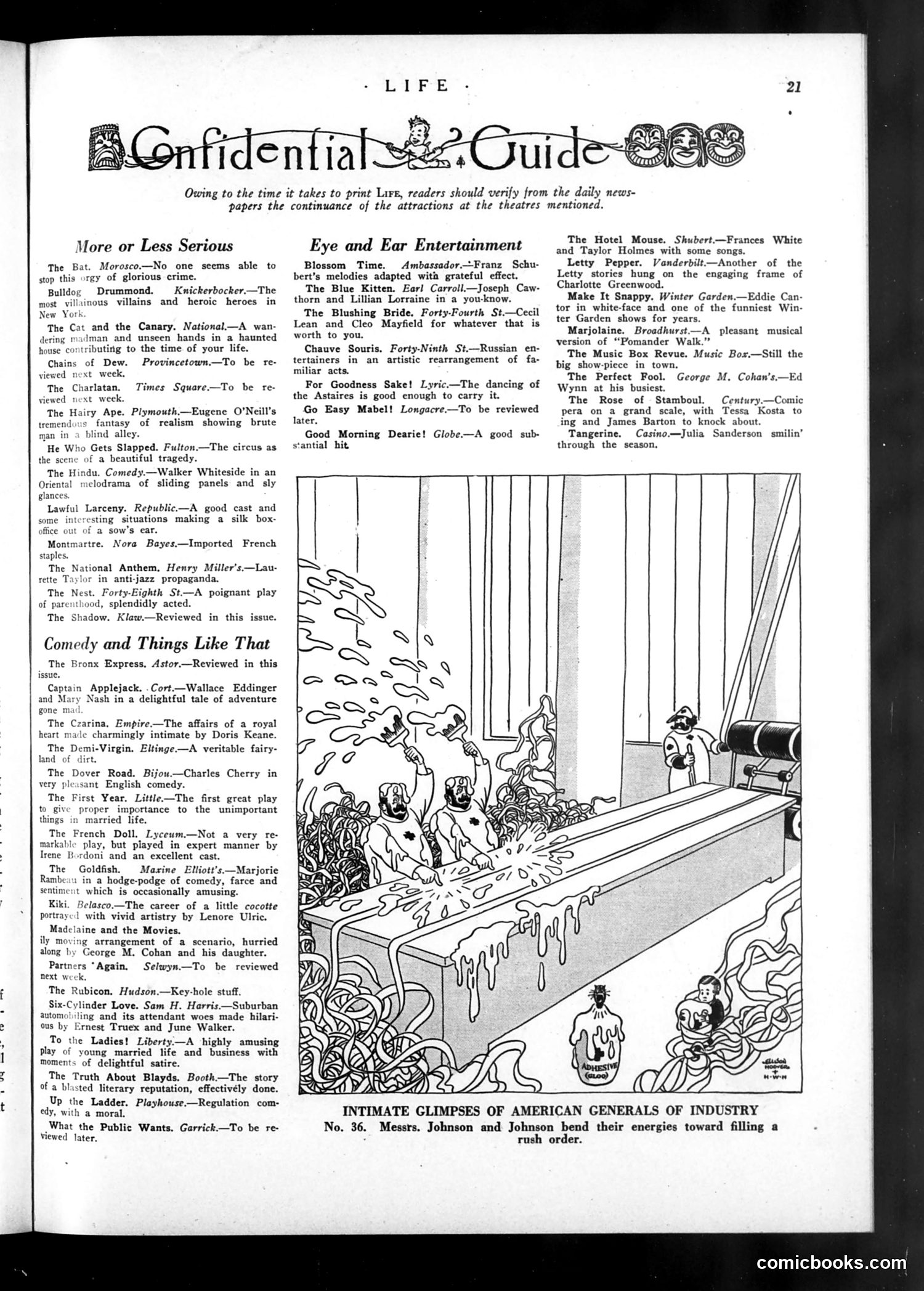
This page is a theater review section from *Life* magazine's "Confidential Guide" listing current Broadway shows and entertainment. The accompanying cartoon illustrates the caption "Intimate Glimpses of American Generals of Industry No. 36. Messrs. Johnson and Johnson bend their energies toward filling a rush order." The cartoon depicts what appears to be executives (the "generals of industry") at Johnson and Johnson frantically rushing to fulfill orders—shown as a chaotic manufacturing scene with workers and materials in disarray, with liquid or product literally overflowing. This is satirical commentary on industrial production during what was likely the post-World War I economic boom, mocking the frenzied pace of American business and corporate efficiency culture. The "generals" metaphor treats business leaders as military commanders mobilizing their forces. The review listings are straightforward theatrical notices with brief critical assessments of current Broadway productions.
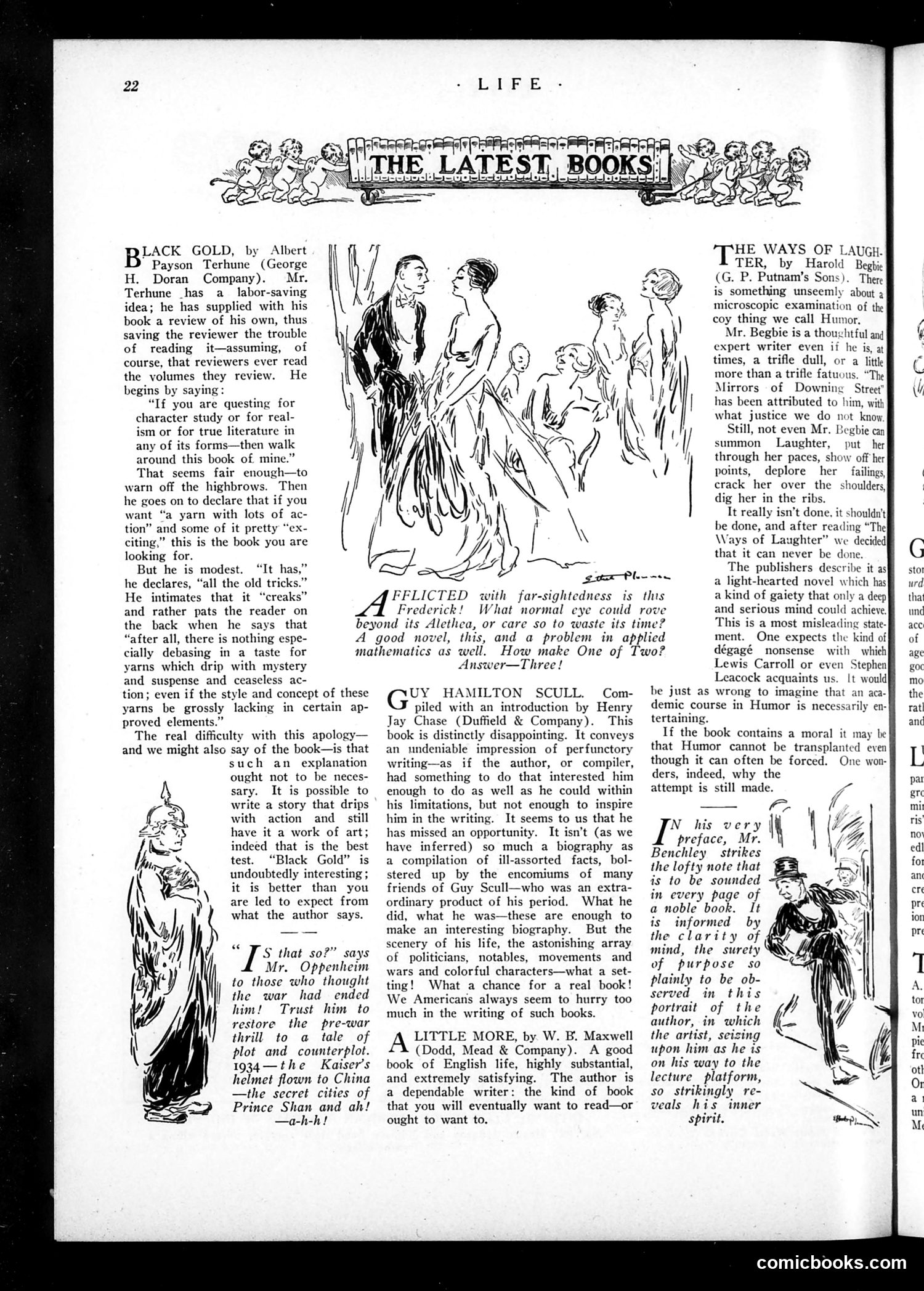
This is a book review page from Life magazine featuring critiques of several contemporary works. The main illustrated content shows a classical drawing of figures in robes, accompanying a review of "The Ways of Laughter" by Harold Begbie—a scholarly examination of humor that the reviewer finds somewhat tedious and overly analytical. The page reviews several 1930s publications including "Black Gold" by Albert Payson Terhune (an adventure novel the author humorously pre-reviews himself), "Guy Hamilton Scull" (a disappointing biography), and "A Little More" by W.B. Maxwell (praised as solid English fiction). The satirical tone is typical of Life's literary criticism: the reviewers gently mock authors' pretensions while assessing whether books deliver entertainment or insight. The page demonstrates how literary magazines of this era combined serious criticism with witty commentary on popular reading tastes.
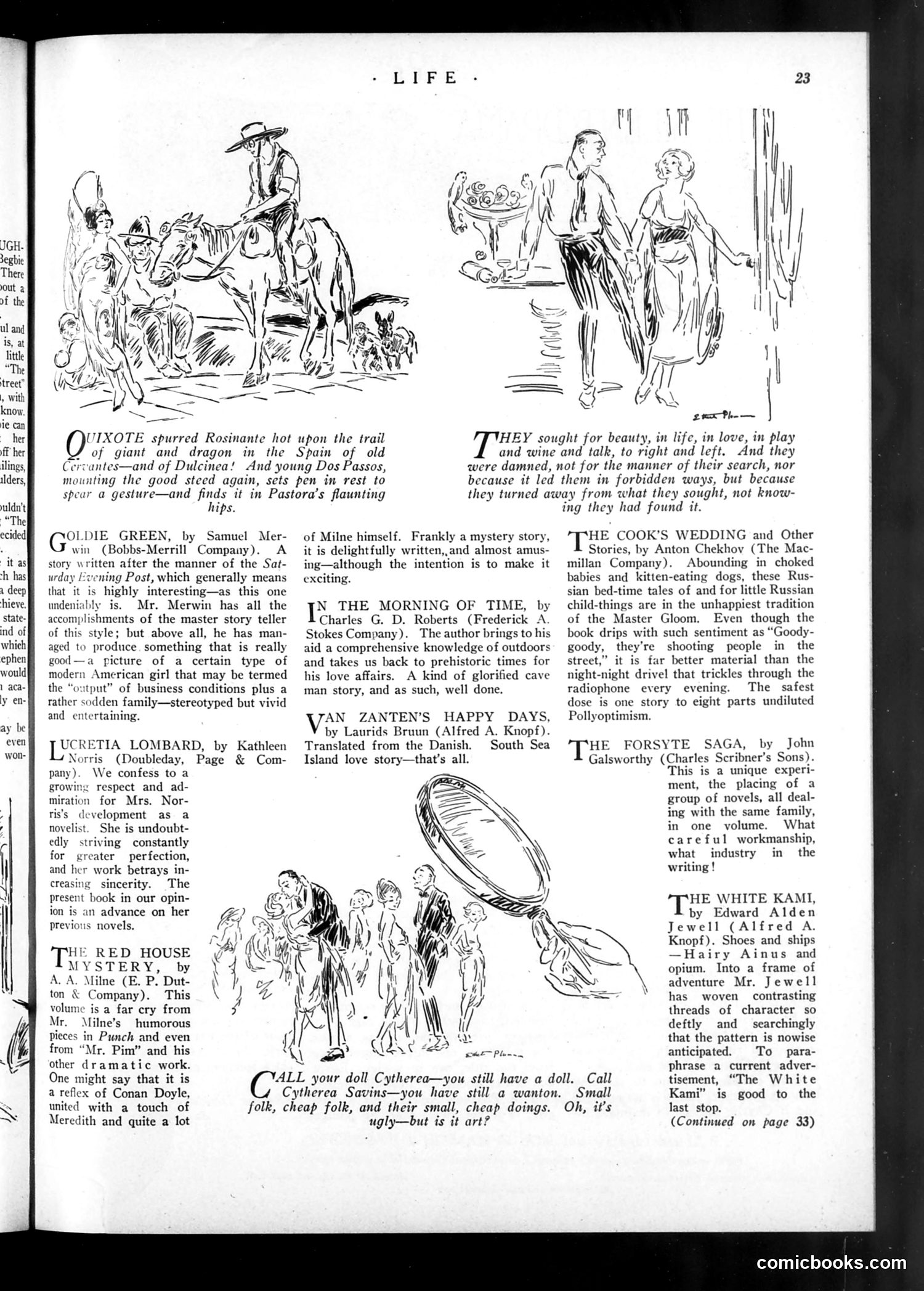
This page presents book reviews from *Life*, the satirical American magazine. The two illustrations are decorative rather than political cartoons—they accompany literary commentary. The left sketch depicts Don Quixote on horseback, referencing a review of a novel by "young Dos Passos" that echoes Cervantes' classic tale. The right illustration shows people in casual repose, accompanying a passage about characters seeking "beauty, in life, in love, in play." The reviews themselves are snippy cultural criticism typical of *Life*'s approach. Notable is the dismissal of Chekhov's stories as "unhappiest tradition" and "night-night drivel," reflecting American readers' preference for lighter fare over Russian literary gloom. The magazine praises certain authors (like Kathleen Norris for "increasing sincerity") while condescending to others. This reflects 1920s American literary tastes and *Life*'s role as arbiter of middlebrow culture—witty, somewhat snobbish commentary on contemporary books for educated readers.
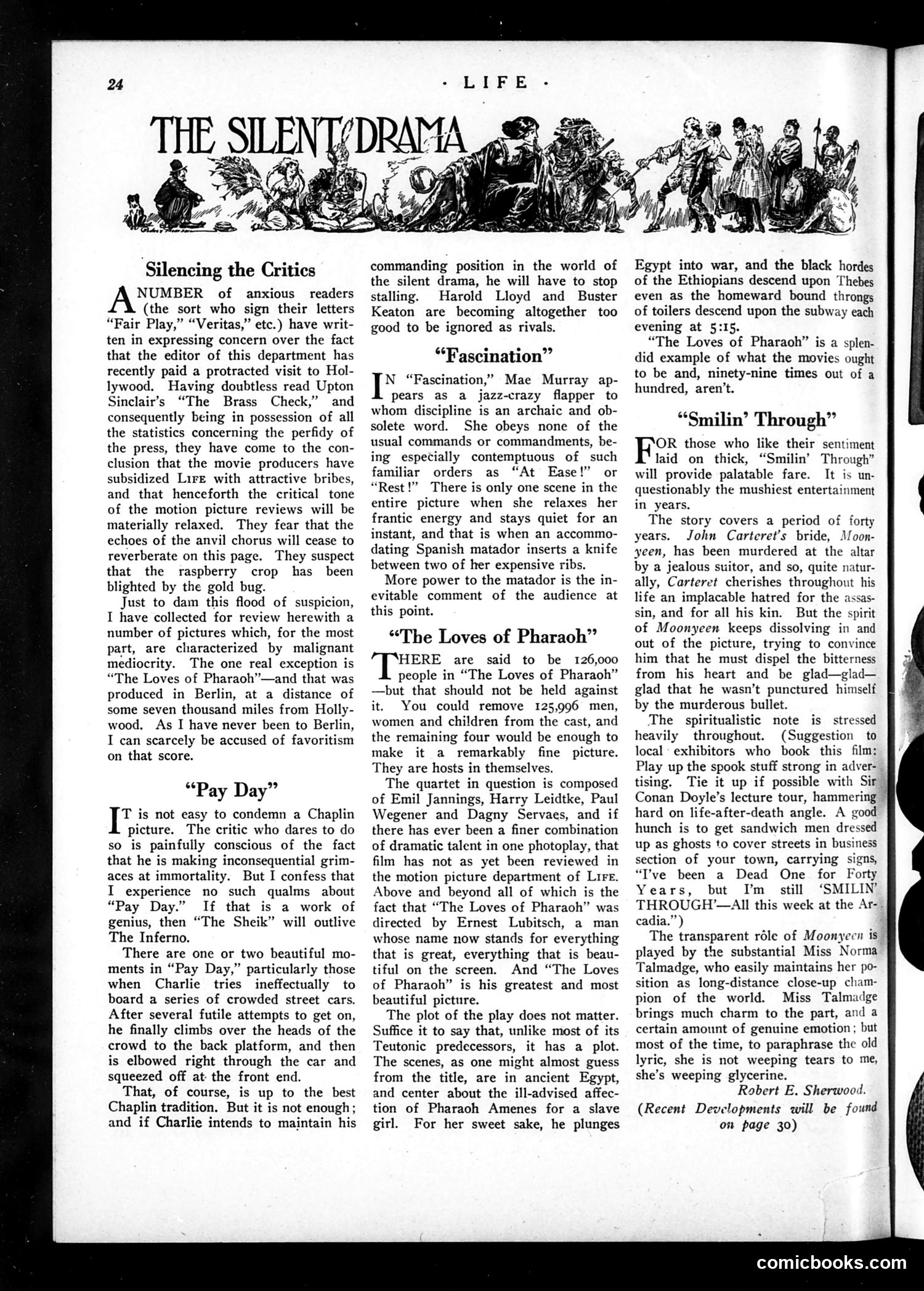
This is a film criticism column from Life magazine's satirical section. The header illustration shows characters from silent films. **Main Content:** The critic addresses readers' suspicion that Hollywood studios bribed him during a recent visit, worried he'd soften his reviews. He defensively lists mediocre films he's critiqued, then praises "The Loves of Pharaoh" (a German production, conveniently distant from Hollywood influence). **Specific Reviews:** - **"Pay Day"** (Chaplin): Dismissively argues it's overrated—if this is genius, then "The Sheik" rivals Dante's *Inferno*. Notes Harold Lloyd and Buster Keaton are becoming competitive rivals. - **"Fascination"** (Mae Murray): Mocks the flapper actress's undisciplined character, sardonically suggesting only a matador's knife between her ribs would quiet her. - **"The Loves of Pharaoh"**: Lavishly praised despite 126,000 extras; argues removing all but four actors wouldn't diminish it. Credits director Ernest Lubitsch as visionary. The satire targets both studio pressure on critics and silent-film industry rivalries of the early 1920s.
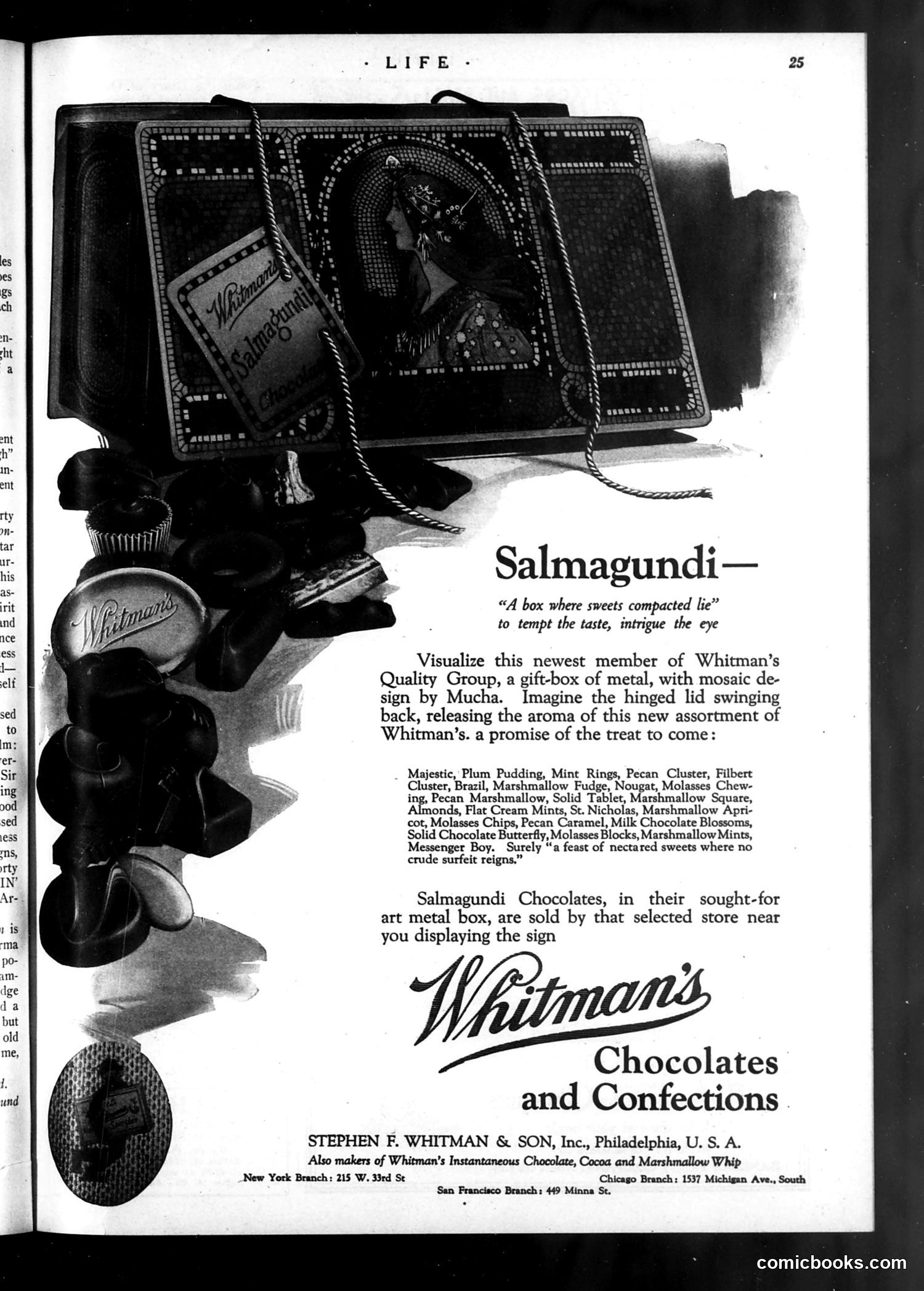
This page is **primarily an advertisement**, not satire or political commentary. It advertises Whitman's "Salmagundi" chocolates, a luxury gift box. The ad's appeal is aesthetic and aspirational rather than humorous. The decorative metal box features "mosaic design by Mucha"—likely referencing the Art Nouveau style of Alphonse Mucha, suggesting sophistication and artistic merit. The ornate packaging with rope handles is displayed prominently alongside the product name "Salmagundi" (a literary reference to a miscellaneous collection, here of assorted sweets). The imagery shows an elegant, decorative box positioned as a premium gift item. The long list of candy varieties ("Majestic, Plum Pudding, Mint Rings," etc.) emphasizes abundance and quality. **For modern readers**: This represents early 20th-century advertising that positioned mass-produced goods as artistically designed luxury items—marketing chocolate as fine art and refined taste rather than mere confection.
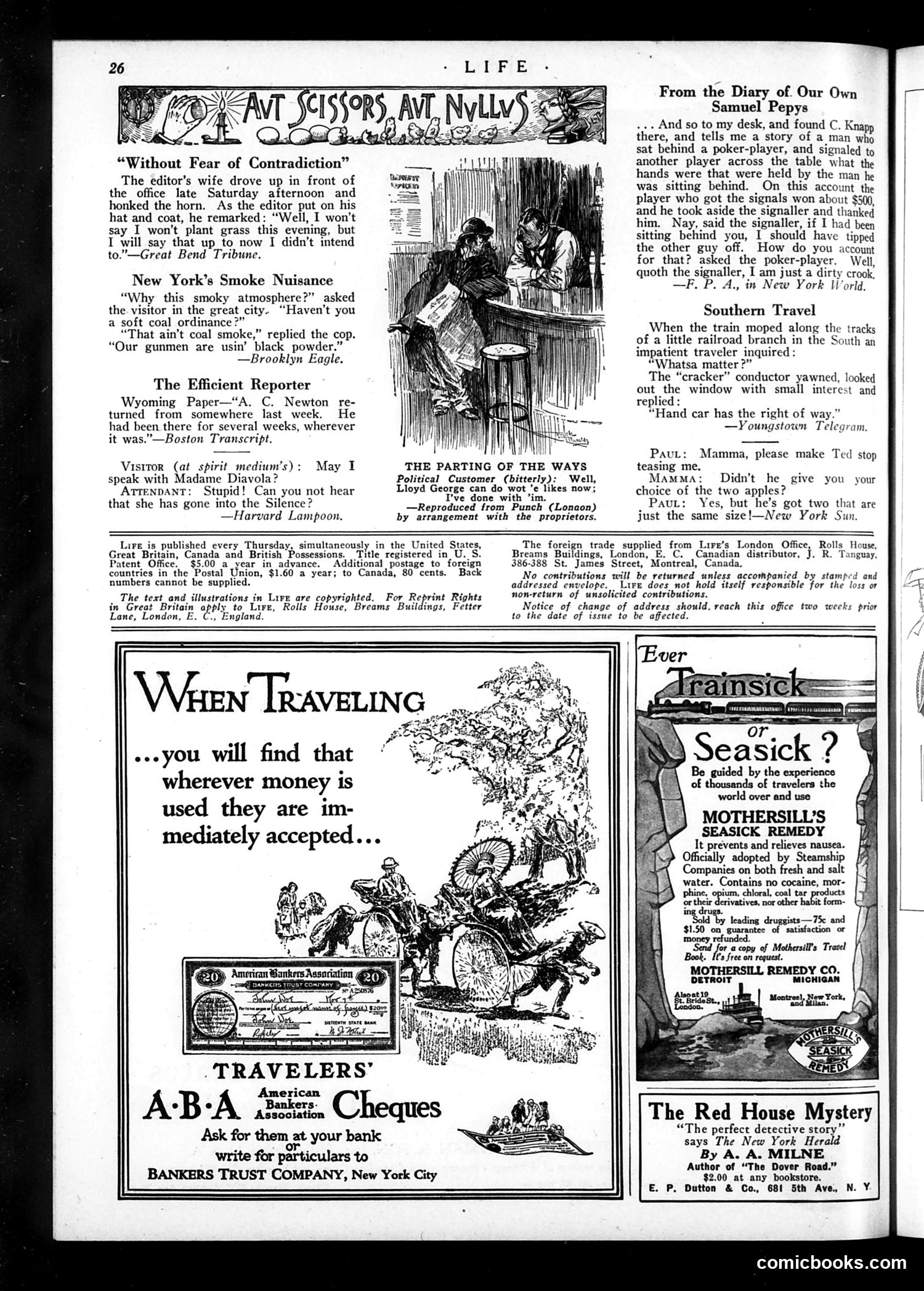
This page contains **brief humorous anecdotes** rather than political cartoons. The jokes mock everyday absurdities: - **"Without Fear of Contradiction"**: An editor's wife honks; he assumes yard work, though he hadn't planned it—satirizing how wives pressure husbands into chores. - **"New York's Smoke Nuisance"**: A cop jokes that NYC's smoke comes from gangsters using black powder, not coal—referencing **Prohibition-era gun violence** (1920s). - **"The Efficient Reporter"**: Mocks vague newspaper writing. - **"The Parting of the Ways"**: A British political customer, angry at Lloyd George, renounces him—likely referencing **post-WWI disillusionment** with British leadership. - **Samuel Pepys anecdote**: A poker cheater admits he's "just a dirty crook"—dark humor about dishonesty. The page is largely **advertisements** (traveler's checks, seasickness remedy) interspersed with these genteel satirical items typical of Life's sophisticated humor for educated readers.
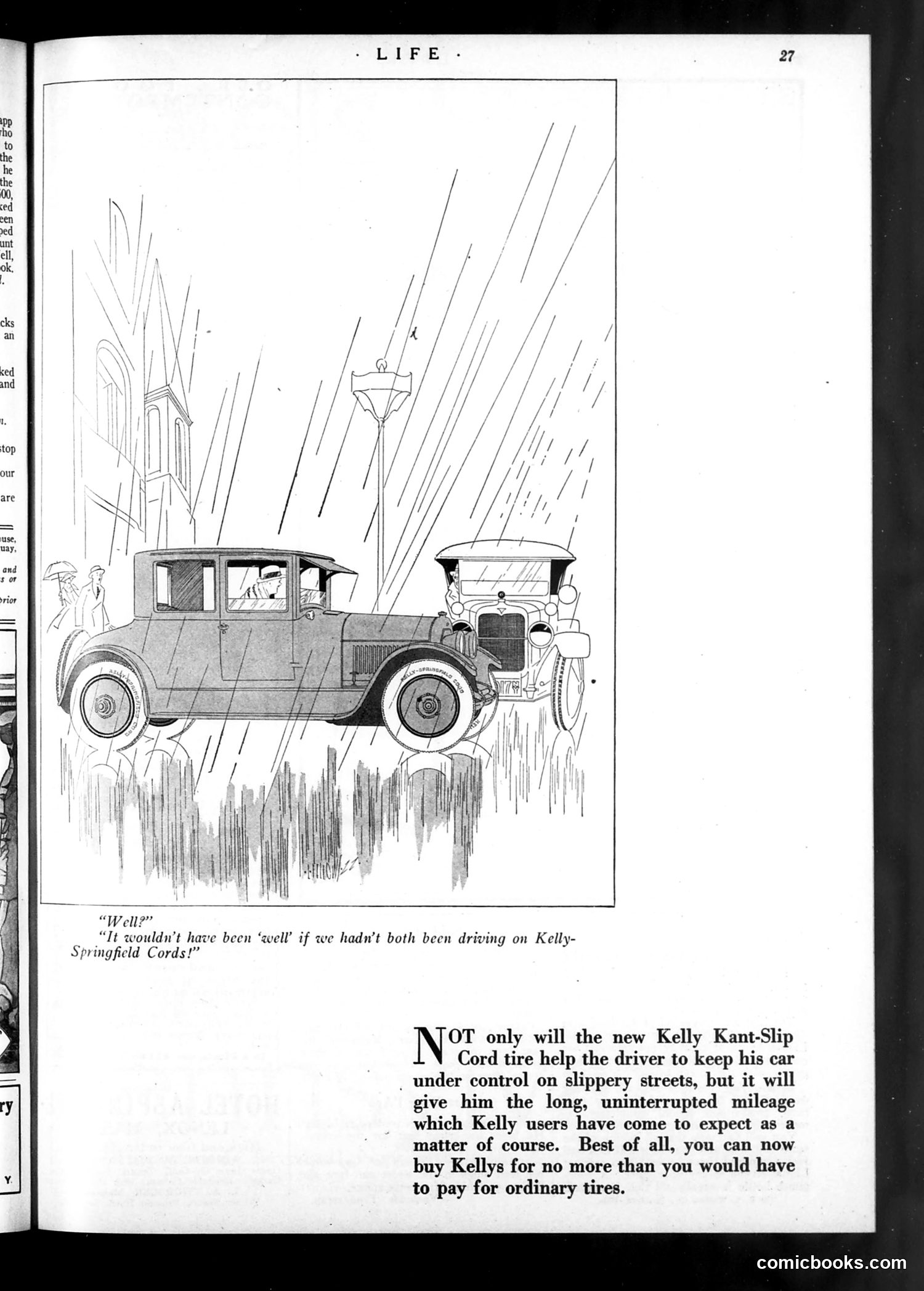
This is a **Kelly-Springfield tire advertisement**, not a political cartoon. The illustration depicts two vintage automobiles driving in heavy rain on slippery streets. The caption's dialogue suggests both drivers are safe because they're using Kelly-Springfield Kant-Slip Cord tires. The humor relies on the double meaning of "well"—implying both that the driving situation went smoothly *and* that the tire brand name (Kelly) sounds like "well." This is a pun-based advertising approach typical of 1920s marketing. The accompanying text promotes the tire's benefits: superior traction on wet roads, long mileage, and competitive pricing against ordinary tires. This reflects early automotive advertising that emphasized safety innovation and reliability—key selling points as automobiles became more common.
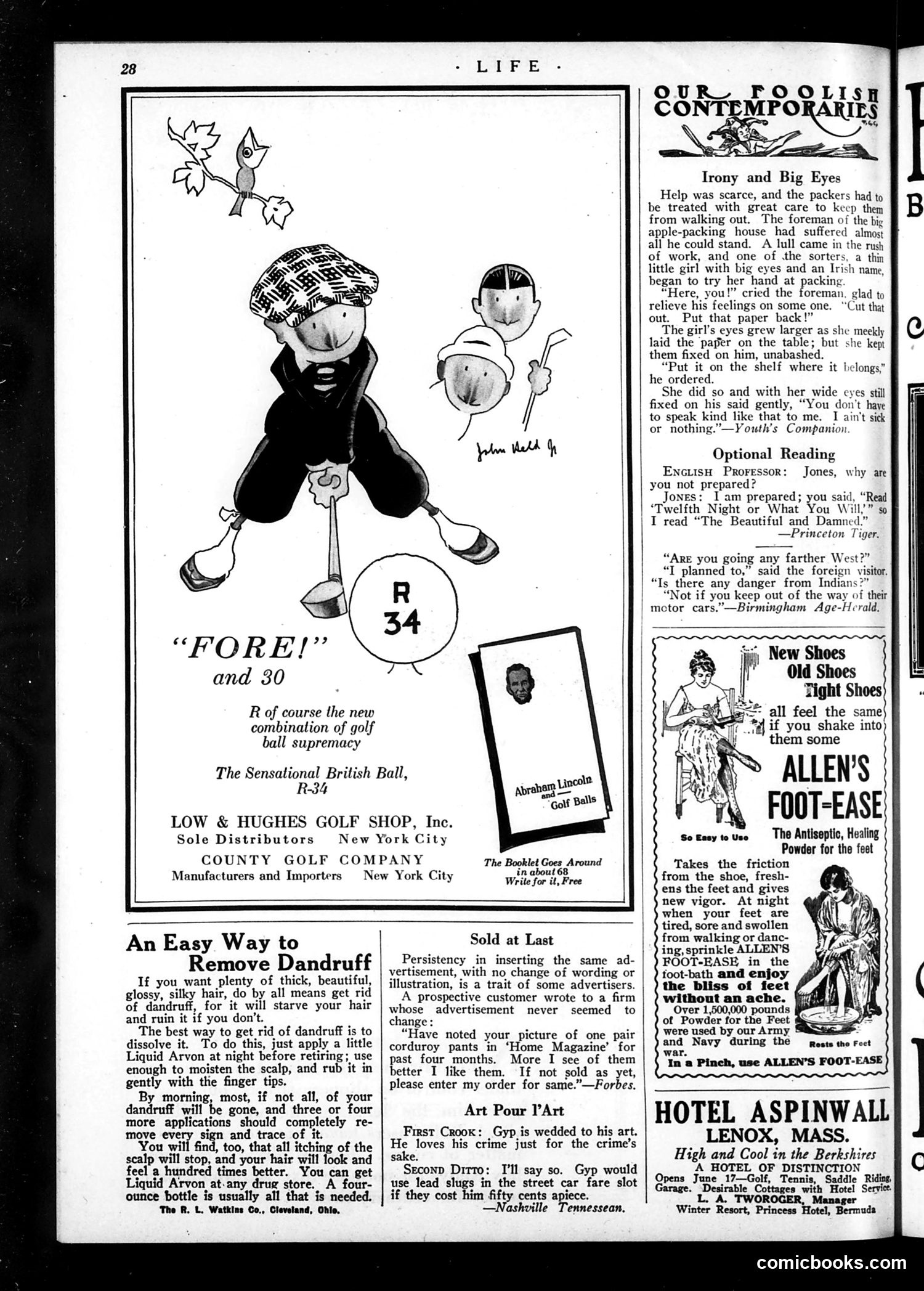
This page is primarily **advertising with inserted humor pieces** rather than political satire. The main cartoon shows a **caricatured golfer** with exaggerated features preparing to swing, labeled "FORE! and 30," advertising the "Sensational British Ball, R-34" golf equipment. The joke appears to reference both the golf term "fore" (warning) and some aspect of the R-34, likely the **British airship R-34** that made headlines for transatlantic flight achievements around this era. The page contains several short comic anecdotes in the section "Our Foolish Contemporaries," including: - A story about a foreman and young female factory worker with "big eyes," playing on ethnic/class dynamics of early 20th-century labor - Academic humor about a student misunderstanding reading assignments - A joke about foreign visitors and American automobiles (suggesting cars are as dangerous as "Indians") These reflect period attitudes toward immigrant workers, class differences, and emerging automobile culture, presented as light comedy rather than serious critique.
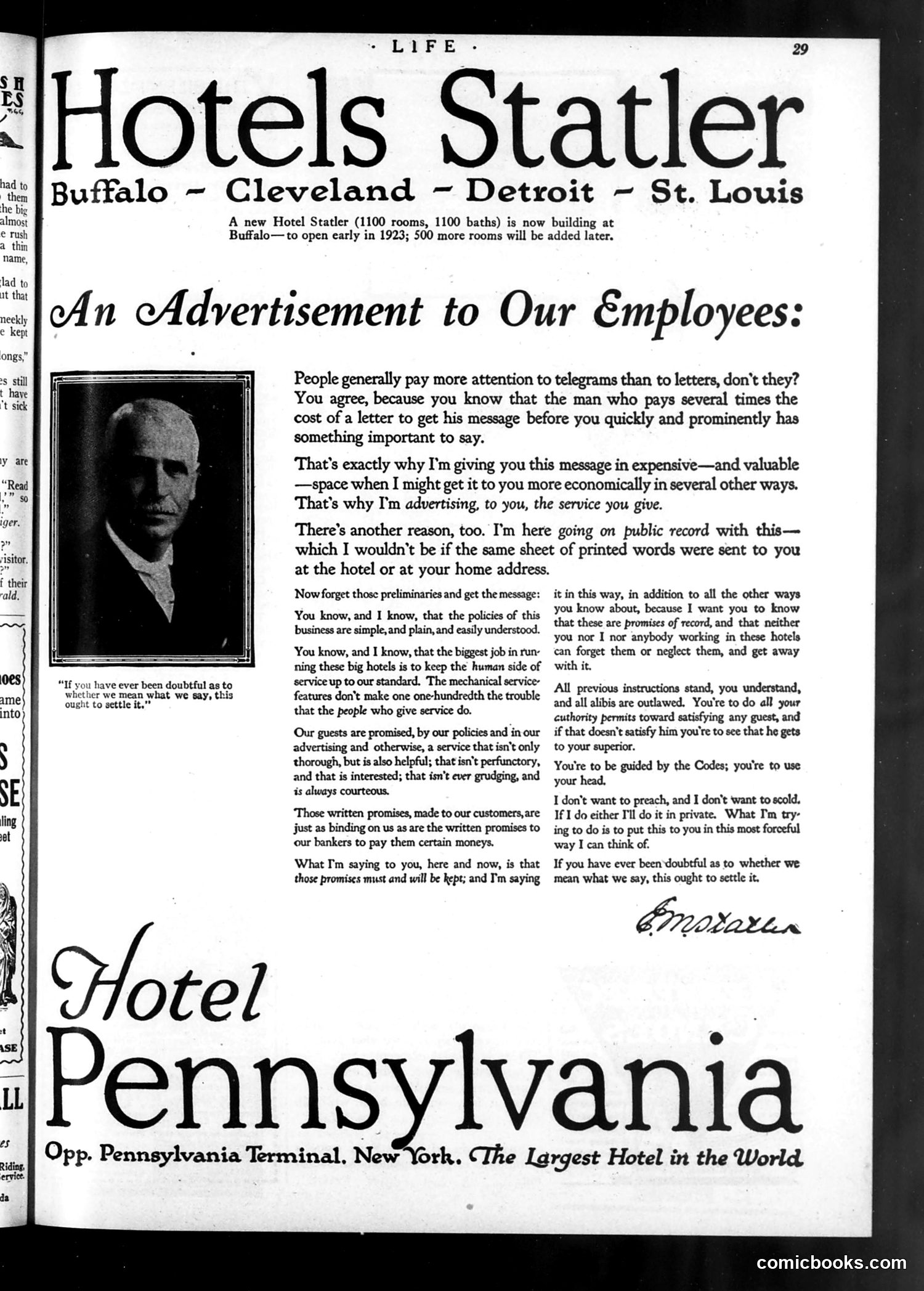
This page is primarily **advertising, not satire or comedy**. It contains two hotel advertisements: 1. **Hotels Statler** (top): Announces new properties opening in Buffalo, Cleveland, Detroit, and St. Louis, with a new Buffalo location opening early 1923. 2. **Hotel Pennsylvania** (bottom): Promotes "The Largest Hotel in the World" near Pennsylvania Terminal in New York. The center section is an **internal company message** from what appears to be a hotel management figure (photo included) to employees. It's a serious, direct appeal emphasizing that the company's written promises to guests are binding—as binding as promises to banks. Management warns employees that service standards cannot be neglected and that all previous instructions remain in effect. The tone is earnest corporate communication, using the magazine's valuable advertising space to reinforce employee accountability rather than make a humorous point. This reflects early 20th-century management philosophy: publicly shaming or motivating workers through mass media.
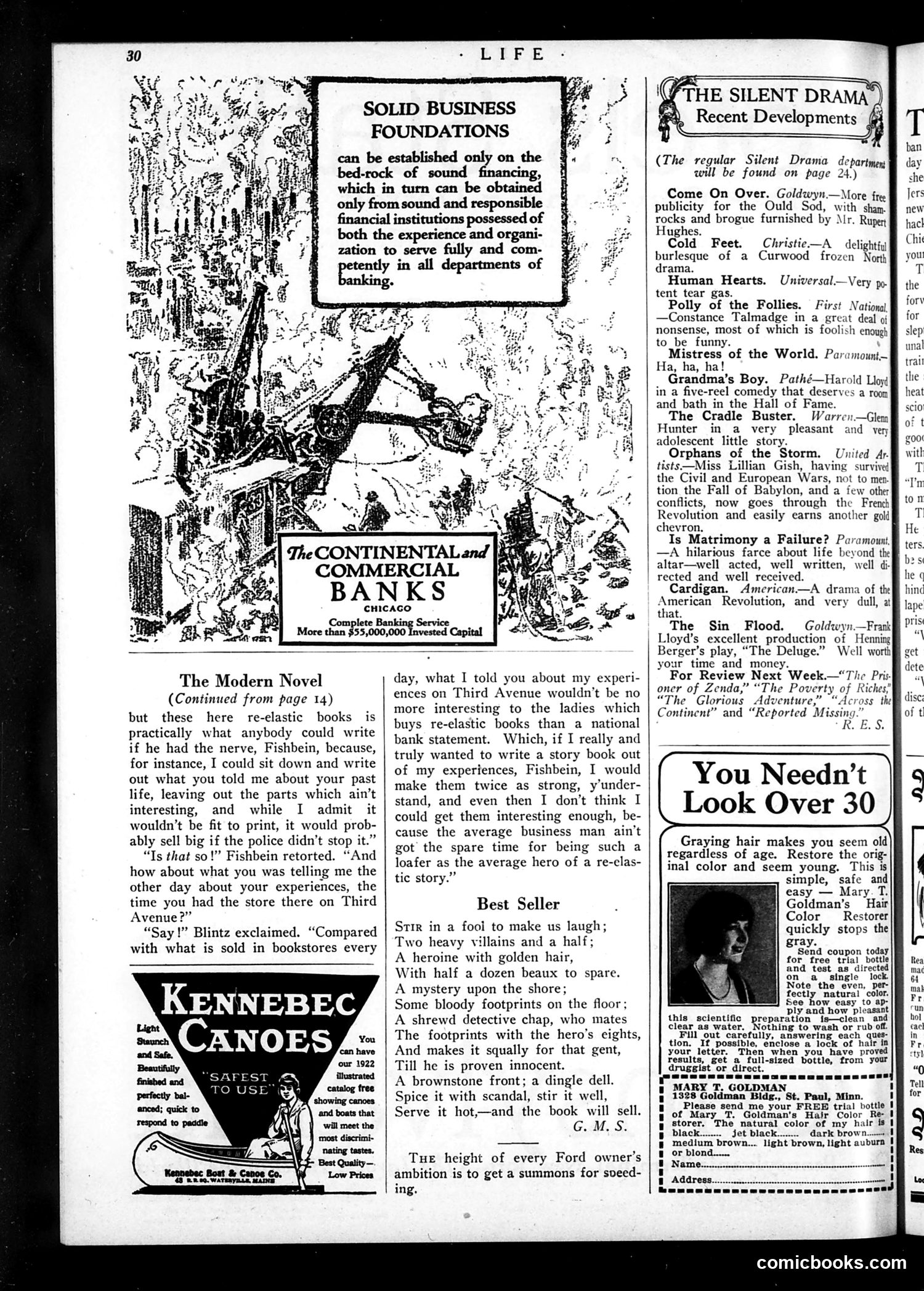
This page from *Life* magazine contains primarily **advertisements and entertainment reviews** rather than political satire. The main content includes: 1. **Banking advertisements** for Continental and Commercial Banks of Chicago, using conventional business messaging about "sound financing." 2. **"The Modern Novel" essay** (continued from page 14)—a humorous dialogue between characters Fishbein and Blintz discussing why modern "re-elastic" novels sell despite being poorly written. The satire targets **lowbrow commercial fiction**, mocking readers' appetite for sensational plots over substance. 3. **"Best Seller" poem** by G.M.S.—a recipe-style satire listing clichéd novel ingredients (fools, villains, golden-haired heroines, mysteries, detectives) that guarantee commercial success. 4. **Silent film reviews** for various movies, mostly positive assessments. 5. **Hair color restoration advertisement** (Goldman's Hair Restorer). The page's humor targets **commercial publishing trends and lowbrow entertainment preferences** of the 1920s rather than political figures or events.
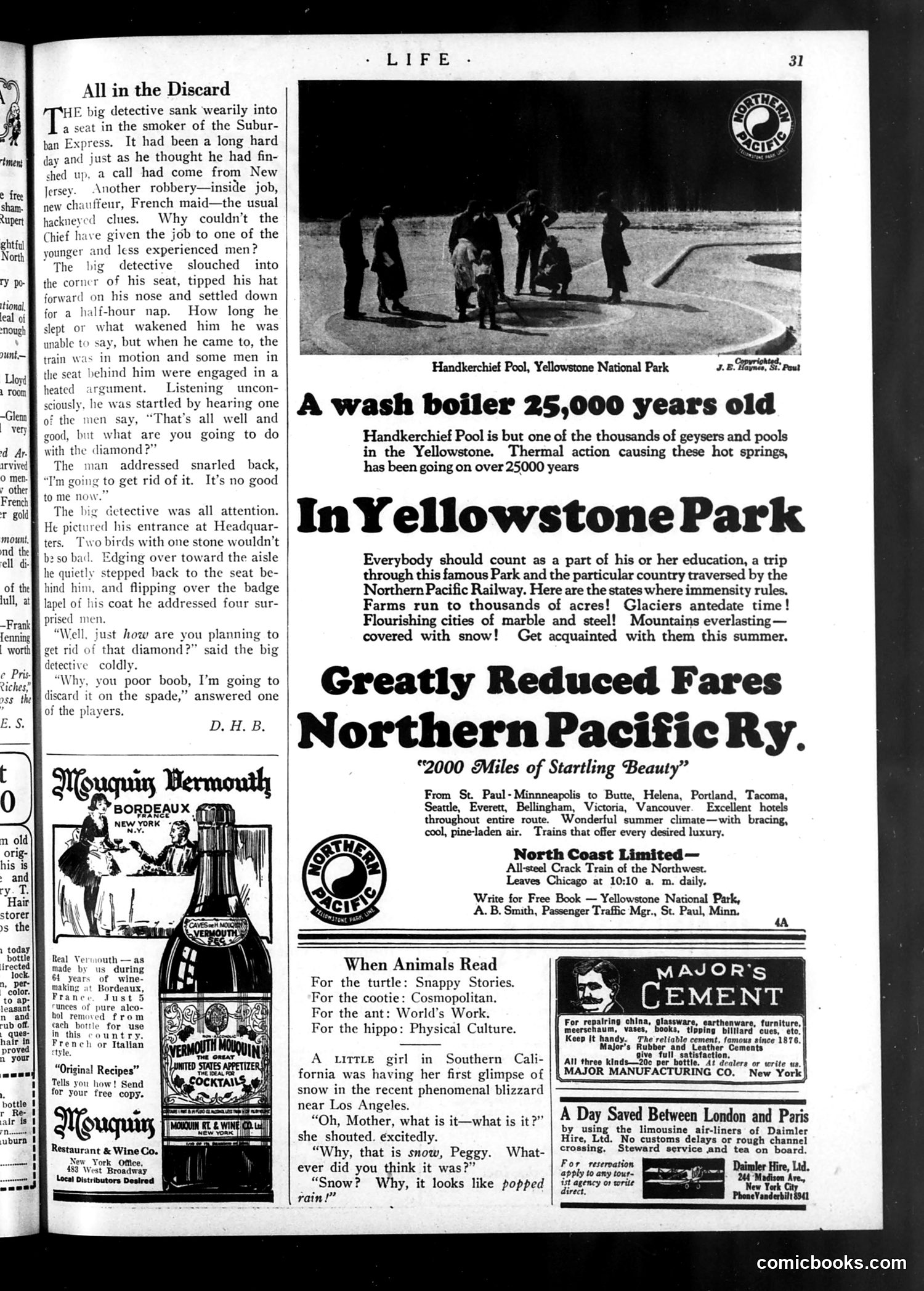
This page contains a short detective story titled "All in the Discard" about a weary detective overhearing criminals on a train discussing how to dispose of a stolen diamond. The story's punchline appears to be that one criminal plans to "discard it on the spade"—likely meaning to play it as a card in a spade suit, suggesting the "diamond" is actually a playing card, not a jewel. The joke deflates the detective's expectations of serious crime. The remainder of the page consists primarily of **advertisements**, including promotions for Northern Pacific Railway's Yellowstone Park tours, Monagin Vermouth liqueur, and Major's Cement. There is also a brief humorous filler piece titled "When Animals Read" making puns about magazine subscriptions for animals. This is a typical Life magazine layout from its early satirical period, mixing short fiction with advertising and light humor rather than political cartoons.
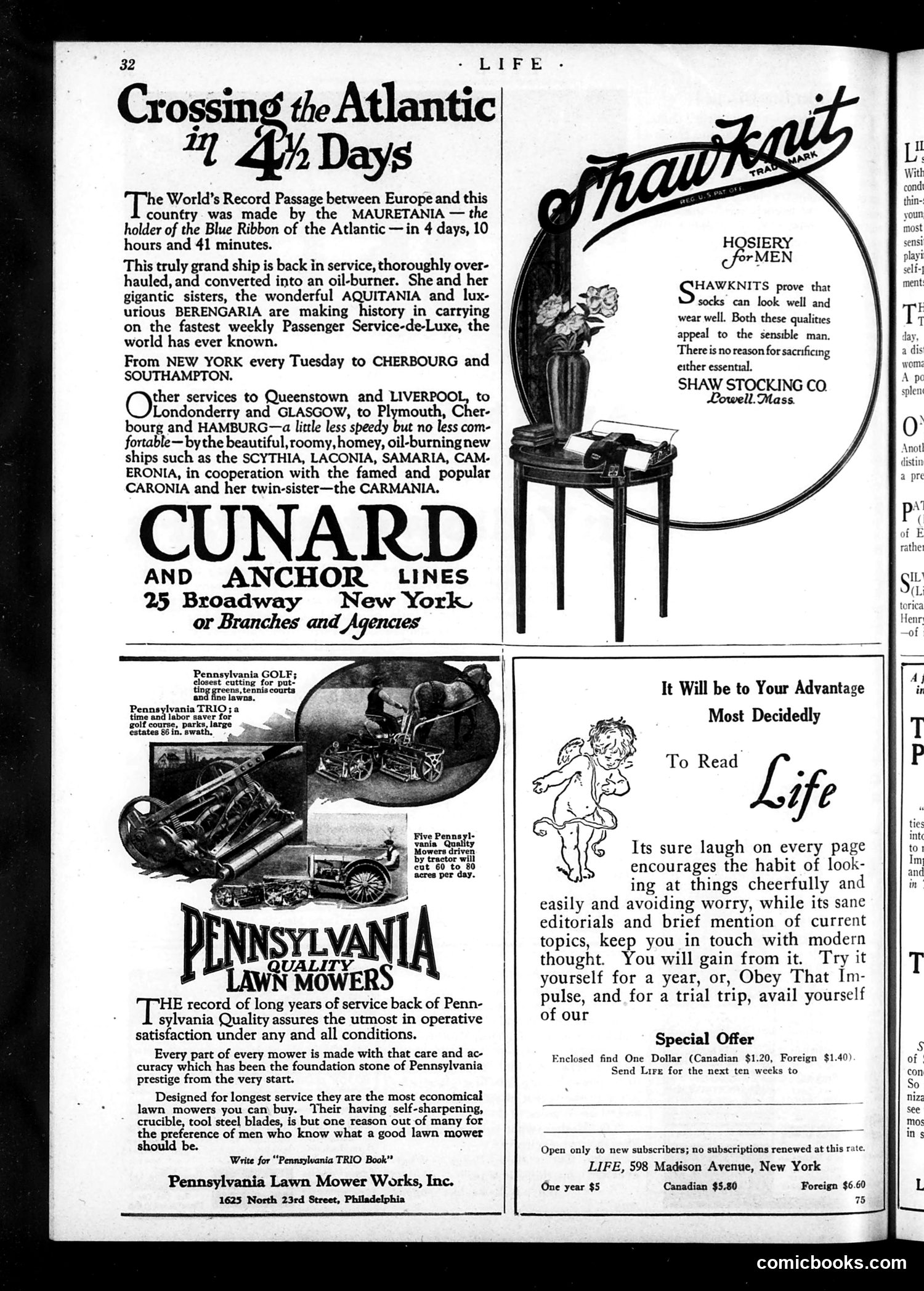
This is primarily an **advertising page** from Life magazine, not a satirical cartoon page. The main content consists of four distinct advertisements: 1. **Cunard and Anchor Lines** (top left): Promotes transatlantic ocean liner service, highlighting the *Mauretania's* speed record crossing in 4½ days and advertising regular passenger routes from New York to European ports. 2. **Shawknit Hosiery** (top right): Features a stylized illustration of a woman's leg in a stocking, advertising men's socks that combine good appearance with durability. 3. **Pennsylvania Lawn Mower Works** (bottom left): Showcases their "TRIO" model mower with technical specifications, emphasizing quality construction and longevity. 4. **Life Magazine itself** (bottom right): A house ad encouraging subscription by promising humor and current-events coverage, offering a discounted trial subscription. There is **no political satire or editorial cartooning** on this page—it's a straightforward commercial advertising compilation typical of 1920s-era magazine layout.
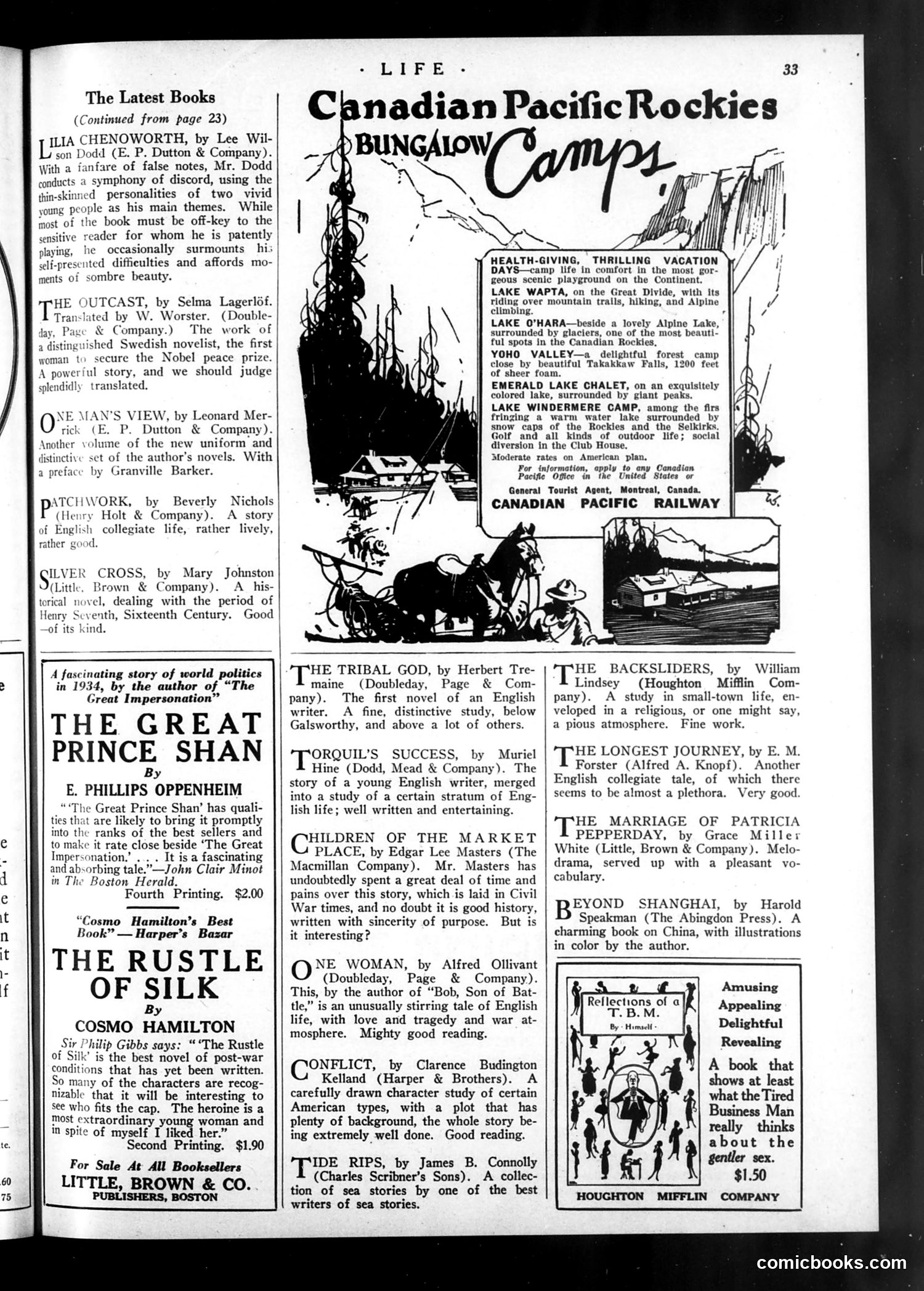
This page is primarily a **book review section** with advertising. The main content lists newly published novels with brief critical assessments—typical of Life's literary coverage during this era. Notable books reviewed include E. Phillips Oppenheim's *The Great Prince Shan*, described as "world politics in 1934," suggesting anxieties about future international conflict. Cosmo Hamilton's *The Rustle of Silk* is praised for depicting "post-war conditions," referencing WWI's aftermath. The page's dominant visual element is a **Canadian Pacific Railway advertisement** for mountain resort camps (Lake Wapta, Yoho Valley, Emerald Lake Chalet), featuring dramatic illustrations of Alpine scenery and horseback riders—marketing leisure travel to wealthy Americans. The book reviews themselves contain no political satire; they're straightforward literary criticism. The page reflects 1920s concerns: post-war recovery, international tensions, and commercialized outdoor recreation for the affluent.
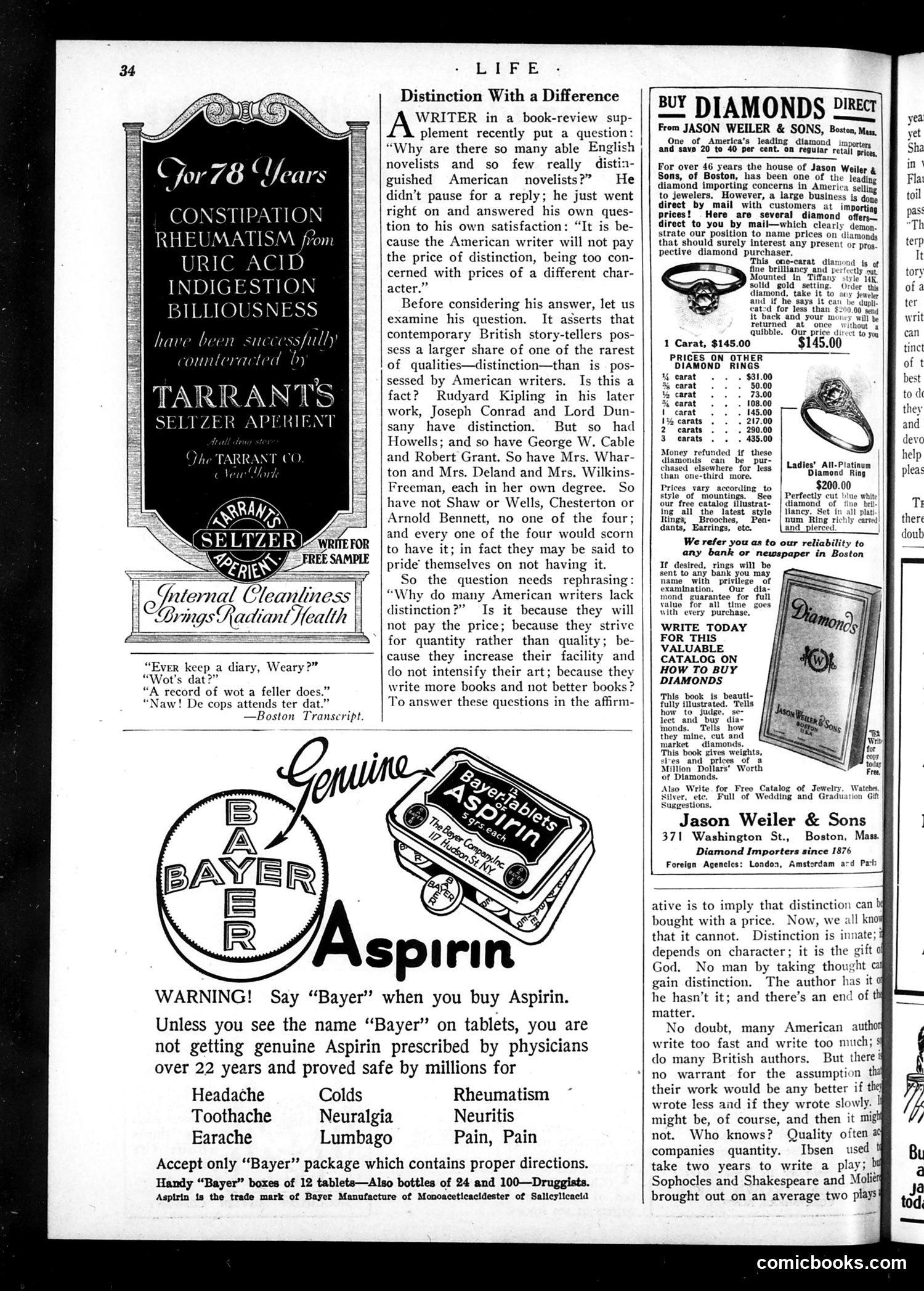
This page primarily consists of **advertisements and light humor**, not political cartoons. The main content is an **editorial essay** arguing that American writers aren't inherently less distinguished than British ones—they simply make different choices. The author refutes the claim that American writers lack "distinction," citing examples like Howells, Cable, and Mrs. Wharton. He suggests American writers prioritize quantity and commercial success over artistic depth. A brief **joke** from the Boston Transcript satirizes police surveillance: when asked if he keeps a diary, a man replies "Naw! De cops attends ter dat"—implying constant police monitoring of citizens' activities. The remainder is **product advertising**: Tarrant's Seltzer Aperient (a digestive aid), Bayer Aspirin (with emphatic warnings to buy only genuine "Bayer" branded tablets), and Jason Weiler & Sons diamonds sold by mail. This appears to be a **typical 1920s Life magazine page**—mixing editorial commentary with commercial advertisements that were the publication's primary revenue source.
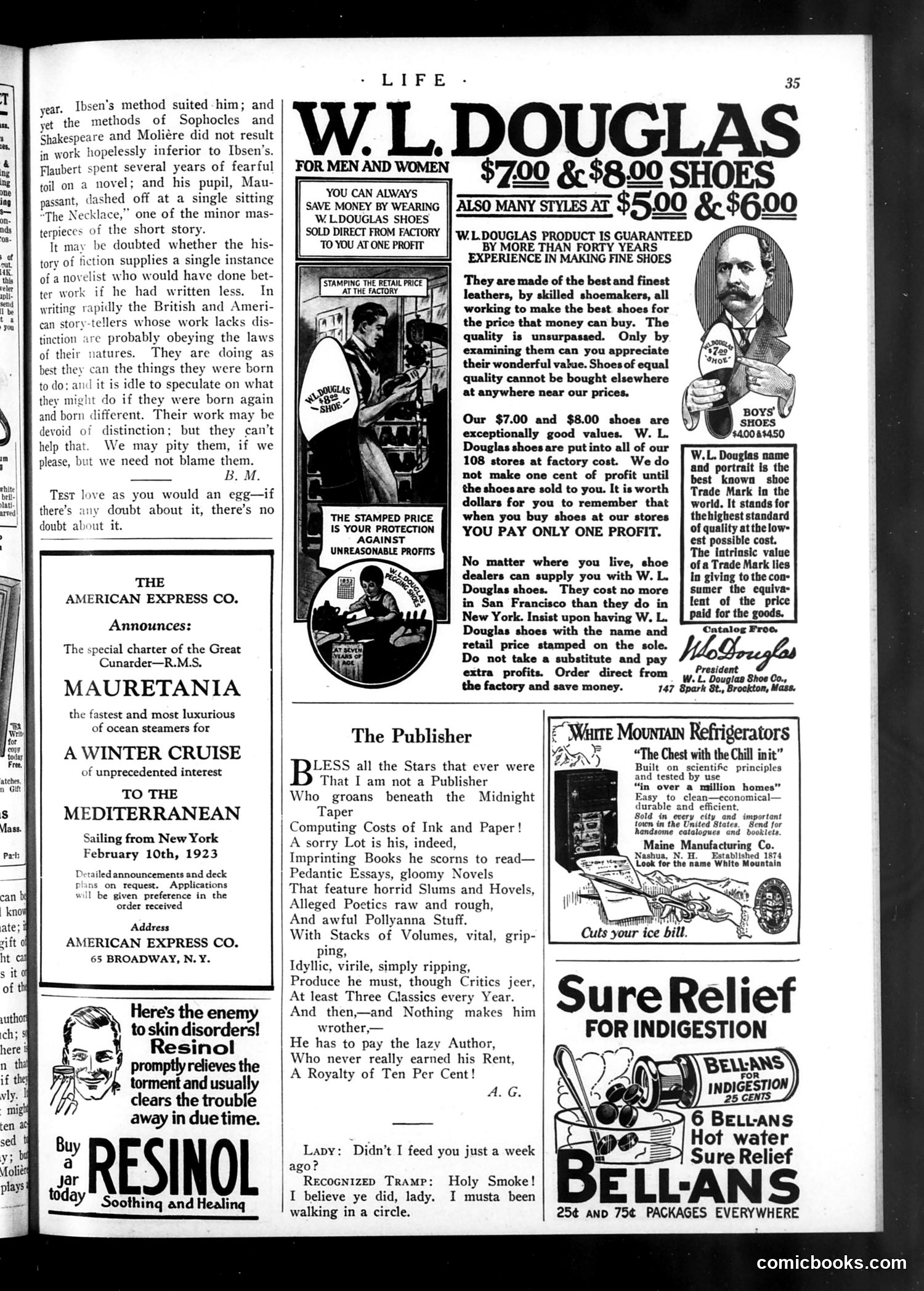
This page is primarily **advertising and light humor**, not political satire. The dominant content features a **W.L. Douglas Shoes advertisement** emphasizing direct factory-to-consumer sales, eliminating middleman profits. The visual shows factory workers and includes portraits promoting the brand's quality and value proposition—common for this era's mail-order shoe marketing. Below is a brief humorous poem titled "The Publisher," credited to A.G., satirizing the publishing industry rather than politics. It humorously complains about publishers' burdens: computing costs, printing books they disdain (pedantic essays, gloomy novels, bad poetry, sentimental "Pollyanna Stuff"). The joke is that publishers suffer financially and creatively from their work. Additional advertisements include **Resinol** (for skin disorders), **American Express cruise announcements**, **White Mountain Refrigerators**, and **Bellans** (indigestion remedy). A small dialogue joke at bottom involves a tramp and lady, unrelated to broader themes. The page reflects 1920s consumer culture and light entertainment rather than serious political commentary.
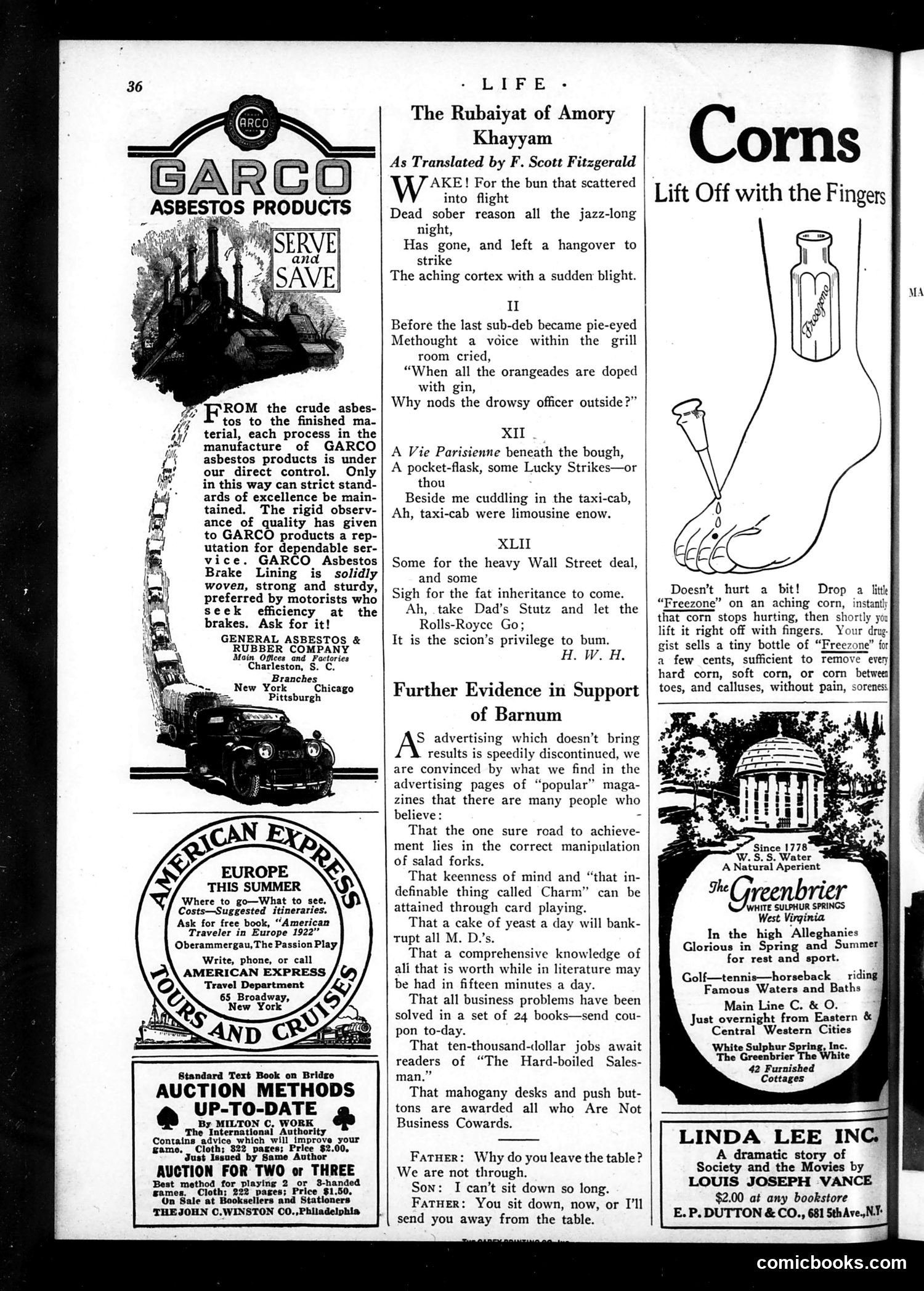
This page consists primarily of **advertisements and satirical poetry**, not political cartoons. The main literary content is a parody titled "The Rubaiyat of Amory Khayyam," credited to F. Scott Fitzgerald. It mockingly rewrites the classic Persian poem in Jazz Age vernacular, satirizing 1920s youth culture: references to hangovers, "sub-debs" (debutantes), gin-spiked drinks, and wealthy young people driving fancy cars like Stutz and Rolls-Royce. The humor targets wealthy, idle youth and Prohibition-era drinking. The "Further Evidence in Support of Barnum" section satirizes gullible consumers who believe advertisement claims—that salad-fork etiquette leads to success, that yeast cakes cure illness, or that self-help books solve business problems. It's skeptical commentary on advertising's manipulative power over the credulous public. The page otherwise contains period advertisements for asbestos products, travel services, and bridge instruction—notably, no warning labels about asbestos's dangers existed then.