
Life, 1922-05-11 · page 19 of 38
Life — May 11, 1922 — page 19: what you’re looking at
What you’re looking at
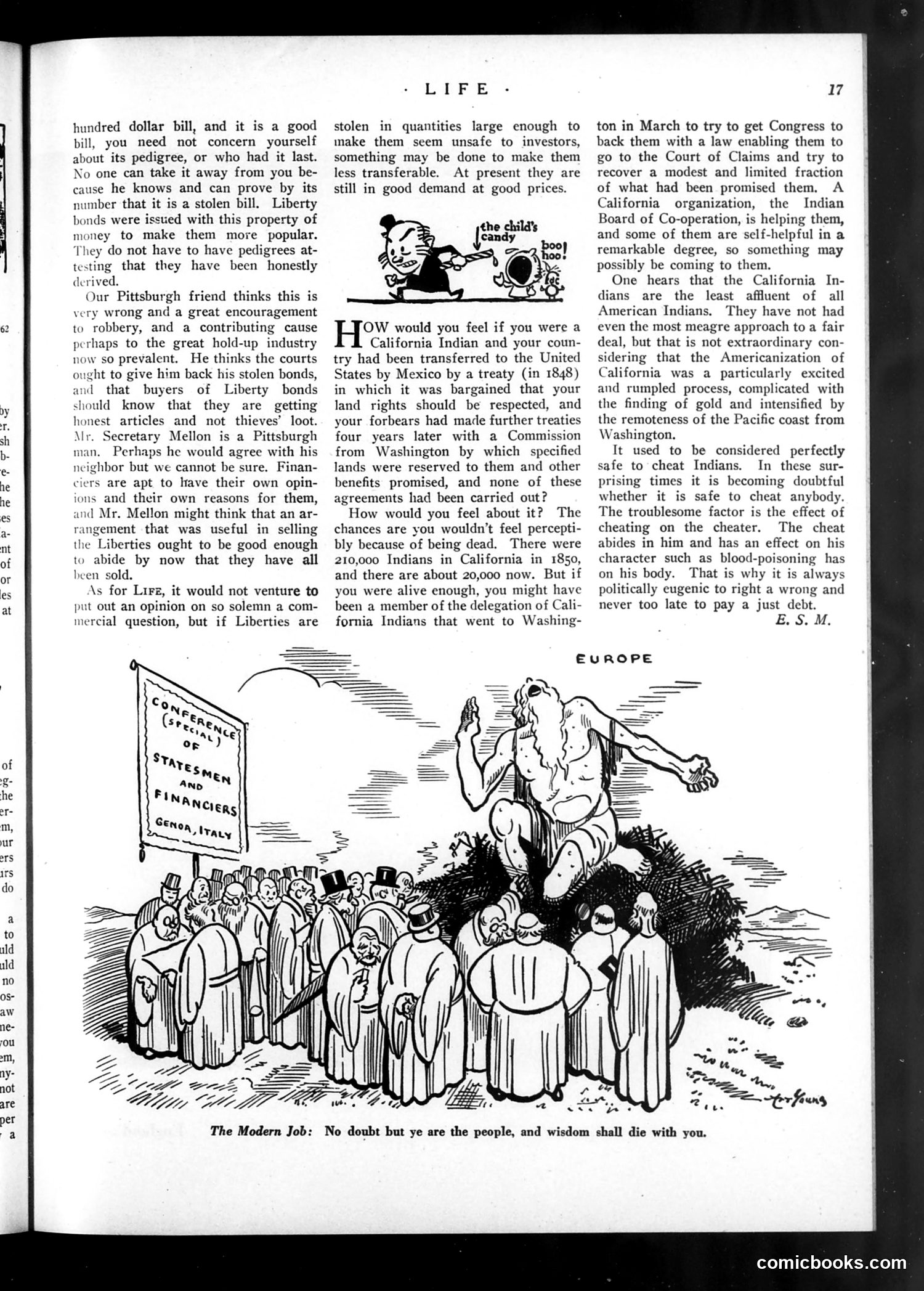
The large political cartoon depicts a bloated, demonic figure looming over a crowd of businessmen and statesmen gathered around a sign reading "Conference of Statesmen and Financiers, Genoa, Italy." **Context:** The Genoa Conference (1922) brought together European and American financial and political leaders to address post-World War I economic reconstruction. The cartoon satirizes their arrogance and ineffectiveness. **The satire:** The monstrous figure represents the accumulated problems—war debt, economic chaos, reparations—that towers over their deliberations. The caption, paraphrasing Job 12:2, mocks their self-importance: these supposedly wise leaders believe only they possess wisdom, yet remain helpless before forces beyond their control. **Point:** Despite their prestigious gathering and confident assertions, these financiers and statesmen are comically impotent against the massive problems confronting them. The satire critiques elite overconfidence during a period of genuine international crisis.
📄 Transcribed text from this page (OCR, searchable)
Machine-transcribed from the original scan — historical spelling and the odd misread are preserved.
hundred dollar bill, and it is a good bill, you need not concern yourself about its pedigree, or who had it last. No one can take it away from you be- cause he knows and can prove by its number that it is a stolen bill. Liberty bonds were issued with this property of money to make them more popular. They do not have to have pedigrees at- testing that they have been honestly derived. Our Pittsburgh friend thinks this is very wrong and a great encouragement to robbery, and a contributing cause perhaps to the great hold-up industry now so prevalent. He thinks the courts ought to give him back his stolen bonds, and that buyers of Liberty bonds should know that they are getting honest articles and not thieves’ loot. Mr. Secretary Mellon is a Pittsburgh man. Perhaps he would agree with his neighbor but we cannot be sure. Finan- ciers are apt to have their own opin- ions and their own reasons for them, and Mr. Mellon might think that an ar- rangement that was useful in selling the Liberties ought to be good enough to abide by now that they have all been sold. \s for Lirz, it would not venture to put out an opinion on so solemn a com- mercial question, but if Liberties are LIFE stolen in quantities large enough to make them seem unsafe to investors, something may be done to make them less transferable. At present they are still in good demand at good prices. OW would you feel if you were a California Indian and your coun- try had been transferred to the United States by Mexico by a treaty (in 1848) in which it was bargained that your land rights should be respected, and your forbears had made further treaties four years later with a Commission from Washington by which specified lands were reserved to them and other benefits promised, and none of these agreements had been carried out? How would you feel about it? The chances are you wouldn’t feel percepti- bly because of being dead. There were 210,000 Indians in California in 1850, and there are about 20,000 now. But if you were alive enough, you might have been a member of the delegation of Cali- fornia Indians that went to Washing- 17 ton in March to try to get Congress to back them with a law enabling them to go to the Court of Claims and try to recover a modest and limited fraction of what had been promised them. A California organization, the Indian Board of Co-operation, is helping them, and some of them are self-helpful in a remarkable degree, so something may possibly be coming to them. One hears that the California In- dians are the least affluent of all American Indians. They have not had even the most meagre approach to a fair deal, but that is not extraordinary con- sidering that the Americanization of California was a particularly excited and rumpled process, complicated with the finding of gold and intensified by the remoteness of the Pacific coast from Washington. It used to be considered perfectly safe to cheat Indians. In these sur- prising times it is becoming doubtful whether it is safe to cheat anybody. The troublesome factor is the effect of cheating on the cheater. The cheat abides in him and has an effect on his character such as blood-poisoning has on his body. That is why it is always politically eugenic to right a wrong and never too late to pay a just debt. E. S. M. The Modern Job: No doubt but ye are the people, and wisdom shall die with you. comicbooks.com