
Life, 1922-05-11 · page 18 of 38
Life — May 11, 1922 — page 18: what you’re looking at
What you’re looking at
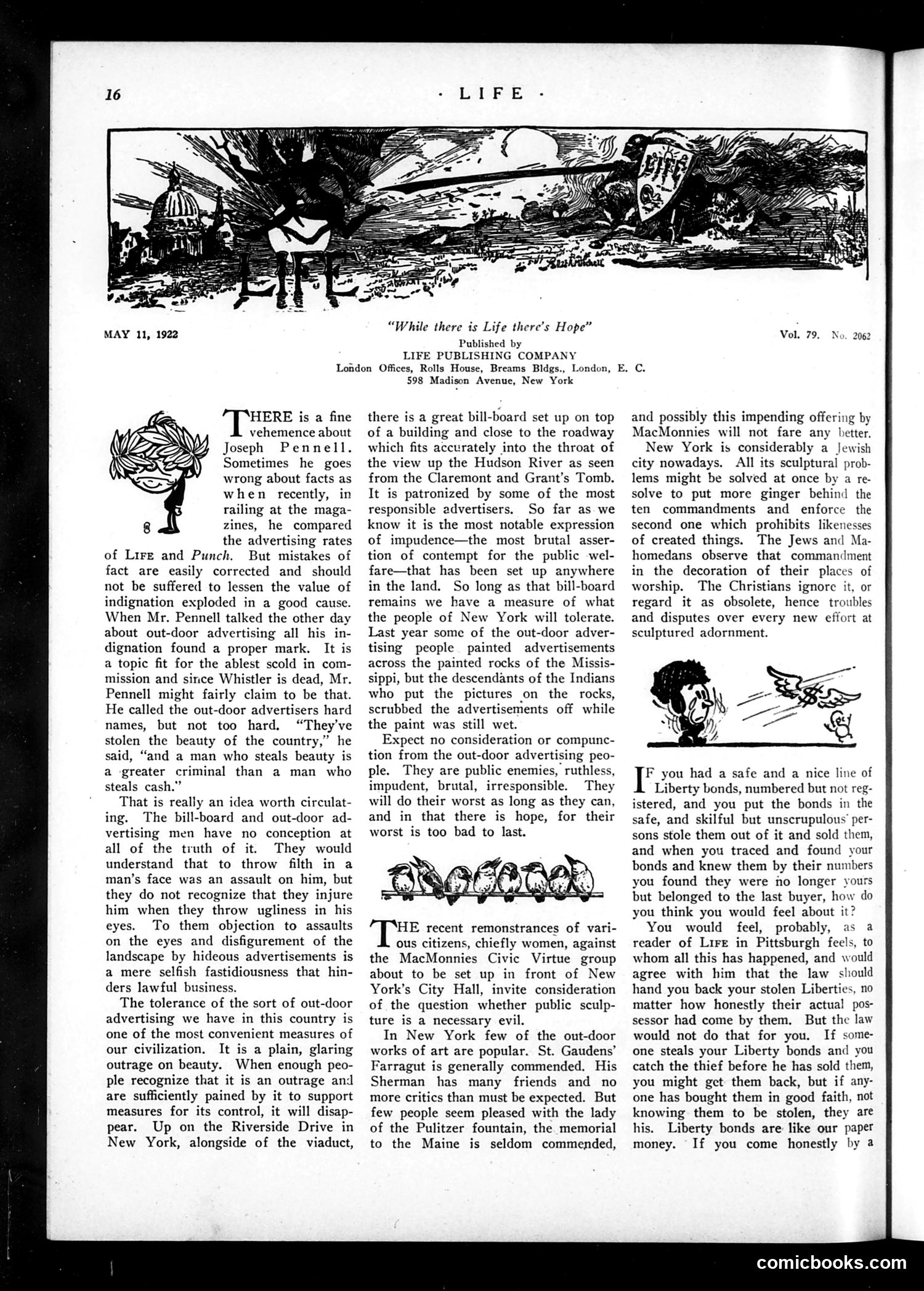
This page contains Joseph Pennell's editorial attack on billboard advertising in America, particularly the eyesore on Riverside Drive overlooking the Hudson River near Grant's Tomb. Pennell argues that outdoor advertisers are "public enemies"—ruthless, brutal, and indifferent to beauty. He compares their assault on the landscape to physical violence, noting that Native Americans once removed advertisements painted on Mississippi rocks, showing more civic respect than modern Americans. The article then pivots to discuss the MacMonnies "Civic Virtue" sculpture soon to be installed at New York City Hall, questioning whether public outdoor art serves the city well. It notes that few New York outdoor artworks are popular, though St. Gaudens' Farragut is generally admired. The piece hints at controversy surrounding the MacMonnies work, possibly referencing its provocative subject matter or reception in the Jewish community (New York being "considerably a Jewish city").
📄 Transcribed text from this page (OCR, searchable)
Machine-transcribed from the original scan — historical spelling and the odd misread are preserved.
MAY 11, 1922 isn iy Al ary ¢ “While there is Life there’s Hope” Published by LIFE PUBLISHING COMPANY London Offices, Rolls House, Breams Bldgs., London, E. C. ‘HERE is a fine vehemence about Joseph Pennell. Sometimes he goes wrong about facts as when recently, in railing at the maga- zines, he compared the advertising rates of Lire and Punch. But mistakes of fact are easily corrected and should not be suffered to lessen the value of indignation exploded in a good cause. When Mr. Pennell talked the other day about out-door advertising all his in- dignation found a proper mark. It is a topic fit for the ablest scold in com- mission and sirice Whistler is dead, Mr. Pennell might fairly claim to be that. He called the out-door advertisers hard names, but not too hard, “They’ve stolen the beauty of the country,” he said, “and a man who steals beauty is a greater criminal than a man who steals cash.” That is really an idea worth circulat- ing. The bill-board and out-door ad- vertising men have no conception at all of the truth of it. They would understand that to throw filth in a man’s face was an assault on him, but they do not recognize that they injure him when they throw ugliness in his eyes. To them objection to assaults on the eyes and disfigurement of the landscape by hideous advertisements is a mere selfish fastidiousness that hin- ders lawful business. The tolerance of the sort of out-door advertising we have in this country is one of the most convenient measures of our civilization. It is a plain, glaring outrage on beauty. When enough peo- ple recognize that it is an outrage and are sufficiently pained by it to support measures for its control, it will disap- pear. Up on the Riverside Drive in New York, alongside of the viaduct, 598 Madison Avenue, New York there is a great bill-board set up on top of a building and close to the roadway which fits accurately into the throat of the view up the Hudson River as seen from the Claremont and Grant’s Tomb. It is patronized by some of the most responsible advertisers. So far as we know it is the most notable expression of impudence—the most brutal asser- tion of contempt for the public wel- fare—that has been set up anywhere in the land. So long as that bill-board remains we have a measure of what the people of New York will tolerate. Last year some of the out-door adver- tising people painted advertisements across the painted rocks of the Missis- sippi, but the descendants of the Indians who put the pictures on the rocks, scrubbed the advertisements off while the paint was still wet. Expect no consideration or compunc- tion from the out-door advertising peo- ple. They are public enemies, ruthless, impudent, brutal, irresponsible. They will do their worst as long as they can, and in that there is hope, for their worst is too bad to last. ‘HE recent remonstrances of vari- ous citizens, chiefly women, against the MacMonnies Civic Virtue group about to be set up in front of New York’s City Hall, invite consideration of the question whether public sculp- ture is a necessary evil. In New York few of the out-door works of art are popular. St. Gaudens’ Farragut is generally commended. His Sherman has many friends and no more critics than must be expected. But few people seem pleased with the lady of the Pulitzer fountain, the memorial to the Maine is seldom commended, and possibly this impending offering by MacMonnies will not fare any better. New York is considerably a Jewish city nowadays. All its sculptural prob- lems might be solved at once by a re- solve to put more ginger behind the ten commandments and enforce the second one which prohibits likenesses of created things. The Jews and Ma- homedans observe that commandment in the decoration of their places of worship. The Christians ignore it, or regard it as obsolete, hence troubles and disputes over every new effort at sculptured adornment. aa F you had a safe and a nice line of Liberty bonds, numbered but not reg- istered, and you put the bonds in the safe, and skilful but unscrupulous’ per- sons stole them out of it and sold them, and when you traced and found your bonds and knew them by their numbers you found they were no longer yours but belonged to the last buyer, how do you think you would feel about it? You would feel, probably, as a reader of Lire in Pittsburgh feels, to whom all this has happened, and would agree with him that the law should hand you back your stolen Liberties, no matter how honestly their actual pos- sessor had come by them. But the law would not do that for you. If some- one steals your Liberty bonds and you catch the thief before he has sold them, you might gct them back, but if any- one has bought them in good faith, not knowing them to be stolen, they are his. Liberty bonds are like our paper money. If you come honestly by @ comicbooks.com