
Life, 1922-05-11 · page 7 of 38
Life — May 11, 1922 — page 7: what you’re looking at
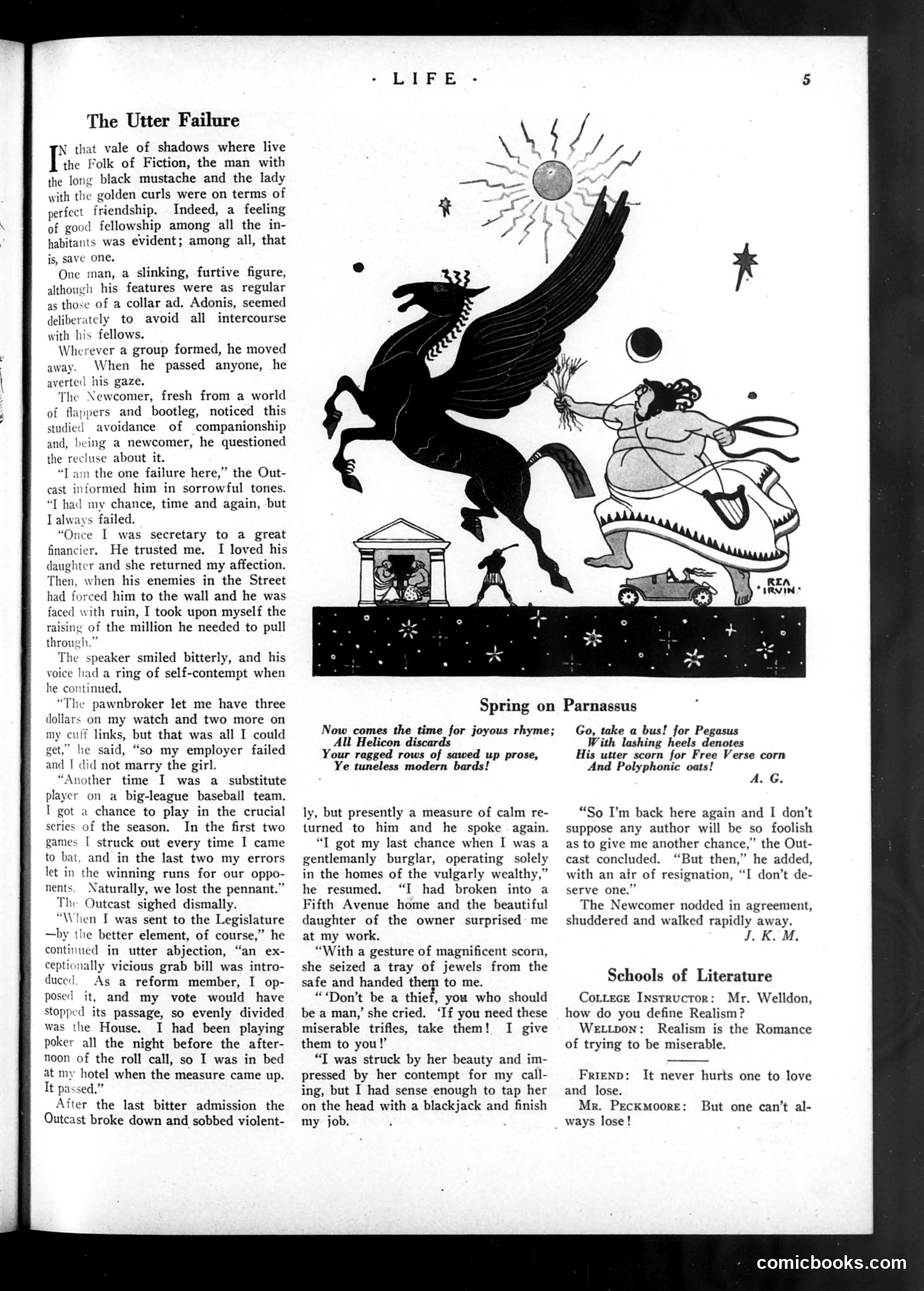
What you’re looking at
This is a whimsical literary satire rather than political commentary. The illustration depicts chaos on Mount Parnassus (the mythological home of the Muses and poetry), with a rearing horse, a fleeing figure, and various fantastical elements amid stars. The accompanying poem mocks modern poetry's decline, using classical allusions. The text laments that contemporary verse lacks merit compared to classical standards—"Helicon discards / Your ragged routs of sewed up prose, / Ye timeless modern bards!" This reflects early 20th-century literary criticism dismissing modernist poetry as inferior to traditional forms. The satire targets contemporary poets and their experimental work, suggesting they've abandoned true poetic craft for incoherent "prose." The mythological setting emphasizes what's been lost from classical literary traditions.
📄 Transcribed text from this page (OCR, searchable)
Machine-transcribed from the original scan — historical spelling and the odd misread are preserved.
The Utter Failure N that vale of shadows where live the Folk of Fiction, the man with the long black mustache and the lady with the golden curls were on terms of perfect friendship. Indeed, a feeling of good fellowship among all the in- habitants was evident; among all, that is, save one. One man, a slinking, furtive figure, although his features were as regular as those of a collar ad. Adonis, seemed deliberately to avoid all intercourse with his fellows. Wherever a group formed, he moved away. When he passed anyone, he averted his gaze. The Newcomer, fresh from a world of flappers and bootleg, noticed this studied avoidance of companionship and, being a newcomer, he questioned the recluse about it. “Tam the one failure here,” the Out- cast informed him in sorrowful tones. “I had my chance, time and again, but was secretary to a great financier. He trusted me. I loved his daughter and she returned my affection. Then, when his enemies in the Street had forced him to the wall and he was vith ruin, I took upon myself the f the million he needed to pull faced The speaker smiled bitterly, and his voice had a ring of self-contempt when he continued. “The pawnbroker let me have three dollars on my watch and two more on y links, but that was all I could id, “so my employer failed and I did not marry the girl. “Another time I was a_ substitute player on a big-league baseball team. I got a chance to play in the crucial series of the season. In the first two games I struck out every time I came to bat, and in the last two my errors let in the winning runs for our oppo- nents. Naturally, we lost the pennant.” The Outcast sighed dismally. \vhen I was sent to the Legislature —by the better element, of course,” he continued in utter abjection, “an ex- ceptionally vicious grab bill was intro- duce As a reform member, I op- Posed it, and my vote would have stopped its passage, so evenly divided was the House. I had been playing poker all the night before the after- noon of the roll call, so I was in bed at my hotel when the measure came up. 1d” After the last bitter admission the Outcast broke down and sobbed violent- Spring on Parnassus Now comes the time for joyous rhyme; All Helicon discards Your ragged rows of sawed up prose, Ye tuneless modern bards! ly, but presently a measure of calm re- turned to him and he spoke again. “I got my last chance when I was a gentlemanly burglar, operating solely in the homes of the vulgarly wealth he resumed. “I had broken into a Fifth Avenue home and the beautiful daughter of the owner surprised me at my work, “With a gesture of magnificent scorn, she seized a tray of jewels from the safe and handed them to me. “Don’t be a thief, you who should be a man,’ she cried. ‘If you need these miserable trifles, take them! I give them to you!’ “I was struck by her beauty and im- pressed by her contempt for my call- ing, but I had sense enough to tap her on the head with a blackjack and finish my job. Go, take a bus! for Pegasus With lashing heels denotes His utter scorn for Free Verse corn And Polyphonic oats! A. G. “So I’m back here again and I don’t suppose any author will be so foolish as to give me another chance,” the Out- cast concluded. “But then,” he added, with an air of resignation, “I don’t de- serve one.” The Newcomer nodded in agreement, shuddered and walked rapidly away. Jo KM, Schools of Literature Cottece Instructor: Mr. Welldon, how do you define Realism? WeLtpon: Realism is the Romance of trying to be miserable. Frienp: It never hurts one to love and lose. Mr. PEcKMOORE: ways lose! But one can’t al- comicbooks.com