
Life, 1922-05-11 · page 25 of 38
Life — May 11, 1922 — page 25: what you’re looking at
What you’re looking at
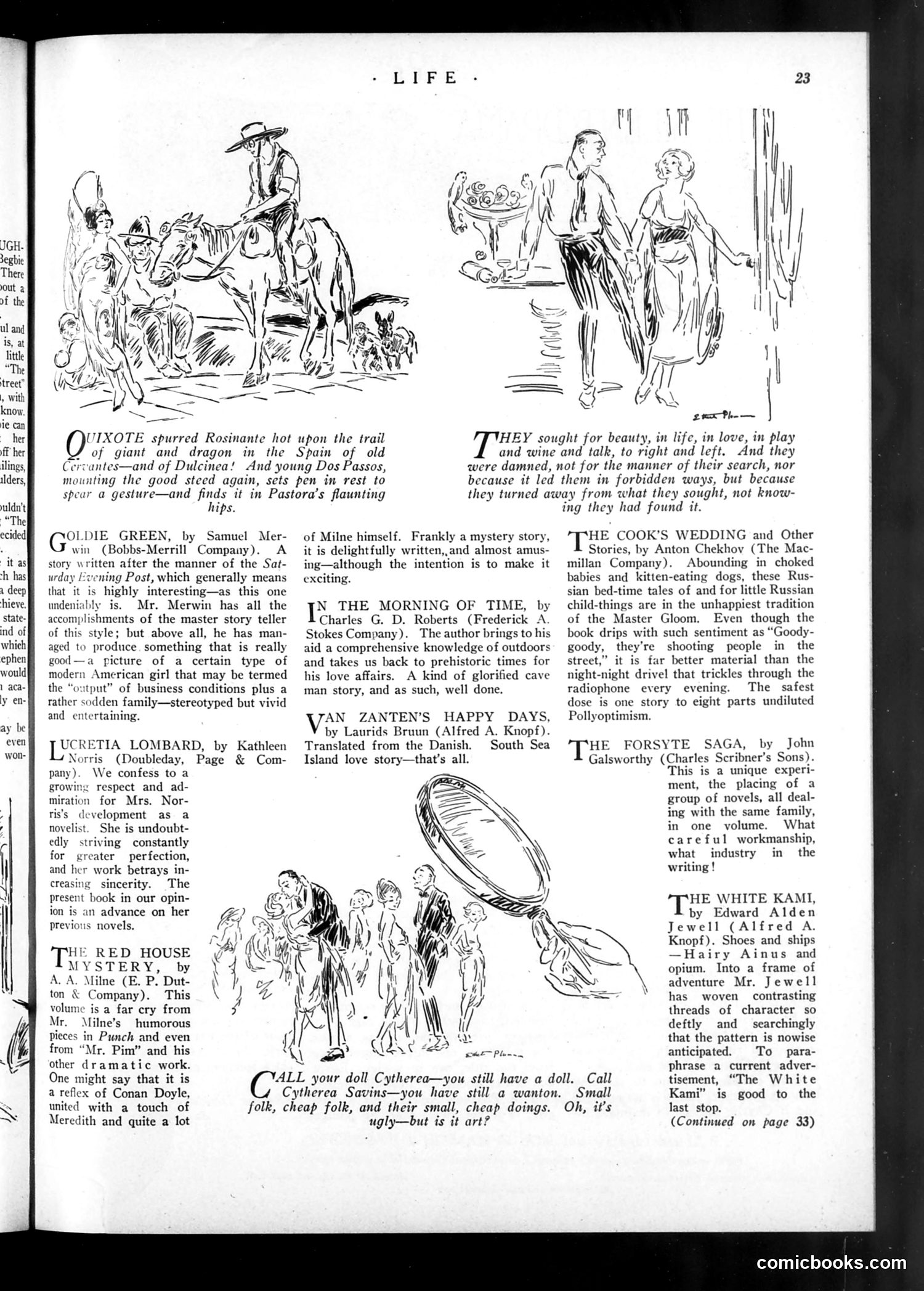
This page presents book reviews from *Life*, the satirical American magazine. The two illustrations are decorative rather than political cartoons—they accompany literary commentary. The left sketch depicts Don Quixote on horseback, referencing a review of a novel by "young Dos Passos" that echoes Cervantes' classic tale. The right illustration shows people in casual repose, accompanying a passage about characters seeking "beauty, in life, in love, in play." The reviews themselves are snippy cultural criticism typical of *Life*'s approach. Notable is the dismissal of Chekhov's stories as "unhappiest tradition" and "night-night drivel," reflecting American readers' preference for lighter fare over Russian literary gloom. The magazine praises certain authors (like Kathleen Norris for "increasing sincerity") while condescending to others. This reflects 1920s American literary tastes and *Life*'s role as arbiter of middlebrow culture—witty, somewhat snobbish commentary on contemporary books for educated readers.
📄 Transcribed text from this page (OCR, searchable)
Machine-transcribed from the original scan — historical spelling and the odd misread are preserved.
treet” , with UIXOTE spurred Rosinante hot upon the trail of giant and dragon in the Spain of old ntes—and of Dulcinea! And young Dos Passos, mounting the good steed again, sets pen in rest to spear a gesture—and finds it in Pastora’s flaunting hips. OLDIE GREEN, by Samuel Mer- win (Bobbs-Merrill Company). A story written after the manner of the Sat- urday Evening Post, which generally means that it is highly interesting—as this one undeniably is. Mr. Merwin has all the accomplishments of the master story teller of this style; but above all, he has man- aged to produce. something that is really gool—a picture of a certain type of modern American girl that may be termed the “output” of business conditions plus a rather sodden family—stereotyped but vivid and entertaining. Le =TIA LOMBARD, by Kathleen is (Doubleday, Page & Com- pany). We confess to a growing respect and ad- n for Mrs. Nor- velopment as a novelist. She is undoubt- edly striving constantly for greater perfection, and her work betrays in- creasing sincerity. The present book in our opin- ion is an advance on her Previous novels. ris's ¢ HE RED HOUSE MYSTERY, by A. A. Milne (E. P. Dut- ton & Company). This volume is a far cry from Mr. Milne’s humorous Pieces in Punch and even from “Mr. Pim” and his other dramatic work. One might say that it is a reflex of Conan Doyle, united with a touch of Meredith and quite a lot of Milne himself. Frankly a mystery story, it is delightfully written, and almost amus- ing—although the intention is to make it exciting. N THE MORNING OF TIME, by Charles G. D. Roberts (Frederick A Stokes Company). The author brings to his aid a comprehensive knowledge of outdoors and takes us back to prehistoric times for his love affairs. A kind of glorified cave man story, and as such, well done. ‘AN ZANTEN’S HAPPY DAYS, by Laurids Bruun (Alfred A. Knopf). Translated from the Danish. South Sea Island love story—that’s all. | Sree your doll Cytherea—you still have a doll. Call Cytherea Savins—you have still a wanton. folk, cheap folk, and their small, cheap doings. ugly—but is it art? re sought for beauty, in life, in love, in play and wine and talk, to right and left, And they were damned, not for the manner of their search, nor because it led them in forbidden ways, but because they turned away from what they sought, not know- ing they had found it. HE COOK’S WEDDING and Other Stories, by Anton Chekhov (The Mac- millan Company). Abounding in choked babies and kitten-eating dogs, these Rus- sian bed-time tales of and for little Russian child-things are in the unhappiest tradition of the Master Gloom. Even though the book drips with such sentiment as “Goody- goody, they’re shooting people in the street,” it is far better material than the night-night drivel that trickles through the radiophone every evening. The safest dose is one story to eight parts undiluted Pollyoptimism. HE FORSYTE SAGA, by John Galsworthy (Charles Scribner’s Sons). This is a unique experi- ment, the placing of a group of novels, all deal- ing with the same family, in one volume. What careful workmanship, what industry in the writing ! HE WHITE KAMI, by Edward Alden Jewell (Alfred A. Knopf). Shoes and ships —Hairy Ainus and opium. Into a frame of adventure Mr. Jewell has woven contrasting threads of character so deftly and searchingly that the pattern is nowise anticipated. To para- phrase a current adver- tisement, “The White Kami” is good to the last stop. (Continued on page 33) Small Oh, it’s comicbooks.com