
Life, 1922-05-11 · page 26 of 38
Life — May 11, 1922 — page 26: what you’re looking at
What you’re looking at
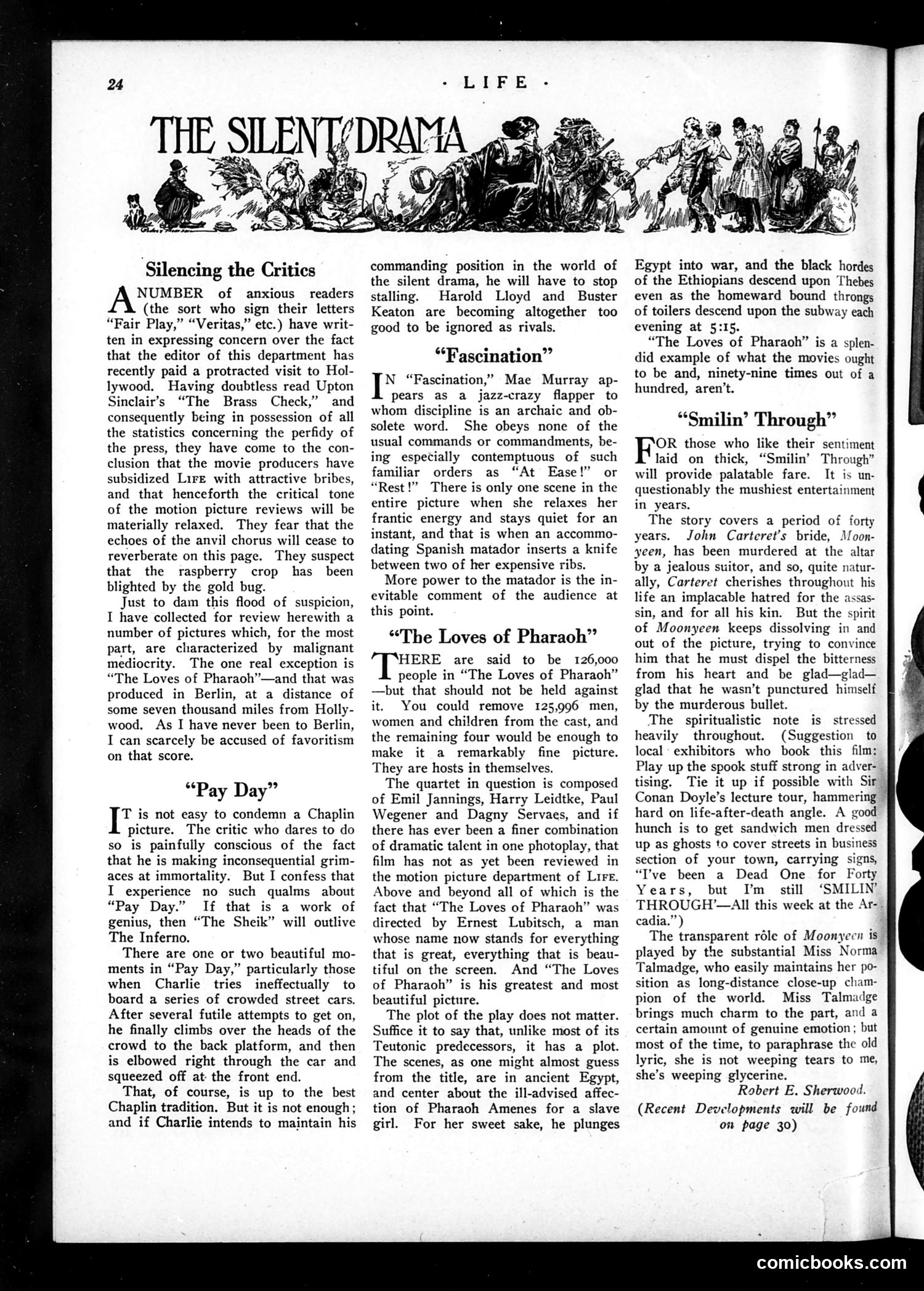
This is a film criticism column from Life magazine's satirical section. The header illustration shows characters from silent films. **Main Content:** The critic addresses readers' suspicion that Hollywood studios bribed him during a recent visit, worried he'd soften his reviews. He defensively lists mediocre films he's critiqued, then praises "The Loves of Pharaoh" (a German production, conveniently distant from Hollywood influence). **Specific Reviews:** - **"Pay Day"** (Chaplin): Dismissively argues it's overrated—if this is genius, then "The Sheik" rivals Dante's *Inferno*. Notes Harold Lloyd and Buster Keaton are becoming competitive rivals. - **"Fascination"** (Mae Murray): Mocks the flapper actress's undisciplined character, sardonically suggesting only a matador's knife between her ribs would quiet her. - **"The Loves of Pharaoh"**: Lavishly praised despite 126,000 extras; argues removing all but four actors wouldn't diminish it. Credits director Ernest Lubitsch as visionary. The satire targets both studio pressure on critics and silent-film industry rivalries of the early 1920s.
📄 Transcribed text from this page (OCR, searchable)
Machine-transcribed from the original scan — historical spelling and the odd misread are preserved.
‘Silencing the Critics NUMBER of anxious readers (the sort who sign their letters “Fair Play,” “Veritas,” etc.) have writ- ten in expressing concern over the fact that the editor of this department has recently paid a protracted visit to Hol- lywood. Having doubtless read Upton Sinclair’s “The Brass Check,” and consequently being in possession of all the statistics concerning the perfidy of the press, they have come to the con- clusion that the movie producers have subsidized Lire with attractive bribes, and that henceforth the critical tone of the motion picture reviews will be materially relaxed. They fear that the echoes of the anvil chorus will cease to reverberate on this page. They suspect that the raspberry crop has been blighted by the gold bug. Just to dam this flood of suspicion, I have collected for review herewith a number of pictures which, for the most part, are characterized by malignant mediocrity. The one real exception is “The Loves of Pharaoh”—and that was produced in Berlin, at a distance of some seven thousand miles from Holly- wood, As I have never been to Berlin, I can scarcely be accused of favoritism on that score. T is not easy to condemn a Chaplin picture. The critic who dares to do so is painfully conscious of the fact that he is making inconsequential grim- aces at immortality. But I confess that I experience no such qualms about “Pay Day.” If that is a work of genius, then “The Sheik” will outlive The Inferno. There are one or two beautiful mo- ments in “Pay Day,” particularly those when Charlie tries ineffectually to board a series of crowded street cars. After several futile attempts to get on, he finally climbs over the heads of the crowd to the back platform, and then is elbowed right through the car and squeezed off at- the front end. That, of course, is up to the best Chaplin tradition. But it is not enough; and if Charlie intends to maintain his commanding position in the world of the silent drama, he will have to stop stalling. Harold Lloyd and Buster Keaton are becoming altogether too good to be ignored as rivals. “Fascination” N “Fascination,” Mae Murray ap- pears as a jazz-crazy flapper to whom discipline is an archaic and ob- solete word. She obeys none of the usual commands or commandments, be- ing especially contemptuous of such familiar orders as “At Ease!” or “Rest!” There is only one scene in the entire picture when she relaxes her frantic energy and stays quiet for an instant, and that is when an accommo- dating Spanish matador inserts a knife between two of her expensive ribs. More power to the matador is the in- evitable comment of the audience at this point. “The Loves of Pharaoh” ‘HERE are said to be 126,000 people in “The Loves of Pharaoh” —but that should not be held against it. You could remove 125,996 men, women and children from the cast, and the remaining four would be enough to make it a remarkably fine picture. They are hosts in themselves. The quartet in question is composed of Emil Jannings, Harry Leidtke, Paul Wegener and Dagny Servaes, and if there has ever been a finer combination of dramatic talent in one photoplay, that film has not as yet been reviewed in the motion picture department of Lire. Above and beyond all of which is the fact that “The Loves of Pharaoh” was directed by Ernest Lubitsch, a man whose name now stands for everything that is great, everything that is beau- tiful on the screen. And “The Loves of Pharaoh” is his greatest and most beautiful picture. The plot of the play does not matter. Suffice it to say that, unlike most of its Teutonic predecessors, it has a plot. The scenes, as one might almost guess from the title, are in ancient Egypt, and center about the ill-advised affec- tion of Pharaoh Amenes for a slave girl. For her sweet sake, he plunges Egypt into war, and the black hordes of the Ethiopians descend upon Thebes even as the homeward bound throngs of toilers descend upon the subway each evening at 5:15. “The Loves of Pharaoh” is a splen- did example of what the movies ought to be and, ninety-nine times out of a hundred, aren’t. “Smilin’ Through” ‘OR those who like their sentiment laid on thick, “Smilin’ Through” will provide palatable fare. It is un- questionably the mushiest entertainment in years. The story covers a period of forty years. John Carteret’s bride, Moon- yeen, has been murdered at the altar by a jealous suitor, and so, quite natur- ally, Carteret cherishes throughout his life an implacable hatred for the assas- sin, and for all his kin. But the spirit of Moonyeen keeps dissolving in and out of the picture, trying to convince him that he must dispel the bitterness from his heart and be glad—glad— glad that he wasn’t punctured himself by the murderous bullet. The spiritualistic note is stressed heavily throughout. (Suggestion to local: exhibitors who book this film: Play up the spook stuff strong in adver- tising. Tie it up if possible with Sir Conan Doyle’s lecture tour, hammering | hard on life-after-death angle. A good hunch is to get sandwich men dressed up as ghosts to cover streets in business section of your town, carrying signs, “I’ve been a Dead One for Forty Years, but I’m. still ‘SMILIN’ THROUGH’—AIl this week at the Ar-- cadia.”’) The transparent rdle of Moonyeen is played by the substantial Miss Norma Talmadge, who easily maintains her po- sition as long-distance close-up cham- pion of the world. Miss Talmadge brings much charm to the part, and a certain amount of genuine emotion ; but most of the time, to paraphrase the old lyric, she is not weeping tears to me, she’s weeping glycerine. Robert E. Sherwood. (Recent Developments will be found on page 30) comicbooks.com