
Life, 1922-05-11 · page 14 of 38
Life — May 11, 1922 — page 14: what you’re looking at
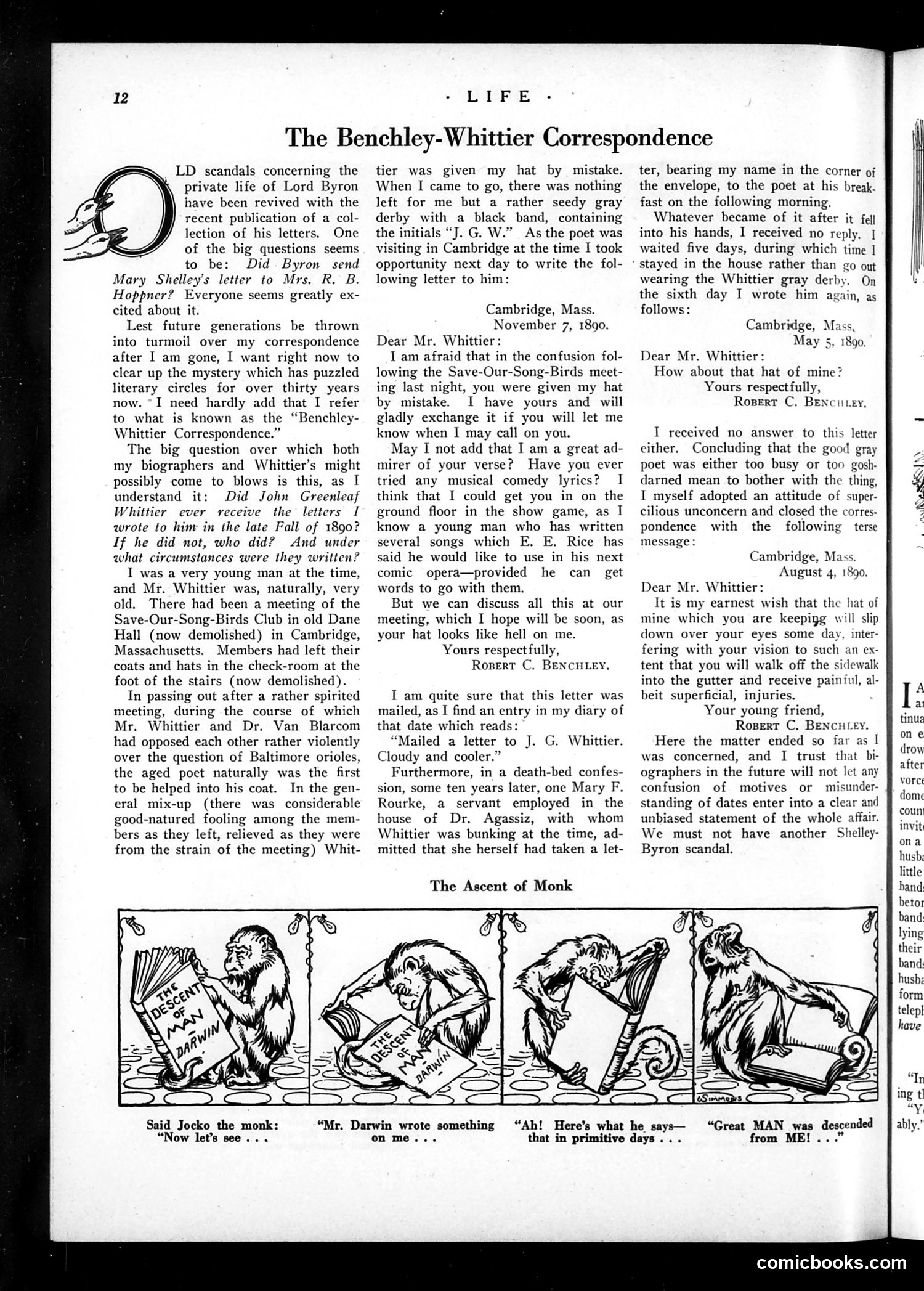
What you’re looking at
This four-panel comic strip satirizes Charles Darwin's theory of evolution. A monkey (labeled "Jacko the monk") progressively transforms, reading Darwin's writings. The sequence shows: the monkey reading "The Descent of Man," then examining Darwin's work, discovering it describes "primitive days," and finally declaring "Great MAN was descended from ME!" The joke inverts Darwin's actual argument—which proposed humans descended from ape-like ancestors—to suggest the monkey humorously claims *humans* evolved from monkeys. This reflects late-19th-century public confusion and religious resistance to evolutionary theory. The cartoon mocks both Darwin's ideas and popular misunderstandings of them, using slapstick humor typical of Life magazine's satirical approach to scientific controversy.
📄 Transcribed text from this page (OCR, searchable)
Machine-transcribed from the original scan — historical spelling and the odd misread are preserved.
~ IE EEE The Benchley-Whittier Correspondence LD scandals concerning the private life of Lord Byron have been revived with the recent publication of a col- lection of his letters. One of the big questions seems to be: Did. Byron send Mary Shelley's letter to Mrs. R. B. Hoppner? Everyone seems greatly ex- cited about it. Lest future generations be thrown into turmoil over my correspondence after I am gone, I want right now to clear up the mystery which has puzzled literary circles for over thirty years now. “I need hardly add that I refer to what is known as the “Benchley- Whittier Correspondence.” The big question over which both my biographers and Whittier’s might possibly come to blows is this, as I understand it: Did John Greenleaf Whittier ever receive the letters I wrote to him in the late Fall of 1890? If he did not, who did? And under what circumstances were they written? I was a very young man at the time, and Mr. Whittier was, naturally, very old. There had been a meeting of the Save-Our-Song-Birds Club in old Dane Hall (now demolished) in Cambridge, Massachusetts. Members had left their coats and hats in the check-room at the foot of the stairs (now demolished). In passing out after a rather spirited meeting, during the course of which Mr. Whittier and Dr. Van Blarcom had opposed each other rather violently over the question of Baltimore orioles, the aged poet naturally was the first to be helped into his coat. In the gen- eral mix-up (there was considerable good-natured fooling among the mem- bers as they left, relieved as they were from the strain of the meeting) Whit- Said Jocko the monk: “Now let’s see . . “Mr. Darwin wrote something tier was given my hat by mistake. When I came to go, there was nothing left for me but a rather seedy gray derby with a black band, containing the initials “J. G. W.” As the poet was visiting in Cambridge at the time I took opportunity next day to write the fol- lowing letter to him: Cambridge, Mass. November 7, 1890. Dear Mr. Whittier: I am afraid that in the confusion fol- lowing the Save-Our-Song-Birds meet- ing last night, you were given my hat by mistake. I have yours and will gladly exchange it if you will let me know when I may call on you. May I not add that I am a great ad- mirer of your verse? Have you ever tried any musical comedy lyrics? I think that I could get you in on the ground floor in the show game, as I know a young man who has written several songs which E. E. Rice has said he would like to use in his next comic opera—provided he can get words to go with them. But we can discuss all this at our meeting, which I hope will be soon, as your hat looks like hell on me. Yours respectfully, Rosert C. BENCHLEY. I am quite sure that this letter was mailed, as I find an entry in my diary of that date which reads: “Mailed a letter to J. G. Cloudy and cooler.” Furthermore, in a death-bed confes- sion, some ten years later, one Mary F. Rourke, a servant employed in the house of Dr. Agassiz, with whom Whittier was bunking at the time, ad- mitted that she herself had taken a let- Whittier. The Ascent of Monk on me... “Ah! Here’s what he says— “Great MAN was descended that in primitive days... _ ter, bearing my name in the corner of the envelope, to the poet at his break. fast on the following morning. Whatever became of it after it fell into his hands, I received no reply, [ waited five days, during which time I stayed in the house rather than go out wearing the Whittier gray derby. On the sixth day I wrote him again, as follows: Cambridge, Mass, May 5, 1890. Dear Mr. Whittier: How about that hat of mine? Yours respectfully, Rosert C. BEncuLey, I received no answer to this letter either. Concluding that the good gray poet was either too busy or too gosh- darned mean to bother with the thing, I myself adopted an attitude of super- cilious unconcern and closed the corres- pondence with the following terse message: Cambridge, Mass. August 4, 1890. Dear Mr. Whittier: It is my earnest wish that the hat of mine which you are keepigg will slip down over your eyes some day, inter- fering with your vision to such an ex- tent that you will walk off the sidewalk into the gutter and receive painful, al- beit superficial, injuries. A Your young friend, a Rosert C. BENCHLEY. tet Here the matter ended so far as 1 "© was concerned, and I trust that bi- drow ographers in the future will not let any alter confusion of motives or misunder- ae standing of dates enter into a clear and Come unbiased statement of the whole affair. an We must not have another Shelley- } "Y" Byron scandal. fu : hush little band betor band: lying their band. hush form telepl have from ME! ..- comicbooks.com