
Life, 1922-05-11 · page 16 of 38
Life — May 11, 1922 — page 16: what you’re looking at
What you’re looking at
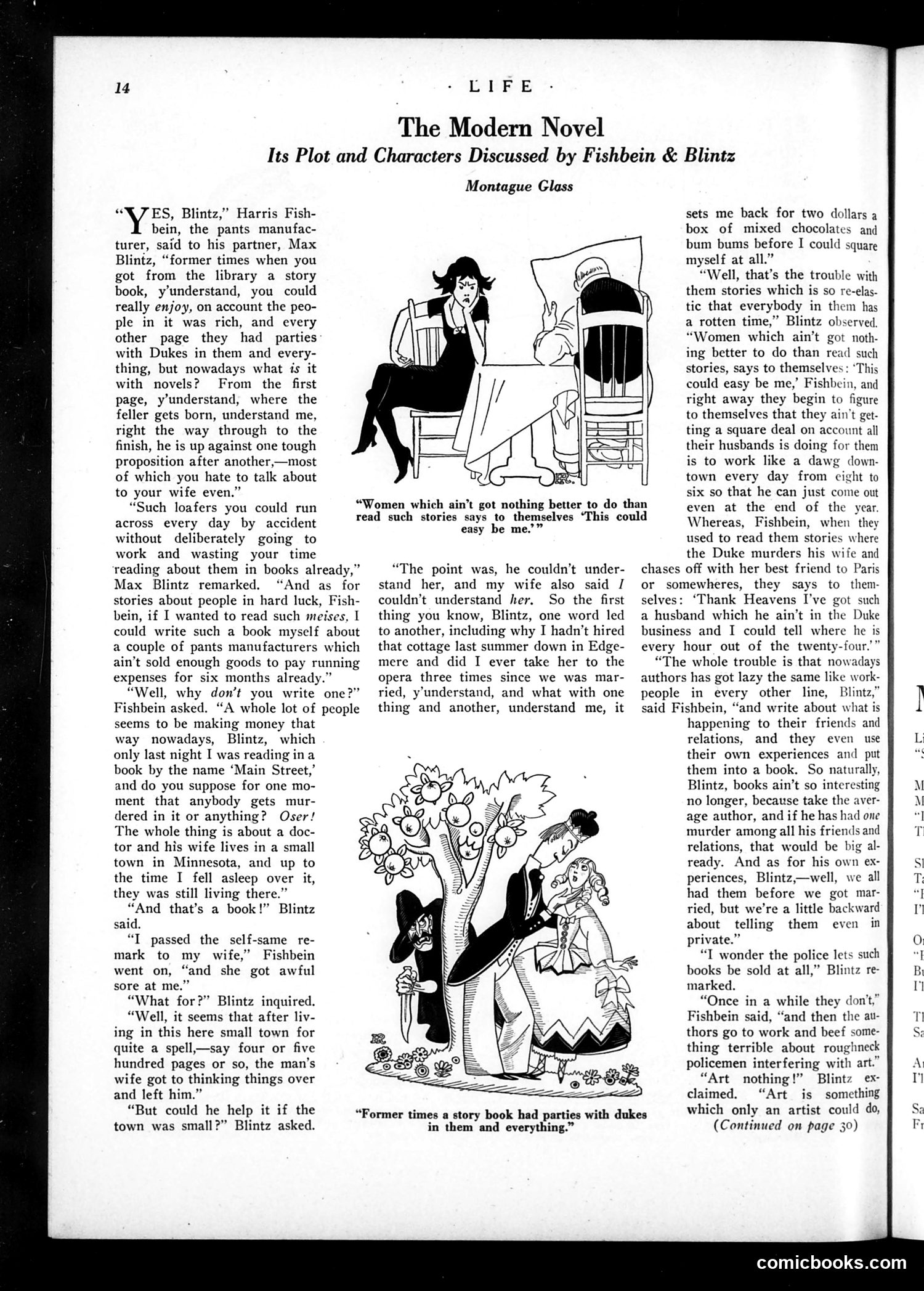
This satirical article discusses how modern novels have become tedious and unrealistic compared to older story books. Harris Fishbein and Max Blintz, identified as pants manufacturers, debate whether contemporary novels are worth reading. The cartoons illustrate their complaint: the first shows a woman finding modern domestic narratives boring (a wife complaining about her husband's mundane work life). The second depicts an exaggerated, chaotic "tree of life" scene—likely mocking modernist literature's experimental complexity and psychological depth. The satire targets the gap between readers' expectations and modernist fiction's actual subject matter: instead of exciting adventures with "dukes" and dramatic parties, readers encounter realistic portrayals of ordinary people's everyday struggles and internal lives—which the characters find insufferably dull.
📄 Transcribed text from this page (OCR, searchable)
Machine-transcribed from the original scan — historical spelling and the odd misread are preserved.
ES, Blintz,” Harris Fish- bein, the pants manufac- turer, said to his partner, Max Blintz, “former times when you got from the library a story book, y’understand, you could really enjoy, on account the peo- ple in it was rich, and every other page they had parties with Dukes in them and every- thing, but nowadays what is it with novels? From the first page, y’understand, where the feller gets born, understand me, right the way through to the finish, he is up against one tough Proposition after another,—most of which you hate to talk about to your wife even.” “Such loafers you could run across every day by accident without deliberately going to work and wasting your time reading about them in books already,” Max Blintz remarked. “And as for stories about people in hard luck, Fish- bein, if I wanted to read such meises, I could write such a book myself about a couple of pants manufacturers which ain’t sold enough goods to pay running expenses for six months already.” “Well, why don’t you write one?” Fishbein asked. “A whole lot of people seems to be making money that way nowadays, Blintz, which only last night I was reading ina book by the name ‘Main Street,’ and do you suppose for one mo- ment that anybody gets mur- dered in it or anything? Oser! The whole thing is about a doc- tor and his wife lives in a small town in Minnesota, and up to the time I fell asleep over it, they was still living there.” “And that’s a book!” Blintz said. “I passed the self-same re- mark to my wife,” Fishbein went on, “and she got awful sore at me.” “What for?” Blintz inquired. “Well, it seems that after liv- ing in this here small town for quite a spell,—say four or five hundred pages or so, the man’s wife got to thinking things over and left him.” “But could he help it if the town was small?” Blintz asked. LIFE The Modern Novel Its Plot and Characters Discussed by Fishbein & Blintz Montague Glass “Women which ain’t got nothing better to do than read such stories says to themselves ‘This could easy be me.’” “The point was, he couldn’t under- stand her, and my wife also said / couldn’t understand her. So the first thing you know, Blintz, one word led to another, including why I hadn’t hired that cottage last summer down in Edge- mere and did I ever take her to the opera three times since we was mar- ried, y’understand, and what with one thing and another, understand me, it “Former times a story book had parties with dukes in them and everything.” sets me back for two dollars a box of mixed chocolates and bum bums before I could square myself at all.” “Well, that’s the trouble with them stories which is so re-elas- tic that everybody in them has a rotten time,” Blintz observed. “Women which ain’t got noth- ing better to do than read such stories, says to themselves: ‘This could easy be me,’ Fishbein, and right away they begin to figure to themselves that they ain't get- ting a square deal on account all their husbands is doing for them is to work like a dawg down- town every day from cight to six so that he can just come out even at the end of the year. Whereas, Fishbein, when they used to read them stories where the Duke murders his wife and chases off with her best friend to Paris or somewheres, they says to them- selves: ‘Thank Heavens I’ve got such a husband which he ain’t in the Duke business and I could tell where he is every hour out of the twenty-four.’” “The whole trouble is that nowadays authors has got lazy the same like work- people in every other line, Blintz,” said Fishbein, “and write about what is happening to their friends and relations, and they even use their own experiences and put them into a book. So naturally, Blintz, books ain’t so interesting no longer, because take the aver- age author, and if he has had one murder among all his friends and relations, that would be big al- ready. And as for his own ex- periences, Blintz,—well, we all had them before we got mar- ried, but we’re a little backward about telling them even in private.” “I wonder the police lets such books be sold at all,” Blintz re- marked. “Once in a while they don't,” Fishbein said, “and then the au- thors go to work and beef some- thing terrible about roughneck policemen interfering with art.” “Art nothing!” Blintz ex- claimed. “Art is something which only an artist could do, (Continued on page 30) comicbooks.com