
Life, 1922-05-11 · page 24 of 38
Life — May 11, 1922 — page 24: what you’re looking at
What you’re looking at
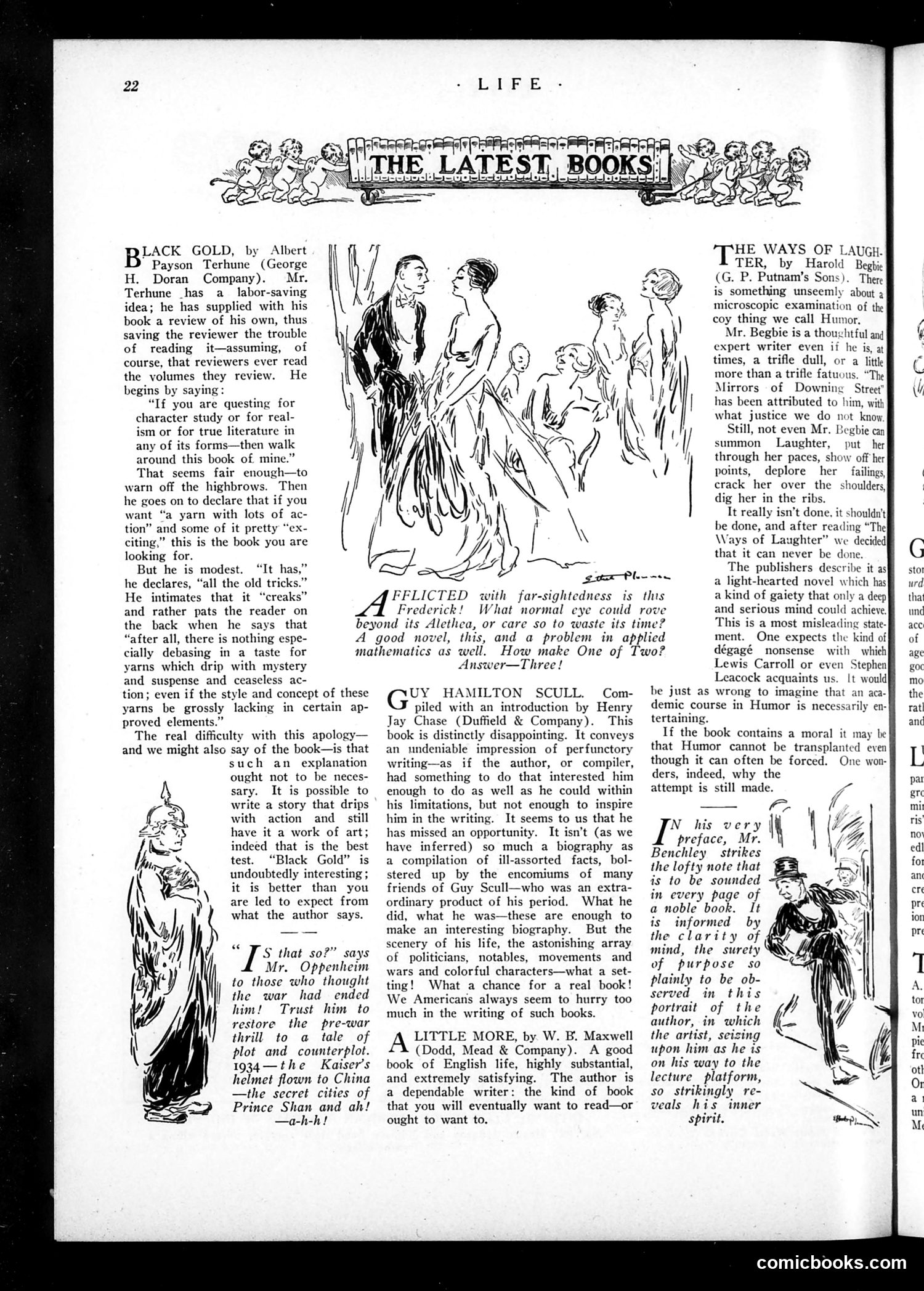
This is a book review page from Life magazine featuring critiques of several contemporary works. The main illustrated content shows a classical drawing of figures in robes, accompanying a review of "The Ways of Laughter" by Harold Begbie—a scholarly examination of humor that the reviewer finds somewhat tedious and overly analytical. The page reviews several 1930s publications including "Black Gold" by Albert Payson Terhune (an adventure novel the author humorously pre-reviews himself), "Guy Hamilton Scull" (a disappointing biography), and "A Little More" by W.B. Maxwell (praised as solid English fiction). The satirical tone is typical of Life's literary criticism: the reviewers gently mock authors' pretensions while assessing whether books deliver entertainment or insight. The page demonstrates how literary magazines of this era combined serious criticism with witty commentary on popular reading tastes.
📄 Transcribed text from this page (OCR, searchable)
Machine-transcribed from the original scan — historical spelling and the odd misread are preserved.
LACK GOLD, by Albert Payson Terhune (George H. Doran Company). Mr. Terhune has a_ labor-saving idea; he has supplied with his book a review of his own, thus saving the reviewer the trouble of reading it—assuming, of course, that reviewers ever read the volumes they review. He begins by saying: “If you are questing for character study or for real- ism or for true literature in any of its forms—then walk around this book of mine.” That seems fair enough—to warn off the highbrows. Then he goes on to declare that if you want “a yarn with lots of ac- tion” and some of it pretty “ex citing,” this is the book you are looking for. But he is modest. “It has,” he declares, “all the old tricks.” He intimates that it “creaks” and rather pats the reader on the back when he says that “after all, there is nothing espe- cially debasing in a taste for yarns which drip with mystery and suspense and ceaseless ac- tion; even if the style and concept of these yarns be grossly lacking in certain ap- proved elements.” The real difficulty with this apology— and we might also say of the book—is that such an_ explanation ought not to be neces- sary. It is possible to write a story that drips with action and_ still have it a work of art; indeed that is the best test. “Black Gold” is undoubtedly interesting ; it is better than you are led to expect from what the author says. af that so?” says Mr. Oppenheim to those who thought the war had ended him! Trust him to restore the pre-war thrill to a tale of plot and counterplot. 1934—the Kaiser's helmet flown to China —the secret cities of Prince Shan and ah! —a-h-h! mathematics as well. Pe ee FFLICTED with far-sightedness is this ick! What normal eye could rove beyond its Alethea, or care so to waste its time? A good novel, this, and a problem in applied How make One of Two? Answer—Three! UY HAMILTON SCULL. Com- piled with an introduction by Henry Jay Chase (Duffield & Company). This book is distinctly disappointing. It conveys an undeniable impression of perfunctory writing—as if the author, or compiler, had something to do that interested him enough to do as well as he could within his limitations, but not enough to inspire him in the writing. It seems to us that he has missed an opportunity. It isn’t (as we have inferred) so much a biography as a compilation of ill-assorted facts, bol- stered up by the encomiums of many friends of Guy Scull—who was an extra- ordinary product of his period. What he did, what he was—these are enough to make an interesting biography. But the scenery of his life, the astonishing array of politicians, notables, movements and wars and colorful characters—what a set- ting! What a chance for a real book! We Americans always seem to hurry too much in the writing of such books. A LITTLE MORE, by. W. B. Maxwell (Dodd, Mead & Company). A good book of English life, highly substantial, and extremely satisfying. The author is a dependable writer: the kind of book that you will eventually want to read—or ought to want to. TH WAYS OF LAUGH. TER, by Harold Beghie (G. P. Putnam’s Sons). There is something unseemly about 3 microscopic examination of the coy thing we call Humor, Mr. Begbie is a thoughtful ang expert writer even if he is, at times, a trifle dull, or a littl more than a trifle fatuous. “The Mirrors of Downing Street has been attributed to him, with what justice we do know, Still, not even Mr. Begbie can summon Laughter, put her through her paces, show off her points, deplore her failings, crack her over the shoulders, dig her in the ribs. It really isn’t done. it shouldn't be done, and after reading “The Ways of Laughter” we decided] that it can never be done. The publishers describe it as a light-hearted novel which has| akind of gaiety that only a deep and serious mind could achieve. This is a most misleading state- ment. One expects the kind of dégagé nonsense with which Lewis Carroll or even Stephen Leacock acquaints us. It would be just as wrong to imagine that an aca- demic course in Humor is necessarily en- tertaining. If the book contains a moral it may be that Humor cannot be transplanted even though it can often be forced. One won- ders, indeed, why the attempt is still made. , ia EE his very preface, Mr. Benchley strikes the lofty note that is to be sounded in every page of a noble book. It is informed by the clarity of & mind, the surety of purpose so plainly to be ob- served in this portrait of the author, in which the artist, seizing upon him as he is on his way to the lecture platform, so strikingly re- veals his inner spirit. comicbooks.com