
Life, 1922-05-11 · page 17 of 38
Life — May 11, 1922 — page 17: what you’re looking at
What you’re looking at
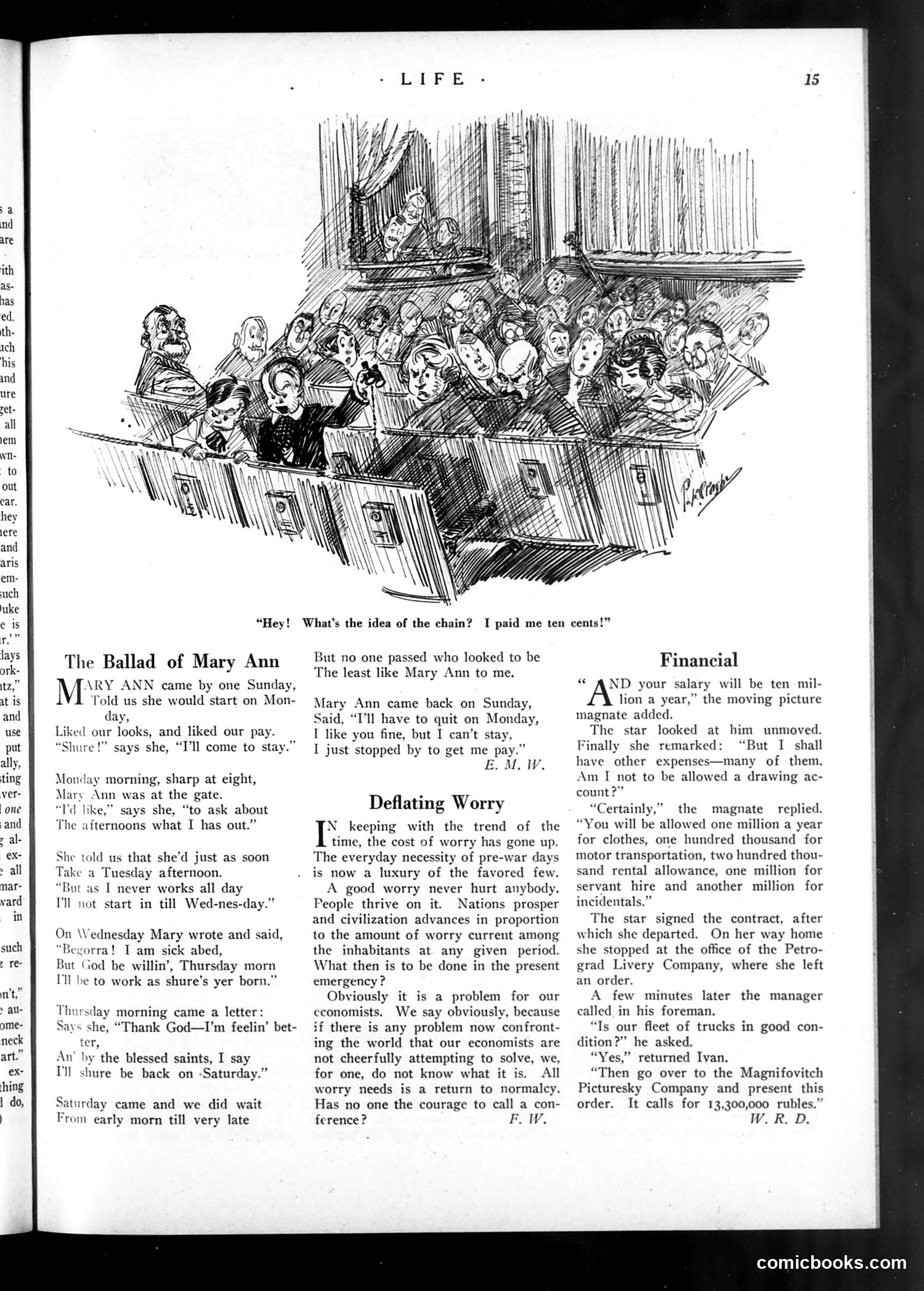
The top cartoon depicts a theater or courtroom scene where someone complains about a "chain" costing ten cents—likely satirizing petty complaints or nickel-and-diming behavior during wartime or economic hardship. The three text pieces mock contemporary absurdities: **"The Ballad of Mary Ann"** ridicules an unreliable domestic servant who constantly makes excuses (illness, saints' blessings) to avoid work while expecting full pay—a common complaint about labor reliability in the 1910s-20s. **"Deflating Worry"** ironically suggests that since economists can't solve real problems, they should tackle "worry" itself through conferences, mocking both economic incompetence and bureaucratic solutions. **"Financial"** satirizes Hollywood excess by showing a movie star negotiate lavish expenses (clothing, cars, servants) so extravagant that she places a 13-million-ruble truck order—absurd given post-WWI economic collapse in Russia. The punchline criticizes both industry waste and the disconnect between American wealth and global hardship.
📄 Transcribed text from this page (OCR, searchable)
Machine-transcribed from the original scan — historical spelling and the odd misread are preserved.
lays ork- tz,” at is and use put ally, ting ver- one and r al- ex- > all mar- vard in such 2 Te n't,” > all- ome- neck art.” ex- hing | do, ) “Hey! The Ballad of Mary Ann \RY ANN came by one Sunday, Told us she would start on Mon- day, Liked our looks, and liked our pay. “Shure!” says she, “I'll come to stay Monday morning, sharp at eight, Mary Ann was at the gate. “T'd like,” says she, “to ask about The afternoons what I has out.” She told us that she’d just as soon Take a Tuesday afternoon. “But as I never works all day I'll not start in till Wed-nes-day.” On \Vednesday Mary wrote and said, “Begorra! I am sick abed, But God be willin’, Thursday morn I'll he to work as shure’s yer born.” Thursday morning came a letter: Says she, “Thank God—I’m feelin’ bet- ter, An’ by the blessed saints, I say I'll shure be back on -Saturday.” Saturday came and we did wait From early morn till very late What's the idea of the chain? I paid me ten cents!” But no one passed who looked to be The least like Mary Ann to me. Mary Ann came back on Sunday, Said, “I'll have to quit on Monday, I like you fine, but I can’t stay, I just stopped by to get me pay.” E.M.W. Deflating Worry N keeping with the trend of the time, the cost of worry has gone up. The everyday necessity of pre-war days is now a luxury of the favored few. A good worry never hurt anybody. People thrive on it. Nations prosper and civilization advances in proportion to the amount of worry current among the inhabitants at any given period. What then is to be done in the present emergency ? Obviously it is a problem for our cconomists. We say obviously, because if there is any problem now confront- ing the world that our economists are not cheerfully attempting to solve, we, for one, do not know what it is. All worry needs is a return to normalcy. Has no one the courage to call a con- ference? F. W. Financial “ AND your salary will be ten mil- lion a year,” the moving picture magnate added. The star looked at him unmoved. Finally she remarked: “But I shall have other expenses—many of them. Am I not to be allowed a drawing ac- count?” “Certainly,” the magnate replied. “You will be allowed one million a year for clothes, one hundred thousand for motor transportation, two hundred thou- sand rental allowance, one million for servant hire and another million for incidentals.” The star signed the contract, after which she departed. On her way home she stopped at the office of the Petro- grad Livery Company, where she left an order. A few minutes later the manager called in his foreman. “Is our fleet of trucks in good con- dition?” he asked. “Yes,” returned Ivan. “Then go over to the Magnifovitch Picturesky Company and present this order. It calls for 13,300,000 rubles.” W. R. D. comicbooks.com