
A complete issue · 34 pages · 1921
Life — December 8, 1921
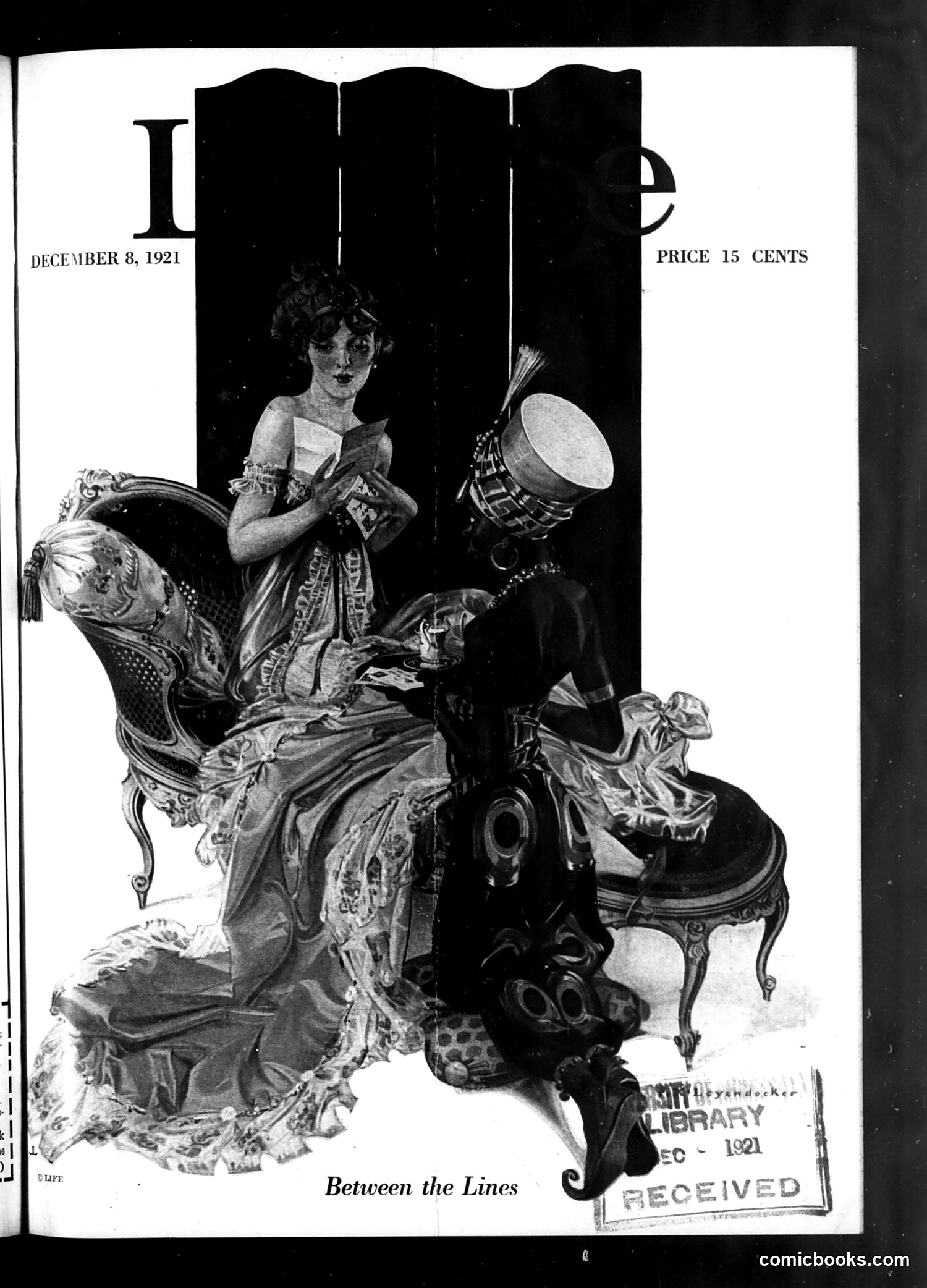
This cover illustration depicts a fashionable woman in an elegant gown seated among decorative chairs, holding what appears to be wrapped packages or gifts. She examines her acquisitions with an expression of satisfaction or anticipation. The title "Between the Lines" suggests the satire concerns reading subtle social meanings in material consumption and fashion. Given the 1921 date and the woman's stylish appearance, this likely comments on post-WWI American consumer culture and women's newfound economic independence during the Jazz Age. The elaborate furnishings and gifts may satirize either wealth display, holiday commercialism, or the emerging "modern woman" of the 1920s and her relationship to consumerism. Without additional context from interior pages, the precise satirical target remains unclear.
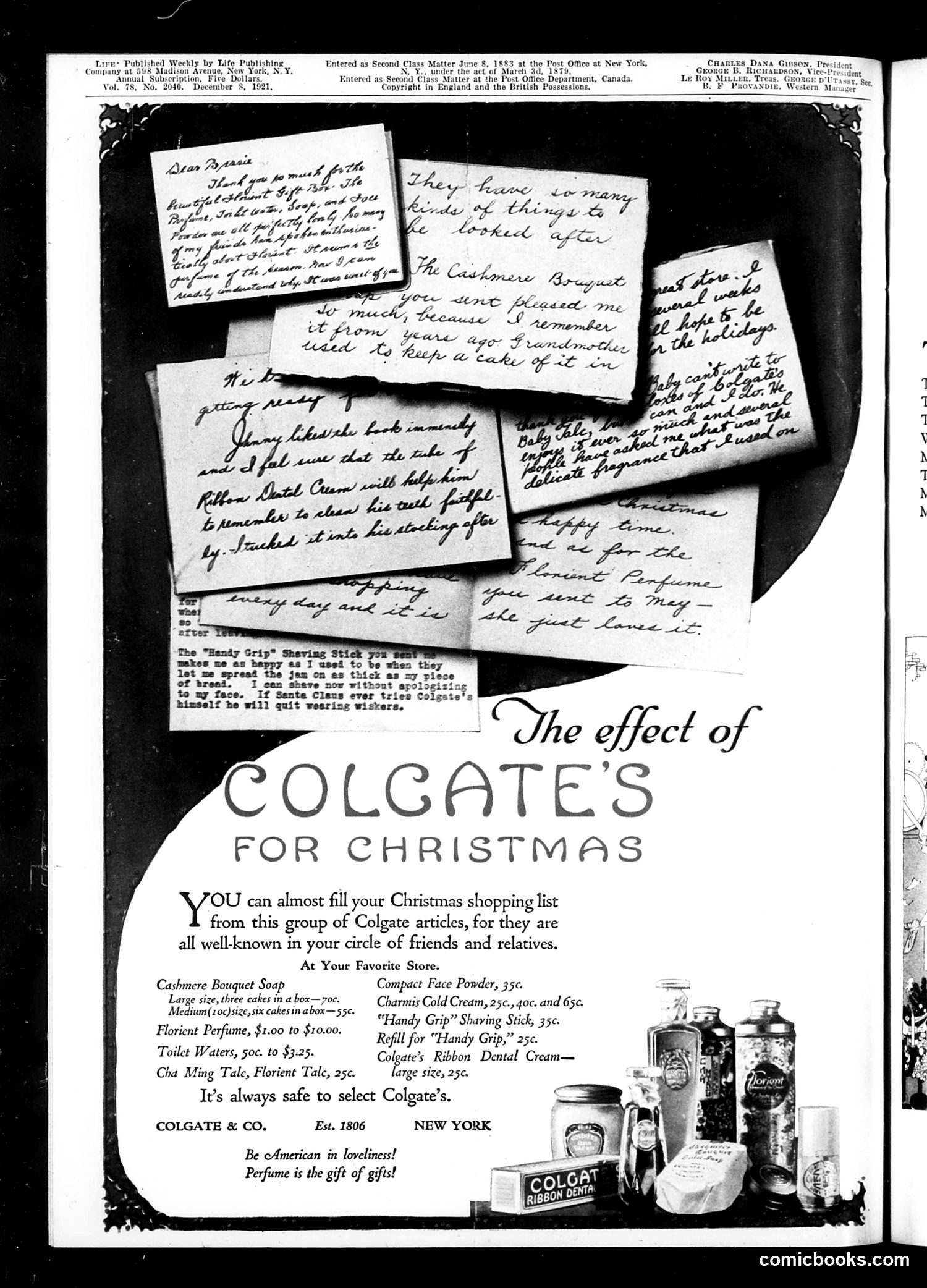
This page is primarily a **commercial advertisement** for Colgate toiletries, not political satire. The centerpiece displays handwritten letters—apparently personal testimonials from satisfied customers praising Colgate products for Christmas gifts. The letters appear authentic or designed to look so, featuring recipients' praise for items like Cashmere Bouquet Soap, shaving sticks, and face powder. The ad's tagline "It's always safe to select Colgate's" emphasizes reliability as gift choices. The only satirical element is a small notation about the "Handy Grip" Shaving Stick, which jokes that users will become so attached they'll refuse to stop wearing it—mild humor typical of 1920s advertising copy. This reflects the era's marketing strategy: using personal endorsements and humor to promote gift-giving.
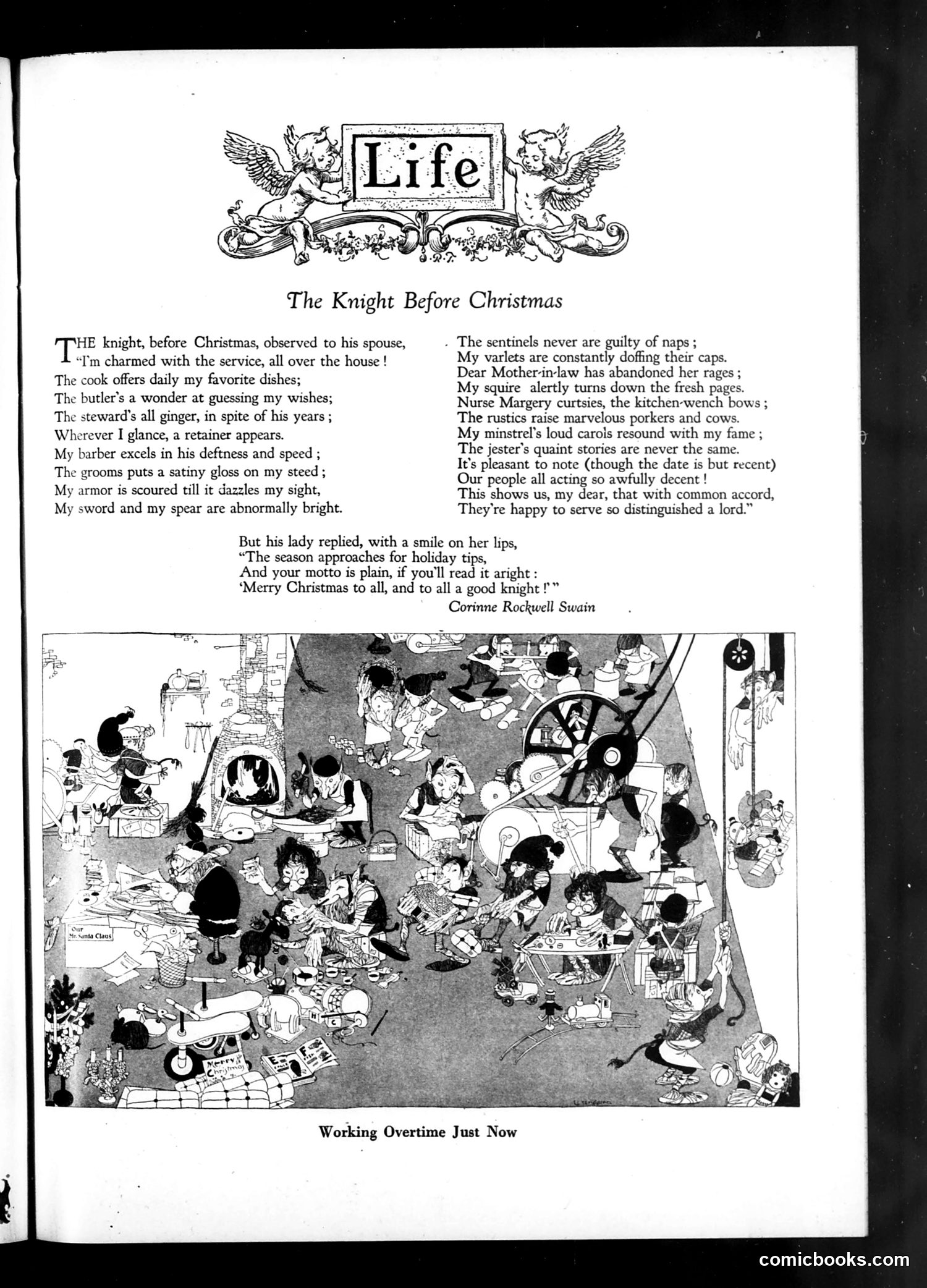
This page from *Life* magazine contains a humorous poem titled "The Knight Before Christmas" by Commie Rockwell Swain, paired with a detailed illustration captioned "Working Overtime Just Now." The poem presents a knight boasting to his wife about household management—servants, staff, and equipment all functioning perfectly—before Christmas. His wife responds that the real point is simply spreading holiday cheer to all. The illustration depicts a chaotic household scene filled with numerous workers and servants frantically managing domestic tasks: cooking, cleaning, maintenance, and childcare. The contrast between the knight's smugly ordered description and the actual bedlam shown in the drawing creates the satire—it mocks upper-class pretense about effortless household management, revealing the frantic, invisible labor required to maintain such establishments, particularly during the busy pre-Christmas season.
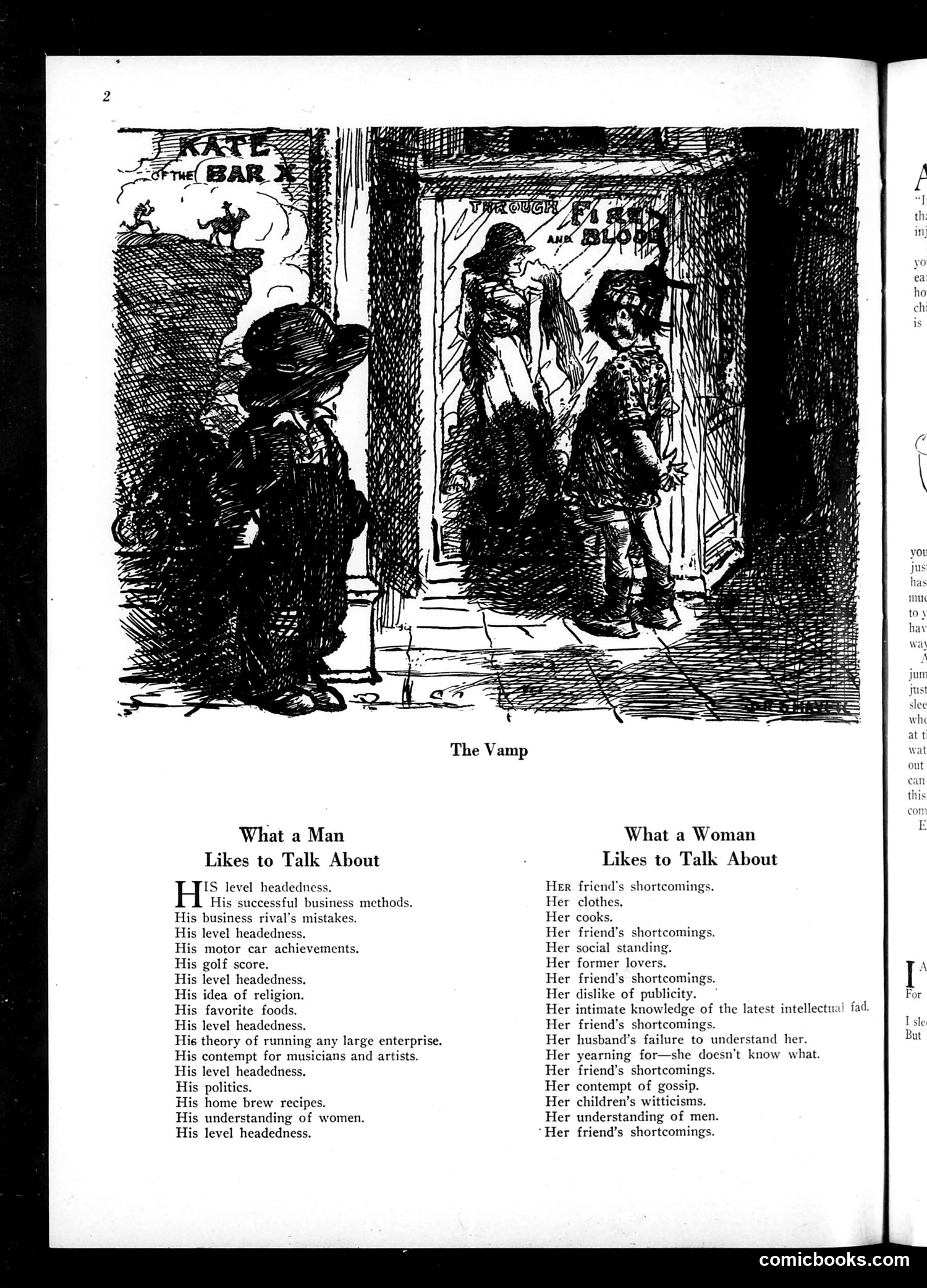
This page presents two complementary satirical lists titled "What a Man Likes to Talk About" and "What a Woman Likes to Talk About," accompanying an illustration labeled "The Vamp." The humor relies on gender stereotypes common to early-20th-century satire. Men's list emphasizes achievement and intellect: business success, golf scores, automobiles, and "level headedness" (repeated obsessively). Women's list mocks feminine conversation as superficial and gossip-focused, centering repeatedly on "her friend's shortcomings" and including complaints about husbands and obsession with appearance and romance. The "Vamp" illustration depicts a seductive woman, likely referencing the popular "vamp" archetype of silent-film era—the dangerous, sexually manipulative female character. This imagery reinforces the page's underlying message that women are either shallow gossips or predatory seductresses, contrasting with men's rational self-importance.
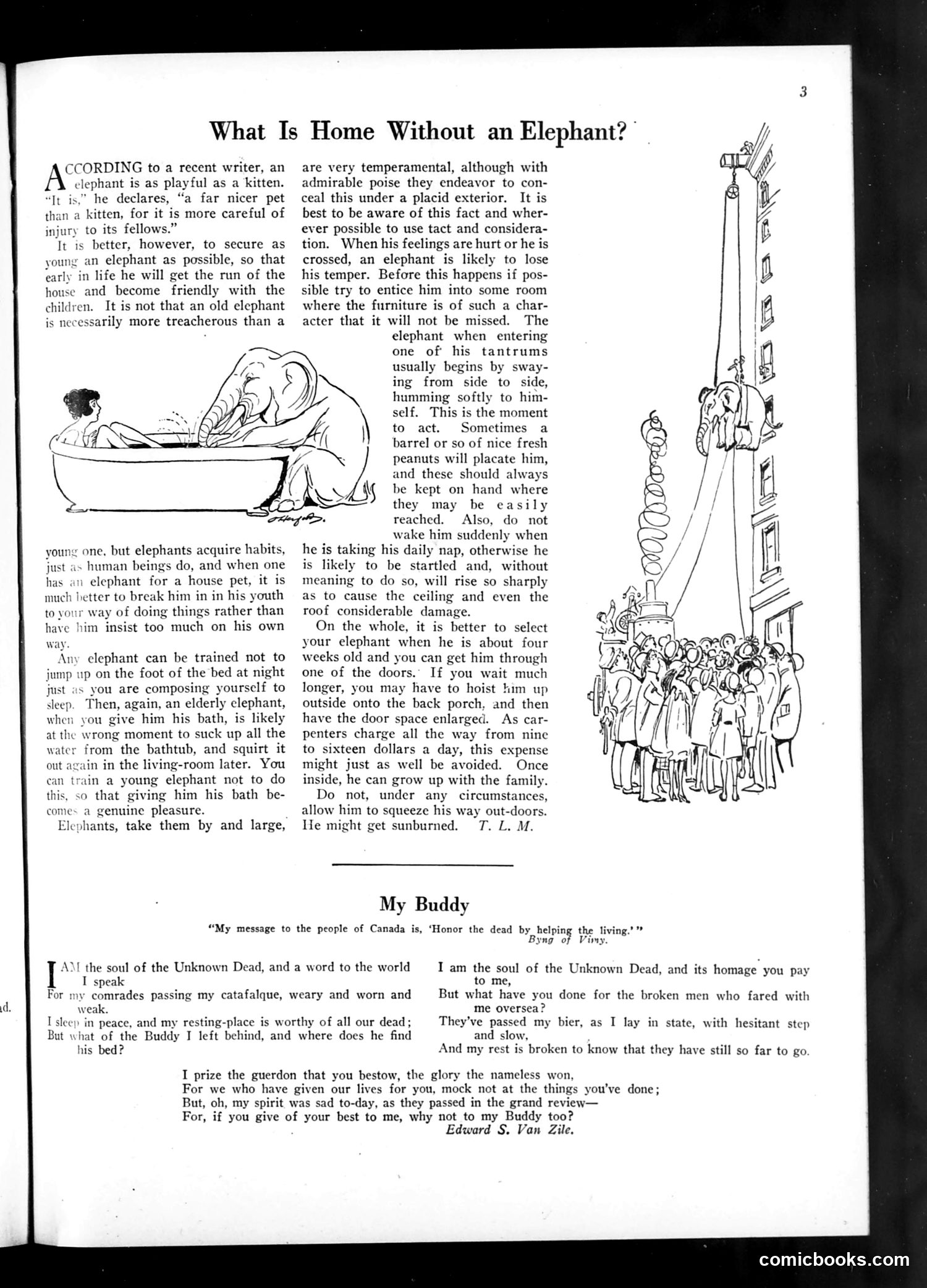
This page contains two unrelated pieces: **"What Is Home Without an Elephant?"** is a humorous advice column about keeping pet elephants in homes. The accompanying illustration shows an elephant in a bathtub. This appears to be gentle satire on the Victorian trend of exotic pet ownership among the wealthy—the impractical notion of maintaining large wild animals domestically. The advice (breaking them of bad habits, using peanuts as rewards, etc.) treats elephants as comedic household problems. **"My Buddy"** is a patriotic poem honoring soldiers who died in World War I (referenced as "the Unknown Dead" and "broken men who fared with me overseas"). The illustration shows civilians gathered below what appears to be a memorial or monument, looking upward. This reflects post-WWI mourning culture and the valorization of war dead common in 1920s American periodicals.
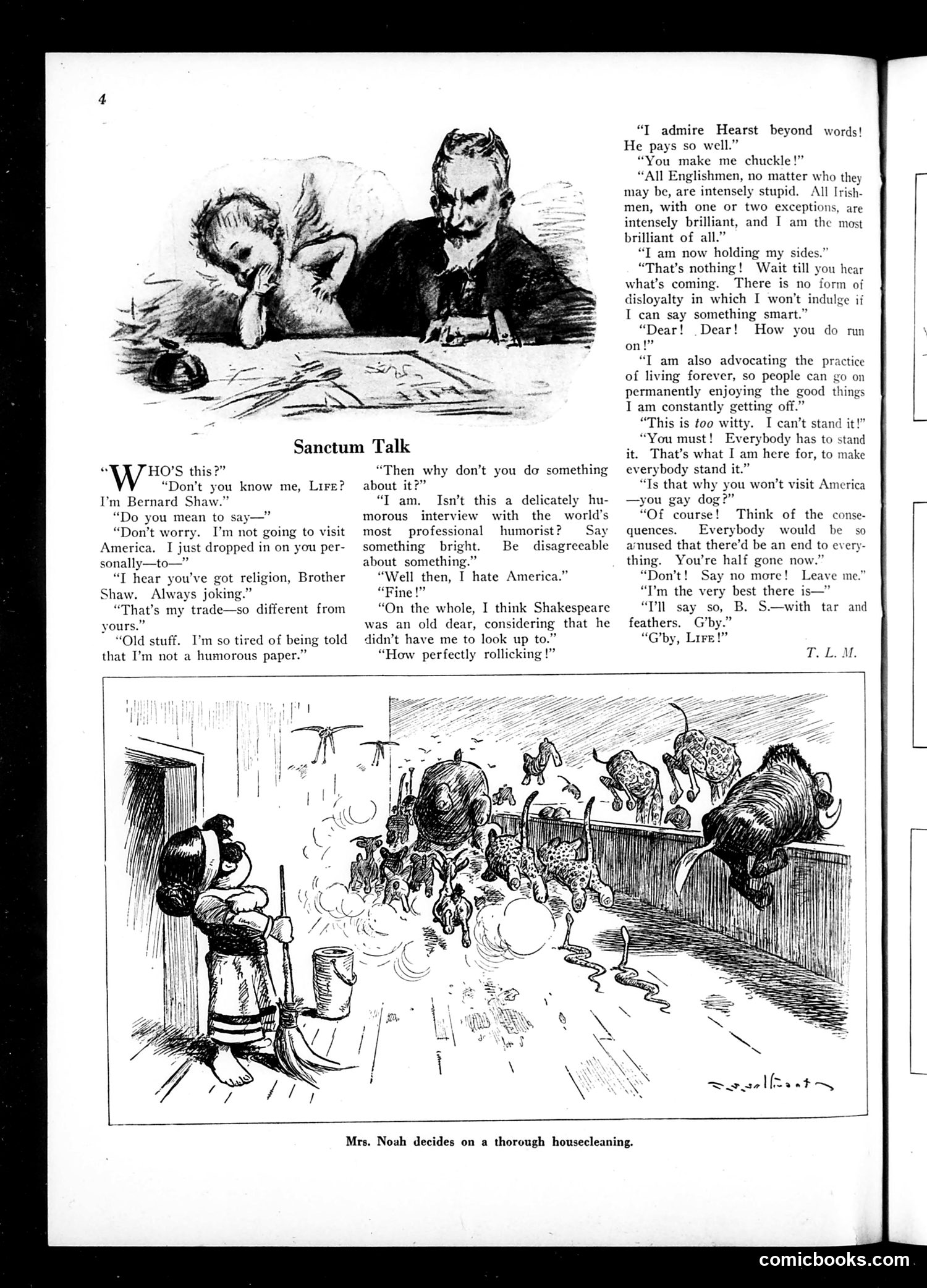
**Top Cartoon ("Sanctum Talk"):** This depicts a conversation between Life magazine staff members about Bernard Shaw (the Irish playwright and critic). Shaw apparently criticized America, prompting Life to mock his pretentiousness. The satire ridicules Shaw's claim to be "the world's most professional humorist" while he makes disagreeable statements about Shakespeare and America. The joke targets Shaw's self-importance and his tendency to provoke controversy for attention. **Bottom Cartoon ("Mrs. Noah decides on a thorough housecleaning"):** This biblical reference depicts Mrs. Noah using a broom to violently expel animals from the ark—depicted as chaotic, explosive housecleaning. The satire likely comments on aggressive social or political "cleaning" or purging, though the specific reference remains unclear without additional context. Both cartoons employ exaggerated caricature typical of early 20th-century satirical illustration.
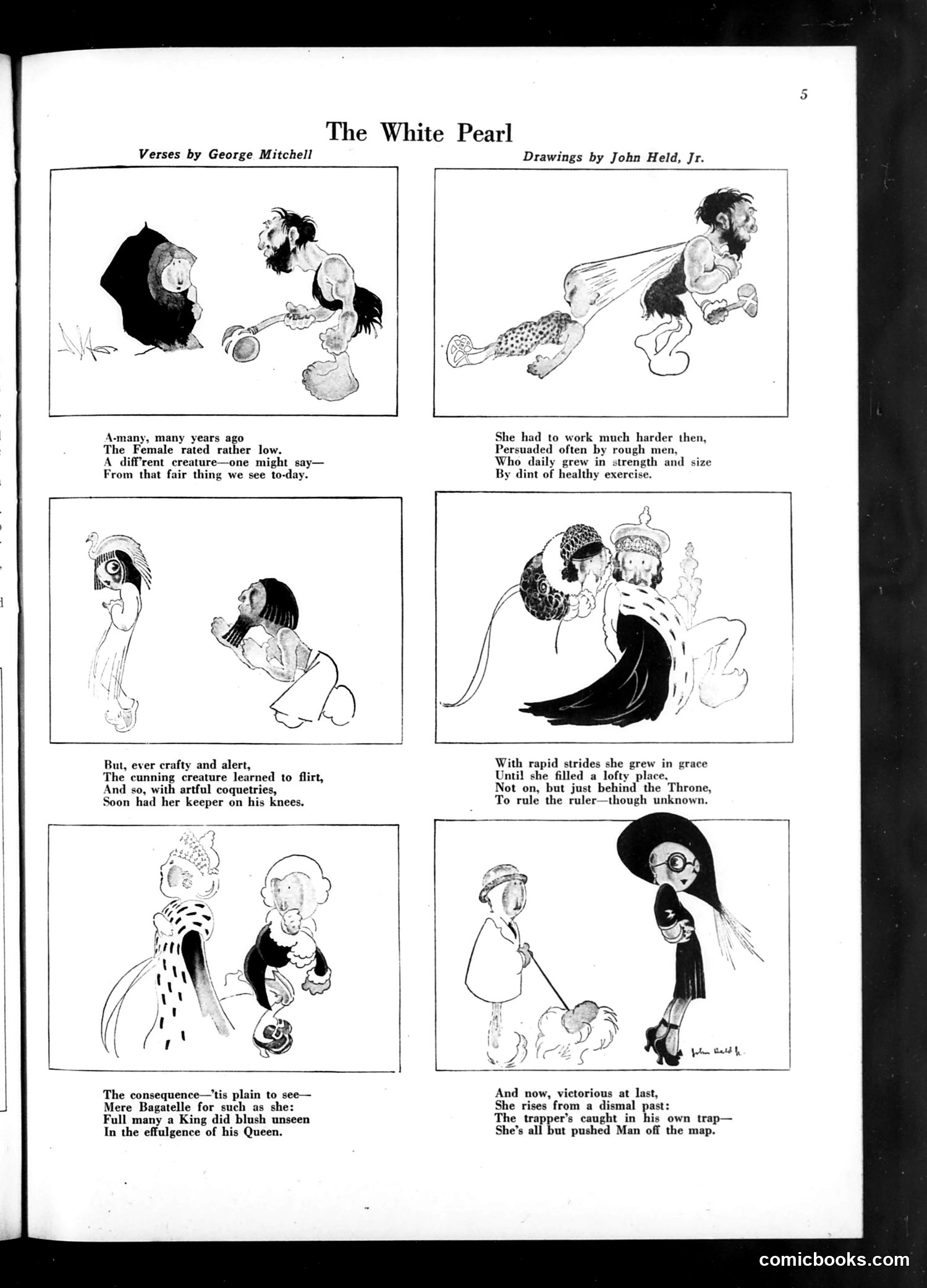
This is a satirical narrative poem illustrated by John Held Jr. about female empowerment disguised as a fairy tale. "The White Pearl" appears to be an allegory where a woman rises from lowly status through strength and cunning to ultimately gain power. The story progresses from her being undervalued ("The Female rated rather low") through her becoming physically strong via "healthy exercise," learning to manipulate men through "artful coquetries," and finally achieving a position of hidden authority—"rule the ruler—though unknown." The satire likely mocks both contemporary debates about women's roles and the notion that female power must remain concealed. The "trapper caught in his own trap" ending suggests the male protagonist is outwitted by his underestimated female counterpart.
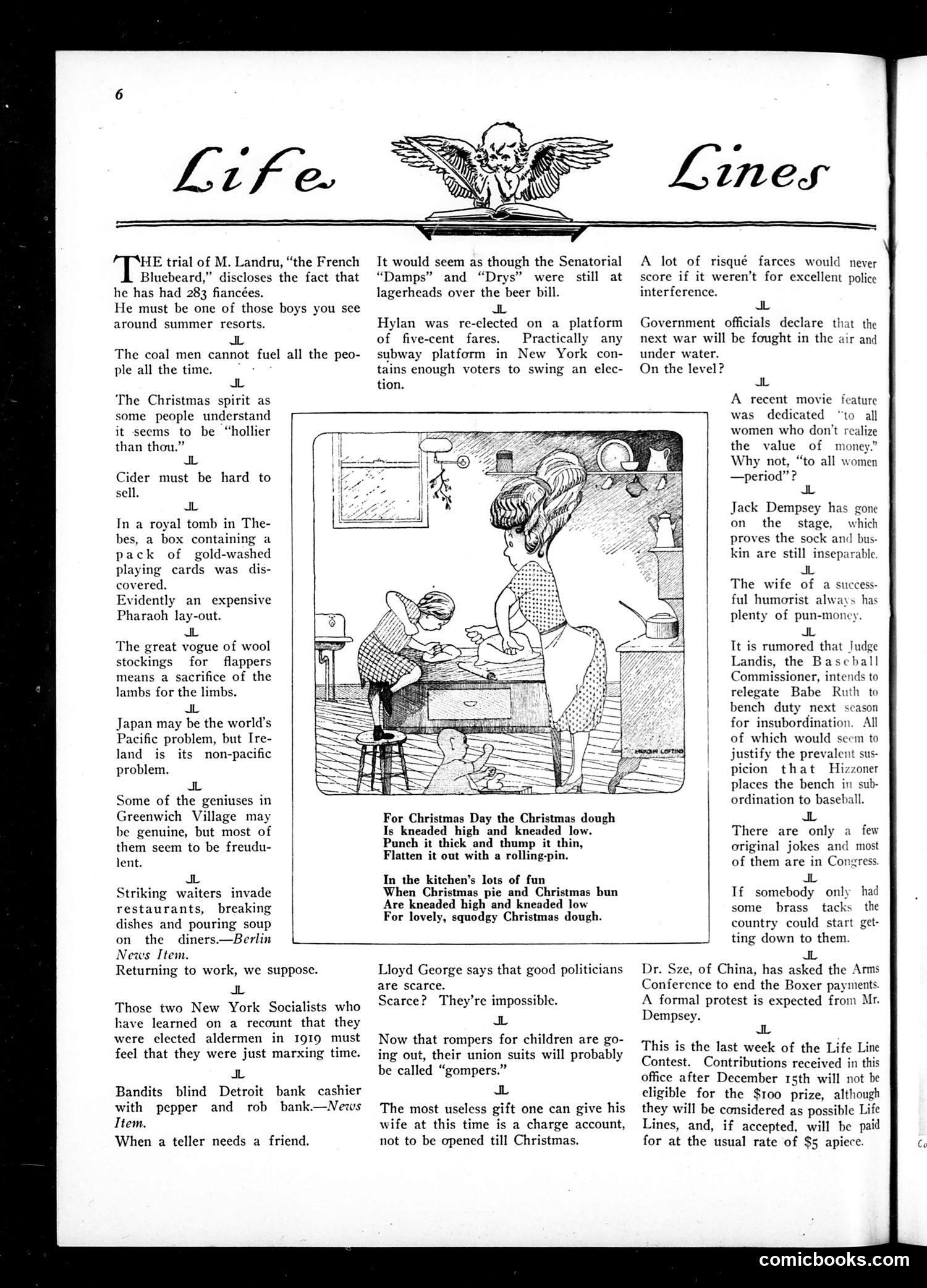
This page is a humor column mixing brief satirical quips with one illustrated cartoon. The cartoon depicts a mother and children in a kitchen making Christmas dough/buns, with accompanying verse about the holiday baking tradition. The textual jokes reference contemporary 1910s-1920s topics: M. Landru (likely the French serial killer), New York politics and election mechanics, labor strikes, Jack Dempsey (the boxer), and Judge Landis (baseball's commissioner). The humor relies on wordplay ("pun-money"), political observation (scarce good politicians), and social commentary (women's relationship to money, class tensions). The "Life Line Contest" mentioned suggests readers submitted jokes for publication and payment. The overall tone is sophisticated, urbane satire aimed at educated readers aware of current events and public figures.
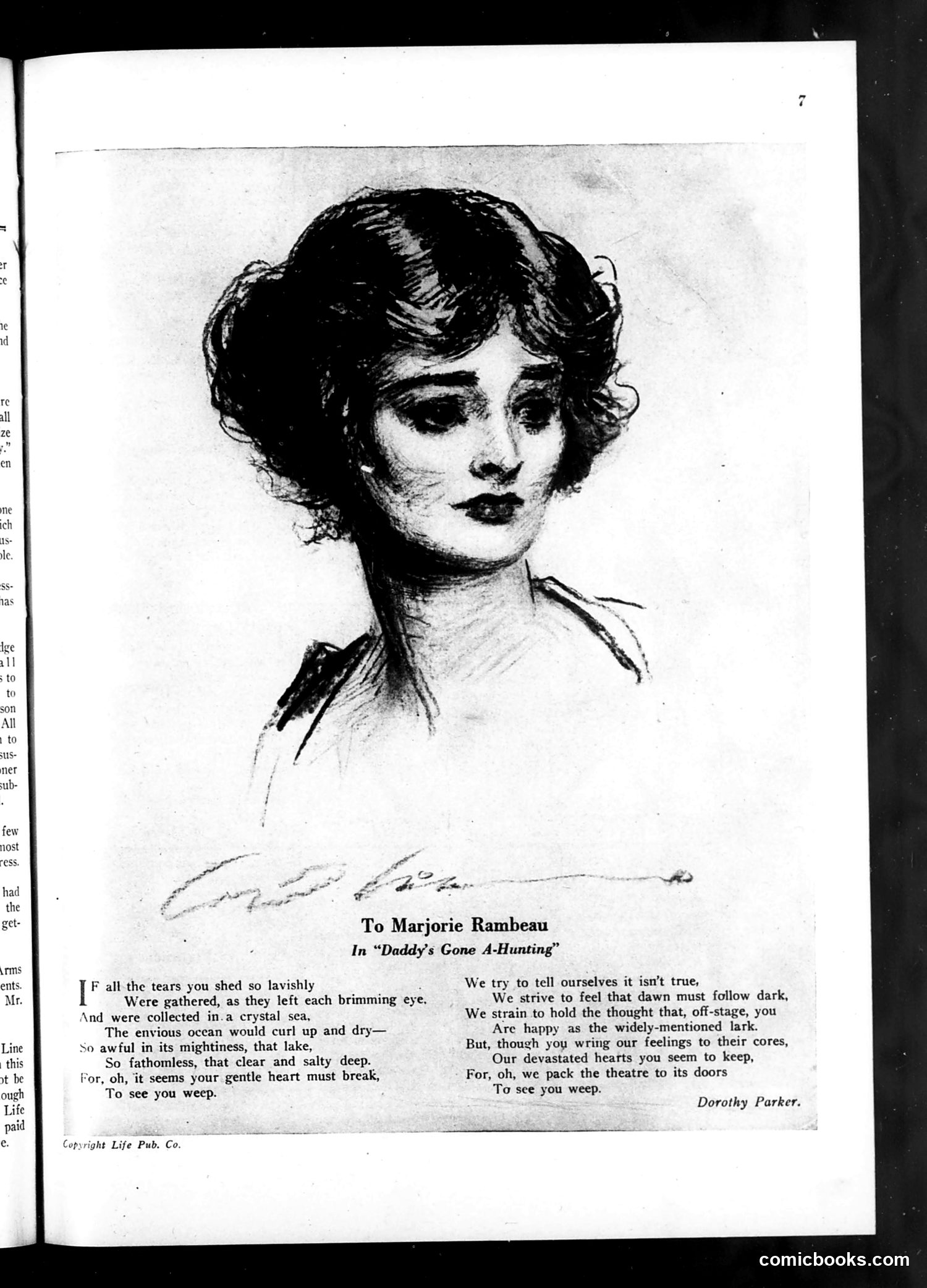
This page features a sketch portrait of actress **Marjorie Rambeau** titled "In 'Daddy's Gone A-Hunting,'" likely referencing a theatrical production. Below the portrait is a poem by **Dorothy Parker** addressing the actress's emotional performance. Parker's verse describes spectators shedding tears while watching Rambeau act, their emotions "collected in a crystal sea." The poem contrasts the audience's struggle to maintain composure—attempting to convince themselves "it isn't true" and that they remain "happy as the widely-mentioned lark"—with their inevitable breakdown, concluding: "we pack the theatre to its doors / To see you weep." The piece is essentially a theatrical tribute celebrating Rambeau's skill at moving audiences through her dramatic performance.
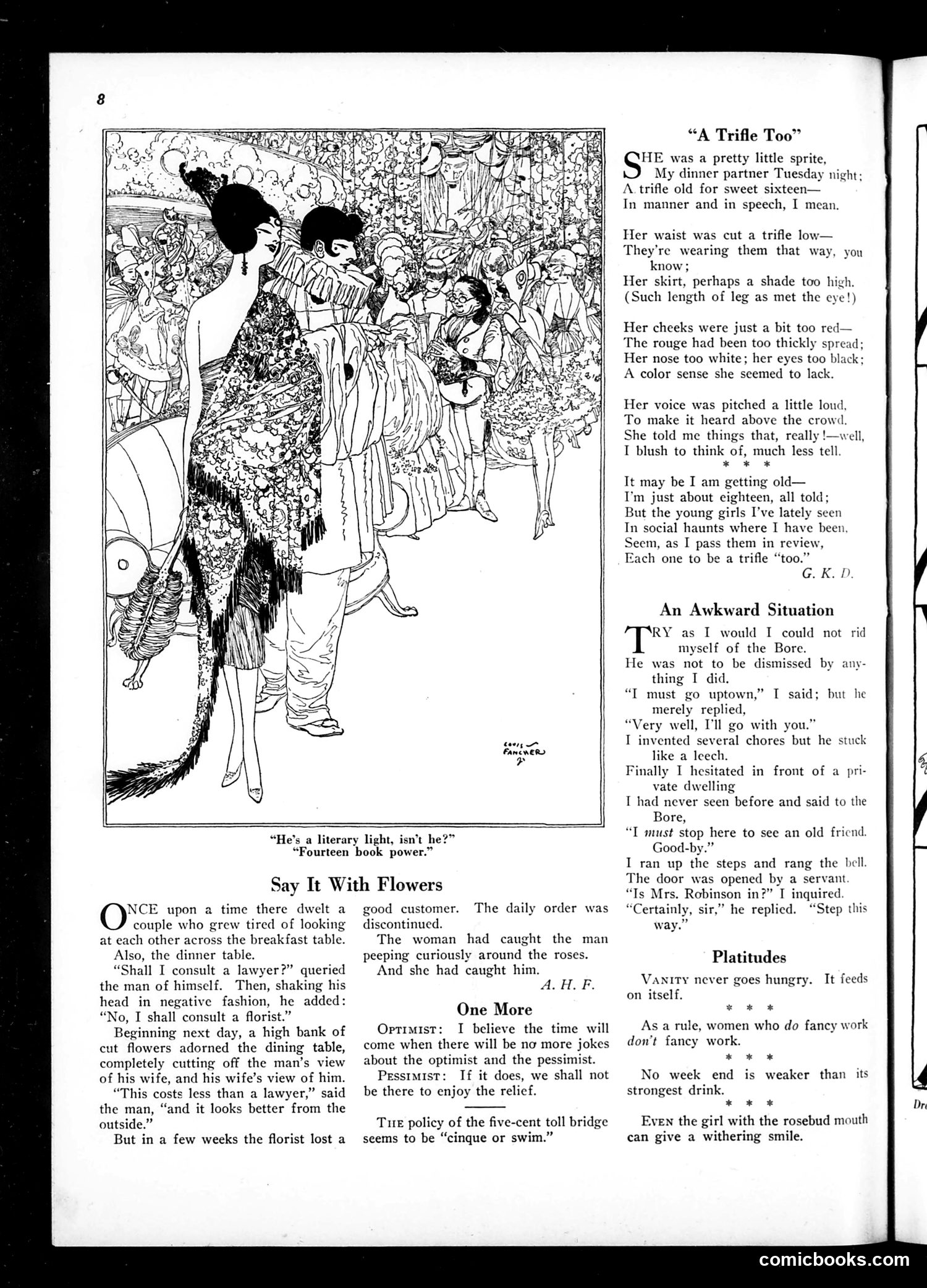
This page contains three unrelated pieces of satirical humor typical of early 20th-century Life magazine: 1. **"A Trifle Too"** (poem by C.K.D.): Social satire about a young woman at dinner whose fashion and behavior are exaggerated—her waist cut too low, skirt too high, makeup too heavy, voice too loud. The speaker criticizes modern young women as "a trifle too" much in every regard, suggesting they've abandoned propriety. 2. **"Say It With Flowers"**: A joke about a couple tired of each other. When the husband consults a florist about blocking his wife's view during dinner, the florist's solution—ordering flowers daily—backfires when the woman catches him "peeping" among the roses. 3. **"An Awkward Situation"**: Brief anecdote about an unwanted social call and an awkward dismissal. The page satirizes social conventions and relationships of the era.
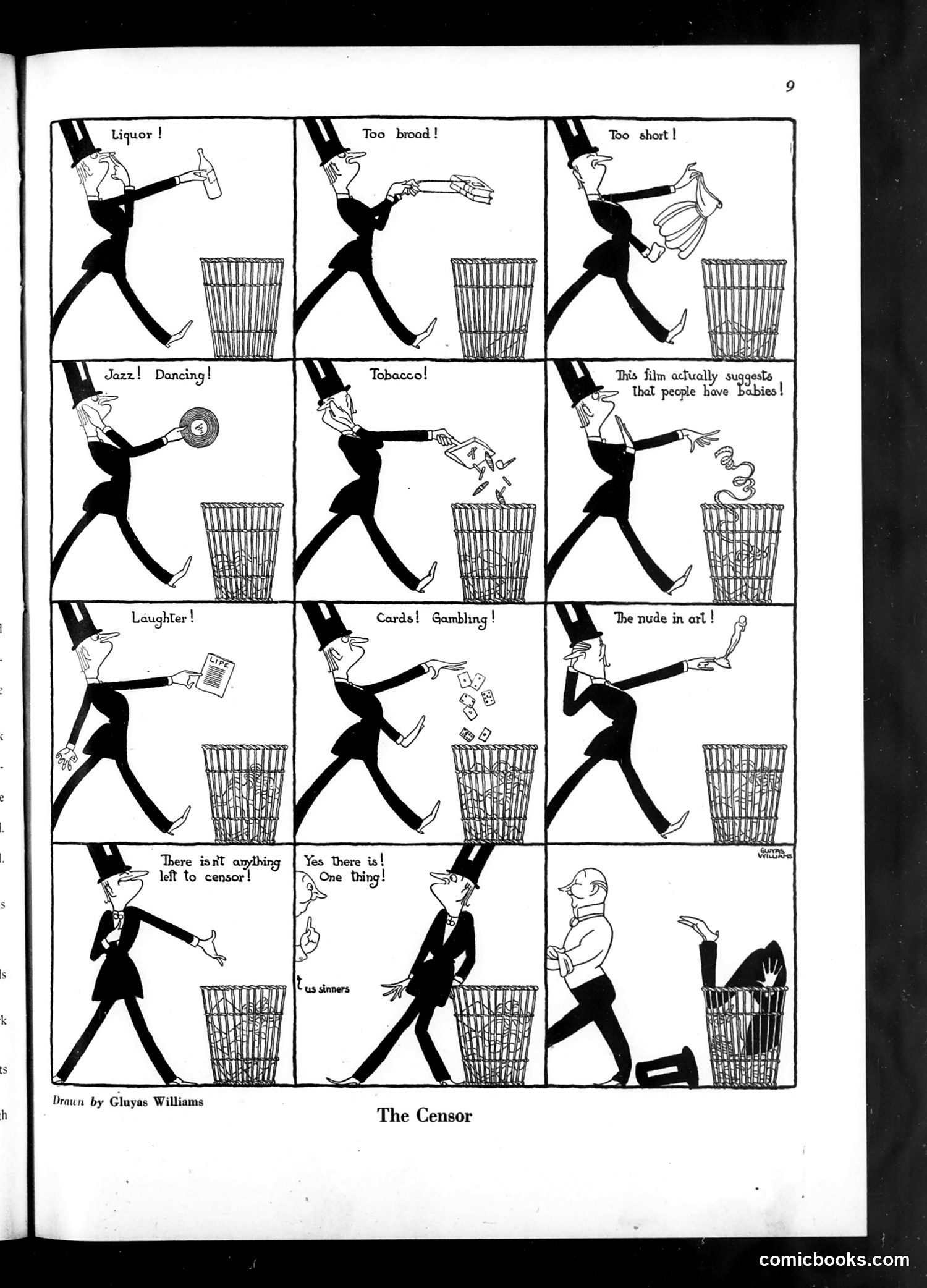
This cartoon satirizes film censorship by depicting a censor character systematically discarding "objectionable" content into a trash bin. The figure throws out items labeled: liquor, broad (slang for woman), short skirts, jazz dancing, tobacco, babies, laughter, cards/gambling, and nude art. The final panels reveal the absurdity: after censoring everything, "there isn't anything left to censor!" except "bus dinners" (poor quality food). The censor's desperate final action—throwing the bus diner into the trash—suggests that censorship has become so extreme it destroys all of life's content and pleasures. This critiques the Motion Picture Production Code and broader censorship movements of the era, arguing that excessive moral regulation eliminates everything worth experiencing.
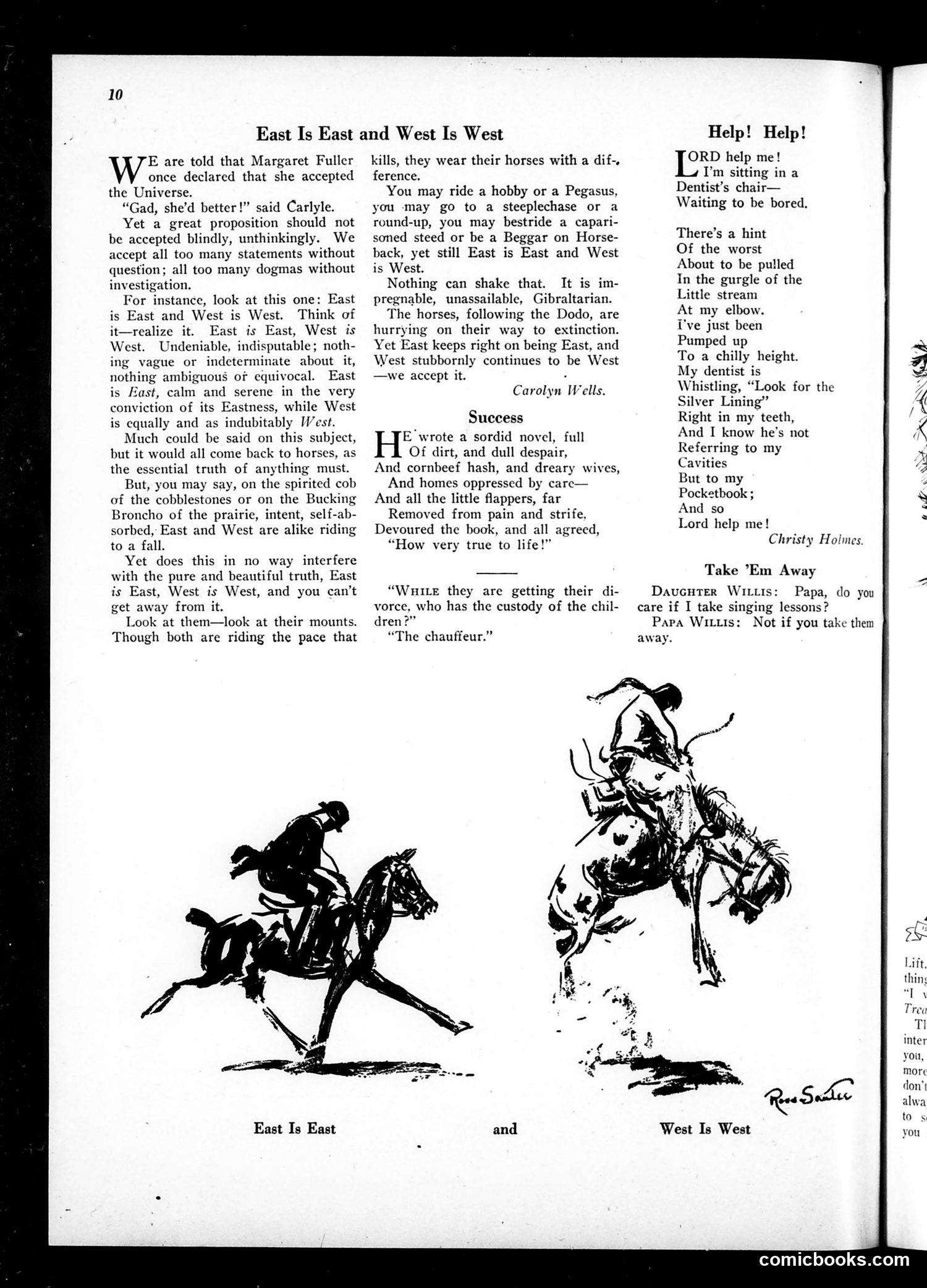
This page contains three distinct pieces: 1. **"East Is East and West Is West"** — An essay defending the absolute nature of geographical/cultural distinctions, using horses as metaphor. It argues that East and West are fundamentally different and unchangeable, regardless of superficial similarities. 2. **"Success"** — A poem about hardship transformed into literary success. 3. **Two cartoons** at bottom illustrate the title essay with horses and riders — one labeled "East Is East" (controlled rider on disciplined horse) and "West Is West" (wild bucking horse). These visually demonstrate the essay's claim about immutable cultural differences. 4. **"Help! Help!"** and **"Take 'Em Away"** — Brief comic pieces unrelated to the main content. The overall page uses the East/West distinction (likely referencing Kipling's famous poem) to make a point about cultural essentialism.
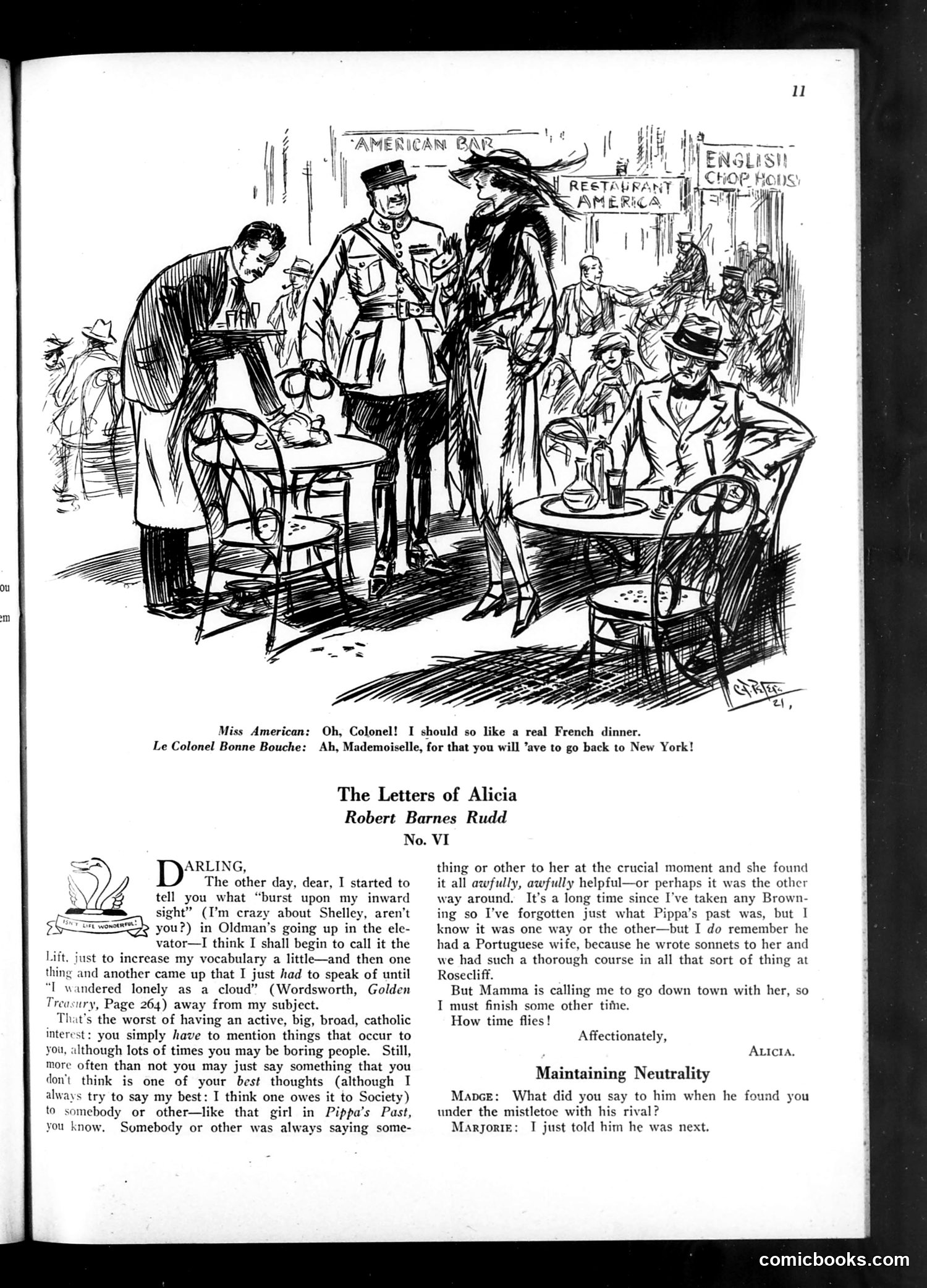
The top cartoon satirizes American attitudes toward French culture during World War I. An American woman in a restaurant encounters a French officer and expresses desire for "a real French dinner," but when the French colonel suggests she'd have to return to New York to experience authentic French cuisine, she demurs—implying that American establishments merely imitate French style without genuine substance. Below this is "The Letters of Alicia" by Robert Barnes Rudd (No. VI), a humor column where the writer discusses verbose expression and social obligation to say something meaningful rather than empty pleasantries. The section "Maintaining Neutrality" presents a brief comedic exchange about what to say when encountering a rival beneath mistletoe. The page reflects early-20th-century American fascination with European sophistication and social etiquette humor.
This page from *Life* magazine presents opera plot summaries by Robert C. Benchley, a humorist. It's not primarily satirical content but rather educational/entertainment material about two operas: *Il Minnestrone* and *Lucy de Lima*. The decorative illustration at bottom shows a stylized female figure with flowing hair—typical Art Deco design of the era, not a political caricature. The humor here is subtle: Benchley's summaries mock the often absurd, melodramatic plots of grand opera through straightforward narration. The first opera's title appears a pun (minnestrone = minestrone soup), suggesting opera's sometimes ridiculous premises. This represents the magazine's satirical approach: gentle mockery of high culture through witty writing rather than editorial cartooning.
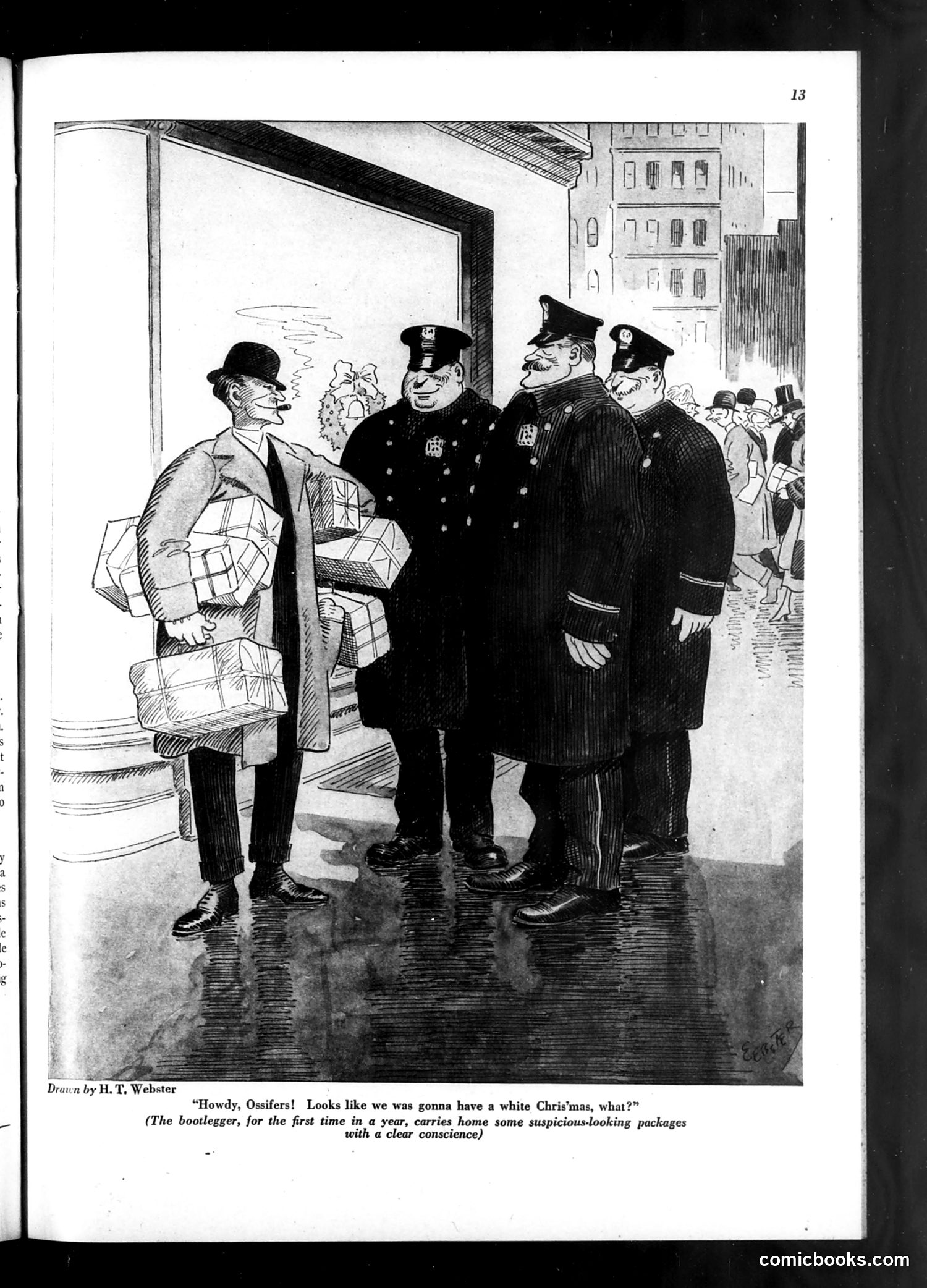
This cartoon satirizes Prohibition-era bootlegging. The caption reads: "Howdy, Osifers! Looks like we was gonna have a white Christmas, what?" with a subtitle noting "(The bootlegger, for the first time in a year, carries home some suspicious-looking packages with a clear conscience)." The humor hinges on a snow pun: "white Christmas" refers both to snow and to cocaine or other white drugs. The bootlegger character (left, in checkered coat) addresses police officers, suggesting he can now carry packages "with a clear conscience" because the white snow provides cover—literal camouflage for illicit goods that would otherwise appear suspicious. The cartoon mocks both bootleggers' brazenness and police ineffectiveness during Prohibition.
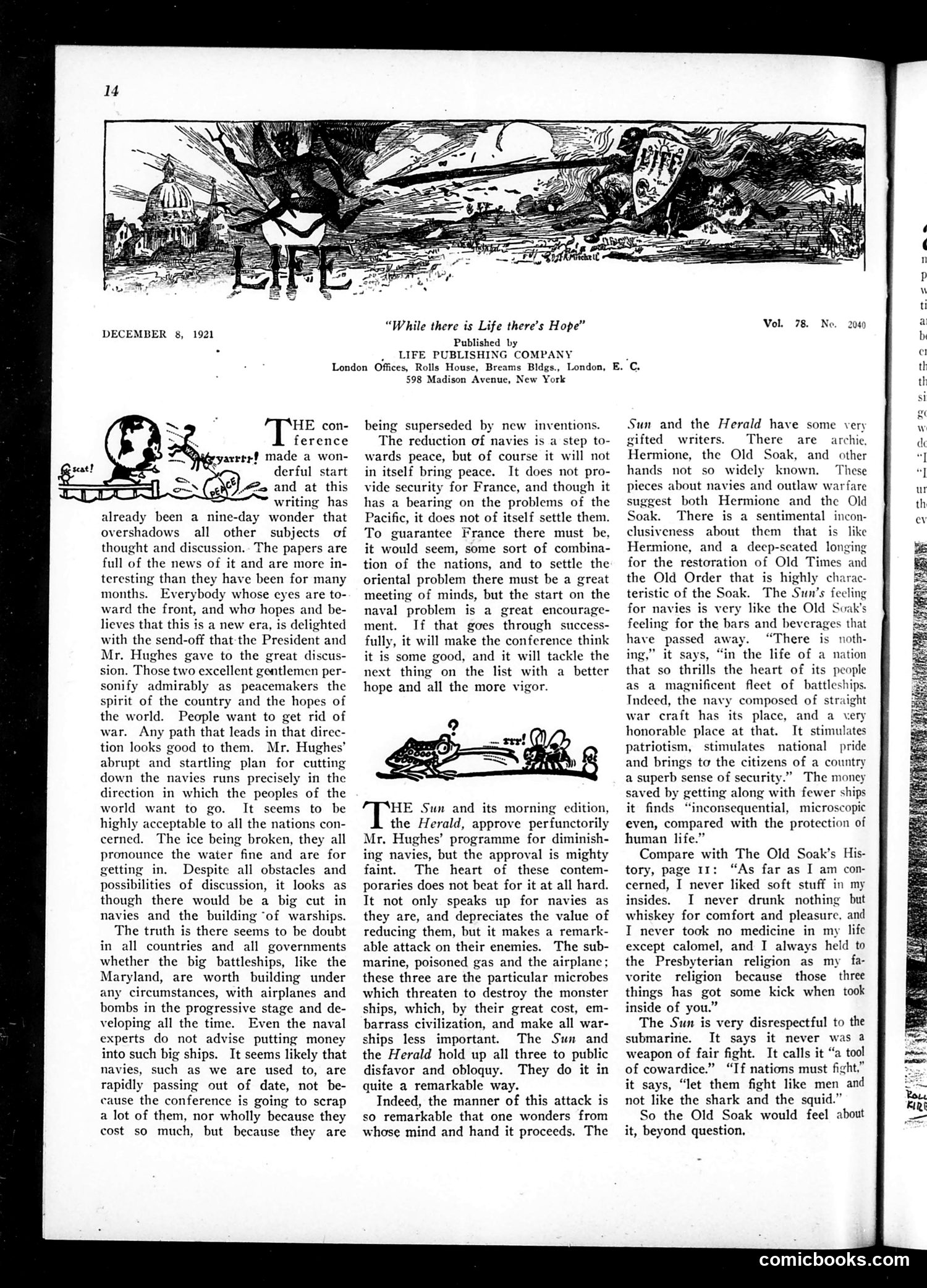
This editorial page discusses post-WWI naval disarmament policy. The masthead cartoon depicts "Life" as a figure observing a landscape with military elements—likely representing the ongoing debate about weapons reduction. The text praises President Hughes's disarmament program for reducing battleships and military expenditure. It favorably compares Hughes's approach to publications like the *Sun* and *Herald*, which the author claims also support naval reduction as economically sound and morally justified after the Great War. The piece argues against maintaining large navies, contending that ships are expensive, strategically vulnerable to modern warfare (poisoned gas, airplanes), and ultimately less important than international cooperation for national security. The satirical point: military advocates waste resources on outdated naval power when peace and diplomacy better protect nations.
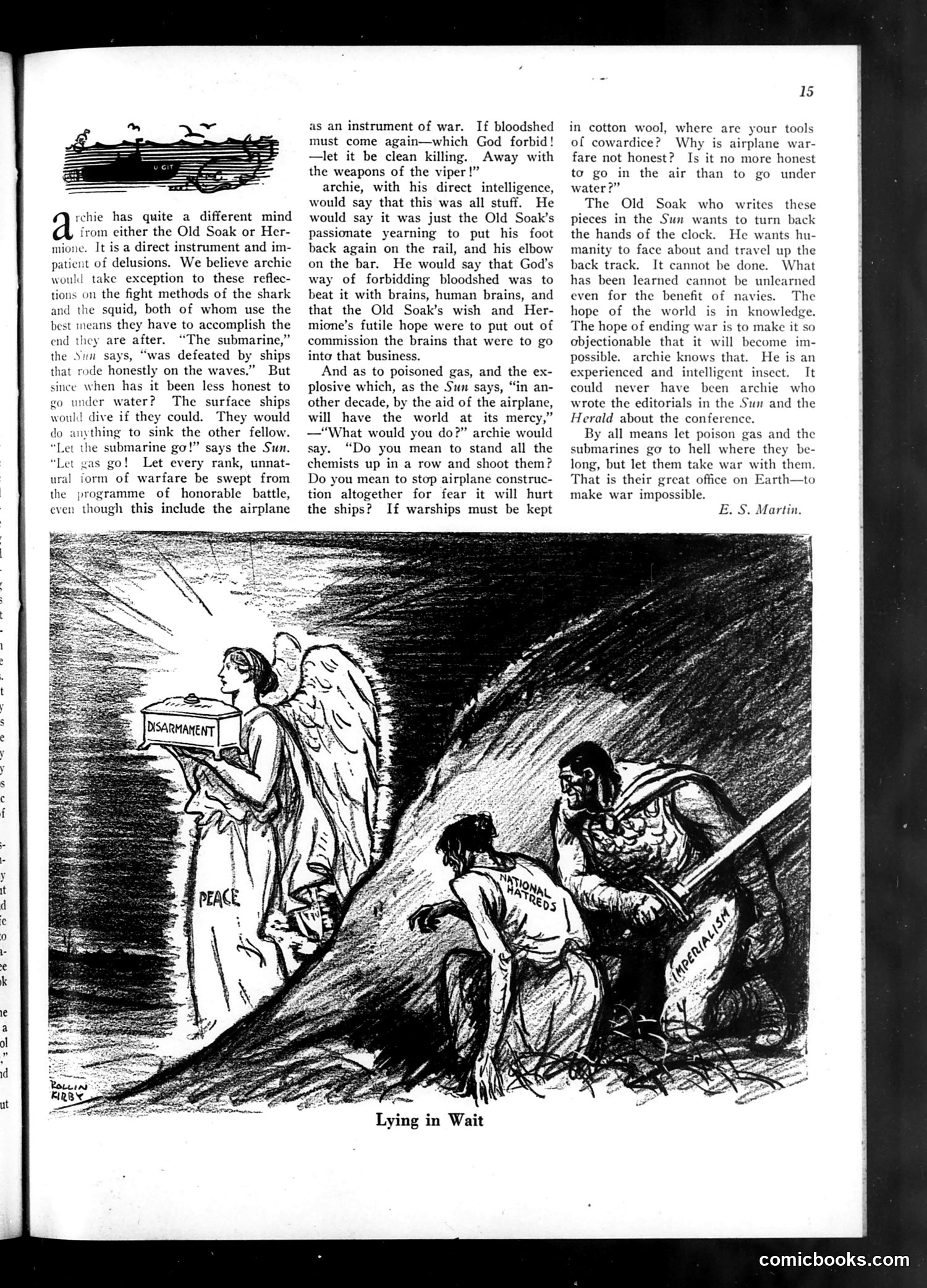
This political cartoon satirizes pacifist arguments against modern warfare technologies. The image depicts Peace standing above figures labeled "Brown Treated" and "Neutrals," who cower before War—a grotesque demon crouching menacingly below. The accompanying text (by E.S. Martin) argues against naive calls to ban submarines, poison gas, and aircraft as "dishonorable" weapons. The piece mocks publications like the *Sun* and *Herald* for wanting to return to "clean killing" and "honest" surface warfare—treating war as if it could be gentlemanly. Martin's persona "archie" (likely the famous cockroach character from the magazine) represents pragmatic intelligence: these weapons exist and cannot be uninvented. The only real solution isn't banning specific arms but making war so objectively terrible that it becomes impossible—through knowledge and deterrence, not wishful thinking. The cartoon illustrates this irony: Peace naively stands guard while War waits below, suggesting that pretending modern weapons don't exist won't prevent conflict.
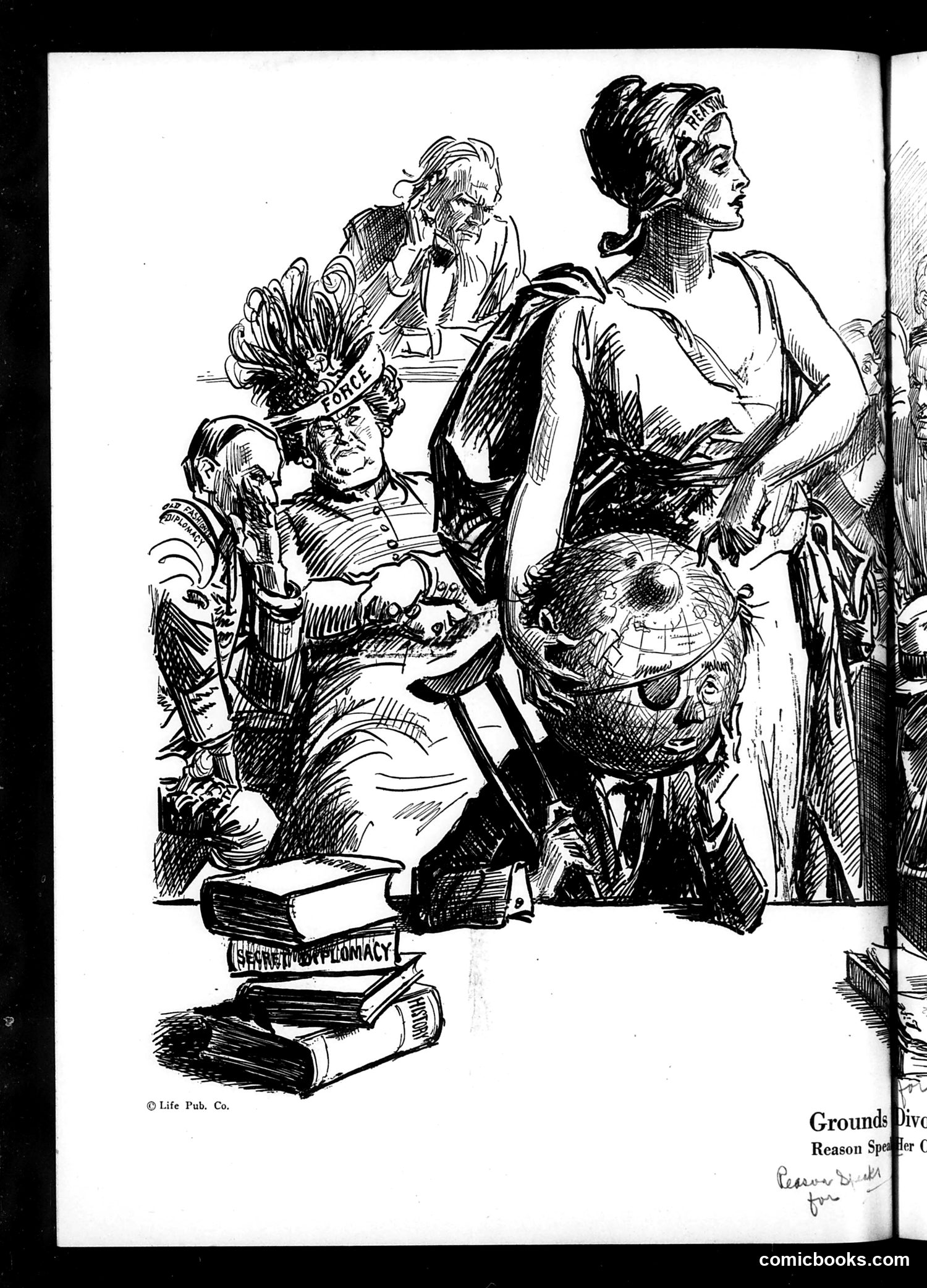
This Life magazine cartoon satirizes diplomatic hypocrisy, likely from the early 20th century. The central figure appears to be a woman representing a nation or diplomatic power, flanked by grotesque caricatured figures. Books labeled "SECRET DIPLOMACY" lie at the bottom, suggesting the cartoon critiques backroom political dealings conducted under false pretenses of respectability. The composition contrasts the elegant, respectable-looking woman with the uglier figures behind her, implying that diplomatic presentations hide unsavory realities or intentions. The specific historical context—which diplomats or nations are referenced—remains unclear without additional publication details, but the satire generally mocks the gap between public diplomatic rhetoric and actual conduct.
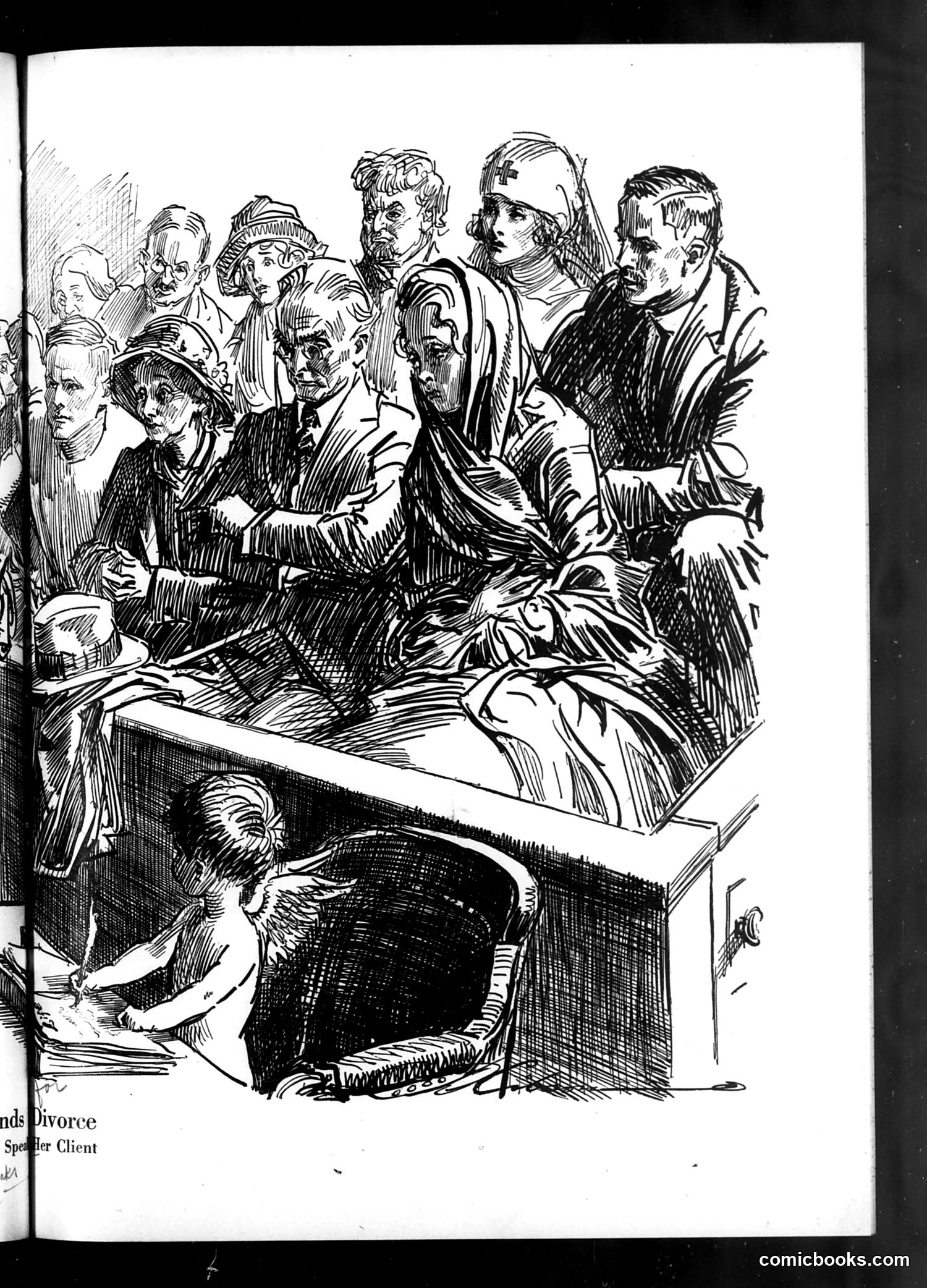
This appears to be a satirical courtroom illustration, likely from Life magazine's social commentary section. The image depicts a divorce proceeding with a judge and multiple witnesses or court participants gathered around a bench. The visible text fragments reference "Divorce" and "Spendler Client," suggesting this cartoon satirizes divorce litigation—possibly mocking the theatrical nature of courtroom proceedings or the various parties involved in contested cases. The detailed cross-hatching and expressive character work is typical of 19th-century satirical illustration. Without additional context or clearer text, the specific individuals or case being referenced remains unclear, though the scene appears to critique legal formality or social attitudes toward marital dissolution during that era.
This is a theater criticism column from Life magazine titled "The Great Plague," humorously treating a sudden glut of new theatrical productions as an epidemic. The author laments that during Life's Christmas hiatus, numerous mediocre plays opened simultaneously at Broadway theaters, comparing their sudden appearance to an infestation. Several plays are mentioned as quick failures ("The Great Way," "The Skirt"), while others receive mixed reviews. A.A. Milne's "The Great Broxopp" is criticized for relying on cheap alliterative puns rather than his customary wit. Rachel Crothers' "Everyday" is dismissed as evangelical melodrama redeemed only by its cast (including Tallulah Bankhead). "We Girls" by the Hattons is called a tired, derivative plot, though Mary Young performs adequately. Arnold Bennett's "The Title" is mocked for sounding like stage directions read aloud. The column uses mock-indignant humor to critique theatrical mediocrity—a common Life magazine approach to entertainment criticism.
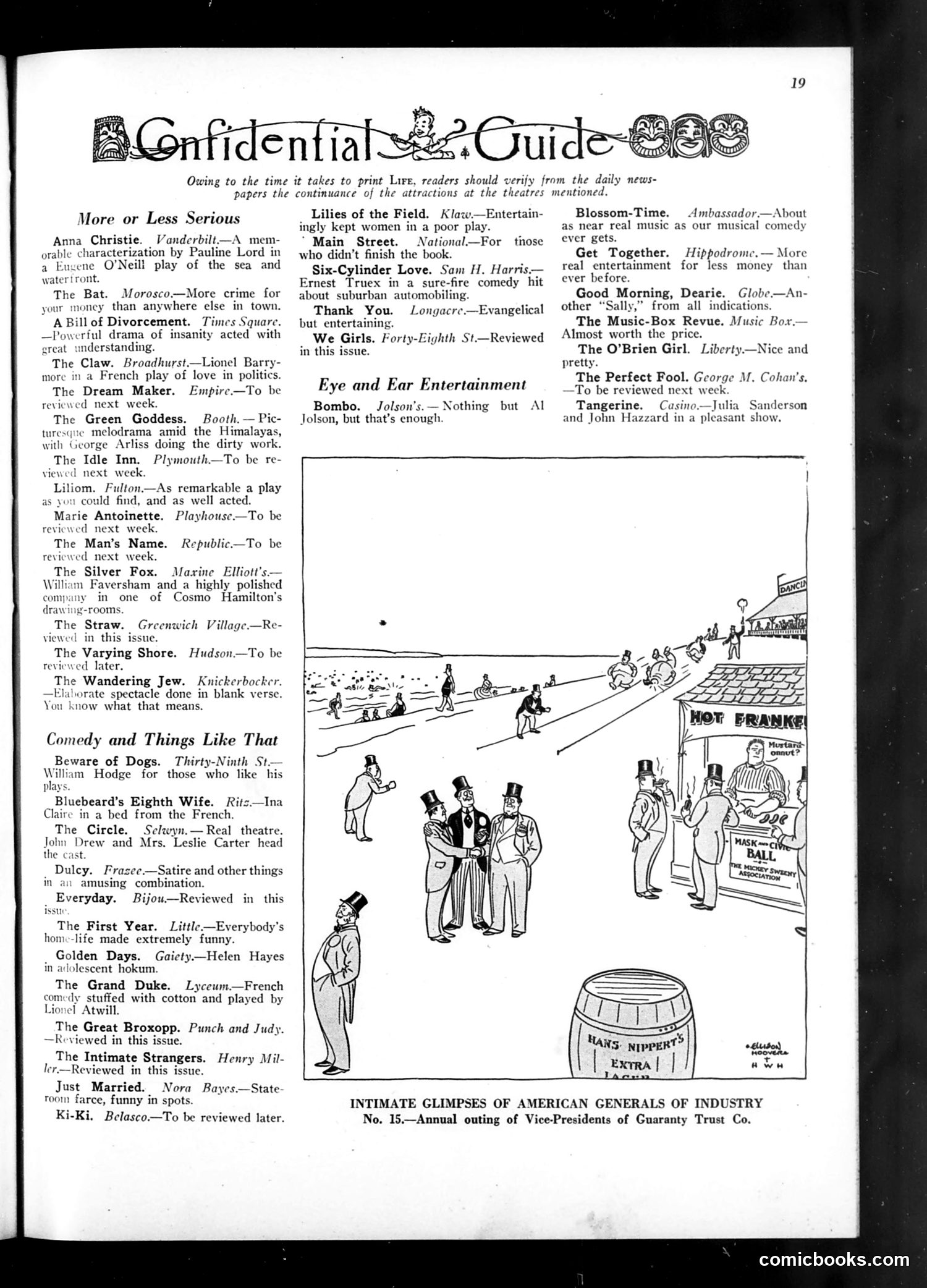
This page is a theater and entertainment guide listing Broadway shows and performances. The main cartoon at the bottom, captioned "Intimate Glimpses of American Generals of Industry No. 15," satirizes corporate executives—specifically vice-presidents of Guaranty Trust Co.—at their annual outing. The illustration depicts well-dressed businessmen in top hats enjoying leisure activities at what appears to be a beach or seaside resort. There's a "Hot Franks" stand and a barrel labeled "Man's Nipperty's Extra Lager," suggesting working-class food and drink contrasts humorously with the executives' formal attire. The satire targets the gap between corporate elites' public dignity and their participation in ordinary recreational pursuits. The "generals of industry" are shown not in boardrooms but engaged in common amusements, poking fun at pretensions of superiority. This fits *Life*'s tradition of mocking American business culture and class distinctions of the early 1920s.
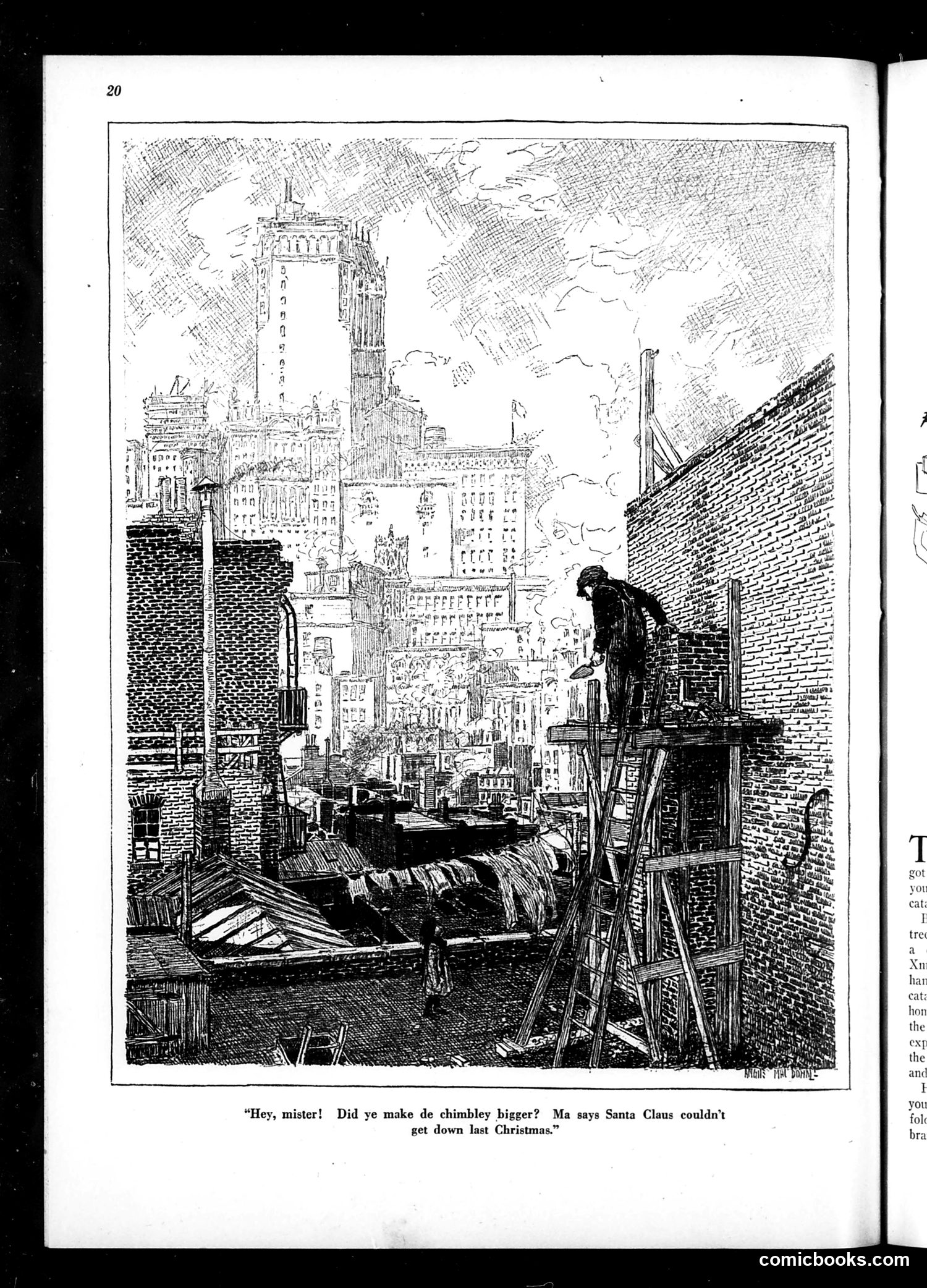
This is a humorous cartoon set on a New York City rooftop, showing a worker on a ladder speaking to a man about chimney repairs. The child's voice (represented in dialect) asks if the chimney has been enlarged because "Santa Claus couldn't get down last Christmas." The joke plays on the practical problem of Santa's access to homes via chimneys—a child's literal concern about Christmas delivery. The urban rooftop setting and working-class dialect suggest this is aimed at immigrant or working-class audiences of the era. The satire gently mocks both the child's earnest belief in Santa and the class circumstances that might require chimney modification for such purposes. It's a lighthearted domestic humor piece typical of Life magazine's comic content.
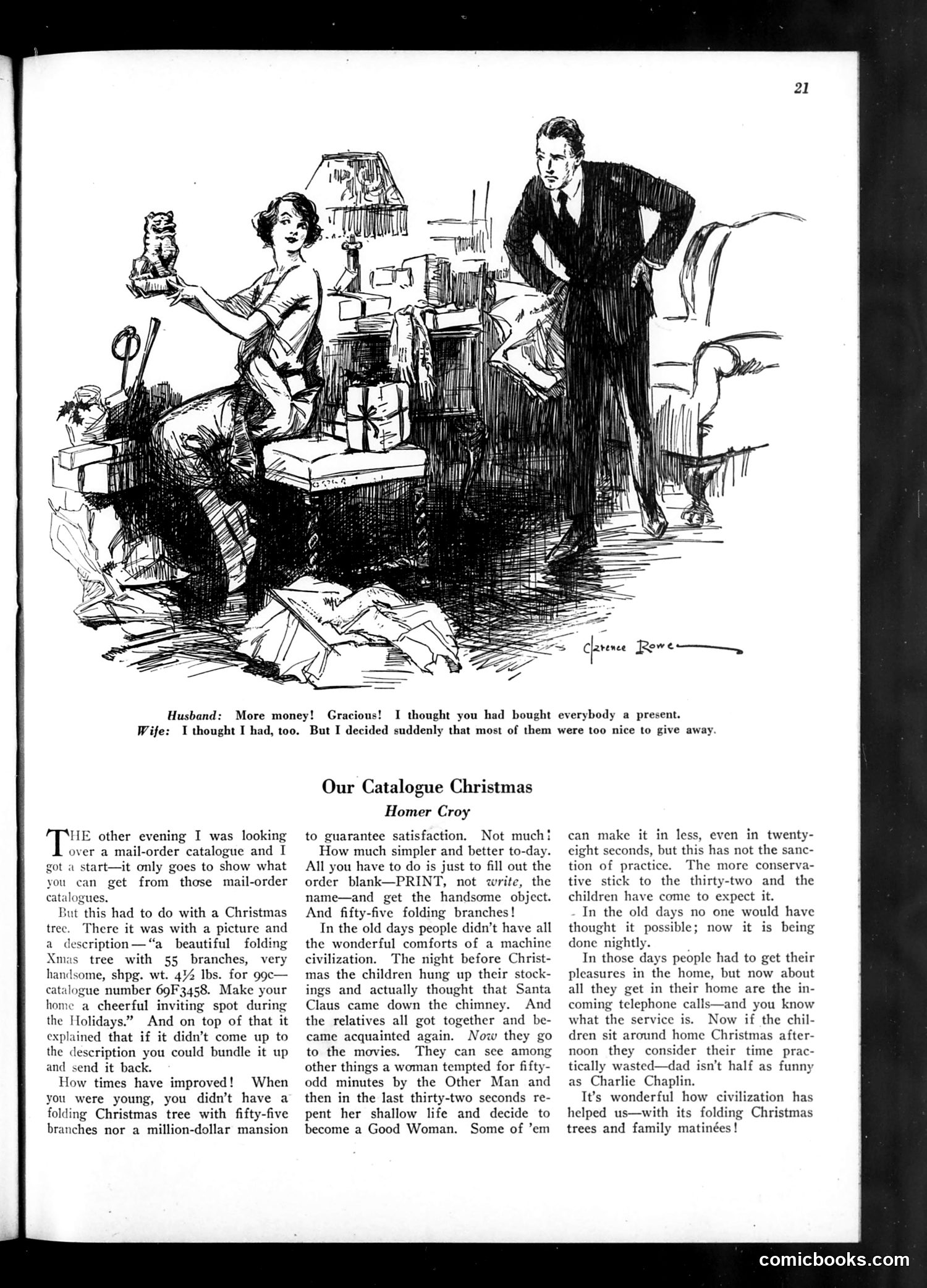
This satirical piece critiques modern consumer culture and declining family values through nostalgic contrast. The cartoon shows a husband upset about his wife's Christmas spending—she bought expensive gifts then decided they were "too nice to give away," illustrating impulsive, wasteful shopping behavior enabled by mail-order catalogs. Croy's essay sarcastically praises "progress": artificial folding Christmas trees (55 branches!) replace natural ones; families now attend movies instead of gathering at home; children find their fathers less entertaining than Charlie Chaplin films; telephone interruptions replace intimate conversation. The satire targets early 20th-century consumerism's promises of convenience and comfort, arguing that mass production and modern entertainment have actually *diminished* genuine family connection and meaningful holiday traditions. The "wonderful civilization" of catalogs and cinema has paradoxically made home life less appealing.
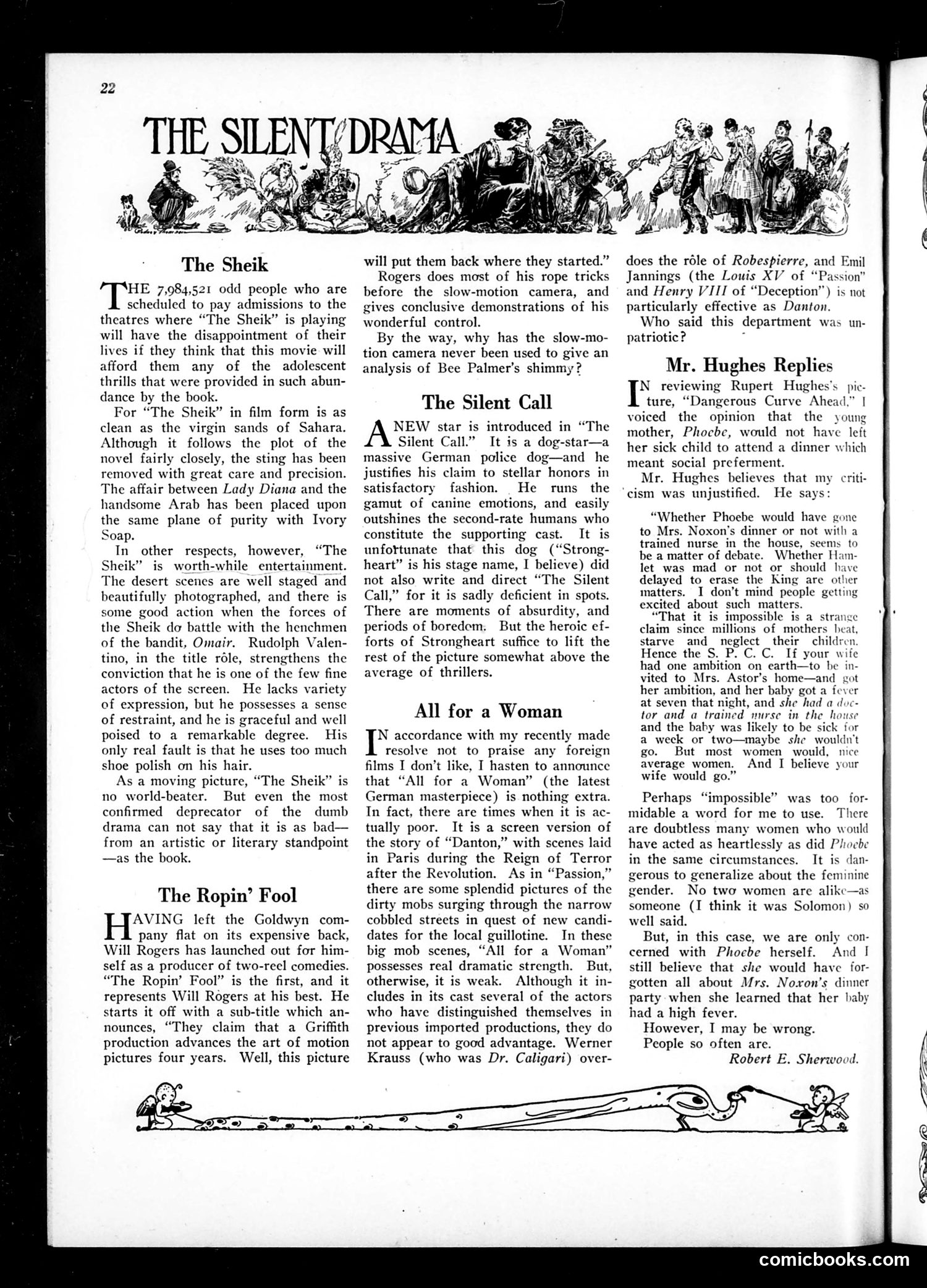
This page reviews four silent films from the early 1920s. The critic sarcastically critiques **"The Sheik"** (starring Rudolph Valentino), noting the film sanitized the scandalous novel for moral acceptability—reducing a romantic affair to "the same plane of purity with Ivory Soap." He praises Valentino's acting but mocks his excessive hair product use. **"The Ropin' Fool"** features Will Rogers performing rope tricks in slow-motion, with Rogers humorously claiming the film will reverse D.W. Griffith's supposed four-year advancement of cinema. **"The Silent Call"** stars a German Shepherd dog ("Strongheart") who outperforms human actors—a backhanded compliment suggesting the supporting cast was weak. **"All for a Woman,"** a German film about the French Revolution's Reign of Terror, receives dismissal as mediocre despite impressive mob scenes. The overall tone reflects 1920s film criticism's focus on moral content, technical innovation, and actor performance while maintaining satirical distance from all subjects.
This is a **full-page advertisement**, not a cartoon or satire. It's a Phoenix Hosiery brand advertisement from *Life* magazine, featuring ornate decorative borders in an Art Nouveau or Art Deco style. The ad makes a straightforward commercial pitch: Phoenix hosiery offers comfort, elegance, durability, and value. The copywriting emphasizes practical "wearing qualities" and "long mileage" while suggesting that comfort and style are pleasant side effects of the product's core benefit—economy (low cost). There is no political commentary, social satire, or caricature here. This represents typical early-20th-century magazine advertising that blended decorative design with product claims, targeting consumers (likely women) seeking quality hosiery at reasonable prices.
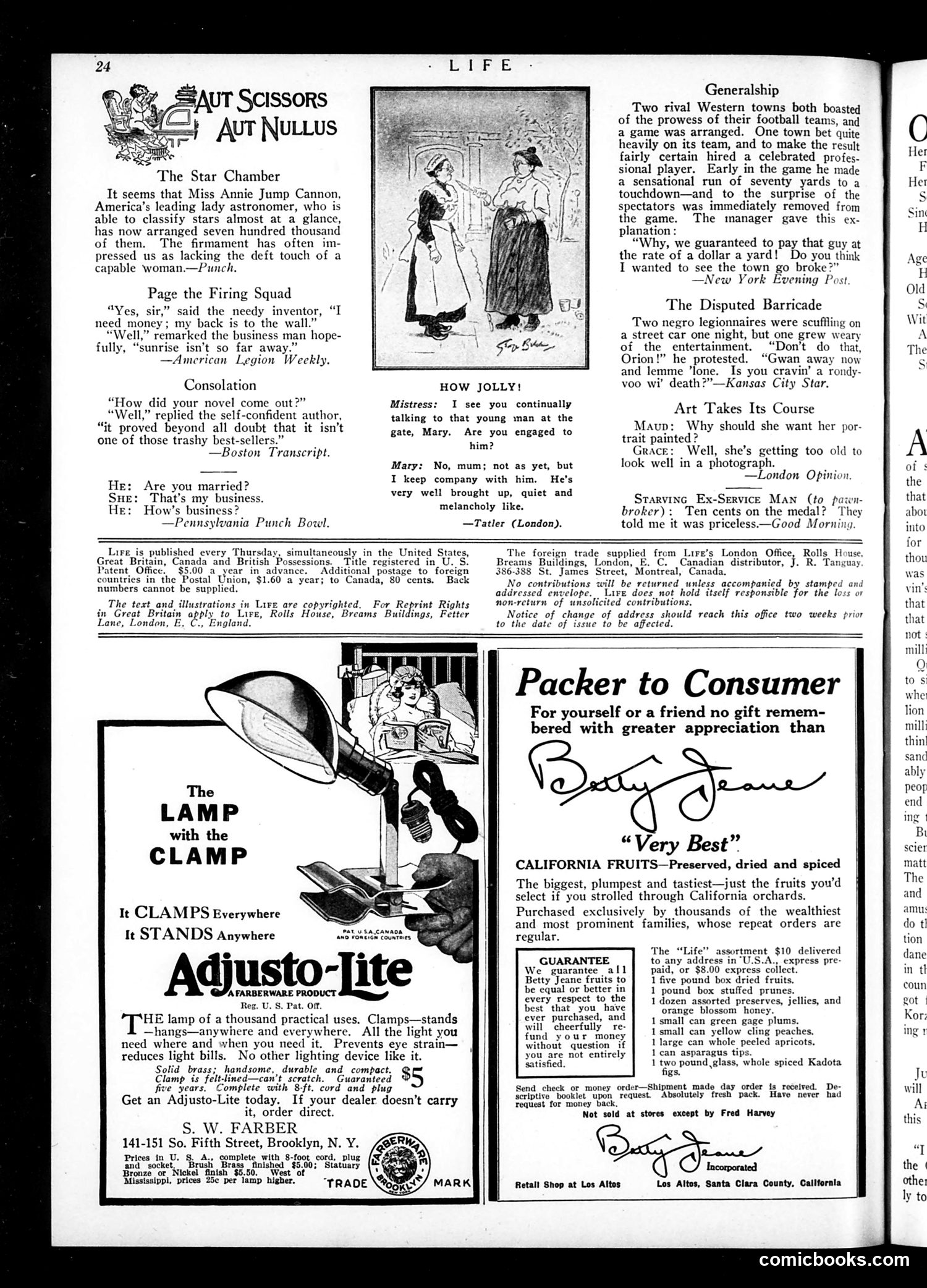
This page from *Life* contains brief satirical pieces typical of the magazine's humor format, plus advertisements. The cartoons mock everyday social situations: a maid denying engagement while admitting she "keeps company" with a young man (a period euphemism); two college football towns' financial desperation when their hired professional player scores too quickly, exhausting their per-yard payment budget; an ex-serviceman pawning a war medal for pittance despite its sentimental value. The opening item praises astronomer Annie Jump Cannon for organizing 700,000 stars, joking that the universe "has often impressed us as lacking the deft touch of a capable woman"—light satire on masculine disorder versus feminine organizational ability. Most of the page comprises advertisements for "Adjusto-Lite" lamps and "Betty Jane" California preserved fruits, with period product claims and guarantees. The humor assumes readers familiar with post-WWI employment struggles, class dynamics, and gender stereotypes of the 1920s-30s era.
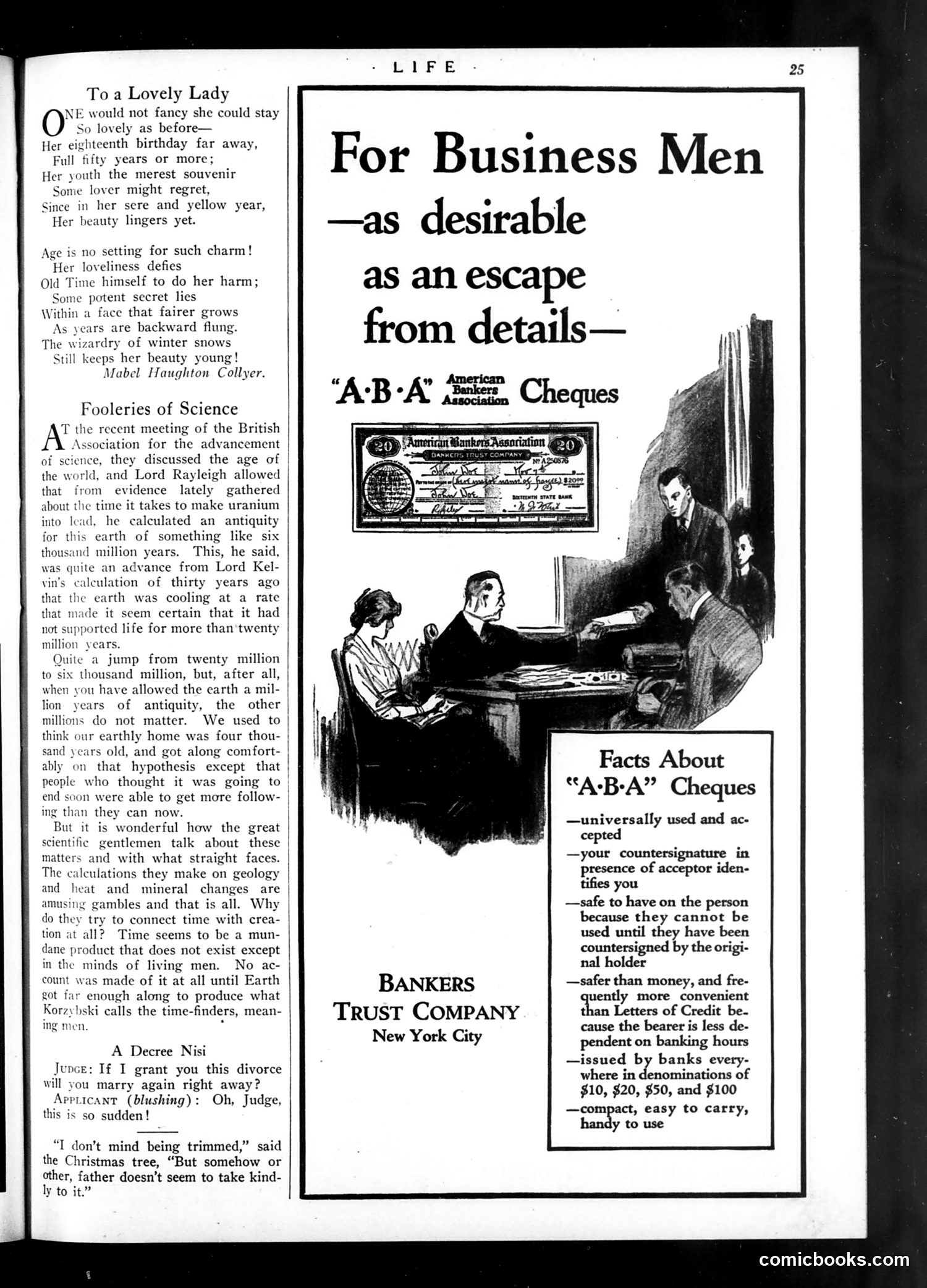
This page mixes poetry, humorous anecdotes, and advertising—typical of Life's format. **Content:** - A sentimental poem about aging beauty (by Mabel Haughton Collyer) - "Fooleries of Science": satirical commentary on British scientists debating Earth's age, jumping from Lord Kelvin's estimate of 20 million years to Lord Rayleigh's 6 billion years. The satire mocks scientists' grandiose calculations as "amusing gambles" disconnected from reality, questioning why they "connect time with creation" when time itself is merely a human construct - Two brief jokes: one about divorce, another about a Christmas tree - A full-page advertisement for "A-B-A" traveler's cheques from Bankers Trust Company, marketed to businessmen as a safe alternative to carrying cash The satirical tone suggests skepticism toward scientific pretension—a common theme in early 20th-century popular magazines challenging academic authority.
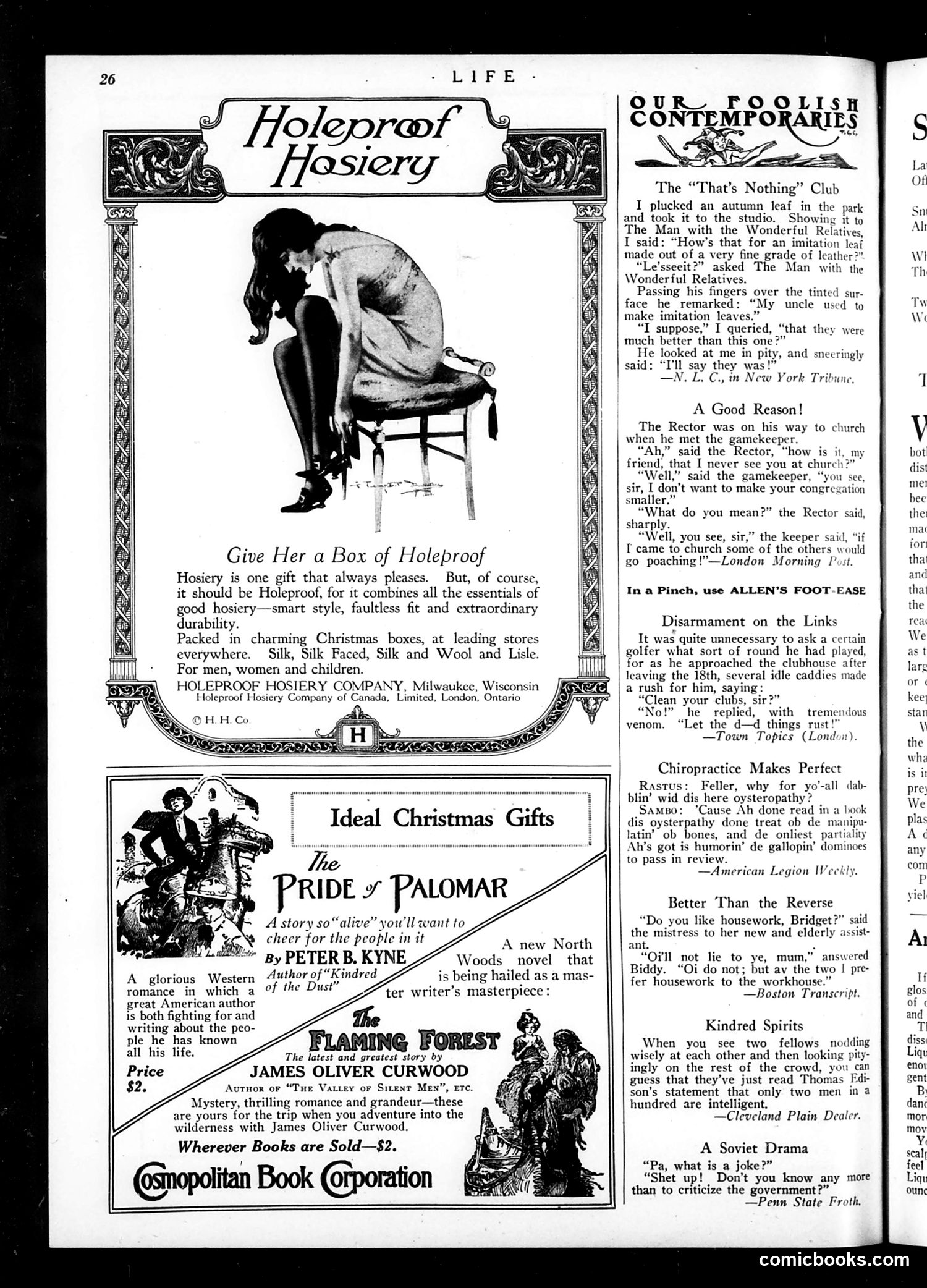
This page contains humorous anecdotes mocking various contemporary behaviors and professions. The sketches include: **"The 'That's Nothing' Club"**: A joke about one-upmanship—someone shows an artificial leaf, and the listener claims his uncle made even better fake leaves, establishing a smug superiority despite the obvious absurdity. **"A Good Reason"**: A gamekeeper explains to a Rector why he doesn't attend church—if he came, poachers would steal the game. The humor lies in his backwards logic: his presence prevents church attendance, not lack of faith. **"Disarmament on the Links"**: A golfer angrily refuses a caddy's offer to clean his clubs, telling them to rust instead. The joke satirizes irritable behavior over minor club maintenance. **"Chiropractice Makes Perfect"**: A dialect-heavy joke mocking chiropractic medicine as folk medicine, using African American vernacular for comedic effect (period-typical but now offensive). The page also advertises Holeproof hosiery and books. Overall, this represents Life magazine's satirical approach: mocking pretension, foolish reasoning, and professional quackery through brief, acidic anecdotes.
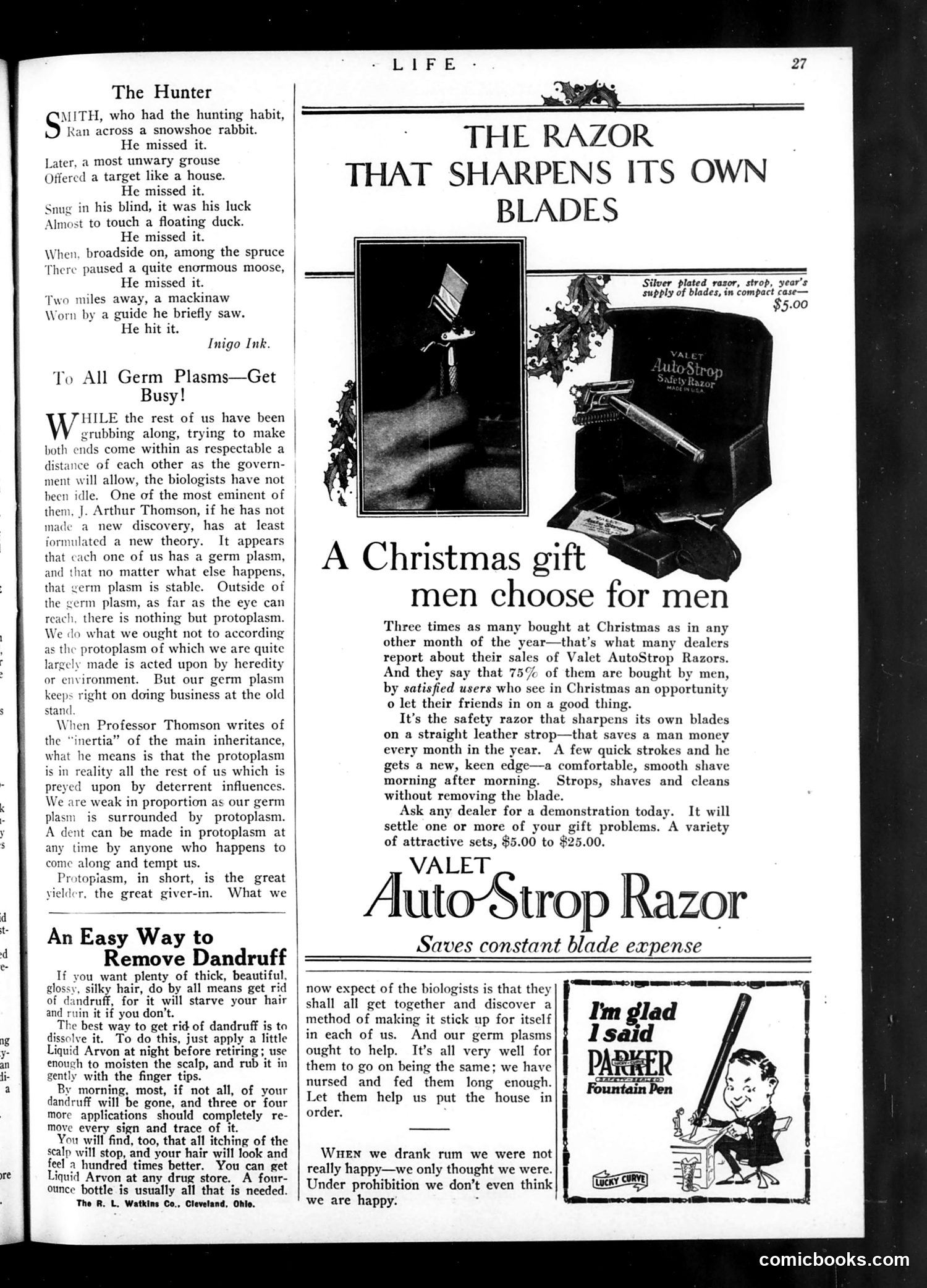
This page contains three distinct pieces: **"The Hunter" (poem):** A satirical verse about a poor marksman who misses easy targets (rabbit, grouse, duck, moose) but accidentally hits a guide wearing a mackinaw coat from two miles away. The joke: incompetence combined with dumb luck. **"To All Germ Plasms—Get Busy!" (essay):** A humorous commentary on Professor J. Arthur Thomson's biological theory distinguishing between stable "germ plasm" (heredity) and malleable "protoplasm" (environmentally-influenced matter). The satire satirizes both the theory's abstraction and humanity's moral weakness—we're weak because our protoplasm is easily tempted by external influences, unlike our supposedly stable genetic core. **Advertisements:** The page is dominated by ads for Valet AutoStrop Razor and Liquid Arvon dandruff treatment, plus a Parker Fountain Pen ad. The predominance of advertising reflects *Life*'s business model as a commercial magazine, not purely satirical content.
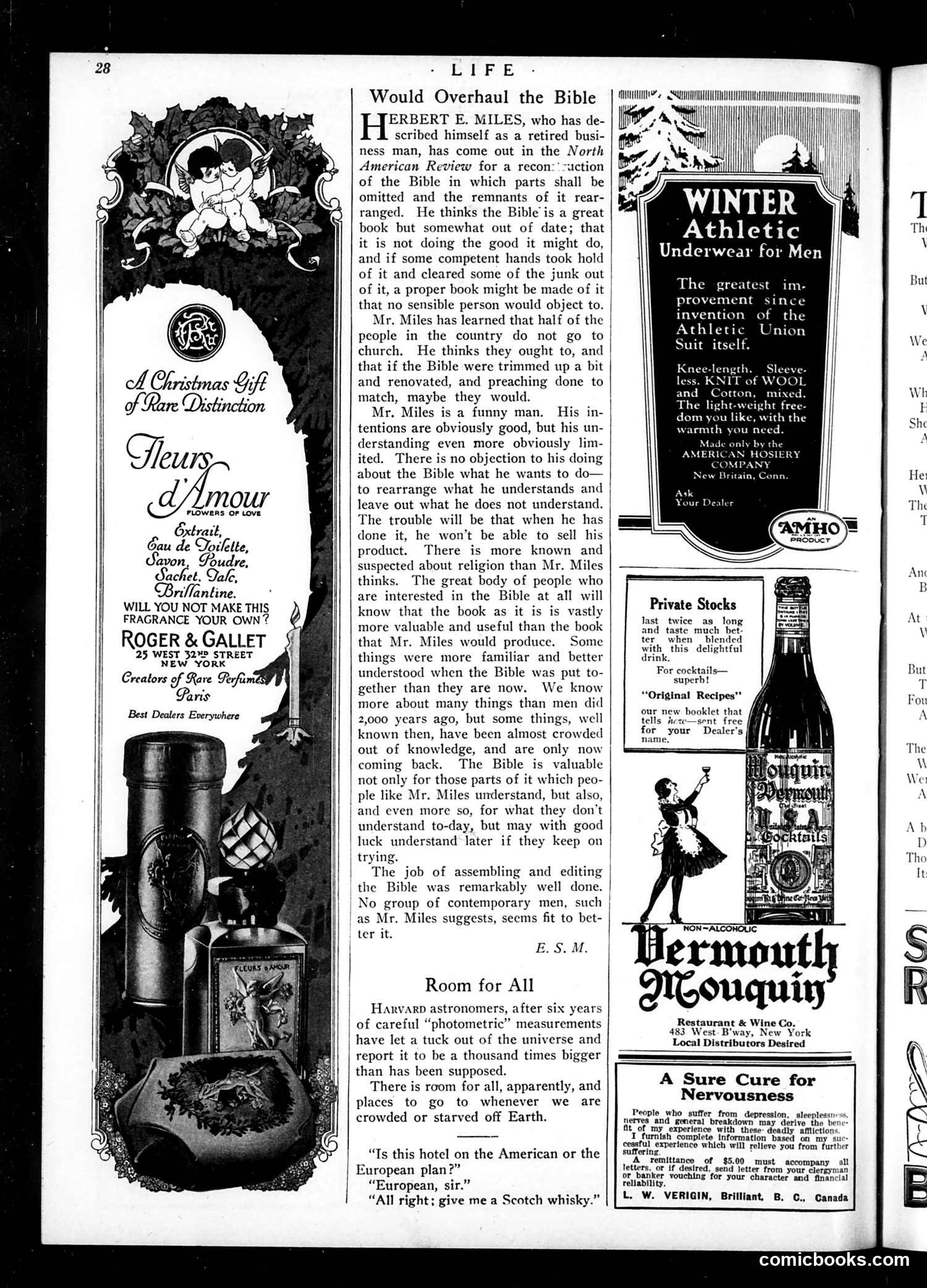
This page contains **editorial commentary and period advertising** rather than political cartoons. The main article critiques Herbert E. Miles's proposal (published in *North American Review*) to edit and reorganize the Bible, removing "outdated" sections. Life's editor argues against this revision, contending that the Bible's value lies not only in its comprehensible parts but also in passages whose significance people may only understand later through continued study. The piece defends the original assembly and editing of the Bible as superior to any contemporary revision attempt. The surrounding advertisements—for French perfume (Roger & Gallet), men's thermal underwear, vermouth, and a "nervousness cure"—are typical of the era's commercial content. A brief humor item about a hotel guest requesting Scotch whisky appears at page bottom, playing on the distinction between American and European hotel plans.
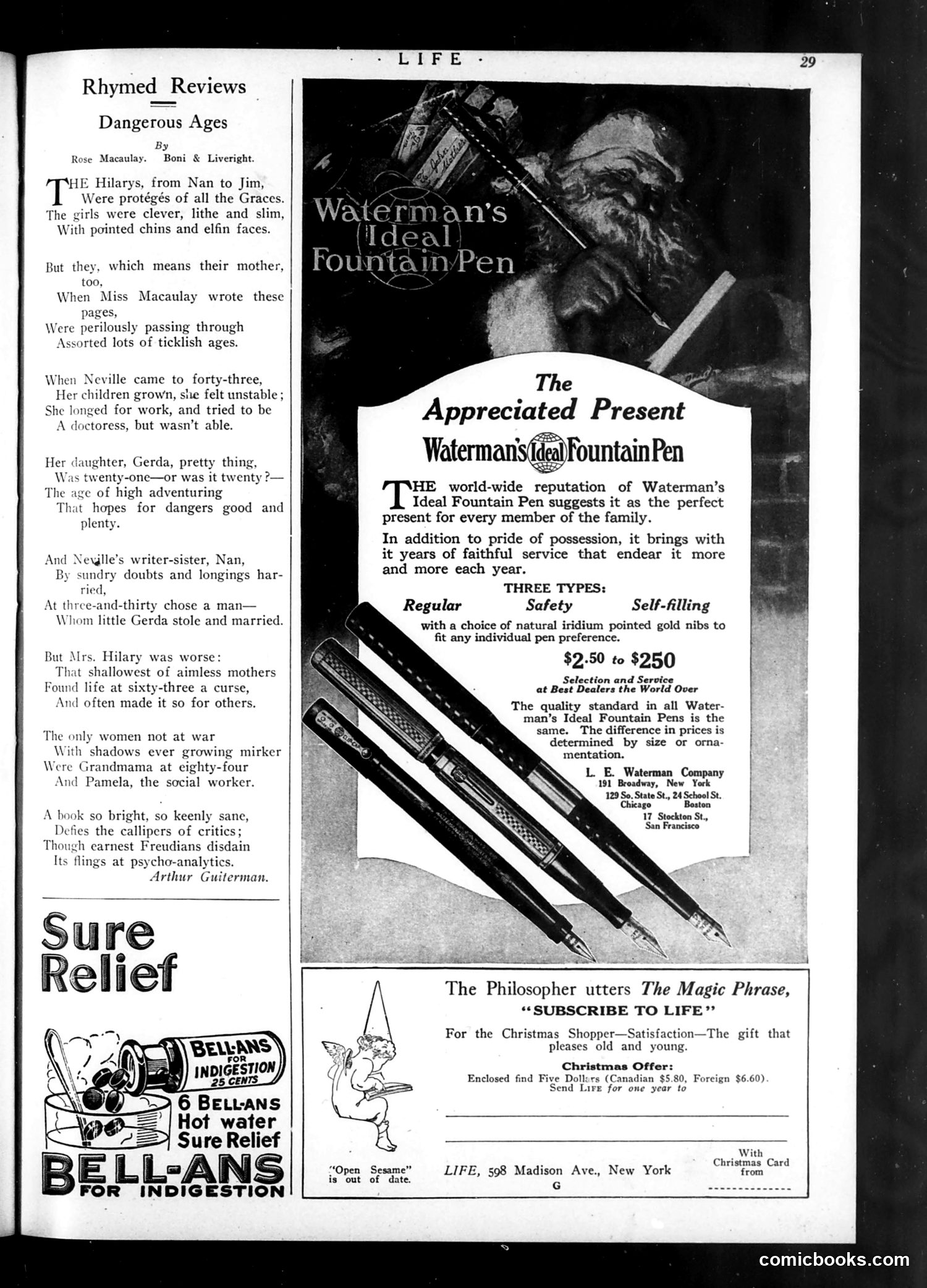
This page is primarily **advertising and book review**, not political satire. **Left column**: A rhymed review of Rose Macaulay's novel *Dangerous Ages*, summarizing its plot about the Hilary family across generations—women of various ages (20s-80s) navigating life transitions and dissatisfaction. The reviewer (Arthur Guiterman) praises the book's wit while noting Freudian critics dislike its psychology commentary. **Right side**: Two large advertisements. The dominant one promotes **Waterman's Ideal Fountain Pen** as an ideal gift, emphasizing reliability and offering three models ($2.50–$250). Below is a whimsical illustration of "The Philosopher" urging *Life* magazine subscriptions as Christmas gifts. **Bottom left**: A **Bell-ans indigestion relief** advertisement showing the product with hot water. The page reflects 1920s consumer culture and literary commentary—no political cartoon or satire is present. The content targets middle-class readers with purchasing power and literary interests.
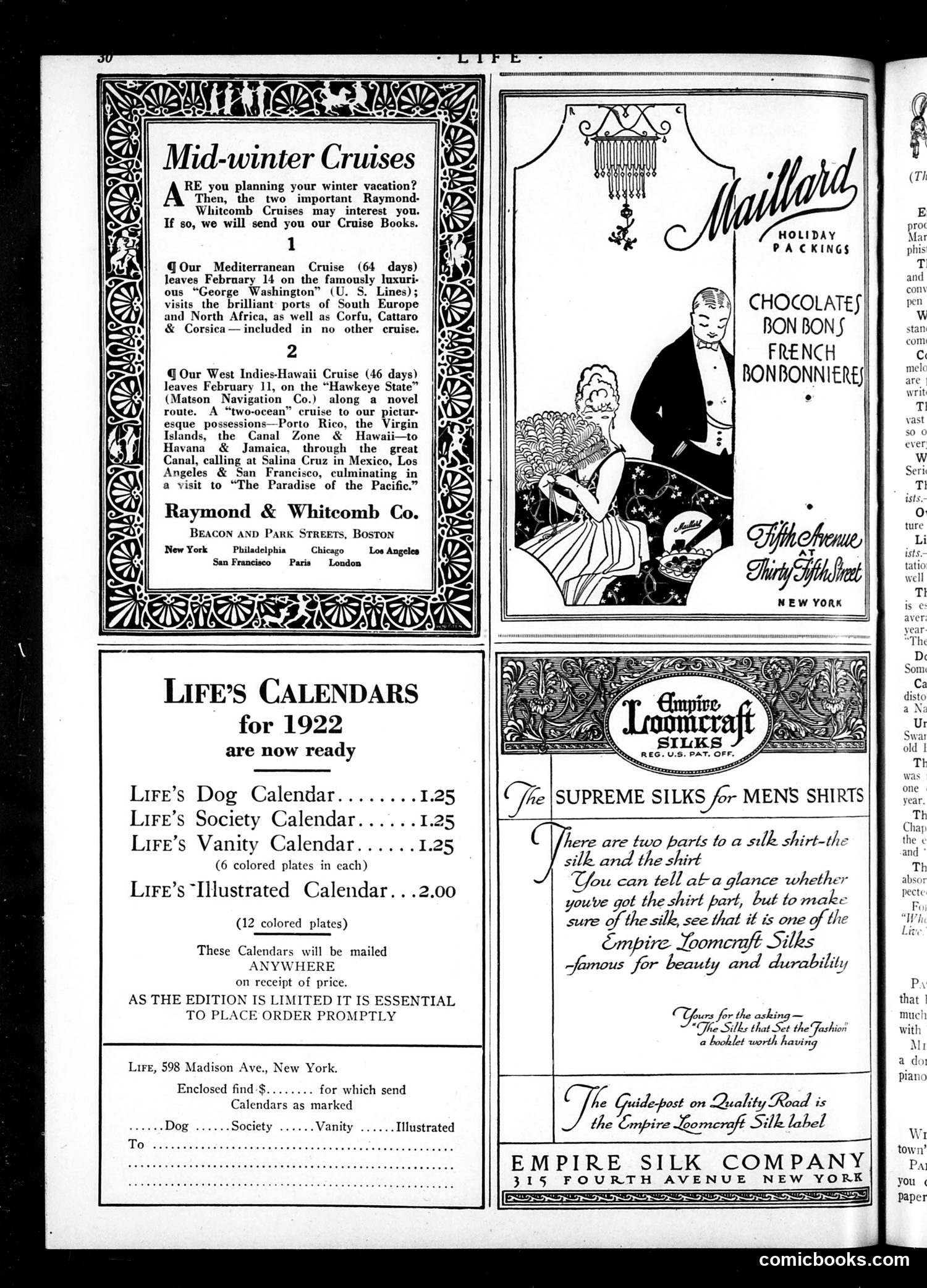
This page contains **no political cartoons or satire**—it's primarily **advertising and promotional content** for Life magazine itself. The left side advertises luxury winter cruises (Mediterranean and West Indies-Hawaii routes) via Raymond & Whitcomb Co., targeting wealthy leisure travelers. Below that, Life promotes its own 1922 calendars in various styles (Dog, Society, Vanity, Illustrated), emphasizing limited availability and urging prompt orders. The right side features advertisements for consumer goods: Maillard chocolates and bonbons (luxury confections), and Empire Loomcraft Silks (marketed as premium fabric for men's dress shirts). These ads reflect the **consumer culture and leisure aspirations of the 1920s**—targeting affluent readers with vacation packages, collectible calendars, imported luxuries, and quality menswear. The elegant art deco borders and sophisticated typography underscore the magazine's upscale positioning.
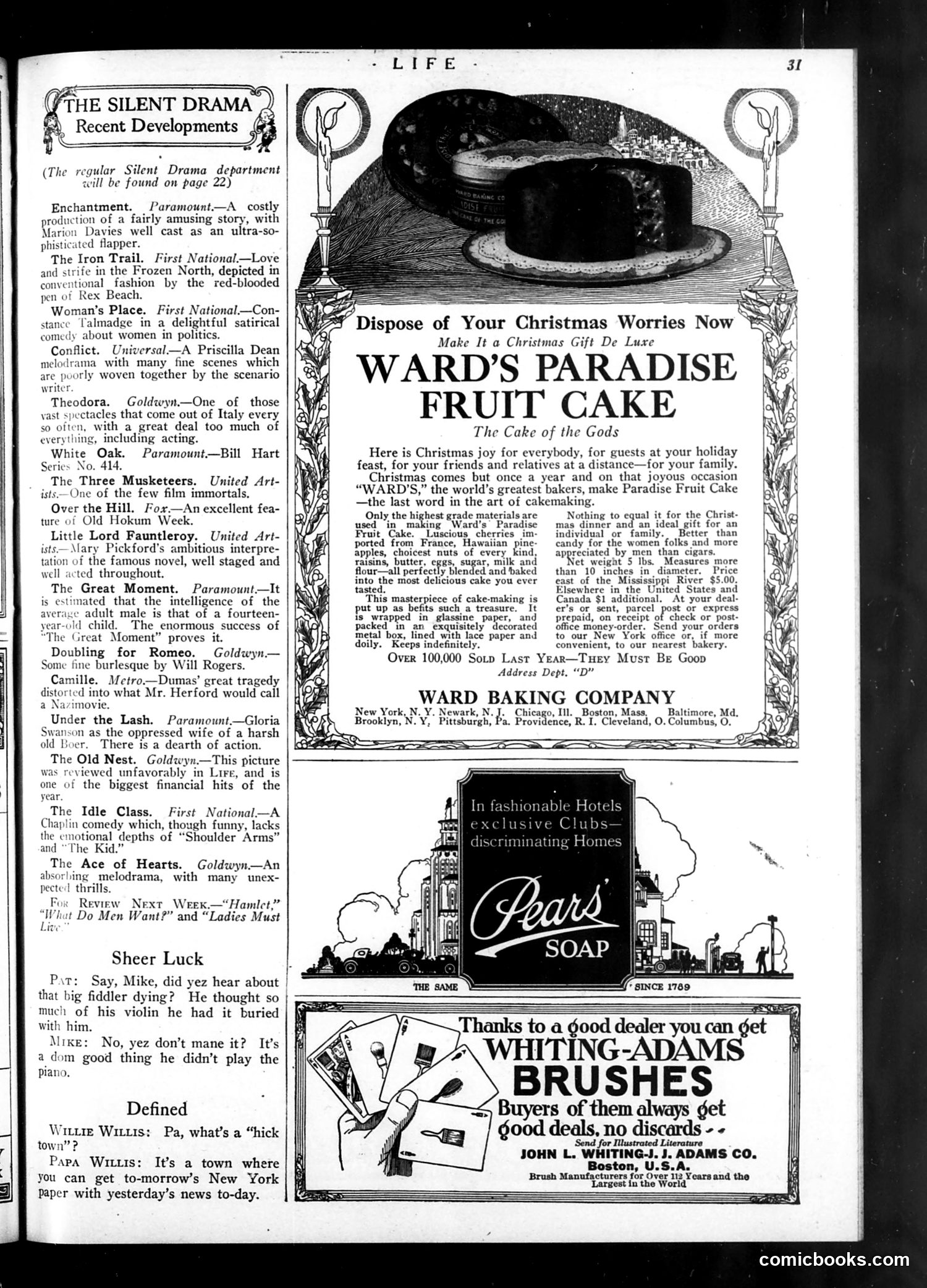
This page primarily consists of **film reviews** and **advertisements** rather than political cartoons. The "Silent Drama" section reviews contemporary silent films (Marion Davies in *Enchantment*, Bill Hart westerns, Mary Pickford in *Little Lord Fauntleroy*, Charlie Chaplin comedies). The reviews are brief and sometimes caustic—notably, the *Great Moment* review sarcastically suggests the film's success proves "the intelligence of the adult male is that of a fourteen-year-old child." The dominant feature is a large **Ward's Paradise Fruit Cake advertisement**, positioned as a Christmas gift solution. This reflects early 1920s consumer culture where packaged luxury goods (imported fruits, premium ingredients) marketed as ideal holiday presents. Below are smaller ads for **Pears Soap** (emphasizing use in "fashionable Hotels" and "discriminating Homes") and **Whiting-Adams Brushes**. There is no political satire or cartoon content on this page—it's primarily entertainment industry coverage and period advertising demonstrating 1920s consumer marketing strategies.
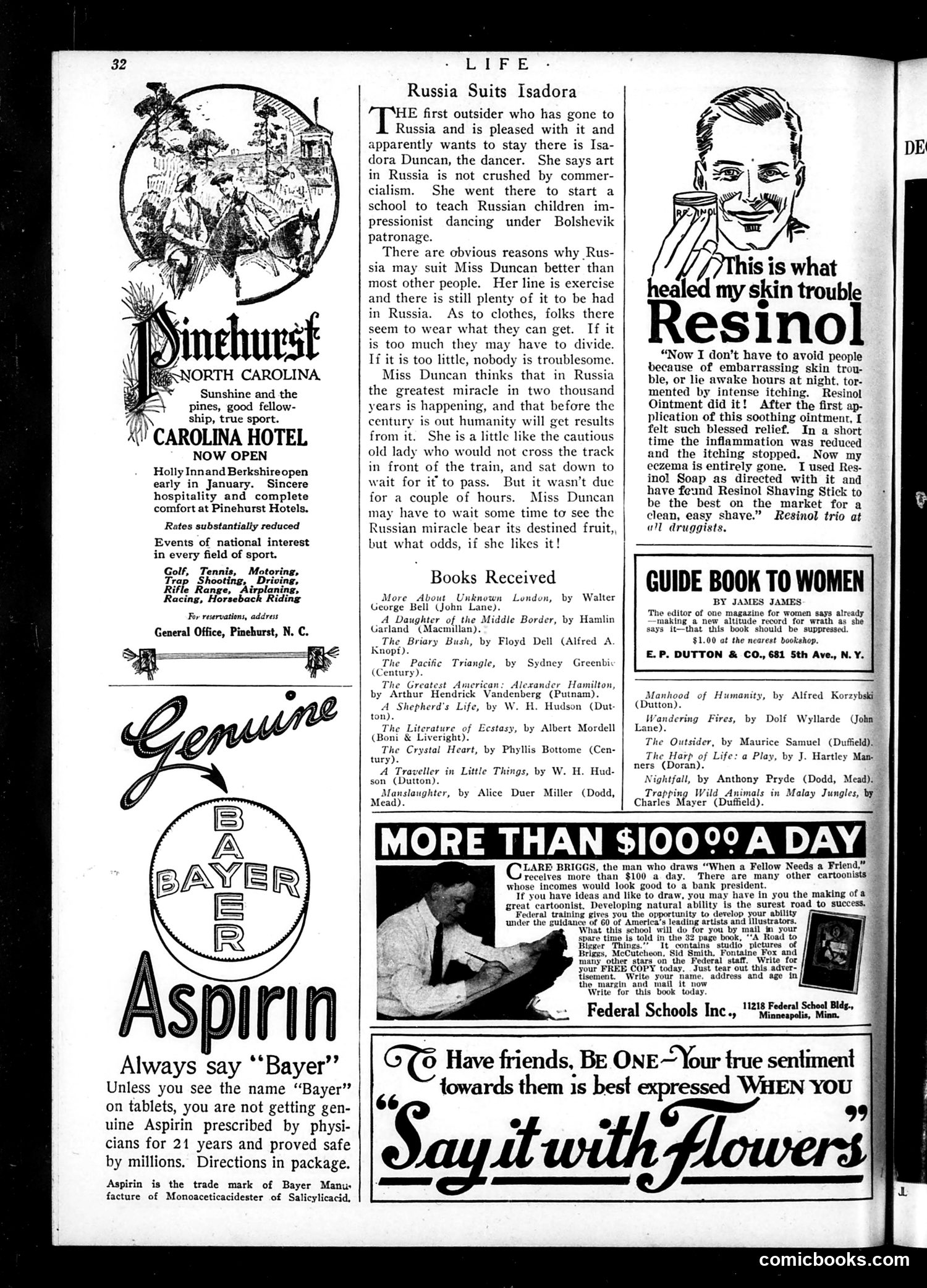
This page is primarily **advertising and book reviews**, not political satire. The main content satirizes **Isadora Duncan's enthusiasm for Soviet Russia**. The article mocks the famous dancer for her optimistic view of Bolshevik Russia. Life's writers suggest Duncan is naive—she believes Russia represents humanity's future miracle, but they compare her to a cautious old woman waiting for a train that may never come, implying her faith in Soviet progress is foolishly patient and possibly misguided. The satire reflects 1920s American skepticism toward the new Soviet state. Duncan's decision to establish a dance school under Bolshevik patronage is presented as idealistic but impractical; the writers note Russians wear "what they can get" and may need to share clothes—gently mocking both Soviet deprivation and Duncan's romantic delusions. The page also features typical period advertisements (Bayer Aspirin, Pinehurst Hotels, Resinol skin cream) and book announcements, filling commercial space standard to Life magazine.