
Life, 1921-12-08 · page 16 of 34
Life — December 8, 1921 — page 16: what you’re looking at
What you’re looking at
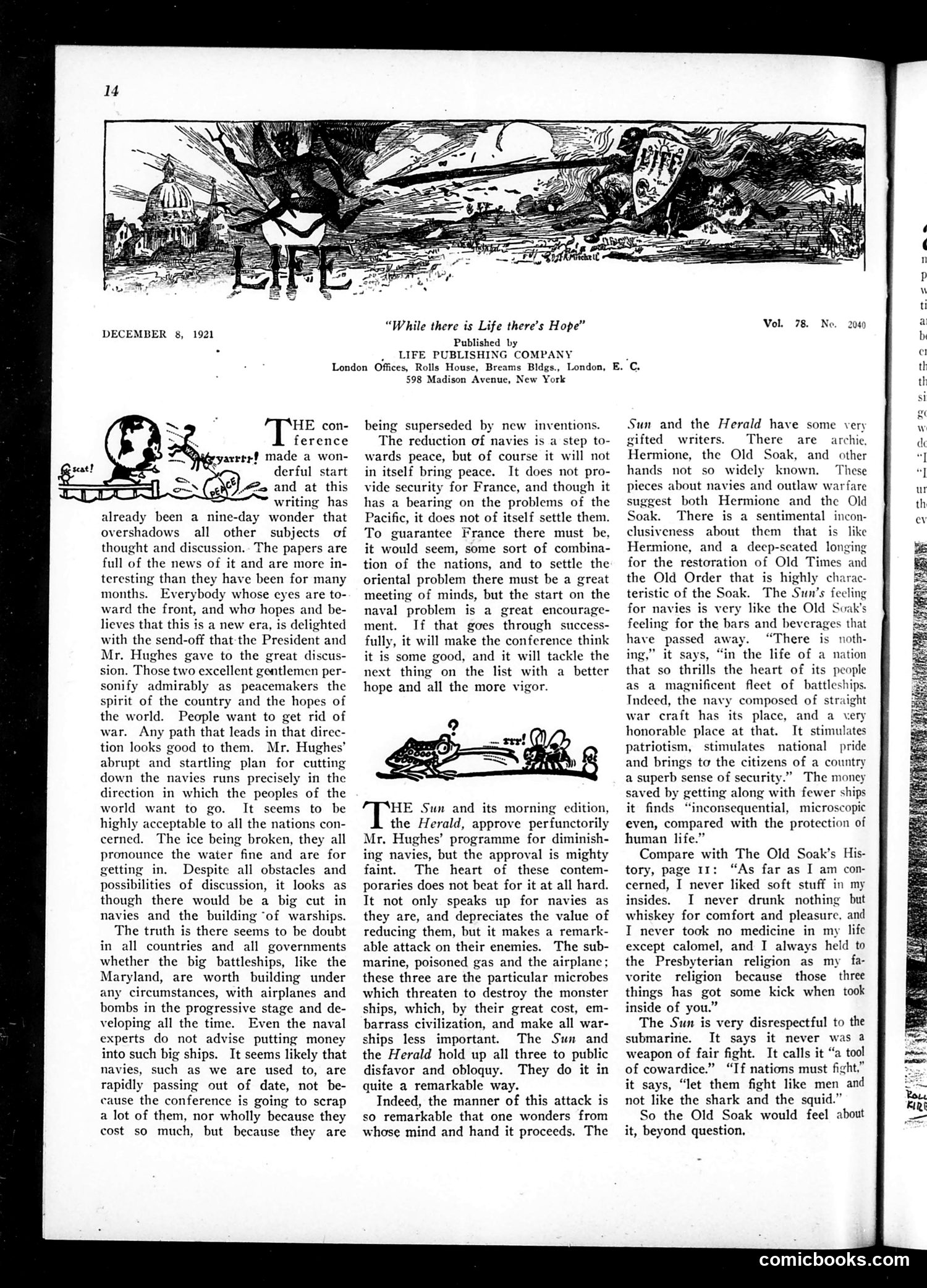
This editorial page discusses post-WWI naval disarmament policy. The masthead cartoon depicts "Life" as a figure observing a landscape with military elements—likely representing the ongoing debate about weapons reduction. The text praises President Hughes's disarmament program for reducing battleships and military expenditure. It favorably compares Hughes's approach to publications like the *Sun* and *Herald*, which the author claims also support naval reduction as economically sound and morally justified after the Great War. The piece argues against maintaining large navies, contending that ships are expensive, strategically vulnerable to modern warfare (poisoned gas, airplanes), and ultimately less important than international cooperation for national security. The satirical point: military advocates waste resources on outdated naval power when peace and diplomacy better protect nations.
📄 Transcribed text from this page (OCR, searchable)
Machine-transcribed from the original scan — historical spelling and the odd misread are preserved.
DECEMBER 8, 1921 “While there is Life there’s Hope” Published by LIFE PUBLISHING COMPANY London Offices, Rolls House, Breams Bldgs., London, E. C. HE con- ference pyarrtr! made a won- S derful start YY 5 and at this writing has already been a nine-day wonder that overshadows all other subjects of thought and discussion.. The papers are full of the news of it and are more in- teresting than they have been for many months. Everybody whose eyes are to- ward the front, and who hopes and be- lieves that this is a new era, is delighted with the send-off that the President and Mr. Hughes gave to the great discus- sion. Those two excellent gentlemen per- sonify admirably as peacemakers the spirit of the country and the hopes of the world. People want to get rid of war. Any path that leads in that direc- tion looks good to them. Mr. Hughes’ abrupt and startling plan for cutting down the navies runs precisely in the direction in which the peoples of the world want to go. It seems to be highly acceptable to all the nations con- cerned. The ice being broken, they all pronounce the water fine and are for getting in. Despite all obstacles and possibilities of discussion, it looks as though there would be a big cut in navies and the building “of warships. The truth is there seems to be doubt in all countries and all governments whether the big battleships, like the Maryland, are worth building under any circumstances, with airplanes and bombs in the progressive stage and de- veloping all the time. Even the naval experts do not advise putting money into such big ships. It seems likely that navies, such as we are used to, are rapidly passing out of date, not be- cause the conference is going to scrap a lot of them, nor wholly because they cost so much, but because they are 598 Madison Avenue, New York being superseded by new inventions. The reduction of navies is a step to- wards peace, but of course it will not in itself bring peace. It does not pro- vide security for France, and though it has a bearing on the problems of the Pacific, it does not of itself settle them. To guarantee France there must be, it would seem, some sort of combina- tion of the nations, and to settle the oriental problem there must be a great meeting of minds, but the start on the naval problem is a great encourage- ment. If that goes through success- fully, it will make the conference think it is some good, and it will tackle the next thing on the list with a better hope and all the more vigor. HE Sun and its morning edition, the Herald, approve perfunctorily Mr. Hughes’ programme for diminish- ing navies, but the approval is mighty faint. The heart of these contem- poraries does not beat for it at all hard. It not only speaks up for navies as they are, and depreciates the value of reducing them, but it makes a remark- able attack on their enemies. The sub- marine, poisoned gas and the airplane; these three are the particular microbes which threaten to destroy the monster ships, which, by their great cost, em- barrass civilization, and make all war- ships less important. The Sun and the Herald hold up all three to public disfavor and obloquy. They do it in quite a remarkable way. Indeed, the manner of this attack is so remarkable that one wonders from whose mind and hand it proceeds. The Sun and the Herald have some very gifted writers. There are archie, Hermione, the Old Soak, and other hands not so widely known. These pieces about navies and outlaw warfare suggest both Hermione and the Old Soak. There is a sentimental incon- clusiveness about them that is like Hermione, and a deep-seated longing for the restoration of Old Times and the Old Order that is highly ch: teristic of the Soak. The Sun’s feeling for navies is very like the Old Svak’s feeling for the bars and beverages that have passed away. “There is noth- ing,” it says, “in the life of a nation that so thrills the heart of its people as a magnificent fleet of battleships. Indeed, the navy composed of straight war craft has its place, and a very honorable place at that. It stimulates patriotism, stimulates national pride and brings to the citizens of a country a superb sense of security.” The money saved by getting along with fewer ships it finds “inconsequential, microscopic even, compared with the protection of human life.” Compare with The Old Soak’s His- tory, page 11: “As far as I am con- cerned, I never liked soft stuff in my insides. I never drunk nothing but whiskey for comfort and pleasure, and I never took no medicine in my life except calomel, and I always held to the Presbyterian religion as my fa- vorite religion because those three things has got some kick when took inside of you.” The Sun is very disrespectful to the submarine. It says it never was a weapon of fair fight. It calls it “a tool of cowardice.” “If nations must fight.” it says, “let them fight like men and not like the shark and the squid.” So the Old Soak would feel about it, beyond question, comicbooks.com