
Life, 1921-12-08 · page 14 of 34
Life — December 8, 1921 — page 14: what you’re looking at
What you’re looking at
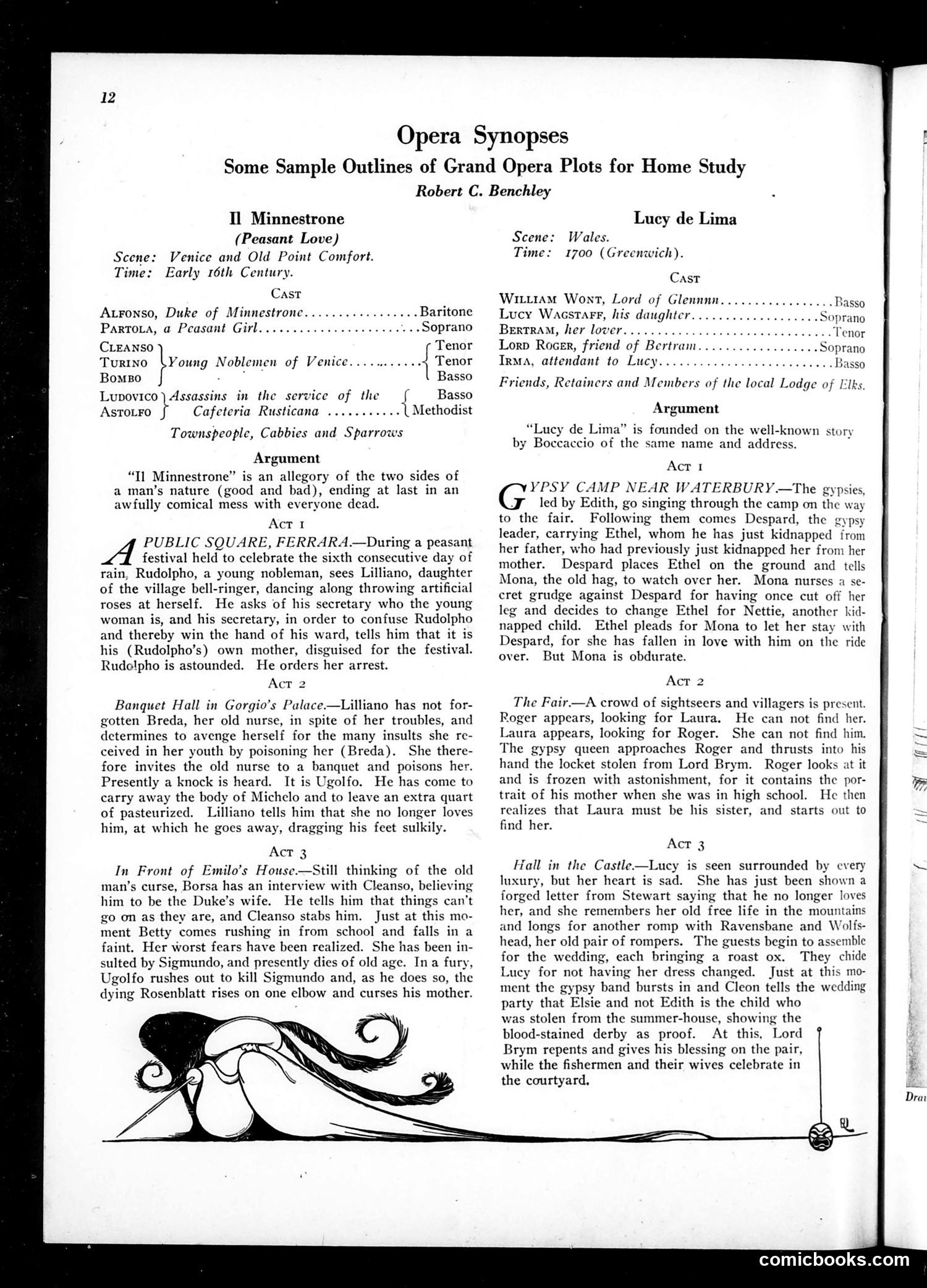
This page from *Life* magazine presents opera plot summaries by Robert C. Benchley, a humorist. It's not primarily satirical content but rather educational/entertainment material about two operas: *Il Minnestrone* and *Lucy de Lima*. The decorative illustration at bottom shows a stylized female figure with flowing hair—typical Art Deco design of the era, not a political caricature. The humor here is subtle: Benchley's summaries mock the often absurd, melodramatic plots of grand opera through straightforward narration. The first opera's title appears a pun (minnestrone = minestrone soup), suggesting opera's sometimes ridiculous premises. This represents the magazine's satirical approach: gentle mockery of high culture through witty writing rather than editorial cartooning.
📄 Transcribed text from this page (OCR, searchable)
Machine-transcribed from the original scan — historical spelling and the odd misread are preserved.
Opera Synopses Some Sample Outlines of Grand Opera Plots for Home Study Robert C. Benchley Il Minnestrone (Peasant Love) Scene: Venice and Old Point Comfort. Time: Early 16th Century. Cast Atronso, Duke of Minnestrone. Partora, a Peasant Girl....... CLEANSO Turtno Young Noblemen of Venice. Bomso _ Lupovico) Assassins in the service of the { Basso ASTOLFO Cafeteria Rusticana .- Methodist Townspeople, Cabbies and Sparrow . Baritone - Soprano Tenor ++) Tenor Basso Argument “Tl Minnestrone” is an allegory of the two sides of a man’s nature (good and bad), ending at last in an awfully comical mess with everyone dead. Act I PUBLIC SQUARE, FERRARA.—During a peasant festival held to celebrate the sixth consecutive day of rain, Rudolpho, a young nobleman, sees Lilliano, daughter of the village bell-ringer, dancing along throwing artificial roses at herself. He asks of his secretary who the young woman is, and his secretary, in order to confuse Rudolpho and thereby win the hand of his ward, tells him that it is his (Rudolpho’s) own mother, disguised for the festival. Rude!pho is astounded. He orders her arrest. Act 2 Banquet Hall in Gorgio’s Palace.—Lilliano has not for- gotten Breda, her old nurse, in spite of her troubles, and determines to avenge herself for the many insults she re- ceived in her youth by poisoning her (Breda). She there- fore invites the old nurse to a banquet and poisons her. Presently a knock is heard. It is Ugolfo. He has come to carry away the body of Michelo and to leave an extra quart of pasteurized. Lilliano tells him that she no longer loves him, at which he goes away, dragging his feet sulkily. Acr'3 In Front of Emilo’s House.—Still thinking of the old man’s curse, Borsa has an interview with Cleanso, believing him to be the Duke’s wife. He tells him that things can’t go on as they are, and Cleanso stabs him. Just at this mo- ment Betty comes rushing in from school and falls in a faint. Her worst fears have been realized. She has been in- sulted by Sigmundo, and presently dies of old age. Ina fury, Ugolfo rushes out to kill Sigmundo and, as he does so, the dying Rosenblatt rises on one elbow and curses his mother. Lucy de Lima Scene: Wales. Time: 1700 (Greenwich). Cast Wiitram Wont, Lord of Glennnn. Lucy WaestarF, his daughter wee Bertram, her lover 5 Tenor Lorp Rocer, friend of B z - prano Irma, attendant to Lucy Friends, Retainers and Members of the local Lodge of Elks. Argument “Lucy de Lima” is founded on the well-known story by Boccaccio of the same name and address. . Act 1 (Cage! CAMP NEAR WATERBURY .—The gypsies, led by Edith, go singing through the camp on the way to the fair. Following them comes Despard, the gypsy leader, carrying Ethel, whom he has just kidnapped from her father, who had previously just kidnapped her from her mother. Despard places Ethel on the ground and tells Mona, the old hag, to watch over her. Mona nurses a se- cret grudge against Despard for having once cut off her leg and decides to change Ethel for Nettie, another kid- napped child. Ethel pleads for Mona to let her stay with Despard, for she has fallen in love with him on the ride over. But Mona is obdurate. Act 2 The Fair—A crowd of sightseers and villagers is present. Roger appears, looking for Laura. He can not find her. aura appears, looking for Roger. She can not find him. The gypsy queen approaches Roger and thrusts into his hand the locket stolen from Lord Brym. Roger looks at it and is frozen with astonishment, for it contains the por- trait of his mother when she was in high school. He then realizes that Laura must be his sister, and starts out to find her. Act 3 Hall in the Castle—Lucy is seen surrounded by every luxury, but her heart is sad. She has just been shown a forged letter from Stewart saying that he no longer loves her, and she remembers her old free life in the mount and longs for another romp with Ravensbane and Wolfs- head, her old pair of rompers. The guests begin to assemble for the wedding, each bringing a roast ox. They chide Lucy for not having her dress changed. Just at this mo- ment the gypsy band bursts in and Cleon tells the wedding party that Elsie and not Edith is the child who was stolen from the summer-house, showing the blood-stained derby as proof. At this, Lord Brym repents and gives his blessing on the pair, while the fishermen and their wives celebrate in the courtyard, comicbooks.com