
Life, 1921-12-08 · page 23 of 34
Life — December 8, 1921 — page 23: what you’re looking at
What you’re looking at
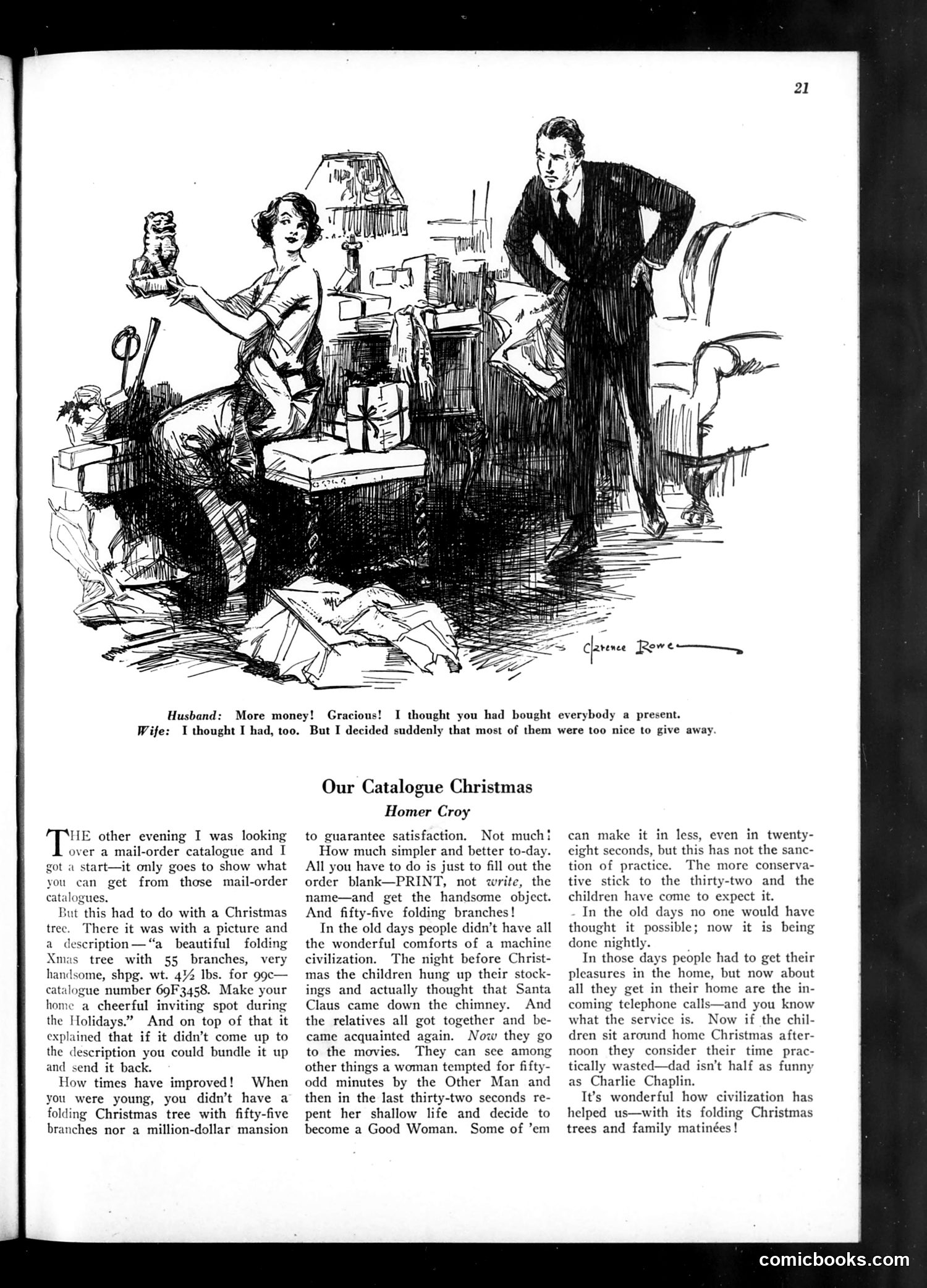
This satirical piece critiques modern consumer culture and declining family values through nostalgic contrast. The cartoon shows a husband upset about his wife's Christmas spending—she bought expensive gifts then decided they were "too nice to give away," illustrating impulsive, wasteful shopping behavior enabled by mail-order catalogs. Croy's essay sarcastically praises "progress": artificial folding Christmas trees (55 branches!) replace natural ones; families now attend movies instead of gathering at home; children find their fathers less entertaining than Charlie Chaplin films; telephone interruptions replace intimate conversation. The satire targets early 20th-century consumerism's promises of convenience and comfort, arguing that mass production and modern entertainment have actually *diminished* genuine family connection and meaningful holiday traditions. The "wonderful civilization" of catalogs and cinema has paradoxically made home life less appealing.
📄 Transcribed text from this page (OCR, searchable)
Machine-transcribed from the original scan — historical spelling and the odd misread are preserved.
Husband: More money! Wife: HE other evening I was looking over a mail-order catalogue and I got a start—it only goes to show what you can get from those mail-order catalogues. But this had to do with a Christmas tree. There it was with a picture and a description—“a beautiful folding Xmas tree with 55 branches, very handsome, shpg. wt. 434 lbs. for 99¢e— catalogue number 69F3458. Make your home a cheerful inviting spot during the Holidays.” And on top of that it explained that if it didn’t come up to the description you could bundle it up and send it back. How times have improved! When you were young, you didn’t have a folding Christmas tree with fifty-five branches nor a million-dollar mansion Gracious! Our Catalogue Christmas Homer Croy to guarantee satisfaction. Not much! How much simpler and better to-day. All you have to do is just to fill out the order blank—PRINT, not write, the name—and get the handsome object. And fifty-five folding branches! In the old days people didn’t have all the wonderful comforts of a machine civilization. The night before Christ- mas the children hung up their stock- ings and actually thought that Santa Claus came down the chimney. And the relatives all got together and be- came acquainted again. Now they go to the movies. They can sce among other things a woman tempted for fifty- odd minutes by the Other Man and then in the last thirty-two seconds re- pent her shallow life and decide to become a Good Woman. Some of ’em I thought you had bought everybody a present. I thought I had, too. But I decided suddenly that most of them were too nice to give away. can make it in less, even in twenty- eight seconds, but this has not the sanc- tion of practice. The more conserva- tive stick to the thirty-two and the children have come to expect it. In the old days no one would have thought it possible; now it is being done nightly. In those days people had to get their pleasures in the home, but now about all they get in their home are the in- coming telephone calls—and you know what the service is. Now if the chil- dren sit around home Christmas after- noon they consider their time prac- tically wasted—dad isn’t half as funny as Charlie Chaplin. It’s wonderful how civilization has helped us—with its folding Christmas trees and family matinées! comicbooks.com