
Life, 1921-12-08 · page 12 of 34
Life — December 8, 1921 — page 12: what you’re looking at
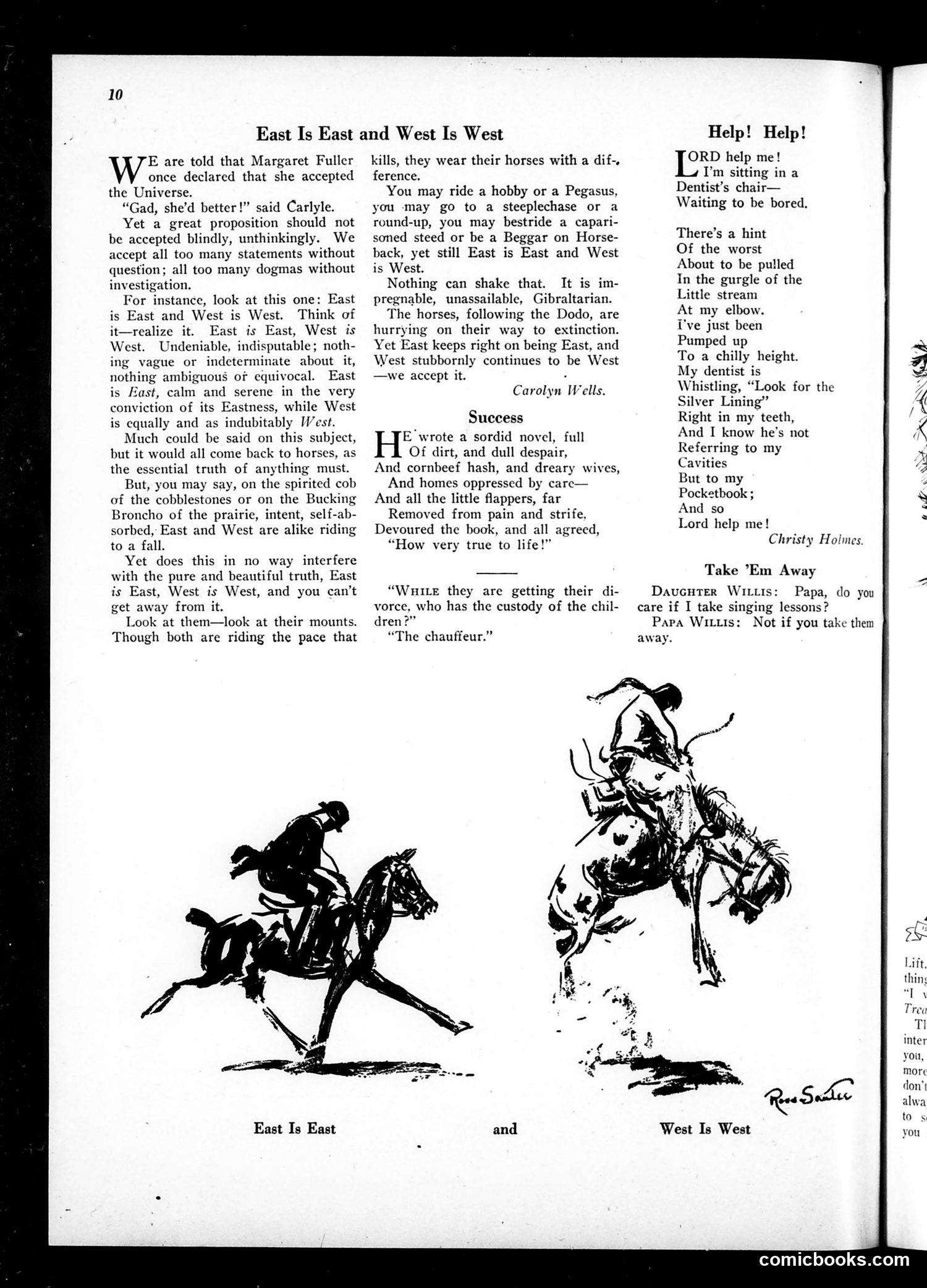
What you’re looking at
This page contains three distinct pieces: 1. **"East Is East and West Is West"** — An essay defending the absolute nature of geographical/cultural distinctions, using horses as metaphor. It argues that East and West are fundamentally different and unchangeable, regardless of superficial similarities. 2. **"Success"** — A poem about hardship transformed into literary success. 3. **Two cartoons** at bottom illustrate the title essay with horses and riders — one labeled "East Is East" (controlled rider on disciplined horse) and "West Is West" (wild bucking horse). These visually demonstrate the essay's claim about immutable cultural differences. 4. **"Help! Help!"** and **"Take 'Em Away"** — Brief comic pieces unrelated to the main content. The overall page uses the East/West distinction (likely referencing Kipling's famous poem) to make a point about cultural essentialism.
📄 Transcribed text from this page (OCR, searchable)
Machine-transcribed from the original scan — historical spelling and the odd misread are preserved.
East Is East and West Is West E are told that Margaret Fuller once declared that she accepted the Universe. “Gad, she’d better!” said Carlyle. Yet a great proposition should not be accepted blindly, unthinkingly. We accept all too many statements without question; all too many dogmas without investigation. For instance, look at this one: East is East and West is West. Think of it—realize it. East is East, West is West. Undeniable, indisputable; noth- ing vague or indeterminate about it, nothing ambiguous of equivocal. East is East, calm and serene in the very conviction of its Eastness, while West is equally and as indubitably West. Much could be said on this subject, but it would all come back to horses, as the essential truth of anything must. But, you may say, on the spirited cob of the cobblestones or on the Bucking Broncho of the prairie, intent, self-ab- sorbed, East and West are alike riding to a fall. Yet does this in no way interfere with the pure and beautiful truth, East is East, West is West, and you can’t get away from it. Look at them—look at their mounts. Though both are riding the pace that East Is East kills, they wear their horses with a dif-, ference. You may ride a hobby or a Pegasus, you may go to a steeplechase or a round-up, you may bestride a capari- soned steed or be a Beggar on Horse- back, yet still East is East and West is West. Nothing can shake that. It is im- pregnable, unassailable, Gibraltarian. The horses, following the Dodo, are hurrying on their way to extinction. Yet East keeps right on being East, and West stubbornly continues to be West —we accept it. Carolyn Wells. Success E'wrote a sordid novel, full Of dirt, and dull despair, And cornbeef hash, and dreary wives, And homes oppressed by care— And all the little flappers, far Removed from pain and strife, Devoured the book, and all agreed, “How very true to life!” “Wuite they are getting their di- vorce, who has the custody of the chil- dren?” “The chauffeur.” Help! Help! | eee help me! I'm sitting in a Dentist’s chair— Waiting to be bored. There’s a hint Of the worst About to be pulled In the gurgle of the Little stream At my elbow. I've just been Pumped up To a chilly height. My dentist is Whistling, “Look for the Silver Lining” Right in my teeth, And I know he’s not Referring to my Cavities But to my Pocketbook ; And so Lord help me! Christy Holmes. Take "Em Away Daucuter Wittis: Papa, do you care if I take singing lessons? Papa WILtIs: Not if you take them away. West Is West \ inter you, more don’ alwa to s you comicbooks.com