
Life, 1921-12-08 · page 20 of 34
Life — December 8, 1921 — page 20: what you’re looking at
What you’re looking at
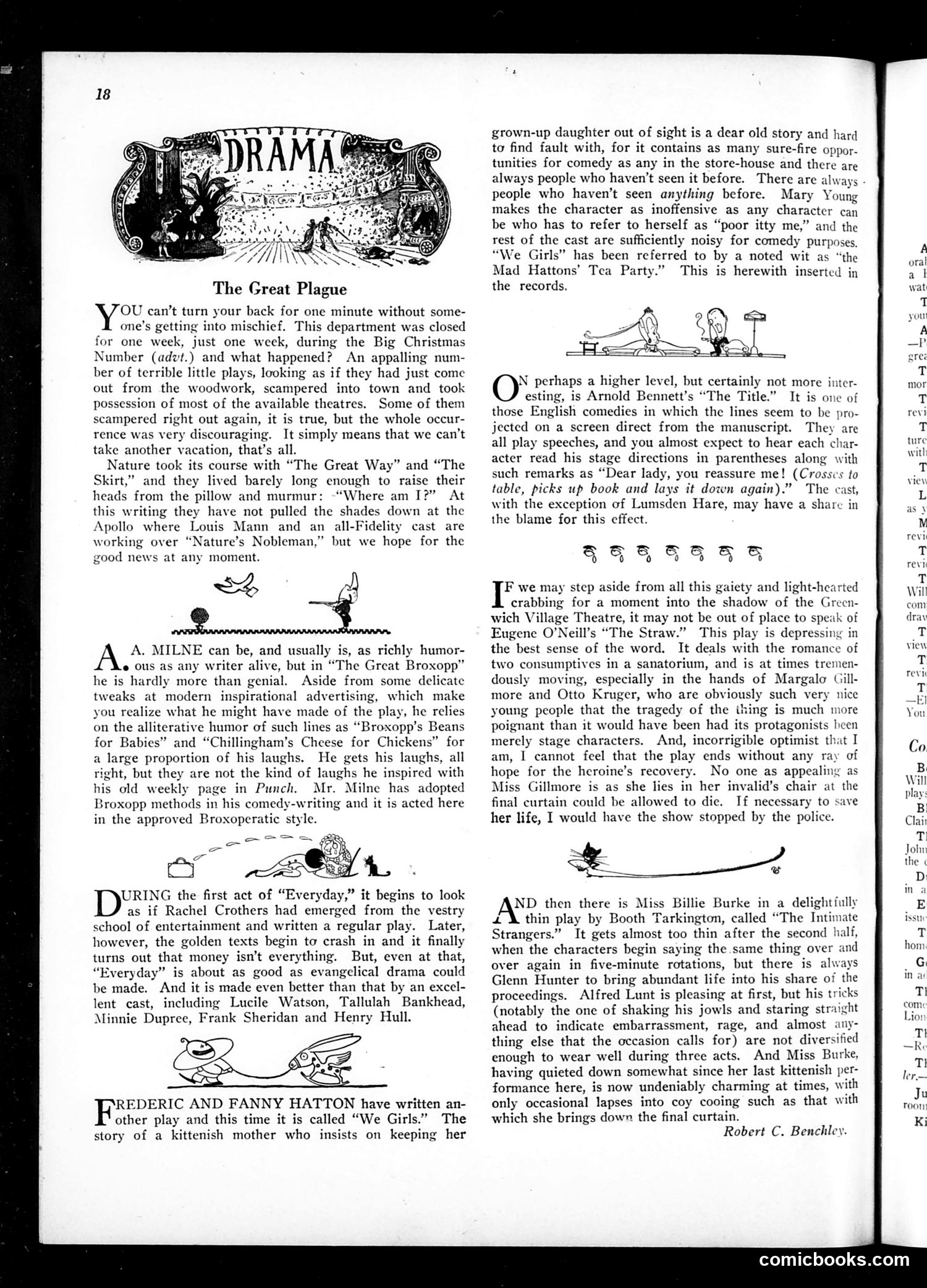
This is a theater criticism column from Life magazine titled "The Great Plague," humorously treating a sudden glut of new theatrical productions as an epidemic. The author laments that during Life's Christmas hiatus, numerous mediocre plays opened simultaneously at Broadway theaters, comparing their sudden appearance to an infestation. Several plays are mentioned as quick failures ("The Great Way," "The Skirt"), while others receive mixed reviews. A.A. Milne's "The Great Broxopp" is criticized for relying on cheap alliterative puns rather than his customary wit. Rachel Crothers' "Everyday" is dismissed as evangelical melodrama redeemed only by its cast (including Tallulah Bankhead). "We Girls" by the Hattons is called a tired, derivative plot, though Mary Young performs adequately. Arnold Bennett's "The Title" is mocked for sounding like stage directions read aloud. The column uses mock-indignant humor to critique theatrical mediocrity—a common Life magazine approach to entertainment criticism.
📄 Transcribed text from this page (OCR, searchable)
Machine-transcribed from the original scan — historical spelling and the odd misread are preserved.
The Great Plague OU can’t turn your back for one minute without some- one’s getting into mischief. This department was closed for one week, just one week, during the Big Christmas Number (advt.) and what happened? An appalling num- ber of terrible little plays, looking as if they had just come out from the woodwork, scampered into town and took possession of most of the available theatres. Some of them scampered right out again, it is true, but the whole occur- rence was very discouraging. It simply means that we can't take another vacation, that’s all. Nature took its course with “The Great Way” and “The Skirt,” and they lived barely long enough to raise their heads from the pillow and murmur: -“Where am I?” At this writing they have not pulled the shades down at the Apollo where Louis Mann and an all-Fidelity cast are working over “Nature’s Nobleman,” but we hope for the good news at any moment. =% 4 A. MILNE can be, and usually is, as richly humor- ous as any writer alive, but in “The Great Broxopp” he is hardly more than genial. Aside from some delicate tweaks at modern inspirational advertising, which make you realize what he might have made of the play, he relies on the alliterative humor of such lines as “Broxopp’s Beans for Babies” and “Chillingham’s Cheese for Chickens” for a large proportion of his laughs. He gets his laughs, all right, but they are not the kind of laughs he inspired with his old weekly page in Punch. Mr. Milne has adopted Broxopp methods in his comedy-writing and it is acted here in the approved Broxoperatic style. URING the first act of “Everyday,” it begins to look as if Rachel Crothers had emerged from the vestry school of entertainment and written a regular play. Later, however, the golden texts begin to crash in and it finally turns out that money isn’t everything. But, even at that, “Everyday” is about as good as evangelical drama could be made. And it is made even better than that by an excel- lent cast, including Lucile Watson, Tallulah Bankhead, Minnie Dupree, Frank Sheridan and Henry Hull. REDERIC AND FANNY HATTON have written an- other play and this time it is called “We Girls.” The story of a kittenish mother who insists on keeping her grown-up daughter out of sight is a dear old story and hard to find fault with, for it contains as many sure-fire oppor- tunities for comedy as any in the store-house and there are always people who haven't seen it before. There are always people who haven’t seen anything before. Mary Young makes the character as inoffensive as any character can be who has to refer to herself as “poor itty me,” and the rest of the cast are sufficiently noisy for comedy purposes, “We Girls” has been referred to by a noted wit as “the Mad Hattons’ Tea Party.” This is herewith inserted in the records. N perhaps a higher level, but certainly not more inter- sting, is Arnold Bennett’s “The Title.” It is one of those English comedies in which the lines seem to be pro- jected on a screen direct from the manuscript. They are all play speeches, and you almost expect to hear each char- acter read his stage directions in parentheses along with such remarks as “Dear lady, you reassure me! (Crosses to table, picks up book and lays it down again).” The cast, with the exception of Lumsden Hare, may have a share in the blame for this effect. F we may step aside from all this gaiety and light-hearted crabbing for a moment into the shadow of the Green- wich Village Theatre, it may not be out of place to speak of Eugene O’Neill’s “The Straw.” This play is depressing in the best sense of the word. It deals with the romance of two consumptives in a sanatorium, and is at times tremen- dously moving, especially in the hands of Margalo Gill- more and Otto Kruger, who are obviously such very nice young people that the tragedy of the ihing is much more poignant than it would have been had its protagonists heen merely stage characters. And, incorrigible optimist that I am, I cannot feel that the play ends without any ray of hope for the heroine’s recovery. No one as appealing as Miss Gillmore is as she lies in her invalid’s chair at the final curtain could be allowed to die. If necessary to save her life, I would have the show stopped by the police. D then there is Miss Billie Burke in a delightfully a AX thin play by Booth Tarkington, called “The Inti Strangers.” It gets almost too thin after the second when the characters begin saying the same thing over < over again in five-minute rotations, but there is always Glenn Hunter to bring abundant life into his share of the proceedings. Alfred Lunt is pleasing at first, but his tricks (notably the one of shaking his jowls and staring straight ahead to indicate embarrassment, rage, and almost any- thing else that the occasion calls for) are not diversified enough to wear well during three acts. And Miss Burke, having quieted down somewhat since her last kittenish per- formance here, is now undeniably charming at times, with only occasional lapses into coy cooing such as that with which she brings down the final curtain. Robert C. Benchley. mor B revi T ture with issu T hom com Lior room Ki comicbooks.com