
Life, 1921-12-08 · page 24 of 34
Life — December 8, 1921 — page 24: what you’re looking at
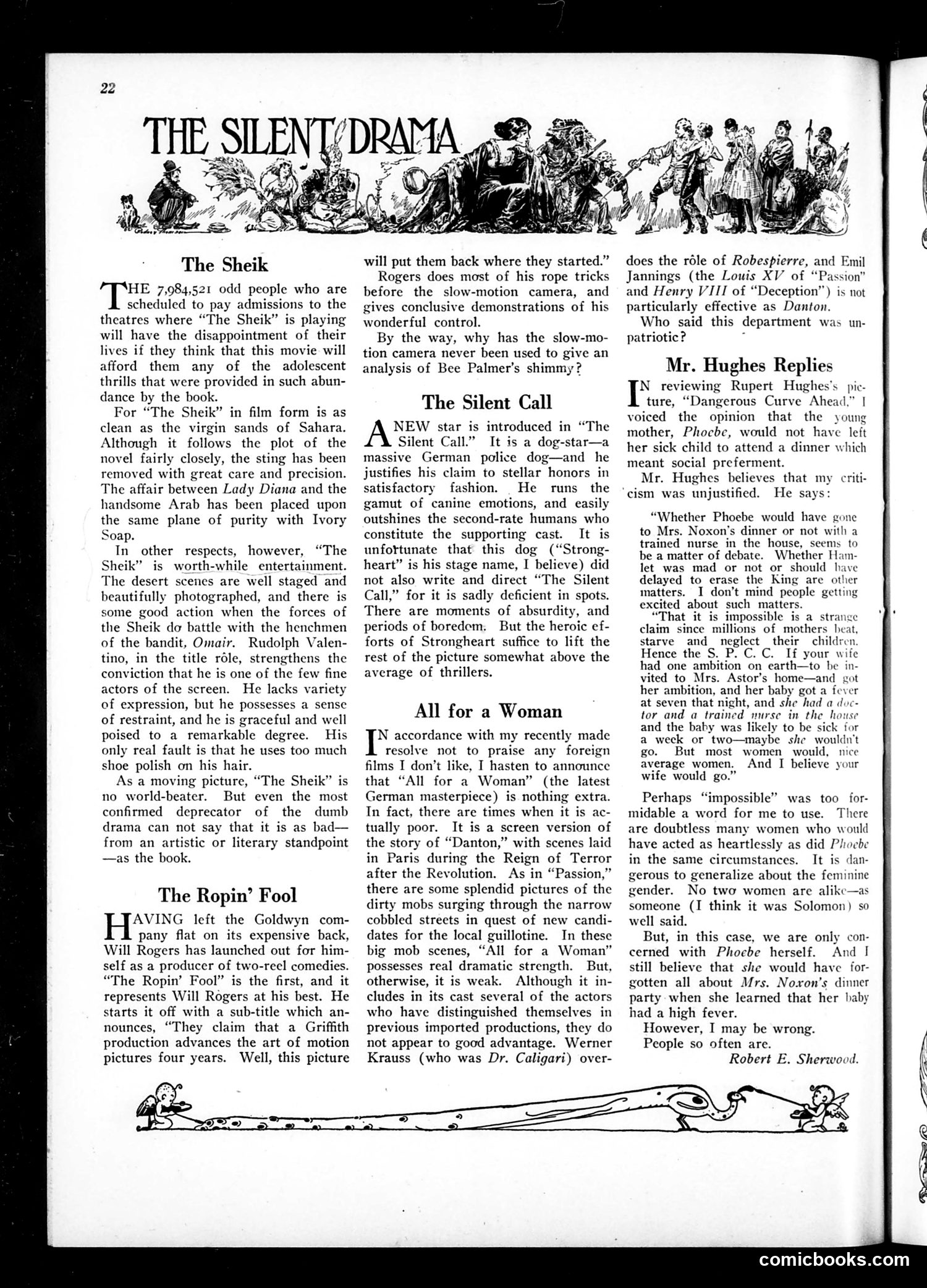
What you’re looking at
This page reviews four silent films from the early 1920s. The critic sarcastically critiques **"The Sheik"** (starring Rudolph Valentino), noting the film sanitized the scandalous novel for moral acceptability—reducing a romantic affair to "the same plane of purity with Ivory Soap." He praises Valentino's acting but mocks his excessive hair product use. **"The Ropin' Fool"** features Will Rogers performing rope tricks in slow-motion, with Rogers humorously claiming the film will reverse D.W. Griffith's supposed four-year advancement of cinema. **"The Silent Call"** stars a German Shepherd dog ("Strongheart") who outperforms human actors—a backhanded compliment suggesting the supporting cast was weak. **"All for a Woman,"** a German film about the French Revolution's Reign of Terror, receives dismissal as mediocre despite impressive mob scenes. The overall tone reflects 1920s film criticism's focus on moral content, technical innovation, and actor performance while maintaining satirical distance from all subjects.
📄 Transcribed text from this page (OCR, searchable)
Machine-transcribed from the original scan — historical spelling and the odd misread are preserved.
The Sheik HE 7,984,521 odd people who are scheduled to pay admissions to the theatres where “The Sheik” is playing will have the disappointment of their lives if they think that this movie will afford them any of the adolescent thrills that were provided in such abun- dance by the book. For “The Sheik” in film form is as clean as the virgin sands of Sahara. Although it follows the plot of the novel fairly closely, the sting has been removed with great care and precision. The affair between Lady Diana and the handsome Arab has been placed upon the same plane of purity with Ivory Soap. In other respects, however, “The Sheik” is worth-while entertainment. The desert scenes are well staged and beautifully photographed, and there is some good action when the forces of the Sheik do battle with the henchmen of the bandit, Omair. Rudolph Valen- tino, in the title role, strengthens the conviction that he is one of the few fine actors of the screen. He lacks variety of expression, but he possesses a sense of restraint, and he is graceful and well poised to a remarkable degree. His only real fault is that he uses too much shoe polish on his hair. As a moving picture, “The Sheik” is no world-beater. But even the most confirmed deprecator of the dumb drama can not say that it is as bad— from an artistic or literary standpoint —as the book. The Ropin’ Fool AVING left the Goldwyn com- pany flat on its expensive back, Will Rogers has launched out for him- self as a producer of two-reel comedies. “The Ropin’ Fool” is the first, and it represents Will Rogers at his best. He starts it off with a sub-title which an- nounces, “They claim that a Griffith production advances the art of motion pictures four years. Well, this picture will put them back where they started.” Rogers does most of his rope tricks before the slow-motion camera, and gives conclusive demonstrations of his wonderful control. By the way, why has the slow-mo- tion camera never been used to give an analysis of Bee Palmer’s shimmy ? The Silent Call NEW star is introduced in “The Silent Call.” It is a dog-star—a massive German police dog—and he justifies his claim to stellar honors in satisfactory fashion. _He runs the gamut of canine emotions, and easily outshines the second-rate humans who constitute the supporting cast. It is unfottunate that this dog (‘Strong- heart” is his stage name, I believe) did not also write and direct “The Silent Call,” for it is sadly deficient in spots. There are moments of absurdity, and periods of boredom. But the heroic ef- forts of Strongheart suffice to lift the rest of the picture somewhat above the average of thrillers. All for a Woman N accordance with my recently made resolve not to praise any foreign films I don’t like, I hasten to announce that “All for a Woman” (the latest German masterpiece) is nothing extra. In fact, there are times when it is ac- tually poor. It is a screen version of the story of “Danton,” with scenes laid in Paris during the Reign of Terror after the Revolution. As in “Passion,” there are some splendid pictures of the dirty mobs surging through the narrow cobbled streets in quest of new candi- dates for the local guillotine. In these big mob scenes, “All for a Woman” possesses real dramatic strength. But, otherwise, it is weak. Although it in- cludes in its cast several of the actors who have distinguished themselves in previous imported productions, they do not appear to good advantage. Werner Krauss (who was Dr. Caligari) over- does the role of Robespierre, and Emil Jannings (the Louis XV of “Passion” and Henry VIII of “Deception” is not particularly effective as Danton. Who said this department was un- patriotic? Mr. Hughes Replies N reviewing Rupert Hughes's pic- ture, “Dangerous Curve Ahead,” | voiced the opinion that the young mother, Phocbe, would not have left her sick child to attend a dinner which meant social preferment. Mr. Hughes belie that my criti- cism was unjustified. He says: “Whether Phoebe would have gone to Mrs. Noxon’s dinner or not with a trained nurse in the house, seems to be a matter of debate. Whether Ham- let was mad or not or should have delayed to erase the King are other matters. I don’t mind people getting excited about such matters. ‘That it is impossible is a stran: claim since millions of mothers heat, starve and_ neglect their childre Hence the S. P. C. C. If your wife had one ambition on earth—to be in- vited to Mrs. Astor’s home—and got her ambition, and her baby got a f at seven that night, and she had a doc- tor and a trained nurse in the house and the baby was likely to be sick for a week or two—maybe she wouldn't go. But most women would, nice average women, And I believe your wife would go.” Perhaps “impossible” was too for- midable a word for me to use. There are doubtless many women who would have acted as heartlessly as did Phoebe in the same circumstances. It is dan- gerous to generalize about the feminine gender. No two women are alike—as someone (I think it was Solomon) so well said. But, in this case, we are only con- cerned with Phoebe herself. still believe that she would fave | for- gotten all about Mrs. Noxon’s dinner party when she learned that her baby had a high fever. However, I may be wrong. People so often are. Robert E. Sherwood. comicbooks.com