
Life, 1921-12-08 · page 17 of 34
Life — December 8, 1921 — page 17: what you’re looking at
What you’re looking at
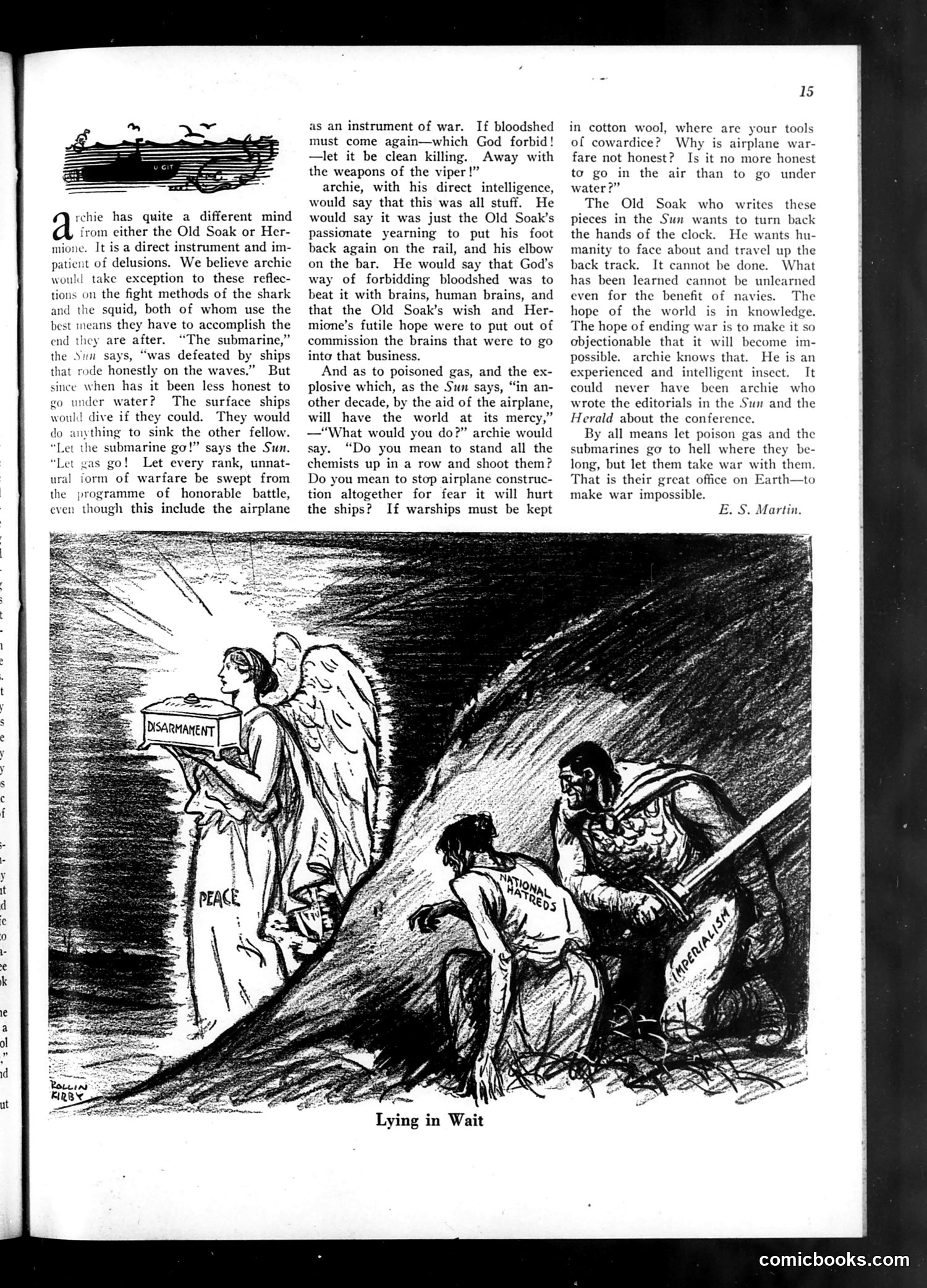
This political cartoon satirizes pacifist arguments against modern warfare technologies. The image depicts Peace standing above figures labeled "Brown Treated" and "Neutrals," who cower before War—a grotesque demon crouching menacingly below. The accompanying text (by E.S. Martin) argues against naive calls to ban submarines, poison gas, and aircraft as "dishonorable" weapons. The piece mocks publications like the *Sun* and *Herald* for wanting to return to "clean killing" and "honest" surface warfare—treating war as if it could be gentlemanly. Martin's persona "archie" (likely the famous cockroach character from the magazine) represents pragmatic intelligence: these weapons exist and cannot be uninvented. The only real solution isn't banning specific arms but making war so objectively terrible that it becomes impossible—through knowledge and deterrence, not wishful thinking. The cartoon illustrates this irony: Peace naively stands guard while War waits below, suggesting that pretending modern weapons don't exist won't prevent conflict.
📄 Transcribed text from this page (OCR, searchable)
Machine-transcribed from the original scan — historical spelling and the odd misread are preserved.
chie has quite a different mind irom either the Old Soak or Her- mione. It is a direct instrument and im- patient of delusions. We believe archie would take exception to these reflec- tions on the fight methods of the shark and the squid, both of whom use the best means they have to accomplish the end they are after. “The submarine,” the Si says, “was defeated by ships that rode honestly on the waves.” But since when has it been less honest to go under water? The surface ships would dive if they could. They would do anything to sink the other fellow. “Let the submarine go!” says the Sun. ‘ gas go! Let every rank, unnat- ural form of warfare be swept from the programme of honorable battle, even though this include the airplane as an instrument of war. If bloodshed must come again—which God forbid! —let it be clean killing. Away with the weapons of the viper!” archie, with his direct intelligence, would say that this was all stuff. He would say it was just the Old Soak’s passionate yearning to put his foot back again on the rail, and his elbow on the bar. He would say that God’s way of forbidding bloodshed was to beat it with brains, human brains, and that the Old Soak’s wish and Her- mione’s futile hope were to put out of commission the brains that were to go into that business. And as to poisoned gas, and the ex- plosive which, as the Sun says, “in an- other decade, by the aid of the airplane, will have the world at its mercy,” —‘What would you do?” archie would say. “Do you mean to stand all the chemists up in a row and shoot them? Do you mean to stop airplane construc- tion altogether for fear it will hurt the ships? If warships must be kept Lying in Wait 15 in cotton wool, where are your tools of cowardice? Why is airplane war- fare not honest? Is it no more honest to go in the than to go under water?” The Old Soak who writes these pieces in the Sun wants to turn back the hands of the clock. He wants hu- manity to face about and travel up the back track. It cannot be done. What has been learned cannot be unlearned even for the benefit of navies. The hope of the world is in knowledge. The hope of ending war is to make it so objectionable that it will become im- possible. archie knows that. He is an experienced and intelligent insect. It could never have been archie who wrote the editorials in the Sun and the Herald about the conference. By all means let poison gas and the submarines go to hell where they be- long, but let them take war with them. That is their great office on Earth—to make war impossible. air E. S. Martin. comicbooks.com