
A complete issue · 34 pages · 1921
Life — September 15, 1921
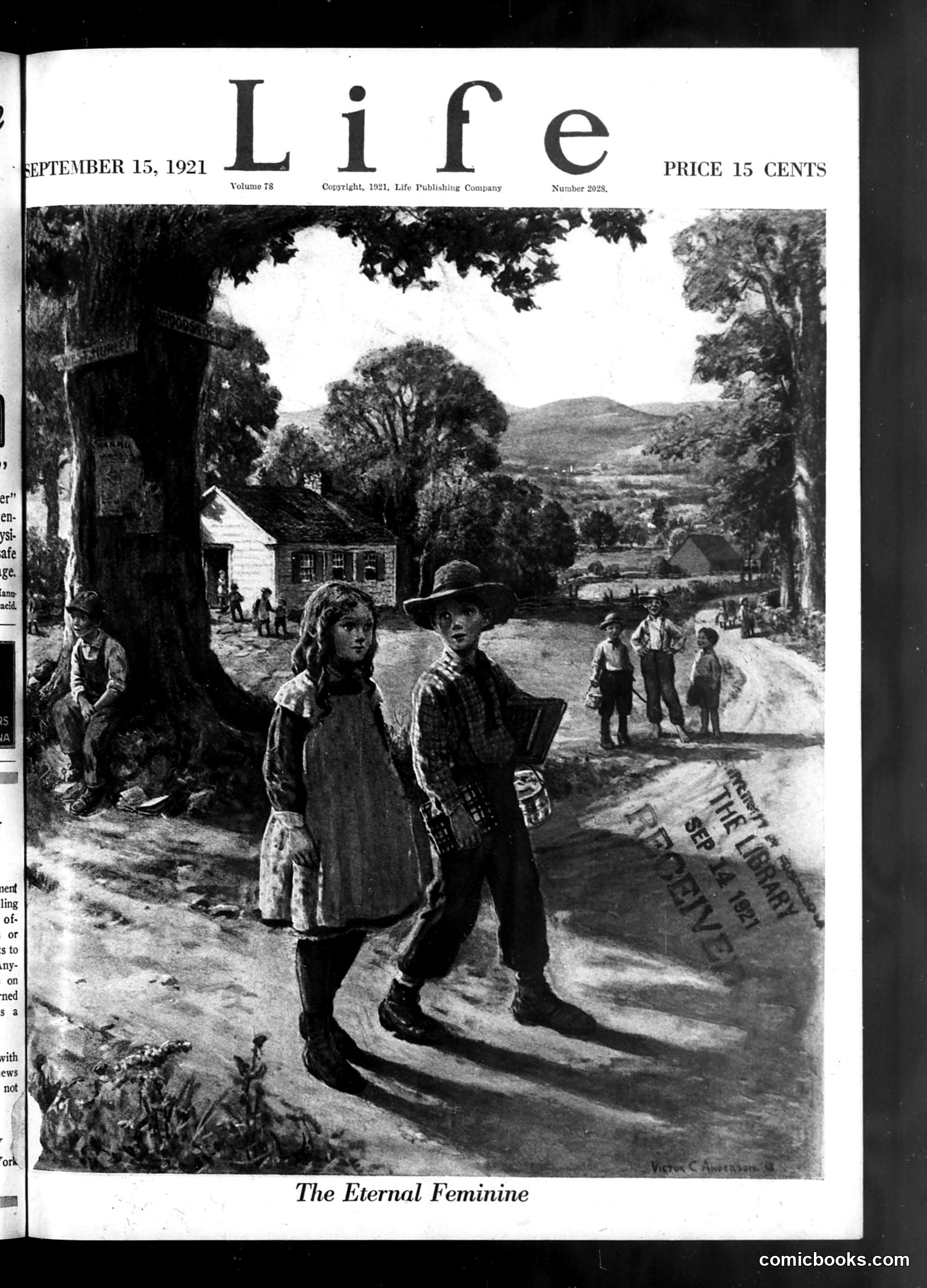
This illustration depicts a rural scene with two figures in period costume—a woman in a long dress and a man in Western attire with a wide-brimmed hat. The title "The Eternal Feminine" suggests commentary on timeless aspects of femininity or gender relations. The image appears to be an illustration rather than political satire. Without additional context from the article text, the precise meaning remains unclear. It likely relates to contemporary discussions about women's roles, possibly referencing romantic or social conventions of the era. The rural setting and period clothing suggest either a historical narrative or allegorical commentary on traditional gender dynamics. The specific point of the satire is not evident from the image alone.

This page is **not a cartoon or satirical content**—it's a straightforward **advertisement for Michelin tires**, published in Life magazine on September 15, 1921. The ad shows two tires photographed against a black background: a dark tire with visible tread pattern on the left, and a lighter-colored tire rim on the right. The Michelin Man mascot (the bibendum character) appears at bottom left. The advertising message is simple: "Their sturdy appearance suggests their durability." This emphasizes the tire's robust construction as proof of reliability—a common early automotive marketing approach when tire quality was a significant consumer concern. The ad lists the Michelin Tire Company's main factory in Milltown, New Jersey, plus additional factories in France, England, and Italy.
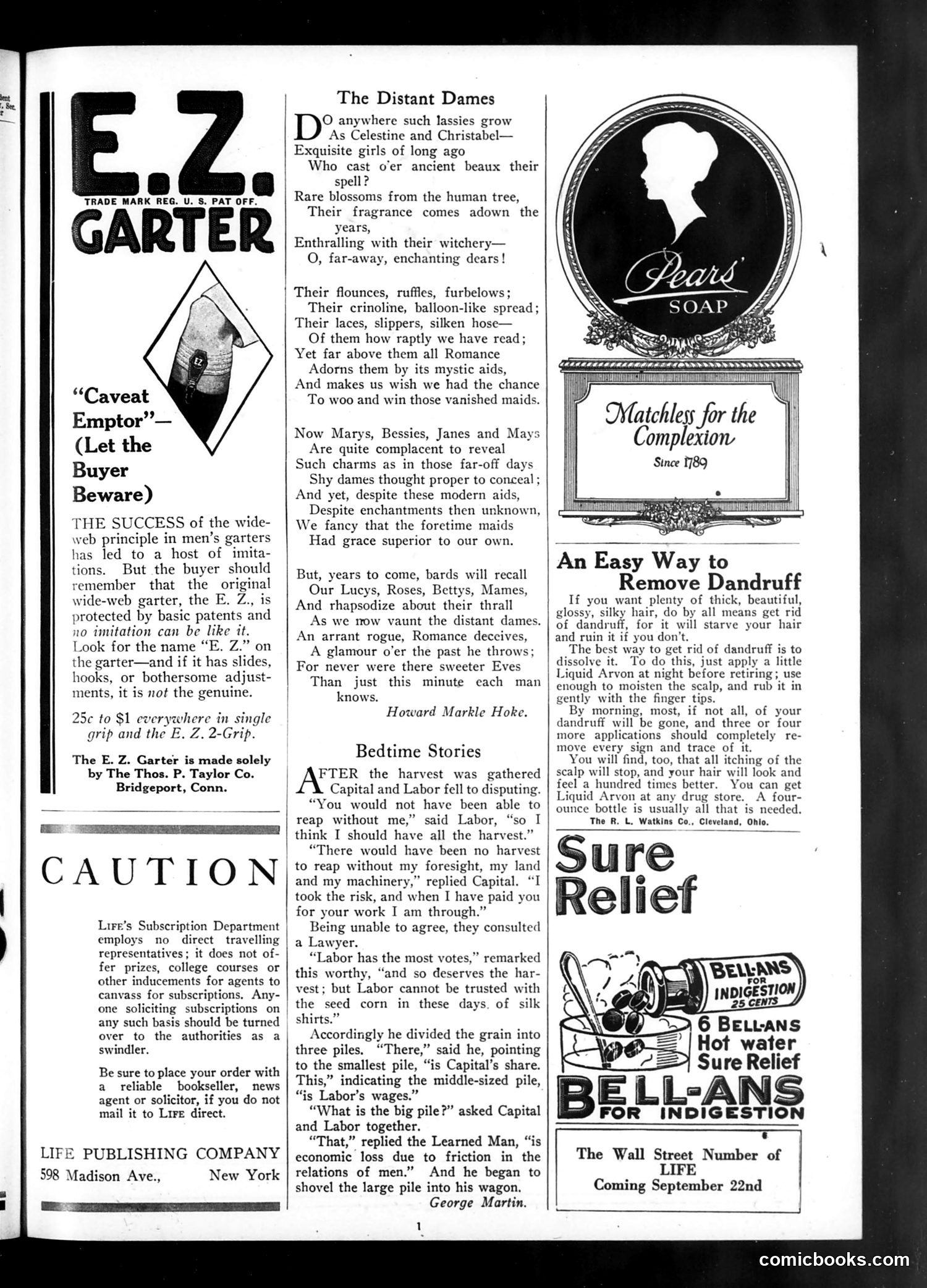
This page is primarily **advertising and fiction**, not political satire. The left side features an **E.Z. Garter advertisement** warning buyers ("Caveat Emptor") to look for the genuine E.Z. brand name, as knockoffs exist. Below is a caution from Life's publishing company about subscription fraud. The center contains **"The Distant Dames,"** a sentimental poem by Howard Marble Hoke comparing idealized women of the past to modern ones, and **"Bedtime Stories,"** a fable by George Martin about Capital and Labor negotiating grain division with a Learned Man mediating—an allegory about fair distribution of resources. The right side shows advertisements for **Pears' Soap** and **Bellans antacid**, emphasizing product reliability. There is **no clear political cartoon** on this page—it's a mix of consumer advertising and light literary content typical of early 20th-century magazines.
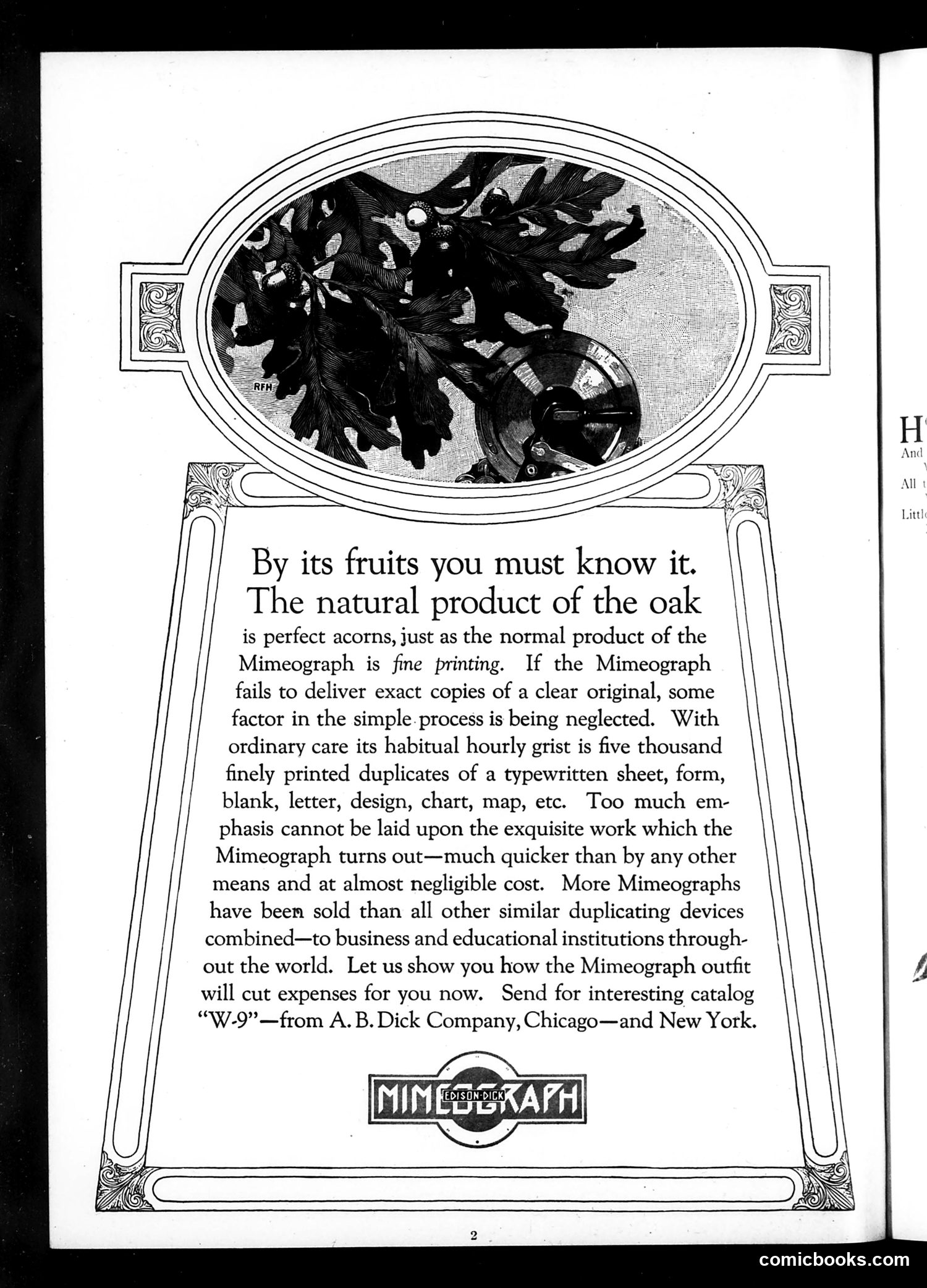
This page is primarily **advertising, not satire or editorial content**. The image shows an oak branch with acorns in an oval frame. The accompanying text is a commercial advertisement for the Mimeograph, a duplicating machine made by A.B. Dick Company (Chicago and New York). The ad uses the metaphor "By its fruits you must know it"—comparing the Mimeograph's output (copies) to acorns as the oak tree's natural product. The pitch emphasizes the machine's efficiency: it produces "five thousand finely printed duplicates" of originals hourly, at negligible cost, and claims more Mimeographs have been sold than "all other similar duplicating devices combined." This is period advertising targeting businesses and educational institutions seeking economical reproduction technology.
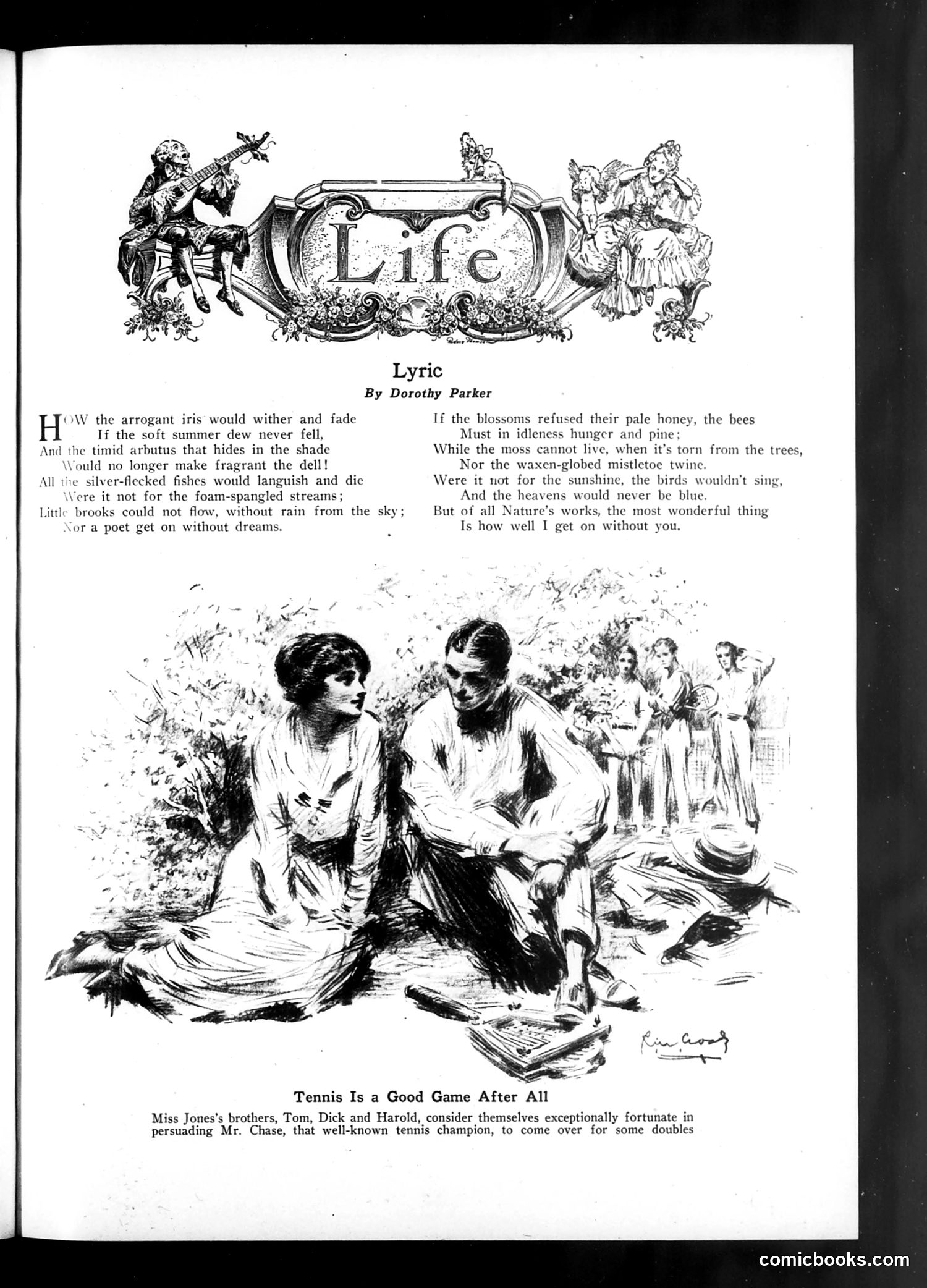
This page contains two distinct elements: **Top: "Life" Lyric by Dorothy Parker** - A romantic poem about nature's interdependence, ending with the speaker's devotion to an unnamed person ("how well I get on without you"). **Bottom: Illustration and Caption** - A sketch showing two people (appears to be a man and woman) sitting outdoors with others in background, titled "Tennis Is a Good Game After All." The caption explains that Miss Jones's brothers (Tom, Dick, and Harold) persuaded a tennis champion named Mr. Chase to play doubles with them. The page appears to be a standard Life magazine feature mixing poetry with a lighthearted social illustration—likely about courtship or leisure activities among upper-class Americans. No specific political satire is evident. The humor seems gentle and domestic rather than topical.
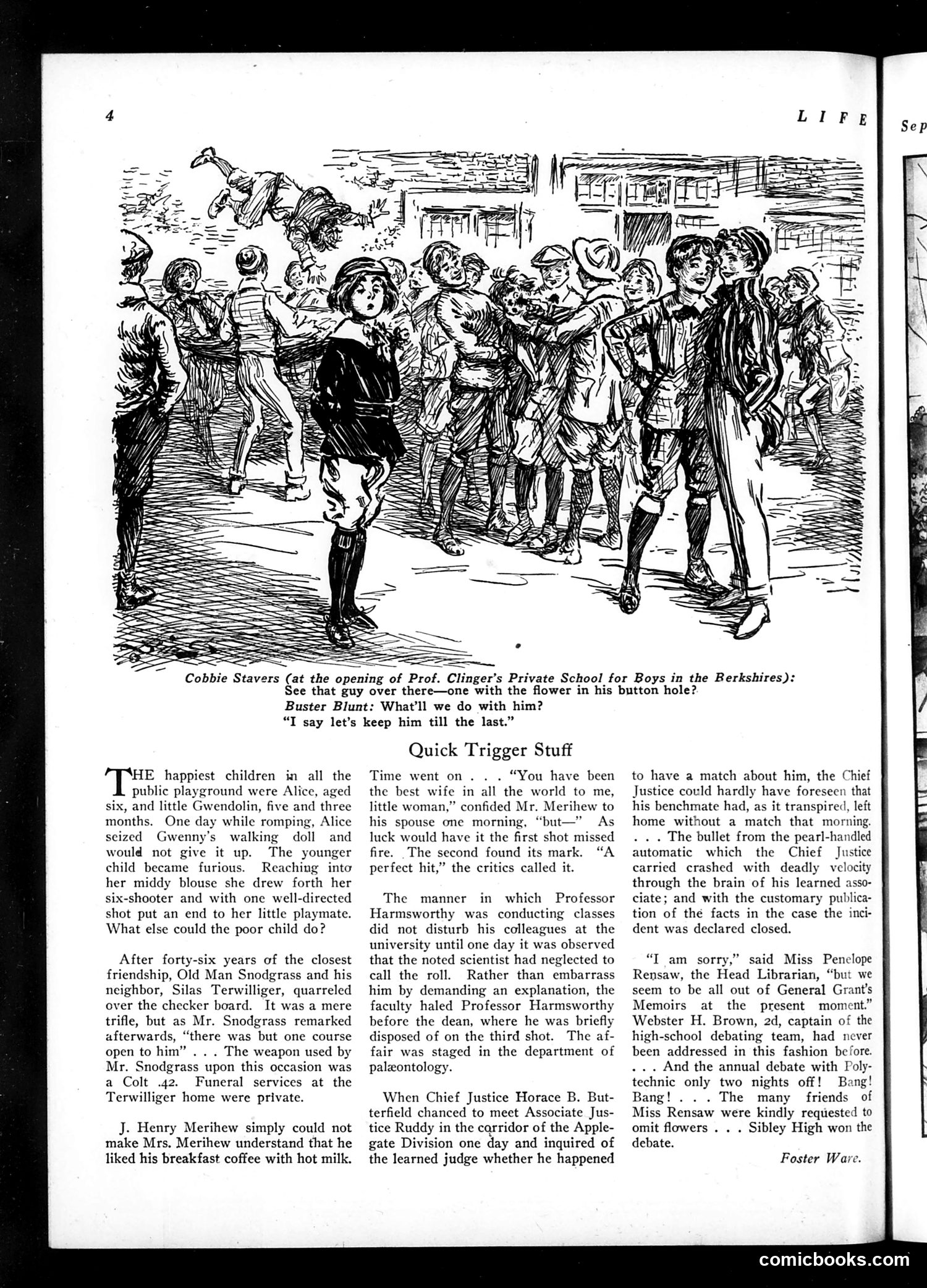
This page contains two satirical pieces: **The cartoon** depicts a scene at "Prof. Clinger's Private School for Boys in the Berkshires." A boy in dark clothing stands before other students and adults. The caption suggests he's being mocked for wearing a flower in his buttonhole—an apparently effeminate or unusual fashion choice that provokes the question "What'll we do with him?" The satire targets rigid social conformity and the cruel treatment of nonconforming children in elite boarding schools. **"Quick Trigger Stuff"** is a humorous short story about a child's missing doll causing domestic chaos, resolved when a Chief Justice's stray bullet accidentally destroys it. The piece satirizes both overprotective parenting and the absurdity of how minor domestic incidents escalate comically when adults become involved. Both pieces reflect early 20th-century satirical humor about social propriety and class anxieties.
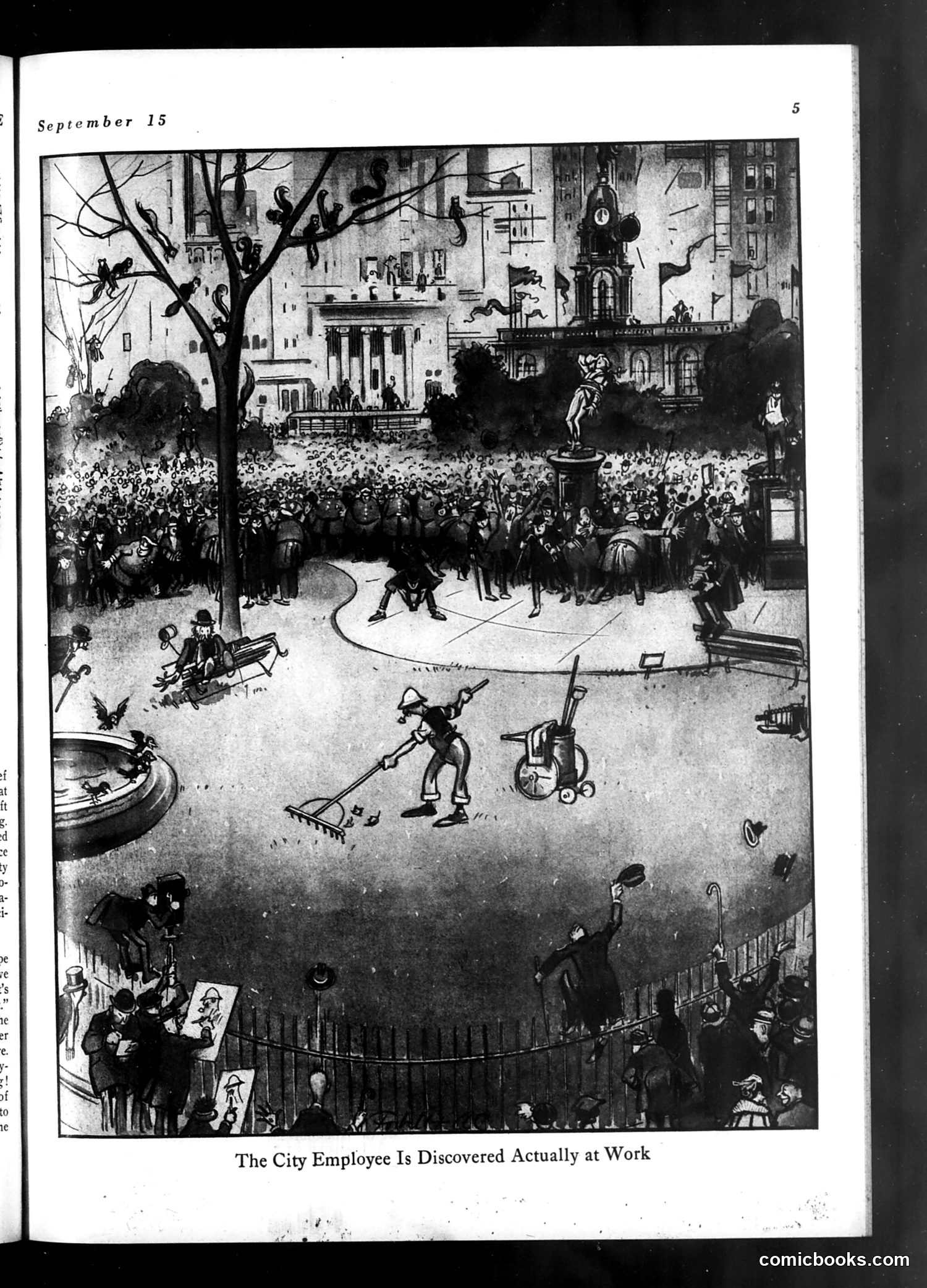
This satirical cartoon depicts a massive public square thronged with spectators gathered around a remarkable sight: a city employee actively performing labor. The crowd's dense presence and amazement suggests this was an extraordinary, nearly unbelievable occurrence. The satire targets a widespread perception—likely from the early 20th century—that municipal workers were notoriously idle or shirked duties. The artist exaggerates this stereotype by presenting an industrious city employee as such a novelty that it draws huge public crowds and attention, as if witnessing something remarkable or nearly impossible. The joke reflects contemporary frustration with municipal bureaucracy and perceived inefficiency in government employment, making it a commentary on public service work ethic of that era.
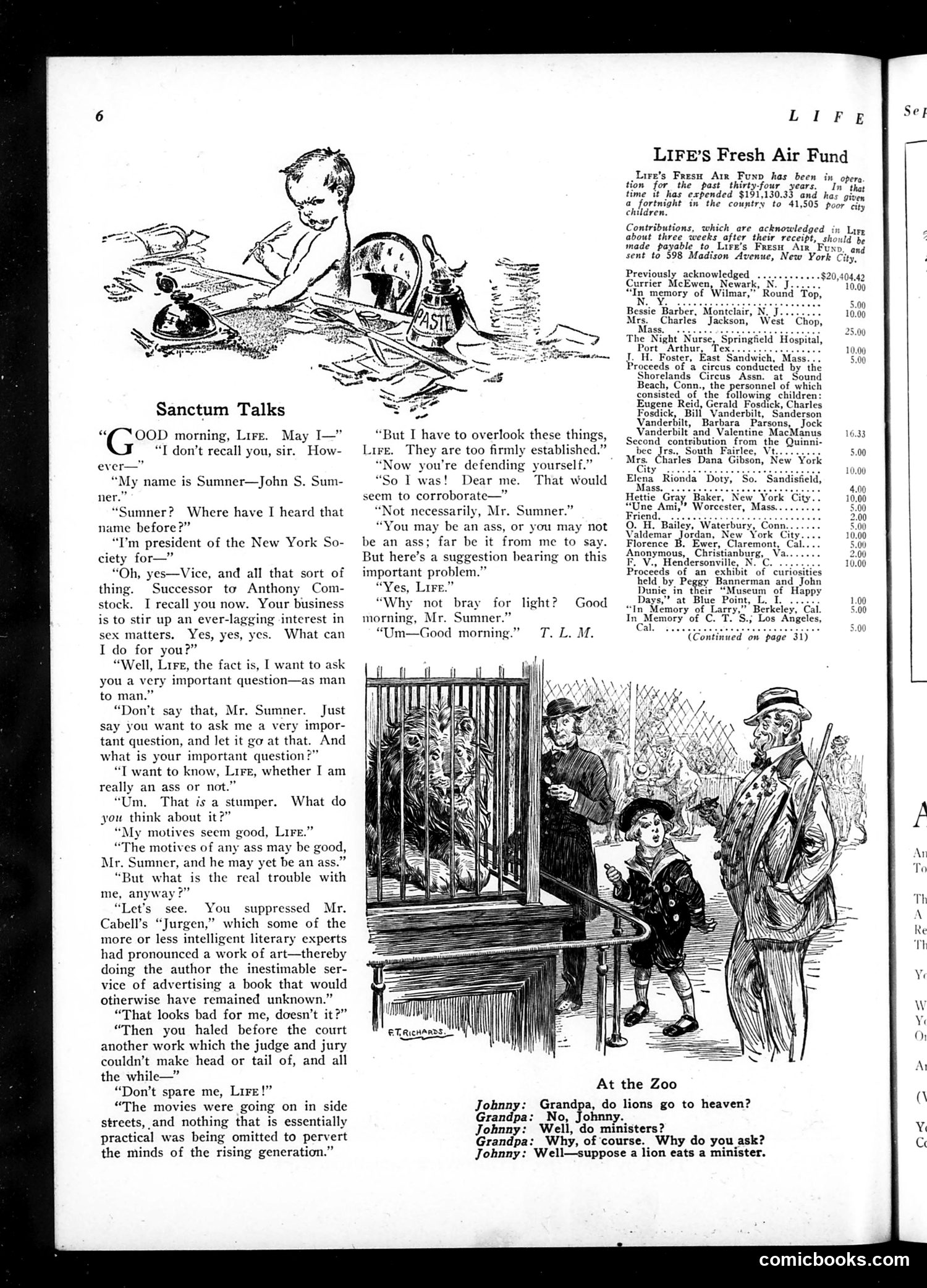
**"Sanctum Talks"** features a dialogue between "LIFE" (the magazine personified) and John S. Sumner, president of the New York Society for the Suppression of Vice. This appears to be satirizing Sumner's censorious efforts—he's challenging the magazine on moral grounds, claiming its content threatens "the rising generation." LIFE defends itself against accusations of impropriety, with Sumner suggesting the publication suppressed a work called "Jurgen" (likely Alexander Cabell's novel, which faced obscenity charges). The satire mocks Sumner's paternalistic moral policing and his attempts to control what the public reads. **"At the Zoo"** is a simple joke cartoon showing a child asking his grandfather whether lions go to heaven, then ministers, playing on the irony of moral authority.
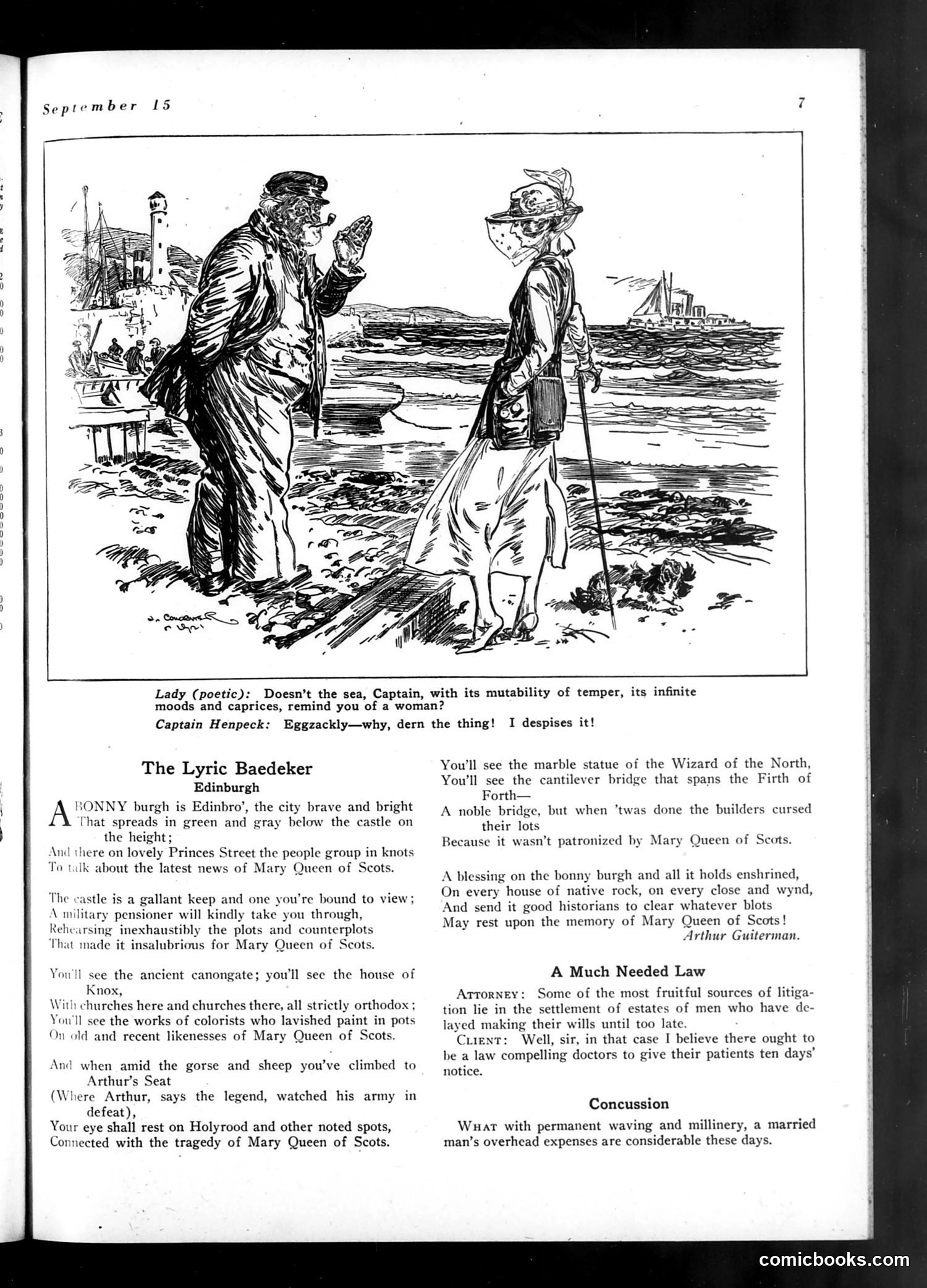
The cartoon at top shows a lady and Captain Henpeck on a beach. The lady compares the sea's changeable moods to a woman's nature; the Captain responds by calling it "despicable" and saying he despises it—a joke about male frustration with female unpredictability. This reflects early 20th-century gender stereotypes portraying women as emotionally volatile and irrational. Below are three separate pieces: "The Lyric Baedeker" (a poem about Edinburgh), "A Much Needed Law" (a brief satirical exchange between an attorney and client about delayed estate settlements), and "Concussion" (a quip about married men's expenses). The humor relies on stereotypes about women's nature, legal incompetence, and domestic financial burden—typical satirical themes of *Life* magazine's era.
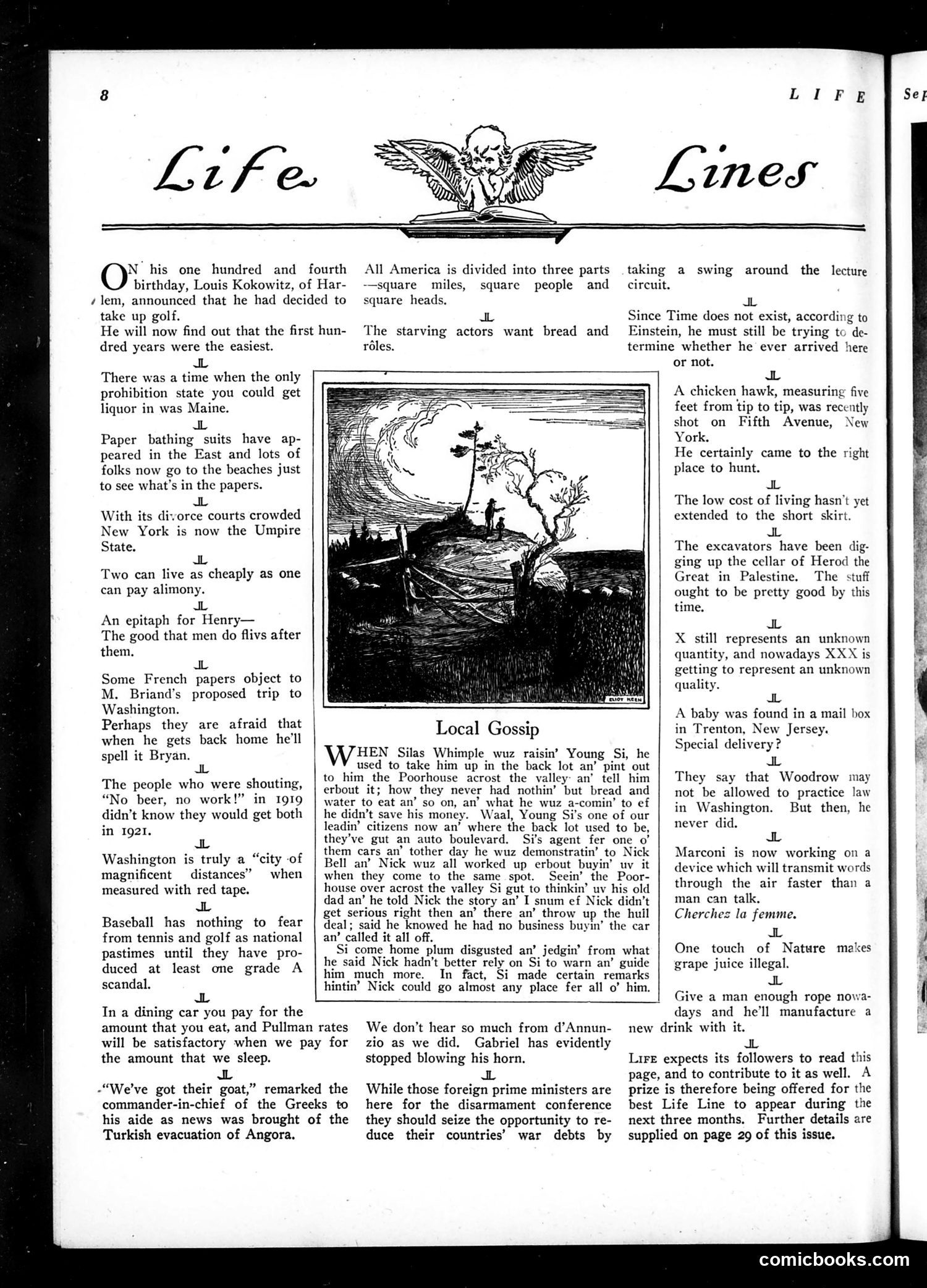
The page contains brief satirical commentary rather than traditional political cartoons. The central illustration depicts a stark landscape with a windswept tree and stormy sky—likely representing rural hardship or desolation. The "Life Lines" section offers cynical observations on contemporary American life: divorce courts making New York the "Empire State," financial struggles ("two can live as cheaply as one can pay alimony"), and critiques of political figures like Henry and M. Briand's proposed Washington trip. The "Local Gossip" section mocks Sila Wittington's automobile mishap in rural Pennsylvania, satirizing both rural simplicity and emerging automotive culture. References to Woodrow (likely Wilson), Marconi's wireless transmission, and grape juice prohibition suggest early 20th-century concerns. Overall, the page satirizes social upheaval, technological change, and political incompetence through dry wit rather than visual caricature.
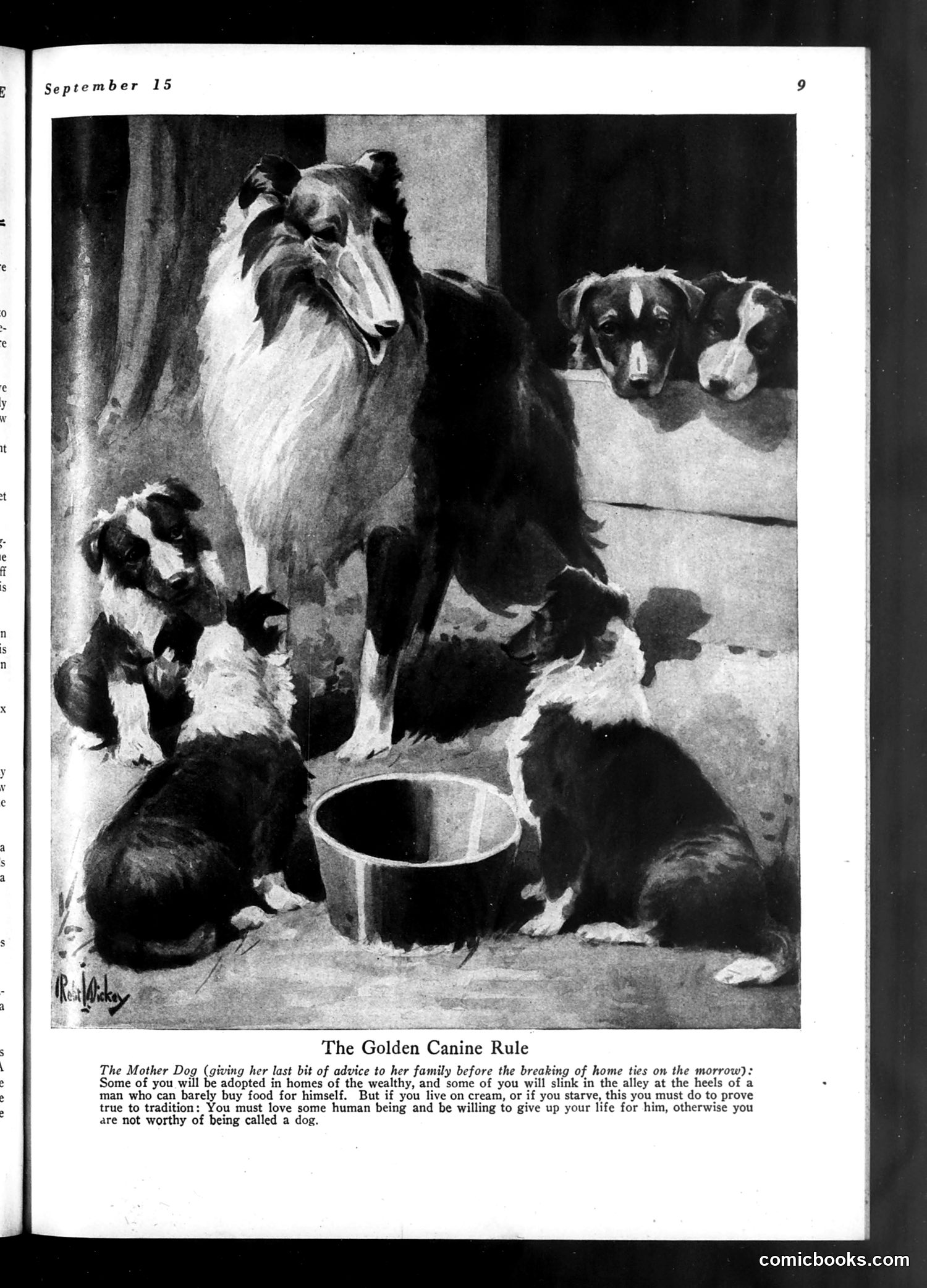
This illustration depicts a mother dog offering final advice to her puppies before they leave home. The accompanying text presents the "golden rule" reframed for dogs: they must love some human being and be willing to sacrifice for them to be worthy of the name "dog." The satire appears to criticize human society by contrast. While dogs naturally demonstrate loyalty and selfless devotion, the text implies humans often fail at this basic moral standard. The wealthy may adopt dogs, but poor humans "slink in the alley at the heels of a man who can barely buy food for himself." This is sentimental animal satire—using dogs' superior moral character to shame human selfishness and economic inequality. The "rule" suggests dogs model virtues humans should emulate but frequently don't.
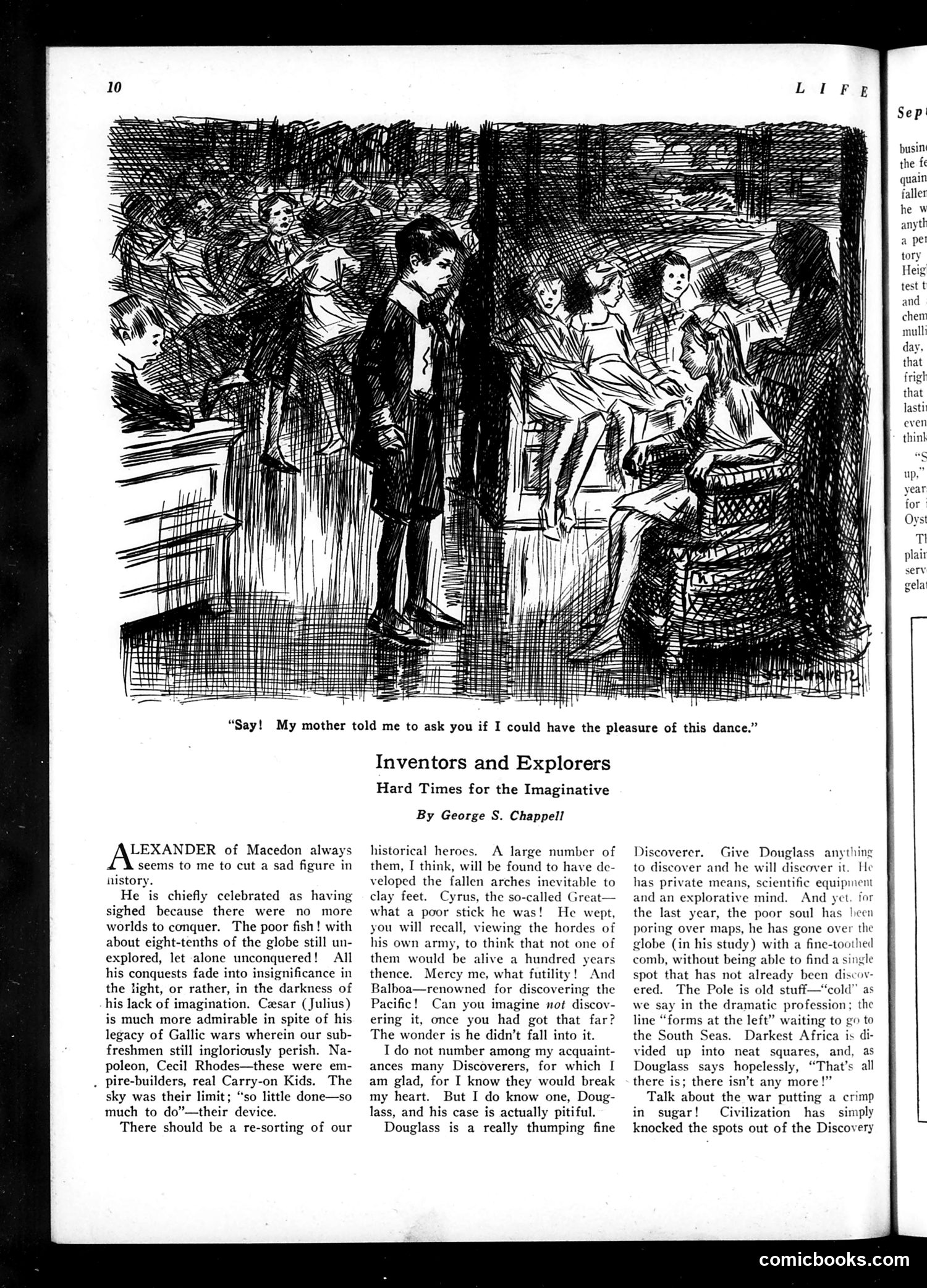
The illustration depicts a social scene at what appears to be a formal dance or party. A young man in dark formal wear stands prominently in the center, addressing a seated woman. The caption reads: "Say! My mother told me to ask you if I could have the pleasure of this dance." The satire targets **awkward courtship etiquette among the socially inexperienced**. Rather than asking the woman directly with confidence (as proper social convention dictated), the young man relies on his mother's instruction, literally asking her permission to request a dance. This reveals his social immaturity and dependence on maternal guidance for basic interaction—treating an adult social engagement like a child's errand. The humor mocks both the boy's lack of social sophistication and the overbearing parenting that infantilizes him in front of potential romantic interests.
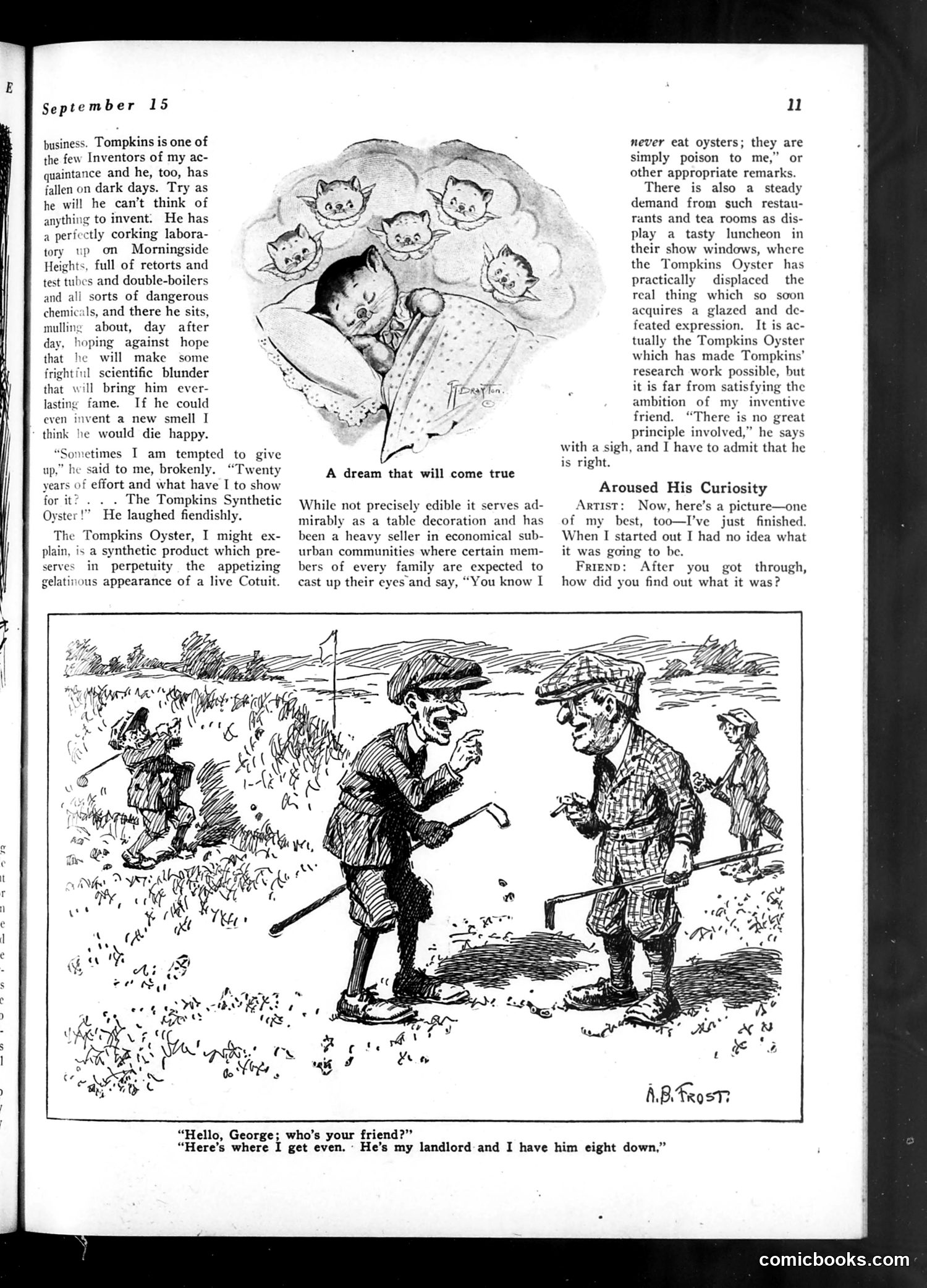
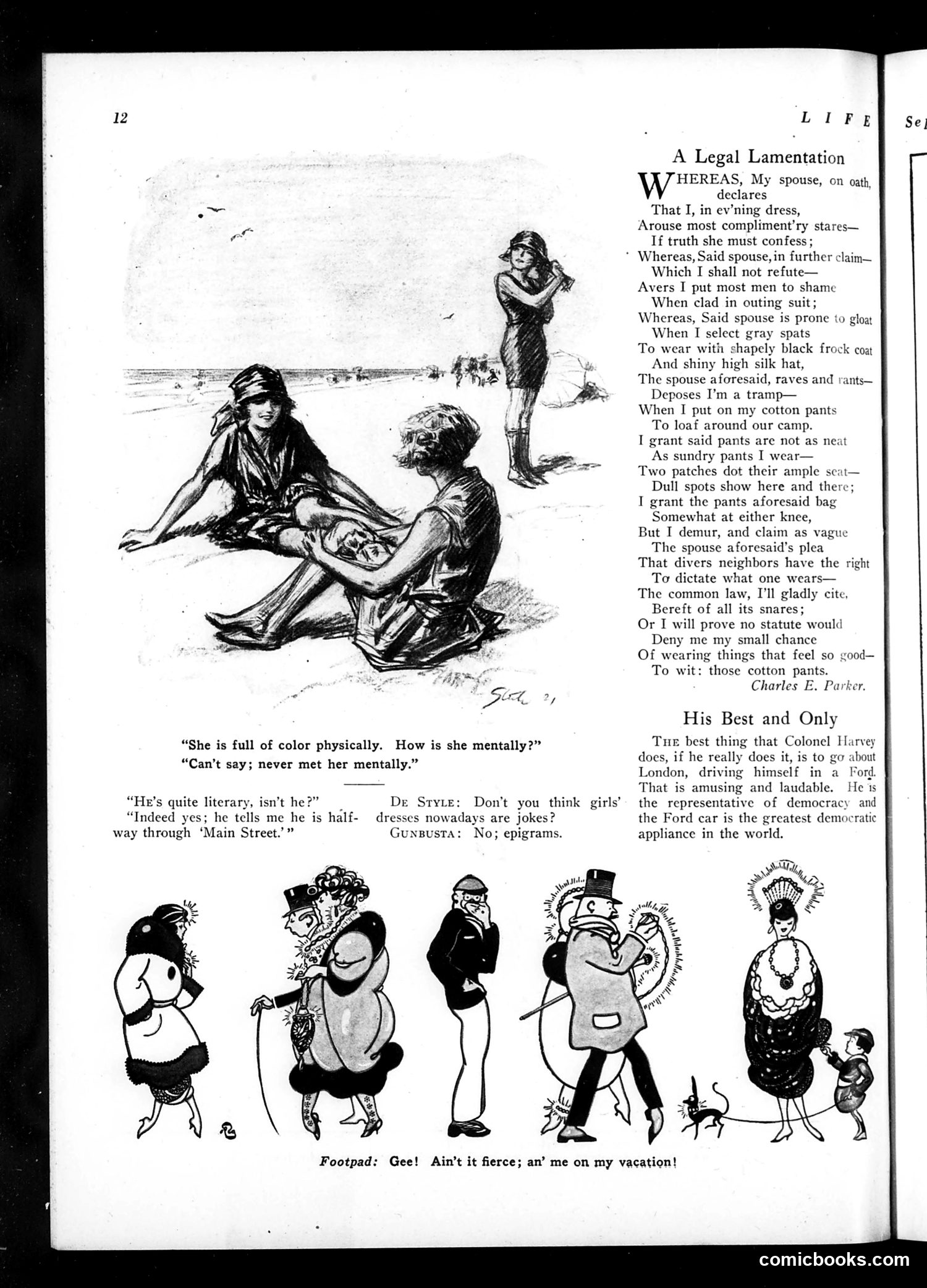
This page contains satirical commentary on gender and fashion in early 20th-century America. **"A Legal Lamentation"** is a poem by Charles E. Parker mocking a husband's complaint about his wife's clothing choices—specifically her evening dress, outing suit, and cotton pants that he deems unfashionable and unladylike. The satire inverts typical gender dynamics by presenting the husband as vain and controlling, while defending a woman's right to wear practical clothing without neighbors' judgment. The upper illustration depicts three figures on a beach, accompanying witty dialogue about women's mental and physical qualities. The lower cartoon strip shows exaggerated caricatured figures in humorous situations, with the caption "Gee! Ain't it fierce; an' me on my vacation!"—satirizing vacation experiences and social pretension. The section "His Best and Only" praises Colonel Harvey's democratic virtue of driving a Ford, positioning the automobile as a symbol of American democracy.
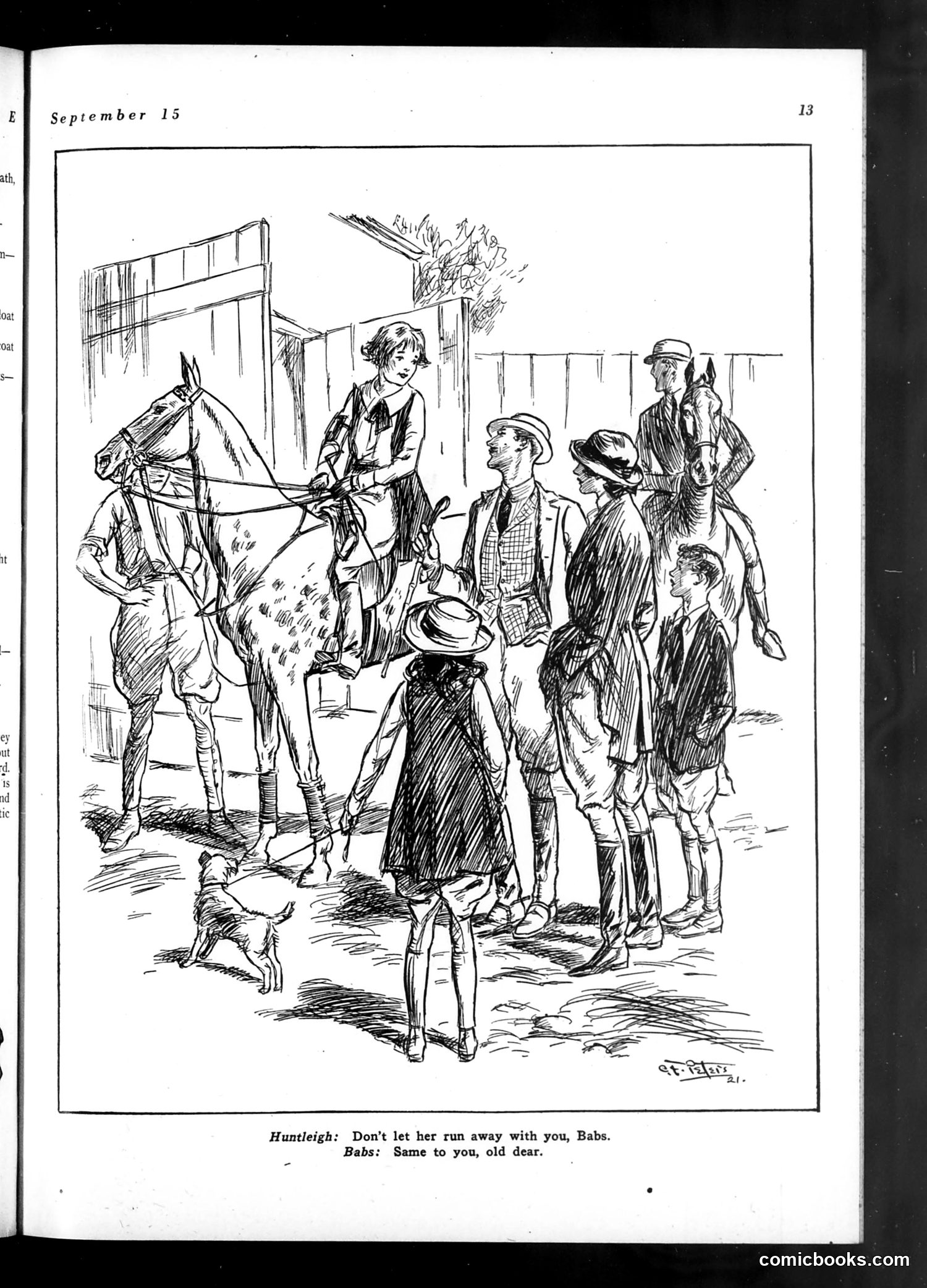
This single-panel cartoon depicts a rural scene where a woman on horseback converses with a group of men and boys standing in a farmyard. A small dog is present in the foreground. The caption reads: "Huntleigh: Don't let her run away with you, Babs. / Babs: Same to you, old dear." The joke appears to be a playful exchange between two characters, likely suggesting romantic or social complications. "Huntleigh" warns "Babs" not to be swept away by someone (possibly the horsewoman), while "Babs" returns an equivalent warning. The humor relies on the double meaning of "run away with"—implying both romantic elopement and being manipulated or deceived. The cartoon satirizes social dynamics and romantic entanglements of the era, though the specific identities of the characters remain unclear from the image alone.
This page discusses Ireland's political situation following British government offers regarding Irish independence and Ulster's status. The text references Lloyd George's negotiations and De Valera's rejection of terms. The small cartoon illustrations appear to be decorative vignettes rather than standalone political cartoons—they show stylized figures but lack clear caricature or identification of specific individuals. The main content is editorial commentary arguing that Ireland's acceptance of the offered terms would be politically wise, suggesting the Irish people have endured sufficient hardship and deserve peace. The piece advocates for sense and pragmatism in resolving the Irish question, positioning Ireland's potential agreement as beneficial to both Irish and British interests. This reflects the complex post-WWI moment of Irish independence negotiations.
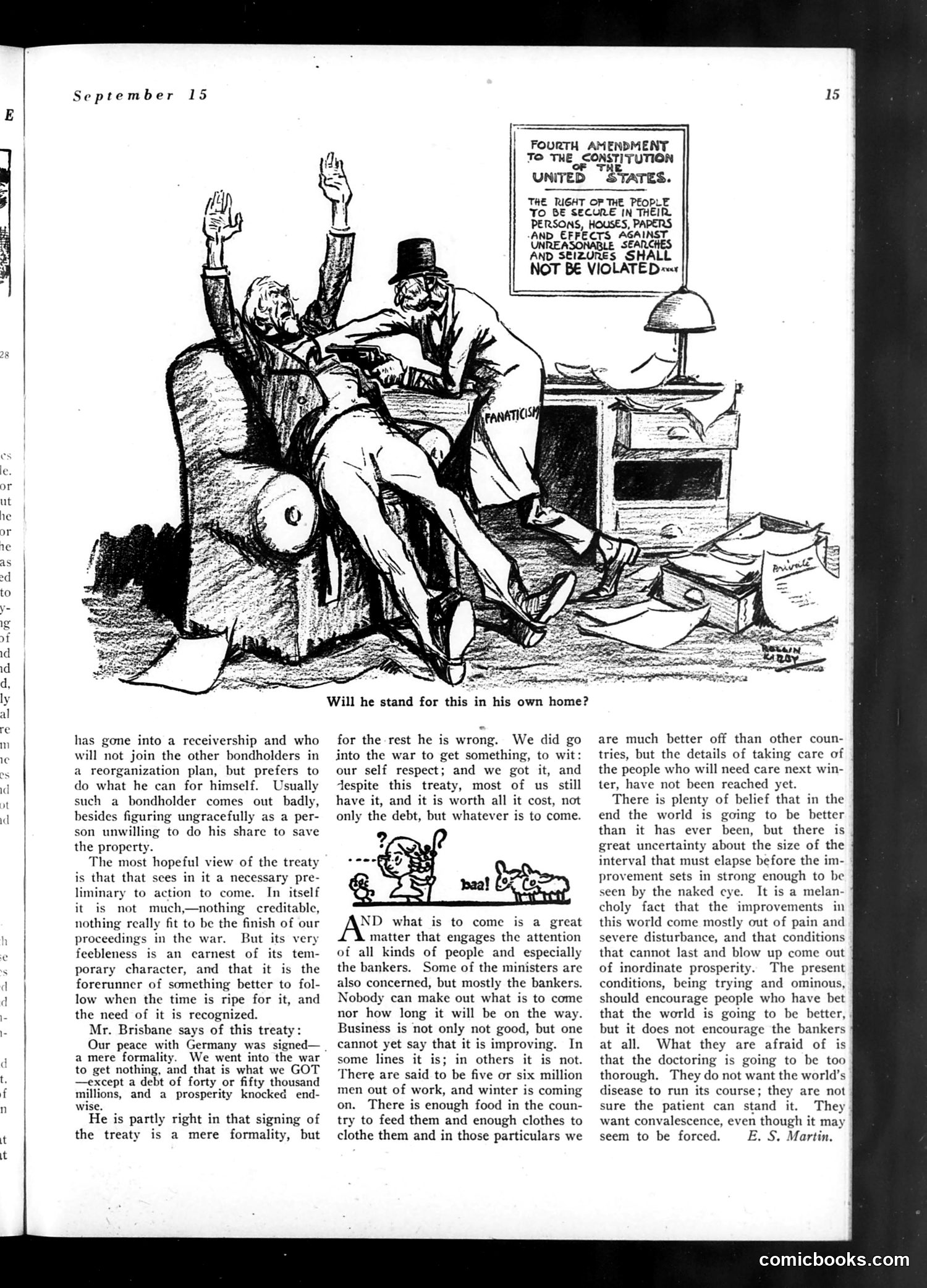
**The Cartoon:** A caricatured figure sits in a chair with arms raised triumphantly, while another man (appearing to be a banker or official) searches through his belongings. A framed Fourth Amendment hangs on the wall behind them. **The Satire:** This is commentary on post-World War I economic conditions and banking practices. The cartoon juxtaposes the Fourth Amendment's protection against unreasonable searches with what appears to be bankers or creditors conducting investigations into citizens' private affairs—likely regarding war bonds, debt, or financial reorganization. **The Point:** The accompanying text by E.S. Martin criticizes bankers' fears about post-war economic recovery being "too thorough," suggesting they don't want fundamental systemic change. The cartoon sarcastically asks whether citizens will tolerate in their own homes the very intrusions they fought to protect against constitutionally—implying bankers are effectively violating citizens' privacy and property rights through financial coercion during uncertain economic times.
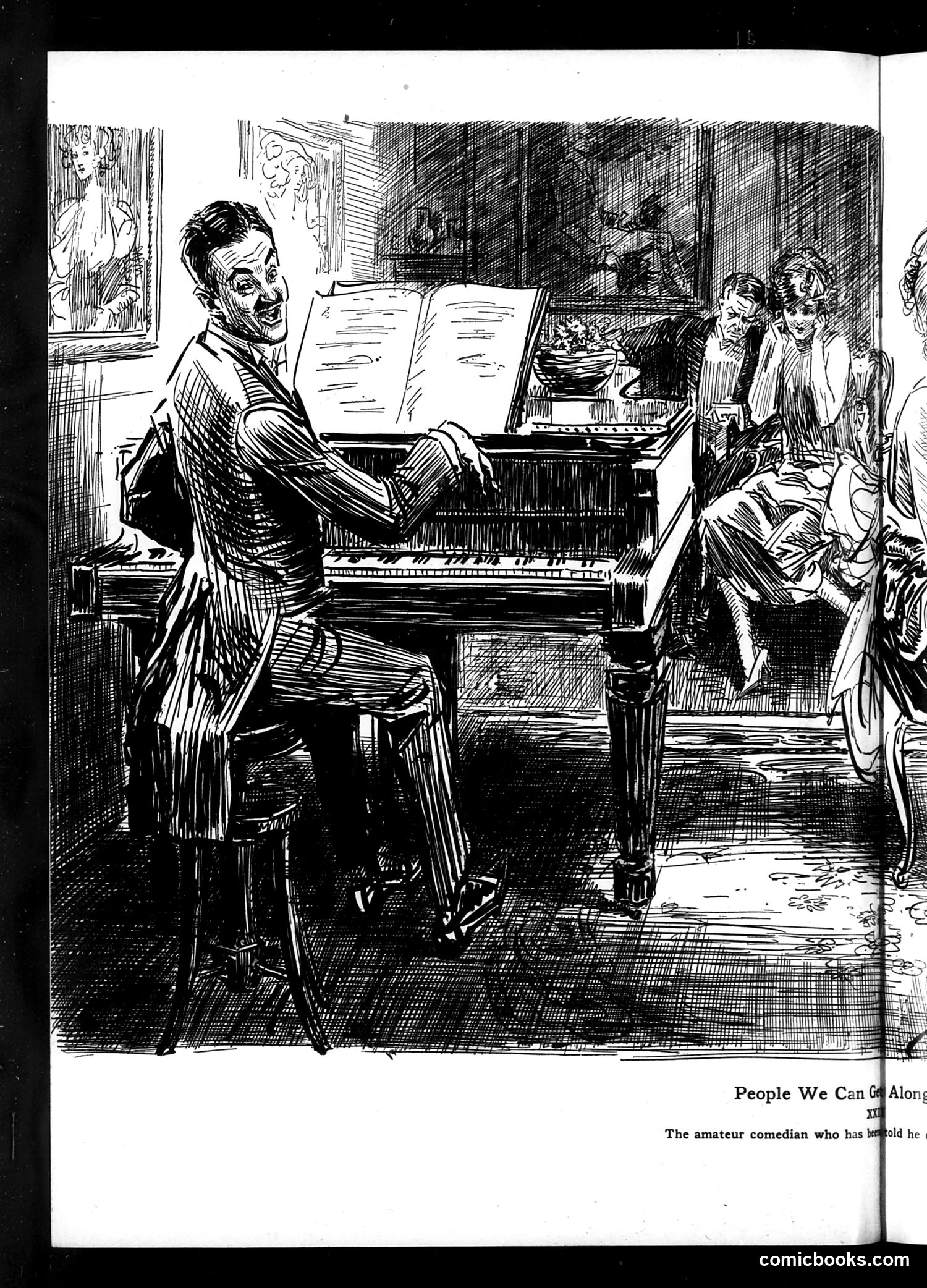
This appears to be a section titled "People We Can Go Along [with]" featuring "The amateur comedian who has be[come]..." (text cuts off). The illustration shows a man seated at a piano, turned toward the viewer with an exaggerated, comedic expression. He's dressed formally in a suit. Several well-dressed people observe him from the right side of the room, suggesting a social gathering or performance setting. The satire likely targets amateur entertainers who perform at social occasions—specifically someone attempting comedy or musical entertainment. The exaggerated facial expression and the formal audience suggest the humor lies in mocking self-appointed entertainers who impose their amateur performances on reluctant guests. The incomplete caption makes the specific target unclear, but the general point appears to be satirizing social pretension or unwanted amateur entertainment at gatherings.
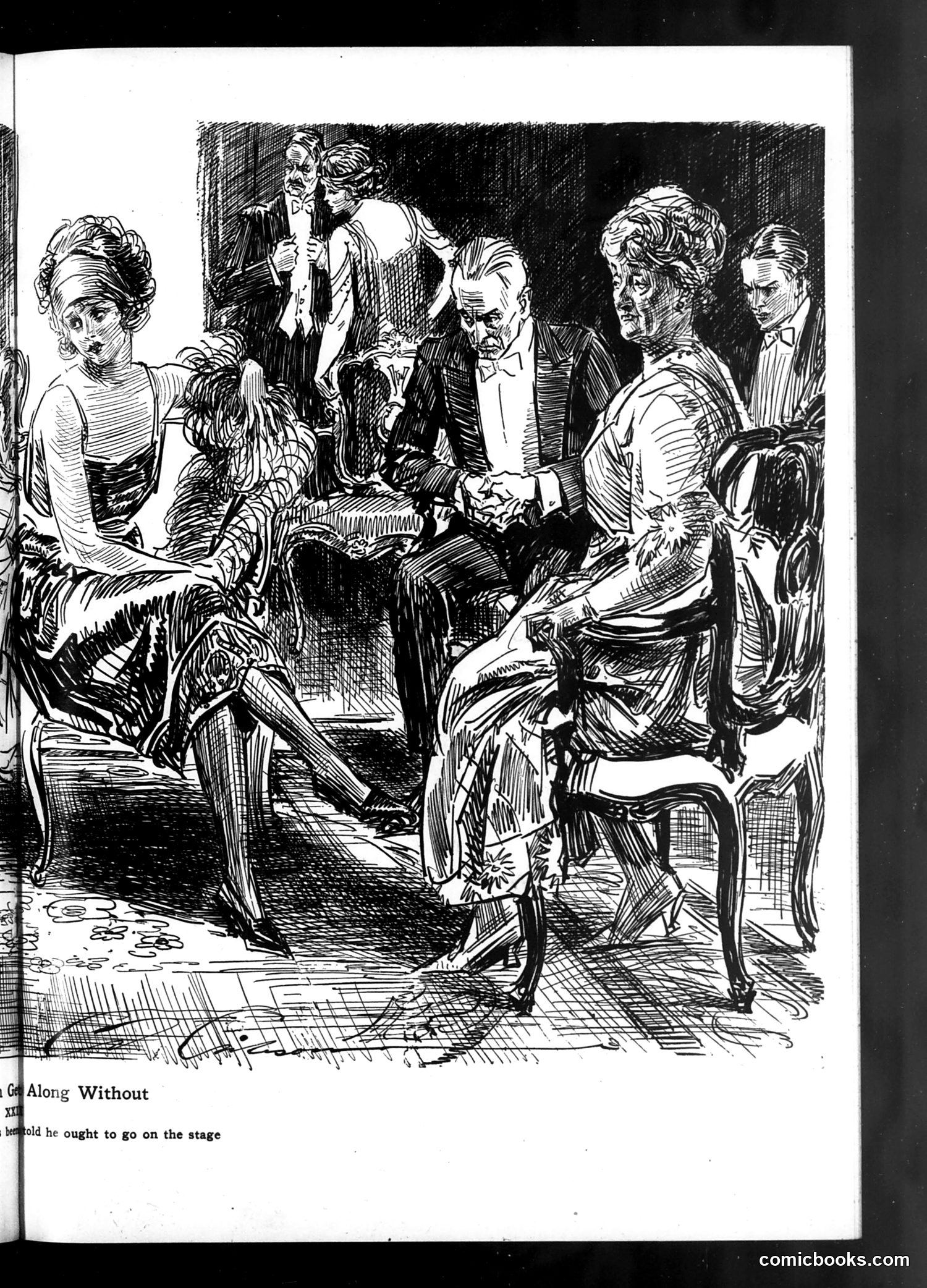
This appears to be a theatrical or social satire scene showing well-dressed figures in formal evening wear at what seems to be a salon or party gathering. The title "Along Without" and the partial visible text mentioning "ought to go on the stage" suggests the cartoon is mocking theatrical pretension or amateur dramatics among high society. The scene depicts elegantly dressed men and women in poses suggesting affected behavior or exaggerated social performance—"putting on a show" in their ordinary social interactions. The satire likely critiques the artificial mannerisms and performative nature of upper-class society gatherings, where attendees present false versions of themselves as if performing on stage rather than genuinely socializing. The detailed crosshatching and expressive line work emphasize the theatrical quality of their body language and expressions, reinforcing the joke about social artificiality.
This is a theatrical review column by Robert C. Benchley critiquing several recent Broadway plays. The three small decorative illustrations (stylized dogs or similar figures) are typical of Life's ornamental separators between sections—they carry no specific satirical meaning. Benchley's satire targets the plays themselves rather than political figures. His criticisms are sharp but humorous: he suggests some plays belong in the Salvation Army donation pile, mocks a sentimental song's lyrics as mimicking "famous stage imitations," and dismisses "Personality" as so cheap its only expense was printing tickets. His praise is reserved for productions like "The Detour" and "Six-Cylinder Love," which elevate formulaic "hokum" through strong acting and casting. The column represents Life's role as cultural arbiter, using witty condescension to entertain readers while guiding theatrical taste during Broadway's crowded 1921 season.
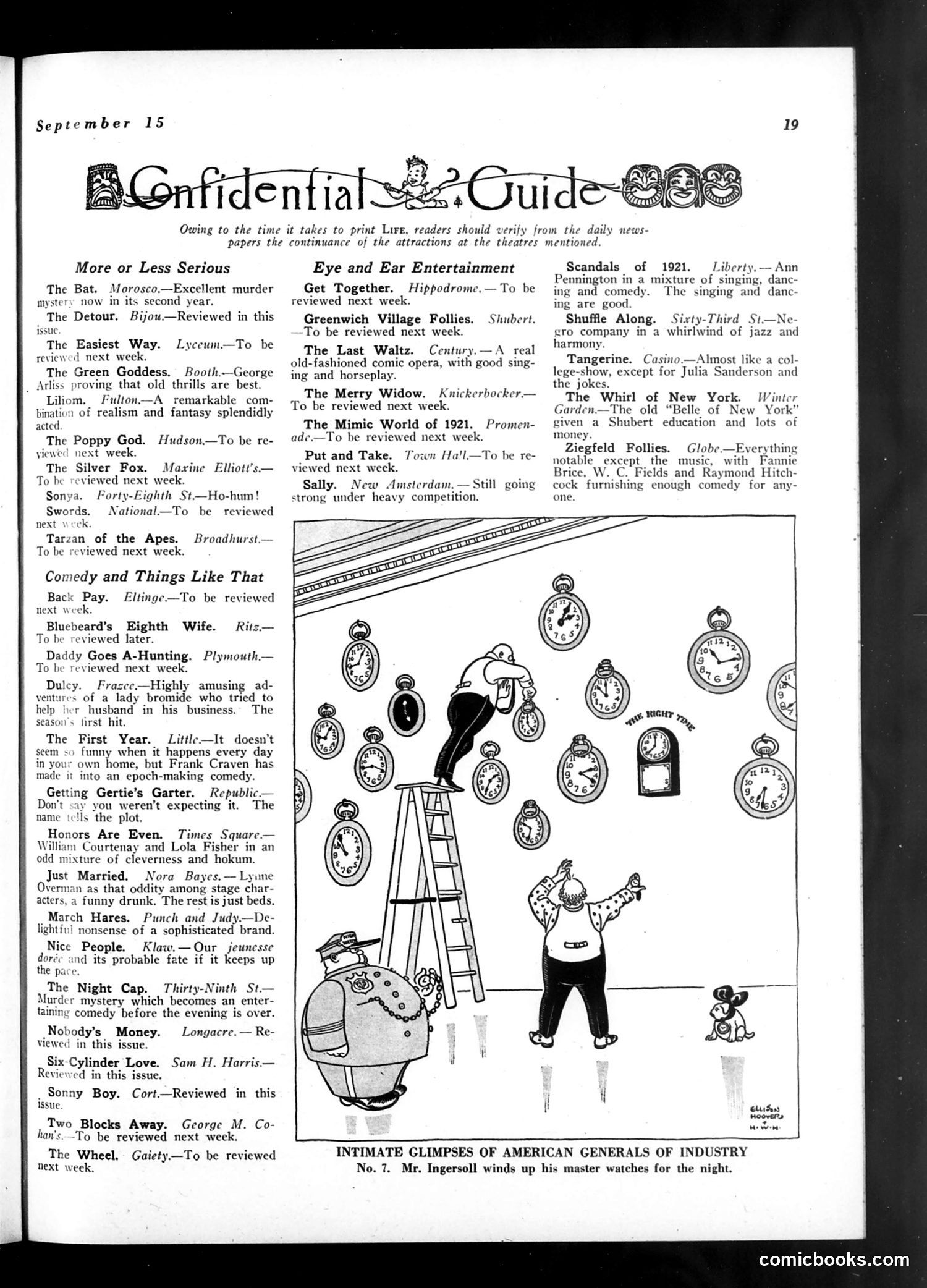
This page is primarily a **theater listing and review section** from Life magazine (September 15, 1921), not political satire. The main content catalogs Broadway shows organized by genre—serious drama, comedy, and entertainment. The cartoon at bottom, titled "Intimate Glimpses of American Generals of Industry," depicts **Mr. Ingersoll** (likely Ralph Ingersoll, a prominent industrialist/watchmaker) winding up pocket watches before bed. The humor is gentle satire: the "general of industry" is portrayed comically treating his watches like children being tucked in, suggesting wealthy industrialists' obsessive attention to detail and their possessions. The ladder and scattered timepieces emphasize the absurdity of this nighttime ritual. The page reflects 1921 Broadway's cultural moment—noting shows like "Shuffle Along" (an important African American musical) alongside more conventional entertainment. Theater reviews used coded language; "To be reviewed next week" meant waiting for fuller critique.
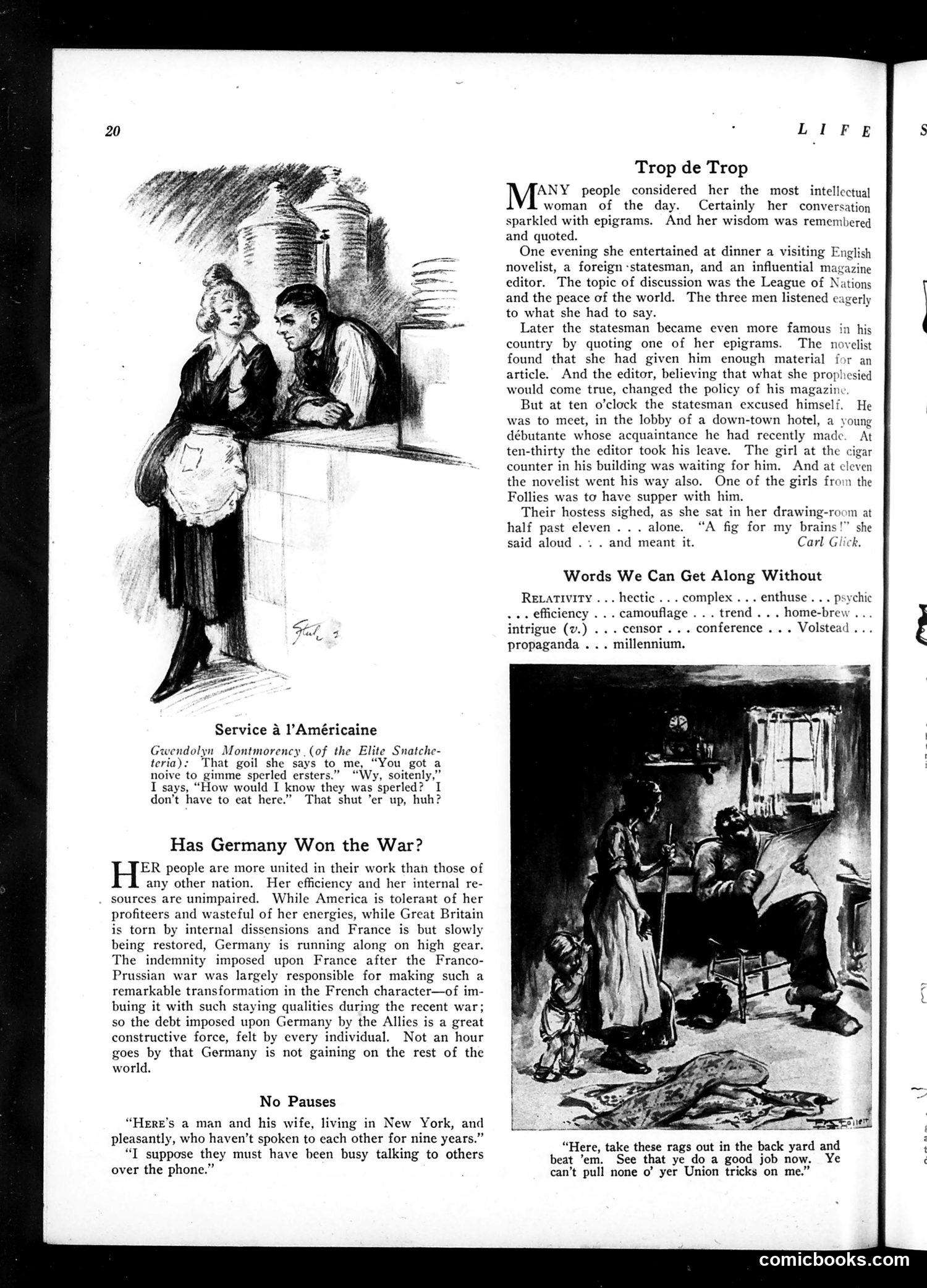
This satire by Carl Glick mocks intellectual pretension. An acclaimed woman hosts dinner with prominent figures—a novelist, statesman, and magazine editor—who listen eagerly to her epigrammatic wisdom on the League of Nations and world peace. Her insights prove so influential that the statesman quotes her, the novelist uses her material, and the editor changes his magazine's policy. However, the punchline reveals the satire's target: at evening's end, all three men abandon her to pursue romantic encounters with younger women (a debutante, a cigar-counter girl, and a Follies dancer). Alone at 11:30 p.m., the hostess sighs, "A fig for my brains!"—meaning her intellectual brilliance means nothing compared to youth and physical attractiveness. The joke critiques how society simultaneously celebrates women's intellect while ultimately valuing their appearance, and how even brilliant women cannot compete with younger women's appeal to powerful men.
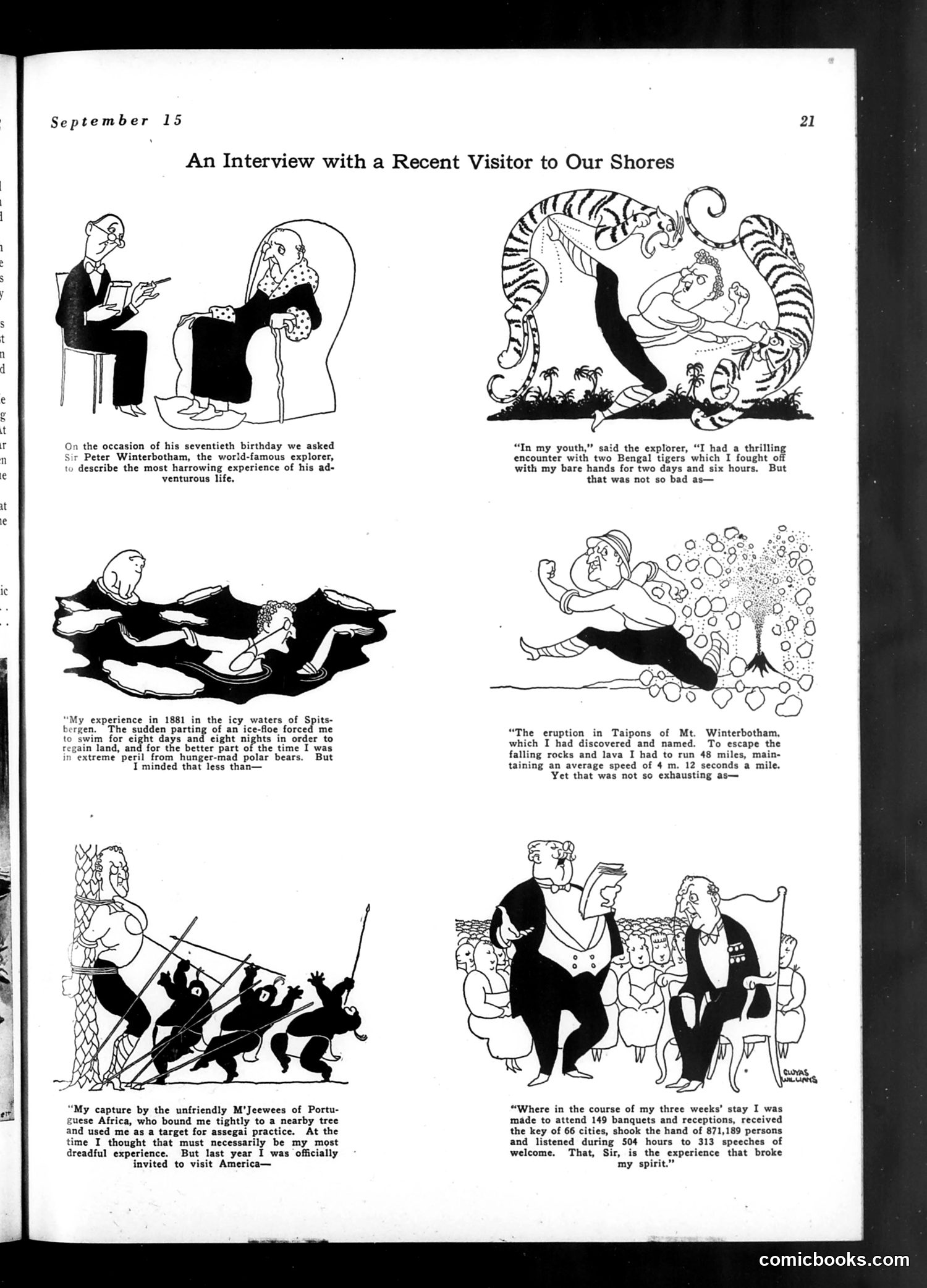
This satirical piece mocks the American custom of overwhelming visiting dignitaries with excessive hospitality. Sir Peter Winterbotham, a fictional "world-famous explorer," recounts increasingly dramatic near-death experiences—polar bear attacks, assegai spears, tiger combat, volcanic eruptions—each introduced as his worst ordeal. The punchline: his three-week American visit, featuring 149 banquets, 66 city keys, handshakes with 871,189 people, and 313 welcome speeches, finally "broke [his] spirit." The cartoon satirizes American civic boosterism and social convention, suggesting that endless formal receptions and ceremonial obligations are more exhausting than genuine physical danger. It's a gentle critique of American enthusiasm and the burdensome expectations placed on honored guests.
This is a film review section from Life magazine (early 1920s, based on references to silent films). The cartoon at the top—"The Silent Drama"—uses simple line drawings of animals and human figures to humorously illustrate the challenges of adapting stage plays to silent film. The sequence suggests a narrative progression, visualizing how subtlety that works in theater ("doesn't photograph so well," as the text notes) becomes exaggerated or loses nuance on screen. The page reviews six films, primarily praising George Arliss in "Disraeli" (a biographical drama about the 19th-century British statesman) and Constance Talmadge in "Wedding Bells." The reviews note recurring concerns: whether screen versions capture stage sophistication, and whether particular actors succeed in their roles. Charles Ray's "A Midnight Bell" receives mixed marks—competent but uninspired compared to his earlier work. The tone is lighthearted and accessible, treating cinema as popular entertainment worthy of serious critical attention.
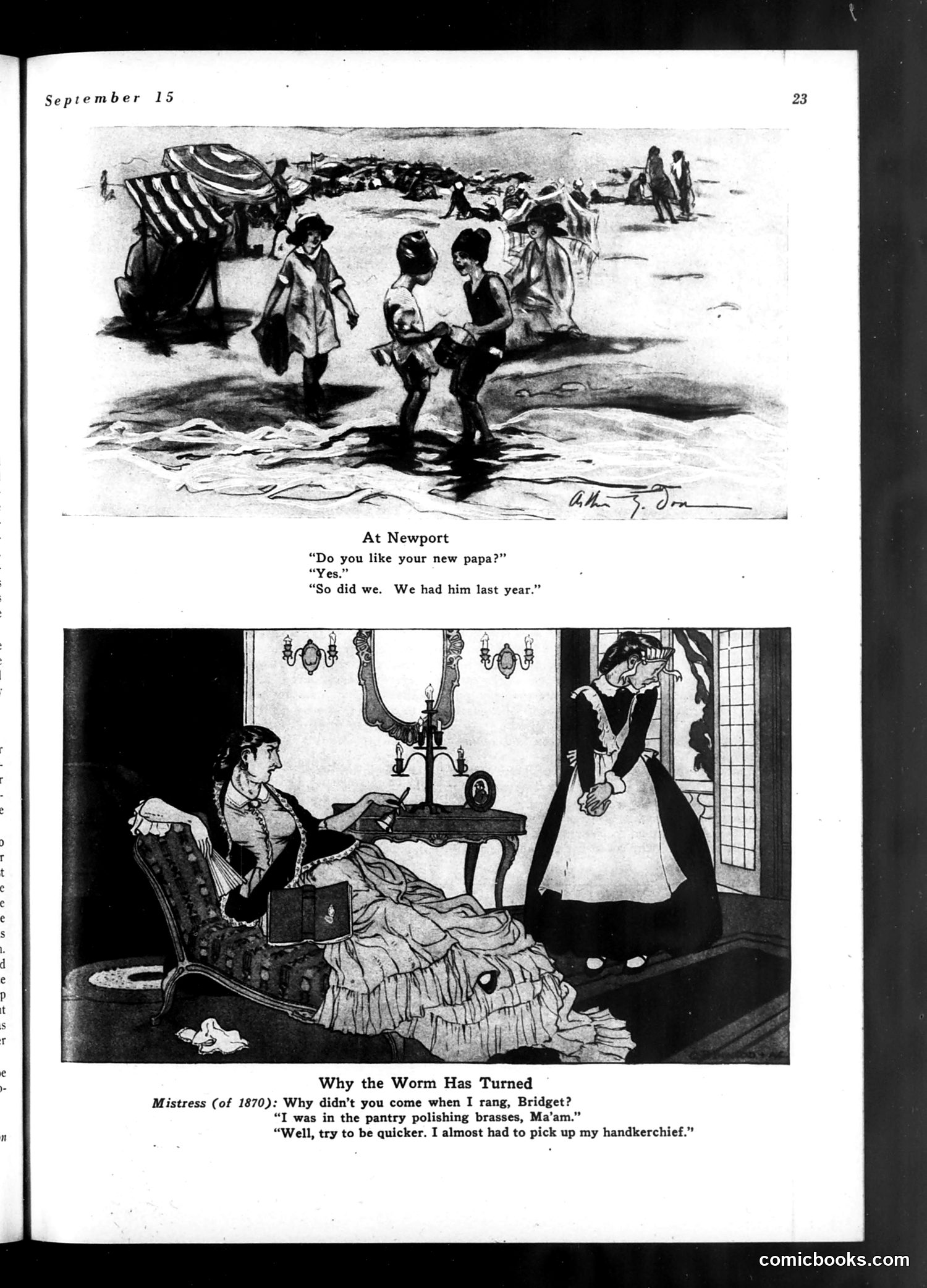
**Top cartoon ("At Newport"):** Shows children at a beach resort discussing their stepfather. The joke satirizes wealthy Newport families' marital instability—the child's casual comment that they "had him last year" implies rapid remarriage and disposable husbands among the rich. **Bottom cartoon ("Why the Worm Has Turned"):** A servant (Bridget, an Irish maid—a common stereotype) refuses to immediately obey her employer's bell. The mistress complains she "almost had to pick up my handkerchief" herself. The satire mocks upper-class entitlement and servants' growing assertiveness. "The worm has turned" refers to social change: working-class people rejecting total subservience to aristocratic demands, even trivial ones. The "1870" notation dates this shift in servant-employer dynamics to that era.
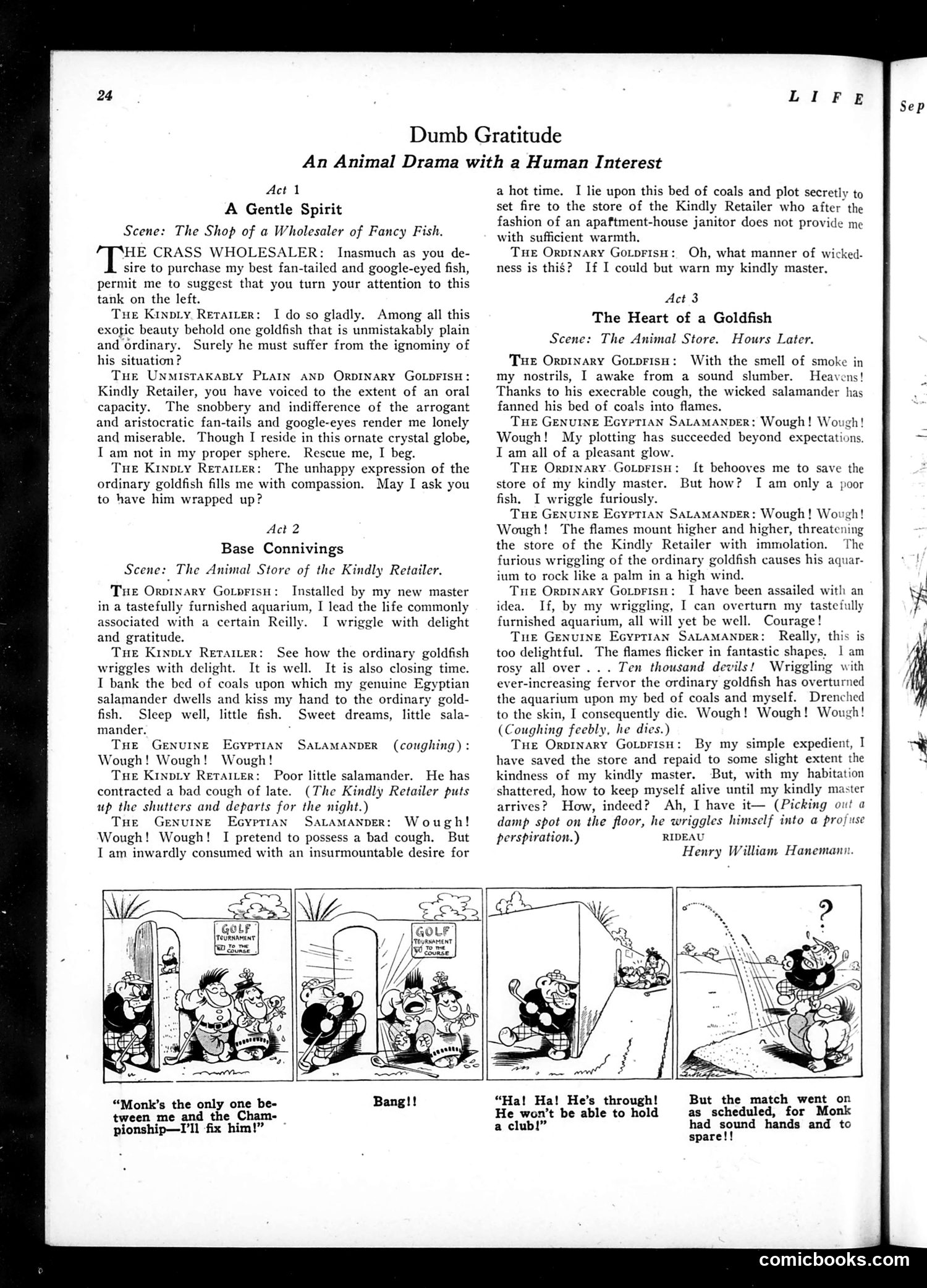
This is a three-act satirical drama written by Henry William Hanemann, presented as humor in *Life* magazine. It's a mock-heroic piece lampooning sentimentality and ironic ingratitude. The plot: A kind-hearted retailer rescues a plain goldfish from loneliness, giving it a comfortable home. Unbeknownst to him, a genuinely Egyptian salamander (kept on hot coals) plots arson out of cold dissatisfaction. The goldfish, grateful to its rescuer, heroically overturns its aquarium to extinguish the fire, accidentally drowning the villainous salamander in the process. The satire targets overwrought Victorian melodrama and anthropomorphic sentimentality. The "dumb gratitude" of the title refers ironically to the goldfish's unwitting heroism—it's "dumb" because the fish cannot comprehend what it's actually doing, yet accidentally performs a noble deed. The piece mocks both animal-welfare sentiment and theatrical convention through absurdist dialogue and exaggerated moral posturing. The comic strip below appears to illustrate a separate golf-related joke.
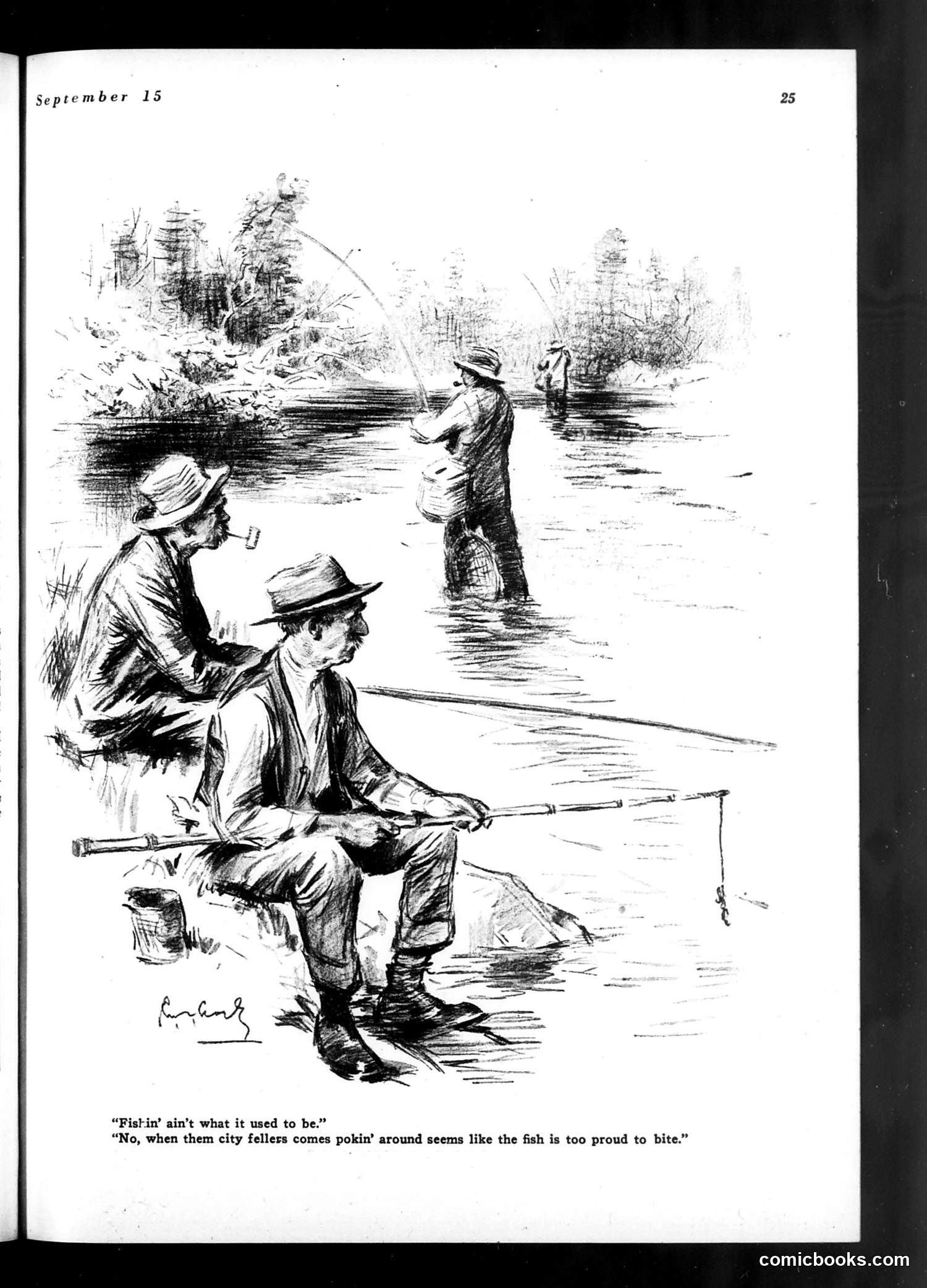
This is a satirical cartoon about rural versus urban culture. Two country fishermen sit by a stream while city visitors fish nearby. The joke centers on class conflict: the rural speakers suggest that fish have become "too proud to bite" when city people arrive—implying the fish are snobby or affected by urban presence. The satire targets both groups: rural folk stereotyped as unsophisticated, and wealthy city visitors as pretentious outsiders. The caption suggests that urban intrusion has corrupted even nature itself, making traditional pastimes less rewarding. This reflects early 20th-century anxieties about urbanization eroding rural American life and values.
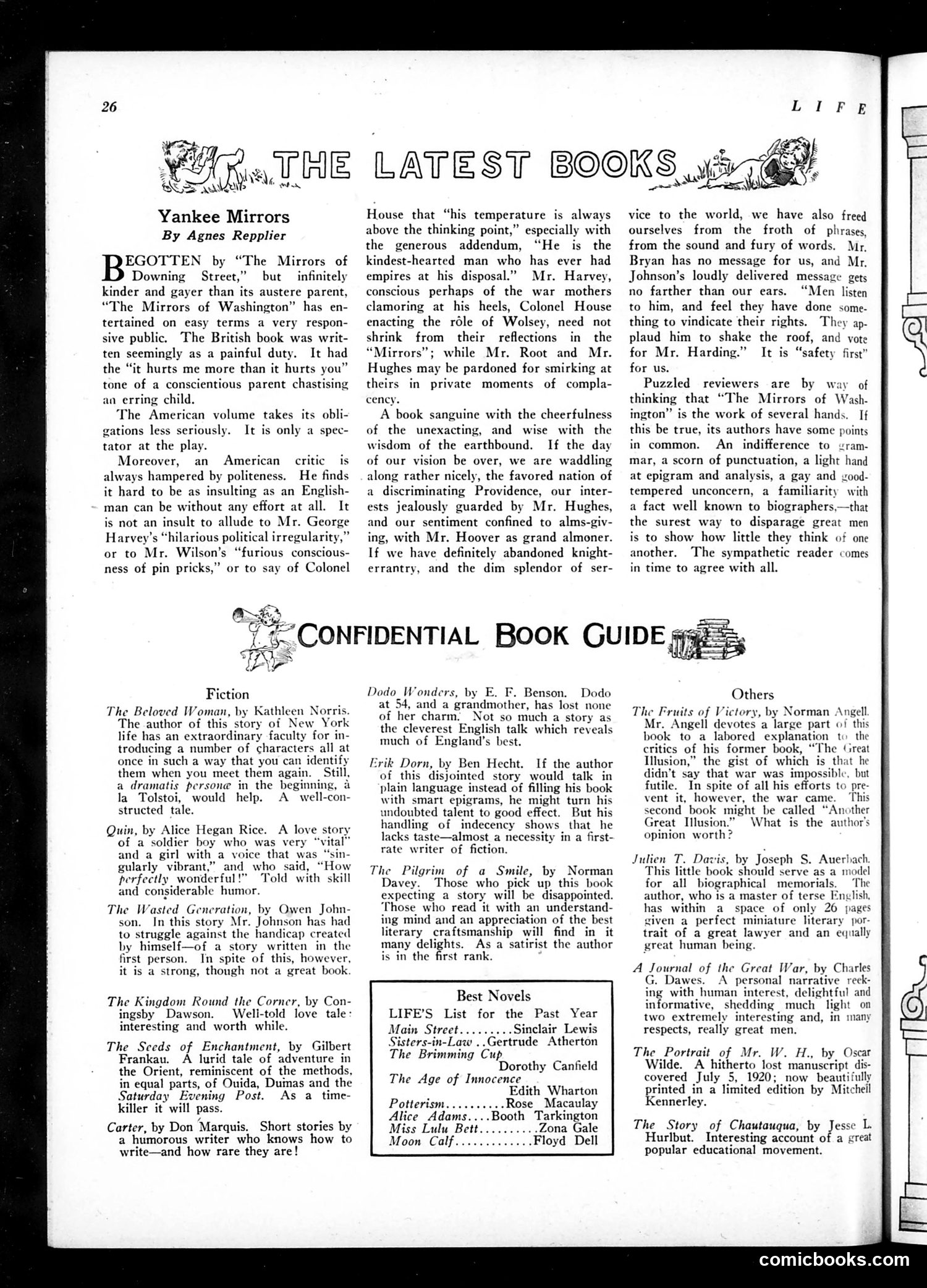
This page reviews Agnes Repplier's *Yankee Mirrors*, a satirical critique of American political figures. The review compares it favorably to the British *Mirrors of Downing Street*, noting that American critics lack the English capacity for blunt insult. The satire targets prominent WWI-era politicians: George Harvey (criticized for "hilarious political irregularity"), President Wilson ("furious consciousness of pin pricks"), Colonel House (styled as Cardinal Wolsey), and Secretary of State Elihu Root. The author gently mocks these figures—Harvey for imperial ambitions, Root for vanity. Repplier's broader critique suggests America under Hughes and Hoover has abandoned idealism ("knight-errantry") for comfortable mediocrity, relying on Providence to guard American interests while charity replaces moral vision. The "temperature...above the thinking point" reference sardonically praises American complacency during the post-WWI period. The review itself demonstrates the "politeness" hampering American satire compared to British wit.
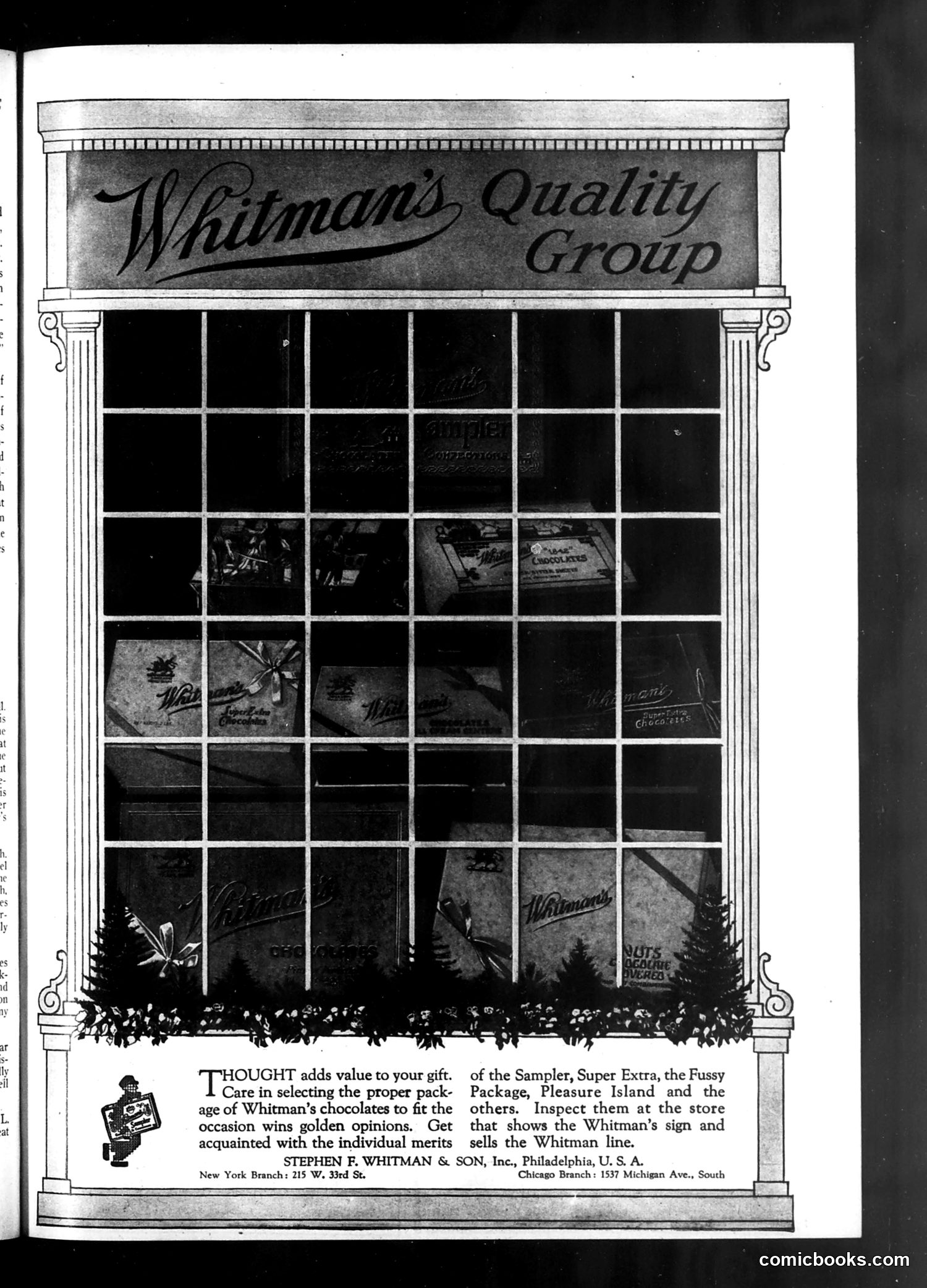
This is primarily a **commercial advertisement**, not political satire. It promotes Whitman's chocolates, a Philadelphia-based confectioner, through a storefront window display illustration. The image shows an elegant shop window divided into a grid of panes, displaying various Whitman's chocolate boxes and products. The headline "Whitman's Quality Group" emphasizes the brand's range of offerings. The accompanying text encourages gift-givers to select the appropriate chocolate package for different occasions—mentioning varieties like "the Sampler, Super Extra, the Fussy Package, Pleasure Island"—arguing that thoughtful gift selection adds value and garners "golden opinions." The small mascot figure (lower left) reinforces the brand message. Company addresses are listed for Philadelphia and Chicago locations. This is straightforward early-20th-century product advertising, not editorial commentary or satire.
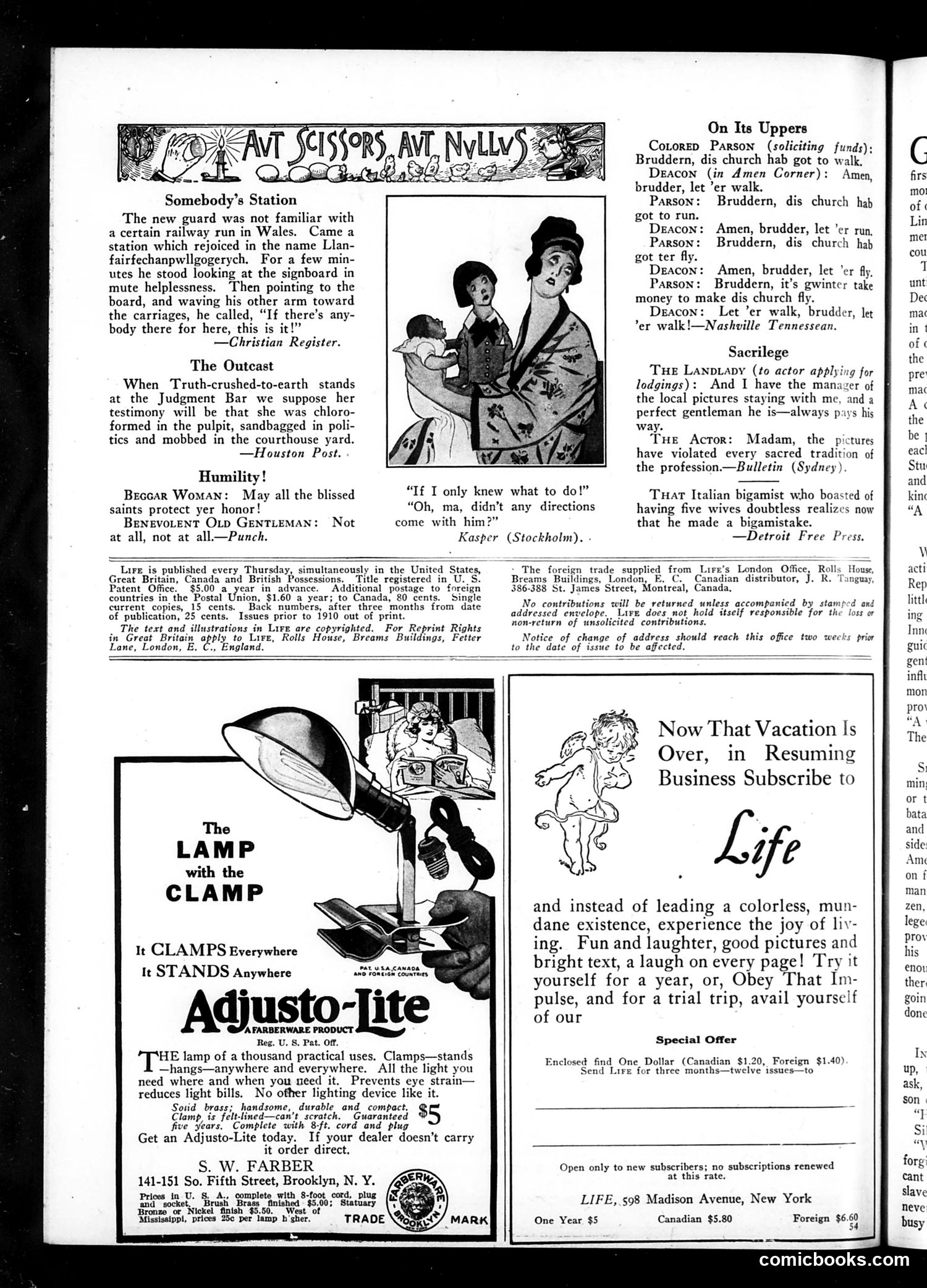
This page contains several brief satirical items typical of Life's humor format: **"Somebody's Station"** mocks a Welsh railway guard confronted with the famously unpronounceable Welsh place name Llanfairfechanpwllgogerych. The joke: he simply points and shouts "If there's anybody there for here, this is it!"—giving up on pronunciation entirely. **"On Its Uppers"** uses dialect humor to satirize a poor Black church's fundraising. A pastor progressively escalates the church's needs (walk → run → fly), but when he finally reveals it requires actual money, the deacon deflates his ambitions, reverting to "let 'er walk." **Other brief items** include gentle jabs at clergy hypocrisy, an actor's complaint about cinema, and a pun about a bigamist. The page is primarily **advertising**, featuring the Adjusto-Lite lamp and a Life subscription offer. The satirical items reflect early 20th-century Life's style: relying on ethnic/racial dialect humor, clergy mockery, and wordplay rather than political commentary.
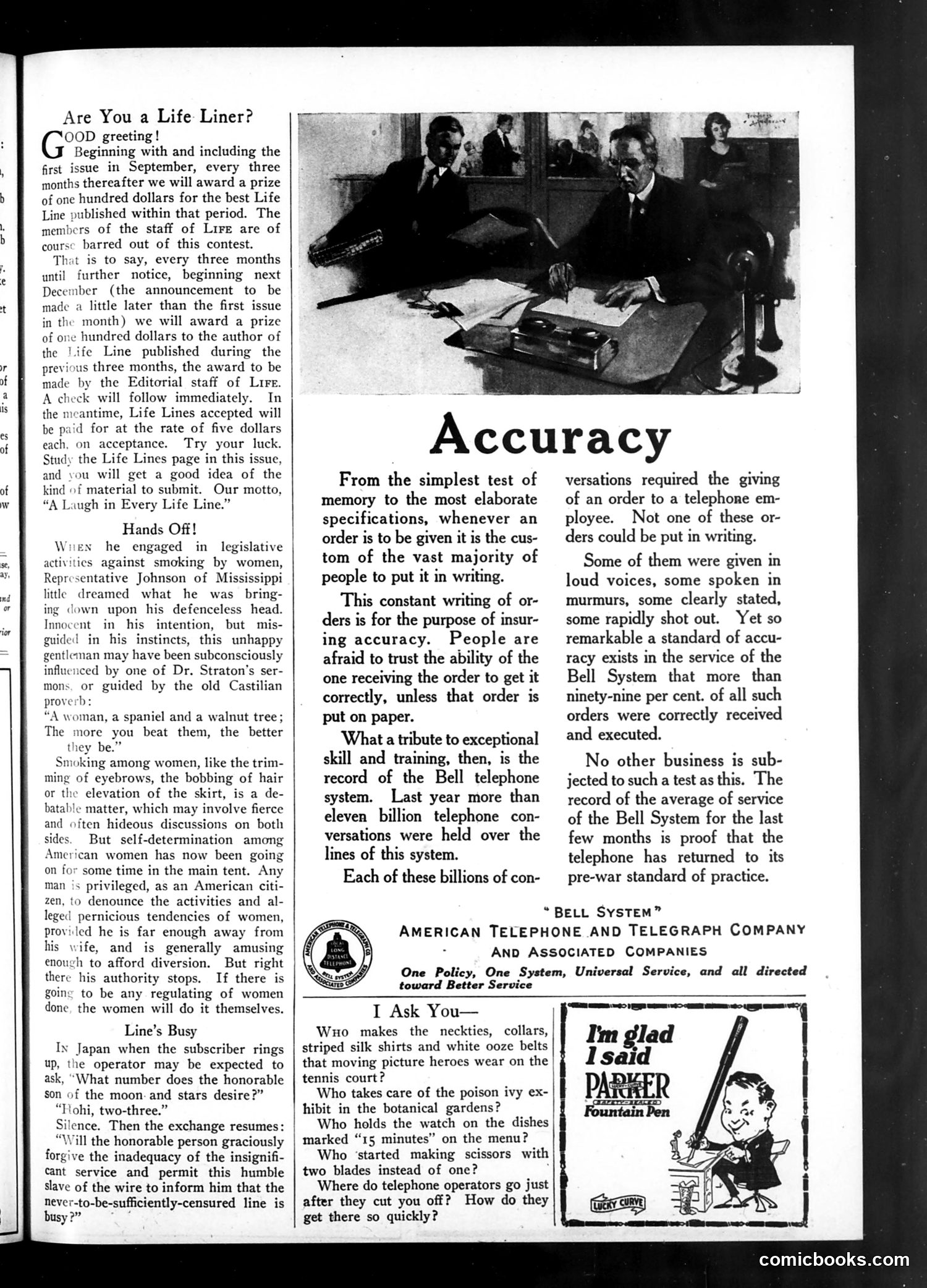
This page contains three distinct sections: a **contest announcement**, a **satirical editorial**, and an **advertisement**. The top section announces Life's "Life Liner" contest—a $100 prize every three months for the best humorous one-liner submitted by readers, paying $5 per accepted submission. The middle editorial, "Hands Off!", satirizes Representative Johnson of Mississippi's legislative attempt to ban women's smoking. The piece mocks his paternalism, comparing women to "a spaniel and a walnut tree" (referencing an old saying that beating them improves behavior). The satire defends women's right to self-determination, arguing men have no authority to regulate women's behavior—women must regulate themselves. The bottom section is a **Bell Telephone System advertisement** disguised as editorial content. It lauds the telephone company's accuracy record: 11 billion conversations annually with 99%+ correct order execution, requiring no written confirmation—presented as evidence of exceptional employee training. The Parker fountain pen advertisement appears separately.
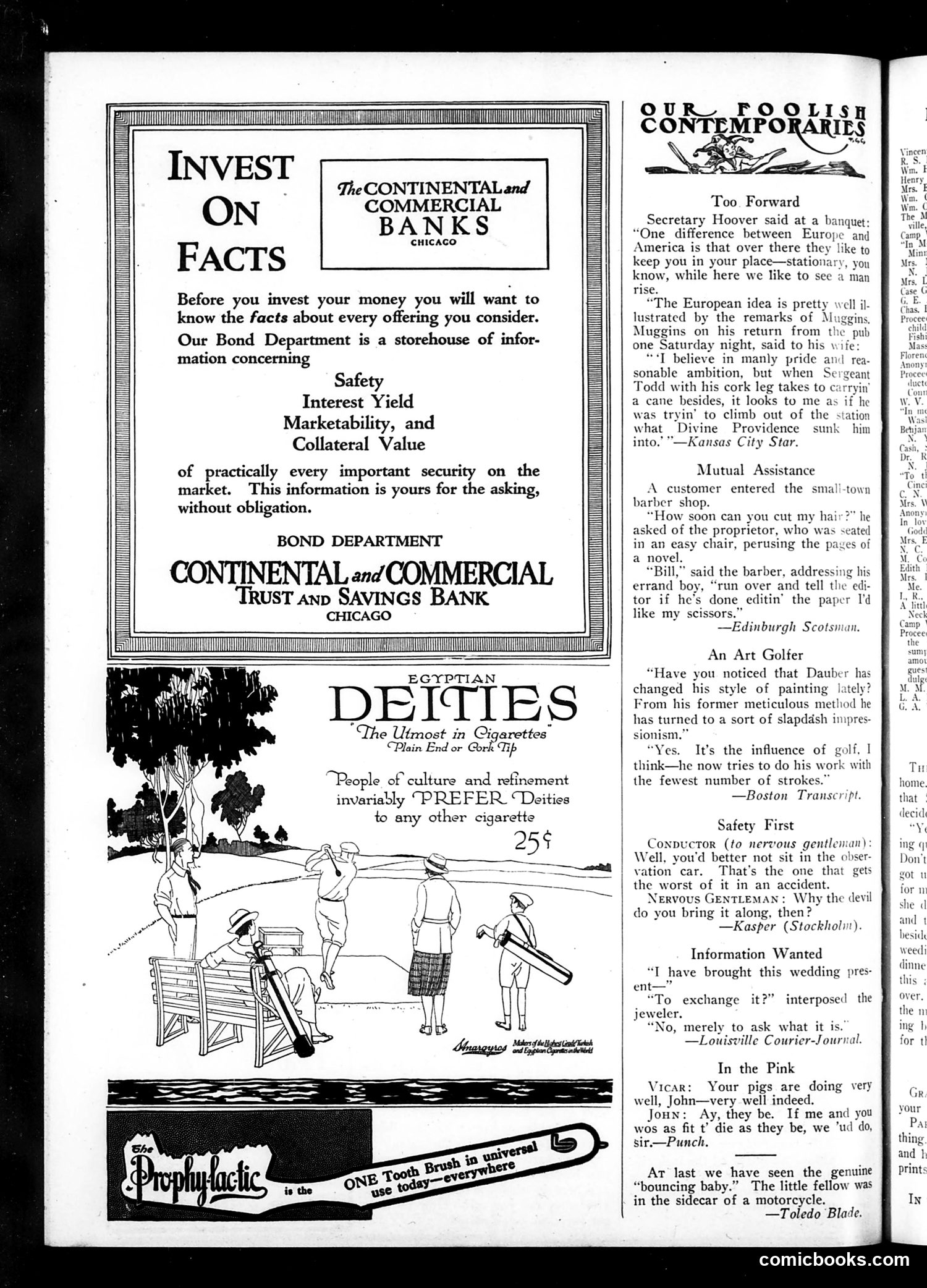
This page is primarily **advertising with humor sidebars**—a common Life magazine format of the era. The main advertisements promote: - **Continental and Commercial Banks' Bond Department** (investment safety information) - **Egyptian Deities cigarettes** (25¢, marketed as refined) - **Prophylactic toothbrush** (universal one-tooth design joke) The right column contains humorous **anecdotes and jokes** typical of Life's "Our Foolish Contemporaries" feature, including: - A reference to **Secretary Hoover** discussing American social mobility versus European class rigidity - British/international humor about barbers, artists, train conductors, and rural life - Satirical commentary on contemporary social anxieties (nervousness about transportation, class pretension, artistic trends) The **Deities cigarette cartoon** depicts leisure-class golfers, suggesting cigarettes signify refinement and cultured relaxation—standard 1920s advertising messaging. Overall, this reflects early 20th-century American magazine culture: financial institutions building credibility through earnest appeals, luxury goods marketed through snobbishness, and gentle satirical humor aimed at urban, educated readers.
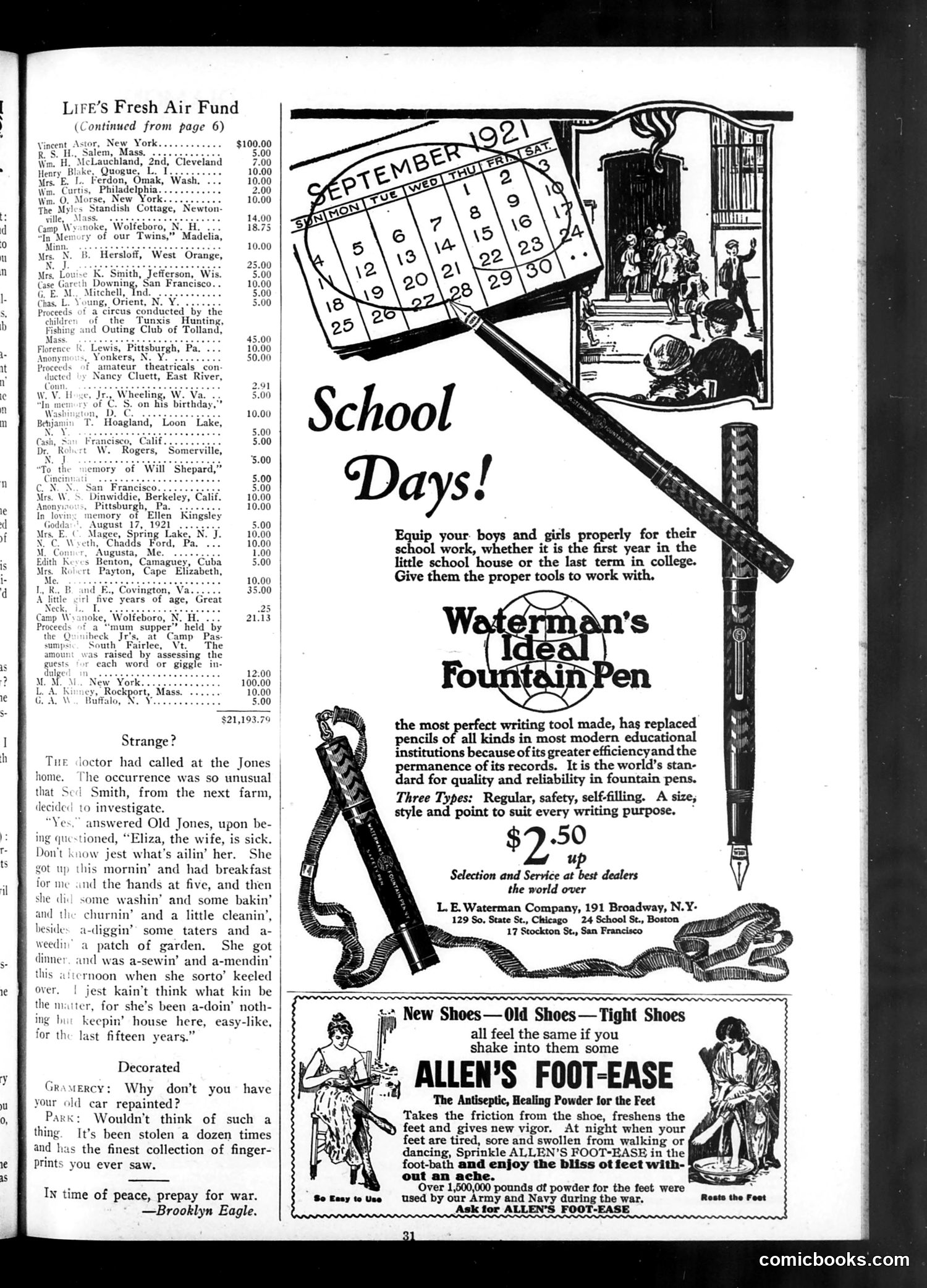
This page is primarily **advertising and fundraising**, not political satire. **Main content:** - **Top**: Life's Fresh Air Fund listing donations for summer camp for poor children - **Center**: Advertisement for Waterman's Ideal Fountain Pen, tying back-to-school season to proper writing tools - **Bottom**: Allen's Foot-Ease powder advertisement **"Strange?" humor section** (small story): A rural comedy piece where a farmer's wife collapses after an exhausting day of cooking, cleaning, laundry, and farm work. The doctor is baffled; the farmer can't understand why she's sick since "she's been a-doin' nothin' but keepin' house." The joke relies on understated irony—the wife's grueling labor is treated as effortless leisure. This reflects period attitudes toward women's domestic work as invisible or easy. **Historical context**: This 1921 issue reflects post-WWI America. The Allen's advertisement mentions Army/Navy use during the war, suggesting recent publication after 1918. The page shows Life as a mixed commercial/editorial publication rather than purely satirical publication.
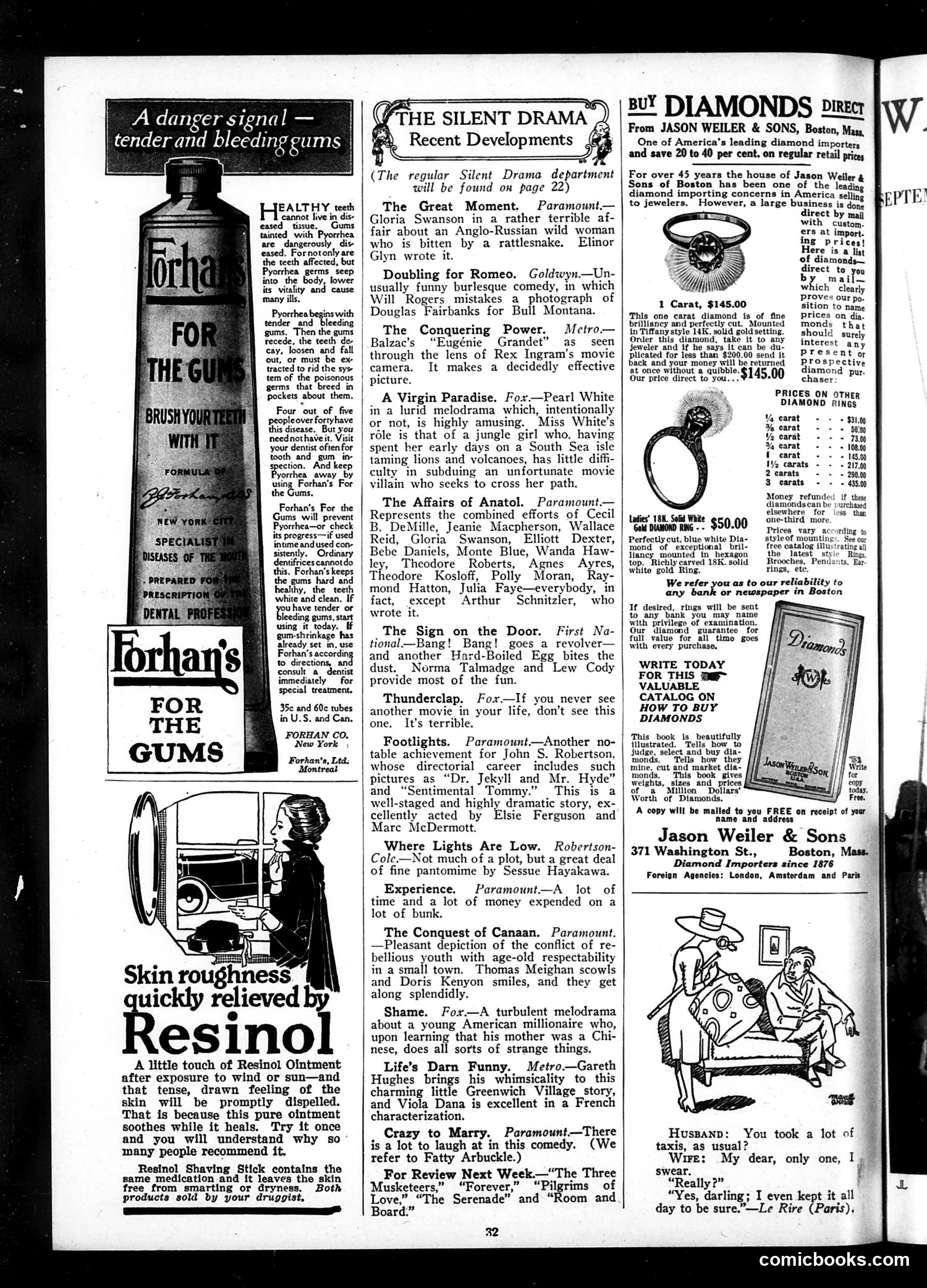
This page is primarily **advertising**, not political satire. It contains two main ads: 1. **Forhan's For the Gums** (left): A dental hygiene advertisement warning about pyorrhea (gum disease), claiming it affects four of five people over forty. The ad promotes Forhan's toothpaste as prevention, using medical language to create urgency—a common marketing technique of the era. 2. **Jason Weiler & Sons Diamonds** (right): A direct-mail diamond retailer advertisement emphasizing they undercut jewelers' prices by 20-40%. They invite customers to verify prices with local jewelers, building trust through this unusual competitive claim. The **"Silent Drama" section** (center) reviews current films from studios like Paramount and Metro, with brief plot summaries. Notably, it mocks Gloria Swanson's film as "rather terrible" and praises Will Rogers' comedic performance. The page reflects **1920s consumer culture**: direct marketing, medical advertising, and entertainment reviews aimed at middle-class readers seeking both health solutions and leisure activities.