
Life, 1921-09-15 · page 6 of 34
Life — September 15, 1921 — page 6: what you’re looking at
What you’re looking at
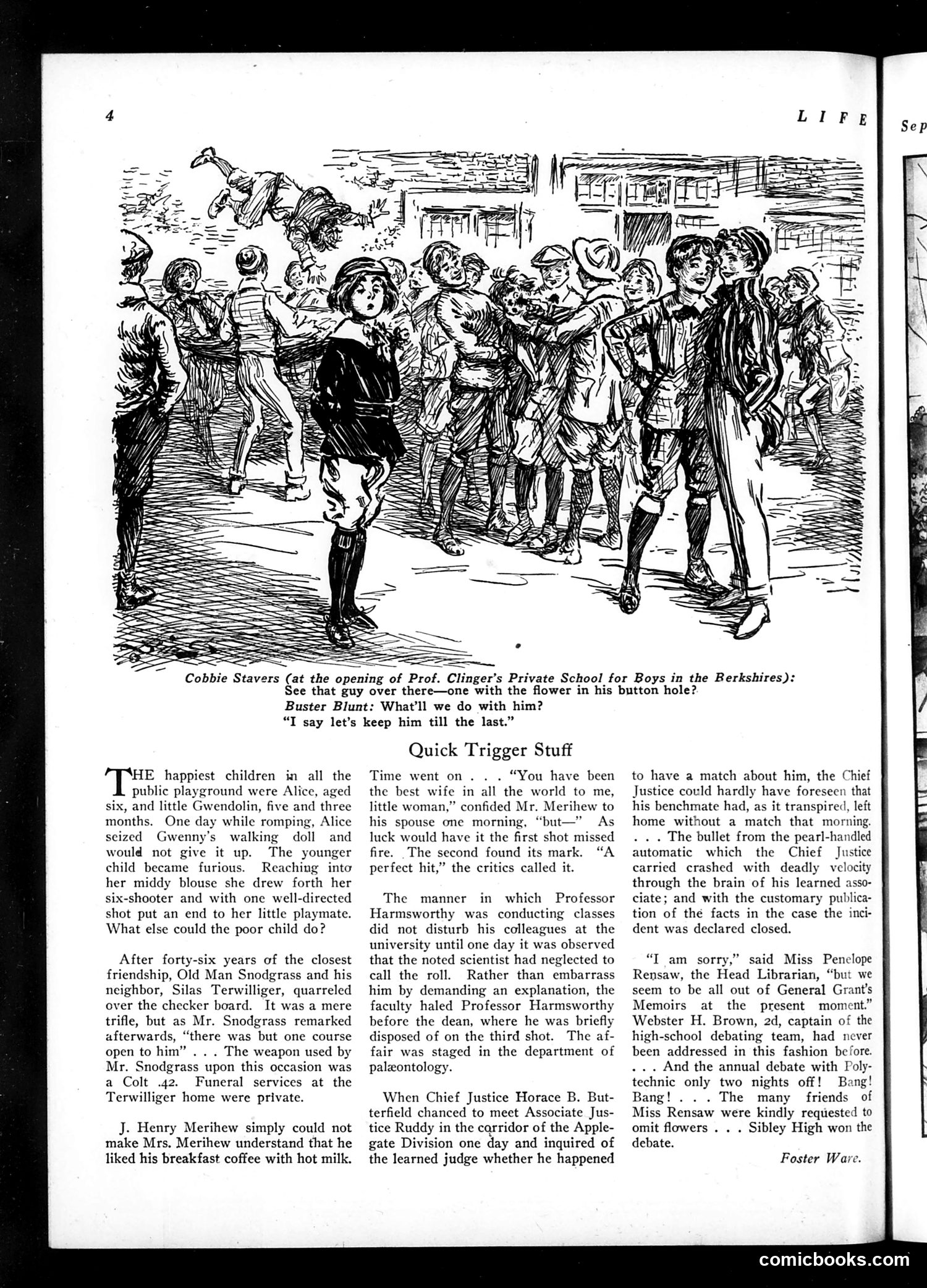
This page contains two satirical pieces: **The cartoon** depicts a scene at "Prof. Clinger's Private School for Boys in the Berkshires." A boy in dark clothing stands before other students and adults. The caption suggests he's being mocked for wearing a flower in his buttonhole—an apparently effeminate or unusual fashion choice that provokes the question "What'll we do with him?" The satire targets rigid social conformity and the cruel treatment of nonconforming children in elite boarding schools. **"Quick Trigger Stuff"** is a humorous short story about a child's missing doll causing domestic chaos, resolved when a Chief Justice's stray bullet accidentally destroys it. The piece satirizes both overprotective parenting and the absurdity of how minor domestic incidents escalate comically when adults become involved. Both pieces reflect early 20th-century satirical humor about social propriety and class anxieties.
📄 Transcribed text from this page (OCR, searchable)
Machine-transcribed from the original scan — historical spelling and the odd misread are preserved.
Cobbie Stavers (at the opening of Prof. Clinger’s Private School for Boys in the Berkshires): See that guy over there—one with the flower in his button hole? Buster Blunt: What’ll we do with him? “I say let’s keep him till the last.” ‘HE happiest children in all the public playground were Alice, aged six, and little Gwendolin, five and three months. One day while romping, Alice seized Gwenny’s walking doll and would not give it up. The younger child became furious. Reaching into her middy blouse she drew forth her six-shooter and with one well-directed shot put an end to her little playmate. What else could the poor child do? After forty-six years of the closest friendship, Old Man Snodgrass and his neighbor, Silas Terwilliger, quarreled over the checker board. It was a mere trifle, but as Mr. Snodgrass remarked afterwards, “there was but one course open to him” . . . The weapon used by Mr. Snodgrass upon this occasion was a Colt .42. Funeral services at the Terwilliger home were private. J. Henry Merihew simply could not make Mrs. Merihew understand that he liked his breakfast coffee with hot milk. Quick Trigger Stuff Time went on. . . “You have been the best wife in all the world to me, little woman,” confided Mr. Merihew to his spouse one morning, “but—” As luck would have it the first shot missed fire. _The second found its mark. “A perfect hit,” the critics called it. The manner in which Professor Harmsworthy was conducting classes did not disturb his colleagues at the university until one day it was observed that the noted scientist had neglected to call the roll. Rather than embarrass him by demanding an explanation, the faculty haled Professor Harmsworthy before the dean, where he was briefly disposed of on the third shot. The af- fair was staged in the department of palzontology. When Chief Justice Horace B. But- terfield chanced to meet Associate Jus- tice Ruddy in the carridor of the Apple- gate Division one day and inquired of the learned judge whether he happened to have a match about him, the Chief Justice could hardly have foreseen that his benchmate had, as it transpired, left home without a match that morning. . . « The bullet from the pearl-handled automatic which the Chief Justice carried crashed with deadly velocity through the brain of his learned asso- ciate; and with the customary publica- tion of thé facts in the case the inci- dent was declared closed. “IT am sorry,” said Miss Penelope Rensaw, the Head Librarian, “but we seem to be all out of General Grant's Memoirs at the present moment.” Webster H. Brown, 2d, captain of the high-school debating team, had never been addressed in this fashion before. . .. And the annual debate with Poly- technic only two nights off! Bang! Bang! . . . The many friends of Miss Rensaw were kindly requested to omit flowers . . . Sibley High won the debate. Foster Ware. comicbooks.com