
Life, 1921-09-15 · page 12 of 34
Life — September 15, 1921 — page 12: what you’re looking at
What you’re looking at
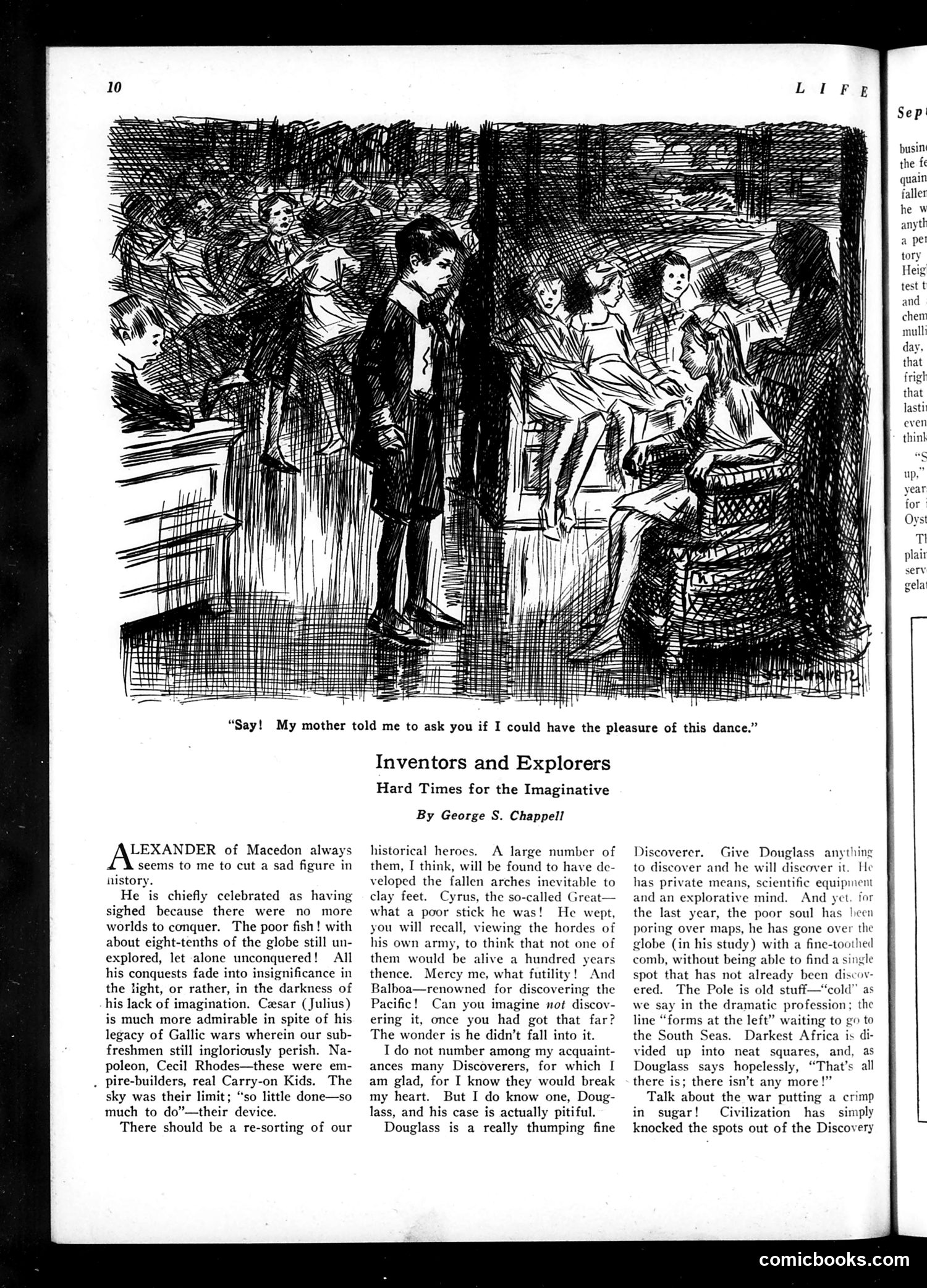
The illustration depicts a social scene at what appears to be a formal dance or party. A young man in dark formal wear stands prominently in the center, addressing a seated woman. The caption reads: "Say! My mother told me to ask you if I could have the pleasure of this dance." The satire targets **awkward courtship etiquette among the socially inexperienced**. Rather than asking the woman directly with confidence (as proper social convention dictated), the young man relies on his mother's instruction, literally asking her permission to request a dance. This reveals his social immaturity and dependence on maternal guidance for basic interaction—treating an adult social engagement like a child's errand. The humor mocks both the boy's lack of social sophistication and the overbearing parenting that infantilizes him in front of potential romantic interests.
📄 Transcribed text from this page (OCR, searchable)
Machine-transcribed from the original scan — historical spelling and the odd misread are preserved.
“Say! My mother told me to ask you if I could have the pleasure of this dance.” LEXANDER of Macedon always seems to me to cut a sad figure in history. He is chiefly celebrated as having sighed because there were no more worlds to conquer. The poor fish! with about eight-tenths of the globe still un- explored, let alone unconquered! All his conquests fade into insignificance in the light, or rather, in the darkness of his lack of imagination. Cesar (Julius) is much more admirable in spite of his legacy of Gallic wars wherein our sub- freshmen still ingloriously perish. Na- poleon, Cecil Rhodes—these were em- . pire-builders, real Carry-on Kids. The sky was their limit; “so little done—so much to do”—their device. There should be a re-sorting of our Inventors and Explorers Hard Times for the Imaginative By George S. Chappell historical heroes. A large number of them, I think, will be found to have de- veloped the fallen arches inevitable to clay feet. Cyrus, the so-called Great— what a poor stick he was! He wept, you will recall, viewing the hordes of his own army, to think that not one of them would be alive a hundred years thence. Mercy me, what futility!) And Balboa—renowned for discovering the Pacific! Can you imagine not discov- ering it, once you had got that far? The wonder is he didn’t fall into it. I do not number among my acquaint- ances many Discoverers, for which I am glad, for I know they would break my heart. But I do know one, Doug- lass, and his case is actually pitiful. Douglass is a really thumping fine Discoverer. Give Douglass anything to discover and he will discover it. He has private means, scientific equipment and an explorative mind. And yet. for the last year, the poor soul has heen poring over maps, he has gone over the globe (in his study) with a fine-toothed comb, without being able to find a at has not already been disc The Pole is old stuff—‘cold” as we say in the dramatic profession; the line “forms at the left” waiting to go to the South Seas. Darkest Africa is di- vided up into neat squares, and, as Douglass says hopelessly, “That's all there is; there isn’t any more!” Talk about the war putting a crimp in sugar! Civilization has simply knocked the spots out of the Discovery Sep busin the fe quain ialler he w anyth a pel tory Heig test t and chem mull day, that frigh that lastii even think up,” year for Oyst Tl plait serv gela comicbooks.com