
Life, 1921-09-15 · page 24 of 34
Life — September 15, 1921 — page 24: what you’re looking at
What you’re looking at
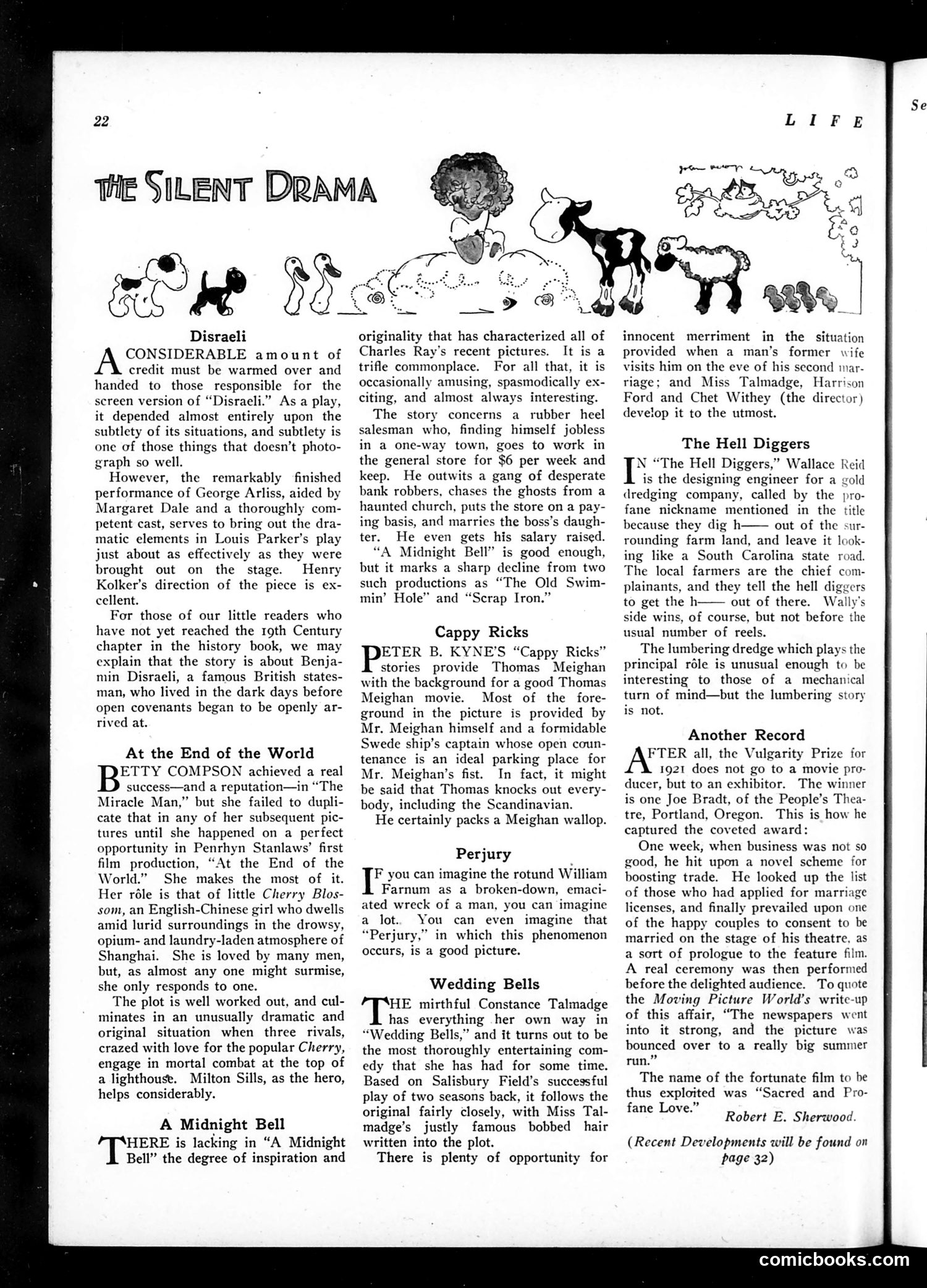
This is a film review section from Life magazine (early 1920s, based on references to silent films). The cartoon at the top—"The Silent Drama"—uses simple line drawings of animals and human figures to humorously illustrate the challenges of adapting stage plays to silent film. The sequence suggests a narrative progression, visualizing how subtlety that works in theater ("doesn't photograph so well," as the text notes) becomes exaggerated or loses nuance on screen. The page reviews six films, primarily praising George Arliss in "Disraeli" (a biographical drama about the 19th-century British statesman) and Constance Talmadge in "Wedding Bells." The reviews note recurring concerns: whether screen versions capture stage sophistication, and whether particular actors succeed in their roles. Charles Ray's "A Midnight Bell" receives mixed marks—competent but uninspired compared to his earlier work. The tone is lighthearted and accessible, treating cinema as popular entertainment worthy of serious critical attention.
📄 Transcribed text from this page (OCR, searchable)
Machine-transcribed from the original scan — historical spelling and the odd misread are preserved.
22 Disraeli CONSIDERABLE amount of credit must be warmed over and handed to those responsible for the screen version of “Disraeli.” As a play, it depended almost entirely upon the subtlety of its situations, and subtlety is one of those things that doesn’t photo- graph so well. However, the remarkably finished performance of George Arliss, aided by Margaret Dale and a thoroughly com- petent cast, serves to bring out the dra- matic elements in Louis Parker’s play just about as effectively as they were brought out on the stage. Henry Kolker’s direction of the piece is ex- cellent. For those of our little readers who have not yet reached the 19th Century chapter in the history book, we may explain that the story is about Benja- min Disraeli, a famous British states- man, who lived in the dark days before open covenants began to be openly ar- rived at. At the End of the World ETTY COMPSON achieved a real success—and a reputation—in “The Miracle Man,” but she failed to dupli- cate that in any of her subsequent pic- tures until she happened on a perfect opportunity in Penrhyn Stanlaws’ first film production, “At the End of the World.” She makes the most of it. Her réle is that of little Cherry Blos- som, an English-Chinese girl who dwells amid lurid surroundings in the drowsy, opium- and laundry-laden atmosphere of Shanghai. She is loved by many men, but, as almost any one might surmise, she only responds to one. The plot is well worked out, and cul- minates in an unusually dramatic and original situation when three rivals, crazed with love for the popular Cherry, engage in mortal combat at the top of a lighthouse. Milton Sills, as the hero, helps considerably. A Midnight Bell HERE is lacking in “A Midnight Bell” the degree of inspiration and originality that has characterized all of Charles Ray's recent pictures. It is a trifle commonplace. For all that, it is occasionally amusing, spasmodically ex- citing, and almost always interesting. The story concerns a rubber heel salesman who, finding himself jobless in a one-way town, goes to work in the general store for $6 per week and keep. He outwits a gang of desperate bank robbers, chases the ghosts from a haunted church, puts the store on a pay- ing basis, and marries the boss’s daugh- ter. He even gets his salary raised. “A Midnight Bell” is good enough, but it marks a sharp decline from two such productions as “The Old Swim- min’ Hole” and “Scrap Iron.” Cappy Ricks JETER B. KYNE’S “Cappy Ricks” stories provide Thomas Meighan with the background for a good Thomas Meighan movie. Most of the fore- ground in the picture is provided by Mr. Meighan himself and a formidable Swede ship’s captain whose open coun- tenance is an ideal parking place for Mr. Meighan’s fist. In fact, it might be said that Thomas knocks out every- body, including the Scandinavian. He certainly packs a Meighan wallop. Perjury F you can imagine the rotund William Farnum as a broken-down, emaci- ated wreck of a man, you can imagine a lot. You can even imagine that “Perjury,” in which this phenomenon occurs, is a good picture. Wedding Bells ‘HE mirthful Constance Talmadge has everything her own way in “Wedding Bells,” and it turns out to be the most thoroughly entertaining com- edy that she has had for some time. Based on Salisbury Field’s successful play of two seasons back, it follows the original fairly closely, with Miss Tal- madge’s justly famous bobbed hair written into the plot. There is plenty of opportunity for innocent merriment in the situation provided when a man’s former wife visits him on the eve of his second mar- riage; and Miss Talmadge, Harrison Ford and Chet Withey (the director) deveiop it to the utmost. The Hell Diggers i “The Hell Diggers,” Wallace Reid is the designing engineer for a gold dredging company, called by the pro- fane nickname mentioned in the title because they dig h—— out of the sur- rounding farm land, and leave it look- ing like a South Carolina state road. The local farmers are the chief com- plainants, and they tell the hell diggers to get the h—— out of there. Wally’s side wins, of course, but not before the usual number of reels. The lumbering dredge which plays the principal réle is unusual enough to be interesting to those of a mechanical turn of mind—but the lumbering story is not. Another Record ArT all, the Vulgarity Prize for 1921 does not go to a movie pro- ducer, but to an exhibitor. The winner is one Joe Bradt, of the People’s Thea- tre, Portland, Oregon. This is how he captured the coveted award: One week, when business was not so good, he hit upon a novel scheme for boosting trade. He looked up the list of those who had applied for marriage licenses, and finally prevailed upon one of the happy couples to consent to be married on the stage of his theatre, as a sort of prologue to the feature film. A real ceremony was then performed before the delighted audience. To quote the Moving Picture World’s write-up of this affair, “The newspapers went into it strong, and the picture was bounced over to a really big summer run.” The name of the fortunate film to be thus exploited was “Sacred and Pro- fane Tove: Robert E. Sherwood. (Recent Developments will be found on page 32) comicbooks.com