
Life, 1921-09-15 · page 22 of 34
Life — September 15, 1921 — page 22: what you’re looking at
What you’re looking at
This satire by Carl Glick mocks intellectual pretension. An acclaimed woman hosts dinner with prominent figures—a novelist, statesman, and magazine editor—who listen eagerly to her epigrammatic wisdom on the League of Nations and world peace. Her insights prove so influential that the statesman quotes her, the novelist uses her material, and the editor changes his magazine's policy. However, the punchline reveals the satire's target: at evening's end, all three men abandon her to pursue romantic encounters with younger women (a debutante, a cigar-counter girl, and a Follies dancer). Alone at 11:30 p.m., the hostess sighs, "A fig for my brains!"—meaning her intellectual brilliance means nothing compared to youth and physical attractiveness. The joke critiques how society simultaneously celebrates women's intellect while ultimately valuing their appearance, and how even brilliant women cannot compete with younger women's appeal to powerful men.
📄 Transcribed text from this page (OCR, searchable)
Machine-transcribed from the original scan — historical spelling and the odd misread are preserved.
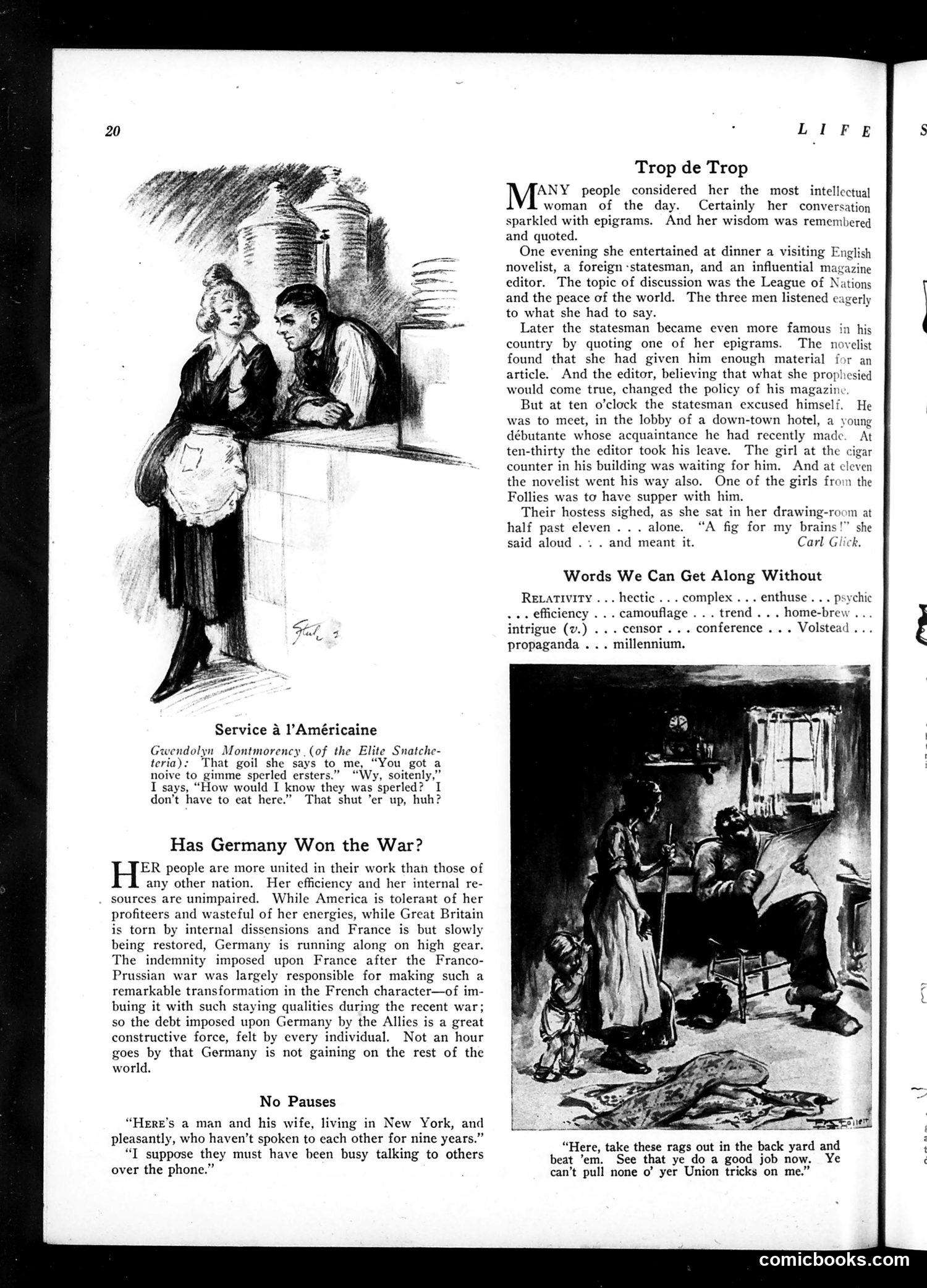
LIFE S Trop de Trop ANY people considered her the most intellectual woman of the day. Certainly her conversation sparkled with epigrams. And her wisdom was remembered and quoted. One evening she entertained at dinner a visiting English novelist, a foreign -statesman, and an influential magazine editor. The topic of discussion was the League of Nations and the peace of the world. The three men listened eagerly to what she had to say. ° Later the statesman became even more famous in his country by quoting one of her epigrams. The novelist found that she had given him enough material for an article. And the editor, believing that what she prophesied would come true, changed the policy of his magazin: But at ten o’clock the statesman excused himself. He was to meet, in the lobby of a down-town hotel, a young débutante whose acquaintance he had recently made. At ten-thirty the editor took his leave. The girl at the cigar counter in his building was waiting for him. And at cleven the novelist went his way also. One of the girls from the Follies was to have supper with him. Their hostess sighed, as she sat in her drawing-room at half past eleven... alone. “A fig for my brains!” she said aloud . . . and meant it. Carl Glick. Words We Can Get Along Without Rexativity ... hectic... complex . . . enthuse . . . psychic ... efficiency . .. camouflage . . . trend... home-brew ... intrigue (v.) ... censor... conference... Volstead... propaganda . .. millennium. Service 4 l’Américaine Gwendolyn Montmorency .(of the Elite Snatche- teria): That goil she says to me, “You got a noive to gimme sperled ersters.” “Wy, soitenly,” I says, “How would I know they was sperled? don’t have to eat here.” That shut ’er up, huh? Has Germany Won the War? ER people are more united in their work than those of any other nation. Her efficiency and her internal re- sources are unimpaired. While America is tolerant of her profiteers and wasteful of her energies, while Great Britain is torn by internal dissensions and France is but slowly being restored, Germany is running along on high gear. The indemnity imposed upon France after the Franco- Prussian war was largely responsible for making such a remarkable transformation in the French character—of im- buing it with such staying qualities during the recent war; so the debt imposed upon Germany by the Allies is a great constructive force, felt by every individual. Not an hour goes by that Germany is not gaining on the rest of the world. No Pauses “Here’s a man and his wife, living in New York, and pleasantly, who haven’t spoken to each other for nine years.” ‘Here, tale’ these tabs Gut iu the bade yard and “I suppose they must have been busy talking to others beat pea ‘See that e do a good job oes Ye over the phone.” can’t pull none o’ yer Union tricks on me.” comicbooks.com