
Life, 1921-09-15 · page 28 of 34
Life — September 15, 1921 — page 28: what you’re looking at
What you’re looking at
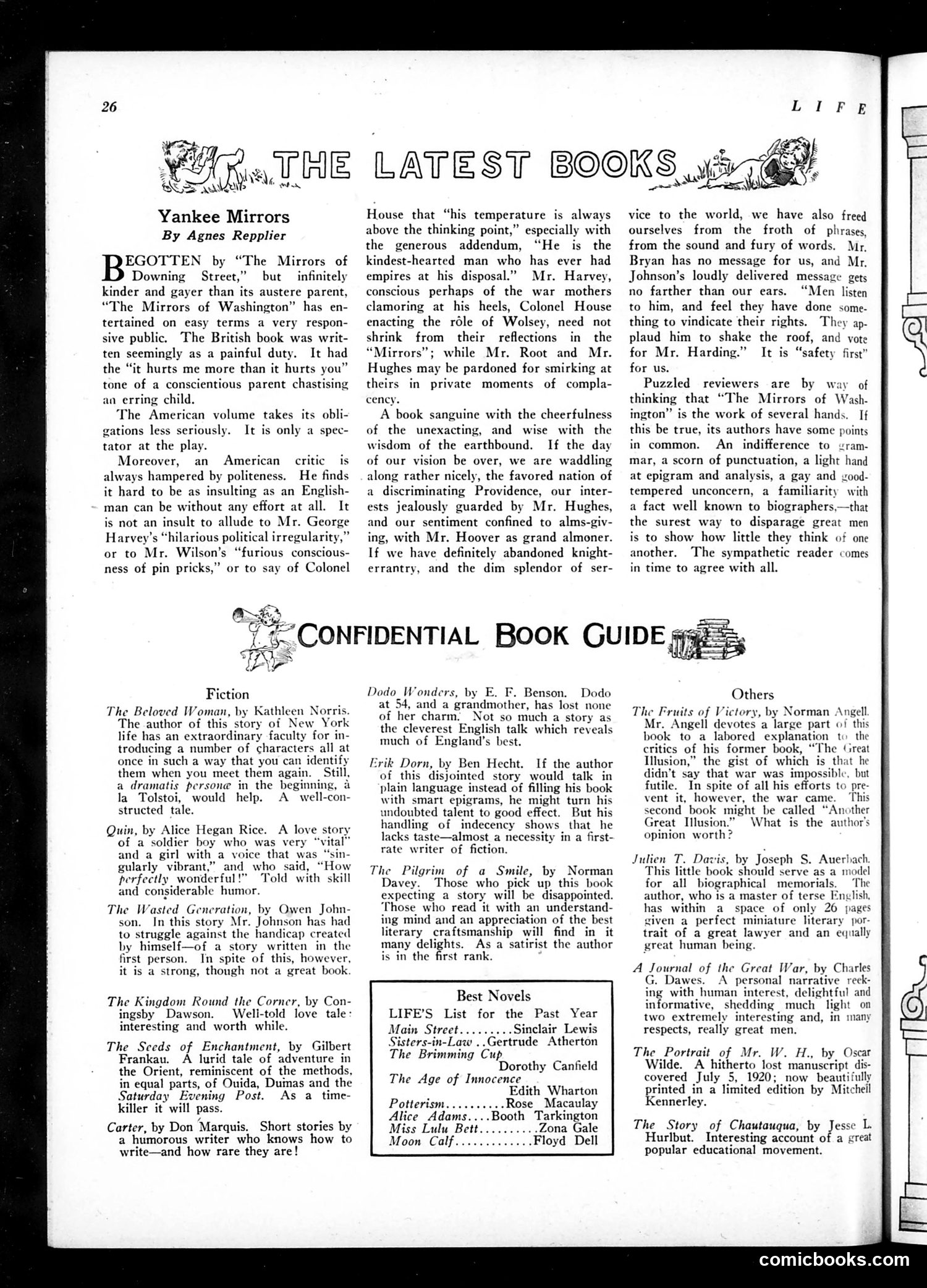
This page reviews Agnes Repplier's *Yankee Mirrors*, a satirical critique of American political figures. The review compares it favorably to the British *Mirrors of Downing Street*, noting that American critics lack the English capacity for blunt insult. The satire targets prominent WWI-era politicians: George Harvey (criticized for "hilarious political irregularity"), President Wilson ("furious consciousness of pin pricks"), Colonel House (styled as Cardinal Wolsey), and Secretary of State Elihu Root. The author gently mocks these figures—Harvey for imperial ambitions, Root for vanity. Repplier's broader critique suggests America under Hughes and Hoover has abandoned idealism ("knight-errantry") for comfortable mediocrity, relying on Providence to guard American interests while charity replaces moral vision. The "temperature...above the thinking point" reference sardonically praises American complacency during the post-WWI period. The review itself demonstrates the "politeness" hampering American satire compared to British wit.
📄 Transcribed text from this page (OCR, searchable)
Machine-transcribed from the original scan — historical spelling and the odd misread are preserved.
aN Yankee Mirrors By Agnes Repplier EGOTTEN by “The Mirrors of Downing Street,” but _ infinitely kinder and gayer than its austere parent, “The Mirrors of Washington” has en- tertained on easy terms a very respon- sive public. The British book was writ- ten seemingly as a painful duty. It had the “it hurts me more than it hurts you” tone of a conscientious parent chastising an erring child. The American volume takes its obli- gations less seriously. tator at the play. Moreover, an American critic is always hampered by politeness. He finds it hard to be as insulting as an English- man can be without any effort at all. It is not an insult to allude to Mr. George Harvey's “hilarious political irregularity,” or to Mr. Wilson’s It is only a spec- “furious conscious- ness of pin pricks,” or to say of Colonel Fiction The Beloved Woman, by Kathleen Norris. The author of this story of New. York life has an extraordinary faculty for in- troducing a number of characters all at once in such a way that you can identify them when you meet them again. St: a dramatis persone in the beginning, a la Tolstoi, would help. A well-con- structed tale. Quin, by Alice Hegan Rice. of a soldier boy who was very * and a girl with a voice that w gularly vibrant,” and who said, “How perfectly wonderful!” Told with skill and considerable humor. The Wasted Generation, by Owen John- son. In this story Mr. Johnson has had to struggle against the handicap created by himself—of a story written in the first person. In spite of this, however, it is a strong, though not a great book. The Kingdom Round the Corner, by Con- ingsby Dawson. Well-told love tale: interesting and worth while. The Seeds of Enchantment, by Gilbert Frankau. A lurid tale of adventure in the Orient, reminiscent of the methods, in equal parts, of Ouida, Dumas and the Saturday Evening Post. As a time- killer it will pass. Carter, by Don ‘Marquis. Short stories by a humorous writer who knows how to write—and how rare they are! House that “his temperature is always above the thinking point,” especially with the generous addendum, “He is the kindest-hearted man who has ever had empires at his disposal.” Mr. Harvey, conscious perhaps of the war mothers clamoring at his heels, Colonel House enacting the rdle of Wolsey, need not shrink from their reflections in the “Mirrors”; while Mr. Root and Mr. Hughes may be pardoned for smirking at theirs in private moments of compla- cency. A book sanguine with the cheerfulness of the unexacting, and wise with the wisdom of the earthbound. If the day of our vision be over, we are waddling along rather nicely, the favored nation of a discriminating Providence, our inter- ests jealously guarded by Mr. Hughes, and our sentiment confined to alms-giv- ing, with Mr. Hoover as grand almoner. If we have definitely abandoned knight- errantry, and the dim splendor of ser- Dodo_Wonders, by E. F. Benson. Dodo at 54, and a grandmother, has lost none of her charm. Not so much a story as the cleverest English talk which reveals much of England’s best. Erik Dorn, by Ben Hecht. If the author of this disjointed story would talk in plain language instead of filling his book with smart epigrams, he might turn his undoubted talent to good effect. But his handling of indecency sho that he lacks taste—almost a necessity in a first- rate writer of fiction. The Pilgrim of Smile, by Norman Davey. Those who pick up this book expecting a story will be disappointed. ‘Those who read it with an understand- ing mind and an appreciation of the best literary craftsmanship will find in it many delights. As a satirist the author is in the first rank. Best Novels LIFE’S List for the Main Street. -Sinclair Lewis Sisters-in-L Gertrude Atherton The Brimming Cup Dorothy Canfield The Age of Innocence Edith Wharton ..Rose Macaulay -Booth Tarkington -Zona Gale Floyd Dell Past Year Potterism... Alice Adams. Miss Lulu Bett. Moon Calf... aTHE LATEST BOOKS, x3 vice to the world, we have also freed ourselves from the froth of phrases, from the sound and fury of words. Mr, Bryan has no message for us, and Mr. Johnson’s loudly delivered message gets no farther than our ears. “Men listen to him, and feel they have done some- thing to vindicate their rights. They ap- plaud him to shake the roof, and vote for Mr. Harding.” It is “safety first” for us. Puzzled reviewers are by way of thinking that “The Mirrors of Wash- ington” is the work of several hands. If this be true, its authors have some points in common. An indifference to yram- mar, a scorn of punctuation, a light hand at epigram and analysis, a gay and yood- tempered unconcern, a familiarity with a fact well known to biographers,—that the surest way to disparage great men is to show how little they think of one another. The sympathetic reader comes in time to agree with all. Others The Fruits of Victory, by Norman Angell Mr. Angell devotes a large part of this book to a labored explanation to the critics of his former book, “The (reat Illusion,” the gist of which is that he didn’t say that war was impossible, but futile. In spite of all his efforts to pre vent it, however, the war came. This second book might be called nother Great Illusion.” What is the author's opinion worth? Julien T. D by Joseph Auerhach. This little book should serve as a model for all biographical memorials. The author, who is a master of terse English, has within a space of only 26 pages given a perfect miniature literary por- trait of a great lawyer and an equally great human being. A Journal of the Great War, by Charles G. Dawes. A personal narrative reck- ing with human interest, delightful and informative, shedding much light on two extremely interesting and, in many respects, really great men. The Portrait of Mr. W. H., by. Oscat Wilde. A hitherto lost manuscript di covered July 5, 1920; now beautifully printed in a limited edition by Mitchel Kennerley. The Story of Chautauqua, by feed Hurlbut. Interesting account of a great popular educational movement. comicbooks.com