
Life, 1921-09-15 · page 20 of 34
Life — September 15, 1921 — page 20: what you’re looking at
What you’re looking at
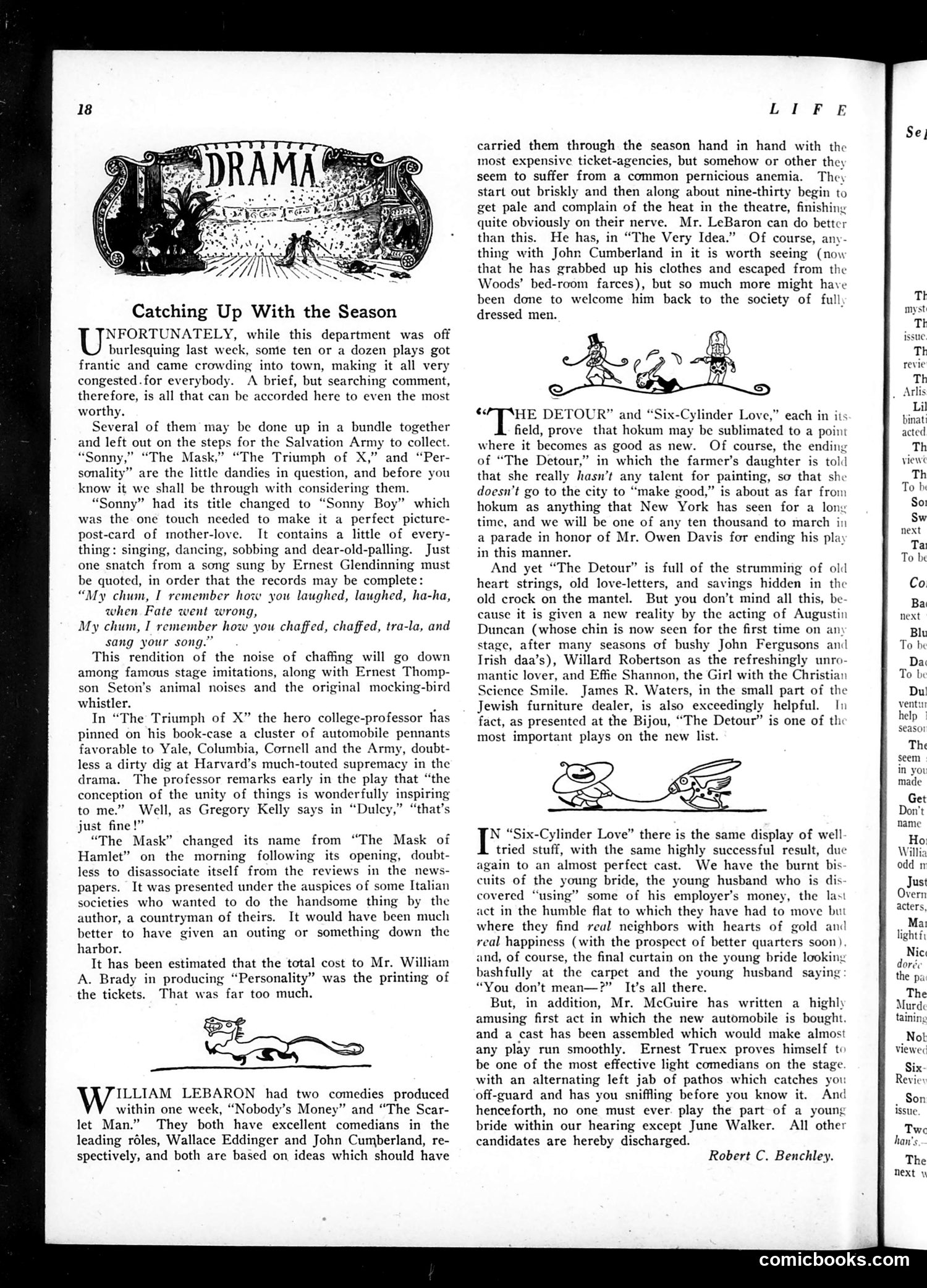
This is a theatrical review column by Robert C. Benchley critiquing several recent Broadway plays. The three small decorative illustrations (stylized dogs or similar figures) are typical of Life's ornamental separators between sections—they carry no specific satirical meaning. Benchley's satire targets the plays themselves rather than political figures. His criticisms are sharp but humorous: he suggests some plays belong in the Salvation Army donation pile, mocks a sentimental song's lyrics as mimicking "famous stage imitations," and dismisses "Personality" as so cheap its only expense was printing tickets. His praise is reserved for productions like "The Detour" and "Six-Cylinder Love," which elevate formulaic "hokum" through strong acting and casting. The column represents Life's role as cultural arbiter, using witty condescension to entertain readers while guiding theatrical taste during Broadway's crowded 1921 season.
📄 Transcribed text from this page (OCR, searchable)
Machine-transcribed from the original scan — historical spelling and the odd misread are preserved.
Catching Up With the Season NFORTUNATELY, while this department was off burlesquing last weck, some ten or a dozen plays got frantic and came crowding into town, making it all very congested.for everybody. A brief, but searching comment, therefore, is all that can be accorded here to even the most worthy. Several of them may be done up in a bundle together and left out on the steps for the Salvation Army to collect. “Sonny,” “The Mask,” “The Triumph of X,” and “Per- sonality” are the little dandies in question, and before you know it we shall be through with considering them. “Sonny” had its title changed to “Sonny Boy” which was the one touch needed to make it a perfect picture- post-card of mother-love. It contains a little of every- thing: singing, dancing, sobbing and dear-old-palling. Just one snatch from a song sung by Ernest Glendinning must be quoted, in order that the records may be complete: “My chum, I remember how you laughed, laughed, ha-ha, when Fate went wrong, My chum, I remember how you chaffed, chaffed, tra-la, and sang your song.” This rendition of the noise of chaffing will go down among famous stage imitations, along with Ernest Thomp- son Seton’s animal noises and the original mocking-bird whistler. . In “The Triumph of X” the hero college-professor has pinned on his book-case a cluster of automobile pennants favorable to Yale, Columbia, Cornell and the Army, doubt- less a dirty dig at Harvard’s much-touted supremacy in the drama. The professor remarks early in the play that “the conception of the unity of things is wonderfully inspiring to me.” Well, as Gregory Kelly says in “Dulcy,” “that’s just fine!” “The Mask” changed its name from “The Mask of Hamlet” on the morning following its opening, doubt- less to disassociate itself from the reviews in the news- papers. It was presented under the auspices of some Italian societies who wanted to do the handsome thing by the author, a countryman of theirs. It would have been much better to have given an outing or something down the harbor. It has been estimated that the total cost to Mr. William A. Brady in producing “Personality” was the printing of the tickets. That was far too much, ILLIAM LEBARON had two comedies produced within one week, “Nobody’s Money” and “The Scar- let Man.” They both have excellent comedians in the leading réles, Wallace Eddinger and John Cumberland, re- spectively, and both are based on ideas which should have LIFE carried them through the season hand in hand with the most expensive ticket-agencies, but somehow or other they seem to suffer from a common pernicious anemia. They start out briskly and then along about nine-thirty begin to get pale and complain of the heat in the theatre, finishing quite obviously on their nerve. Mr. LeBaron can do better than this. He has, in “The Very Idea.” Of course, any- thing with John Cumberland in it is worth seeing (now that he has grabbed up his clothes and escaped from the Woods’ bed-room farces), but so much more might have been done to welcome him back to the society of full, dressed men. é< HE DETOUR?” and “ Cylinder Love,” each in its field, prove that hokum may be sublimated to a point where it becomes as good as new. Of course, the ending of “The Detour,” in which the farmer’s daughter is told that she really hasn’t any talent for painting, so that she doesn't go to the city to “make good,” is about as far fro hokum as anything that New York has seen for a long time, and we will be one of any ten thousand to march in a parade in honor of Mr. Owen Davis for ending his pla) in this manner. And yet “The Detour” is full of the strumming of old heart strings, old love-letters, and savings hidden in the old crock on the mantel. But you don’t mind all this, be- cause it is given a new reality by the acting of Augustin Duncan (whose chin is now seen for the first time on an stage, after many seasons of bushy John Fergusons anil Irish daa’s), Willard Robertson as the refreshingly unro- mantic lover, and Effie Shannon, the Girl with the Christian Science Smile. James R. Waters, in the small part of the Jewish furniture dealer, is also exceedingly helpful. In fact, as presented at the Bijou, “The Detour” is one of the most important plays on the new list. Ix “Six-Cylinder Love” there is the same display of well tried stuff, with the same highly successful result, due again to an almost perfect cast. We have the burnt bis cuits of the young bride, the young husband who is dis covered “using” some of his employer’s money, the last act in the humble flat to which they have had to move but where they find real neighbors with hearts of gold and real happiness (with the prospect of better quarters soon) and, of course, the final curtain on the young bride looking bashfully at the carpet and the young husband saying: “You don’t mean—?” It’s all there. But, in addition, Mr. McGuire has written a highly amusing first act in which the new automobile is bought. and a cast has been assembled which would make almost any play run smoothly. Ernest Truex proves himself to be one of the most effective light comedians on the stage. with an alternating left jab of pathos which catches yc off-guard and has you sniffing before you know it. Ar henceforth, no one must ever. play the part of a young bride within our hearing except June Walker. All other candidates are hereby discharged. Robert C. Benchley. Sej TI myst binat acted Tai To be Co Ba next Blu To be in you lightiy Nic: doré: the pa The Murde taining Not viewed Six Revie _ Son issue. Twe han's The Next \\ comicbooks.com