
Life, 1921-09-15 · page 17 of 34
Life — September 15, 1921 — page 17: what you’re looking at
What you’re looking at
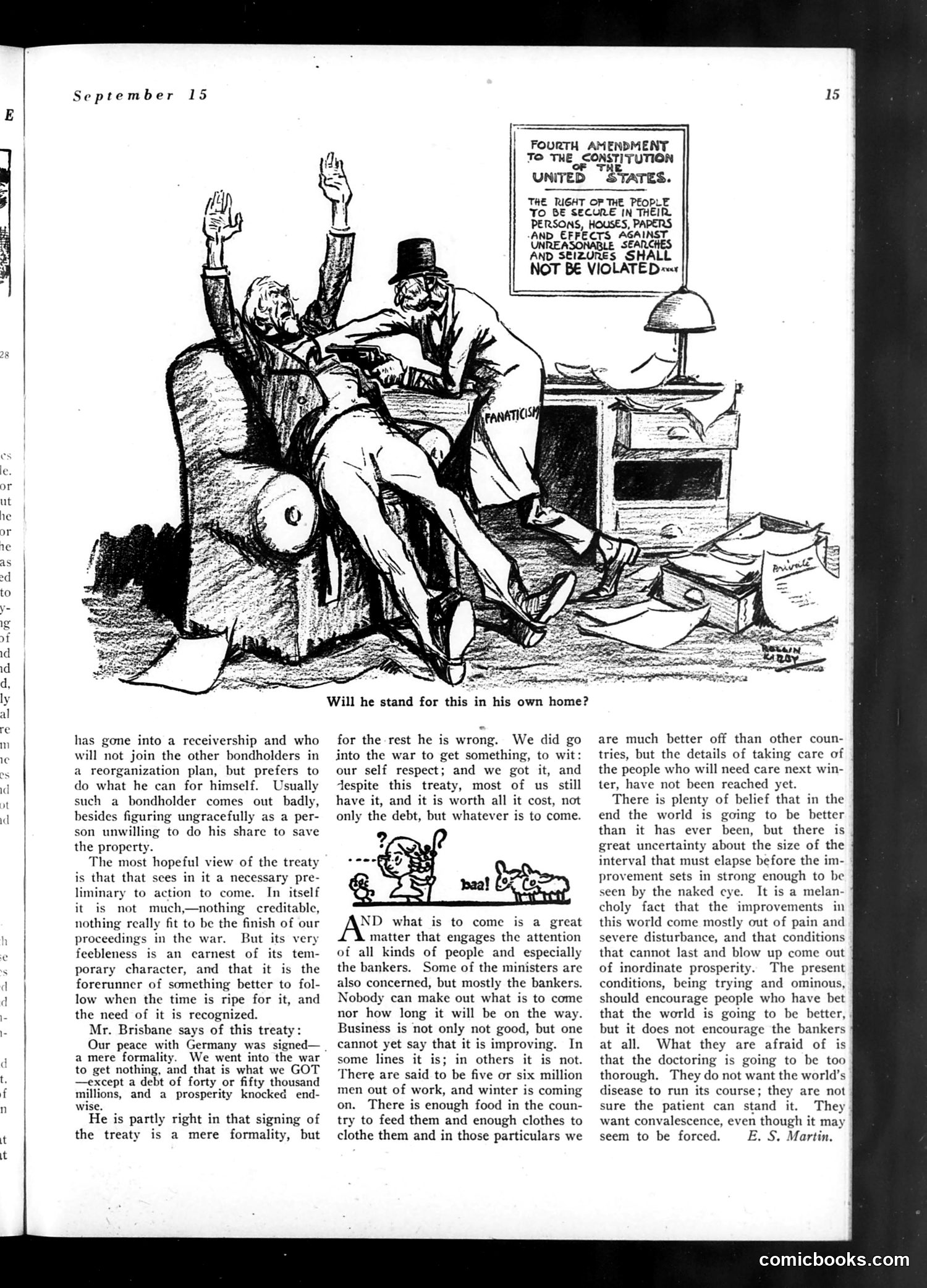
**The Cartoon:** A caricatured figure sits in a chair with arms raised triumphantly, while another man (appearing to be a banker or official) searches through his belongings. A framed Fourth Amendment hangs on the wall behind them. **The Satire:** This is commentary on post-World War I economic conditions and banking practices. The cartoon juxtaposes the Fourth Amendment's protection against unreasonable searches with what appears to be bankers or creditors conducting investigations into citizens' private affairs—likely regarding war bonds, debt, or financial reorganization. **The Point:** The accompanying text by E.S. Martin criticizes bankers' fears about post-war economic recovery being "too thorough," suggesting they don't want fundamental systemic change. The cartoon sarcastically asks whether citizens will tolerate in their own homes the very intrusions they fought to protect against constitutionally—implying bankers are effectively violating citizens' privacy and property rights through financial coercion during uncertain economic times.
📄 Transcribed text from this page (OCR, searchable)
Machine-transcribed from the original scan — historical spelling and the odd misread are preserved.
or ut he as od y~ ig id id has gone into a receivership and who will not join the other bondholders in a reorganization plan, but prefers to do what he can for himself. Usually such a bondholder comes out badly, besides figuring ungracefully as a per- son unwilling to do his share to save the property. The most hopeful view of the treaty is that that sees in it a necessary pre- liminary to action to come. In itself it is not much,—nothing creditable, nothing really fit to be the finish of our proceedings in the war. But its very feebleness is an earnest of its tem- porary character, and that it is the forerunner of something better to fol- low when the time is ripe for it, and the need of it is recognized. Mr. Brisbane says of this treaty: Our peace with Germany was signed— a mere formality. We went into the war to get nothing, and that is what we GOT —except a debt of forty or fifty thousand millions, and a prosperity knocked end- wise. He is partly right in that signing of the treaty is a mere formality, but FOURTH AMENDMENT TO THE CONSTITUTION OF THE UNITED STATES. THE RIGHT OF THE PEOPLE 15 TO BE SECURE IN THEIR. PERSONS, HOUSES, PAPERS AND_EFFECTS AGAINST. UNREASONABLE SEARCHES AND SeIzURES SHALL NOT BE VIOLATED«<«« Will he stand for this in his own home? for the rest he is wrong. We did go into the war to get something, to wit: our self respect; and we got it, and despite this treaty, most of us still have it, and it is worth all it cost, not only the debt, but whatever is to come. ND what is to come is a great matter that engages the attention of all kinds of people and especially the bankers. Some of the ministers are also concerned, but mostly the bankers. Nobody can make out what is to come nor how long it will be on the way. Business is not only not good, but one cannot yet say that it is improving. In some lines it is; in others it is not. There are said to be five or six million men out of work, and winter is coming on. There is enough food in the coun- try to feed them and enough clothes to clothe them and in those particulars we are much better off than other coun- tries, but the details of taking care of the people who will need care next win- ter, have not been reached yet. There is plenty of belief that in the end the world is going to be better than it has ever been, but there is great uncertainty about the size of the interval that must elapse before the im- provement sets in strong enough to be seen by the naked cye. It is a melan- choly fact that the improvements in this world come mostly out of pain and severe disturbance, and that conditions that cannot last and blow up come out of inordinate prosperity. The present conditions, being trying and ominous, should encourage people who have bet that the world is going to be better, but it does not encourage the bankers at all. What they are afraid of is that the doctoring is going to be too thorough. They do not want the world’s disease to run its course; they are not sure the patient can stand it. They want convalescence, even though it may seem to be forced. E. S. Martin. comicbooks.com